Liverworts and mosses form the two great divisions of the bryophyte world, and they reward close study because they compress an entire plant life cycle into a few centimetres of damp ground. Both groups share the defining bryophyte architecture: a haploid gametophyte that dominates the visible plant body, multicellular sex organs, and a sporophyte that remains permanently attached to its photosynthetic parent. Yet within that shared frame, liverworts and mosses diverge sharply in body plan, in the mechanics of asexual propagation, and in the elaboration of the spore-bearing capsule.
This lesson examines liverworts first, tracing the thalloid, dorsiventral body of Marchantia, the gemma cups that scatter asexual buds, and the foot-seta-capsule sporophyte that releases spores after meiosis. It then turns to mosses, where the gametophyte passes through a creeping protonema stage before producing upright leafy shoots that bear antheridia and archegonia at their apices. The moss sporophyte is more elaborate than that of liverworts, and its capsule shows a refined mechanism of spore dispersal.
Because the previous lesson established why bryophytes are called amphibians of the plant kingdom, this lesson builds directly on that foundation and pushes toward the structural detail that distinguishes the two groups. The material follows the order of ideas in the source: habitat and general features, then liverworts, then mosses, with the sex organs, sporophyte differentiation, and meiotic spore formation treated as the connecting thread throughout.
On This Page
Habitat, Body Plan and the Bryophyte Frame
Bryophytes include the various mosses and liverworts found commonly growing in moist shaded areas in the hills. They usually occur in damp, humid and shaded localities, and they play an important role in plant succession on bare rocks and soil. This ecological role is the practical reason the group matters beyond the classroom.
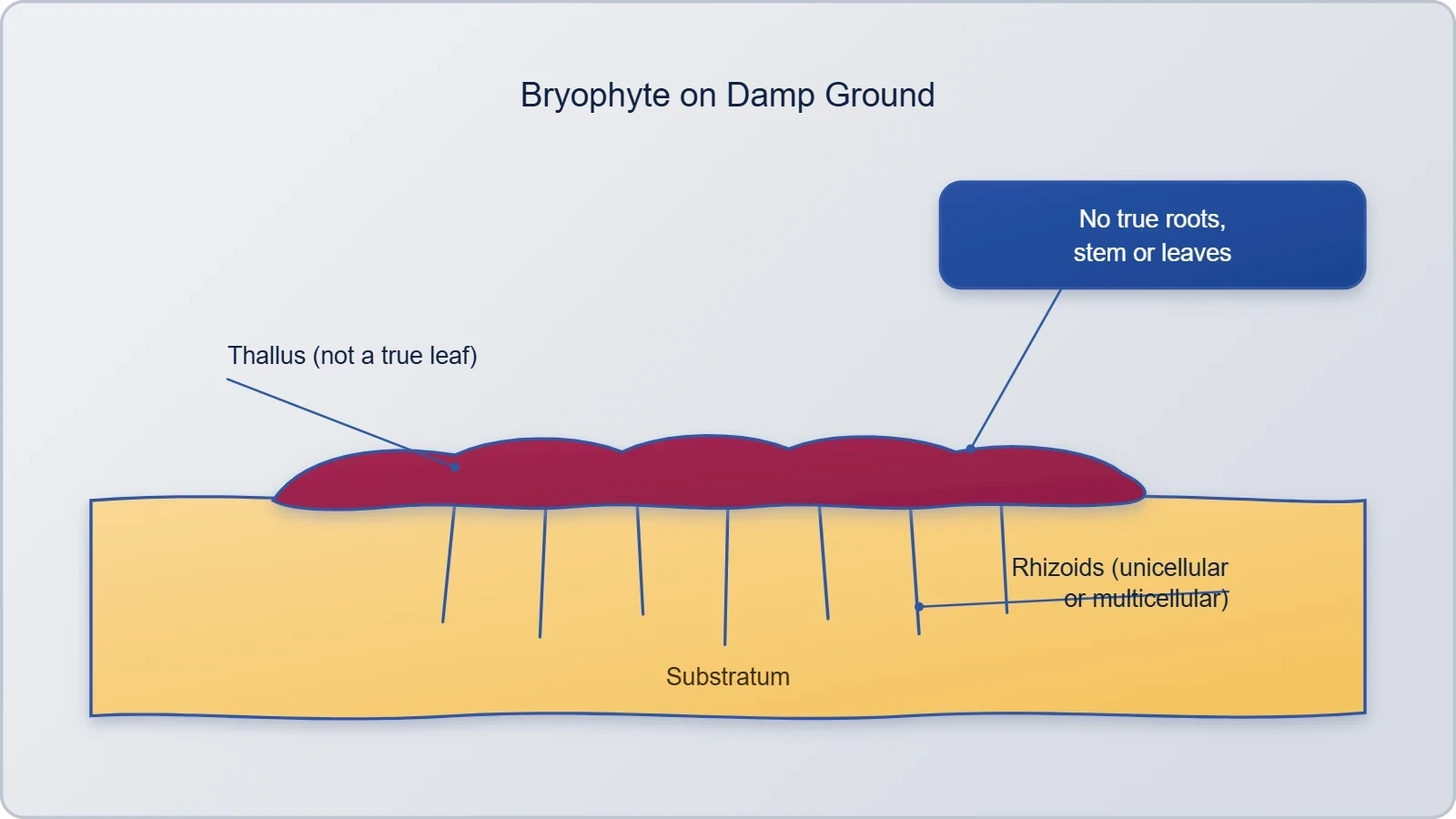
The plant body of bryophytes is more differentiated than that of algae. It is thallus-like and prostrate or erect, attached to the substratum by unicellular or multicellular rhizoids. They lack true roots, stem or leaves, though they may possess root-like, leaf-like or stem-like structures. The main plant body is haploid and produces gametes, hence it is called a gametophyte.
Sex Organs and the Water-Dependent Fertilisation
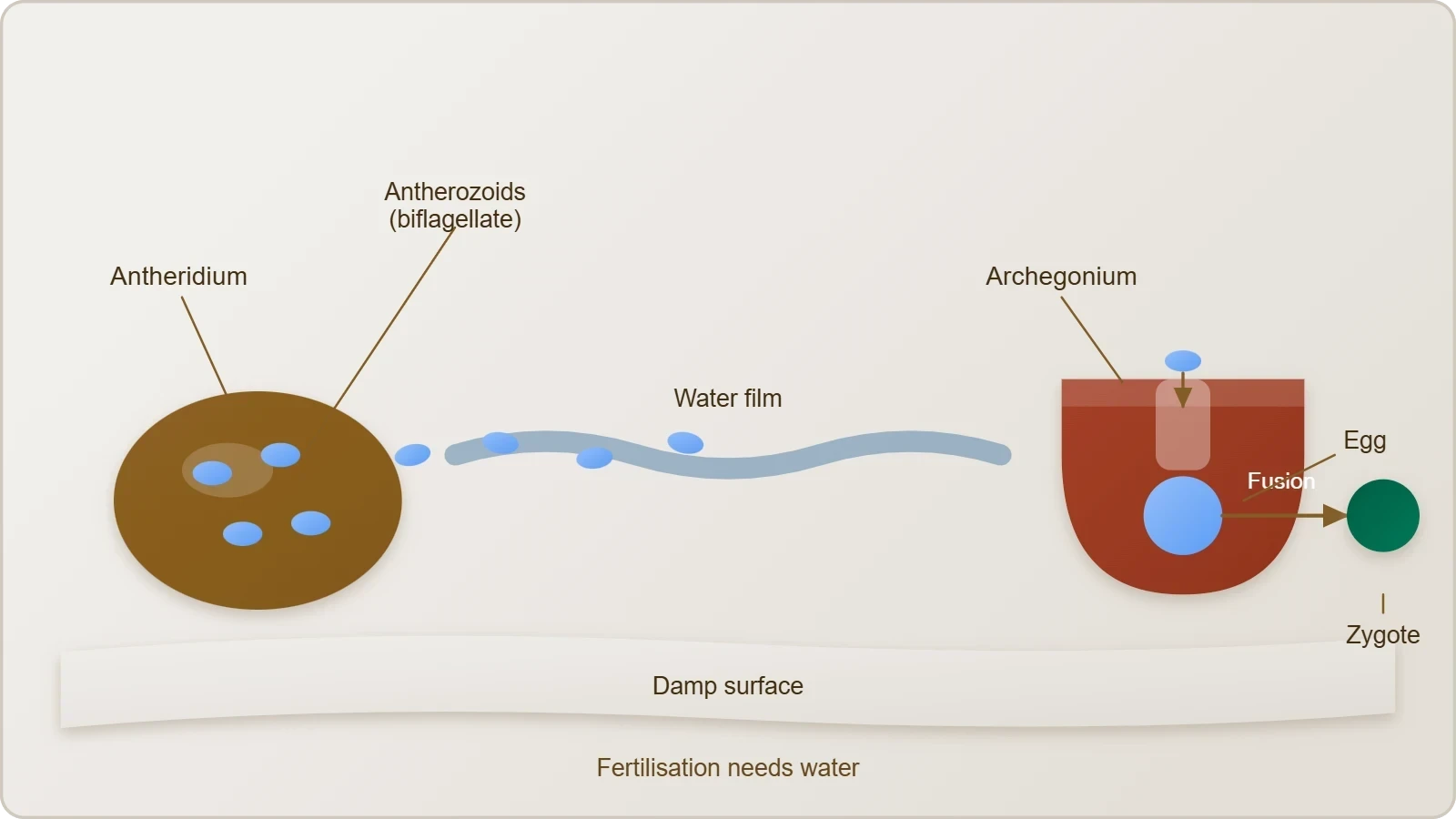
The sex organs in bryophytes are multicellular. The male sex organ is the antheridium, which produces biflagellate antherozoids. The female sex organ, the archegonium, is flask-shaped and produces a single egg. This asymmetry between many motile male gametes and one stationary female gamete is the structural basis of oogamy in the group.
Antherozoids are released into water, where they come in contact with the archegonium. An antherozoid fuses with the egg to produce the zygote. This dependence on a film of water for fertilisation is precisely why bryophytes are called amphibians of the plant kingdom, able to live on soil but reliant on water for sexual reproduction.
The Sporophyte and Meiotic Spore Formation
Zygotes do not undergo reduction division immediately. They produce a multicellular body called a sporophyte, which is not free-living but attached to the photosynthetic gametophyte and derives nourishment from it. Some cells of the sporophyte then undergo reduction division, or meiosis, to produce haploid spores.
These spores germinate to produce the gametophyte, closing the cycle. The alternation is therefore between a dominant haploid gametophyte and a dependent diploid sporophyte, the reverse of the pattern that will appear in pteridophytes. The sporophyte is differentiated into a foot, seta and capsule in both liverworts and mosses.
Liverworts: Thalloid Bodies and Gemma Cups
Liverworts grow usually in moist, shady habitats such as banks of streams, marshy ground, damp soil, bark of trees and deep in the woods. The plant body of a liverwort is thalloid, as in Marchantia. The thallus is dorsiventral and closely appressed to the substrate, a flat ribbon of tissue pressed against its surface.
Leafy members of the group carry tiny leaf-like appendages in two rows on the stem-like structures. This distinction between thalloid and leafy forms is the first practical identification step in the field. The dorsiventral symmetry of the thallus, with distinct upper and lower faces, is a reliable marker of the thalloid liverworts.
Asexual Reproduction by Fragmentation and Gemmae
Asexual reproduction in liverworts takes place by fragmentation of thalli, or by the formation of specialised structures called gemmae. A gemma is a green, multicellular, asexual bud that develops in a small receptacle called a gemma cup located on the thallus. The gemmae become detached from the parent body and germinate to form new individuals.
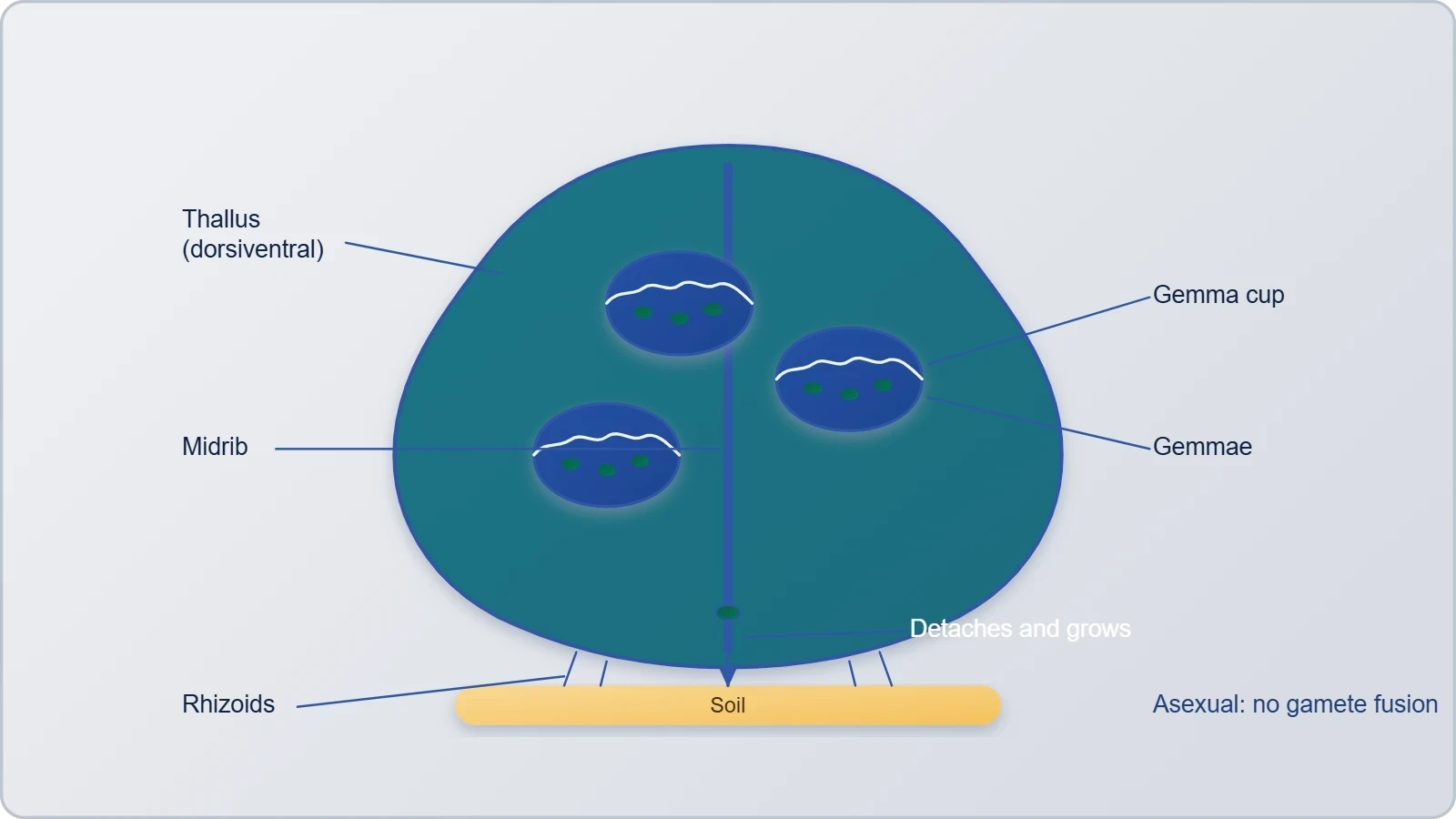
Fragmentation is the simpler route: a piece of thallus breaks away and regenerates a complete plant. The gemma cup route is more organised, since the parent invests in dedicated propagules rather than relying on accidental breakage. Both pathways produce genetically identical offspring, which is the defining consequence of asexual reproduction.
Sexual Reproduction and the Differentiated Sporophyte
During sexual reproduction, male and female sex organs are produced either on the same or on different thalli. The sporophyte is differentiated into a foot, seta and capsule. After meiosis, spores are produced within the capsule, and these spores germinate to form free-living gametophytes.
The foot anchors the sporophyte in the gametophyte tissue and absorbs nourishment, the seta raises the capsule, and the capsule manufactures and releases spores. This three-part division is the standard bryophyte sporophyte plan, and it will reappear in mosses in a more elaborate form. The liverwort version is the simpler of the two.
Mosses: Protonema, Leafy Shoots and Apical Sex Organs
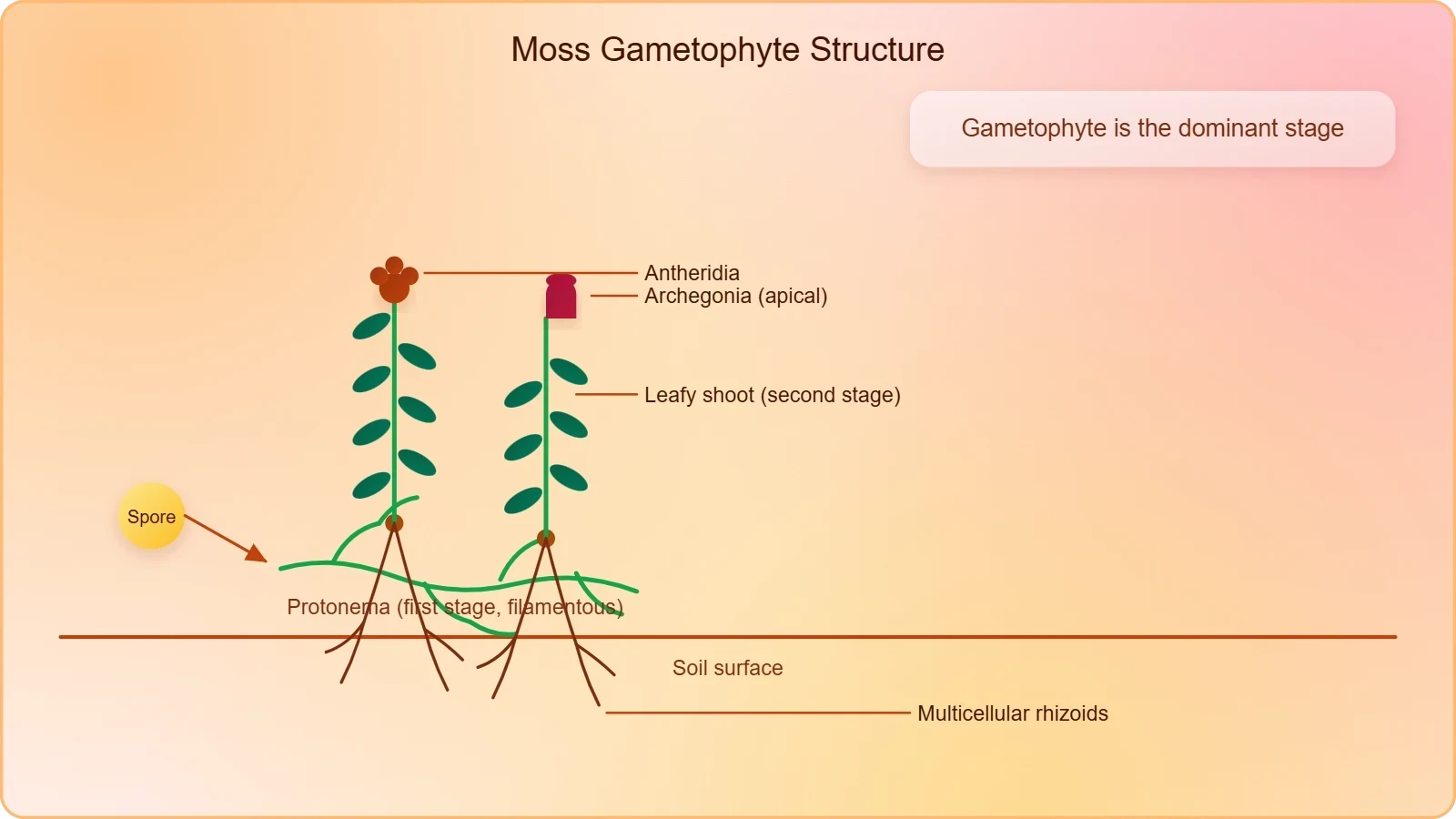
The predominant stage of the life cycle of a moss is the gametophyte, which consists of two stages. The first is the protonema stage, developing directly from a spore as a creeping, green, branched and frequently filamentous structure. The second is the leafy stage, which develops from the secondary protonema as a lateral bud.
The leafy stage consists of upright, slender axes bearing spirally arranged leaves. These axes are attached to the soil through multicellular and branched rhizoids. This stage bears the sex organs, so the leafy shoot is the reproductive platform of the moss. The two-stage gametophyte is the single most distinctive feature separating mosses from liverworts.
Vegetative Reproduction and the Position of Sex Organs
Vegetative reproduction in mosses is by fragmentation and budding in the secondary protonema. In sexual reproduction, the sex organs antheridia and archegonia are produced at the apex of the leafy shoots. Apical placement matters because it puts the gametes at the highest point of the shoot, where rain and splash can carry antherozoids between plants.
The antheridia release biflagellate antherozoids, and the archegonia each hold a single egg, exactly as in liverworts. Water is again the medium of transfer. The difference lies in the architecture of the shoot that bears these organs, not in the organs themselves.
The Elaborate Sporophyte and Spore Dispersal
After fertilisation, the zygote develops into a sporophyte consisting of a foot, seta and capsule. The sporophyte in mosses is more elaborate than that in liverworts. The capsule contains spores, which are formed after meiosis, and the mosses have an elaborate mechanism of spore dispersal.
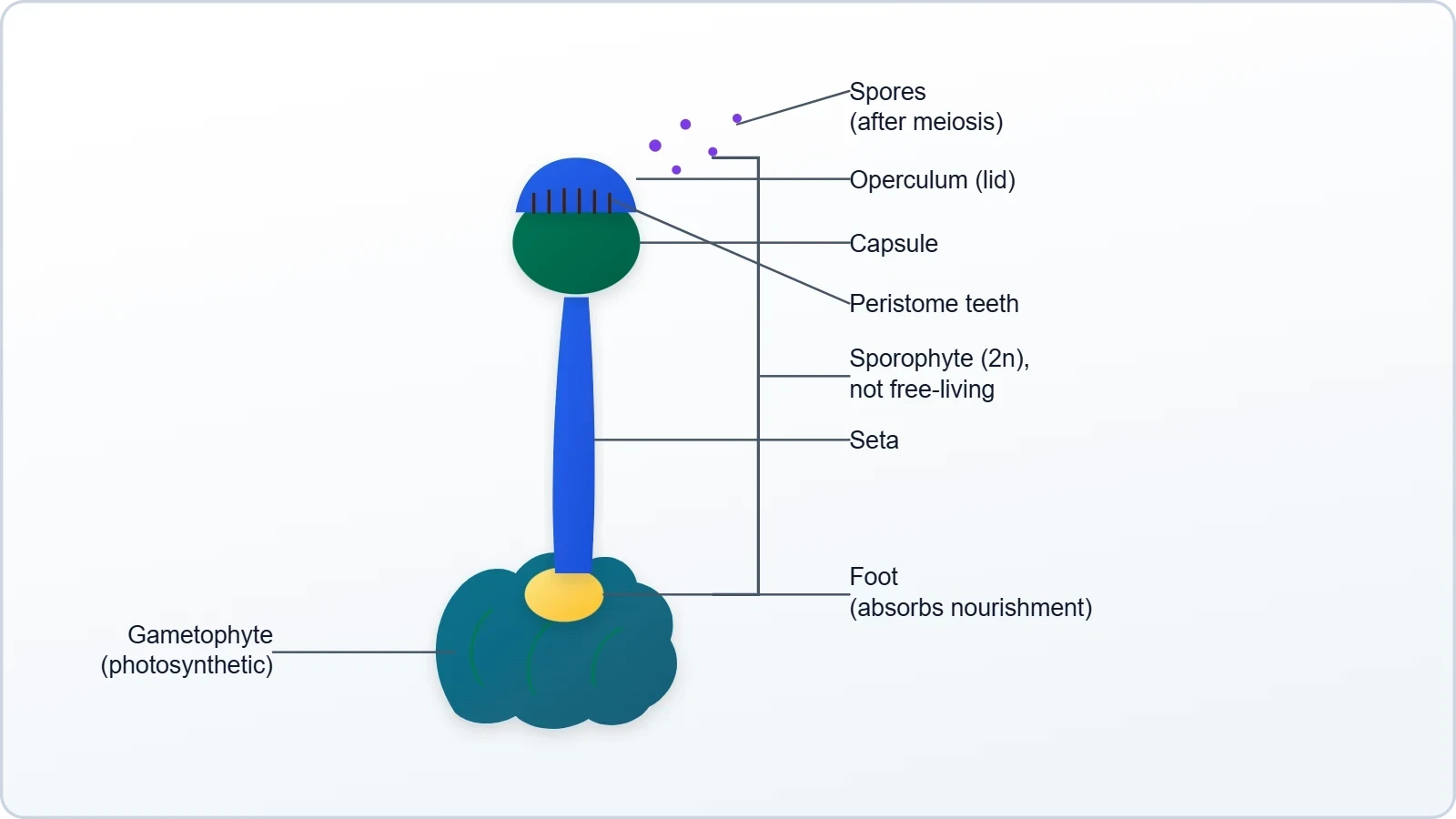
Common examples of mosses are Funaria, Polytrichum and Sphagnum. The capsule of a moss is not a passive sac; its structure regulates when and how spores leave. This refinement in dispersal is the functional payoff of the more elaborate sporophyte, and it helps explain the wide distribution of mosses across damp habitats.
Ecological and Economic Importance of Bryophytes
Bryophytes in general are of little economic importance, but some mosses provide food for herbaceous mammals, birds and other animals. Species of Sphagnum provide peat, long used as fuel and as packing material for trans-shipment of living material because of their capacity to hold water. That water-holding capacity is the practical basis of the packing trade.
Mosses along with lichens are the first organisms to colonise rocks, and hence are of great ecological importance. They decompose rocks, making the substrate suitable for the growth of higher plants. Since mosses form dense mats on the soil, they reduce the impact of falling rain and prevent soil erosion.
Pioneers of Plant Succession
The colonising role of mosses and lichens is the mechanism behind plant succession on bare rock. By decomposing rock and trapping moisture and organic debris, they create the first thin layer of soil. Higher plants then establish on ground that bryophytes prepared, which is why the group is described as ecologically foundational.
Dense moss mats also act as a physical shield for the soil beneath. Rain strikes the mat rather than bare earth, so the kinetic energy of falling drops is absorbed and erosion is reduced. This is a small-scale effect repeated across whole landscapes, and its cumulative value is considerable.
Sphagnum, Peat and the Water-Holding Trait
Sphagnum is the moss most often cited in economic contexts. Its peat has served as fuel, and its capacity to hold water makes it useful as packing material for trans-shipment of living material. The same trait that makes Sphagnum useful in transit also makes it a major component of waterlogged, acidic peatlands.
Beyond Sphagnum, the food value of mosses for herbaceous mammals, birds and other animals is a modest but real contribution. The overall verdict of the source is that bryophytes are of little economic importance, with these specific exceptions. Ecological importance, by contrast, is described as great.
The Life Cycle Read as a Sequence
Reading the bryophyte life cycle as a sequence makes the relationship between liverworts and mosses easier to hold in memory. A haploid spore germinates into a gametophyte, which in mosses passes through a protonema before leafy shoots appear. The gametophyte bears antheridia and archegonia, and water carries antherozoids to the egg.
Fertilisation produces a zygote that does not undergo reduction division immediately. It grows into a multicellular sporophyte attached to the gametophyte and nourished by it. Some sporophyte cells then undergo meiosis to produce haploid spores, and the cycle restarts when those spores germinate.
Where Meiosis Sits in the Cycle
Meiosis occurs in the sporophyte, not in the gametophyte, and this placement defines the whole alternation. The sporophyte is diploid, so reduction division is required to restore the haploid state before spores are released. Every spore is therefore a product of recombination, while every gemma is a clone.
This contrast between meiotic spores and mitotic gemmae is the conceptual hinge of the lesson. Sexual reproduction generates variation through meiosis and fertilisation; asexual reproduction through fragmentation and gemmae preserves the parental genotype. Both routes coexist in liverworts, and mosses achieve the same duality through fragmentation and budding.
Preparing for the Vascular Shift
In bryophytes the dominant phase is the gametophytic plant body, and the sporophyte depends on it. The next lesson turns to pteridophytes, where the main plant body is a sporophyte differentiated into true root, stem and leaves with well-differentiated vascular tissues. That reversal is the evolutionary threshold this lesson sets up.
Pteridophytes are, evolutionarily, the first terrestrial plants to possess vascular tissues, namely xylem and phloem. They are found in cool, damp, shady places, though some flourish in sandy-soil conditions. Holding the bryophyte pattern clearly in mind makes the pteridophyte inversion immediately legible.
Going further
A gemma is a small multicellular bud that can detach and grow into a new individual, which is why gemmae are a form of asexual reproduction. Because no fusion of gametes is involved, the offspring carry the same genetic material as the parent thallus. This is the reason gemma cups are treated as a propagation strategy rather than a sexual structure.
The protonema is the first green stage that develops directly from a moss spore, before the leafy shoots appear. It spreads across the substrate as a branched filament, building the photosynthetic base from which lateral buds later rise. Recognising the protonema in the field explains why a young moss colony can look like a green film rather than a stand of leafy plants.
Also Read
- No links available.
From our network :
- Mastering DB2 12.1 Instance Design: A Technical Deep Dive into Modern Database ArchitectureComprehensive guide to DB2 12.1 Instance Design. Explore architectural components, HADR setup, buffer pool tuning, and security policies for IBM DB2 12.1. Includes 10 functional SQL and Shell samples.
- 98% of Global MBA Programs Now Prefer GRE Over GMAT Focus EditionExplore why 98% of global MBA programs now prefer the GRE over GMAT Focus. Learn about the shorter GRE format, verbal logic importance, and strategic versatility for students.
- Trump Political Strategy How Geopolitical Stunts Serve As Media Diversions
- Vite 6/7 'Cold Start' Regression in Massive Module GraphsIn-depth analysis of Vite 6/7 cold start regressions in massive module graphs. Learn about barrel file issues, pre-bundling optimizations, and how to improve Vite dev server performance.
- EV 2.0: The Solid-State Battery Breakthrough and Global Factory ExpansionDiscover the impact of the Solid-State Battery Breakthrough on the EV market. Learn about CATL and BYD stock growth, global factory expansion in Europe, and the future of EV 2.0 technology.
- Mastering DB2 LUW v12 Tables: A Comprehensive Technical GuideComprehensive guide on DB2 LUW v12 tables. Explore CREATE TABLE syntax, BLU Acceleration, range partitioning, data types, and security features for IBM DB2 LUW v12.
- AI-Powered 'Precision Diagnostic' Replaces Standard GRE Score ReportsDiscover the new GRE Precision Diagnostic. Learn how AI-powered behavioral analytics and time-to-solve tracking are replacing standard GRE score reports to empower students.
- Analyzing Trump Deportation Numbers Insights Into The 2026 Immigration Crackdown
- 10 Physics Numerical Problems with Solutions for IIT JEEPrepare for IIT JEE with 10 physics numerical problems, complete with detailed solutions and conceptual explanations. Ideal for mastering kinematics, thermodynamics, electromagnetism, and optics.
RESOURCES
- Bryophyte - Wikipediaen.wikipedia.orgThe life cycle of a dioicous bryophyte. The gametophyte (haploid) ... Liverworts, mosses and hornworts spend most of their lives as gametophytes.
- Bryophytes, hornworts, liverworts and mosses - Australian Plant ...anbg.gov.auFeb 2, 2024 ... What is a bryophyte? The three groups of Bryophytes · Life cycles · Reproduction & dispersal · Ecology · Classification…
- Mosses and liverworts - Australian Antarctic Programantarctica.gov.auNov 30, 2021 ... The dominant stage in the life cycle of bryophytes is the sexually reproducing gametophyte plant stage. But because of the…
- Mosses and Liverworts - an overview | ScienceDirect Topicssciencedirect.comBryophytes and hornworts are unique among extant embryophytes in that they have a gametophyte-dominant life cycle; the sporophyte usually is relatively short- ...
- Nuclear protein phylogenies support the monophyly of the three ...nph.onlinelibrary.wiley.comNov 9, 2018 ... An initial split between bryophytes and vascular plants implies that the bryophyte life cycle ... bryophyte groups, namely mosses, liverworts ...
- Windows into the early evolution of land plantsbsapubs.onlinelibrary.wiley.comMar 1, 2011 ... ... life cycle and unbranched sporophytes bearing one sporangium: the liverworts (Marchantiophyta), mosses (Bryophyta)...
- Liverworts - Missouri Department of Conservationmdc.mo.govNov 21, 2024 ... ... life cycle, and how to identify them. Liverworts, like ... Taxonomically, liverworts (division Marchantiophyta), mosses (division Bryophyta) ...
- 25.3 Bryophytes - Biology 2e | OpenStaxopenstax.orgMar 28, 2018 ... The life cycle of a typical lobate liverwort is shown. ... Figure 25.14 Reproductive cycle of mosses. This illustration shows…
- Bryophytes: Understanding Liverworts and Mosses in Plant Evolutionfacebook.com3 days ago ... OCR: Bryophytes: Liverworts vs. Mosses Structural & Life-Cycle Life- Guide Thalloid Dorsiventral Body Unicellular Rhizoids Gametaphyte ...
- Bryophyte - Moss, Liverwort, Hornwort | Britannicabritannica.comThe life cycle of bryophytes consists of an alternation of two stages, or generations, called the sporophyte and the gametophyte. Each generation has a ...
- Mosses, Liverworts, and Lichens - National Park Servicenps.govNov 10, 2021 ... Mosses, also sometimes called bryophytes, are little flowerless plants that tend to grow in tufts or mats. ... The lifecycle…
- 25.3: Bryophytes - Biology LibreTextsbio.libretexts.orgApr 9, 2022 ... 3 : The life cycle of a typical liverwort is shown. (credit ... 6 : This illustration shows the life…
- Fossil bryophytes as recorders of ancient CO 2 levels: Experimental ...agupubs.onlinelibrary.wiley.comAug 19, 2005 ... Unlike vascular plants, bryophytes (liverworts, hornworts and mosses) ... life cycle [Raven et al., 1999]. Some liverwort species possess ...
- Lecture 7 - The Plantsappstate.eduMosses and other Bryophyte Life Cycles 1. Bryophytes (about 10,000 species of mosses) a. mosses, liverworts, and hornworts (wort is an old botanical term…
- Mosses and liverworts | Wildlife Gardening Forumwlgf.orgLife cycle. Like ferns, bryophytes have two life stages, which differ in the number of chromosomes In their cells. In “higher” plants and most…