Algae occupy a distinctive position within Kingdom Plantae, and understanding them is essential for anyone tracing the broader story of plant classification. They are chlorophyll-bearing, simple, thalloid, autotrophic organisms that are largely aquatic, thriving in both fresh water and marine environments. Yet their adaptability extends well beyond water, since they also colonise moist stones, soils and wood, and even live in association with fungi as lichens or with animals such as the sloth bear.
This lesson examines algae as a group: their variable form and size, their three modes of reproduction, their considerable usefulness to humankind, and the three classes into which they are divided. It builds directly on the shift from artificial to natural and phylogenetic classification systems, and it prepares the ground for a closer look at Chlorophyceae, Phaeophyceae and Rhodophyceae in the lesson that follows.
What makes algae such a rewarding subject is the sheer range they display. A single group spans colonial forms like Volvox, filamentous forms like Ulothrix and Spirogyra, and massive marine plant bodies such as the kelps. That diversity of form, reproduction and habitat is the thread running through every section below.
On This Page
Defining Algae: Chlorophyll-Bearing, Thalloid Autotrophs
At its simplest, an alga is a chlorophyll-bearing organism that is thalloid, autotrophic and predominantly aquatic. Each of those four descriptors carries real biological weight, and together they separate algae from the land plants that follow them in the plant kingdom. The definition is compact, but it opens onto a remarkably varied group.
The Core Characteristics
Chlorophyll-bearing means algae possess the green pigment required for photosynthesis, which anchors them firmly among autotrophs. Thalloid means their plant body is not differentiated into true roots, stems and leaves. Autotrophic confirms they manufacture their own food, while largely aquatic describes their preferred habitat across fresh water and marine systems.
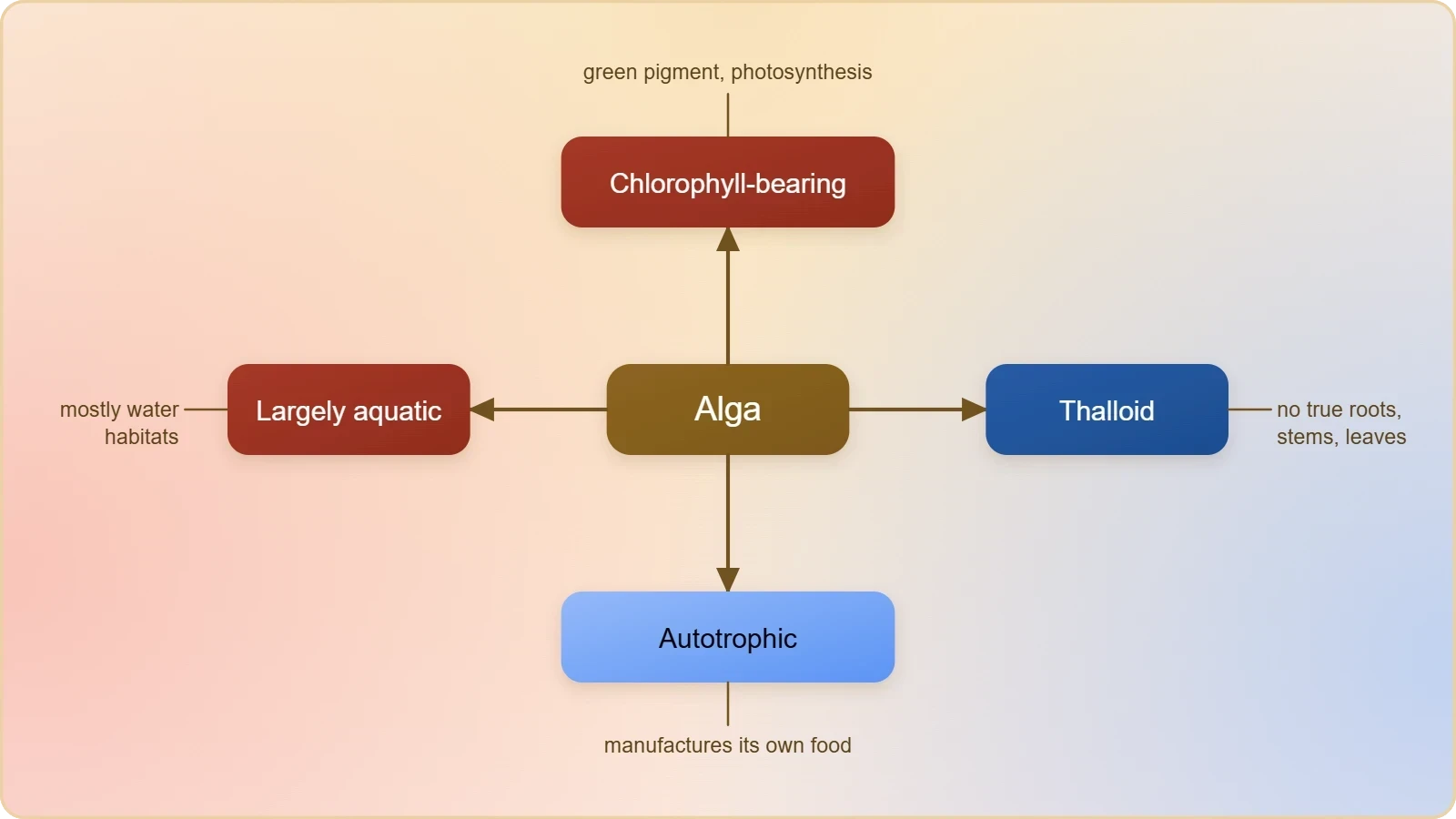
These characteristics are not merely descriptive labels; they explain algal success. Because a thallus needs no complex transport tissues, algae can adopt simple, efficient body plans. Because they photosynthesise, they sit at the base of aquatic food chains. The definition, in short, predicts the ecology.
Habitats Beyond Water
Although algae are largely aquatic, their range of habitats is broader than the word "aquatic" might suggest. They occur on moist stones, in soils and on wood, wherever sufficient moisture persists. Some also live in association with fungi, forming lichens, and with animals, as on the sloth bear.
This flexibility matters for classification and ecology alike. It shows that the algal body plan is robust enough to tolerate conditions far removed from open water. Learners should therefore resist reducing algae to pond scum; the group is far more versatile than that casual image implies.
Form and Size: From Colonies to Massive Kelps
The form and size of algae is highly variable, and this variability is one of the group's most striking features. Any survey of algae must therefore begin with the range of body types rather than a single representative form. Three broad patterns illustrate the spectrum clearly and prepare learners for the classes ahead.
Colonial and Filamentous Forms
Colonial forms such as Volvox consist of cells grouped together in a common arrangement, while filamentous forms such as Ulothrix and Spirogyra present cells joined end to end in threads. These two patterns dominate freshwater habitats and are among the most familiar algae studied in laboratories.
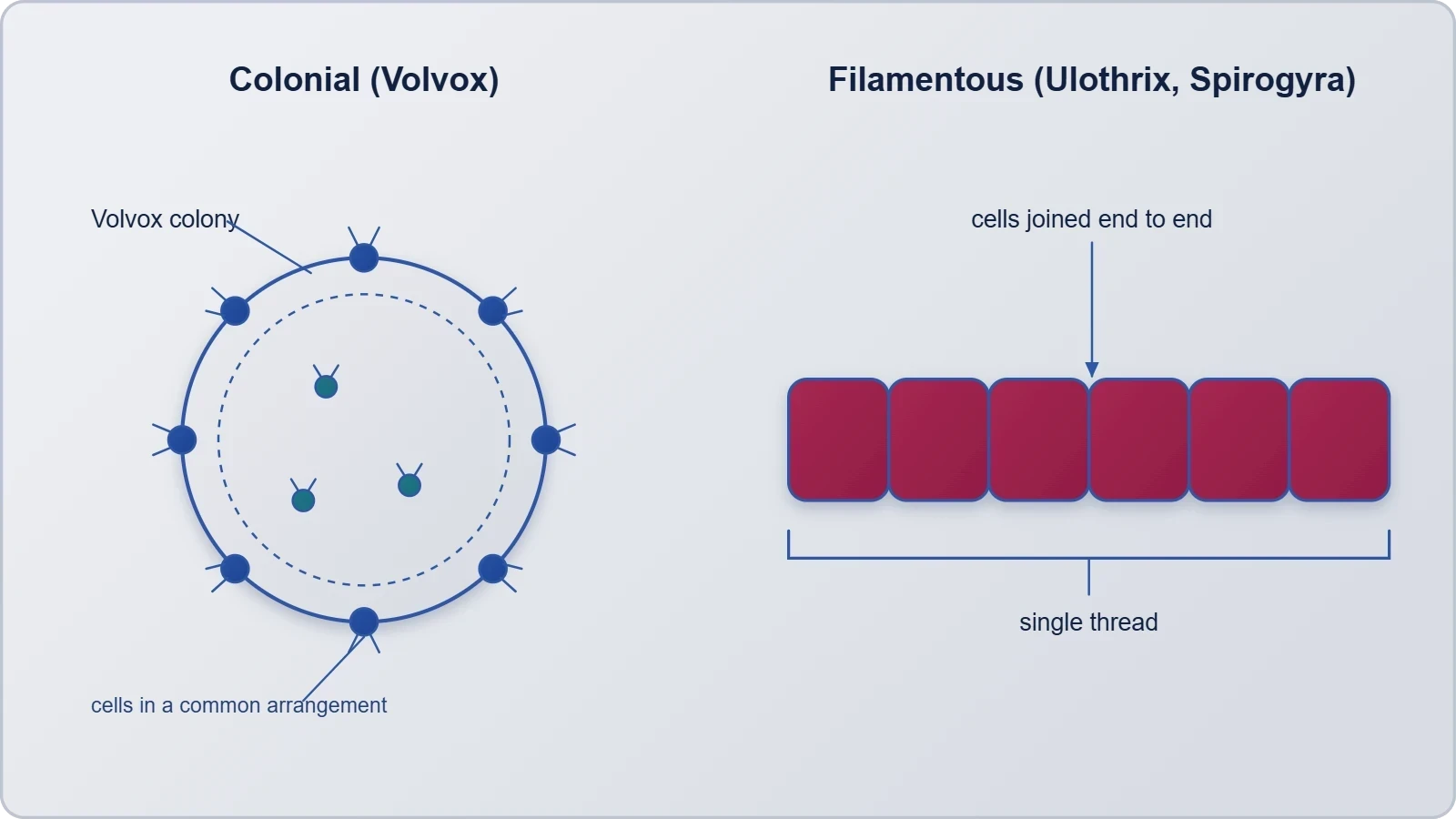
The distinction between colonial and filamentous organisation is more than cosmetic. It reflects different ways of building a multicellular body from individual cells, and it recurs throughout the plant kingdom. Recognising these patterns early makes later comparisons with bryophytes and pteridophytes far easier to follow.
Massive Marine Plant Bodies
A few marine forms, notably the kelps, form massive plant bodies that dwarf their freshwater relatives. Kelps can reach extraordinary dimensions, and their bulk demonstrates that a thalloid body plan need not imply small size. Size, in algae, is a matter of habitat and growth strategy rather than structural complexity.
This point deserves emphasis because it corrects a common misconception. Learners often assume that simple organisation means small organisms, yet kelps contradict that assumption decisively. The algal thallus can be simple in construction and still achieve impressive physical scale in the right marine environment.
Reproduction: Vegetative, Asexual and Sexual Pathways
Algae reproduce by vegetative, asexual and sexual methods, and each pathway deserves careful attention because the vocabulary introduced here recurs throughout the plant kingdom. The three methods differ in mechanism, in the structures involved and in the genetic outcomes they produce. Together they give algae remarkable reproductive flexibility.
Fragmentation and Spore Formation
Vegetative reproduction occurs by fragmentation, in which each fragment develops into a new thallus. Asexual reproduction proceeds through the production of different types of spores, the most common being zoospores. These are flagellated and motile, and on germination they give rise to new plants.
The contrast between the two methods is instructive. Fragmentation simply multiplies an existing body, whereas spore formation produces specialised reproductive units capable of dispersal. Both strategies allow algae to colonise new surfaces efficiently, and both are common among the forms learners encounter in freshwater habitats.
Isogamy, Anisogamy and Oogamy
Sexual reproduction takes place through the fusion of two gametes, and the nature of those gametes defines three distinct patterns. Isogamous reproduction involves gametes that are similar in size, whether flagellated as in Ulothrix or non-flagellated as in Spirogyra. Anisogamous reproduction involves gametes dissimilar in size, as in species of Eudorina.
Oogamous reproduction represents the most pronounced differentiation, involving fusion between one large, non-motile female gamete and a smaller, motile male gamete, as seen in Volvox and Fucus. The progression from isogamy to oogamy illustrates an increasing specialisation of sex cells across algal groups.

Economic and Ecological Importance of Algae
Algae are useful to man in a variety of ways, and their importance extends from global carbon cycling to everyday commercial products. Any account of the group would be incomplete without acknowledging this dual ecological and economic significance. The figures and examples below show just how far that influence reaches.
Primary Producers and Oxygen Contributors
At least half of the total carbon dioxide fixation on earth is carried out by algae through photosynthesis. Being photosynthetic, they increase the level of dissolved oxygen in their immediate environment. They are of paramount importance as primary producers of energy-rich compounds forming the basis of food cycles of all aquatic animals.
These roles are difficult to overstate. Algae underpin aquatic food webs, and their collective carbon fixation rivals that of terrestrial forests. When learners consider climate and oxygen budgets, algae deserve a prominent place in the discussion, not a footnote.
Food, Hydrocolloids and Agar
Many species of Porphyra, Laminaria and Sargassum are among the 70 species of marine algae used as food. Certain marine brown and red algae produce large amounts of hydrocolloids, such as algin from brown algae and carrageen from red algae, which are used commercially.
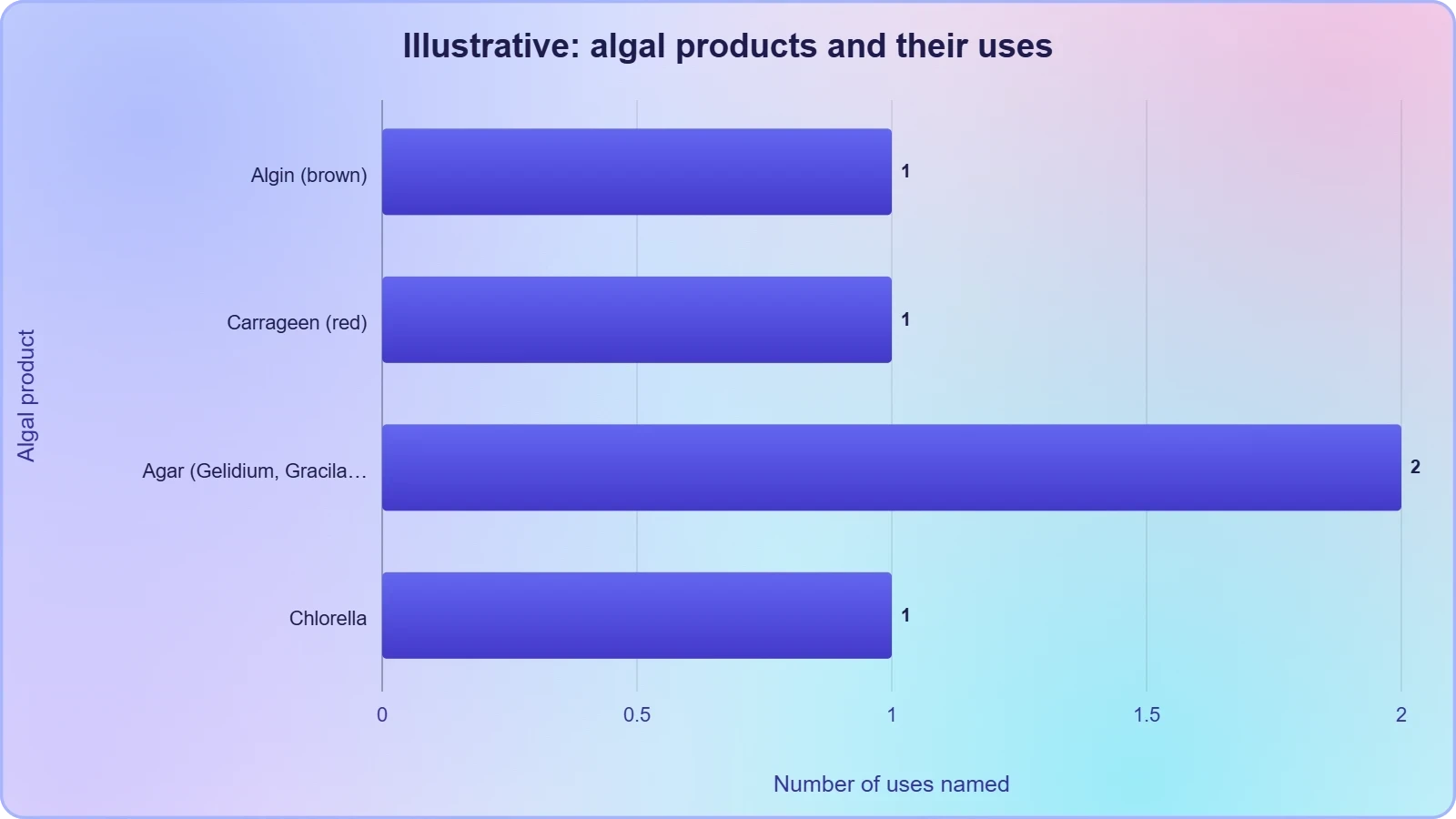
Agar, obtained from Gelidium and Gracilaria, is used to grow microbes and in preparations of ice-creams and jellies. Chlorella, a unicellular alga rich in proteins, is used as a food supplement even by space travellers, a striking testament to algal nutritional value.
The Three Classes of Algae: An Orientation
Algae are divided into three main classes: Chlorophyceae, Phaeophyceae and Rhodophyceae. This lesson introduces the division so that learners grasp the overall architecture before the detailed treatment that follows. A brief orientation here prevents the classes from appearing as disconnected lists of facts.
Green, Brown and Red Algae
Chlorophyceae are commonly called green algae, Phaeophyceae are the brown algae, and Rhodophyceae are the red algae. The names reflect the dominant pigments that give each class its characteristic colour. This pigment-based division is the organising principle for the lessons ahead.
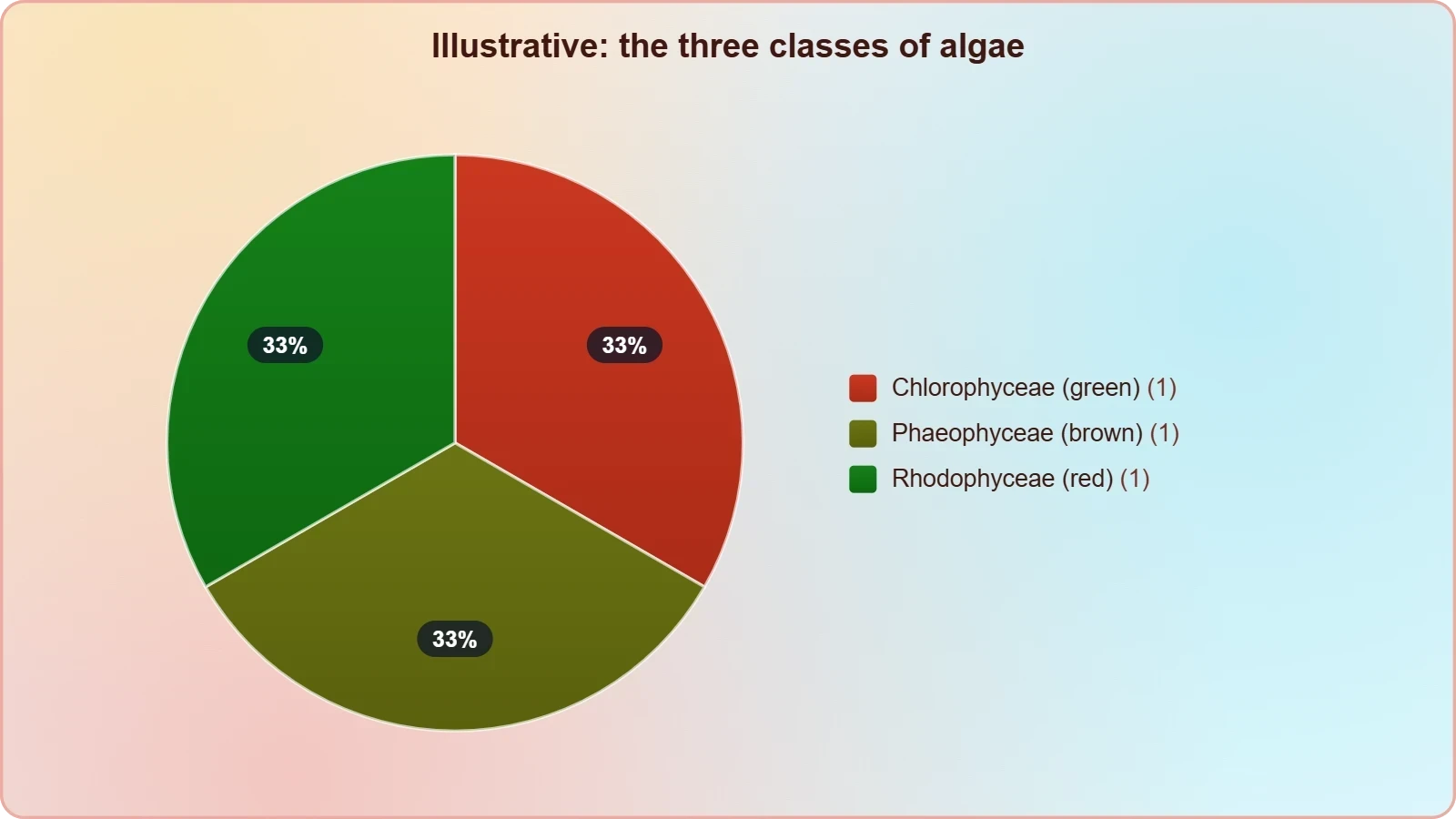
Each class also differs in habitat, form and reproduction, as the next lesson will show in detail. For now, the essential point is that the three-class scheme provides a manageable framework. Learners should hold this framework in mind as they move from general characteristics to class-specific detail.
Preparing for Class-Level Detail
The general characteristics covered here apply across all three classes, which is precisely why they come first. Once the shared features are secure, the distinguishing features of each class become easier to absorb. This sequencing mirrors the logic of classification itself, moving from the general to the particular.
Learners should therefore treat this lesson as a foundation rather than a complete account. The pigments, storage bodies, cell walls and reproductive details that separate Chlorophyceae, Phaeophyceae and Rhodophyceae await in the following lesson, where the three-class division receives its full treatment.
Going Further: Context for the Algal Body Plan
A few well-established points of background help the material above settle into place, and they are offered here separately so that the core lesson remains clearly bounded. These notes explain terminology and mechanisms rather than adding new syllabus content. They are intended to deepen understanding, not to replace the definitions already given.
What "Thalloid" Really Means
A thallus is a plant body that is not differentiated into true roots, stems and leaves, which is why algae are described as thalloid. This single clarification explains much of what follows. Without roots, stems and leaves, an alga must absorb nutrients and photosynthesise across its whole surface.
Understanding the thallus also clarifies why algae remain tied to moist or aquatic habitats. Lacking the vascular tissues and protective structures of land plants, they cannot easily regulate water loss. The thalloid body plan is therefore both a simplification and a constraint, shaping where algae can live.
Why Agar and Hydrocolloids Matter
Agar obtained from Gelidium and Gracilaria is a gel-forming substance, which explains its use in growing microbes and in ice-creams and jellies. The same principle applies to other hydrocolloids. Algin and carrageen hold water, which is precisely why industry values them.
These gelling and water-holding properties are the link between algal biology and commercial application. Once learners see that the useful behaviour of agar and algin follows from their chemistry, the list of products becomes a coherent story rather than a set of isolated facts to memorise.
Also Read
- No links available.
From our network :
- Vite 6/7 'Cold Start' Regression in Massive Module GraphsIn-depth analysis of Vite 6/7 cold start regressions in massive module graphs. Learn about barrel file issues, pre-bundling optimizations, and how to improve Vite dev server performance.
- Trump Political Strategy How Geopolitical Stunts Serve As Media Diversions
- 10 Physics Numerical Problems with Solutions for IIT JEEPrepare for IIT JEE with 10 physics numerical problems, complete with detailed solutions and conceptual explanations. Ideal for mastering kinematics, thermodynamics, electromagnetism, and optics.
- EV 2.0: The Solid-State Battery Breakthrough and Global Factory ExpansionDiscover the impact of the Solid-State Battery Breakthrough on the EV market. Learn about CATL and BYD stock growth, global factory expansion in Europe, and the future of EV 2.0 technology.
- Mastering DB2 LUW v12 Tables: A Comprehensive Technical GuideComprehensive guide on DB2 LUW v12 tables. Explore CREATE TABLE syntax, BLU Acceleration, range partitioning, data types, and security features for IBM DB2 LUW v12.
- Analyzing Trump Deportation Numbers Insights Into The 2026 Immigration Crackdown
- Mastering DB2 12.1 Instance Design: A Technical Deep Dive into Modern Database ArchitectureComprehensive guide to DB2 12.1 Instance Design. Explore architectural components, HADR setup, buffer pool tuning, and security policies for IBM DB2 12.1. Includes 10 functional SQL and Shell samples.
- AI-Powered 'Precision Diagnostic' Replaces Standard GRE Score ReportsDiscover the new GRE Precision Diagnostic. Learn how AI-powered behavioral analytics and time-to-solve tracking are replacing standard GRE score reports to empower students.
- 98% of Global MBA Programs Now Prefer GRE Over GMAT Focus EditionExplore why 98% of global MBA programs now prefer the GRE over GMAT Focus. Learn about the shorter GRE format, verbal logic importance, and strategic versatility for students.
RESOURCES
- Algae – Definition, Characteristics, Types and Examples - BYJU'Sbyjus.comSpecific general characteristics of algae are common to plants as well as animals. ... Reproduction in algae occurs in both asexual and sexual forms.
- Algae- General Characteristics and Economic Importancelndcollege.co.inSexual reproduction involves isogamy, anisogamy and oogamy in different groups. 12. Different types of life cycle occur, viz., Haplontic (haploid phase dominant) ...
- Algae: general characters and classification | PPTX - Slideshareslideshare.netThey range in size from microscopic to large seaweeds and reproduce both sexually through gametes and asexually through cell division or fragmentation. Major ...
- General Characteristics of Algae | PDF - Scribdscribd.com... important roles as primary producers in aquatic ecosystems. They reproduce both sexually and asexually. Algae have economic importance as food, animal feed ...
- Algae: Characteristics, Classes, Structure, Reproduction, Importancemicrobenotes.comAug 20, 2025 ... Reproduction is both vegetative and sexual. Sexual reproduction varies from isogamy to oogamy. Rhodophyceae- These are referred to as red…
- First freshwater coralline alga and the role of local features in a ...nature.comJan 21, 2016 ... cetinaensis, commonly with reproductive structures (arrow) (e). Results. Species description. Pneophyllum cetinaensis Kaleb, Žuljević & V. Peña, ...
- Seagrass and Seagrass Beds - Smithsonian Ocean Portalocean.si.eduSexual Reproduction: Seagrasses reproduce sexually like terrestrial grasses ... Many species of algae and microalgae (such as diatoms), bacteria and ...
- BOTANY SYLLABUS UNIT-1 Algae-General characteristics ...ssbodisha.ac.inBacteria-Archaea- General features, Cellstructure, Eubacteria-Structure, Nutrition and. Reproduction ( Vegetative, Asexual and Sexual ), Economic importance.
- a case study in Pennsylvanian phylloid algae in southern Guizhou ...sciencedirect.comHowever, the role of intrinsic factors, such as the growth and reproductive characteristics of phylloid algae, has received less attention. Remarkably well ...
- B.Sc., Botany - First Year - Tamil Nadu Open Universitytnou.ac.inA group of organisms able to produces its own food materials, inhabits various altitudes and landscapes are said to be algae. The basi characteristic…
- Protist | Definition, Characteristics, Reproduction, Examples, & Factsbritannica.comOct 18, 2026 ... amoeba with extending pseudopodia Chlamydomonas blackwater fever General features of a paramecium. ... Why are algae important? Britannica AI Icon.
- Green algae | Botany | Research Starters - EBSCOebsco.comReproduction in green algae can be complex, with both sexual and ... General Characteristics. The green algae, or chlorophytes, may be unicellular ...
- Algae | Definition, Characteristics, Classification, Examples, & Factsbritannica.comOct 9, 2026 ... Their photosynthetic pigments are more varied than those of plants, and their cells have features not found among plants and…
- Chlorophyceae (Green Algae) – Characteristics ...facebook.comSep 21, 2025 ... Chlorophyceae (Green Algae) – Characteristics, Reproduction, and Importance ...
- What are Algae? - News-Medicalnews-medical.netOct 4, 2021 ... ... reproduction, setting them apart from ... algae/Physical-and-ecological-features-of-algae; Adltya T et al. (2016) The Role of Algae ...