Angiosperms are the flowering plants, and they stand apart from every other group in Kingdom Plantae because their reproductive structures are gathered into flowers. Pollen grains and ovules develop inside these specialised structures, and the seeds that follow are enclosed within fruits. This lesson examines that defining architecture, the extraordinary range of habitats and sizes the group occupies, the practical value it delivers to human life, and the division of angiosperms into two classes: dicotyledons and monocotyledons.
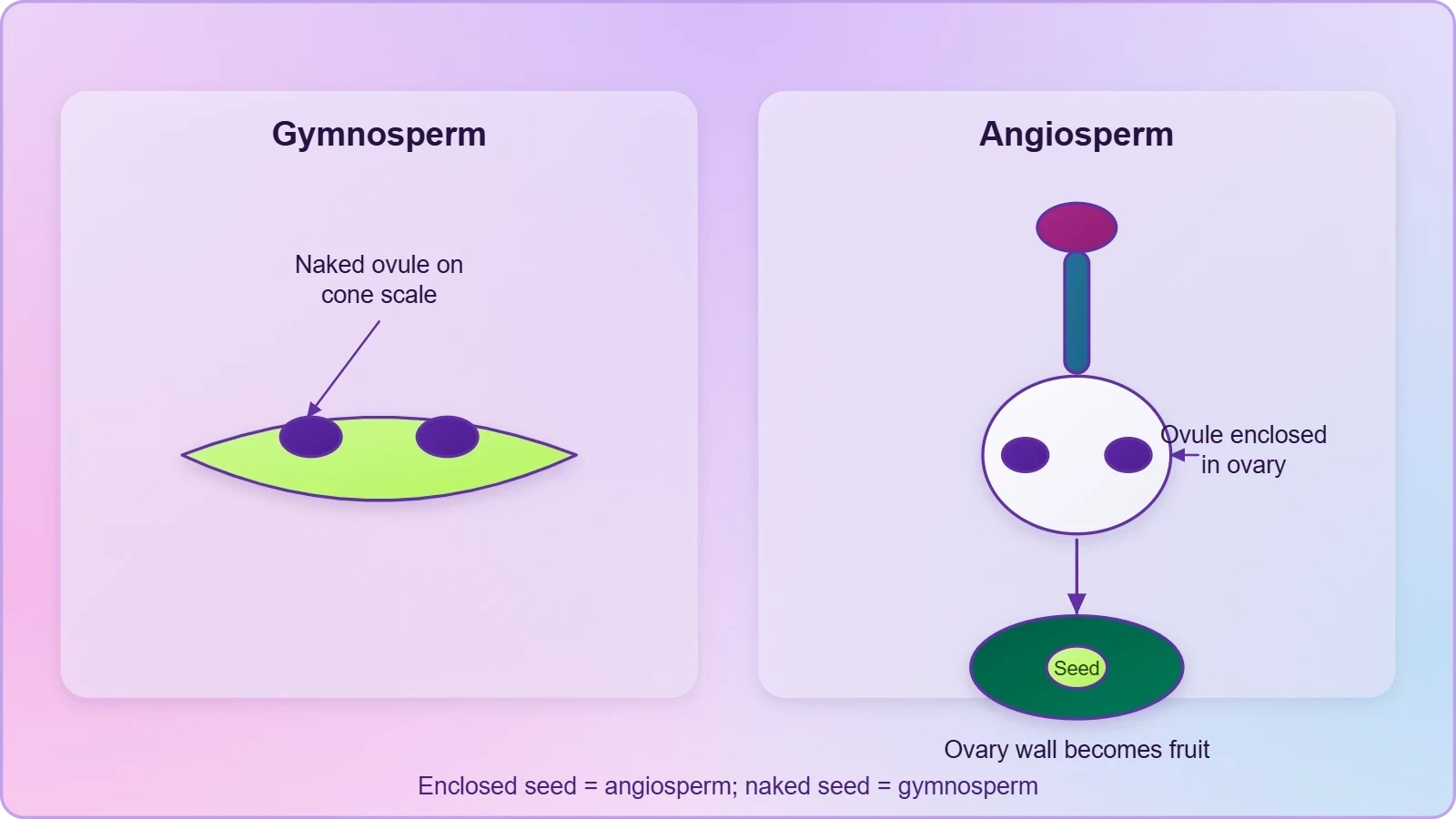
The contrast with the preceding lesson matters. Gymnosperms carry naked ovules, exposed on cone scales, whereas angiosperms protect their ovules within an ovary that matures into fruit. That single shift in design has consequences for pollination, seed dispersal, and survival across environments. Learners who followed the gymnosperm lesson will recognise how the enclosed seed represents a further step in reproductive refinement, and this lesson builds directly on that foundation.
Angiosperms are an exceptionally large group, occurring in a wide range of habitats and spanning sizes from the tiny floating Wolffia to Eucalyptus trees exceeding one hundred metres. They supply food, fodder, fuel, medicines, and numerous commercially important products. The lesson closes by distinguishing the two classes on the basis of cotyledon number, preparing the ground for the summary of the plant kingdom that follows.
On This Page
Defining Angiosperms: Flowers, Enclosed Seeds and Fruits
The defining feature of angiosperms is the flower, a specialised structure in which both pollen grains and ovules develop. Unlike gymnosperms, where ovules sit naked on cone scales, angiosperm ovules are enclosed within an ovary. After fertilisation, that ovary develops into a fruit, so the seeds are enclosed in fruits rather than exposed to the open air.
The Flower as a Specialised Reproductive Structure
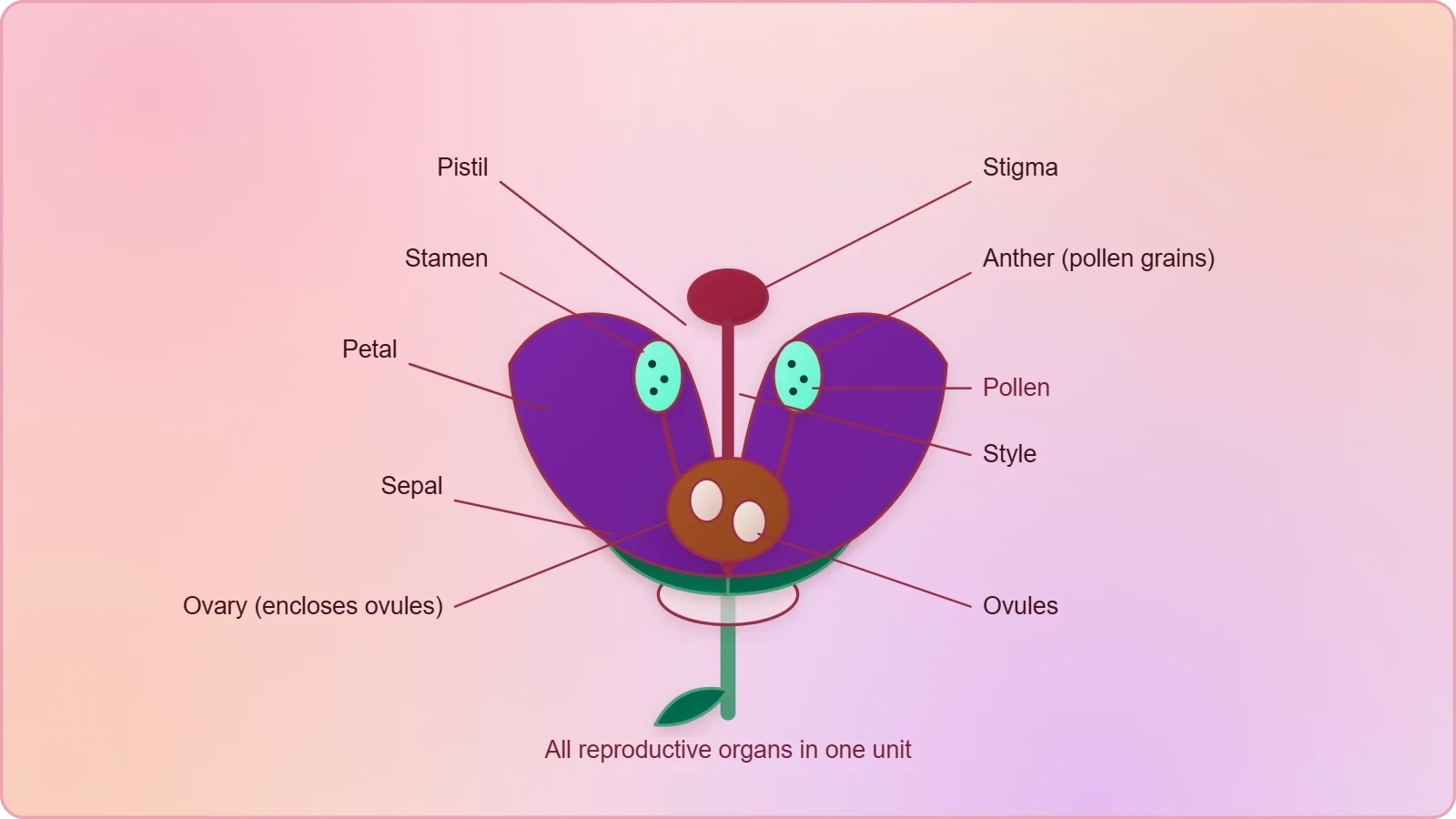
In angiosperms, the flower concentrates the reproductive organs into a single compact unit. Pollen grains develop in the anthers, while ovules develop within the ovary at the base of the pistil. This arrangement brings male and female structures into close proximity and creates opportunities for precise pollen transfer by wind, insects, birds, or other agents.
The flower is therefore not merely decorative. It is the structural reason angiosperms achieve such efficient fertilisation and such reliable seed set. Every subsequent feature of the group, from fruit formation to dispersal strategy, traces back to this central innovation in reproductive organisation.
Seeds Enclosed in Fruits
Once fertilisation occurs, the ovule becomes the seed and the ovary wall thickens into the fruit. The seed is thus enclosed, protected, and often equipped for dispersal by animals, wind, or water. This enclosure distinguishes angiosperms sharply from gymnosperms, whose seeds rest exposed on the surfaces of cone scales.
The fruit also serves functions beyond protection. Fleshy fruits attract animals that carry seeds away from the parent plant, while dry fruits may split open or be carried by wind. The enclosed seed, wrapped in fruit tissue, is the structural signature of the flowering plants.
Habitat Range and Size: From Wolffia to Eucalyptus
Angiosperms occur across a remarkably wide range of habitats, from aquatic environments to dry terrestrial landscapes, and from tropical forests to temperate grasslands. This ecological breadth reflects the versatility of the flowering plant body and its reproductive strategy. No other plant group occupies so many different environments so successfully.
An Exceptionally Large and Widespread Group
The angiosperms are described as an exceptionally large group of plants. Their capacity to colonise varied habitats rests on efficient pollination, protected seeds, and effective dispersal through fruits. These features allow flowering plants to establish themselves in conditions where other plant groups struggle to reproduce reliably.
Habitat range and group size are connected. Broad environmental tolerance, combined with reliable seed production, lets angiosperms expand into new territories and diversify. The result is the dominant vegetation of most terrestrial landscapes on Earth today.
The Smallest and the Tallest
In size, angiosperms range from the smallest Wolffia to tall trees of Eucalyptus exceeding one hundred metres. Wolffia is a minute floating plant, while Eucalyptus reaches towering heights. This span illustrates how the same basic flowering plant architecture can be scaled across an extraordinary range of forms.
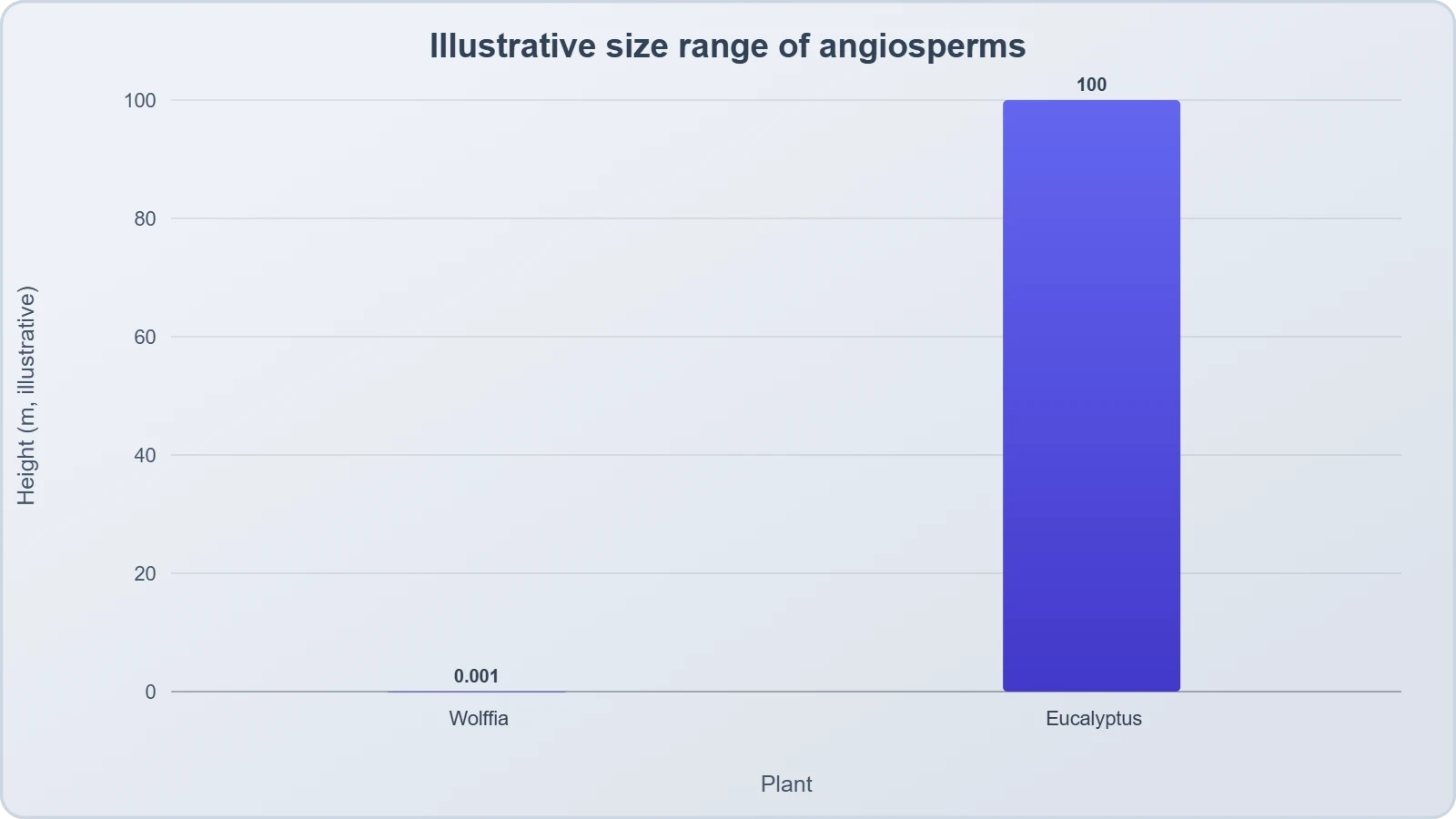
The size range is not a curiosity but a measure of the group's adaptability. Small floating forms exploit open water surfaces, while tall trees compete for light in dense forests. Both extremes share the defining angiosperm features of flowers, enclosed ovules, and seeds within fruits.
Economic and Practical Importance of Flowering Plants
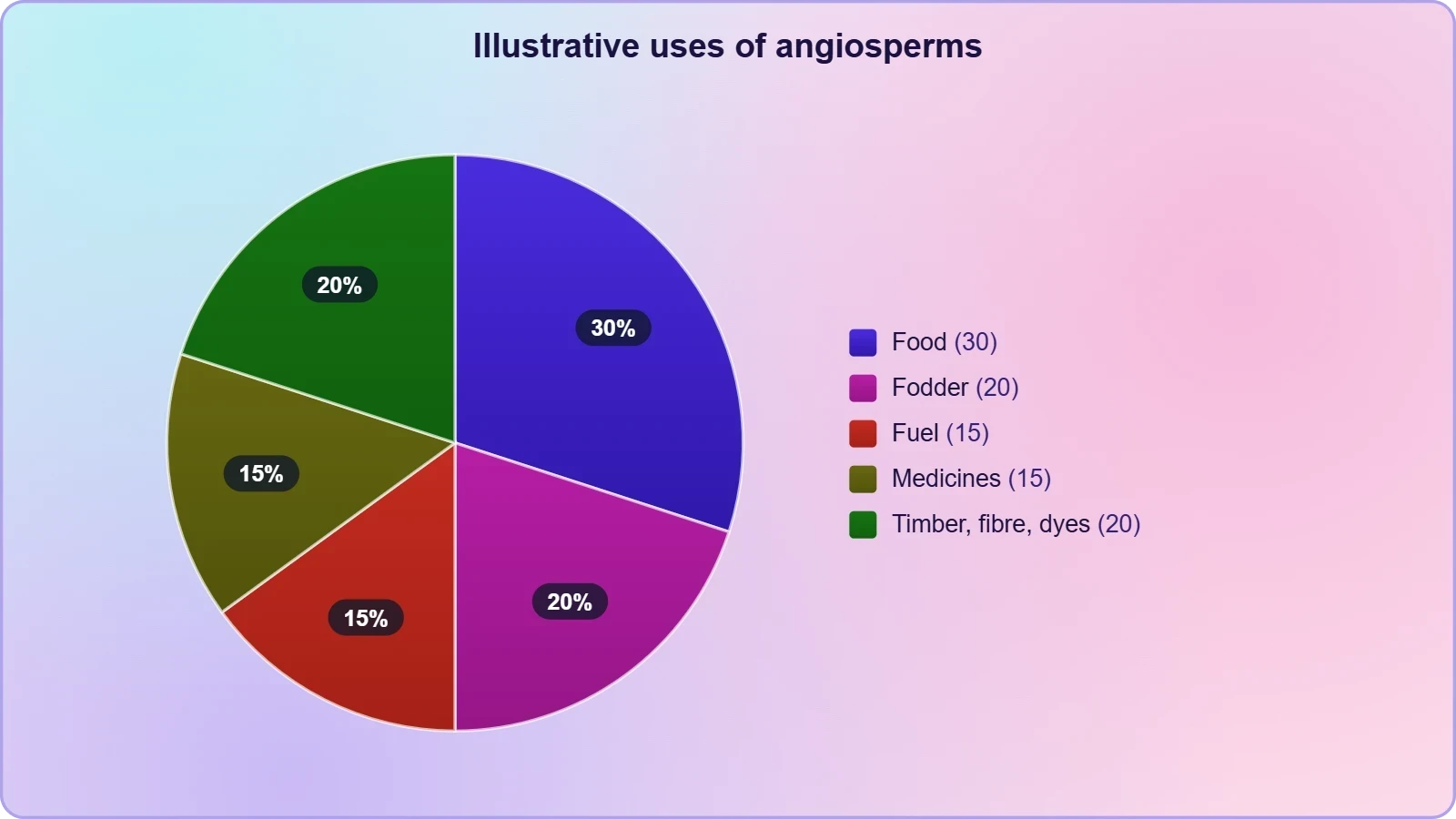
Angiosperms provide food, fodder, fuel, medicines, and several other commercially important products. This practical value is difficult to overstate, since the great majority of cultivated crops, forage plants, timber sources, and medicinal species belong to this group. Human agriculture and commerce rest substantially on flowering plants.
Food, Fodder and Fuel
Cereals, pulses, fruits, vegetables, and oilseeds all come from angiosperms. Fodder crops sustain livestock, and fuel wood and other plant-derived fuels support daily life in many regions. The food chain, from staple grains to the produce of orchards, depends on flowering plants at its base.
These categories are not separate curiosities but interconnected strands of the same dependence. A single cereal species may supply human food, animal fodder, and industrial raw material. The versatility of angiosperm products explains their central place in economies worldwide.
Medicines and Commercial Products
Medicines derived from flowering plants include a vast range of traditional remedies and modern pharmaceutical compounds. Beyond medicine, angiosperms yield timber, fibres, rubber, dyes, and ornamental plants. Several other commercially important products, as the material notes, flow from this group into global trade.
The commercial importance of angiosperms extends well beyond the farm gate. Industries built on plant fibres, plant oils, and plant-derived chemicals depend on reliable supplies of flowering plant material. This economic weight reinforces why the group receives such detailed study in plant classification.
The Two Classes: Dicotyledons and Monocotyledons
Angiosperms are divided into two classes: the dicotyledons and the monocotyledons. This division is the final structural point of the lesson and the bridge to the summary that follows. The two classes differ in cotyledon number, and this difference is accompanied by further distinctions in leaves, roots, and floral parts.
Dicotyledons
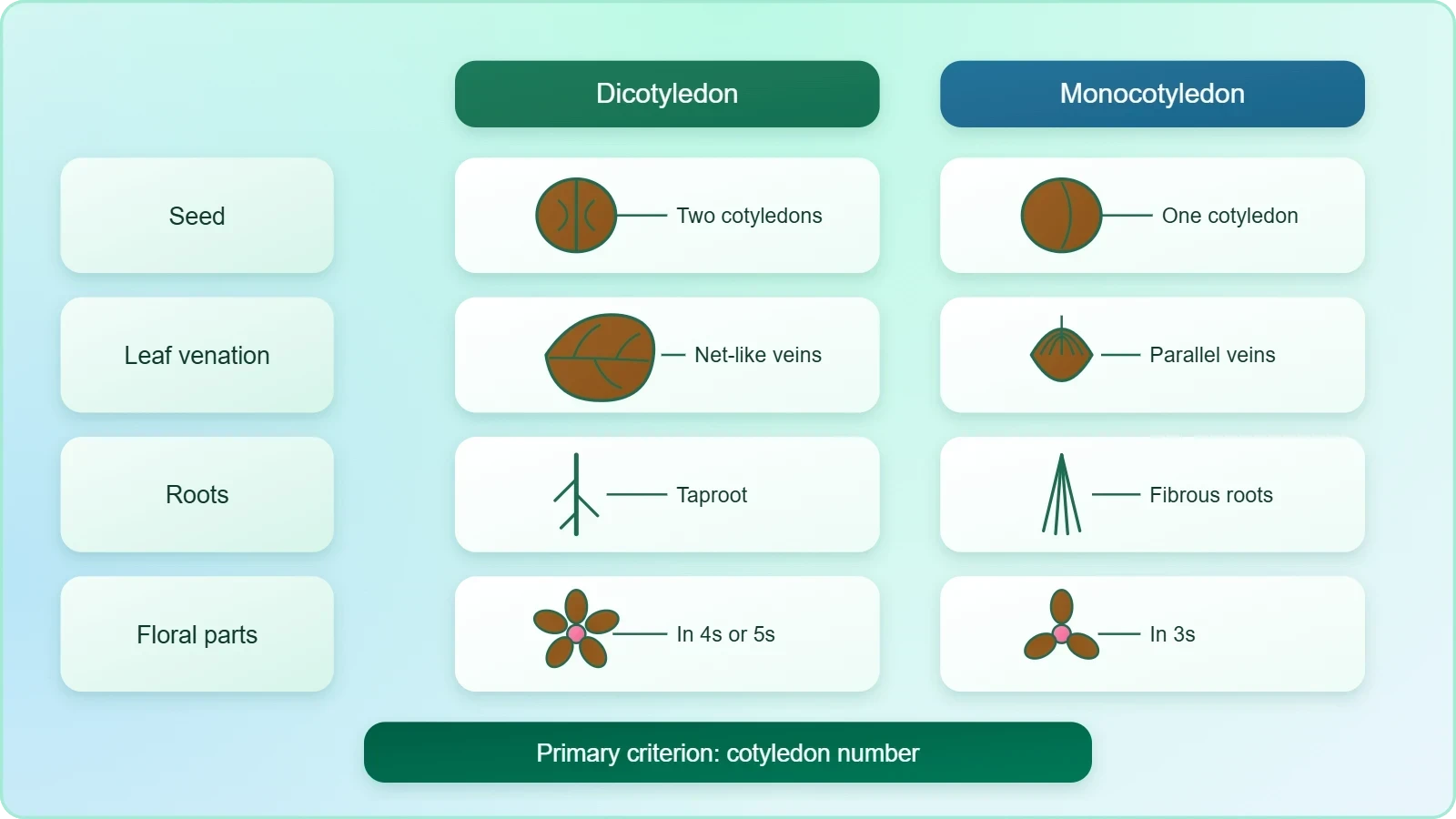
Dicotyledons are the class of flowering plants whose seeds carry two cotyledons, the seed leaves that store or absorb food for the young plant. Their leaves typically show a branching network of veins, and their floral parts commonly occur in fours or fives. Many familiar trees, shrubs, and crop plants belong here.
The name itself records the defining trait: di, meaning two, and cotyledon, the seed leaf. In the classification of angiosperms, this feature is the primary dividing line. Dicotyledons form one of the two great branches of the flowering plants.
Monocotyledons
Monocotyledons carry a single cotyledon in the seed. Their leaves generally show parallel venation, their roots are typically fibrous, and their floral parts commonly occur in threes. Grasses, lilies, palms, and orchids are familiar monocotyledons, and many staple cereal crops belong to this class.
The contrast with dicotyledons is clean and teachable. One seed leaf against two, parallel veins against branching veins, floral parts in threes against fours or fives. These paired differences give learners a reliable framework for placing a flowering plant in the correct class.
Reading the Two Classes in the Field
Recognising a flowering plant's class begins with the seed, but field identification often relies on leaves and flowers. A leaf with a branching vein network points toward dicotyledons, while parallel veins suggest monocotyledons. Counting floral parts in fours, fives, or threes provides a second check.
Practical Identification Steps
Start with the cotyledons if a seedling is available, since the seed leaf count is the defining feature. Then examine leaf venation and root type. Finally, count the floral parts. Agreement across these features gives a confident placement within either dicotyledons or monocotyledons.
Disagreement between features should prompt caution rather than a rushed conclusion. The classification rests on cotyledon number as its primary criterion, and the accompanying traits are supporting evidence. Learners should treat the seed character as decisive and the others as corroborating signals.
Common Pitfalls
A frequent error is judging class from leaf shape alone. Venation is more reliable than outline, because leaf shape varies enormously within both classes. Another pitfall is counting floral parts carelessly, especially in small or crowded inflorescences where individual flowers are easily missed.
Careful observation resolves most confusion. A hand lens helps with small flowers, and a seedling provides direct evidence of cotyledon number. Building the habit of checking several features in sequence turns classification from guesswork into a dependable observational routine.
Going Further
The name angiosperm means "vessel seed", referring to seeds enclosed within a fruit, in contrast with the naked seeds of gymnosperms. This etymology reinforces the central distinction of the lesson. The vessel is the fruit, and the seed it contains is the protected product of the flower.
Etymology and the Smallest Example
Wolffia is a very small floating flowering plant, which is why it serves as the smallest example of angiosperms. Despite its minute size, it carries the same defining features as a towering Eucalyptus. Flowers, enclosed ovules, and seeds within fruits unite the entire group.
These background notes sit apart from the core material and are offered only to aid understanding. Nothing here alters the definitions, numbers, or order of ideas presented in the lesson. The essential content remains the flower, the enclosed seed, the fruit, the habitat and size range, the uses, and the two classes.
Also Read
- No links available.
From our network :
- Vite 6/7 'Cold Start' Regression in Massive Module GraphsIn-depth analysis of Vite 6/7 cold start regressions in massive module graphs. Learn about barrel file issues, pre-bundling optimizations, and how to improve Vite dev server performance.
- 10 Physics Numerical Problems with Solutions for IIT JEEPrepare for IIT JEE with 10 physics numerical problems, complete with detailed solutions and conceptual explanations. Ideal for mastering kinematics, thermodynamics, electromagnetism, and optics.
- EV 2.0: The Solid-State Battery Breakthrough and Global Factory ExpansionDiscover the impact of the Solid-State Battery Breakthrough on the EV market. Learn about CATL and BYD stock growth, global factory expansion in Europe, and the future of EV 2.0 technology.
- Mastering DB2 12.1 Instance Design: A Technical Deep Dive into Modern Database ArchitectureComprehensive guide to DB2 12.1 Instance Design. Explore architectural components, HADR setup, buffer pool tuning, and security policies for IBM DB2 12.1. Includes 10 functional SQL and Shell samples.
- Mastering DB2 LUW v12 Tables: A Comprehensive Technical GuideComprehensive guide on DB2 LUW v12 tables. Explore CREATE TABLE syntax, BLU Acceleration, range partitioning, data types, and security features for IBM DB2 LUW v12.
- Trump Political Strategy How Geopolitical Stunts Serve As Media Diversions
- 98% of Global MBA Programs Now Prefer GRE Over GMAT Focus EditionExplore why 98% of global MBA programs now prefer the GRE over GMAT Focus. Learn about the shorter GRE format, verbal logic importance, and strategic versatility for students.
- Analyzing Trump Deportation Numbers Insights Into The 2026 Immigration Crackdown
- AI-Powered 'Precision Diagnostic' Replaces Standard GRE Score ReportsDiscover the new GRE Precision Diagnostic. Learn how AI-powered behavioral analytics and time-to-solve tracking are replacing standard GRE score reports to empower students.
RESOURCES
- Back to Basics Monocots and Dicots | Arboriculture & Urban Forestryauf.isa-arbor.comThese plants are called angiosperms and have been around for about 125 million years. ... The flowering plants constitute a majority of all plants…
- Confused on monocots and dicots : r/botany - Redditreddit.comJun 27, 2020 ... All angiosperms (flowering plants) are either monocot or dicot, but gymnosperms (conifers, cycads, etc.) · Almost all of the time,…
- Dicotyledon - Wikipediaen.wikipedia.orgThe dicotyledons, also known as dicots (or, more rarely, dicotyls), are one of the two groups into which all the flowering plants (angiosperms) were ...
- Angiospermae (Flowering Plants) - The Biology Primerthebiologyprimer.com... seeds". Ovules in angiosperms This diagram is showing the differences between monocotyledonous flowers or dicotyledonous flowers. Monocots have a. 0 items. $0.
- Angiosperm - Flowering, Monocots, Dicots | Britannicabritannica.comSep 25, 2026 ... The angiosperms are a well-characterized, sharply defined group. There is not a single living plant species whose status as an…
- The chloroplast genome of Nymphaea alba - PubMedpubmed.ncbi.nlm.nih.govAngiosperms (flowering plants) dominate contemporary terrestrial flora with ... Instead, they support the basal monocot-dicot split. Consistent with ...
- Monocotyledon | Definition, Evolution, Characteristics, Plants ...britannica.comOct 9, 2026 ... Monocotyledon, one of the two great groups of flowering plants, or angiosperms, the other being the eudicotyledons (eudicots).
- Fossil reveals new genus of 125-million-year-old eudicot from Chinafloridamuseum.ufl.eduMar 30, 2011 ... Eudicots, known as “typical dicots,” are one of the largest groups of flowering plants. angiosperm fossil from China This Leefructus…
- Dicotyledon | Botany | Research Starters | EBSCOhostebsco.comprimary categories of angiosperms, the other being monocotyledons, which contain only one cotyledon. Dicots ... flowering plants as monocots or dicots. Cotyledons ...
- What is the difference between monocot and dicot plants? - Facebookfacebook.comJan 2, 2022 ... So there is no real group of plants called 'dicots' anymore. I guess you could contrast monocots with 'all other…
- Monocots and Whaticots? Eudicots? - Dave's Gardendavesgarden.comMar 5, 2014 ... Most of us were taught that angiosperms (flowering plants) were either a monocot (monocotyledon) or dicot (dicotyledon). Today scientists prefer ...
- 14.4 Seed Plants: Angiosperms - Concepts of Biology | OpenStaxopenstax.orgApr 25, 2013 ... Eudicots, or true dicots, are characterized by the presence of two cotyledons. Veins form a network in leaves. Flower parts…
- Overview of Angiosperm Phylogeny - Digital Atlas of Ancient Lifedigitalatlasofancientlife.orgNov 10, 2019 ... Examples of members of the major groups of angiosperms (flowering plants) discussed on this page. ... Monocots versus dicots, the…
- Monocots vs dicots key differences in plants - Facebookfacebook.comJul 12, 2025 ... This diagram contrasts the key differences between monocots and dicots, two major groups of angiosperms (flowering plants). Monocots, on the ...
- Education Activity—Angiosperms and Gymnosperms - ArbNetarbnet.orgIf the veins run parallel to one another and the flower contains 3 peddles, the plant is usually a monocot. o Dicot- A type…