Every biology student eventually meets a name like Mangifera indica Linn. and wonders why three separate pieces of information sit inside one short string. That single line carries the genus, the specific epithet, and the abbreviated surname of the scientist who first described the species. Behind this compact convention lies a carefully negotiated agreement among biologists worldwide, designed so that a mango is never mistaken for anything else, in any language, on any continent.
This lesson, the fourth in a ten-part course on the living world, examines the universal rules of nomenclature and the author citation. It builds directly on the two-component binomial name introduced earlier and prepares the ground for the processes of classification and taxonomy that follow. The rules themselves are few, but each one carries real consequences for how scientific literature is written, printed, and read across borders.
Local names fail precisely because they are local. The same organism may carry a dozen regional labels, and a single label may point to unrelated organisms in different districts. Standardisation solves this confusion, and the rules below are the machinery of that standardisation. Mastery of these conventions is not pedantry; it is the practical literacy every working biologist needs before reading a flora, a fauna, or a research paper.
On This Page
Why Universal Rules Are Needed at All
As exploration continues, new organisms are identified even in well-studied regions, and the catalogue of known plants and animals keeps expanding into the millions. Local names cannot keep pace with this growth, because they vary from place to place even within a single country. Without a shared vocabulary, biologists would be unable to communicate reliably about the organisms they study.
The remedy is nomenclature: the standardised naming of living organisms so that a particular organism is known by the same name everywhere in the world. Naming, however, is only possible when the organism has been described correctly and we know exactly which organism the name is attached to. That prior step is identification, and it anchors every name to a real, verifiable specimen.
The International Codes Behind the Names
Scientists have established formal procedures for assigning scientific names, and these procedures are accepted by biologists across the world. For plants, the agreed principles and criteria are set out in the International Code for Botanical Nomenclature, known as ICBN. Animal taxonomists, working separately, evolved the International Code of Zoological Nomenclature, or ICZN.
These codes guarantee that each organism has only one valid name. A proper description should enable a reader anywhere on earth to arrive at the same name, and the codes also ensure that a proposed name has not already been used for some other known organism. The result is stability, traceability, and a shared reference point for all biological work.
From Local Labels to a Single Scientific Name
The shift from local labels to scientific names is not merely linguistic housekeeping. A scientific name is a compressed hypothesis about identity and relationship, and it must be reproducible by strangers working independently. When two researchers in different countries examine the same plant, the code ensures they converge on one name rather than two.
This reproducibility depends on correct description and identification preceding the naming act. A name attached to a misidentified specimen propagates error through the literature, which is why the codes place such weight on the description. Nomenclature is the final, visible layer of a process that begins with careful observation.
The Binomial Name and Its Two Components
Each scientific name has two components: the generic name and the specific epithet. This two-component system is called binomial nomenclature, and it was given by Carolus Linnaeus. Biologists everywhere practise it today because the two-word format proved convenient, compact, and unambiguous in daily use.
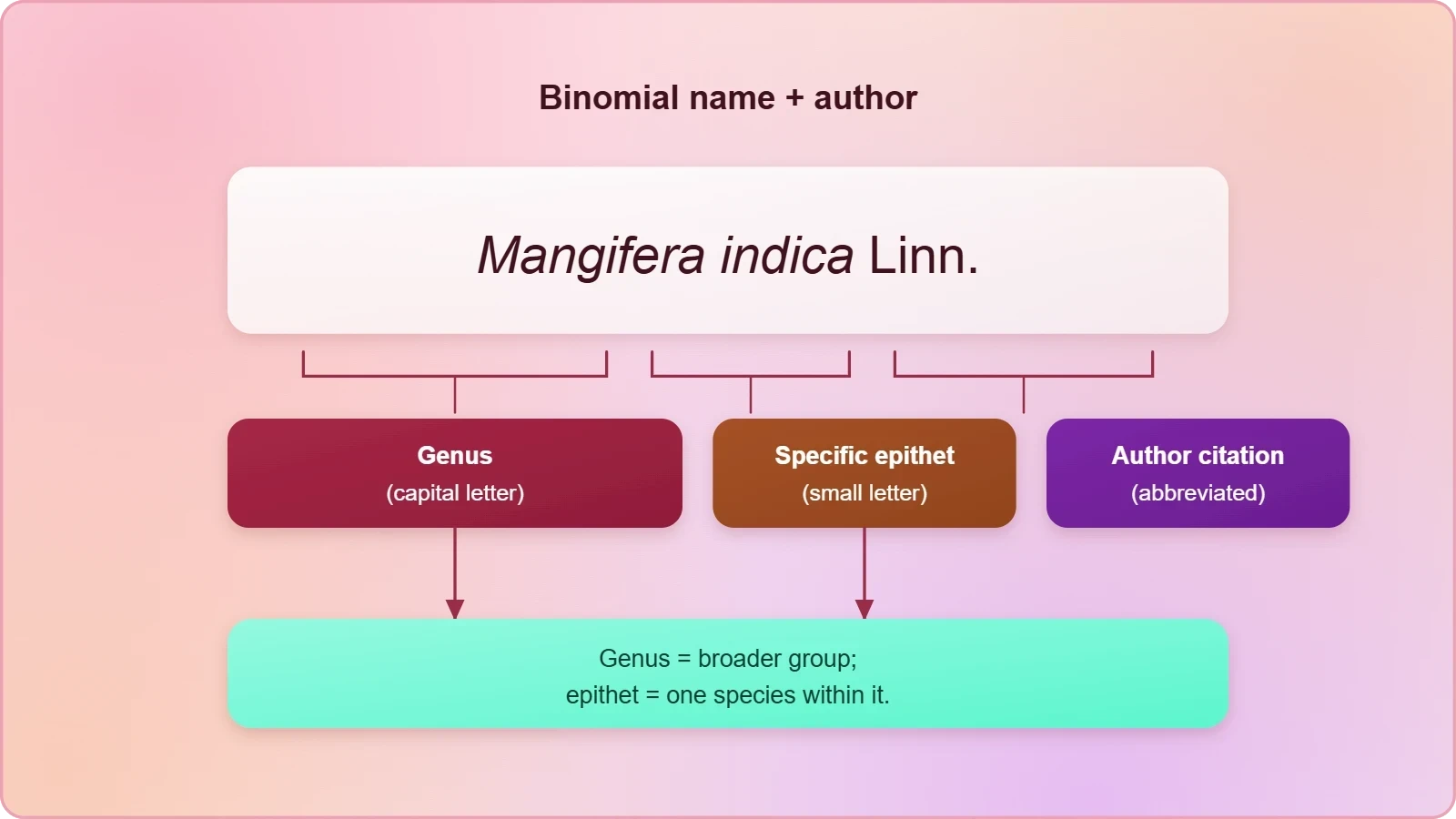
The mango illustrates the structure cleanly. Its scientific name is written as Mangifera indica, where Mangifera represents the genus and indica denotes a particular species, that is, the specific epithet. Two words, two levels of information, one unambiguous identity.
Genus and Specific Epithet Distinguished
The first word in a biological name always represents the genus, a grouping that may contain many related species. The second component denotes the specific epithet, which narrows the identity to one species within that genus. The genus is the broader container; the epithet is the precise label inside it.
This hierarchy matters when reading names in sequence. Several species of Mangifera may exist, but only one carries the epithet indica. The pairing is what makes the name unique, and neither word alone identifies the organism completely.
Why Two Words Proved Convenient
A single word cannot encode both grouping and specificity without becoming unwieldy. The binomial format solves this by assigning one word to the genus and one to the species, so the name simultaneously places the organism and pins it down. Linnaeus's system has survived because it does both jobs economically.
The convenience is practical as well as logical. Names remain short enough for field notes, labels, and indexes, yet informative enough for taxonomic placement. This balance explains why the two-word format spread across all of biology and remains standard practice today.
The Universal Rules of Nomenclature
Beyond the two-component structure, four universal rules govern how biological names are written. They concern language, order, typography, and capitalisation. Together they ensure that a name looks the same whether it appears in a printed journal, a handwritten field notebook, or an examination answer sheet.
These rules are not arbitrary decoration. Each one signals something about the name: its Latin origin, its internal hierarchy, and its status as a formal scientific designation rather than a common label. Learning them is a matter of habit, and once formed, the habit is difficult to break.
Latin Origin and Italic Setting
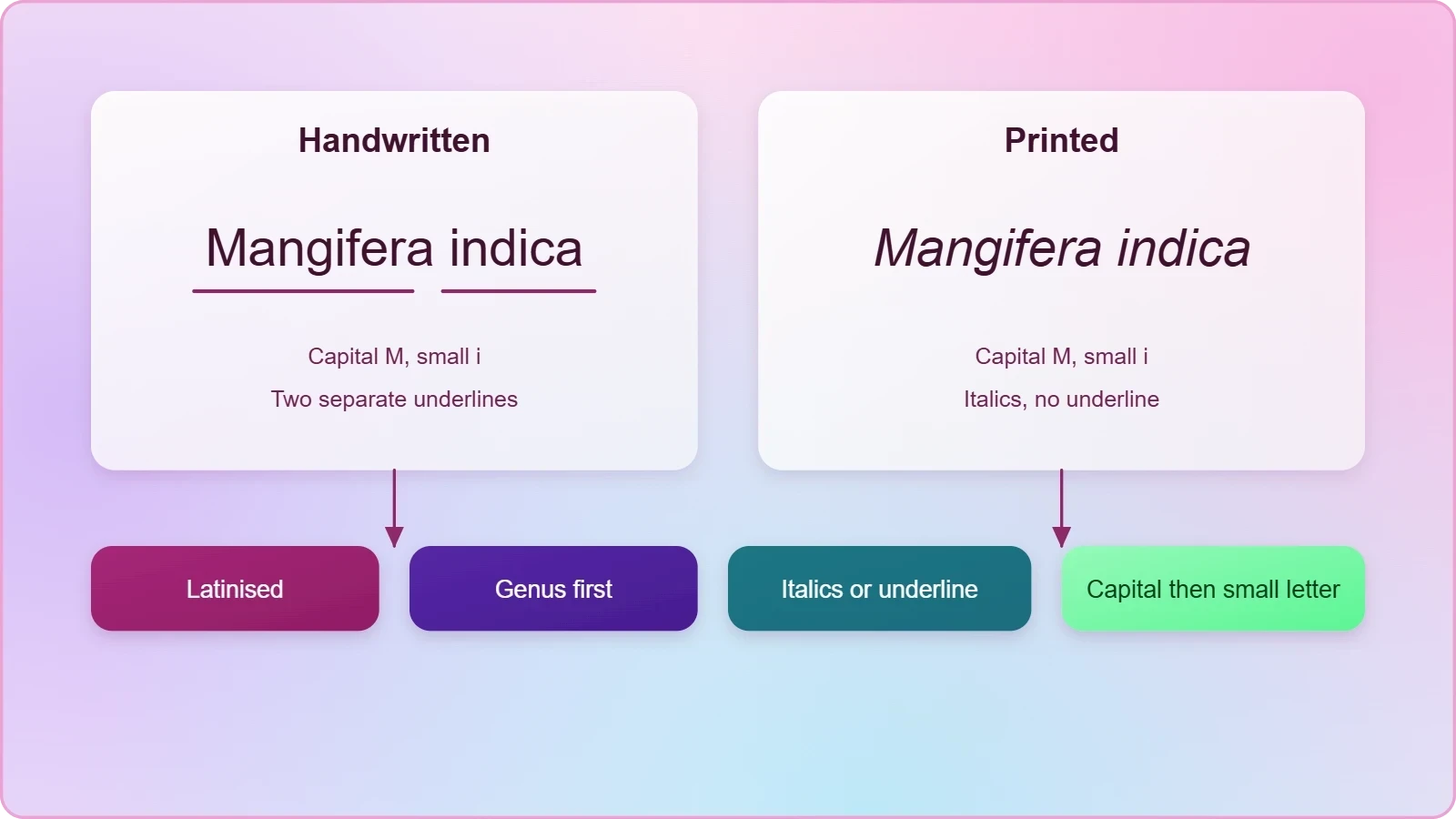
Biological names are generally in Latin and written in italics. They are Latinised, or derived from Latin, irrespective of the language from which the original word came. A name coined from Greek, Sanskrit, or a modern surname is still reshaped to fit Latin conventions before it enters the literature.
The italic setting is a typographic signal, not an aesthetic choice. It tells the reader immediately that the word is a scientific name rather than an ordinary noun. When a name appears in running text, the italics separate it from the surrounding prose and prevent misreading.
Underlining, Capitals, and the Specific Epithet
When a biological name is handwritten, both words are separately underlined; when printed, the same effect is achieved with italics. The underlining marks the Latin origin of the name. Note that each word is underlined separately, not as a single continuous stroke beneath the pair.
Capitalisation follows a fixed pattern. The first word, denoting the genus, starts with a capital letter, while the specific epithet starts with a small letter. Mangifera indica illustrates the rule exactly: capital M for the genus, small i for the epithet.
The Author Citation After the Specific Epithet
The name of the author appears after the specific epithet, that is, at the end of the biological name, and it is written in an abbreviated form. The full citation therefore reads Mangifera indica Linn. The abbreviation signals that this species was first described by Linnaeus.
The author citation is a small but powerful piece of metadata. It records priority, credits the original describer, and allows later readers to trace the name back to its first formal publication. Without it, two names for the same organism could circulate indefinitely with no way to establish which came first.
Reading the Abbreviation Correctly
The abbreviation is not part of the organism's name in the strict sense; it is an attribution appended to it. When writing the name in an examination or a report, the binomial itself is italicised, while the author abbreviation conventionally stands in ordinary roman type. The distinction keeps the two kinds of information visually separate.
Students often ask whether the author name should be capitalised. Because it is an abbreviation of a proper name, it begins with a capital letter, as in Linn. The period marks the truncation. The same convention applies to other abbreviated authorities encountered in botanical and zoological literature.
Why Attribution Matters in Practice
Attribution protects the integrity of the taxonomic record. If a species is later transferred to a different genus, the original author's name is retained in parentheses, preserving the history of the name. The citation thus functions as a compact audit trail embedded in every formal reference.
For students, the practical lesson is simple: always check whether an author citation accompanies a name in the source you are reading. Its presence tells you the name has been formally published and validated, while its absence may indicate a casual or incomplete reference.
From Names to Categories: Taxa and Classification
Naming is one part of a larger enterprise. Since it is nearly impossible to study all living organisms individually, biologists devise means of grouping them, and this process is classification. Classification groups organisms into convenient categories based on easily observable characters, making the diversity of life tractable.
We recognise groups such as plants, animals, dogs, cats, or insects, and each term carries associated characters. Say "dog" and everyone pictures dogs, not cats; say "mammals" and the image shifts to animals with external ears and body hair. In plants, "wheat" evokes wheat alone, never rice.
Taxa at Different Levels
The scientific term for these categories is taxa. Crucially, taxa can indicate categories at very different levels. "Plants" forms a taxon, and "wheat" also forms a taxon; "animals", "mammals", and "dogs" are all taxa, yet a dog is a mammal and a mammal is an animal.
This nesting is the heart of the matter. The same word "taxon" applies to a broad grouping and to a narrow one, and the hierarchy is what organises them. Recognising that taxa sit at different levels prepares the ground for the ranked categories that follow in the next lesson.
Taxonomy and Its Four Basic Processes
Based on characteristics, all living organisms can be classified into different taxa, and this process of classification is taxonomy. External and internal structure, the structure of the cell, development processes, and ecological information all form the basis of modern taxonomic studies.
Four processes are basic to taxonomy: characterisation, identification, classification, and nomenclature. Each depends on the others, and together they convert raw biological diversity into an ordered, communicable system. Nomenclature, the subject of this lesson, is the final step that makes the system public.
Systematics and the Historical Roots of Classification
Taxonomy is not something new. Human beings have always been interested in knowing more about the various kinds of organisms, particularly with reference to their own use. In early days, people needed sources for basic needs of food, clothing, and shelter, so the earliest classifications were based on the uses of organisms.
Interest later widened from utility to relationship. Humans were not only curious about different kinds of organisms and their diversities but also about the relationships among them. This branch of study was referred to as systematics, a word derived from the Latin "systema", meaning systematic arrangement of organisms.
From Use-Based Grouping to Relationship-Based Study
The earliest classifications grouped organisms by how people used them, which was practical but not biological. As understanding deepened, the organising principle shifted toward observable characters and, eventually, toward evolutionary relationships. Systematics grew out of this shift and gave the discipline its comparative, relationship-focused character.
Linnaeus stands at the hinge of this history, and his binomial system remains the working language of biology. The rules examined in this lesson are his legacy, refined by later generations of taxonomists into the international codes that govern naming today.
Preparing for the Next Step
With the rules of nomenclature established, the stage is set for the ranked taxonomic categories from species to kingdom. The next lesson develops classification, taxa, and taxonomy as processes, building on the nesting of taxa introduced here. The author citation and the binomial format will reappear throughout that discussion.
For now, the essential takeaway is that a scientific name is a contract. It binds the observer, the describer, and every future reader to a single, verifiable identity, and the rules of nomenclature are the terms of that contract.
Going Further
The abbreviation "Linn." is the example of an abbreviated author name attached to the end of a biological name, and it identifies Linnaeus as the first describer of the species. The rule about capital and small letters is illustrated with the same example, Mangifera indica, where the genus takes a capital and the epithet a small letter.
These two details are worth memorising together, because they demonstrate how a single name can carry language, hierarchy, typography, and attribution in one compact string. Once the pattern is recognised, unfamiliar names in any flora or fauna become readable rather than opaque.
Also Read
- No links available.
From our network :
- Analyzing Trump Deportation Numbers Insights Into The 2026 Immigration Crackdown
- EV 2.0: The Solid-State Battery Breakthrough and Global Factory ExpansionDiscover the impact of the Solid-State Battery Breakthrough on the EV market. Learn about CATL and BYD stock growth, global factory expansion in Europe, and the future of EV 2.0 technology.
- Vite 6/7 'Cold Start' Regression in Massive Module GraphsIn-depth analysis of Vite 6/7 cold start regressions in massive module graphs. Learn about barrel file issues, pre-bundling optimizations, and how to improve Vite dev server performance.
- AI-Powered 'Precision Diagnostic' Replaces Standard GRE Score ReportsDiscover the new GRE Precision Diagnostic. Learn how AI-powered behavioral analytics and time-to-solve tracking are replacing standard GRE score reports to empower students.
- Trump Political Strategy How Geopolitical Stunts Serve As Media Diversions
- Mastering DB2 12.1 Instance Design: A Technical Deep Dive into Modern Database ArchitectureComprehensive guide to DB2 12.1 Instance Design. Explore architectural components, HADR setup, buffer pool tuning, and security policies for IBM DB2 12.1. Includes 10 functional SQL and Shell samples.
- 10 Physics Numerical Problems with Solutions for IIT JEEPrepare for IIT JEE with 10 physics numerical problems, complete with detailed solutions and conceptual explanations. Ideal for mastering kinematics, thermodynamics, electromagnetism, and optics.
- Mastering DB2 LUW v12 Tables: A Comprehensive Technical GuideComprehensive guide on DB2 LUW v12 tables. Explore CREATE TABLE syntax, BLU Acceleration, range partitioning, data types, and security features for IBM DB2 LUW v12.
- 98% of Global MBA Programs Now Prefer GRE Over GMAT Focus EditionExplore why 98% of global MBA programs now prefer the GRE over GMAT Focus. Learn about the shorter GRE format, verbal logic importance, and strategic versatility for students.
RESOURCES
- A universal system of naming living organisms using exactly two ...facebook.comJul 14, 2026 ... ... Author Citation → The name of the scientist who first described ... Universal Rules for binomial nomenclature. 1. Binomial…
- What is Binomial Nomenclature? Importance, Format, Examples, Tipseditage.comOct 18, 2022 ... Author citations follow different conventions in zoology (surname ... The rules of binomial nomenclature are not a single global standard.
- What is binomial nomenclature in scientific naming? - Facebookfacebook.comOct 25, 2026 ... OCR: Binomial Nomenclature: The Universal Naming System ANATOMY OF A BINOMIAL NAME UNIVERSAL ... Author Citations Writteni Roman Font. Scientist ...
- Binomial nomenclature - Wikipediaen.wikipedia.orgThe application of binomial nomenclature is now governed by various internationally agreed codes of rules ... Main articles: Author citation (zoology) and Author ...
- Scientific names are more than just complicated Latin words They ...instagram.comMay 17, 2026 ... #ScienceEducation · May 17. OCR. NOMENCLATURE RULES THE UNIVERSAL LANGUAGE OF LIFE Binomial nomenclature species using two LATIN? giving ...
- Give notes on binomial nomenclature - Filoaskfilo.comSep 4, 2026 ... Universal Rules of Binomial Nomenclature. To maintain uniformity ... Author Citation: Sometimes, the name of the author who first ...
- Ten rules for robust taxonomy in ecological datasetsnph.onlinelibrary.wiley.comOct 12, 2026 ... Although often seen as a detail, it is important to store full scientific names (i.e. Latin binomial names and their…
- Protecting stable biological nomenclatural systems enables ...academic.oup.com... biological nomenclature and allow unambiguous universal communication in biology. ... nomenclature with objective rules: universality, stability ...
- International Code of Botanical Nomenclature (ICBN)jagiroadcollegelive.co.in(genusnovum). Rule 5 Citation of Author's Name. Thebotanical name is ... According to binomial system name of any species consists of two names i.e.…
- Guide for authors - International Journal of Infectious Diseasessciencedirect.comData references should include the following elements: author name(s), dataset title, data repository, version (where available), year, and global persistent ...
- Binomial nomenclature | PPTX - Slideshareslideshare.netAdvantages • Binomial names are universal names for plants • Definite and precise names • Describes ... Author citations 4. Rules for acceptance and…
- (PDF) Protecting stable biological nomenclatural systems enables ...researchgate.netAug 20, 2026 ... fair and impartial guides to the principles governing biological nomenclature, and 2. allow unambiguous universal communication in biology.
- Rules for writing binomial nomenclature. - Lifeeasy Biologybiology.lifeeasy.orgMentioning the author's name after the species name is called as Citation. ... Universal rules of nomenclature are as follows: a. Biological names are ...
- Binomial Nomenclature | Definition, Rules & Importance - Lessonstudy.comAuthor. Lisa Stewart. Author: Lisa Stewart. Show more ... This naming system is important because it allows organisms to have a universal and specific…
- Author Checklist for AFS Book Chapter Preparationfisheries.orgGive the scientific name (Latin binomial) of any species the first time it is ... Instead, list them as text citations with the author's…