Every scientific name you have ever read on a specimen label, a field guide or a museum drawer rests on two deceptively simple ranks: species and genus. They are the twin foundations of binomial nomenclature, the lowest and second-lowest rungs of the taxonomic hierarchy, and the point at which abstract classification finally touches living, breathing organisms. Understanding them precisely is what separates a student who memorises names from one who can actually read the biological world.
This lesson examines both categories exactly as the source material defines them. It begins with the species as a group of individuals sharing fundamental similarities, distinguishable from close relatives by distinct morphological differences, and then moves to the genus as an aggregate of closely related species bound by a larger pool of shared characters. The examples are deliberately familiar: mango, potato, lion, tiger, leopard, brinjal and the human being.
Because this is the eighth lesson of the sequence, the hierarchy itself is already in place. What follows builds directly on that scaffolding, sharpening the two lowest ranks before the next lesson widens the lens to family, order and class. Read the definitions slowly; every later category is assembled from the ones you are about to study.
On This Page
Species: The Basic Unit of Classification
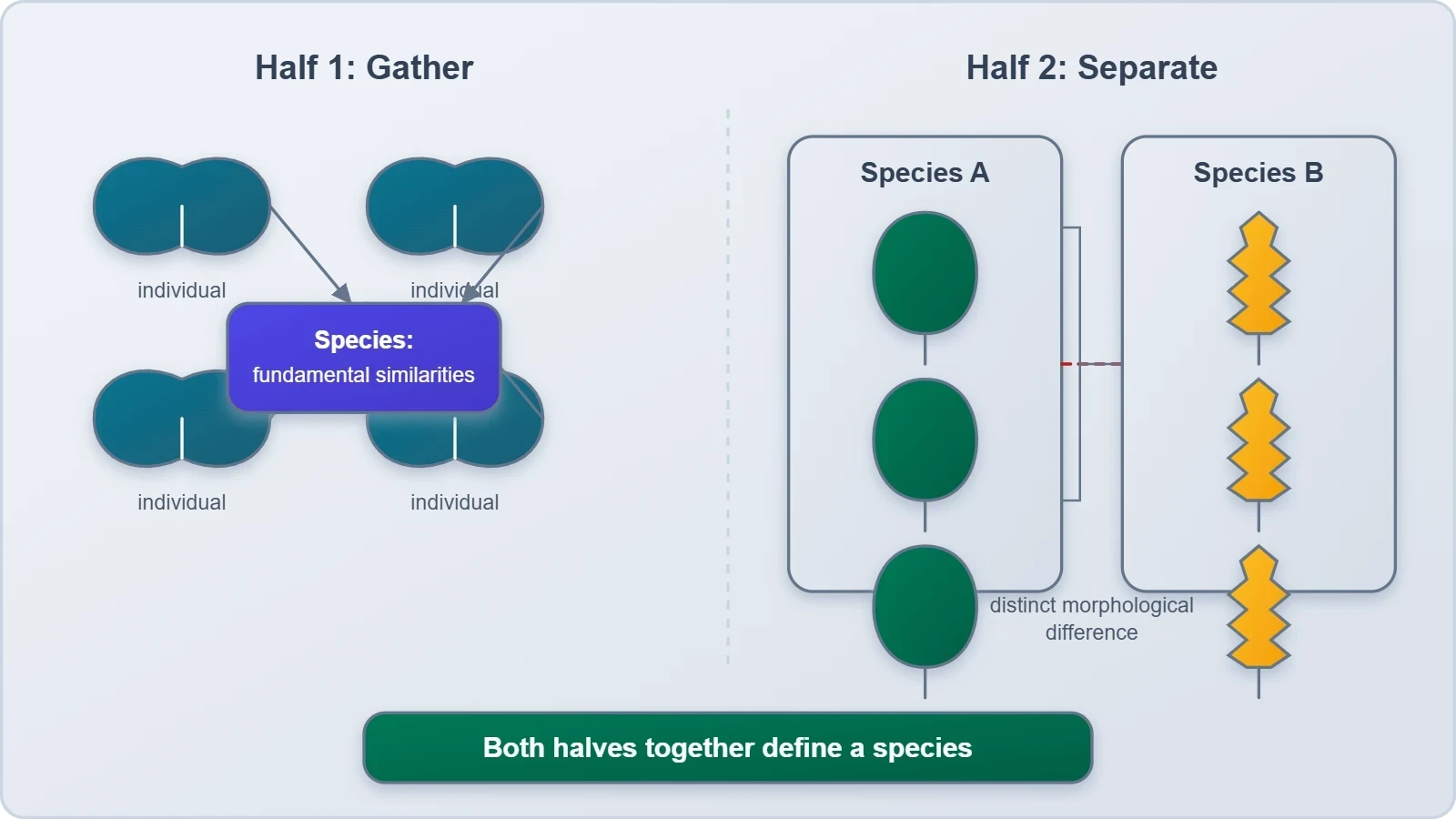
Taxonomic studies treat a group of individual organisms with fundamental similarities as a species. That phrase carries real weight: the similarities must be fundamental, not incidental, and the group must be separable from its nearest relatives. Species is the lowest category in the hierarchy, and all organisms, whether plant or animal, are ultimately placed within one.
Fundamental Similarity and Distinct Morphological Difference
The definition has two halves that work together. The first half gathers organisms into a group on the strength of fundamental similarities; the second half insists that one species be distinguishable from other closely related species on the basis of distinct morphological differences. Neither half alone is sufficient for sound taxonomic practice.
Morphology here means observable form and structure, the features a trained eye can compare across specimens. Two populations may resemble each other broadly, yet a consistent difference in leaf shape, floral structure, body form or dentition can justify separation at species level. The judgement is comparative and always made against close relatives, never in isolation.
Why the Lowest Rank Matters
Placing species at the bottom of the hierarchy is not an arbitrary convention. It reflects the observation that below this level, the shared fundamental similarities become the defining signature of the group. Every higher category, from genus upward, is built by bundling species together, so the accuracy of the entire edifice depends on getting species boundaries right.
Reading Specific Epithets: indica, tuberosum and leo
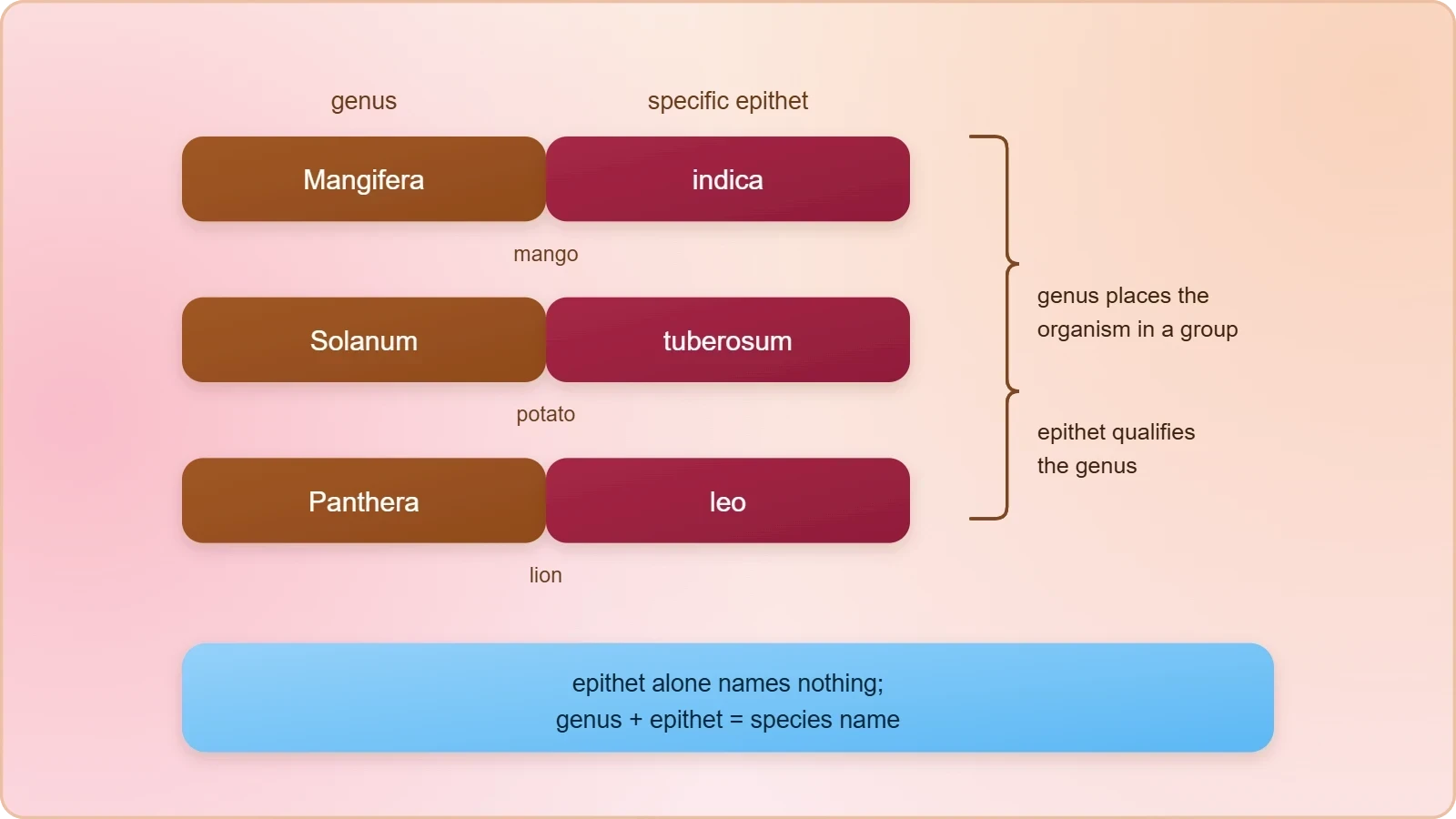
Consider three names side by side: Mangifera indica, Solanum tuberosum (potato) and Panthera leo (lion). In each, the second word, indica, tuberosum and leo, is the specific epithet. The first word in each case, Mangifera, Solanum and Panthera, is the genus, representing a higher level of taxon or category.
The specific epithet on its own does not name an organism; it qualifies a genus. Written together, genus plus epithet form the scientific name of the species. This is the mechanical heart of binomial nomenclature, and it explains why the two words are always treated as a single unit in formal writing.
Human beings belong to the species sapiens, which is grouped in the genus Homo. The scientific name for the human being is therefore written as Homo sapiens. The pattern is identical to the plant and animal examples above, confirming that the same two-rank logic applies across the living world.
Genus: An Aggregate of Closely Related Species
A genus comprises a group of related species which has more characters in common in comparison to species of other genera. Put plainly, genera are aggregates of closely related species. The genus therefore sits one rank above species and gathers organisms whose shared features run deeper than those linking them to outsiders.
The Comparative Logic Behind Genus Boundaries
The definition is explicitly comparative. It is not enough that species within a genus resemble one another; they must share more characters with each other than they do with species placed in other genera. This relative measure of similarity is what gives the rank its diagnostic power and keeps genera from becoming loose, arbitrary bundles.
Because the criterion is a comparison of character counts, genus delimitation demands careful observation across many features rather than a single striking trait. A genus is a working hypothesis about relatedness expressed through shared morphology, and it is revised whenever the evidence of shared characters shifts.
One Genus, Several Epithets
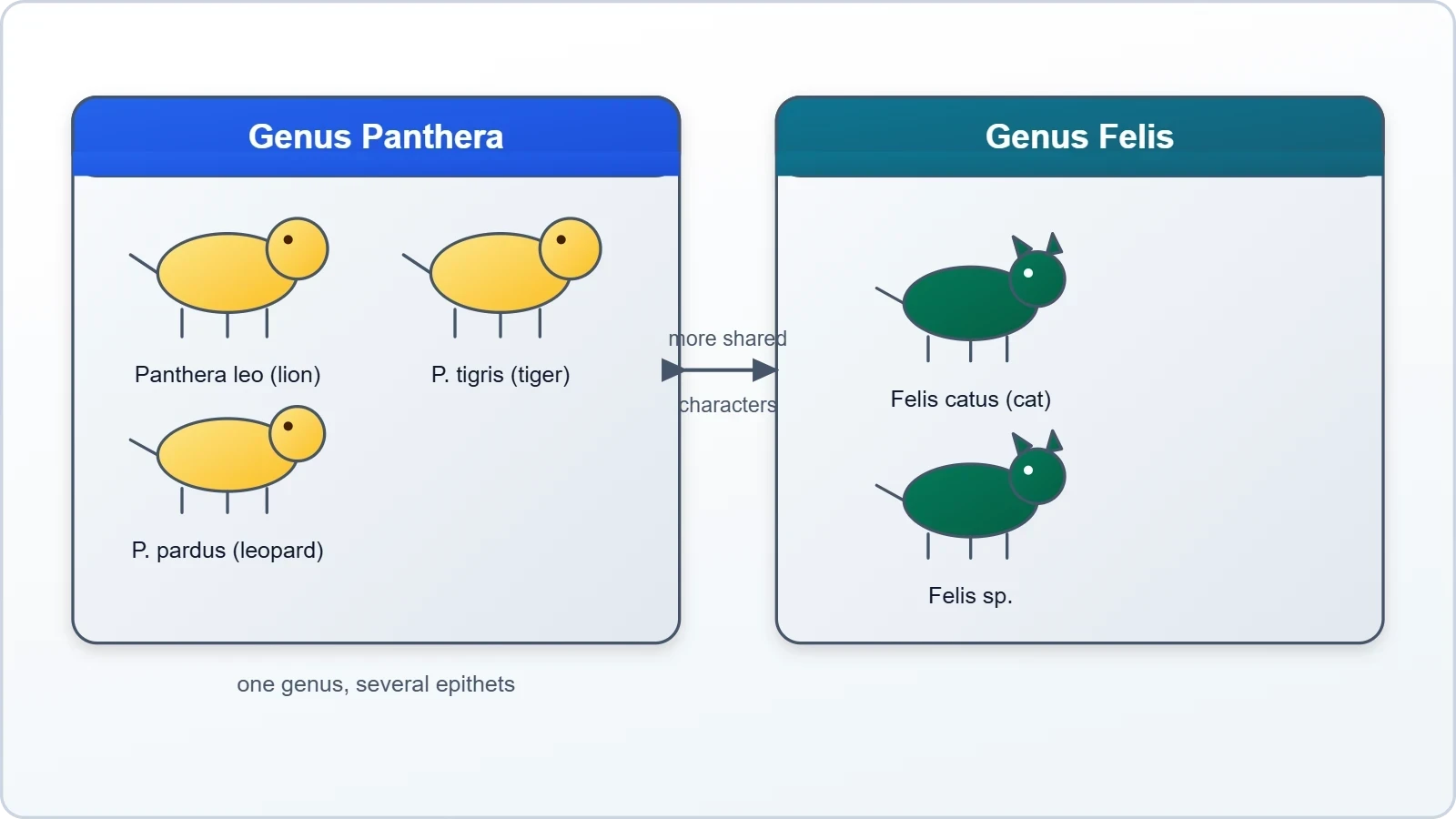
Each genus may have one or more than one specific epithet representing different organisms, but those organisms retain morphological similarities. This is why a genus name can appear repeatedly across a list of species. The repetition is not redundancy; it is the visible signature of relatedness at the rank above species.
Worked Examples: Solanum and Panthera
Potato and brinjal are two different species, yet both belong to the genus Solanum. The genus also includes species such as nigrum and melongena, alongside tuberosum. Here is a single genus accommodating several distinct organisms that nonetheless share a recognisable suite of morphological characters.
Among animals, lion (Panthera leo), leopard (P. pardus) and tiger (P. tigris) share several common features and are all species of the genus Panthera. The genus differs from another genus, Felis, which includes cats. The contrast between Panthera and Felis makes the comparative criterion concrete.
Notice how the examples mirror each other across kingdoms. A plant genus and an animal genus are defined by exactly the same logic: related species grouped because they share more characters with one another than with species of other genera. The rank behaves identically whether the organism photosynthesises or hunts.
How Species and Genus Interlock in the Hierarchy
The two ranks are not independent labels but nested levels of one arrangement. Species sits at the base, genus immediately above it, and every genus is assembled from one or more species. This nesting is what allows a binomial name to function as a compact address within the taxonomic hierarchy.
From Taxon to Rank: A Structural View
Each category in the hierarchy is referred to as a unit of classification and represents a rank, commonly termed a taxon. Species and genus are simply the two lowest such taxa. Recognising them as ranks rather than mere names clarifies why the same organism can be discussed at several levels of generality.
The hierarchy itself arose because classification is not a single step process but involves a series of steps, each representing a rank or category. All categories together constitute the taxonomic hierarchy. Species and genus are the first two steps a student climbs, and the ones on which all subsequent steps depend.
Characters as the Currency of Placement
Placing an organism in a category requires knowledge of the characters of an individual or group. That knowledge reveals similarities and dissimilarities among individuals of the same kind and of other kinds. Without character data, neither species nor genus can be assigned with any confidence.
Why the Two Ranks Are Distinct Biological Entities
Taxonomic groups are distinct biological entities, not merely morphological aggregates. A species is not a convenient pile of similar specimens, and a genus is not a folder of loosely related names. Each rank expresses a claim about shared fundamental characters that has been tested against close relatives.
This is why the source insists on distinguishing a species from other closely related species through distinct morphological differences. The distinction is a positive act of separation, performed with reference to neighbours in the hierarchy. Genus then performs the same act one level up, separating aggregates of related species from other genera.
Binomial Nomenclature in Practice
The binomial system gives every species a two-word scientific name: the genus followed by the specific epithet. Mangifera indica, Solanum tuberosum, Panthera leo and Homo sapiens all follow this pattern without exception. The first word locates the organism in a genus; the second pins down the species.
Why the Genus Comes First
Ordering the genus first is a design choice with practical consequences. It means that related species sort together alphabetically and in catalogues, because they share the leading word. A reader scanning a list immediately sees clusters of related organisms, which is precisely the grouping the genus rank is meant to express.
The specific epithet, by contrast, is meaningful only in combination with its genus. leo alone tells you nothing until you know it belongs to Panthera. This dependency is the reason the two words are conventionally treated as one name and why the epithet is never used in isolation in formal taxonomy.
Consistency Across Kingdoms
The same binomial logic governs plants and animals alike. Mangifera indica and Solanum tuberosum are plants; Panthera leo and Homo sapiens are animals. The naming convention does not change with kingdom, which is exactly what makes it universal and portable across the whole of biology.
Common Names Versus Scientific Names
Common names such as potato, brinjal, lion and tiger are useful in conversation but unstable across languages and regions. The binomial name is the stable reference. When the source writes Solanum tuberosum (potato), it pairs the scientific name with the common one for clarity, not because the two carry equal taxonomic weight.
This pairing is a teaching convenience. In examination answers and in formal writing, the scientific name is the one that carries precision. The common name is a gloss, helpful for recognition but never a substitute for the genus and specific epithet that define the species.
Character Evidence and the Discipline of Comparison
Everything in this lesson turns on characters. The knowledge of characters of an individual or group of organisms is the basic requirement for placing it in any category. Characters reveal similarities and dissimilarities, and those comparisons are what justify a species boundary or a genus grouping.
Morphological Difference as Evidence
Distinct morphological differences are the working evidence for separating closely related species. The source does not ask for a single decisive feature but for a pattern of difference that reliably distinguishes one species from another. This is a comparative, observational discipline rather than a matter of memorising labels.
At genus level the same evidence is counted differently. The question becomes whether the species in question share more characters with one another than with species of other genera. The shift from difference to relative similarity is subtle but decisive, and it is the conceptual hinge between the two ranks.
Reading the Panthera and Felis Contrast
The contrast between Panthera and Felis is the clearest illustration available. Lion, leopard and tiger share several common features and sit together in Panthera; cats sit in Felis. The two genera are separated because the characters shared within each group outweigh those shared across the divide.
Building Toward Family, Order and Class
Species and genus are the foundation on which the next lesson builds. Family gathers related genera with still fewer similarities, and the source already signals this by placing Solanum, Petunia and Datura in Solanaceae, and Panthera with Felis in Felidae. The pattern of widening similarity continues upward.
Understanding the two lowest ranks thoroughly therefore prepares you for everything above them. Each higher category is assembled by the same comparative logic, applied to progressively fewer shared characters. Master the species and the genus, and the rest of the hierarchy becomes a matter of extending a familiar method.
Going Further
Two small observations from the source reward a closer look. The first concerns abbreviation: the leopard is written as P. pardus, with the genus Panthera shortened to its initial after it has already been given in full. This convention keeps lists readable while preserving the binomial structure, and it is standard practice once the genus is unambiguous in context.
The second concerns contrast. The source notes that the genus Panthera differs from another genus, Felis, which includes cats. That single sentence does a great deal of work, because it demonstrates that genus boundaries are established by comparison rather than by description alone. A genus is defined as much by what it excludes as by what it contains.
Both observations reinforce the central lesson. Species and genus are comparative ranks, and the conventions of abbreviation and contrast exist to keep that comparative logic visible on the page. Carry them into the next lesson, where family, order and class extend the same reasoning to broader groups.
Also Read
- No links available.
From our network :
- Vite 6/7 'Cold Start' Regression in Massive Module GraphsIn-depth analysis of Vite 6/7 cold start regressions in massive module graphs. Learn about barrel file issues, pre-bundling optimizations, and how to improve Vite dev server performance.
- 10 Physics Numerical Problems with Solutions for IIT JEEPrepare for IIT JEE with 10 physics numerical problems, complete with detailed solutions and conceptual explanations. Ideal for mastering kinematics, thermodynamics, electromagnetism, and optics.
- Mastering DB2 LUW v12 Tables: A Comprehensive Technical GuideComprehensive guide on DB2 LUW v12 tables. Explore CREATE TABLE syntax, BLU Acceleration, range partitioning, data types, and security features for IBM DB2 LUW v12.
- Trump Political Strategy How Geopolitical Stunts Serve As Media Diversions
- EV 2.0: The Solid-State Battery Breakthrough and Global Factory ExpansionDiscover the impact of the Solid-State Battery Breakthrough on the EV market. Learn about CATL and BYD stock growth, global factory expansion in Europe, and the future of EV 2.0 technology.
- AI-Powered 'Precision Diagnostic' Replaces Standard GRE Score ReportsDiscover the new GRE Precision Diagnostic. Learn how AI-powered behavioral analytics and time-to-solve tracking are replacing standard GRE score reports to empower students.
- 98% of Global MBA Programs Now Prefer GRE Over GMAT Focus EditionExplore why 98% of global MBA programs now prefer the GRE over GMAT Focus. Learn about the shorter GRE format, verbal logic importance, and strategic versatility for students.
- Analyzing Trump Deportation Numbers Insights Into The 2026 Immigration Crackdown
- Mastering DB2 12.1 Instance Design: A Technical Deep Dive into Modern Database ArchitectureComprehensive guide to DB2 12.1 Instance Design. Explore architectural components, HADR setup, buffer pool tuning, and security policies for IBM DB2 12.1. Includes 10 functional SQL and Shell samples.
RESOURCES
- Taxonomic rank - Wikipediaen.wikipedia.orgThe basic ranks are species and genus. When an organism is given a species name it is assigned to a genus, and the genus…
- a new plethodontid salamander species, genus Bolitoglossa, from ...tandfonline.comHowever, because of morphological similarities of these salamanders and respective taxonomic uncertainties involved, most populations reported from Amazonian ...
- Genus - Wikipediaen.wikipedia.orgGenus is a taxonomic rank above species and below family as used in the biological classification of living and fossil organisms as well as…
- Genus | Definition & Examples | Britannicabritannica.comOct 23, 2026 ... genus, biological classification ranking between family and species, consisting of structurally or phylogenetically related species or a ...
- biological classification - Students | Britannica Kids | Homework Helpkids.britannica.comThe genus (plural, genera) is the taxonomic rank between family and species. The groups of organisms in a genus share many structural similarities and…
- Review of the taxonomy of the genus Arthrobacter ... - PubMedpubmed.ncbi.nlm.nih.govReview of the taxonomy of the genus Arthrobacter, emendation of the genus Arthrobacter sensu lato, proposal to reclassify selected species of the genus ...
- Advancing Taxonomy with Machine Learning: A Hybrid Ensemble ...mdpi.comFeb 13, 2025 ... Advancing Taxonomy with Machine Learning: A Hybrid Ensemble for Species and Genus Classification. Loris Nanni * ,. Matteo De Gobbi…
- Genus - Definition and Examples - Biology Online Dictionarybiologyonline.comSep 8, 2023 ... A genus is a taxonomic category ranking used in biological classification that is below family and above species. Species exhibiting…
- Taxonomy, ecology, and relevance to food safety of the genus ...pubmed.ncbi.nlm.nih.govFeb 14, 2024 ... Since 2010, the genus Listeria has had the addition of 22 new species that more than tripled the number of…
- Can someone explain the difference between species and genus?reddit.comJan 8, 2024 ... Species is the smaller one and genus is the larger one, encompassing multiple species. This classification goes further up into…
- Integrative taxonomy describes a new species of the genus ...zse.pensoft.netJun 20, 2025 ... We describe a new species, Sinocyclocheilus panzhouensis sp. nov., from Panzhou City, Guizhou Province, China, using morphological and ...
- Review of the taxonomy of the genus Arthrobacter, emendation of ...microbiologyresearch.orgJan 1, 2016 ... ... species of the genus Arthrobacter in the novel genera Glutamicibacter gen. nov., Paeniglutamicibacter gen. nov., Pseudoglutamicibacter gen ...
- A revision of European species of the genus Tetrastichus Haliday ...bdj.pensoft.netDec 16, 2020 ... integrative taxonomy, DNA barcoding, new species, parasitoids, Tetrastichinae, taxonomic revision, morphology, parasitoid, gregarious ...
- Taxonomy of the weed species of the genus Echinochloa (Poaceae ...phytokeys.pensoft.netMay 23, 2022 ... Echinochloa P. Beauv. is a predominantly tropical to warm-temperate genus of 40–50 species that are usually associated with wet or…
- Integrative taxonomy reveals four new species in the superdiverse ...europeanjournaloftaxonomy.euMay 18, 2026 ... Integrative taxonomy reveals four new species in the superdiverse genus Macrobiotus (Tardigrada: Eutardigrada: Macrobiotidae). Daniel Stec ...