Every serious study of biodiversity eventually arrives at the same quiet realisation: the names we give organisms are not decoration but architecture. A housefly, a mango tree, a field of wheat and a human being all occupy precise coordinates within a single, ascending ladder of categories, and that ladder is what makes comparison possible at all. This closing lesson of the course examines the two highest rungs of that ladder — phylum or division, and kingdom — and shows how the entire hierarchy from species upward holds together as one coherent system.
The material here is deliberately compact but conceptually demanding. It explains why animals sharing a notochord and a dorsal hollow neural system are gathered into phylum Chordata, why botanists speak of divisions where zoologists speak of phyla, and why all animal phyla finally converge on Kingdom Animalia while all plant divisions converge on Kingdom Plantae. It then turns to the logic that governs the whole structure: as we climb from species toward kingdom, the number of shared common characteristics steadily decreases, and the difficulty of establishing relationships increases.
Because this is the final lesson, the emphasis falls on synthesis rather than novelty. The taxonomic categories are presented in ascending order, the placement of four familiar organisms is tabulated, and the reasoning behind hierarchical classification is made explicit. By the end, the learner should be able to read any organism's full taxonomic address and understand precisely what each rank is claiming about it.
On This Page
Phylum and Division: The Rank Above Class
Classes do not float free in the taxonomic system; they are gathered into a higher category on the strength of features they share. In the animal kingdom this rank is called phylum, and in the plant kingdom the corresponding rank is called division. The two terms describe the same level of the hierarchy, differing only because botanical and zoological traditions evolved separate vocabularies.
Phylum Chordata and the Animal Classes
The classes comprising fishes, amphibians, reptiles, birds and mammals are grouped together into the phylum Chordata. What unites these otherwise strikingly different animals is a small set of fundamental features, chief among them the presence of a notochord and a dorsal hollow neural system. These are structural signatures that run beneath the surface diversity of the group.
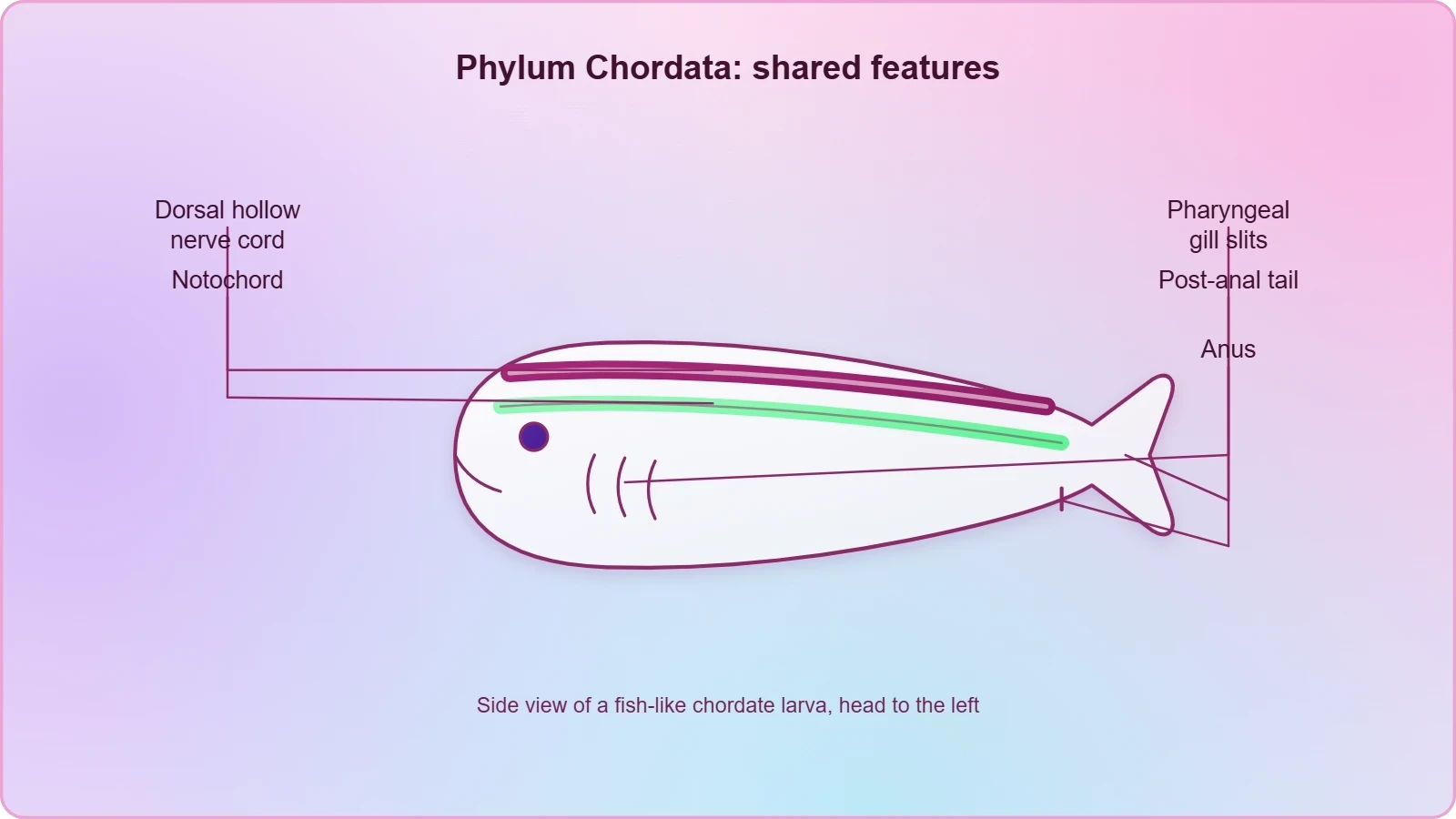
This is a useful lesson in how taxonomic reasoning actually works. A fish and a mammal share almost nothing in habit, habitat or outward form, yet they share deep organisational features that justify placing them side by side. The phylum, in other words, records common ancestry and fundamental body plan rather than superficial resemblance, which is precisely why it sits so high in the hierarchy.
Division in the Plant Kingdom
In the case of plants, classes with a few similar characters are assigned to a higher category called Division. The wording matters: the shared characters at this level are few, not many. That scarcity is not a weakness of the system but an accurate reflection of how far back in the hierarchy the grouping reaches.
Botanists therefore speak of divisions such as Angiospermae rather than phyla, and the classes beneath them — Dicotyledonae and Monocotyledonae, for instance — carry the more detailed distinguishing characters. The division simply announces the broadest shared architecture, while the classes below it refine that architecture into workable groups for study and identification.
Kingdom: The Highest Category
Above phylum and division stands the kingdom, the broadest category in the classification system. All animals belonging to the various phyla are assigned to the highest category called Kingdom Animalia. The Kingdom Plantae, on the other hand, is distinct, and comprises all plants from the various divisions. Henceforth these two groups are referred to simply as the animal and plant kingdoms.
Kingdom Animalia and Kingdom Plantae
The kingdom is where the system makes its boldest claim. Every animal, from a sponge to a whale, belongs to Kingdom Animalia; every plant, from a moss to a mango tree, belongs to Kingdom Plantae. At this altitude the shared characteristics are extraordinarily few, yet they are decisive enough to separate the two great branches of life.
This is why the kingdom is described as a broad category rather than a precise one. It does not tell you what an organism looks like, how it feeds, or where it lives. It tells you only which of the fundamental modes of existence the organism belongs to, and that single fact organises the entire remainder of its taxonomic address.
Reading the Hierarchy in Ascending Order
The taxonomic categories from species to kingdom are shown in ascending order, beginning with species. Species, genus, family, order, class, phylum or division, and kingdom form the sequence. Each step upward gathers more organisms under fewer shared features, and each step downward narrows the membership while multiplying the characteristics held in common.
Taxonomists have also developed sub-categories within this hierarchy to facilitate more sound and scientific placement of various taxa. These refinements do not disturb the main sequence; they simply allow finer resolution where the standard ranks prove too coarse for the organisms under examination.
The Inverse Rule: Characteristics Decrease as We Ascend
The hierarchy is not merely a list; it obeys a rule. As we go higher from species to kingdom, the number of common characteristics goes on decreasing. Lower the taxa, the more are the characteristics that the members within the taxon share. This inverse relationship is the engine that drives the entire classification system.
Why Lower Taxa Share More
A species is the narrowest category, and its members share an enormous number of characteristics — form, function, behaviour, genetic constitution. A genus gathers a handful of such species and retains most of those features. By the time we reach a class, only a few broad characters remain in common across all its members.
This is why identification becomes easier as we descend and harder as we ascend. At the species level, a single distinguishing trait may suffice. At the level of kingdom, the defining traits must be so fundamental that they survive across millions of wildly different organisms, and such traits are necessarily few.
The Growing Difficulty of Relationship
Higher the category, greater is the difficulty of determining the relationship to other taxa at the same level. Two species within one genus are obviously related; two phyla within one kingdom are related only in the most general sense. Hence, the problem of classification becomes more complex as we move upward through the ranks.
This complexity is not a flaw in taxonomy but an honest description of biological reality. Deep relationships are genuinely harder to establish than shallow ones, and the hierarchy encodes that difficulty directly into its structure. The ascending ladder is therefore both a filing system and a statement about the limits of comparison.
Four Organisms, Four Complete Taxonomic Addresses
Abstract rules become concrete only when applied. The table of common organisms — housefly, man, mango and wheat — lists the taxonomic categories to which each belongs, and reading across any row reveals a complete taxonomic address. Reading down any column reveals how a single rank gathers very different organisms under one heading.
Man and the Housefly
Man is Homo sapiens, of genus Homo, family Hominidae, order Primata, class Mammalia and phylum Chordata. The housefly is Musca domestica, of genus Musca, family Muscidae, order Diptera, class Insecta and phylum Arthropoda. Both are animals, yet their addresses diverge sharply from the class level downward.
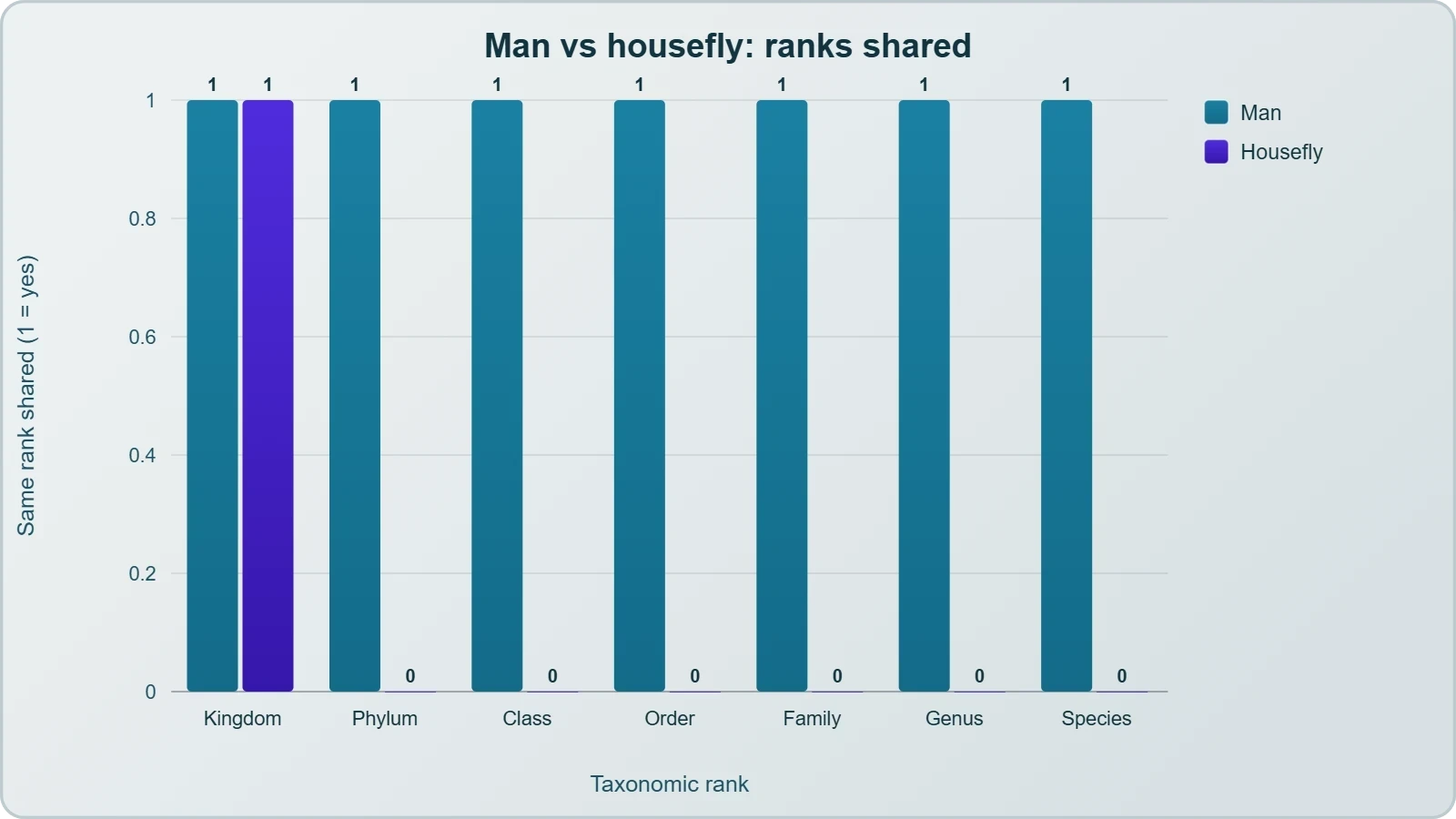
Notice that the two organisms share only the kingdom and, in a loose sense, the broadest animal features. Their phyla differ, their classes differ, and every rank below diverges completely. This is the inverse rule made visible: the higher ranks unite them, the lower ranks separate them, and the separation is far more detailed than the union.
Mango and Wheat
Mango is Mangifera indica, of genus Mangifera, family Anacardiaceae, order Sapindales, class Dicotyledonae and division Angiospermae. Wheat is Triticum aestivum, of genus Triticum, family Poaceae, order Poales, class Monocotyledonae and division Angiospermae. Both are plants, and both sit within the same division.
Here the comparison is instructive in a different way. Mango and wheat share a division but diverge at the class level, one being dicotyledonous and the other monocotyledonous. Their families and orders are entirely distinct, yet the shared division still records a genuine botanical kinship that the lower ranks cannot express.
Sub-Categories and the Refinement of the Hierarchy
The seven principal ranks are broad categories, and breadth brings imprecision. Taxonomists have therefore developed sub-categories within this hierarchy to facilitate more sound and scientific placement of various taxa. These refinements sit between the standard ranks and allow organisms to be positioned with greater accuracy than the main sequence alone permits.
Why Refinement Becomes Necessary
A single class may contain thousands of species whose relationships are far from uniform. Sub-categories allow the taxonomist to express finer gradations of kinship without abandoning the familiar seven-rank framework. The hierarchy remains intact; it simply acquires additional resolution where the organisms demand it.
This is a mark of a mature science rather than a sign of confusion. The framework is stable enough to absorb refinement, and the refinements are disciplined enough not to fracture the framework. Classification thus grows more precise over time while remaining comparable across the whole of biology.
Preparing for the Wider Taxonomic Landscape
With kingdom reached, the ascent is complete. The learner can now place any organism within a seven-rank address and interpret what each rank asserts about shared characteristics and relational difficulty. That competence is the foundation for everything that follows in the study of diversity, from identification to nomenclature to classification.
The course closes here, but the hierarchy remains open. Every new species described, every relationship clarified, and every sub-category introduced extends the same structure. The living world is rich in variety, and the taxonomic hierarchy is the instrument by which that variety is made intelligible, comparable and scientifically usable.
Going Further
Two observations extend the material without altering it. First, the development of sub-categories is not a minor administrative convenience but a response to genuine biological complexity; as more organisms are described, the need for finer placement grows, and the hierarchy accommodates that need without losing its shape. Second, the placement of mango under Dicotyledonae and wheat under Monocotyledonae, both within the division Angiospermae, illustrates how a single division can contain classes that differ in fundamental seed structure.
These points reinforce the central lesson of this final session. The hierarchy from species to kingdom is a single instrument with a single logic: shared characteristics decrease as rank rises, and relational difficulty increases in step. Mastery of that logic is what allows a student to move from memorising names to understanding classification as a scientific method rather than a catalogue.
Also Read
- No links available.
From our network :
- AI-Powered 'Precision Diagnostic' Replaces Standard GRE Score ReportsDiscover the new GRE Precision Diagnostic. Learn how AI-powered behavioral analytics and time-to-solve tracking are replacing standard GRE score reports to empower students.
- 10 Physics Numerical Problems with Solutions for IIT JEEPrepare for IIT JEE with 10 physics numerical problems, complete with detailed solutions and conceptual explanations. Ideal for mastering kinematics, thermodynamics, electromagnetism, and optics.
- Analyzing Trump Deportation Numbers Insights Into The 2026 Immigration Crackdown
- EV 2.0: The Solid-State Battery Breakthrough and Global Factory ExpansionDiscover the impact of the Solid-State Battery Breakthrough on the EV market. Learn about CATL and BYD stock growth, global factory expansion in Europe, and the future of EV 2.0 technology.
- Mastering DB2 LUW v12 Tables: A Comprehensive Technical GuideComprehensive guide on DB2 LUW v12 tables. Explore CREATE TABLE syntax, BLU Acceleration, range partitioning, data types, and security features for IBM DB2 LUW v12.
- Mastering DB2 12.1 Instance Design: A Technical Deep Dive into Modern Database ArchitectureComprehensive guide to DB2 12.1 Instance Design. Explore architectural components, HADR setup, buffer pool tuning, and security policies for IBM DB2 12.1. Includes 10 functional SQL and Shell samples.
- 98% of Global MBA Programs Now Prefer GRE Over GMAT Focus EditionExplore why 98% of global MBA programs now prefer the GRE over GMAT Focus. Learn about the shorter GRE format, verbal logic importance, and strategic versatility for students.
- Vite 6/7 'Cold Start' Regression in Massive Module GraphsIn-depth analysis of Vite 6/7 cold start regressions in massive module graphs. Learn about barrel file issues, pre-bundling optimizations, and how to improve Vite dev server performance.
- Trump Political Strategy How Geopolitical Stunts Serve As Media Diversions
RESOURCES
- Taxonomic rank - Wikipediaen.wikipedia.orgThese include seven main taxonomic ranks: kingdom, phylum or division, class, order, family, genus, and species; these seven ranks are often preceded by an ...
- biological classification - Students | Britannica Kids | Homework Helpkids.britannica.com... divisions among living things. Phylum. The phylum (plural, phyla) ranks below the kingdom and above the class in taxonomy. Scientists use the term…
- Kingdom (taxonomy) - Wikipediaen.wikipedia.orgIn biology, a kingdom is the second highest taxonomic rank, just below domain. Kingdoms are divided into smaller groups called phyla (singular phylum).
- Phylum - Definition and Examples - Biology Online Dictionarybiologyonline.comMay 29, 2023 ... The main taxonomic ranks are as follows: Domain, Kingdom, Phylum/Division, Class, Order, Family, Genus, Species, and Subspecies. Among the ...
- Taxonomic Hierarchy in Biological Classification - BYJU'Sbyjus.comThere are 5 kingdoms in which the living organisms are classified, namely, Animalia, Plantae, Fungi, Protista, and Monera. Phylum. This is the next level…
- What is classification? - Australian Museumaustralian.museumApr 28, 2026 ... Levels of classification · Kingdoms is the most basic classification of living things. · Phylum is the next level following…
- I teach high school biology, recently heard the best acronym ... - Redditreddit.comDec 17, 2011 ... FaerFoxx's Guide to Taxonomic Hierarchy (First in a New Series on ... Was our taxonomic classification system (kingdom, phylum etc.) ...
- Understanding the Taxonomic Hierarchy: 7 Major Ranks Explainedfacebook.comAug 15, 2026 ... ... Kingdom, Phylum, Class, Order, Family, Genus, and Species. ... The commonly used hierarchical sequence in plant taxonomy is: Kingdom…
- 2.1 Plant Taxonomy – The Science of Plantsopen.lib.umn.eduThe plant systematics hierarchy we will use in this course is as follows, from highest (most inclusive) to lowest level: Kingdom; Division (or Phylum,…
- Ch. 20 Key Terms - Biology 2e | OpenStaxopenstax.orgMar 28, 2018 ... phylum: (plural: phyla) kingdom division in the taxonomic classification system. polytomy: branch on a phylogenetic tree with more than two ...
- Biology - Search For A System Flashcards - Quizletquizlet.com... classification use five kingdoms., Which division of the plant kingdom includes club mosses ... Which phylum of the animal kingdom includes all organisms ...
- Domain, Kingdom, Phylum, Class, Order, Family, Genus, Speciesbaike.baidu.comHe was the first to divide animals into the two major groups of vertebrates and invertebrates, a classification still in use today. However, because…
- What is taxonomy? | Natural History Museumnhm.ac.ukKingdom: Taxonomic kingdoms were originally the highest rank and divide domains into distinct ways of life. ... Phylum: A phylum (often called a division ...
- Search For A System Flashcards | Quizletquizlet.com... classification use five kingdoms., Which division of the plant kingdom includes club mosses ... Which phylum of the animal kingdom includes all organisms ...
- BIOL 4320 The Plant Kingdom - Tennessee Stateww2.tnstate.eduJul 9, 2013 ... How do we divide up the kingdom. We will divide it into 12 divisions (this is the same taxonomic rank…