Classification in biology is never a single act of labelling; it is a disciplined sequence of decisions, each one narrowing the field until a single organism can be placed with precision. Every step in that sequence occupies a defined rank, and every rank carries a name. Taken together, these ranks form the taxonomic hierarchy, the scaffolding on which the entire diversity of life is arranged. Understanding this ladder is what separates a casual observer from a student who can reason about where an unfamiliar specimen belongs.
The hierarchy runs from the broadest grouping down to the narrowest, and the same seven principal categories serve organisms as different as a mango tree and a lion. Kingdom, phylum or division, class, order, family, genus and species each represent a unit of classification, commonly termed a taxon. Species sits at the base for every organism, plant or animal, and it is here that the practical work of identification begins. Placing an organism correctly demands knowledge of its characters, not guesswork about its appearance alone.
This lesson builds directly on the enlarged scope of systematics and prepares the ground for the detailed treatment of species and genus that follows. It works through the meaning of taxonomic categories, the logic of hierarchy, and the standard ranks with the examples of Mangifera indica, Solanum tuberosum and Panthera leo. The aim is not memorisation of lists but a working grasp of how biologists convert observable characters into a stable, communicable position in the living world.
On This Page
Classification as a Hierarchy of Steps
Classification is not a single step process but involves a hierarchy of steps in which each step represents a rank or category. Because the category is a part of the overall taxonomic arrangement, it is called the taxonomic category, and all categories together constitute the taxonomic hierarchy. Each category, referred to as a unit of classification, in fact represents a rank and is commonly termed a taxon, with the plural taxa.
This definition matters because it fixes the vocabulary of everything that follows. A category is a level in the scheme; a taxon is the actual group of organisms occupying that level. The distinction keeps discussion precise, allowing a biologist to say that insects form a taxon at a particular rank without confusing the rank itself with the creatures placed within it.
Rank, Category and Taxon Distinguished
Insects illustrate the idea cleanly. They represent a group of organisms sharing common features such as three pairs of jointed legs, which means insects are recognisable concrete objects that can be classified and were therefore given a rank or category. Other such groups of organisms can be named in the same way, and each group represents a category, while the category further denotes rank.
Each rank or taxon represents a unit of classification. These taxonomic groups and categories are distinct biological entities and not merely morphological aggregates, a point worth holding firmly. A taxon is not a convenient bundle of similar-looking specimens; it is a biological unit with an identity of its own, recognised because its members share fundamental characters rather than superficial resemblance.
Why the Hierarchy Is Necessary
Taxonomical studies of all known organisms have led to the development of common categories such as kingdom, phylum or division for plants, class, order, family, genus and species. All organisms, including those in the plant and animal kingdoms, have species as the lowest category. The hierarchy therefore provides a single framework that accommodates every described form of life.
Without such a framework, names would multiply without order and comparison across groups would collapse. The hierarchy allows a student to move from a broad kingdom down to a single species by successive refinement, and it allows a researcher to state precisely how closely two organisms are related within the accepted scheme.
Placing an Organism: The Role of Characters
How does one place an organism in the various categories? The basic requirement is knowledge of the characters of an individual or group of organisms. This knowledge helps in identifying similarities and dissimilarities among individuals of the same kind of organisms as well as of other kinds of organisms. Character analysis, not intuition, drives placement.
In practice, the taxonomist observes structure, form and other fundamental features, compares them against known groups, and assigns the specimen to the rank where the match is strongest. The hierarchy then records that decision in a standardised way, so that another worker anywhere can read the position and understand the reasoning behind it.
Similarity, Dissimilarity and Identification
Identifying similarities and dissimilarities is the engine of the whole process. Two specimens that share fundamental features belong together at a lower rank; those that diverge at a higher level of organisation separate earlier in the descent through the hierarchy. The comparison is systematic and repeatable, which is precisely why taxonomy can function as a science rather than a private opinion.
This is also why the characters of a group matter as much as those of a single individual. A group shares features that define it, and those shared features are what allow the group to be recognised as a concrete object of classification and given a rank. The individual specimen is then placed by reference to the group it matches.
From Observation to Rank
Once characters are known, the assignment follows the ladder. A specimen is first located in the appropriate kingdom, then narrowed through phylum or division, class, order, family and genus, until the species is reached. Each step uses the characters relevant to that level, and each step reduces the set of possible placements until only one remains.
The order of ideas is deliberate: broad to narrow, general to specific. Reversing it would be inefficient and error-prone, because the broad categories carry the largest and most fundamental distinctions. The hierarchy is built so that the most inclusive separations come first, and the finest discriminations come last, at the level of species.
Species: The Lowest Category
Taxonomic studies consider a group of individual organisms with fundamental similarities as a species. One should be able to distinguish one species from the other closely related species based on the distinct morphological differences. Species is the lowest category for all organisms, plant or animal, and it is the foundation on which every higher rank rests.
The emphasis on fundamental similarities is important. Species are not defined by any single trait but by a consistent set of shared characters that hold a group together and separate it from its nearest relatives. Distinct morphological differences provide the practical test by which closely related species are told apart in the field and in the herbarium.
Specific Epithets and Genera
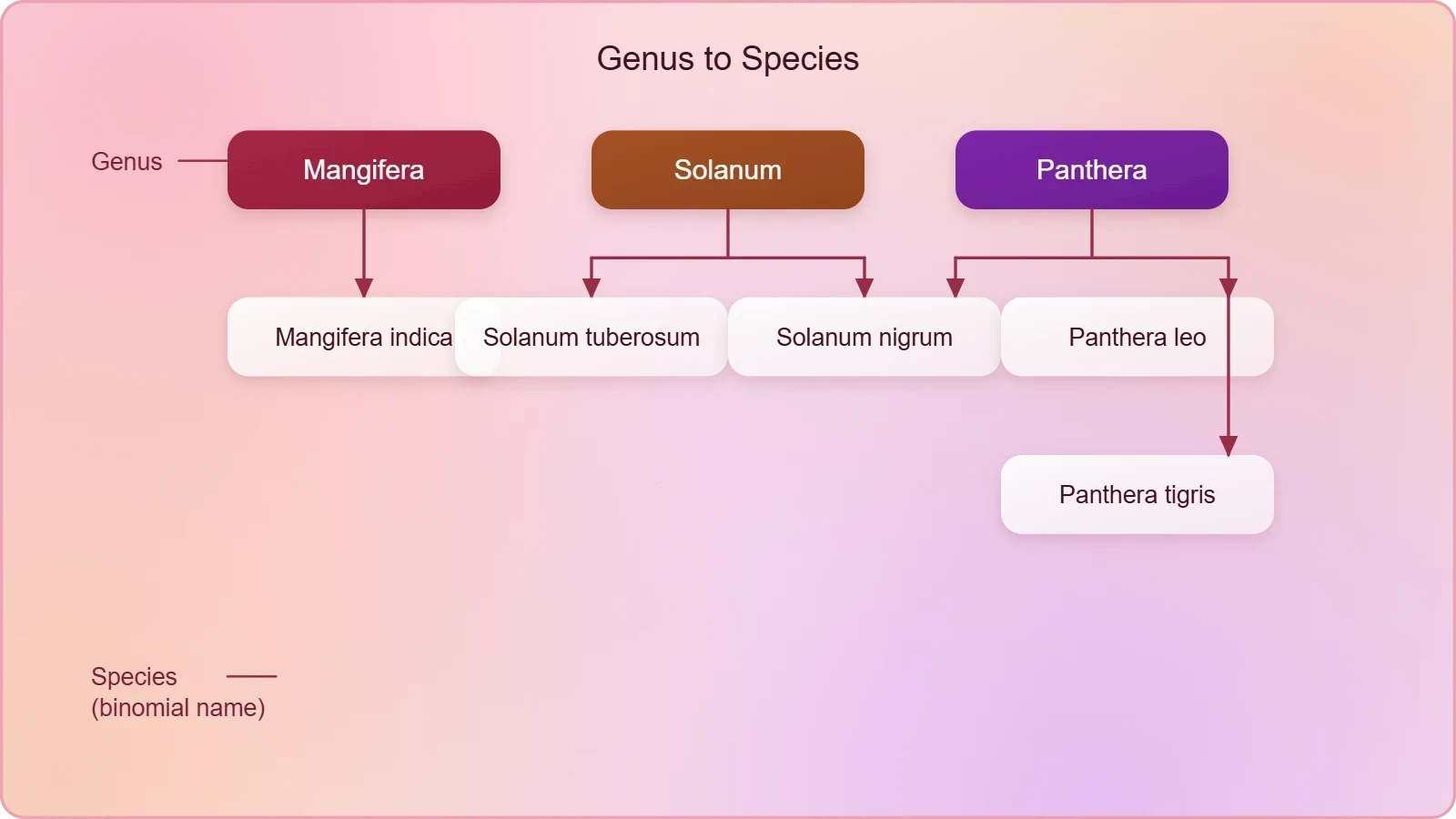
Consider Mangifera indica, Solanum tuberosum (potato) and Panthera leo (lion). All three names, indica, tuberosum and leo, represent the specific epithets, while the first words Mangifera, Solanum and Panthera are genera and represent another higher level of taxon or category. The two-part name thus encodes two ranks at once.
Each genus may have one or more than one specific epithet representing different organisms, but having morphological similarities. For example, Panthera has another specific epithet called tigris, and Solanum includes species like nigrum and others. The genus gathers related species under one heading, while the specific epithet marks the individual species within it.
Reading a Binomial Name
A binomial name is therefore a compact statement of position in the hierarchy. The genus name places the organism in a higher taxon; the specific epithet fixes the species. Together they identify the organism unambiguously, provided the characters have been correctly assessed and the name correctly applied under the rules of nomenclature.
This is why the same genus can carry several epithets without confusion. Panthera leo and Panthera tigris share a genus but differ at the species level, and the shared genus signals their morphological similarities. The epithet alone would be meaningless; it is the pairing that carries the taxonomic information.
From Species Upward: Genus, Family and Order
Above the species, the hierarchy gathers related species into a genus, related genera into a family, and related families into an order. Each upward step widens the circle of organisms included and loosens the closeness of the shared characters. The ranks are not arbitrary labels but positions defined by the degree of relatedness they express.
The genus is the first higher taxon encountered when moving up from species, and it is the one most directly visible in the binomial name. Family and order then group genera and families respectively, providing the intermediate structure that connects the fine detail of species to the broad categories of class and phylum.
The Intermediate Ranks in Practice
In practice, a student moving upward from a known species asks which other species share its genus, which genera share its family, and which families share its order. Each answer requires the same character-based comparison used at the species level, applied to progressively broader sets of organisms. The method is consistent throughout the ladder.
This upward movement is the mirror image of placement from the top down. Whether one begins with a kingdom and descends or begins with a species and ascends, the hierarchy remains the same structure, and the characters used at each rank remain the same in kind, differing only in their breadth.
Keeping Ranks Distinct
Because the ranks are distinct biological entities and not merely morphological aggregates, a family is not simply a larger species nor an order a larger family in a loose sense. Each rank represents a genuine unit of classification, defined by the characters appropriate to it. Confusing the ranks undermines the whole scheme and produces placements that cannot be defended.
The discipline of keeping ranks distinct is what allows the hierarchy to function as a shared language. Two biologists who have never met can compare placements because they are using the same ranks with the same meanings, and any disagreement can be traced to specific characters rather than to private definitions.
Class, Division and Kingdom: The Broadest Ranks
At the upper end of the hierarchy sit class, phylum or division, and kingdom. For plants the rank is called division, while for animals it is called phylum; the difference in name reflects the different traditions of the two kingdoms, not a difference in the logic of the rank. Class sits between order and phylum or division.
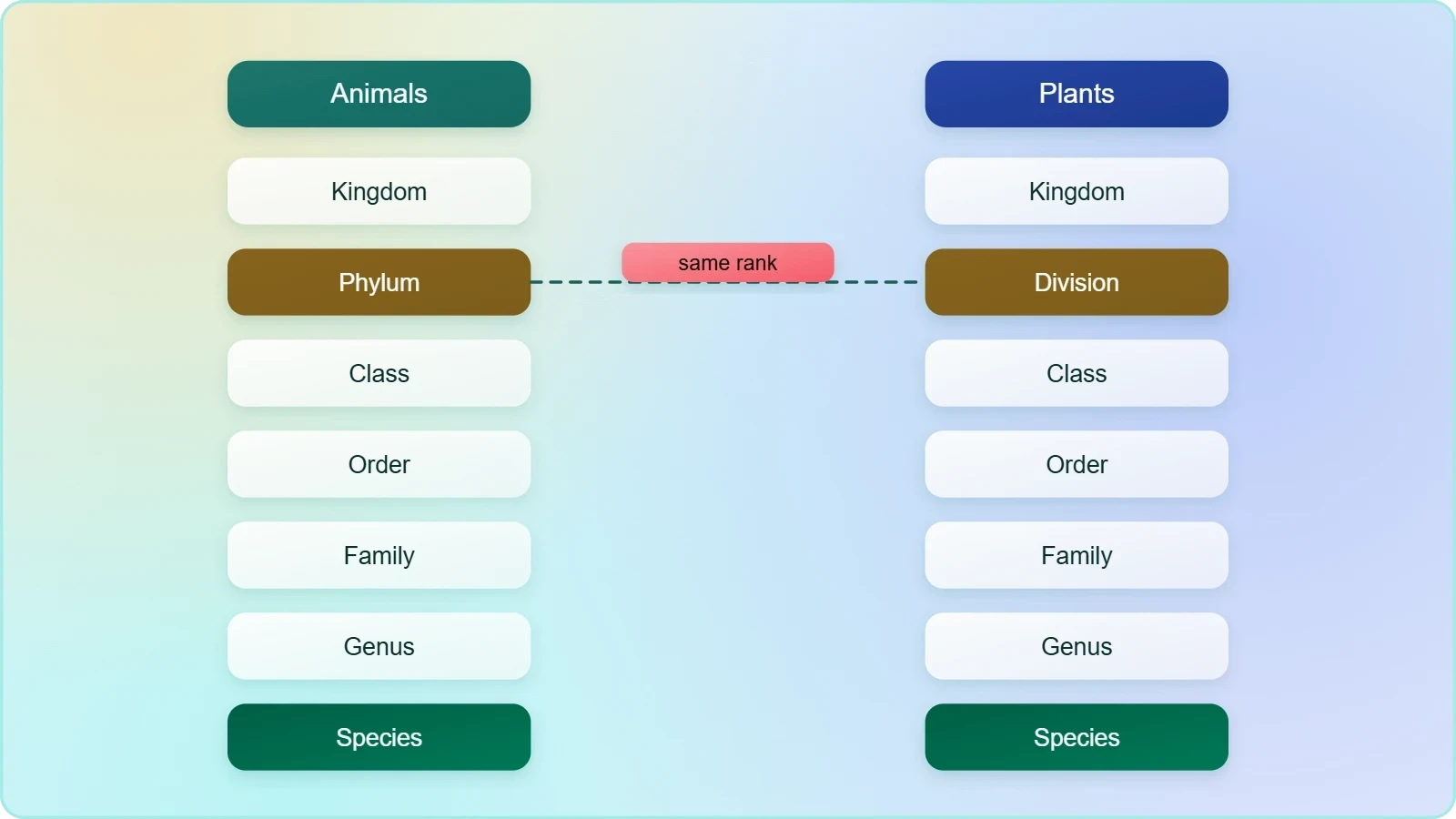
These broad ranks carry the most inclusive distinctions. They separate organisms on fundamental features of organisation rather than on the finer morphological details used at the species level. A student who understands this can see why the same seven ranks serve both a mango tree and a lion without contradiction.
Phylum for Animals, Division for Plants
The dual naming is a practical convention worth noting. Botanists speak of divisions within the plant kingdom, while zoologists speak of phyla within the animal kingdom. The rank occupies the same position in both hierarchies, directly below kingdom and above class, and the choice of term signals only which kingdom is under discussion.
This convention is part of the standardised vocabulary that makes taxonomy communicable across specialisms. A plant taxonomist and an animal taxonomist can discuss the same level of the hierarchy while each using the term customary in their field, and no confusion arises because the position of the rank is fixed.
One Framework for Plants and Animals
All organisms, including those in the plant and animal kingdoms, have species as the lowest category, and all are arranged within the same set of common categories. The hierarchy is therefore genuinely universal in its structure, even though the organisms it contains differ profoundly in form, habitat and way of life.
This universality is the great strength of the scheme. It allows a single student to learn one ladder and apply it to a garden plant, a crop, a wild cat and an insect, moving up and down the ranks as the question requires. The categories are common; only the organisms placed within them vary.
Going further
The insects example deserves a moment of reflection beyond the material itself. Three pairs of jointed legs is a character set that reliably marks out a recognisable group, and it is precisely this reliability that allows the group to be treated as a concrete object of classification rather than a loose collection. Character-based grouping is what gives a taxon its standing.
The insistence that taxonomic groups are distinct biological entities and not merely morphological aggregates carries real weight. It warns against building categories purely from surface resemblance, and it points toward the deeper biological reality that systematics, with its attention to evolutionary relationships, seeks to capture. A taxon should reflect biology, not just appearance.
Readers preparing for the next lesson on species and genus will find that this foundation pays off immediately. The binomial name, the specific epithet and the genus are all positions in the hierarchy studied here, and the characters used to distinguish species are the same characters used to place them. The ladder learned in this lesson is the instrument for everything that follows.
Also Read
- No links available.
From our network :
- 98% of Global MBA Programs Now Prefer GRE Over GMAT Focus EditionExplore why 98% of global MBA programs now prefer the GRE over GMAT Focus. Learn about the shorter GRE format, verbal logic importance, and strategic versatility for students.
- 10 Physics Numerical Problems with Solutions for IIT JEEPrepare for IIT JEE with 10 physics numerical problems, complete with detailed solutions and conceptual explanations. Ideal for mastering kinematics, thermodynamics, electromagnetism, and optics.
- EV 2.0: The Solid-State Battery Breakthrough and Global Factory ExpansionDiscover the impact of the Solid-State Battery Breakthrough on the EV market. Learn about CATL and BYD stock growth, global factory expansion in Europe, and the future of EV 2.0 technology.
- Vite 6/7 'Cold Start' Regression in Massive Module GraphsIn-depth analysis of Vite 6/7 cold start regressions in massive module graphs. Learn about barrel file issues, pre-bundling optimizations, and how to improve Vite dev server performance.
- Trump Political Strategy How Geopolitical Stunts Serve As Media Diversions
- AI-Powered 'Precision Diagnostic' Replaces Standard GRE Score ReportsDiscover the new GRE Precision Diagnostic. Learn how AI-powered behavioral analytics and time-to-solve tracking are replacing standard GRE score reports to empower students.
- Mastering DB2 LUW v12 Tables: A Comprehensive Technical GuideComprehensive guide on DB2 LUW v12 tables. Explore CREATE TABLE syntax, BLU Acceleration, range partitioning, data types, and security features for IBM DB2 LUW v12.
- Analyzing Trump Deportation Numbers Insights Into The 2026 Immigration Crackdown
- Mastering DB2 12.1 Instance Design: A Technical Deep Dive into Modern Database ArchitectureComprehensive guide to DB2 12.1 Instance Design. Explore architectural components, HADR setup, buffer pool tuning, and security policies for IBM DB2 12.1. Includes 10 functional SQL and Shell samples.
RESOURCES
- Taxonomic rank - Wikipediaen.wikipedia.orgIn biological taxonomy, a taxonomic rank determines the level that a group of organisms—either taxon or clade—occupies in a hierarchical system of ...
- Taxonomic Hierarchy in Biological Classification - BYJU'Sbyjus.comTaxonomic hierarchy refers to the sequence of categories in increasing or decreasing order. Kingdom is the highest rank and species is the lowest rank…
- Taxonomy: the science of classificationnaturalsciences.beThe Taxonomic Hierarchy · Class: More specific subdivisions within a phylum. · Order: Groups of families that share characteristics. · Family: Organisms with ...
- PROTAX-GPU: a scalable probabilistic taxonomic classification ...royalsocietypublishing.orgMay 6, 2024 ... PROTAX is based on a hierarchical tree structure, where each node represents a different taxonomic unit (figure 2). It uses…
- lineage-aware refinement of Kraken2 taxonomic classification for ...academic.oup.comSep 16, 2026 ... (A) In the family-exclusion experiment, Kraken2 predictions are categorized as TP, LCP, and FP. Perseus substantially reduces FPs by converting ...
- Discovering the unseen: A performance comparison of taxonomic ...besjournals.onlinelibrary.wiley.comJul 16, 2026 ... Early work confirming the utility of DNA barcodes for taxonomic classification of unknown specimens has typically focussed on cases where…
- Taxonomic Classification for Living Organisms Using Convolutional ...pmc.ncbi.nlm.nih.govNov 17, 2017 ... Taxonomic classification is a hierarchical system used to categorize organisms to the species level, as is shown in Figure 1.…
- Robust taxonomic classification of uncharted microbial sequences ...link.springer.comOct 22, 2019 ... Classifications are automatically made at low taxonomic ranks if closely related organisms are present in the reference database and at…
- Learning Consistent Taxonomic Classification through Hierarchical ...arxiv.orgJan 21, 2026 ... To address this gap, we propose VL-Taxon, a two-stage, hierarchy-based reasoning framework designed to improve both leaf-level accuracy and ...
- PROTAX-GPU: a scalable probabilistic taxonomic classification ...pubmed.ncbi.nlm.nih.govJun 24, 2024 ... DNA-based identification is vital for classifying biological specimens, yet methods to quantify the uncertainty of sequence-based taxonomic ...
- A curated protein dataset for taxonomic classification of ... - Naturenature.comDec 3, 2025 ... The ProSynTax dataset and classification workflow assigns taxonomic classifications to metagenomic reads based on the taxonomic hierarchy in ...
- MycoAI: Fast and accurate taxonomic classification for fungal ITS ...pubmed.ncbi.nlm.nih.govBy employing a multi-head output architecture and multi-level hierarchical label smoothing, MycoAI effectively generalizes across the taxonomic hierarchy. Using ...
- biological classification - Students | Britannica Kids | Homework Helpkids.britannica.comThe science of naming and classifying organisms is called taxonomy. The term is derived from the Greek taxis (“arrangement”) and nomos (“law”). Taxonomists ...
- Taxonomy - NCBI - NLM - NIHncbi.nlm.nih.govTaxonomy · NCBI Taxonomy is a curated classification system that organizes data in the public sequence databases and provides standardized organism names and ...
- What is taxonomy? | Natural History Museumnhm.ac.ukUnder the most widely used system of biological classification, known as the Linnean system, every taxon is then put into a hierarchy based on…