Biology begins with a sense of wonder, and the opening lesson of the living world course leans into that wonder deliberately. A galloping horse, migrating birds, a valley of flowers, an attacking shark, a cold mountain slope, a hot spring, a freshwater lake — each of these scenes provokes the same quiet astonishment, and each of them is a legitimate doorway into scientific study. The living world is astonishing not because it is mysterious in a vague way, but because its range of types and habitats is so wide that description itself becomes a serious intellectual project.
That astonishment, however, must eventually become a question. The lesson separates two questions that are often tangled together: a technical question about what living actually is, as opposed to non-living matter, and a philosophical question about the purpose of life. As scientists, the course states plainly, we shall not attempt the second. We will reflect only on the first. This is a disciplined choice, and it is the choice that makes a science of biology possible at all.
This first lesson of ten therefore sets the stage rather than the taxonomy. It surveys the diversity of living organisms, introduces the idea that each distinct kind of plant, animal or organism represents a species, and records the working figure of 1.7–1.8 million known and described species. It also explains why early human societies that took an anthropocentric view of biology made only limited progress, and why systematic description eventually demanded identification, nomenclature and classification. The lessons that follow build directly on this foundation.
On This Page
- The Living World as an Object of Scientific Attention
- The Two Questions Hidden Inside "What Is Life?"
- Diversity in the Living World: What Observation Reveals
- Habitats, Behaviour and the Reach of Wonder
- The Revelation of Shared Similarity and Its Consequences
- Ernst Mayr and the Scientific Study of Species Diversity
- Going Further: Context for the Opening Lesson
The Living World as an Object of Scientific Attention
Biology is the science of life forms and living processes, and the living world comprises an amazing diversity of living organisms. Early man could easily perceive the difference between inanimate matter and living organisms, even without any formal method. That perceptual difference is the historical seed from which the discipline eventually grew, though the growth took a very long time.
From Awe and Deification to Description
Early man deified some of the inanimate matter — wind, sea, fire — and also some among the animals and plants. A common feature of all such forms, inanimate and animate alike, was the sense of awe or fear that they evoked. The description of living organisms, including human beings, began much later in human history, once that awe had been partly converted into curiosity.
The delay matters for understanding how biology matured. Awe is a response, not a record; it does not accumulate into knowledge unless someone writes things down, compares specimens, and corrects earlier accounts. The movement from reverence to description is therefore the first real methodological step in the study of life, and it is worth marking clearly.
The Cost of an Anthropocentric View
Societies which indulged in an anthropocentric view of biology could register limited progress in biological knowledge. When the human being is treated as the only subject worth studying, the rest of the living world becomes scenery rather than evidence. The lesson states this limitation directly, and it functions as a warning about how perspective shapes what a culture is able to discover.
Systematic and monumental description of life forms brought in, out of necessity, detailed systems of identification, nomenclature and classification. The necessity is practical: once descriptions multiply, they must be organised or they become unusable. Naming and grouping are not decorative additions to biology; they are the infrastructure that lets one observer's record be checked by another.
The Two Questions Hidden Inside "What Is Life?"
The ecological conflict and cooperation among members of a population, among populations of a community, and even the molecular traffic inside a cell all make us deeply reflect on what indeed is life. The lesson observes that this single question has two implicit questions within it, and that separating them is essential before any scientific work can begin.
The Technical Question: Living Versus Non-Living
The first question is a technical one and seeks an answer to what living is as opposed to the non-living. It asks for criteria, for observable properties, for a boundary that can be tested rather than merely felt. This is the question the course commits to, and every later lesson on classification depends on it being answered carefully.
Framing the question technically does not make it trivial. The boundary between living and non-living is genuinely subtle at the margins, and the lesson does not pretend otherwise. What it insists upon is that the question be posed in a form where evidence, rather than sentiment, can settle the matter.
The Philosophical Question: The Purpose of Life
The second question is a philosophical one and seeks an answer to what the purpose of life is. As scientists, the lesson states, we shall not attempt answering the second question. This is not a dismissal of philosophy; it is a recognition that purpose is not the kind of thing biological method is equipped to measure.
Keeping the two questions apart protects both of them. Biology gains a clear scope, and philosophy is spared the indignity of being answered by a microscope. Students who understand this division early tend to write better answers, because they stop smuggling metaphysical claims into questions that ask for criteria.
Diversity in the Living World: What Observation Reveals
If you look around, you will see a large variety of living organisms, be it potted plants, insects, birds, your pets or other animals and plants. There are also several organisms that you cannot see with your naked eye, but they are all around you. Observation, in other words, begins at home and immediately exceeds what the eye can confirm.
The Effect of Widening the Area of Observation
If you were to increase the area in which you make observations, the range and variety of organisms that you see would increase. If you were to visit a dense forest, you would probably see a much greater number and kinds of living organisms in it. The lesson uses this simple thought experiment to make a methodological point about sampling.
Diversity is therefore partly a function of where you look and how widely. A courtyard survey and a forest survey do not disagree about the world; they sample it at different scales. Recognising this prevents the common error of treating a familiar local list as a description of life in general.
Species as the Unit of Diversity
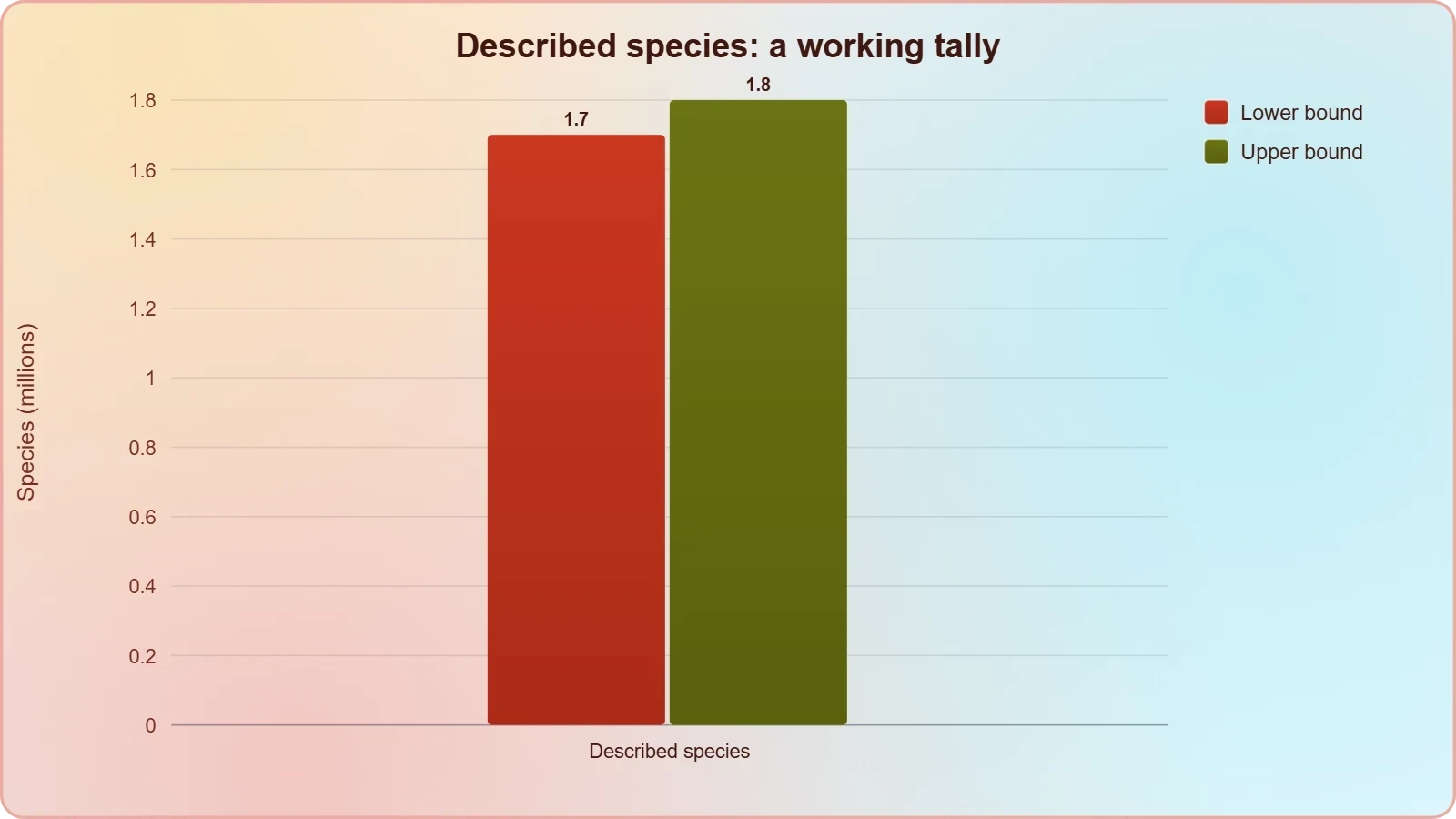
Each different kind of plant, animal or organism that you see represents a species. The number of species that are known and described ranges between 1.7 and 1.8 million. This figure refers to biodiversity, or the number and variety of organisms, and it is a count of described species rather than a count of all species that exist.
The distinction between described and existing is worth holding onto. The lesson's number is a working figure from the taxonomic record, and it grows as new organisms are formally described. Students should treat 1.7–1.8 million as a documented tally, not as a ceiling on the living world.
Habitats, Behaviour and the Reach of Wonder
The extraordinary habitats in which we find living organisms — cold mountains, deciduous forests, oceans, fresh water lakes, deserts or hot springs — leave us speechless. The lesson lists them without ranking them, and the effect is to show that life is not confined to comfortable places. Extremes of cold, heat, salinity and depth are all occupied.
Scenes That Provoke Reflection
The beauty of a galloping horse, of migrating birds, the valley of flowers or the attacking shark evokes awe and a deep sense of wonder. These images are chosen for their range: grace, navigation, colour and predation. Together they show that wonder is not a single emotion but a family of responses to very different biological phenomena.
Wonder of this kind has real pedagogical value, because it motivates the patience that description requires. A student who has felt the pull of a migrating flock is more likely to tolerate the tedium of counting, measuring and naming. The lesson uses imagery deliberately, as fuel for the systematic work that follows.
Conflict, Cooperation and Molecular Traffic
The ecological conflict and cooperation among members of a population and among populations of a community make us reflect on life. So does the molecular traffic inside a cell, which is invisible in the landscape but equally organised. The lesson places these scales side by side to show that the question of life arises at every level of organisation.
Conflict and cooperation are not opposites to be resolved but twin features of living systems. Predation, competition, mutualism and parasitism all appear within the same community, and the molecular traffic inside a cell is itself a kind of cooperation among components. Diversity, at every scale, is structured rather than random.
The Revelation of Shared Similarity and Its Consequences
The biggest spin-off of systematic description was the recognition of the sharing of similarities among living organisms, both horizontally and vertically. Horizontal similarity links organisms living at the same time; vertical similarity links them across generations. Once both are visible, the living world stops looking like a catalogue and starts looking like a family.
Relatedness Across Time and Across the Present
That all present-day living organisms are related to each other, and also to all organisms that ever lived on this earth, was a revelation. The lesson calls it humbling, and the word is well chosen. It removes the human being from a separate pedestal and places our species inside a single connected history.
This recognition did not stay inside laboratories. It led to cultural movements for conservation of biodiversity, because a world of related organisms is a world whose losses are irreversible. The lesson presents conservation as a consequence of biological insight rather than as a sentiment added on afterwards, which is a stronger and more durable framing.
Why Standard Names Became Necessary
Detailed systems of identification, nomenclature and classification emerged because description at scale demanded them. Without agreed names, two observers cannot confirm they are discussing the same organism, and without agreed groups, comparisons collapse into anecdote. The next lesson takes up species, biodiversity and the need for standard names in detail.
The order of ideas in this lesson is deliberate: wonder, then question, then observation, then diversity, then the need for system. Each step creates the pressure that makes the next step necessary. Students who follow that sequence will find taxonomy far less arbitrary than it first appears, because they will have felt the problem it solves.
Ernst Mayr and the Scientific Study of Species Diversity
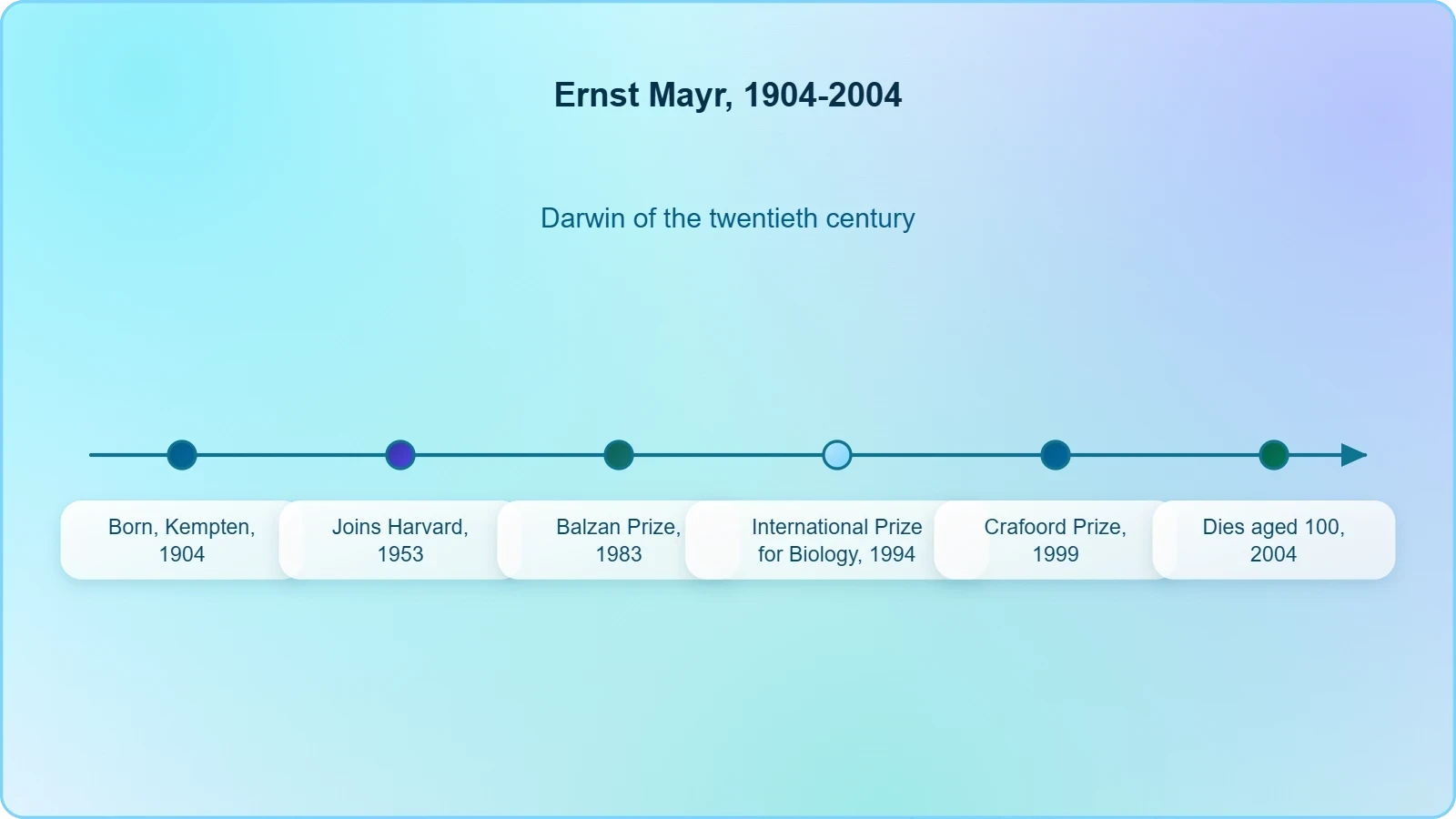
Born on 5 July 1904 in Kempten, Germany, Ernst Mayr was the Harvard University evolutionary biologist called the Darwin of the twentieth century and counted among the 100 greatest scientists of all time. He joined Harvard's Faculty of Arts and Sciences in 1953 and retired in 1975, assuming the title Alexander Agassiz Professor of Zoology Emeritus.
A Career Spanning Nearly Eighty Years
Throughout his nearly 80-year career, Mayr's research spanned ornithology, taxonomy, zoogeography, evolution, systematics, and the history and philosophy of biology. That breadth is itself instructive: the questions raised in this lesson are not confined to one speciality. Taxonomy, evolution and the philosophy of biology meet in the problem of what a species is.
Mayr almost single-handedly made the origin of species diversity the central question of evolutionary biology that it is today. He also pioneered the currently accepted definition of a biological species. Both contributions connect directly to the material here, where species is introduced as the unit that each distinct kind of organism represents.
Recognition and Legacy
Mayr was awarded the three prizes widely regarded as the triple crown of biology: the Balzan Prize in 1983, the International Prize for Biology in 1994, and the Crafoord Prize in 1999. He died at the age of 100 in 2004, having outlived most of the debates he helped to start and settle.
Placing a biographical note at the opening of a chapter on diversity is a deliberate editorial choice. It signals that the concepts ahead were built by identifiable people working over decades, not handed down as fixed doctrine. Students preparing for examinations should read such notes as context, not as memorised trivia.
Going Further: Context for the Opening Lesson
This lesson is the entry point of Unit 1, Diversity in the Living World, which the course says will describe animals and plants from a taxonomist's perspective. The chapters that follow cover the living world, biological classification, the plant kingdom and the animal kingdom. The opening therefore has a job beyond its own content: it must make the reader want the taxonomy that comes next.
Wonder as a Starting Point, Not a Criterion
The awe evoked by living things is presented here as a starting point for biological study, not as a scientific criterion of life. This distinction deserves emphasis, because students often confuse the two. A feeling of wonder can open an inquiry, but it cannot settle whether a virus, a crystal or a flame belongs on one side of the living boundary or the other.
Keeping the two apart also protects the lesson from a common misreading. The poetic passages about galloping horses and valleys of flowers are not decoration to be skipped; neither are they evidence. They establish motive, while the technical question supplies method, and the course needs both to proceed.
Preparing for the Next Lesson
The next lesson turns to diversity in the living world, species, biodiversity and the need for standard names. Everything established here — the 1.7–1.8 million figure, the species as the unit of diversity, the necessity of identification and nomenclature — becomes the working material for that discussion. Nothing in this lesson is merely introductory in the dismissive sense.
Students should leave this lesson able to state the two questions hidden inside "what is life?", explain why only the technical one is pursued, describe how observation scale affects perceived diversity, and account for why systematic description produced both taxonomy and a conservation ethic. Those four competencies form the base on which the remaining nine lessons are built.
Also Read
- No links available.
From our network :
- EV 2.0: The Solid-State Battery Breakthrough and Global Factory ExpansionDiscover the impact of the Solid-State Battery Breakthrough on the EV market. Learn about CATL and BYD stock growth, global factory expansion in Europe, and the future of EV 2.0 technology.
- 98% of Global MBA Programs Now Prefer GRE Over GMAT Focus EditionExplore why 98% of global MBA programs now prefer the GRE over GMAT Focus. Learn about the shorter GRE format, verbal logic importance, and strategic versatility for students.
- 10 Physics Numerical Problems with Solutions for IIT JEEPrepare for IIT JEE with 10 physics numerical problems, complete with detailed solutions and conceptual explanations. Ideal for mastering kinematics, thermodynamics, electromagnetism, and optics.
- Analyzing Trump Deportation Numbers Insights Into The 2026 Immigration Crackdown
- AI-Powered 'Precision Diagnostic' Replaces Standard GRE Score ReportsDiscover the new GRE Precision Diagnostic. Learn how AI-powered behavioral analytics and time-to-solve tracking are replacing standard GRE score reports to empower students.
- Mastering DB2 LUW v12 Tables: A Comprehensive Technical GuideComprehensive guide on DB2 LUW v12 tables. Explore CREATE TABLE syntax, BLU Acceleration, range partitioning, data types, and security features for IBM DB2 LUW v12.
- Mastering DB2 12.1 Instance Design: A Technical Deep Dive into Modern Database ArchitectureComprehensive guide to DB2 12.1 Instance Design. Explore architectural components, HADR setup, buffer pool tuning, and security policies for IBM DB2 12.1. Includes 10 functional SQL and Shell samples.
- Vite 6/7 'Cold Start' Regression in Massive Module GraphsIn-depth analysis of Vite 6/7 cold start regressions in massive module graphs. Learn about barrel file issues, pre-bundling optimizations, and how to improve Vite dev server performance.
- Trump Political Strategy How Geopolitical Stunts Serve As Media Diversions
RESOURCES
- Diversity of Living World | TG Zoology Class 11 - Khan Academykhanacademy.orgUp next for you:Introduction to Biological ClassificationGet 3 of 4 questions to level up! Practice. Not started. Taxonomy and the tree of life |…
- Diversity in the Living World | CK-12 Foundation - FlexBooksflexbooks.ck12.orgOct 1, 2026 ... This lesson explores biodiversity and classification in biological sciences, aligned with the NCERT textbook for CBSE Class 11.
- unit 1 - diversity in the living world - NCERTncert.nic.inBiology is the science of life forms and living processes. The living world comprises an amazing diversity of living organisms. Early man could easily ...
- Class 11 Biology: The Living World Overview | PDF - Scribdscribd.comClass 11 Biology: The Living World Overview ... Life is a complex organization of molecules that express themselves through chemical reactions, leading to growth, ...
- THE LIVING WORLD (ncert) Flashcards - Quizletquizlet.comCBSE/NCERT Biology 11 Chapter 1: The Living World. 63 terms. Profile Picture ... Diversity, Classification, and Taxonomic Hierarchy in Biology. 108 terms.
- Mind Map of Diversity in Living World - Pinterestpinterest.comClass 11 Biology Notes · Living World Notes For Neet · Neet Biology Notes · Ncert Biology. Class 11 Biology Chapter 1: The Living…
- NCERT Solutions for Class 11 Biology Chapter 1byjus.comBiology is the science of life forms and living processes. This living world embraces an astonishing diversity of living entities and is vastly distinct…
- The Living world - Facebookfacebook.com2 days ago ... OCR: Class 11 Biology THE LIVING WORLD For Board Exa and NEET 2027 Introduction Earth living organisms. These organisms show…
- Chapter 1. Diversity in the Living World | PPTX - Slideshareslideshare.netBiodiversity - The diverse form of organisms present on earth is called biodiversity.
- Chapter 1 - Diversity in the Living World | Neela Bakore Tutorialsyoutube.comChapter 1 - Diversity in the Living World | NEET & Class XI CBSE Board | Neela Bakore Tutorials ... Master "The Living World"…
- unit 1 - diversity in the living world - Sainik School Gopalganjssgopalganj.inBiology is the science of life forms and living processes. The living world comprises an amazing diversity of living organisms. Early man could easily ...
- NEET Questions on The Living World | Easy Biologyeasybiology.science.blognomenclature and identification of plants and animals. Page 4. NEET Questions on The Living World. Page 4. C. diversity of kinds of organisms and…
- Class 11 Chapter 1 The Living World | PPTX - Slideshareslideshare.netBIOLOGY CLASS XI CHAPTER 1 THE LIVING WORLD By: Dr Heena Devnani M.Sc · WHAT IS LIVING? · CHARACTERISTICS OF LIVING ORGANISMS 1. ·…
- Class 11 Biology | Chapter 1 – The Living World Master the basics ...instagram.comJul 7, 2026 ... Diversity in Living World Taxonomy Classification 🏷️ Binomial Nomenclature Taxonomical Hierarchy Species Important Exam ...
- unit 1 - diversity in the living world - Smart Achieverssmartachievers.onlineBiology is the science of life forms and living processes. The living world comprises an amazing diversity of living organisms. Early man could easily ...