Step outside and the living world announces itself in layers: potted plants on a balcony, insects threading through grass, birds crossing a courtyard, a pet asleep in the shade. Widen the radius of observation and the register lengthens — a park, a riverbank, a dense forest, each adding kinds of organisms the previous view never contained. Every distinct kind encountered in that expanding survey represents a species, and the tally of species known and described to science sits between 1.7 and 1.8 million.
That figure carries a name of its own: biodiversity, meaning the number and types of organisms present on earth. It is a count, but it is also a confession of incompleteness, because exploration has not stopped. New areas are being surveyed and old ones re-examined, and organisms previously unnamed are continuously being identified and added to the record. The catalogue of life is therefore an open document, revised with every expedition and every careful laboratory study.
Against this abundance stands a practical difficulty that has troubled biology since its beginnings. We know the plants and animals of our own locality by local names, and those names shift from place to place, even within a single country. A conversation about a particular tree can collapse into confusion when two speakers attach different words to the same organism, or the same word to different ones. Standardising names is not bureaucratic tidiness; it is the precondition for talking about life at all.
On This Page
The Scale of Biological Diversity and the Meaning of Species
Diversity is the first fact of biology, and it is encountered before any theory is learned. The range of living types is astonishing, and so are the habitats that support them: cold mountains, deciduous forests, oceans, freshwater lakes, deserts and hot springs all hold organisms adapted to their conditions. Each different kind of plant, animal or organism observed in these settings represents a species, the basic unit around which the whole account is organised.
Reading the 1.7–1.8 Million Figure
The number of species known and described ranges between 1.7 and 1.8 million, and this range is the working estimate of biodiversity — the number and types of organisms present on earth. The phrasing matters: these are species known and described, not species that exist. Description is a human activity with a history, and the figure records what that activity has so far accomplished rather than what nature contains.
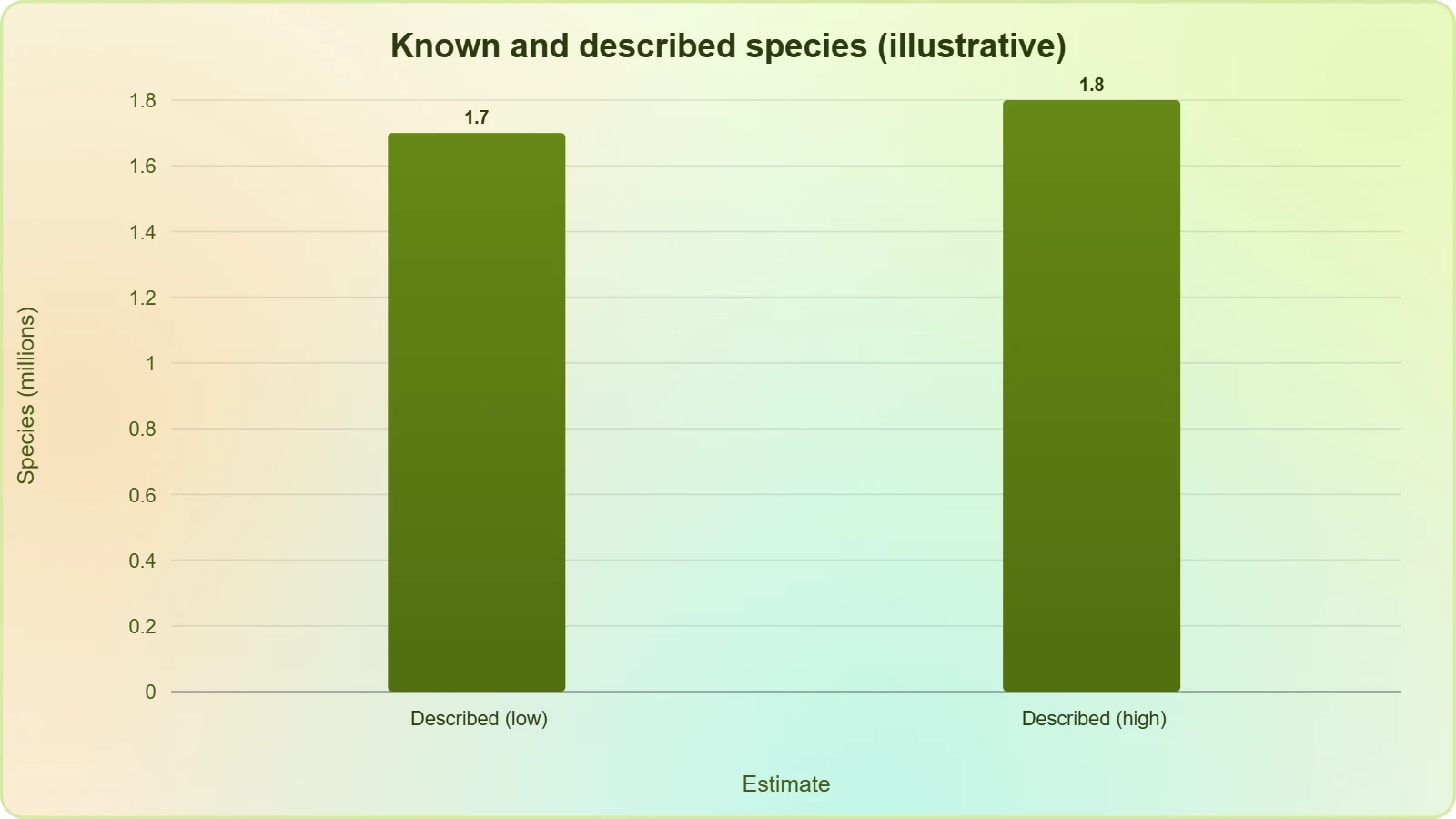
Because the count is a record of description, it moves. As new areas are explored, and even old ones revisited with better methods, new organisms are continuously being identified. A student should therefore read the figure as a snapshot of an ongoing process, not a fixed constant. The same caution applies to any total quoted for a group, a region or a kingdom.
Why Each Kind Is Counted as a Species
In the observational sense used here, each different kind of plant, animal or organism that you see represents a species. The definition is deliberately concrete: it begins with recognition of difference in the field, the same recognition that early humans exercised when distinguishing inanimate matter from living organisms. Taxonomy later refines that recognition into formal criteria, but the starting point remains the observed distinctness of kinds.
This unit of counting gives biodiversity its arithmetic. A forest is biodiverse not because it is large but because it contains many distinct kinds, each representing a species. Conservation movements, which arose from the recognition that present-day organisms are related to one another and to all organisms that ever lived, inherit this same unit: what is counted, and what is lost, is counted and lost in species.
Local Names and the Confusion They Create
There are millions of plants and animals in the world, and every community names the ones it lives among. These local names are not wrong; they are simply local. They vary from place to place, even within a country, so the same organism may carry several names and one name may cover several organisms. The confusion this creates is easy to recognise once stated, and it is the practical problem that standardisation exists to solve.
The Same Organism, Different Words
Consider what happens when two people from distant regions discuss a plant they both know. Each uses the word learned at home, and neither word appears in the other's vocabulary. Without a shared reference, the conversation cannot proceed, and a written record becomes worse than useless because a reader elsewhere cannot determine which organism was meant. Local names serve local communication and fail at wider scale.
The failure is not merely linguistic. If a name cannot be trusted to point at one organism, then observations cannot be pooled, comparisons cannot be made, and knowledge cannot accumulate across regions. Biology as a cumulative science depends on the possibility of referring unambiguously to the thing being studied, which is precisely what a standardised name supplies.
From Confusion to a Shared Vocabulary
Hence the need to standardise the naming of living organisms, so that a particular organism is known by the same name all over the world. This process is called nomenclature. The definition is worth holding precisely: nomenclature is the system of naming, and its purpose is universality — one organism, one name, intelligible to every biologist regardless of the language spoken locally.
Nomenclature, however, rests on a prior step. Naming is only possible when the organism has been described correctly and we know to what organism the name is attached; that step is identification. Description establishes what the organism is, identification determines which named group it belongs to, and nomenclature fixes the label. The sequence is strict, and skipping a stage produces names without anchors.
Nomenclature, Identification and the International Codes
To facilitate study, scientists have established procedures for assigning a scientific name to each known organism, and these procedures are accepted by biologists all over the world. The authority behind them is not a single institution but a pair of international codes. For plants, scientific names rest on agreed principles and criteria provided in the International Code for Botanical Nomenclature, known as ICBN.
Two Codes, One Purpose
Animal taxonomists evolved a parallel instrument, the International Code of Zoological Nomenclature, or ICZN. The division reflects the practical history of the disciplines rather than any difference in principle: plants and animals are governed by separate rulebooks, each maintained by its own community. Both codes pursue the same end, which is a naming system that any competent worker anywhere can apply and verify.
The codes exist to guarantee three outcomes. Scientific names ensure that each organism has only one name; the description of any organism should enable people in any part of the world to arrive at the same name; and the rules ensure that a name has not already been used for some other known organism. Uniqueness, reproducibility and non-duplication are the whole architecture in three clauses.
Description, Identification, Nomenclature
The three activities form a chain, and the order cannot be reversed. Description records the features of an organism; identification determines the organism to which a name is attached; nomenclature assigns the standard name under the codes. A name issued before identification is a guess, and a description too vague to permit identification makes the name unusable by anyone else.
This is why the codes place such weight on description. If the account of an organism is precise enough, a reader in another country, working from that account alone, should reach the same name as the original author. The test of a good description is therefore reproducibility across distance and language, and the test of a good name is that it survives that test without collision.
Binomial Nomenclature and the Two-Component Name
Biologists follow universally accepted principles when providing scientific names, and each name has two components: the generic name and the specific epithet. This system of providing a name with two components is called binomial nomenclature. The naming system was given by Carolus Linnaeus and is practised by biologists all over the world, and the two-word format was found convenient in use.
Reading a Name: Mangifera indica
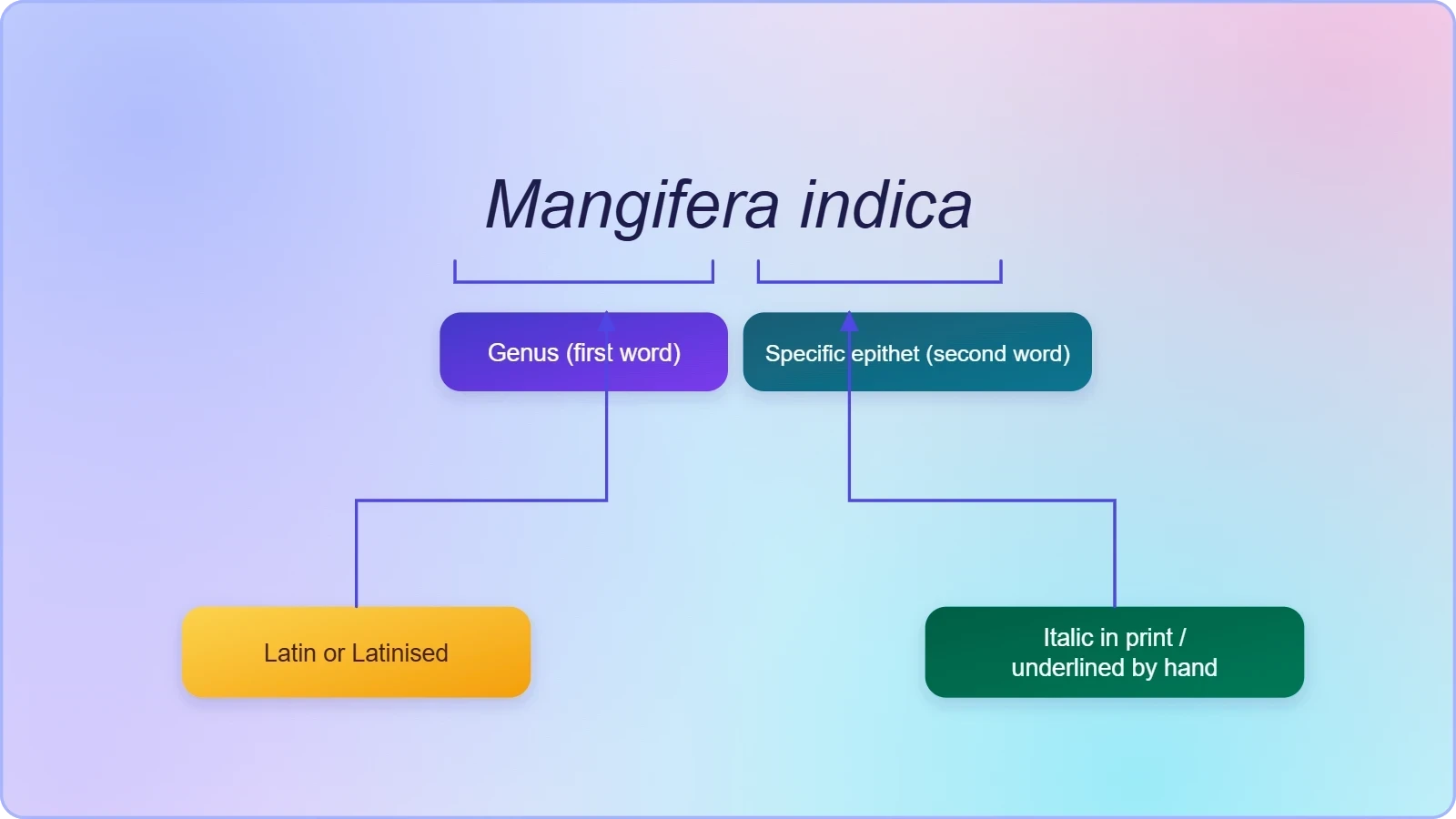
The scientific name of mango is written as Mangifera indica, and it repays close reading. Mangifera represents the genus, the broader grouping; indica is a particular species, the specific epithet. Two words, two ranks, one organism. The example is worth memorising because it demonstrates the whole logic of the system in a familiar object rather than an exotic one.
The structure generalises without exception. The first word in a biological name represents the genus, while the second component denotes the specific epithet. A student who can parse Mangifera indica can parse any binomial name in the literature, because the grammar of the name is the same everywhere and the position of each word carries fixed meaning.
The Universal Rules of Naming
Biological names are generally in Latin and written in italics; they are Latinised or derived from Latin irrespective of their origin. When handwritten, both words in a biological name are separately underlined, or printed in italics, to indicate their Latin origin. The convention is small but consequential, since the typography signals to every reader that a scientific name is being used.
These rules complete the machinery of standardisation. A name in Latin, italicised or underlined, with a generic name first and a specific epithet second, is intelligible to a biologist in any country. The conventions are not decoration; they are the visible surface of the codes, and they allow a name to be recognised as a name at a glance.
Why Standard Names Matter for Biology and Conservation
Standard names are the infrastructure on which biological knowledge is built, and their value becomes clearest when the alternative is imagined. Without a shared name, an observation made in one country cannot be compared with an observation made in another, and a specimen collected today cannot be matched to a description published a century ago. The science would fragment into local traditions.
Shared Names, Shared Knowledge
The recognition that living organisms share similarities, both horizontally among contemporary forms and vertically through lineage, was the great spin-off of systematic description. That recognition depends on names. Only when organisms can be reliably referred to can similarities be compared, and only when comparisons are possible can the relatedness of present-day organisms to one another and to all organisms that ever lived be established.
This is the intellectual payoff of what might otherwise look like clerical work. Identification, nomenclature and classification were developed out of necessity, as detailed systems for managing the description of life forms. What emerged from them was a revelation: that all present-day living organisms are related to each other and to all organisms that ever lived on this earth.
From Wonder to Conservation
That revelation humbled man and led to cultural movements for conservation of biodiversity. The sequence deserves attention. Wonder at the range of living types came first, then the laborious description of life forms, then the recognition of universal relatedness, and finally the ethical and cultural response of conservation. Standard names sit in the middle of that chain, enabling everything downstream.
Societies that indulged in an anthropocentric view of biology could register only limited progress in biological knowledge. The corrective was systematic and monumental description of life forms, undertaken without the assumption that one species stood at the centre. Conservation inherits this lesson: what is worth protecting is a network of related organisms, and the network can only be described and defended through precise, shared names.
Ernst Mayr and the Species Question
The species concept that underpins this lesson has a modern architect. Ernst Mayr, born on 5 July 1904 in Kempten, Germany, was the Harvard University evolutionary biologist called the Darwin of the twentieth century and counted among the 100 greatest scientists of all time. He joined Harvard's Faculty of Arts and Sciences in 1953 and retired in 1975, assuming the title Alexander Agassiz Professor of Zoology Emeritus.
A Career Across Disciplines
Across a career of nearly eighty years, Mayr's research spanned ornithology, taxonomy, zoogeography, evolution, systematics, and the history and philosophy of biology. The breadth is instructive: the species question was not settled by a single technique but by a lifetime of work across several fields. He almost single-handedly made the origin of species diversity the central question of evolutionary biology that it is today.
He also pioneered the currently accepted definition of a biological species. For a lesson concerned with counting species and naming them, this is the theoretical anchor. The practical act of recognising each different kind as a species rests on a definition that Mayr helped to establish, and the definition in turn connects the counting of diversity to the study of evolution.
Recognition and Legacy
Mayr was awarded the three prizes widely regarded as the triple crown of biology: the Balzan Prize in 1983, the International Prize for Biology in 1994, and the Crafoord Prize in 1999. He died at the age of 100 in 2004. The honours record a career that reshaped how biology thinks about diversity, and the centenary of his birth fell in the same year as his death.
His legacy in this unit is the connection between the field and the theory. A student who counts species in a forest is doing what Mayr spent a career explaining: the diversity observed is the product of an evolutionary process, and the species is the unit through which that process becomes visible. Naming and counting are therefore not preliminary chores but the entry point to the science.
Going further
The figure of 1.7–1.8 million is a count of known and described species, and the material itself stresses that a large number still remains unknown. Exploration of new areas and re-examination of old ones continue to add organisms to the record, so the total should be read as a working estimate that grows with each survey rather than a settled inventory of life on earth.
Because local names differ from place to place, the same organism can carry different names in different regions, and the same name can be applied to different organisms. This is precisely the practical problem that nomenclature solves: a standard name gives every biologist, whatever language they speak, a single reliable way to refer to one organism and to know which organism is meant.
The binomial format can be written formally as a pair of components, which makes the rule easy to remember and to apply when reading any scientific name in a textbook or a field guide.
For the mango, the substitution is direct and can be checked against the rules stated above: the genus occupies the first position and the specific epithet the second, with both words Latinised and italicised in print.
# A small check on the binomial rule using the mango example
scientific_name = "Mangifera indica"

genus, epithet = scientific_name.split()

print("Genus:", genus)          # Mangifera
print("Specific epithet:", epithet)  # indica
print("Is binomial:", len(scientific_name.split()) == 2)
This lesson has established the scale of diversity, the meaning of species and biodiversity, the confusion created by local names, and the standardising response of nomenclature, identification and binomial naming. The next lesson takes up the international codes and the two-component name in detail, building directly on the vocabulary introduced here.
Also Read
- No links available.
From our network :
- AI-Powered 'Precision Diagnostic' Replaces Standard GRE Score ReportsDiscover the new GRE Precision Diagnostic. Learn how AI-powered behavioral analytics and time-to-solve tracking are replacing standard GRE score reports to empower students.
- Trump Political Strategy How Geopolitical Stunts Serve As Media Diversions
- Vite 6/7 'Cold Start' Regression in Massive Module GraphsIn-depth analysis of Vite 6/7 cold start regressions in massive module graphs. Learn about barrel file issues, pre-bundling optimizations, and how to improve Vite dev server performance.
- 10 Physics Numerical Problems with Solutions for IIT JEEPrepare for IIT JEE with 10 physics numerical problems, complete with detailed solutions and conceptual explanations. Ideal for mastering kinematics, thermodynamics, electromagnetism, and optics.
- EV 2.0: The Solid-State Battery Breakthrough and Global Factory ExpansionDiscover the impact of the Solid-State Battery Breakthrough on the EV market. Learn about CATL and BYD stock growth, global factory expansion in Europe, and the future of EV 2.0 technology.
- 98% of Global MBA Programs Now Prefer GRE Over GMAT Focus EditionExplore why 98% of global MBA programs now prefer the GRE over GMAT Focus. Learn about the shorter GRE format, verbal logic importance, and strategic versatility for students.
- Analyzing Trump Deportation Numbers Insights Into The 2026 Immigration Crackdown
- Mastering DB2 LUW v12 Tables: A Comprehensive Technical GuideComprehensive guide on DB2 LUW v12 tables. Explore CREATE TABLE syntax, BLU Acceleration, range partitioning, data types, and security features for IBM DB2 LUW v12.
- Mastering DB2 12.1 Instance Design: A Technical Deep Dive into Modern Database ArchitectureComprehensive guide to DB2 12.1 Instance Design. Explore architectural components, HADR setup, buffer pool tuning, and security policies for IBM DB2 12.1. Includes 10 functional SQL and Shell samples.
RESOURCES
- The genus Phomopsis: biology, applications, species concepts and ...link.springer.comSep 6, 2011 ... The genus Phomopsis: biology, applications, species concepts and names of common phytopathogens. Fungal Diversity 50, 189–225 (2011). https ...
- 'Ocean biodiversity informatics': a new era in marine biology ...int-res.comJul 3, 2006 ... ... names of described marine species are currently available online in authoritative master lists. ... standard formats that enable ...
- Generic names and mislabeling conceal high species diversity in ...conbio.onlinelibrary.wiley.comJun 22, 2018 ... Consumers have the power to influence conservation of marine fishes ... In Australia, “snapper” appears in the standard names of…
- U.S. Urged to Tighten Data Standards for Aquarium Fish Importsbiologicaldiversity.orgMar 14, 2023 ... Center for Biological Diversity: Millions of Ornamental Fish Imported Each Year Without Species ... The government needs to require a…
- Methods for memorizing a ton of scientific names? : r/biology - Redditreddit.comNov 30, 2018 ... 15 votes, 12 comments. I'm taking a class with a test coming up where we need to learn 40 scientific…
- What is Taxonomy? - Convention on Biological Diversitycbd.intJun 4, 2010 ... Taxonomists provide unique names for species, labels that can ... have the same 'common' name in English. For this reason…
- WoRMS - World Register of Marine Speciesmarinespecies.orgINVEMAR launches the Colombia Register of Marine Species to enhance knowledge of the country's marine biodiversity. Added on: 2026-06-24 08:51:05 by Dekeyzer, ...
- plantR: An R package and workflow for managing species records ...besjournals.onlinelibrary.wiley.comDec 2, 2021 ... ... species records from biological collections for ... By default, people's names are returned in the Biodiversity Information Standards ...
- Should we be naming species after people? - Department of Biologybiology.ox.ac.ukMar 13, 2023 ... Another striking example of the dangers of overtly politicizing biological names ... Due to codes around renaming species, whereby the…
- 2-LS4-1 Biological Evolution: Unity and Diversitynextgenscience.org... animals to compare the diversity of ... The standards integrate three dimensions within each standard and have intentional connections across standards.
- Virus species names have been standardized - ASM Journalsjournals.asm.orgApr 23, 2025 ... ... species epithet format of binomial species names used elsewhere in biology. Organism or “common” names. The scientific names of…
- The genus Phomopsis: biology, applications, species concepts and ...researchgate.netSep 4, 2026 ... The genus Phomopsis: biology, applications, species concepts and names of common phytopathogens. September 2011; Fungal Diversity 50(1):189 ...
- What are EBVs? - GEO BONgeobon.orgEssential Biodiversity Variables (EBVs) are a set of standardized biological ... Filling the EBV cube requires collecting biodiversity observations by ...
- Integrated Taxonomic Information System (ITIS): ITIS.govitis.govThe ITIS mission is to communicate a comprehensive taxonomy of global species that enables biodiversity ... Common Name, Scientific Name, TSN*. In. every ...
- A Revised List of the North American Sphaeriidae: Common Names ...bioone.orgMay 4, 2026 ... ... diversity at 227 species. The most recent subfamily Sphaeriinae ... We could not find a common name for Euglesa…