Proteins occupy a singular place in the chemistry of life. They are the working molecules of the cell, the agents that carry oxygen, defend against infection, transmit signals, and catalyse the reactions that keep metabolism running. In the composition of a typical cell, proteins account for roughly 10 to 15 percent of total cellular mass, second only to water, which makes up 70 to 90 percent. That figure alone signals how central these molecules are to biological organisation, and it explains why any serious study of biomolecules must treat proteins as a class in their own right rather than as a footnote to carbohydrates or lipids.
This lesson examines proteins as polypeptides: linear chains of amino acids joined by peptide bonds. It explains why a protein is described as a heteropolymer rather than a homopolymer, introduces the twenty amino acid types that serve as building blocks, and distinguishes essential from non-essential amino acids in relation to diet. It then surveys the functional range of proteins using the standard examples, including collagen as the most abundant protein in the animal world and RuBisCO as the most abundant protein in the entire biosphere. The treatment stays close to the chapter's own terminology, tables, and order of ideas.
The material builds directly on the previous lesson, which established how living tissue is fractionated into acid-soluble and acid-insoluble pools and why macromolecules, including proteins, fall into the macromolecular fraction. It also prepares the ground for the lesson that follows on polysaccharides, another class of macromolecules recovered from the acid-insoluble pellet. Learners should therefore read this lesson as one link in a chain: the chemistry of the peptide bond here, the chemistry of the glycosidic bond next.
On This Page
Proteins as Polypeptides: The Defining Structure
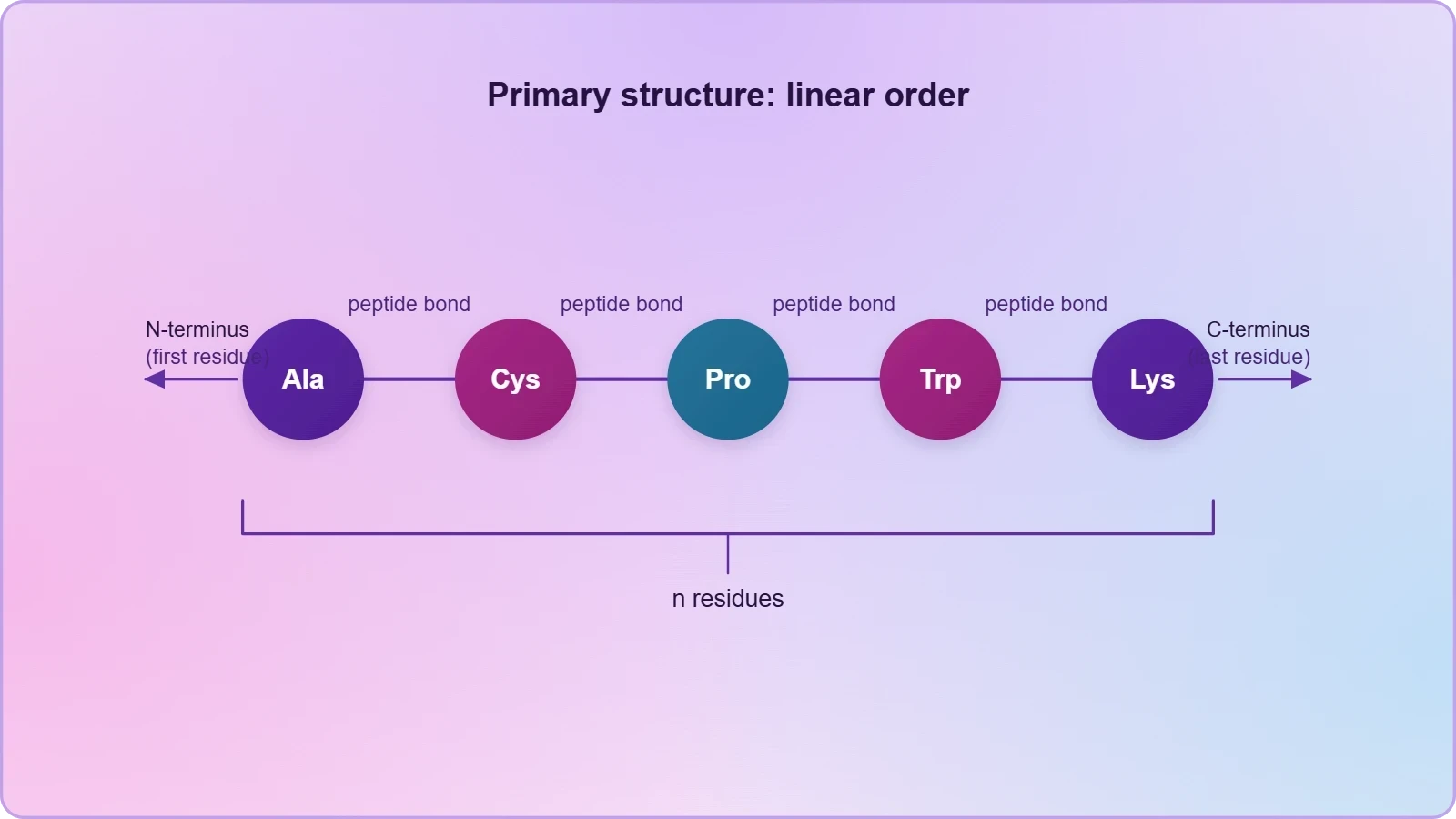
Proteins are polypeptides. That single sentence carries the core structural definition of the entire lesson: a protein is a linear chain of amino acids linked by peptide bonds. The word linear matters, because it establishes the primary architecture before any folding is considered. Each protein is a polymer of amino acids, and the chain is read directionally, with one end representing the first amino acid and the other end representing the last. This positional information, the sequence in which residues appear, is what biologists call the primary structure of a protein.
The chain metaphor is deliberate and useful. A protein is imagined as a line, the left end represented by the first amino acid and the right end represented by the last. Everything else about protein structure, the coils, sheets, and globular shapes that appear at higher levels of organisation, is a consequence of how this linear string behaves in three-dimensional space. For the purposes of this lesson, the essential point is that the linear sequence is the foundation, and the functional molecule is what that sequence becomes once it folds.
Why Proteins Are Heteropolymers
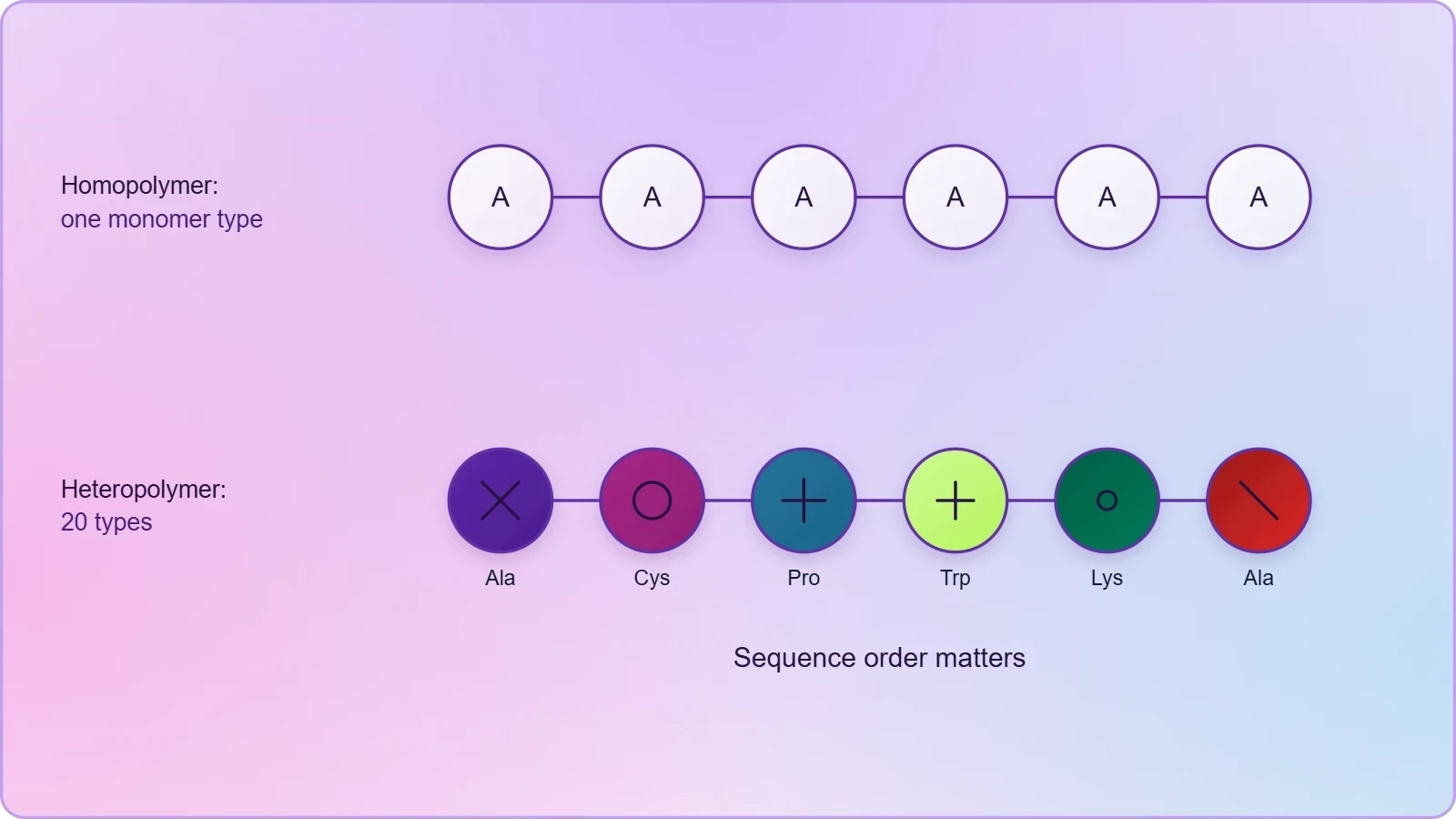
A homopolymer has only one type of monomer repeating n number of times. Proteins do not fit that description. There are twenty types of amino acids, among them alanine, cysteine, proline, tryptophan, and lysine, and a protein draws on this set in varying combinations and orders. Because more than one monomer type is involved, a protein is a heteropolymer and not a homopolymer. This distinction is not pedantic; it is the reason proteins can carry out such a wide range of functions while polysaccharides built from a single sugar often serve narrower structural or storage roles.
The twenty amino acid types provide the combinatorial vocabulary. A chain of even modest length can arrange these residues in an enormous number of sequences, and each distinct sequence produces a distinct molecule with distinct behaviour. This is why the amino acid content of a protein matters so much, both structurally and nutritionally. The chapter flags this explicitly: information about amino acid content becomes important later in nutrition lessons, where certain amino acids are identified as essential for health and must be supplied through diet.
The Peptide Bond in Brief
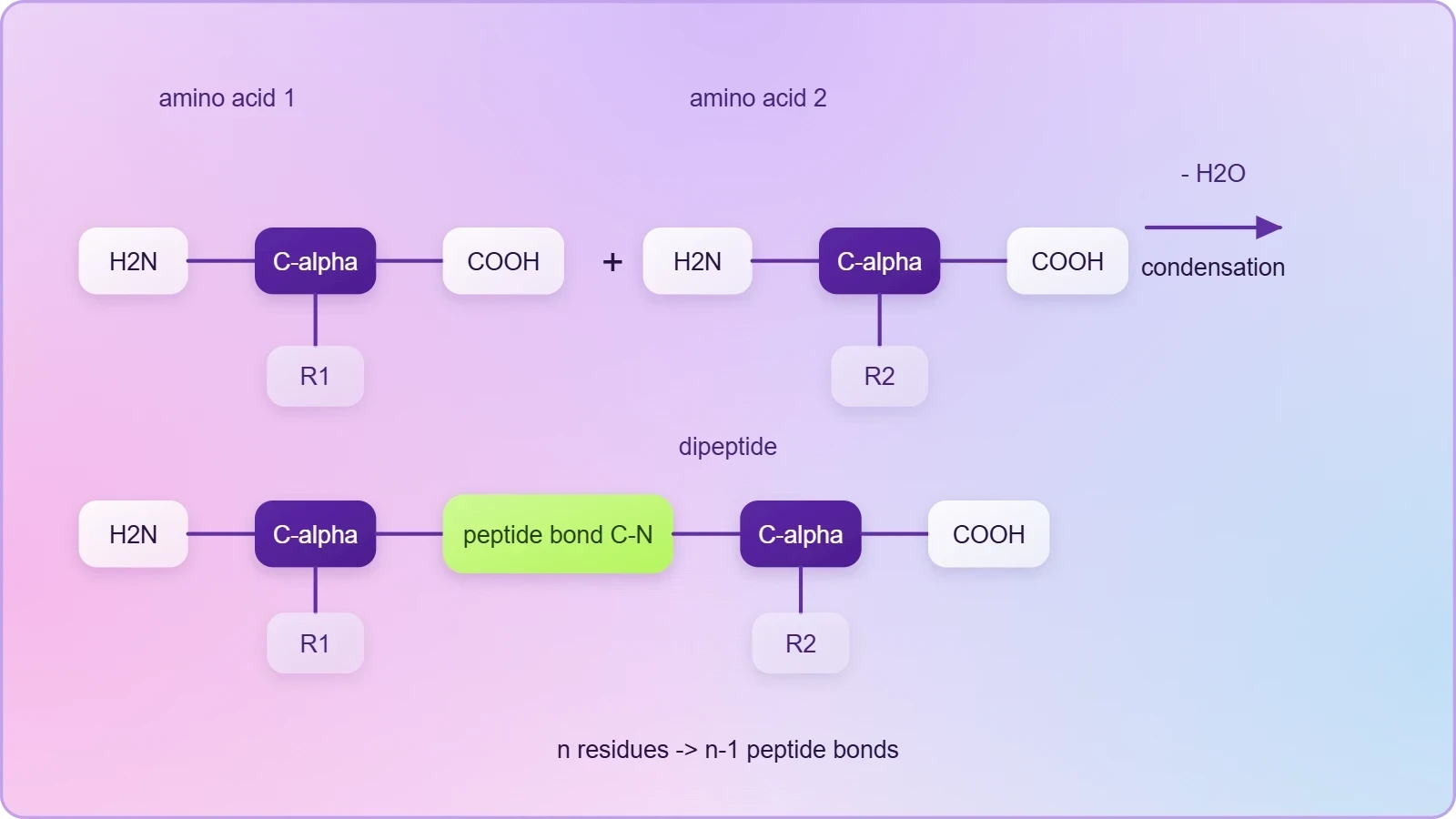
The linkage that holds the chain together is the peptide bond, and the chapter names it without elaboration at this stage. The bond forms between the carboxyl group of one amino acid and the amino group of the next, releasing water in the process. Repeated many times, this condensation produces the polypeptide backbone. The sequence of residues along that backbone, read from the first amino acid to the last, constitutes the primary structure and encodes everything the protein will eventually do.
Because the peptide bond is the repeating unit of the chain, the number of bonds in a polypeptide is one fewer than the number of amino acid residues it contains. A chain of ##n## residues therefore contains ##n-1## peptide bonds. This simple arithmetic relationship is worth holding onto, because it recurs whenever polypeptide length is discussed in later lessons on protein structure and enzyme kinetics.
Essential and Non-Essential Amino Acids
Amino acids divide into two dietary categories. Essential amino acids are those the body cannot make and must therefore obtain through food; non-essential amino acids are those the body can synthesise for itself. Dietary proteins are consequently the source of essential amino acids, which is why protein intake matters nutritionally and not merely structurally. The chapter introduces this distinction while discussing amino acid content, and it explicitly links forward to later nutrition lessons where the concept is developed in detail.
The distinction is worth stating precisely because it is easy to blur. The terms describe the body's capacity for synthesis, not the importance of the amino acid to protein function. A non-essential amino acid is no less necessary inside a finished polypeptide; it is simply one the organism can manufacture from other precursors. Essentiality is therefore a property of the organism's metabolic repertoire, not of the amino acid's role in the chain. Keeping that distinction clear prevents a common confusion when the topic returns in nutrition.
Dietary Proteins as the Source of Essential Amino Acids
Because the body cannot manufacture essential amino acids, they must arrive preformed in the diet. Dietary proteins supply them, and this is the reason protein quality is discussed in nutritional terms at all. A diet lacking sufficient essential amino acids cannot support the synthesis of proteins that require them, regardless of how much non-essential amino acid the body can produce internally. The chapter states this plainly: dietary proteins are the source of essential amino acids, and amino acids can accordingly be classified as essential or non-essential.
This nutritional framing also explains why the twenty amino acid types are introduced by name in the chapter, with alanine, cysteine, proline, tryptophan, and lysine given as examples. The list is not decorative. It establishes that the building blocks are chemically distinct entities, each with its own identity, and that the body's relationship to each one differs. Some it can make; some it must be given. The polypeptide chain, in other words, is assembled from a vocabulary the organism only partly controls.
Reading the Classification Correctly
The classification is best understood as a statement about supply, not about structure. Every amino acid in a protein, essential or not, is joined by the same peptide bond and occupies a position in the same linear chain. What differs is where the residue comes from before assembly. Non-essential amino acids are those our body can make; essential amino acids we get through our diet or food. The chapter's wording is deliberately simple, and it is worth preserving that simplicity rather than overcomplicating a distinction that is fundamentally about sourcing.
For learners moving toward the next lesson on polysaccharides, the parallel is instructive. Just as amino acids divide into essential and non-essential categories on nutritional grounds, sugars divide into structural and storage roles on functional grounds. In both cases, a small set of building blocks generates a large set of macromolecules, and the classification systems exist to help organise that diversity rather than to fragment it.
The Functional Range of Proteins
Proteins carry out many functions in living organisms. The chapter's summary is broad but concrete: some transport nutrients across cell membranes, some fight infectious organisms, some are hormones, some are enzymes, and so on. This functional breadth is the payoff of the heteropolymer structure described earlier. Because the chain can be built from twenty different residue types in any order, evolution has been able to shape proteins into catalysts, messengers, defenders, receptors, and structural materials without changing the underlying chemistry of the peptide bond.
The functions are best learned through named examples rather than abstract categories. The chapter provides a compact table of proteins and their functions, and each entry anchors a general role to a specific molecule. Collagen, trypsin, insulin, antibody, receptor, and GLUT-4 together illustrate structural support, catalysis, hormonal signalling, immune defence, sensory reception, and membrane transport. Working through these examples one by one is the most reliable way to retain the functional taxonomy, because each name carries a concrete image that the abstract category alone does not.
Table 9.5: Proteins and Their Functions
The table lists six proteins against their functions. Collagen serves as intercellular ground substance, providing the structural matrix between cells. Trypsin is an enzyme. Insulin is a hormone. Antibody fights infectious agents. Receptor mediates sensory reception, including smell, taste, and hormone detection. GLUT-4 enables glucose transport into cells. Read together, these six entries span the major functional classes of proteins and give the learner a working vocabulary for describing what any newly encountered protein might do.
The pairing of molecule and function is the pedagogical point. A learner who can recall that GLUT-4 enables glucose transport into cells has also learned that membrane transport is a protein function, and can generalise from there. The same holds for the receptor entry, which explicitly extends sensory reception to smell, taste, and hormone detection, showing that a single functional category can cover several apparently different physiological roles. The table is compact, but each row is a doorway into a larger topic.

Collagen and RuBisCO: The Abundance Records
Two proteins carry abundance records that are worth committing to memory. Collagen is the most abundant protein in the animal world, and Ribulose bisphosphate Carboxylase-Oxygenase, known as RuBisCO, is the most abundant protein in the whole of the biosphere. The pairing is instructive: collagen dominates within animals because it forms the intercellular ground substance of connective tissue, while RuBisCO dominates globally because it is the carboxylating enzyme of photosynthesis and is therefore present in enormous quantities across the plant kingdom.
These two records also connect back to the composition table introduced earlier in the chapter. Proteins make up 10 to 15 percent of average cellular mass, and within that fraction collagen and RuBisCO are the standout contributors at their respective scales. Remembering the records alongside the percentage figure gives a coherent picture: proteins are a major component of cells, and two specific proteins are so widely deployed that they set the abundance benchmarks for the animal world and the biosphere respectively.
Proteins in the Macromolecular Fraction
Proteins belong to the acid-insoluble fraction of living tissue. When a tissue is ground, the cell structure is disrupted, and membrane fragments form vesicles that are not water soluble; these vesicles separate along with the acid-insoluble pool and hence appear in the macromolecular fraction. Proteins, together with polysaccharides and nucleic acids, comprise the true macromolecular fraction of any living tissue or cell. The acid-soluble pool, by contrast, represents roughly the cytoplasmic composition. Together the two pools represent the entire chemical composition of living tissues or organisms.
This placement matters for the lesson sequence. The previous lesson established the fractionation scheme and the acid-insoluble fraction; this lesson identifies proteins as one of its principal members. The next lesson turns to polysaccharides, another class recovered from the same pellet. Seeing proteins in this context prevents the common error of treating them as free-floating cytoplasmic solutes. Many proteins are integral to membranes and other structures, which is precisely why they travel with the insoluble fraction rather than the soluble one.
Where Proteins Sit in the Composition Table
Table 9.4 gives the average composition of cells by percentage of total cellular mass. Water leads at 70 to 90 percent. Proteins follow at 10 to 15 percent. Nucleic acids account for 5 to 7 percent, carbohydrates for 3 percent, lipids for 2 percent, and ions for 1 percent. Arranged class-wise from the abundance point of view, water is the most abundant chemical in living organisms, and proteins are the most abundant macromolecular class after it. The ordering is a useful anchor when reasoning about which molecules dominate cellular chemistry.
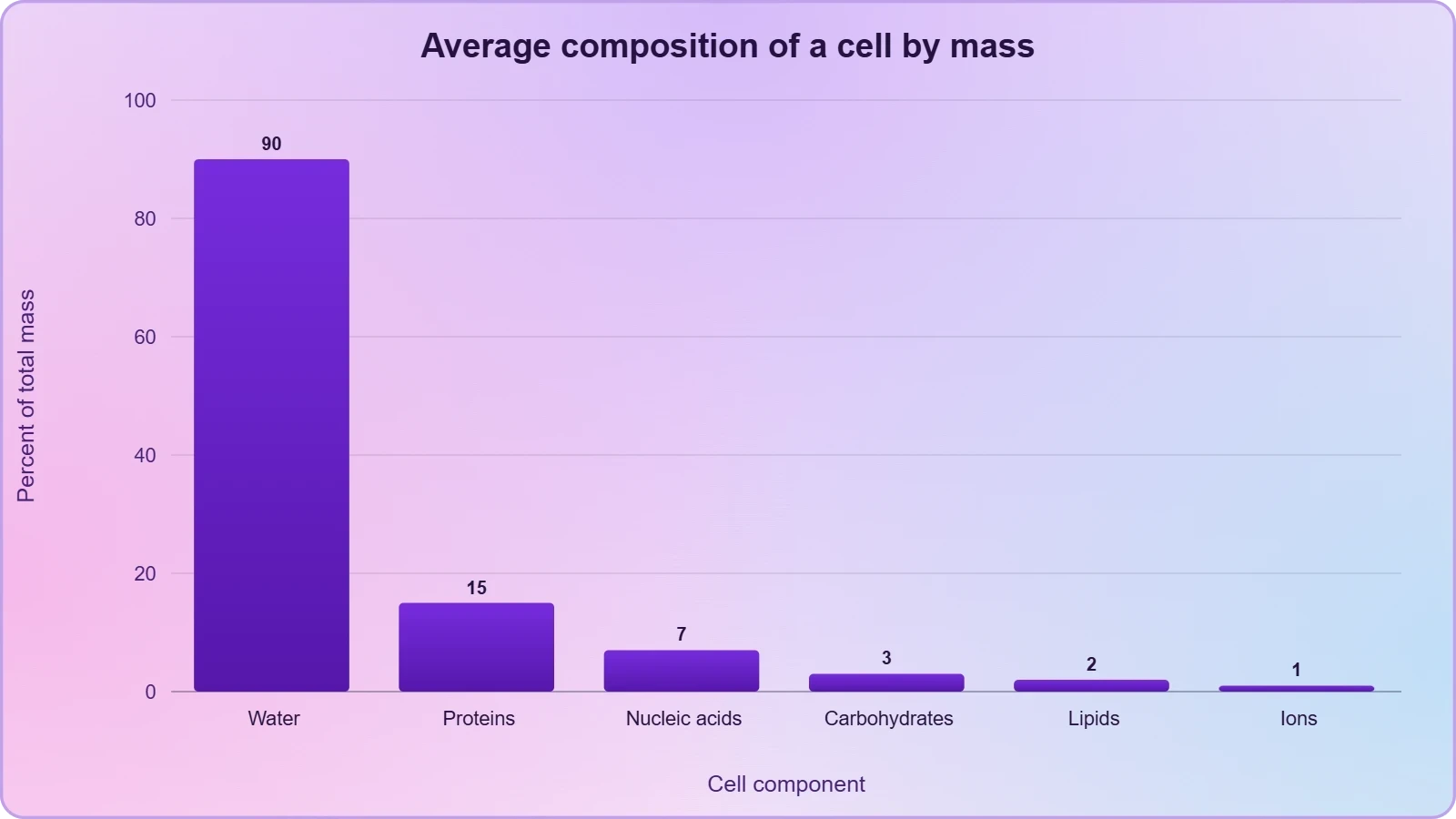
The table also clarifies a subtle point raised in the fractionation discussion: lipids are not strictly macromolecules, even though membrane fragments containing them travel with the acid-insoluble pool. Proteins, by contrast, are genuine macromolecules, built as heteropolymers of amino acids. Keeping the two categories distinct avoids conflating a fractionation outcome with a chemical definition, a distinction the chapter is careful to preserve and one that learners should carry forward into the polysaccharide lesson.
From Composition to Structure
Composition tables tell us how much protein a cell contains; structure tells us how those proteins are built. The chapter moves from one to the other by describing protein structure at four levels, of which the primary structure is the sequence of amino acids, the positional information specifying which residue is first, which second, and so on. This lesson has concentrated on that primary level, because the linear chain is the foundation on which the higher levels rest. Later lessons develop the remaining levels in the order the chapter presents them.
The transition is worth marking explicitly. A learner who understands that a protein is a linear heteropolymer of twenty amino acid types, joined by peptide bonds and read directionally from first residue to last, is ready to ask how that line folds into a functional three-dimensional molecule. That question belongs to the structural levels that follow, but the answer depends entirely on the primary sequence established here. The chain is not merely a description; it is the specification from which the working protein is built.
Going Further: Peptide Bonds and Enzyme Function
Two pieces of well-established background help consolidate the material without altering it. The first concerns the chemistry of the peptide bond itself. The bond forms between the carboxyl group of one amino acid and the amino group of the next, with the elimination of a water molecule. This condensation reaction is repeated along the chain, and the resulting backbone is what gives the polypeptide its linear character. Understanding the bond clarifies why the chain is directional and why the sequence can be read from one end to the other.
The second concerns enzymes. Enzymes are proteins that speed up reactions, and this is why protein structure matters for digestion and metabolism. Trypsin, listed in the functional table as an enzyme, is a concrete example: it catalyses the breakdown of proteins during digestion. The connection is direct. A protein's ability to act as a catalyst depends on its folded three-dimensional shape, which in turn depends on the primary sequence described in this lesson. Structure and function are linked at every level.
Why the Bond Chemistry Matters
The condensation reaction that forms a peptide bond can be represented simply. One amino acid contributes a carboxyl group, the next contributes an amino group, and water is released as the bond forms. Repeating this across many residues builds the polypeptide. The reverse process, hydrolysis, breaks the bond by adding water back, which is precisely what digestive enzymes such as trypsin accomplish. The chemistry is reversible in principle, and biology exploits both directions: synthesis during protein production, hydrolysis during digestion.
This equation captures the essential arithmetic of polypeptide assembly. Each bond formed releases one water molecule, and each bond broken consumes one. For a chain of ##n## residues, ##n-1## such condensation events are required. The simplicity of the relationship is deceptive, because the sequence in which the residues are joined is what determines the final molecule's identity. The bond chemistry is uniform; the sequence is not. That combination of uniform linkage and variable order is what makes proteins both reliable to build and endlessly diverse in function.
Structure, Catalysis, and the Path Ahead
Enzymes illustrate why the study of protein structure is not an abstract exercise. A catalyst must present a precise surface to its substrate, and that surface is created by folding. Folding depends on the primary sequence, which is the linear order of amino acids established in this lesson. When the next lessons develop the higher levels of protein structure, they will be explaining how the chain described here becomes the working catalyst. The functional table's entry for trypsin is therefore a promise as much as an example.
The same logic applies to the other functions surveyed. GLUT-4 enables glucose transport into cells because its folded shape creates a passage through the membrane. Antibodies fight infectious agents because their folded surfaces recognise specific molecular shapes. Receptors mediate sensory reception because they bind particular molecules and transmit a signal. In every case, the linear heteropolymer described in this lesson is the starting point, and the folded structure is the working instrument. The chain comes first; the function follows.
Consolidating the Lesson
The lesson can be reduced to a small set of claims that fit together. Proteins are polypeptides, linear chains of amino acids linked by peptide bonds. Each protein is a polymer of amino acids, and because there are twenty types, a protein is a heteropolymer rather than a homopolymer. Amino acids are either essential, obtained through diet, or non-essential, made by the body. Proteins carry out many functions, illustrated by collagen, trypsin, insulin, antibody, receptor, and GLUT-4. Collagen is the most abundant protein in the animal world; RuBisCO is the most abundant in the whole biosphere.
These claims are not isolated facts but a connected argument. The heteropolymer structure explains the functional diversity. The functional diversity explains why proteins matter nutritionally as well as structurally. The abundance records explain why proteins dominate the macromolecular fraction of cells. And the primary structure, the sequence of residues, explains how the linear chain becomes a working molecule. Holding the argument together is more valuable than memorising the individual sentences, because the connections are what the later lessons will build upon.
What to Carry Forward
Three items deserve to travel with the learner into the next lesson. First, the definition: a protein is a linear chain of amino acids linked by peptide bonds, a heteropolymer of twenty amino acid types. Second, the functional table: six named proteins and their roles, with collagen and RuBisCO as the abundance benchmarks. Third, the placement: proteins belong to the acid-insoluble, macromolecular fraction of living tissue, alongside polysaccharides and nucleic acids. Each of these will be assumed rather than re-explained as the course proceeds.
The next lesson turns to polysaccharides, the other major class of macromolecules recovered from the acid-insoluble pellet. The contrast will be instructive. Polysaccharides are long chains of sugars, and many are homopolymers, such as cellulose, which consists of only one type of monosaccharide, glucose. Proteins, by contrast, are heteropolymers. Seeing the two classes side by side sharpens the definition of each. The peptide bond and the glycosidic bond, the heteropolymer and the homopolymer, the twenty amino acids and the single sugar: these pairings organise the material that follows.
A Final Check on Terminology
Precision in terminology repays the effort here. A polypeptide is a linear chain of amino acids; a protein is such a chain considered as a functional molecule. A heteropolymer draws on more than one monomer type; a homopolymer repeats a single type. Essential amino acids come from the diet; non-essential ones the body makes. Primary structure is the sequence of residues; the higher levels of structure describe how that sequence folds. Keeping these distinctions sharp prevents the kind of loose usage that causes confusion later, when the same terms reappear in discussions of enzymes, nutrition, and molecular biology.
The chapter's own phrasing is a reliable guide. Proteins are polypeptides; they are linear chains of amino acids linked by peptide bonds. Each protein is a polymer of amino acids. As there are twenty types of amino acids, a protein is a heteropolymer and not a homopolymer. These sentences are compact and exact, and they carry the lesson. Returning to them after working through the tables and examples is a useful way to confirm that the details have settled into a coherent whole rather than a list of separate facts.
Also Read
- No links available.
From our network :
- AI-Powered 'Precision Diagnostic' Replaces Standard GRE Score ReportsDiscover the new GRE Precision Diagnostic. Learn how AI-powered behavioral analytics and time-to-solve tracking are replacing standard GRE score reports to empower students.
- Analyzing Trump Deportation Numbers Insights Into The 2026 Immigration Crackdown
- Mastering DB2 LUW v12 Tables: A Comprehensive Technical GuideComprehensive guide on DB2 LUW v12 tables. Explore CREATE TABLE syntax, BLU Acceleration, range partitioning, data types, and security features for IBM DB2 LUW v12.
- 10 Physics Numerical Problems with Solutions for IIT JEEPrepare for IIT JEE with 10 physics numerical problems, complete with detailed solutions and conceptual explanations. Ideal for mastering kinematics, thermodynamics, electromagnetism, and optics.
- Trump Political Strategy How Geopolitical Stunts Serve As Media Diversions
- Vite 6/7 'Cold Start' Regression in Massive Module GraphsIn-depth analysis of Vite 6/7 cold start regressions in massive module graphs. Learn about barrel file issues, pre-bundling optimizations, and how to improve Vite dev server performance.
- EV 2.0: The Solid-State Battery Breakthrough and Global Factory ExpansionDiscover the impact of the Solid-State Battery Breakthrough on the EV market. Learn about CATL and BYD stock growth, global factory expansion in Europe, and the future of EV 2.0 technology.
- Mastering DB2 12.1 Instance Design: A Technical Deep Dive into Modern Database ArchitectureComprehensive guide to DB2 12.1 Instance Design. Explore architectural components, HADR setup, buffer pool tuning, and security policies for IBM DB2 12.1. Includes 10 functional SQL and Shell samples.
- 98% of Global MBA Programs Now Prefer GRE Over GMAT Focus EditionExplore why 98% of global MBA programs now prefer the GRE over GMAT Focus. Learn about the shorter GRE format, verbal logic importance, and strategic versatility for students.
RESOURCES
- 19.1: Polypeptides and Proteins - Biology LibreTextsbio.libretexts.orgA peptide is two or more amino acids joined together by peptide bonds, and a polypeptide is a chain of many amino acids. A…
- Protein Structure | Learn Science at Scitable - Naturenature.comWhen connected together by a series of peptide bonds, amino acids form a polypeptide, another word for protein. The polypeptide will then fold into…
- proteins polypeptides amino acids - CETAFcetaf.orgproteins polypeptides amino acids linear sequences of amino acids linked by peptide bonds. Published October Oct 13, 2026 1:00 AM. In my personal ...
- Protein Structure and Function - StatPearls - NCBI Bookshelf - NIHncbi.nlm.nih.govAug 30, 2026 ... Peptides are short-chain biopolymers, typically consisting of 2 to 50 amino acid residues linked by covalent amide (peptide) bonds.
- What Is the Difference Between a Peptide and a Protein? - Britannicabritannica.com2 days ago ... Structurally, proteins and peptides are very similar, being made up of chains of amino acids that are held together by…
- amino acids to polypeptides to proteins What are peptidestbsigma.org3 days ago ... As the chain grows, we define it as a polypeptide, which is essentially a linear sequence of amino acids linked…
- Peptide - National Human Genome Research Institute (NHGRI)genome.govA peptide is one or more amino acids linked by chemical bonds ... A longer chain of linked amino acids (51 or more) is…
- Complete MCAT Amino Acids Proteins Guide - Jack Westinjackwestin.comLong chain polypeptides can be formed by linking many amino acids to each other via peptide bonds. The peptide bond can only be broken…
- Introduction to proteins and amino acids (article) - Khan Academykhanacademy.orgThe amino acids of a polypeptide are attached to their neighbors by covalent bonds known as a peptide bonds. Each bond forms in a…
- Peptide Bond - an overview | ScienceDirect Topicssciencedirect.comA peptide bond is defined as the covalent bond that links amino acids together to form peptides, polypeptides, and proteins, created through a condensation ...
- 9.3: The Peptide Bond - Chemistry LibreTextschem.libretexts.orgExplain how a peptide bond is formed from individual amino acids. Identify the N-terminus and C-terminus of a polypeptide or protein. Our body has…
- amino acid peptide bond polypeptide amino acidtbsigma.org3 days ago ... amino acid peptide bond polypeptide When many amino acids are bonded together by peptide bonds A chain ofamino acidunits, called…
- proteins are polymers of amino acids peptide bondsarchaeology.orgOct 17, 2026 ... Each protein in your cells consists of one or more polypeptide chains, which are essentially long, linea Protein polypeptide chains…
- Peptide bond - Wikipediaen.wikipedia.orgPeptides and proteins are chains of amino acids held together by peptide bonds (and sometimes by a few isopeptide bonds). Organisms use enzymes to…
- what forms polypeptides amino acids are joined together by peptide ...kkpsi.org2 days ago ... The Building Blocks: Amino Acids and Peptide Bonds. At the most basic level, amino acids are the building blocks of…