Every enzyme in a living cell carries a name that encodes what it does, and every catalytic reaction depends on molecular machinery that is often more than protein alone. This closing lesson of the biomolecules course brings those two ideas together. It sets out the six classes into which thousands of discovered enzymes have been sorted according to the reactions they catalyse, explains the four-digit numbering system that gives each enzyme a precise identity, and then turns to the non-protein helpers called co-factors that many enzymes require before they can work at all.
The material builds directly on the previous lesson, which examined how enzymes act and what alters their activity. Here the focus shifts from behaviour to classification and composition: which family an enzyme belongs to, how its systematic name is constructed, and how the protein portion of an enzyme relates to the prosthetic groups, co-enzymes and metal ions bound to it. Concrete examples anchor each idea, from malonate blocking succinic dehydrogenase to haem in catalase, NAD and NADP carrying the vitamin niacin, and zinc serving carboxypeptidase. The lesson ends the course by showing that catalytic activity is lost when the co-factor is removed.
Because this is the final lesson, it also serves as a point of consolidation. The six reaction classes map neatly onto the metabolic reactions encountered throughout the course, and the co-factor discussion ties the chemistry of vitamins and trace metals to the proteins that depend on them. Learners preparing for examinations should pay particular attention to the reaction schemes for each class, the distinction between prosthetic groups and co-enzymes, and the logic of the four-digit code, since these are the details most often tested and most easily confused.
On This Page
The Six Classes of Enzymes and the Reactions They Catalyse
Thousands of enzymes have been discovered, isolated and studied, and most of them have been classified into different groups based on the type of reactions they catalyse. The classification rests on a simple principle: an enzyme is placed in the class whose reaction pattern it performs, regardless of the substrate it happens to act upon. Enzymes are divided into six classes, each with four to thirteen subclasses, and each enzyme is named accordingly by a four-digit number. This arrangement gives biochemists a shared vocabulary that works across species and tissues.
Oxidoreductases, Transferases and Hydrolases
Oxidoreductases, also called dehydrogenases, catalyse oxidoreduction between two substrates S and S'. The general transformation is written as S reduced + S' oxidised → S oxidised + S' reduced. Transferases catalyse the transfer of a group G, other than hydrogen, between a pair of substrates S and S', following the pattern S-G + S' → S + S'-G. Hydrolases catalyse the hydrolysis of ester, ether, peptide, glycosidic, C-C, C-halide or P-N bonds, splitting a molecule with the participation of water.
These first three classes cover a great deal of ordinary metabolism. Oxidation and reduction reactions drive energy extraction, transferase reactions move functional groups between molecules, and hydrolysis breaks the bonds that link building blocks together. Recognising the pattern behind each class makes it easier to predict what an unfamiliar enzyme does simply from its name. The reaction schemes above are worth memorising precisely, because examination questions frequently ask learners to assign a described reaction to its correct class.
Lyases, Isomerases and Ligases
Lyases catalyse the removal of groups from substrates by mechanisms other than hydrolysis, leaving double bonds behind. Isomerases include all enzymes catalysing the inter-conversion of optical, geometric or positional isomers. Ligases catalyse the linking together of two compounds, for example enzymes that catalyse the joining of C-O, C-S, C-N or P-O bonds. Together these three classes complete the set of six, and each occupies a distinct chemical territory that the others do not cover.
The distinction between a lyase and a hydrolase deserves attention, since both remove groups from substrates. The deciding factor is the mechanism: hydrolysis uses water, whereas a lyase removes a group by another route and leaves a double bond in the product. Ligases perform the reverse kind of operation, joining two compounds together, and such bond-forming reactions typically require energy input. Isomerases are the rearrangers of the enzyme world, converting one isomer into another without adding or removing anything.
The Four-Digit Naming System
Enzymes are divided into six classes, each with four to thirteen subclasses, and named accordingly by a four-digit number. The code is hierarchical: the first digit identifies the class, and the remaining digits narrow the enzyme down through subclass and further subdivisions until a single reaction is specified. This systematic naming removes the ambiguity of common names, which sometimes honour the discoverer or the source tissue rather than the chemistry. A four-digit number tells any biochemist exactly which reaction an enzyme catalyses.
Why Systematic Names Matter
Common enzyme names arose historically and often describe a substrate, a source or a striking property rather than the reaction itself. Systematic nomenclature solves this by assigning a unique number to each catalytic activity, so that enzymes from different organisms performing the same reaction share an identity. The system also accommodates newly discovered enzymes without disturbing existing entries. For learners, the practical benefit is a reliable way to check whether two differently named enzymes are in fact the same catalyst.
The four-digit code also reveals relationships. Enzymes sharing the first digit belong to the same broad class and therefore catalyse the same general type of reaction. Moving along the digits, the shared prefix grows shorter as the enzymes become more chemically distinct. Reading a number from left to right is thus a little like reading a postal address, narrowing from country to street to house. This structure makes the classification both a naming device and a compact description of catalytic behaviour.
Reading the Code in Practice
Applying the system requires identifying the reaction first and the enzyme second. Once the reaction pattern is recognised, the class follows directly, and the remaining digits locate the specific activity within that class. The same logic explains why the six classes were defined by reaction type rather than by substrate: a classification built on substrates would fragment endlessly as new molecules were discovered, whereas reaction types form a finite and stable set. The four-digit number is the practical expression of that stability.
For examination purposes, learners should be able to state the six classes in order, describe the reaction each catalyses, and explain what the four digits represent. Questions rarely demand memorisation of individual enzyme numbers, but they do test understanding of the hierarchy. A useful habit is to classify any unfamiliar enzyme by asking what happens to the substrate: is it oxidised, does a group move, is water used, is a double bond created, is an isomer rearranged, or are two molecules joined?
Co-factors, Apoenzymes and the Protein Portion
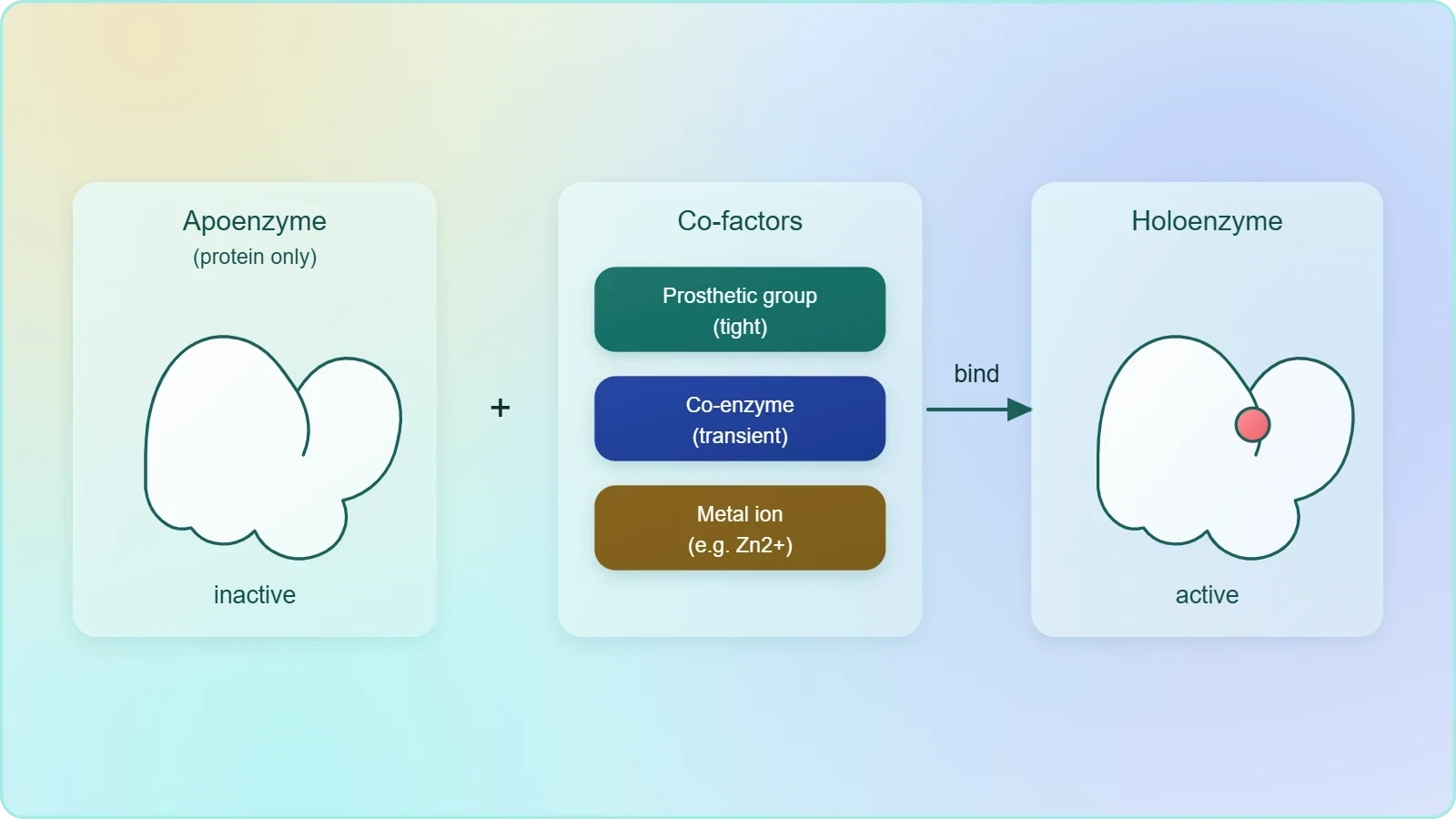
Enzymes are composed of one or several polypeptide chains, yet there are a number of cases in which non-protein constituents called co-factors are bound to the enzyme to make it catalytically active. In these instances, the protein portion of the enzyme is called the apoenzyme. The relationship is best pictured as a partnership: the apoenzyme supplies the folded structure and the binding site, while the co-factor supplies chemistry that the amino acid side chains alone cannot perform. Three kinds of cofactors may be identified: prosthetic groups, co-enzymes and metal ions.
Prosthetic Groups: Tightly Bound Organic Helpers
Prosthetic groups are organic compounds and are distinguished from other cofactors in that they are tightly bound to the apoenzyme. The textbook example is haem, the prosthetic group of peroxidase and catalase, the enzymes that catalyse the breakdown of hydrogen peroxide to water and oxygen. Haem is a part of the active site of the enzyme, not a loose passenger. Because the attachment is tight, the prosthetic group remains with the apoenzyme through purification and behaves almost like a permanent structural feature.
The tightness of the bond has practical consequences. A prosthetic group is not exchanged with the surrounding solution during each catalytic cycle; it stays in place while substrates come and go. This makes it well suited to reactions where the same chemical feature must be presented repeatedly, such as the decomposition of hydrogen peroxide. The distinction between a prosthetic group and a co-enzyme is therefore one of binding strength and persistence rather than of chemical composition, since both are organic compounds.
Co-enzymes and Their Vitamin Origins
Co-enzymes are also organic compounds, but their association with the apoenzyme is only transient, usually occurring during the course of catalysis. Furthermore, co-enzymes serve as co-factors in a number of different enzyme-catalysed reactions. The essential chemical components of many coenzymes are vitamins; for example, the coenzymes nicotinamide adenine dinucleotide (NAD) and NADP contain the vitamin niacin. A single co-enzyme can therefore assist several different enzymes, carrying chemical groups between them like a reusable shuttle.
The transient binding is the defining feature. A co-enzyme attaches during catalysis and departs afterwards, which allows it to serve multiple enzymes in sequence. This is precisely why the same co-enzyme appears in many different reactions, and why a deficiency of the vitamin from which it is made can affect many pathways at once. NAD and NADP, both built around niacin, illustrate the point neatly: one small organic molecule, drawn from the diet, becomes the working part of a whole family of catalysts.
Metal Ions as Co-factors
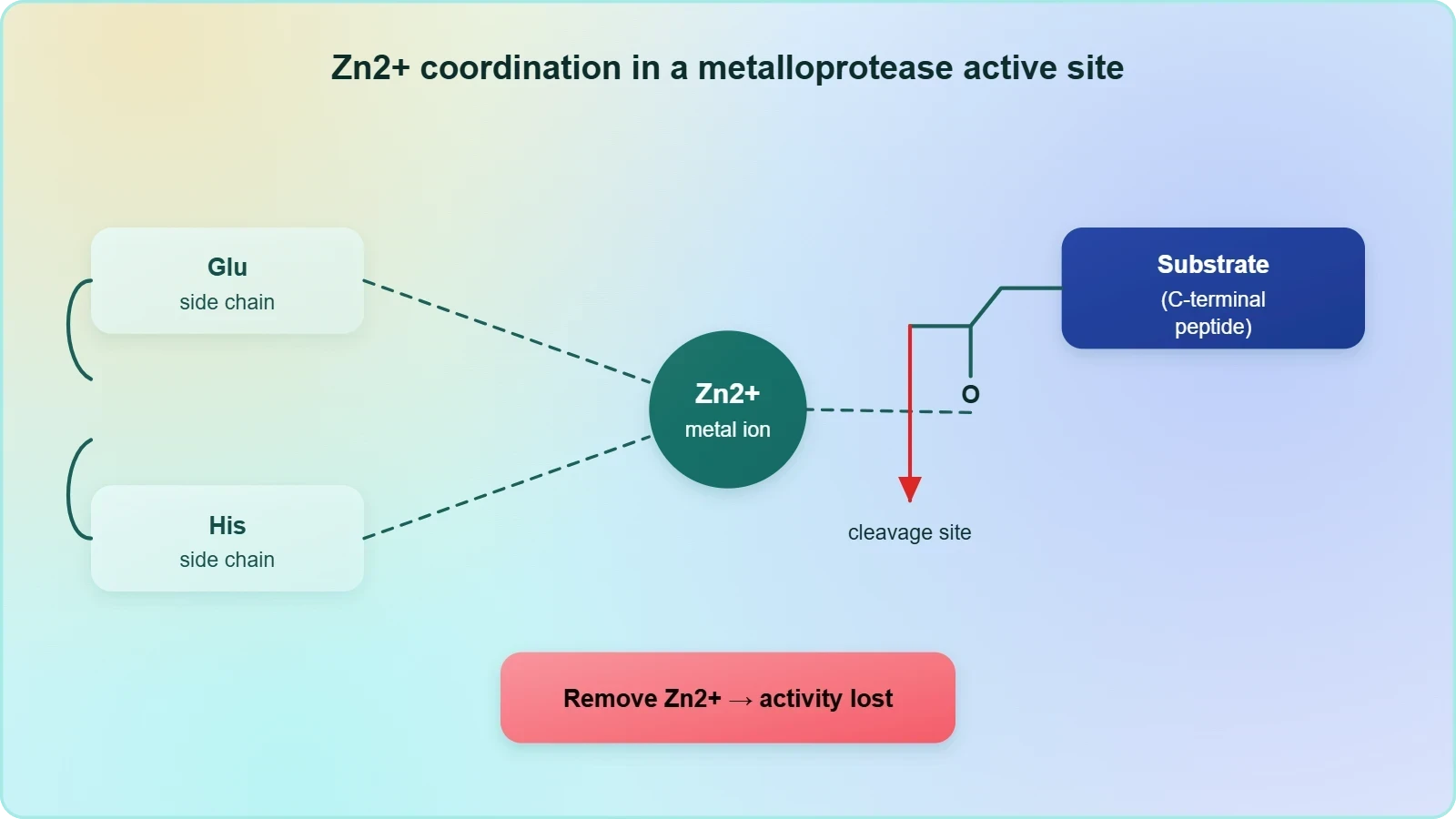
A number of enzymes require metal ions for their activity. These ions form coordination bonds with side chains at the active site and at the same time form one or more coordination bonds with the substrate. The metal therefore acts as a bridge, holding the substrate in the correct orientation while the catalytic side chains do their work. Zinc is a cofactor for the proteolytic enzyme carboxypeptidase, a clear example of a metal ion embedded at the heart of an active site.
How Metal Ions Assist Catalysis
The double role of the metal ion explains its usefulness. By bonding to both the protein side chains and the substrate, it stabilises the substrate in a precise position and can also withdraw or donate electron density as the reaction requires. This is a form of chemical assistance that amino acid side chains alone cannot always provide. The result is a catalytic centre in which the metal is not a passive spectator but an integral part of the machinery that lowers the barrier to reaction.
Carboxypeptidase illustrates the arrangement concretely. Zinc sits at the active site of this proteolytic enzyme, coordinating with side chains of the protein and with the substrate being cleaved. Remove the zinc and the enzyme loses its activity, which demonstrates how essential the ion is. The same principle applies across the many metalloenzymes found in living systems, where the identity of the metal determines what chemistry the enzyme can perform.
Proving the Co-factor Is Essential
Catalytic activity is lost when the co-factor is removed from the enzyme, and this observation testifies that co-factors play a crucial role in the catalytic activity of the enzyme. The logic is straightforward: if taking away the non-protein part destroys activity, then the non-protein part must be doing something the protein cannot do alone. This experimental test is the strongest evidence for the functional importance of prosthetic groups, co-enzymes and metal ions alike.
The test also clarifies the relationship between apoenzyme and co-factor. Neither component is catalytically competent in isolation; activity appears only when they are combined. The apoenzyme provides specificity and structure, while the co-factor provides the chemical capability. Together they form the complete, active enzyme. This division of labour is one of the most important ideas in the study of biomolecules, and it explains why diets deficient in vitamins or trace minerals can impair enzyme function throughout the body.
Inhibition Revisited: Competitive Inhibitors and Enzyme Control
When a chemical shuts off enzyme activity, the process is called inhibition and the chemical is called an inhibitor. When the inhibitor closely resembles the substrate in its molecular structure and inhibits the activity of the enzyme, it is known as a competitive inhibitor. Due to its close structural similarity with the substrate, the inhibitor competes with the substrate for the substrate-binding site of the enzyme. Consequently, the substrate cannot bind and, as a result, the enzyme action declines.
The Malonate and Succinate Example
The classic illustration is the inhibition of succinic dehydrogenase by malonate, which closely resembles the substrate succinate in structure. Because the two molecules look alike, malonate occupies the substrate-binding site and blocks succinate from entering. The enzyme itself is not damaged; it is simply prevented from binding its true substrate. Such competitive inhibitors are often used in the control of bacterial pathogens, turning a structural resemblance into a practical tool for suppressing microbial enzymes.
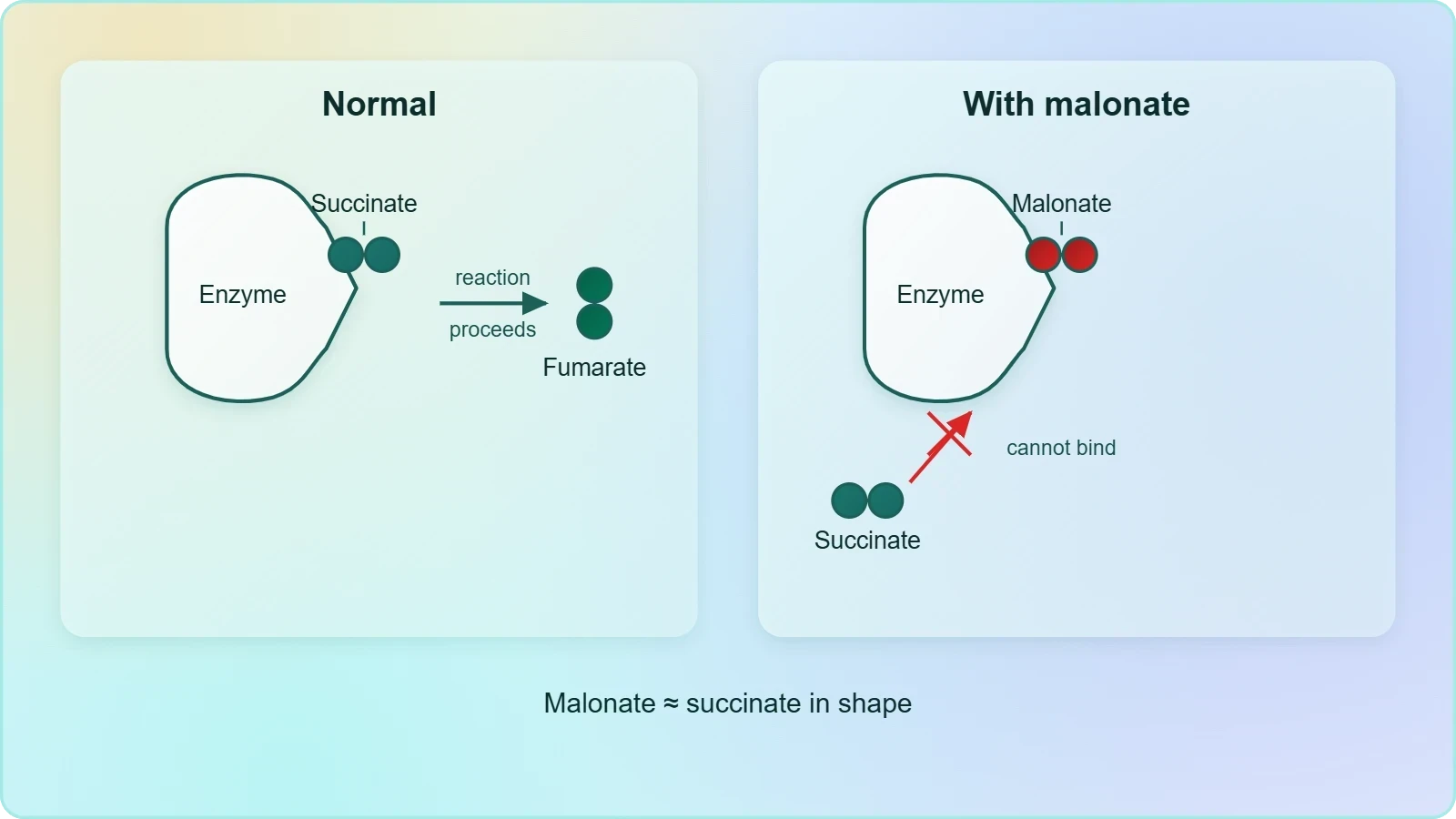
This example connects the classification lesson back to the previous discussion of enzyme activity. Competitive inhibition depends on shape, and shape is precisely what the active site provides. The inhibitor succeeds because it mimics the substrate closely enough to be accepted at the binding site. Understanding this mechanism explains why some drugs and antimicrobial agents work, and why altering the concentration of substrate can sometimes overcome the inhibition by giving the true substrate more chances to bind.
Linking Inhibition to Classification
Inhibition and classification are two views of the same molecular logic. Classification tells us what reaction an enzyme performs; inhibition tells us how that reaction can be interrupted. Both depend on the precise fit between molecules at the active site. A competitive inhibitor exploits the same binding specificity that allows the enzyme to recognise its substrate in the first place. Seen together, the two topics show that enzyme function is governed by structure at every level, from the four-digit code down to the shape of a single binding pocket.
For learners completing this course, the practical takeaway is that enzymes can be understood from several angles at once: by the reaction they catalyse, by the systematic number that names them, by the co-factors they require, and by the molecules that can block them. Each angle illuminates the others. The competitive inhibitor malonate, for instance, makes sense only once one appreciates that succinic dehydrogenase binds succinate at a specific site, which in turn depends on the protein structure built in earlier lessons.
Consolidating the Course: From Molecules to Catalysis
This final lesson closes a course that began with the chemical composition of living tissues and moved through metabolites, biomacromolecules, proteins, polysaccharides, nucleic acids and the four levels of protein structure. The classification of enzymes and the study of co-factors bring those threads together. Enzymes are proteins, built from the amino acids described earlier, folded into the structures that create active sites, and sometimes partnered with non-protein co-factors that supply additional chemistry. The four-digit naming system then gives this diversity an orderly index.
What the Course Has Established
Although there is a bewildering diversity of living organisms, their chemical composition and metabolic reactions appear to be remarkably similar. The elemental composition of living tissues and non-living matter appears similar when analysed qualitatively, yet closer examination reveals that the relative abundance of carbon, hydrogen and oxygen is higher in living systems. Water is the most abundant chemical in living organisms, and thousands of small molecular weight biomolecules, below 1000 Da, populate their cells. These foundations explain why a single classification scheme can serve all life.
Only three types of macromolecules are found in living systems: proteins, nucleic acids and polysaccharides. Lipids, because of their association with membranes, separate in the macromolecular fraction. Biomacromolecules are polymers made of different building blocks: proteins are heteropolymers of amino acids, while nucleic acids, RNA and DNA, are composed of nucleotides. Biomacromolecules have a hierarchy of structures, and that hierarchy is exactly what allows an apoenzyme to position a haem group or a zinc ion precisely where catalysis demands it.
Preparing for Further Study
With the course complete, learners are equipped to read enzyme names with understanding and to reason about why a particular co-factor matters. The six classes, the four-digit code, the three kinds of co-factor and the competitive inhibition example form a compact toolkit. Each item connects to the wider story of metabolism, where oxidoreductases, transferases, hydrolases, lyases, isomerases and ligases cooperate to keep a cell alive. Recognising these patterns is the beginning of fluency in biochemistry.
The next stage of study will naturally extend these ideas into metabolic pathways, where individual enzymes are arranged in sequences and where co-enzymes such as NAD and NADP shuttle groups between reactions. The habit of asking what reaction an enzyme catalyses, what co-factor it needs, and what molecule might block it will remain useful throughout. The material in this lesson is deliberately foundational: it supplies the vocabulary and the classification that make the detailed study of metabolism possible.
Going further
Vitamins are essential in the diet partly because some are used to make co-enzymes. The material notes that NAD and NADP contain the vitamin niacin, which illustrates the principle directly: without an adequate supply of the vitamin, the body cannot manufacture these co-enzymes, and the many enzymes that depend on them work less effectively. Zinc is likewise a trace mineral needed by many enzymes in the body, and carboxypeptidase, with its zinc co-factor, is one well-documented example of that wider dependence.
Also Read
- No links available.
From our network :
- 10 Physics Numerical Problems with Solutions for IIT JEEPrepare for IIT JEE with 10 physics numerical problems, complete with detailed solutions and conceptual explanations. Ideal for mastering kinematics, thermodynamics, electromagnetism, and optics.
- 98% of Global MBA Programs Now Prefer GRE Over GMAT Focus EditionExplore why 98% of global MBA programs now prefer the GRE over GMAT Focus. Learn about the shorter GRE format, verbal logic importance, and strategic versatility for students.
- AI-Powered 'Precision Diagnostic' Replaces Standard GRE Score ReportsDiscover the new GRE Precision Diagnostic. Learn how AI-powered behavioral analytics and time-to-solve tracking are replacing standard GRE score reports to empower students.
- Analyzing Trump Deportation Numbers Insights Into The 2026 Immigration Crackdown
- Mastering DB2 LUW v12 Tables: A Comprehensive Technical GuideComprehensive guide on DB2 LUW v12 tables. Explore CREATE TABLE syntax, BLU Acceleration, range partitioning, data types, and security features for IBM DB2 LUW v12.
- EV 2.0: The Solid-State Battery Breakthrough and Global Factory ExpansionDiscover the impact of the Solid-State Battery Breakthrough on the EV market. Learn about CATL and BYD stock growth, global factory expansion in Europe, and the future of EV 2.0 technology.
- Vite 6/7 'Cold Start' Regression in Massive Module GraphsIn-depth analysis of Vite 6/7 cold start regressions in massive module graphs. Learn about barrel file issues, pre-bundling optimizations, and how to improve Vite dev server performance.
- Mastering DB2 12.1 Instance Design: A Technical Deep Dive into Modern Database ArchitectureComprehensive guide to DB2 12.1 Instance Design. Explore architectural components, HADR setup, buffer pool tuning, and security policies for IBM DB2 12.1. Includes 10 functional SQL and Shell samples.
- Trump Political Strategy How Geopolitical Stunts Serve As Media Diversions
RESOURCES
- The CoFactor database: organic cofactors in enzyme catalysis - PMCpmc.ncbi.nlm.nih.govMACiE (mechanism, annotation and classification in enzymes): novel tools for searching catalytic mechanisms. ... Enzyme nomenclature. Recommendations 1992 ...
- Cofactor (biochemistry) - Wikipediaen.wikipedia.orgA cofactor is a non-protein chemical compound or metallic ion that is required for an enzyme's role as a catalyst. Cofactors can be considered…
- Enzymes – Structure, Classification, and Function - BYJU'Sbyjus.comAn enzyme and its cofactor together constitute the holoenzyme. There are three kinds of cofactors present in enzymes: Prosthetic groups: These are cofactors ...
- Enzyme - Wikipediaen.wikipedia.orgFactors affecting enzyme activity. As enzymes are made up of proteins, their ... Nomenclature and Classification of Enzymes by the Reactions they Catalyse".
- Restriction Enzymes - MilliporeSigmasigmaaldrich.comRestriction Enzymes are classified based on their activity sites, required cofactors, and recognition sequences. The detailed classification and description of ...
- BRENDA and the IUBMB - BRENDA Enzyme Databasebrenda-enzymes.org... classification and nomenclature of enzymes. Since 2025, responsibility for ... cofactor may bind differently to different enzymes, making this term imprecise.
- Classification and nomenclature of enzymes | PPTX - Slideshareslideshare.netThe document also describes the three types of cofactors that can bind to enzymes and enable their catalytic activity: prosthetic groups, coenzymes, and metal ...
- 1653988785.docx - SILAPATHAR COLLEGEsilapatharcollege.edu.inStructure of enzyme: holoenzyme, apoenzyme, cofactors, coenzymes and prosthetic group; Classification of enzymes; Features of active site, substrate specificity ...
- Enzyme Classification - an overview | ScienceDirect Topicssciencedirect.com... classification and rational nomenclature of known and new enzymes. ... Other information is also available for each record, such as alternative names, cofactors ...
- Enzymes: Structure, Types, Mechanism, Functions - Microbe Notesmicrobenotes.comNov 9, 2023 ... Nomenclature of Enzymes; Classification of Enzymes; Functions ... The enzymes that require cofactors are called apoenzymes when they do not…
- INTERNATIONAL COMMISSION ON ENZYMES - Naturenature.comagreed terminology for this group of co-enzymes, and would therefore be in a position to deal with the nomenclature of enzymes functioning with these…
- Enzyme Classification - IUBMB Nomenclatureiubmb.qmul.ac.ukOther examples of systems consisting of several structurally and functionally linked enzymes (and cofactors) are the pyruvate dehydrogenase system, the similar ...
- Enzymes and biocatalysis - Knowledge @ AMBOSSamboss.comAug 3, 2026 ... Some enzymes require cofactors (biotin, lipoamide, cobalamin) to function properly. ... Enzymes are classified as oxidoreductases, transferases, ...
- biomolecules chapter 9 - NCERTncert.nic.inClassification and Nomenclature of Enzymes. Thousands of enzymes have ... Furthermore, co-enzymes serve as co-factors in a number of different enzyme ...
- BRENDA, enzyme data and metabolic information - PubMedpubmed.ncbi.nlm.nih.gov... cofactors, activators, structure ... The database is a resource for data of enzymes, classified according to the EC system of the IUBMB Enzyme…