Every discussion of the molecules of life eventually arrives at a deceptively simple question: what, precisely, are the building blocks from which living tissue is assembled? The previous lesson established how a tissue sample is weighed wet, dried, and finally burnt to ash, separating water, organic matter and inorganic residue, and how elemental analysis reveals the proportions of hydrogen, oxygen, carbon and nitrogen that living matter contains. That accounting tells us which elements are present, but it says nothing about how those elements are arranged into the recurring chemical units that biology actually uses. This lesson takes the next step and examines three of those units in detail: amino acids, fatty acids and lipids.
The treatment follows the order in which the subject naturally unfolds. Amino acids are introduced first as substituted methanes, with an amino group, a carboxyl group, a hydrogen atom and a variable R group arranged around a single α-carbon. Their classification into acidic, basic, neutral and aromatic types follows directly from the chemistry of that R group, and the ionizable nature of the amino and carboxyl groups leads to the zwitterionic form that dominates in solution. From there the lesson turns to lipids: simple fatty acids with their carboxyl group and hydrocarbon tail, glycerol as trihydroxy propane, the mono-, di- and triglycerides formed when fatty acids esterify with glycerol, and finally the phospholipids that carry phosphorus into the lipid fraction.
Throughout, the emphasis stays on the terminology, definitions and numerical examples that the chapter itself supplies, so that the vocabulary of palmitic acid, arachidonic acid, lecithin and the twenty proteinaceous amino acids becomes familiar and usable. A short block headed "Going further" adds two pieces of well-established background — the buffering behaviour that follows from the zwitterionic form, and the amphipathic architecture that makes phospholipids the natural fabric of cell membranes — clearly separated from the core material so that the distinction between what the chapter states and what is added for understanding remains visible. The lesson closes by preparing the ground for the nitrogen bases, nucleosides and nucleotides that follow.
On This Page
Amino Acids as Substituted Methanes
Amino acids are organic compounds that carry an amino group and an acidic group as substituents on the same carbon atom, and that shared carbon is designated the α-carbon. Because both functional groups sit on this single α-position, the molecules are properly called α-amino acids. The chapter describes them as substituted methanes: the methane skeleton supplies four valency positions, and each position is occupied by a substituent. Three of those substituents are constant across the family — a hydrogen atom, a carboxyl group and an amino group — while the fourth is a variable group designated the R group. It is the identity of that R group that generates the diversity of amino acids.
The number of possible amino acids is large, since the R group can take many chemical forms, but those that actually occur in proteins are of only twenty types. The chapter illustrates the range with three examples. When the R group is simply a hydrogen atom, the amino acid is glycine, the smallest of the set. When the R group is a methyl group, the amino acid is alanine. When the R group is a hydroxymethyl group, the amino acid is serine. These three cases already show how modest changes in a single substituent produce chemically distinct molecules, and the remaining seventeen follow the same logic with more elaborate side chains.
The Constant Backbone and the Variable Side Chain
The structural logic of an α-amino acid can be written compactly by isolating the shared backbone and treating the R group as a placeholder. Every proteinaceous amino acid conforms to the same general formula, and the only degree of freedom is the identity of ##R##. This is why the chemical and physical properties of amino acids are described in the chapter as essentially the properties of the amino group, the carboxyl group and the R functional group taken together. The backbone supplies the reactivity that lets amino acids link into chains; the side chain supplies the individuality that lets each residue contribute a distinct character to the finished protein.
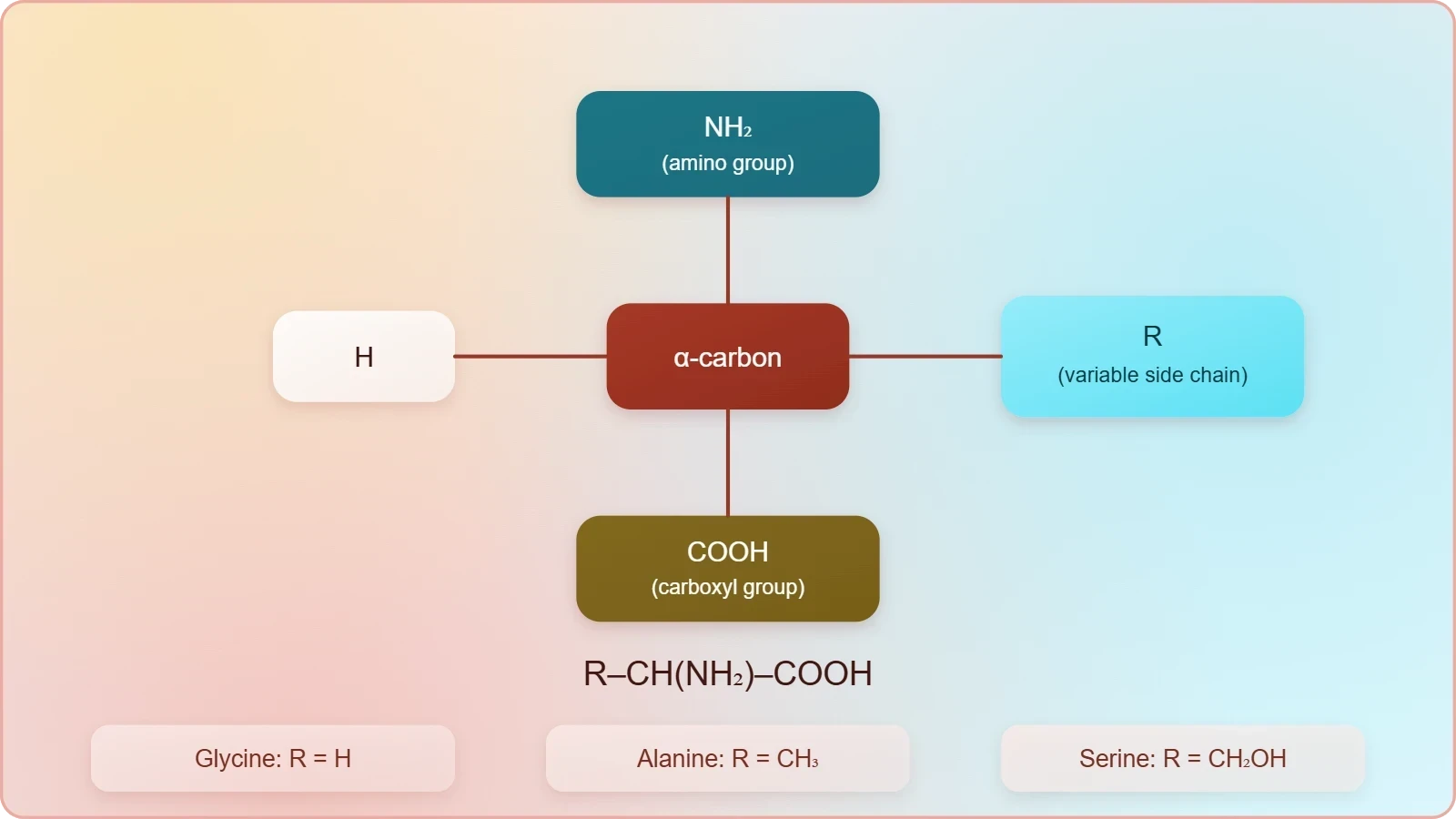
Reading the formula from left to right, the amino group sits on the α-carbon, the R group branches from the same carbon, and the carboxyl group completes the tetravalency. Glycine is recovered by setting ##R = H##, alanine by setting ##R = CH_3##, and serine by setting ##R = CH_2OH##. The pattern is worth committing to memory because every subsequent discussion of peptide bonds, protein structure and enzyme active sites assumes fluency with this single template and with the idea that a protein is, at bottom, a sequence of R groups threaded onto a repeating backbone.
Why the α-Position Matters
Placing both the amino and the carboxyl group on the same carbon is not an arbitrary arrangement. It is what allows two amino acids to condense head to tail, with the carboxyl group of one reacting with the amino group of the next, and it is what makes the resulting chain a regular polymer with a repeating backbone. An amino acid in which the two groups were separated by additional carbons would not polymerise in this clean, repeating fashion. The α-arrangement is therefore the structural precondition for proteins, and the chapter's insistence on the term α-amino acid is a precise chemical statement rather than a stylistic preference.
The twenty proteinaceous amino acids differ only in their R groups, yet that single point of variation is enough to give proteins an extraordinary range of behaviours. Some side chains are oily and avoid water, others carry charges, others can form hydrogen bonds, and one, cysteine, can form covalent cross-links. None of this variety requires a different backbone; it all flows from the fourth valency position. Keeping that picture in mind makes the classification that follows feel like a natural consequence of structure rather than a list to be memorised.
Classifying Amino Acids by Their R Groups
Because the R group governs behaviour, the standard classification of amino acids is built on the number and kind of ionizable groups the side chain contributes. The chapter distinguishes acidic, basic and neutral amino acids according to the number of amino and carboxyl groups present in the molecule as a whole. It then identifies a separate aromatic category on the basis of ring structure in the side chain. These categories are not watertight compartments in every respect, but they organise the twenty amino acids usefully and they connect directly to the behaviour of proteins in solution.
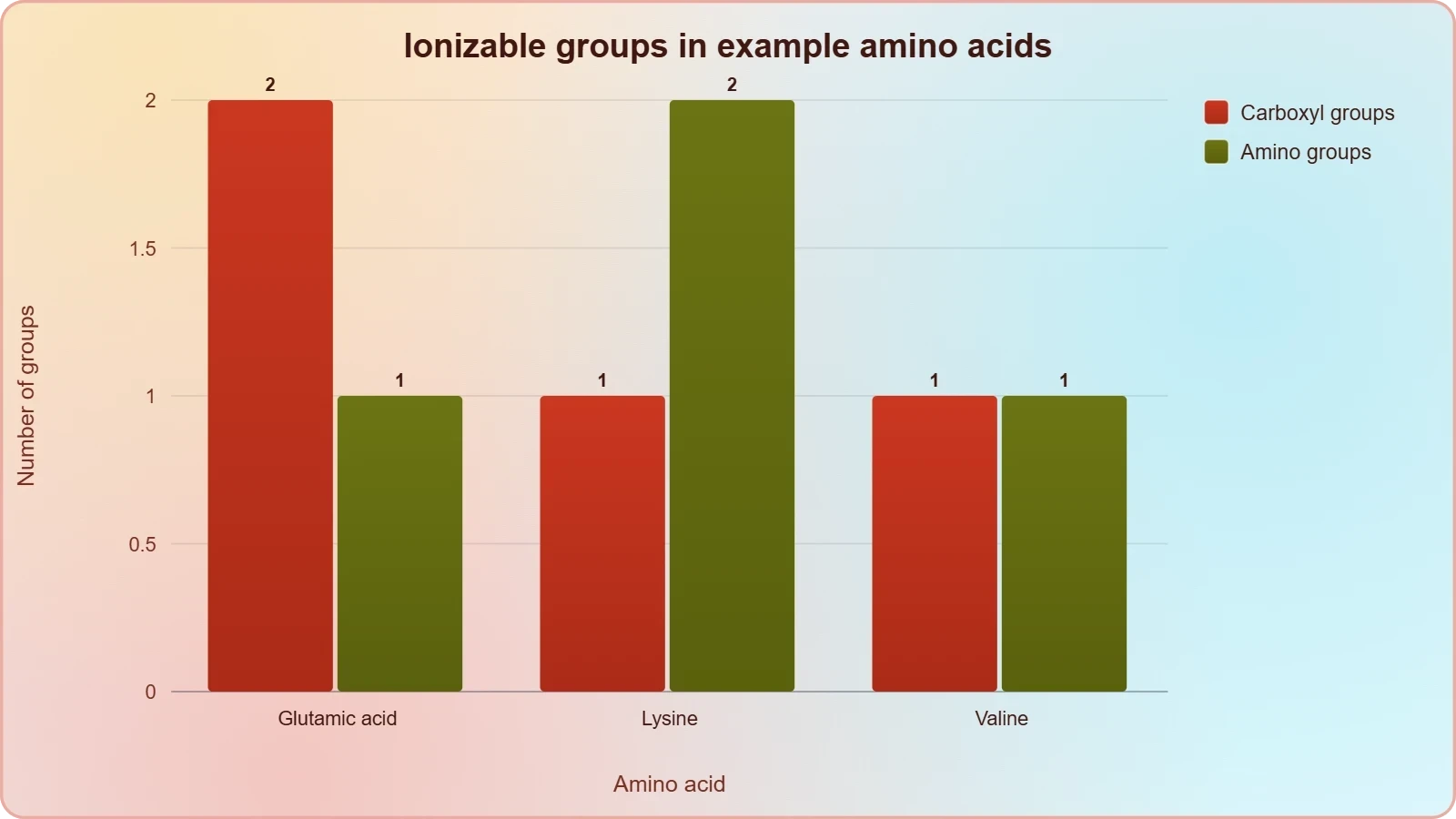
An acidic amino acid carries an additional carboxyl group in its side chain, so the molecule as a whole has more carboxyl groups than amino groups. Glutamic acid is the chapter's example. A basic amino acid carries an additional amino group, so the balance tips the other way; lysine is given as the example. A neutral amino acid has the amino and carboxyl groups in equal number, with valine cited as the representative case. The aromatic amino acids — tyrosine, phenylalanine and tryptophan — are grouped by the presence of an aromatic ring in the R group rather than by charge balance.
Acidic, Basic and Neutral Types
The logic behind the acidic and basic labels is a simple count. Glutamic acid has two carboxyl groups and one amino group, so in neutral solution it tends to lose protons and behave as an acid. Lysine has two amino groups and one carboxyl group, so it tends to accept protons and behave as a base. Valine, with one of each, is neutral in the counting sense. This accounting matters because the side chains of acidic and basic residues are the groups that carry charge on the surface of a folded protein, and charge is what makes proteins soluble, what lets them bind ions, and what allows enzymes to hold their substrates in position.
The aromatic amino acids deserve separate attention because their side chains absorb ultraviolet light and because they are relatively bulky and hydrophobic. Tyrosine carries a phenolic hydroxyl group, which can ionise under strongly basic conditions and can participate in hydrogen bonding. Phenylalanine carries a plain benzene ring and is purely hydrophobic. Tryptophan carries an indole ring, the largest side chain among the twenty. These three are comparatively rare in proteins but disproportionately important, since they often sit at the interfaces where proteins recognise other molecules.
The Ionizable Groups and the Zwitterionic Form
The chapter singles out one property of amino acids as particularly characteristic: the ionizable nature of the –NH₂ and –COOH groups. Because the amino group can accept a proton and the carboxyl group can donate one, the structure of an amino acid changes with the pH of the solution it sits in. At a particular intermediate pH, the molecule carries both a positive charge on the protonated amino group and a negative charge on the deprotonated carboxyl group at the same time. This doubly charged but overall neutral species is called the zwitterionic form, and the chapter labels it simply as B.
The zwitterion is not a minor curiosity; it is the dominant form of a free amino acid in aqueous solution near neutral pH. The molecule behaves simultaneously as an acid and as a base, which is precisely what the term amphoteric describes. This dual character explains why amino acids dissolve readily in water, why they have relatively high melting points for such small organic molecules, and why they conduct electricity in solution. It also sets up the buffering behaviour discussed in the "Going further" block below, where the same ionizable groups are shown to resist changes in pH.
Fatty Acids and the Chemistry of the Lipid Fraction
Lipids are defined in the chapter by a physical property rather than a single structural formula: they are generally water insoluble. The simplest lipids are the fatty acids, and a fatty acid has a carboxyl group attached to an R group. That R group may be a methyl group, an ethyl group, or a longer chain containing a higher number of –CH₂ units, ranging from one carbon to nineteen carbons. The carboxyl carbon is counted as part of the total, so the smallest fatty acids are short and the largest approach twenty carbons in length. This simple architecture — a polar head and a long hydrocarbon tail — is the template for everything that follows.
The chapter gives two concrete examples that anchor the numbering convention. Palmitic acid has sixteen carbons including the carboxyl carbon. Arachidonic acid has twenty carbon atoms including the carboxyl carbon. These figures are worth noting because they illustrate the range over which fatty acids occur and because the counting convention, which includes the carboxyl carbon, is easy to get wrong. A fatty acid described as having sixteen carbons therefore has fifteen carbons in its tail plus the one in the carboxyl group, and the same arithmetic applies to the twenty-carbon arachidonic acid.
Saturated and Unsaturated Fatty Acids
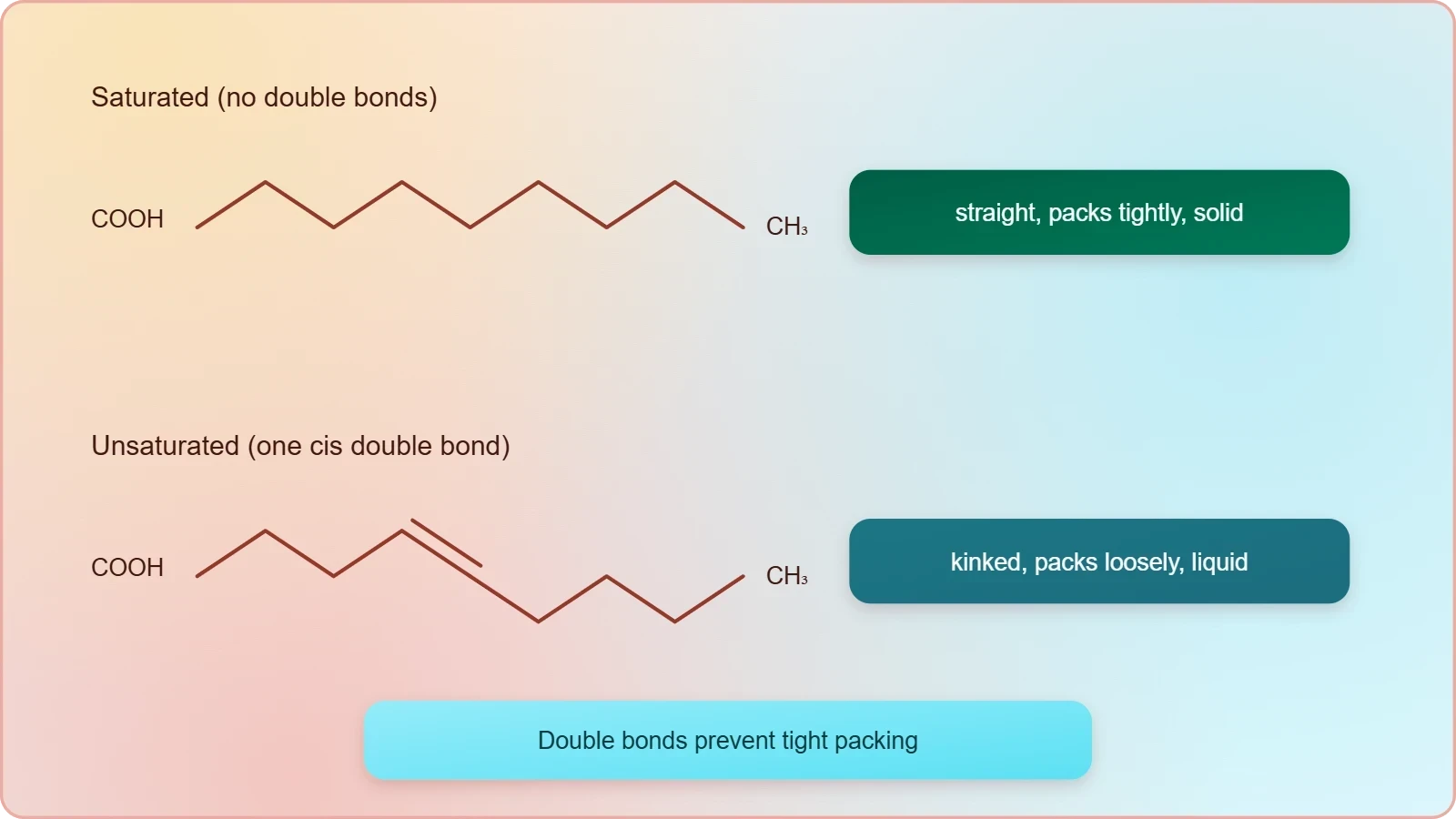
Fatty acids are divided into two classes according to the presence or absence of double bonds in the hydrocarbon chain. A saturated fatty acid has no double bond; its carbon chain is fully hydrogenated and therefore straight and flexible. An unsaturated fatty acid has one or more C=C double bonds, and each double bond introduces a rigid kink into the chain. This single structural difference has large consequences for packing, melting point and physical state, which is why the chapter introduces the distinction at this point rather than treating it as a footnote. The terms saturated and unsaturated are among the most frequently used in nutrition and biochemistry, and they originate here.
The presence of double bonds also explains why unsaturated fatty acids tend to be liquid at room temperature while saturated ones tend to be solid. A straight saturated chain can pack tightly against its neighbours, so the intermolecular forces are strong and the melting point is high. A kinked unsaturated chain cannot pack as neatly, so the forces are weaker and the melting point is lower. This is the structural reason behind the difference between a cooking oil that pours and a fat that spreads, and it connects directly to the distinction between oils and fats that the chapter draws a little later.
Glycerol and the Glycerides
Another simple lipid named in the chapter is glycerol, described as trihydroxy propane. The name states its structure precisely: a three-carbon propane skeleton carrying a hydroxyl group on each carbon. Those three hydroxyl groups are the points at which fatty acids can attach, and when they do, the fatty acids are said to be esterified with glycerol. The resulting molecules are classified by how many of the three positions are occupied. A monoglyceride has one fatty acid esterified to glycerol, a diglyceride has two, and a triglyceride has all three positions filled.
Triglycerides are the molecules commonly called fats and oils, and the chapter distinguishes between the two labels on the basis of melting point. Oils have a lower melting point and therefore remain liquid; gingelly oil is given as an example, and the chapter notes that it stays an oil through the winter. Fats have a higher melting point and are solid at ordinary temperatures. The distinction is not a difference in chemical class but a difference in the mix of fatty acids attached, since a triglyceride built mainly from unsaturated fatty acids will melt lower than one built mainly from saturated fatty acids.
Phospholipids and the Membrane Fraction
Not every lipid is built from glycerol and fatty acids alone. The chapter notes that some lipids contain phosphorus together with a phosphorylated organic compound, and these are called phospholipids. They are found in the cell membrane, and lecithin is given as one example. The addition of a phosphate-containing group changes the molecule's character substantially, because the phosphate head is strongly polar while the fatty acid tails remain non-polar. This combination of a water-loving end and a water-fearing end is what allows phospholipids to organise into the sheets and bilayers that form the fabric of cellular membranes.
The chapter also observes that some tissues, especially neural tissues, contain lipids with more complex structures. This is a reminder that the lipid fraction of a living tissue is not a single chemical class but a family of related molecules that share the defining property of water insolubility. The simple fatty acids, the glycerides and the phospholipids form a progression from the simplest to the more elaborate, and each step adds a functional group that changes what the molecule can do. Keeping that progression in mind makes the lipid section easier to hold together than a list of separate names would be.
Phospholipids in the Membrane
The presence of phospholipids in cell membranes is one of the most consequential facts in the whole of biochemistry, and the chapter states it plainly. A membrane is not a solid wall but a thin film built from molecules that have a polar head and non-polar tails. In water, these molecules arrange themselves so that the tails face one another and the heads face the surrounding aqueous environment on both sides. The result is a stable bilayer that separates the inside of a cell from the outside while still permitting controlled exchange. Lecithin, the example named in the chapter, is one of the most abundant of these membrane phospholipids.
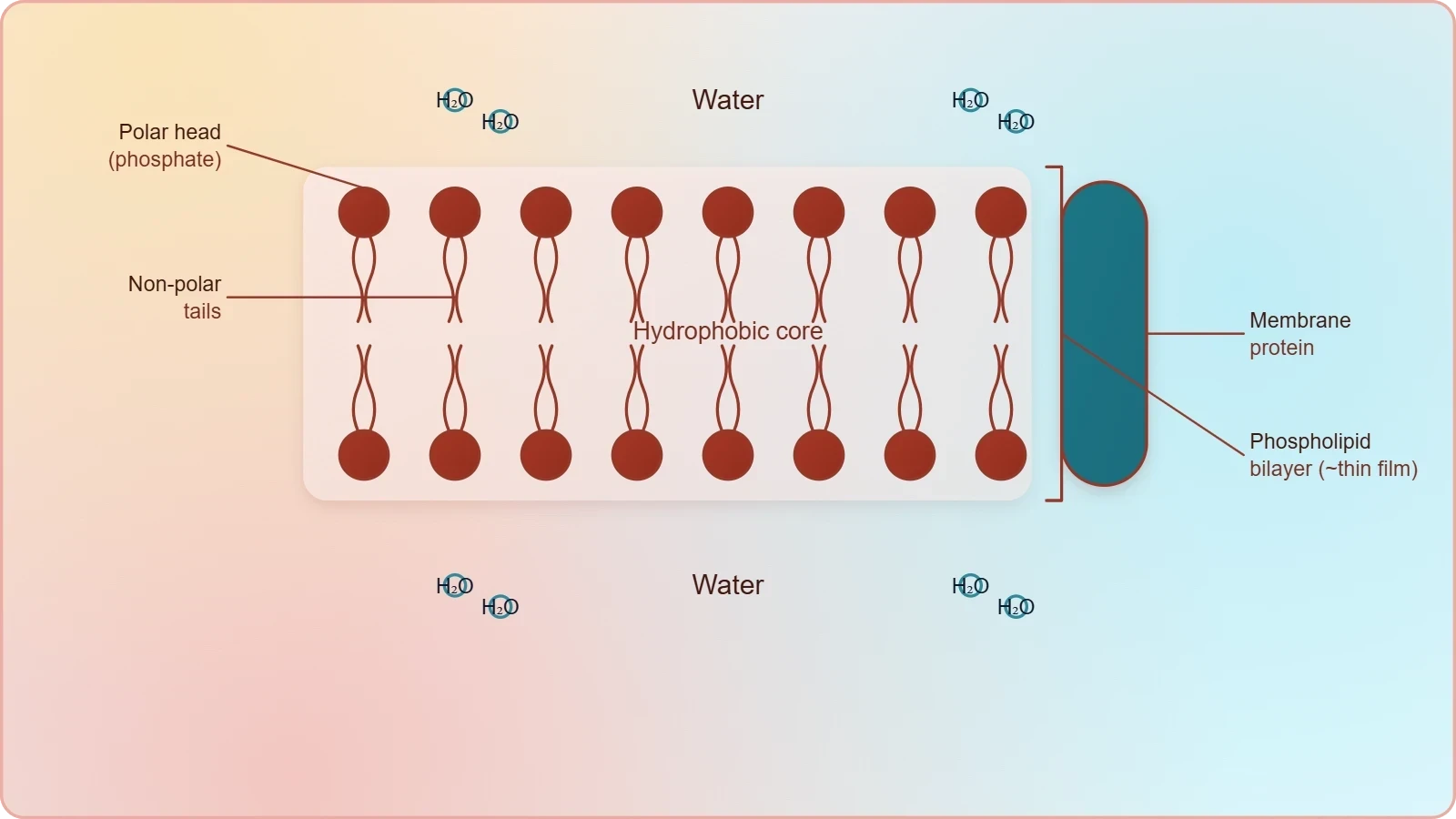
The phosphorylated organic compound attached to a phospholipid is what gives the head its polarity. Without it, the molecule would be an ordinary glyceride and would simply dissolve into fat droplets. With it, the molecule becomes amphipathic, meaning it has both a water-loving and a water-fearing region, and amphipathic molecules spontaneously form ordered structures in water. This is the structural reason why phospholipids, rather than triglycerides, are the molecules that build membranes, and it is why the chapter introduces them immediately after the glycerides rather than in a separate section.
Complex Lipids of Neural Tissue
The chapter's remark that neural tissues contain lipids of more complex structure is a brief but important pointer. Neural tissue is unusually rich in lipid, and much of that lipid is not simple triglyceride but more elaborate molecules in which additional groups are attached to the phosphate or to the sugar-like head. These complex lipids are essential to the insulation of nerve fibres and to the functioning of nerve cell membranes. The detail belongs to more advanced study, but the mention here serves to show that the lipid family extends well beyond the simple fatty acids and glycerides that open the section.
For the purposes of this lesson, the essential point is that the lipid category is defined by solubility rather than by a single structure. Fatty acids, glycerol, glycerides, phospholipids and the complex neural lipids all fall within it because none of them dissolves readily in water. That single shared property is what justifies grouping them together, and it is also what makes the lipid fraction separable from the aqueous fraction during the extraction procedures described in the previous lesson. The chemistry of the individual members then explains why they behave so differently from one another once separated.
Reading the Structures Together
The amino acids and the lipids examined in this lesson are different in almost every respect, yet they share a common architectural principle. Each is built around a small, constant backbone with a variable appendage: the α-carbon with its amino and carboxyl groups in the amino acids, the glycerol skeleton with its three hydroxyl positions in the glycerides. In both cases, the backbone supplies the chemistry of assembly while the variable part supplies the diversity. Recognising this shared pattern is more useful than memorising individual structures, because it is the pattern that recurs throughout the study of biomolecules.
The lesson has also shown how a single functional group can change a molecule's role entirely. Adding a carboxyl group to an amino acid side chain turns a neutral molecule into an acidic one; adding a phosphate group to a glyceride turns a storage fat into a membrane lipid. These are small chemical edits with large biological consequences, and they illustrate why the chapter organises its material by functional group rather than by biological function. The same molecule can serve different purposes depending on which groups are present and on the environment in which it finds itself.
Connecting Back to the Previous Lesson
The previous lesson established that living tissue can be separated into water, organic matter and ash, and that elemental analysis reveals the proportions of carbon, hydrogen, oxygen and nitrogen. The molecules discussed here are precisely the organic matter that the burning step removes. Amino acids account for a large share of the nitrogen in a tissue, since nitrogen is concentrated in their amino groups. Fatty acids and lipids account for much of the carbon and hydrogen, since their hydrocarbon chains are rich in both. The elemental percentages from the earlier lesson thus become intelligible once the molecular classes are known.
This connection also explains why the elemental composition of living matter differs so sharply from that of the earth's crust. The crust is dominated by oxygen and silicon, with silicon alone making up a large fraction of its mass. Living tissue contains negligible silicon but substantial carbon, hydrogen and nitrogen, because its structure is built from amino acids, lipids and the other carbon compounds that the chapter calls biomolecules. The contrast is not a curiosity but a direct consequence of the molecular classes examined in this lesson and the ones that follow.
Preparing for Nitrogen Bases and Nucleotides
The next lesson turns to a third family of biomolecules: the nitrogen bases adenine, guanine, cytosine, uracil and thymine, together with the nucleosides and nucleotides built from them. The pattern will be familiar. A nitrogen base attached to a sugar gives a nucleoside, and a nucleoside with a phosphate group esterified to the sugar gives a nucleotide. Nucleic acids such as DNA and RNA consist of nucleotides only, and they function as genetic material. The same logic of a constant backbone with variable appendages, and of added functional groups changing a molecule's role, carries straight through from the present lesson into the next.
It is worth noticing that the phosphate group appears in both lessons, attached to a lipid in the phospholipids and attached to a sugar in the nucleotides. This is one of the small chemical motifs that recur across the biomolecules, and recognising it makes the transition to the next lesson smoother. The amino acids, fatty acids and lipids studied here supply the vocabulary and the structural habits of thought that the nucleotides will require, and the chapter's order of presentation reflects that dependence deliberately rather than arbitrarily.
Going Further
Two pieces of well-established background help to explain why the structures described above behave as they do. Neither is stated in the chapter itself, and both are offered here as context rather than as part of the core material. The first concerns the buffering behaviour that follows from the zwitterionic form of amino acids. The second concerns the amphipathic architecture that makes phospholipids the natural fabric of cell membranes. Both ideas are standard in biochemistry and both connect directly to the structures already introduced, so they extend understanding without altering anything the chapter says.
These additions are deliberately kept separate from the main exposition so that the boundary between the chapter's content and supplementary context remains clear. A learner who needs only the chapter material can stop at the preceding section; a learner who wants to see how the structures behave in a living system will find the two ideas below useful. The distinction matters because examinations test the chapter's definitions and examples, while broader understanding rewards the extra context. Keeping the two layers distinct allows both purposes to be served without confusion.
Why the Zwitterion Buffers
An amino acid in solution carries both an acidic group and a basic group, and each can exchange a proton with the surrounding water. When a small amount of acid is added, the deprotonated carboxyl group can accept protons and limit the fall in pH. When a small amount of base is added, the protonated amino group can release protons and limit the rise in pH. This ability to absorb added acid or base without large changes in pH is what chemists call buffering, and it follows directly from the ionizable nature of the –NH₂ and –COOH groups that the chapter identifies as a characteristic property of amino acids.
The buffering effect is strongest near the pH at which the amino acid is predominantly in its zwitterionic form, because that is the point at which both the protonated and deprotonated species are present in comparable amounts. This is why amino acids and the proteins built from them are effective buffers in the physiological range. The same principle underlies the buffering capacity of blood and of the interior of cells, where proteins and free amino acids together help to hold pH steady. The zwitterion is therefore not merely a structural curiosity but the chemical basis of a biologically essential function.
Why Phospholipids Build Membranes
A phospholipid has a water-loving phosphate head and two water-fearing hydrocarbon tails, and this combination is what makes it suited to membrane assembly. In an aqueous environment, the tails avoid water by turning inward toward one another while the heads remain in contact with water on both faces. The result is a bilayer, a thin sheet two molecules thick that closes on itself to form a sealed compartment. This spontaneous arrangement requires no external template; it is a direct consequence of the molecule's amphipathic structure, and it is why phospholipids rather than triglycerides are the molecules that build cell membranes.
The bilayer formed in this way is stable but not rigid. Its components can move laterally within the sheet, which allows membranes to bend, fuse and reseal after damage. Proteins embedded in the bilayer carry out transport, signalling and recognition, while the lipid sheet itself provides the barrier that separates inside from outside. The chapter's brief statement that phospholipids are found in cell membrane is therefore the tip of a large and important subject, and the amphipathic structure of lecithin and its relatives is the key that opens it.
Worked Examples and Self-Check
The best way to consolidate this material is to work through a few short calculations and structural questions that use the chapter's own numbers. The examples below take the carbon counts and group counts given in the text and apply them in the way an examination would. Each is deliberately brief, and each is followed by a short explanation so that the reasoning is visible rather than merely the answer. Working through them actively, with pen and paper, is far more effective than reading them passively, because the arithmetic and the structural logic both need to become automatic.
A second purpose of this section is to check that the terminology has been absorbed. Several of the questions ask for a definition or a classification rather than a number, and these are the questions that most often expose a gap in understanding. If a term cannot be defined in one sentence, it has not yet been learned. The self-check at the end gathers the key points into a compact list, and the final table summarises the lesson's main comparisons for quick revision before the next lesson on nitrogen bases and nucleotides.
Counting Carbons and Groups
Consider palmitic acid, which the chapter states has sixteen carbons including the carboxyl carbon. The tail therefore contains fifteen carbons, and if the acid is saturated, the tail is a straight chain of –CH₂ units terminated by a –CH₃ group. Now consider arachidonic acid, with twenty carbons including the carboxyl carbon, giving a tail of nineteen. The general rule is that the total carbon count equals the tail carbons plus one for the carboxyl group, and this rule applies to every fatty acid in the chapter regardless of whether it is saturated or unsaturated.
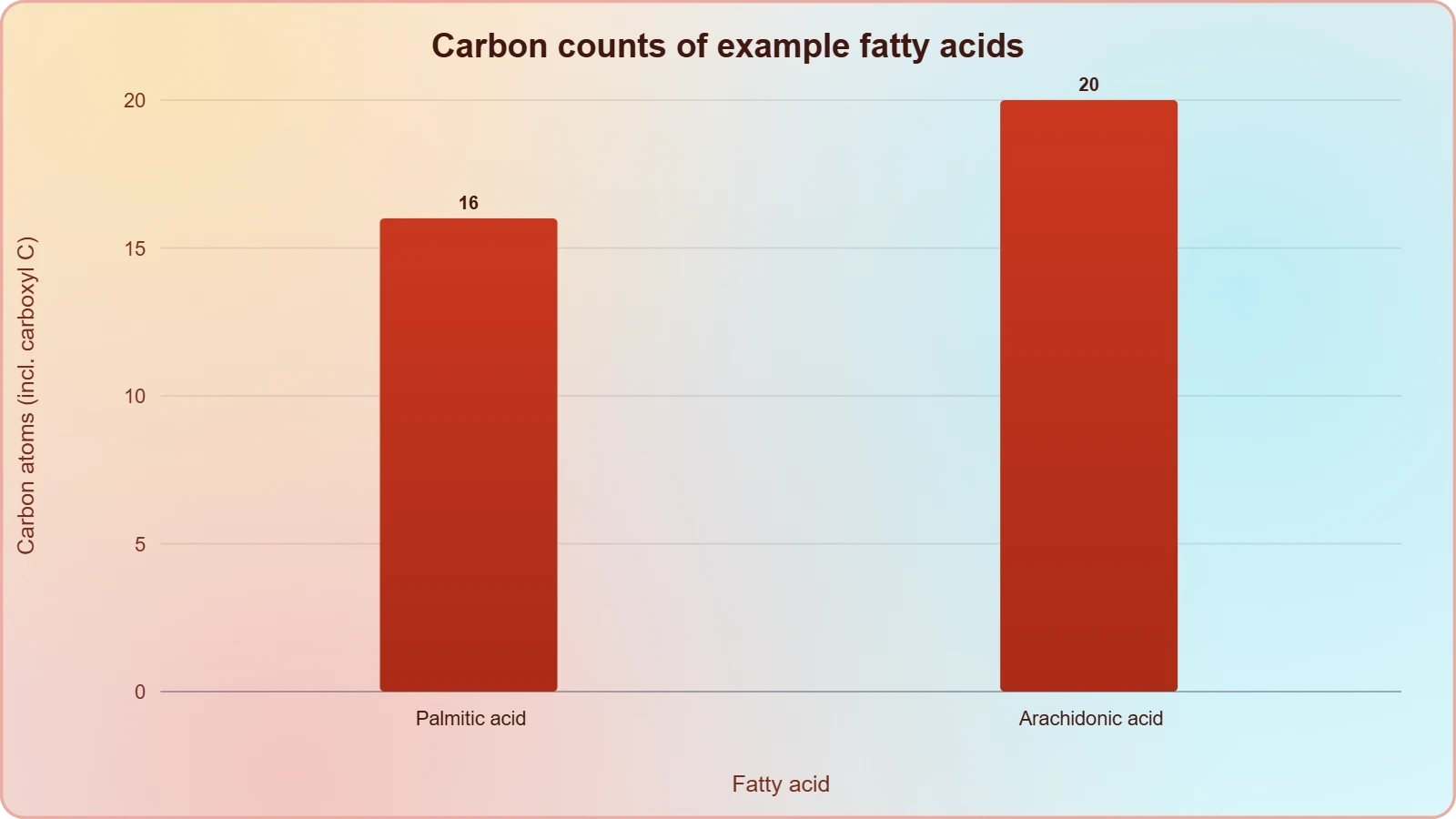
Applying the same counting discipline to amino acids, glutamic acid has two carboxyl groups and one amino group, so its excess of acidic groups is one. Lysine has two amino groups and one carboxyl group, so its excess of basic groups is one. Valine has one of each, so its excess is zero and it is neutral. These small counts are the whole basis of the acidic, basic and neutral classification, and performing them explicitly prevents the common error of confusing the number of groups with the number of carbon atoms.
Self-Check Questions
Try these before moving on. First, why are amino acids described as substituted methanes, and which four groups occupy the valency positions? Second, name the three amino acids the chapter uses to illustrate the R group and state the R group in each. Third, classify glutamic acid, lysine and valine as acidic, basic or neutral and justify each answer by counting groups. Fourth, explain what the zwitterionic form is and why it arises. Fifth, state the carbon count of palmitic acid and of arachidonic acid, remembering to include the carboxyl carbon in each case.
Sixth, distinguish saturated from unsaturated fatty acids and explain why the distinction affects melting point. Seventh, define glycerol and explain what is meant by saying a fatty acid is esterified with it. Eighth, distinguish monoglycerides, diglycerides and triglycerides, and explain why fats and oils are both triglycerides. Ninth, state what a phospholipid contains that a simple glyceride does not, name the example given in the chapter, and say where phospholipids are found. Tenth, explain in one sentence why neural tissue is mentioned in connection with complex lipids.
Also Read
- No links available.
From our network :
- Mastering DB2 LUW v12 Tables: A Comprehensive Technical GuideComprehensive guide on DB2 LUW v12 tables. Explore CREATE TABLE syntax, BLU Acceleration, range partitioning, data types, and security features for IBM DB2 LUW v12.
- 10 Physics Numerical Problems with Solutions for IIT JEEPrepare for IIT JEE with 10 physics numerical problems, complete with detailed solutions and conceptual explanations. Ideal for mastering kinematics, thermodynamics, electromagnetism, and optics.
- Trump Political Strategy How Geopolitical Stunts Serve As Media Diversions
- 98% of Global MBA Programs Now Prefer GRE Over GMAT Focus EditionExplore why 98% of global MBA programs now prefer the GRE over GMAT Focus. Learn about the shorter GRE format, verbal logic importance, and strategic versatility for students.
- AI-Powered 'Precision Diagnostic' Replaces Standard GRE Score ReportsDiscover the new GRE Precision Diagnostic. Learn how AI-powered behavioral analytics and time-to-solve tracking are replacing standard GRE score reports to empower students.
- Vite 6/7 'Cold Start' Regression in Massive Module GraphsIn-depth analysis of Vite 6/7 cold start regressions in massive module graphs. Learn about barrel file issues, pre-bundling optimizations, and how to improve Vite dev server performance.
- Mastering DB2 12.1 Instance Design: A Technical Deep Dive into Modern Database ArchitectureComprehensive guide to DB2 12.1 Instance Design. Explore architectural components, HADR setup, buffer pool tuning, and security policies for IBM DB2 12.1. Includes 10 functional SQL and Shell samples.
- EV 2.0: The Solid-State Battery Breakthrough and Global Factory ExpansionDiscover the impact of the Solid-State Battery Breakthrough on the EV market. Learn about CATL and BYD stock growth, global factory expansion in Europe, and the future of EV 2.0 technology.
- Analyzing Trump Deportation Numbers Insights Into The 2026 Immigration Crackdown
RESOURCES
- The Molecular Composition of Cells - The Cell - NCBI Bookshelfncbi.nlm.nih.govThe simplest lipids are fatty acids, which consist of long hydrocarbon ... acids, so the shapes of proteins are determined by their amino acid…
- Carbohydrates, Proteins, and Fats - Nutrition - Merck Manualsmerckmanuals.comCarbohydrates into sugars. Proteins into amino acids. Fats into fatty acids and glycerol. The body uses these basic ...
- How Cells Obtain Energy from Food - Molecular Biology of the Cellncbi.nlm.nih.govGlycolysis and the citric acid cycle provide the precursors needed to synthesize many important biological molecules. The amino acids, nucleotides, lipids ...
- Friedel-Crafts reactions for biomolecular chemistry - PubMedpubmed.ncbi.nlm.nih.govMay 8, 2024 ... ... synthesis; Peptides / chemistry; Proteins* / chemistry. Substances. Proteins; Amino Acids; Carbohydrates; Fatty Acids; Lipids; Nucleosides ...
- Advancements in compound-specific hydrogen stable-isotope ...sciencedirect.comFatty and amino acids can be analysed separately from other biomolecules or bulk tissues that might have been subjected to metabolic processes or unwanted…
- Hydrothermal Reactions of Biomolecules Relevant for Microalgae ...pubs.acs.org... fatty acids, polar lipids are also found in microalgae cells. ... They further investigated whether these amides formed via reactions of fatty acids…
- 2.3 Biological Molecules – Concepts of Biology – 1st Canadian Editionopentextbc.caThe R group is the only difference in structure between the 20 amino acids; otherwise, the amino acids are identical. ... fat: a lipid…
- Foundation 1: Biomolecules | MCAT | Test prep - Khan Academykhanacademy.orgZoom into the world of biomolecules as you explore the structure and function of proteins, nucleic acids, carbohydrates, lipids, ATP, and more ... Amino…
- Biological Molecules & Functions | Notes - Pearsonpearson.comProteins: Polymers of amino acids (e.g., enzymes, structural proteins) ... Fats: Composed of glycerol and three fatty acids joined by ester linkages.
- 2.3 Biological Molecules - Concepts of Biology | OpenStaxopenstax.orgApr 25, 2013 ... Figure 2.18 Lipids include fats, such as triglycerides, which are made up of fatty acids and glycerol, phospholipids, and steroids.…
- Energy metabolism in health and diseases - Naturenature.comFeb 18, 2025 ... The metabolism of glucose, fats, and amino acids produces ATP, which is required for cellular energy processes. Notably, carbohydrate and…
- Bio-nano interactions: binding proteins, polysaccharides, lipids and ...pmc.ncbi.nlm.nih.gov... biomolecules: proteins, lipids, nucleic acids and carbohydrates. Special ... Some examples of fatty acids such as oleic acid [80, 128] and ricinoleic ...
- N-Acyl Amino Acids: Metabolism, Molecular Targets, and Role in ...mdpi.comDec 3, 2019 ... The lipid signal is becoming increasingly crowded as increasingly fatty acid amide derivatives are being identified and considered relevant ...
- The Regulation of Fat Metabolism during Aerobic Exercise - PMCpmc.ncbi.nlm.nih.govDec 21, 2020 ... ... fat and skeletal muscle cells. Keywords: lipid metabolism, endurance exercise, plasma fatty acids, lipoprotein, high-density lipoprotein ...
- biomolecules chapter 9 - NCERTncert.nic.inMany lipids have both glycerol and fatty acids. Here the fatty acids are ... Amino acids, monosaccharide and disaccharide sugars, fatty acids, glycerol ...