Enzymes occupy a singular place in the architecture of living chemistry. They are, in the overwhelming majority of cases, proteins — molecules whose long amino acid threads fold into the intricate three-dimensional shapes described in the preceding lesson on tertiary and quaternary structure. That folding is not decorative. It is precisely what carves out the crevices and pockets that give an enzyme its power to accelerate reactions, and it is why a protein that loses its shape loses its function. This lesson examines how those folded chains become working catalysts, beginning with the active site and moving outward to the chemistry they govern.
The material ahead builds directly on the structural vocabulary already established: primary sequence, secondary helix and sheet, tertiary folding, and quaternary assembly. From that foundation we move to a small but important exception — the ribozymes, nucleic acids that behave like enzymes — and then to the active site itself, the pocket into which a substrate fits. We will compare enzyme catalysts with inorganic catalysts, noting where their behaviour diverges sharply, and we will close with the language of chemical reactions: what distinguishes a chemical change from a physical one, how rate is defined, and how temperature and catalysis reshape it.
Throughout, the carbonic anhydrase reaction serves as our worked example, a single equation that carries the whole argument about catalytic speed. The lesson is deliberately bounded: it introduces enzymes and the chemistry of reaction rates, but leaves the detailed mechanisms by which enzymes achieve such high rates, and the metabolic pathways they populate, to the lesson that follows. Read this as the groundwork — the definitions, the structures, the numbers — on which that later discussion depends.
On This Page
- Enzymes as Proteins and the Ribozyme Exception
- The Active Site: A Pocket Built by Folding
- Enzyme Catalysts Versus Inorganic Catalysts
- Chemical Reactions: Physical Change Versus Chemical Change
- Temperature, Rate and the Carbonic Anhydrase Example
- Rate Enhancement and the Limits of This Lesson
- Going further
Enzymes as Proteins and the Ribozyme Exception
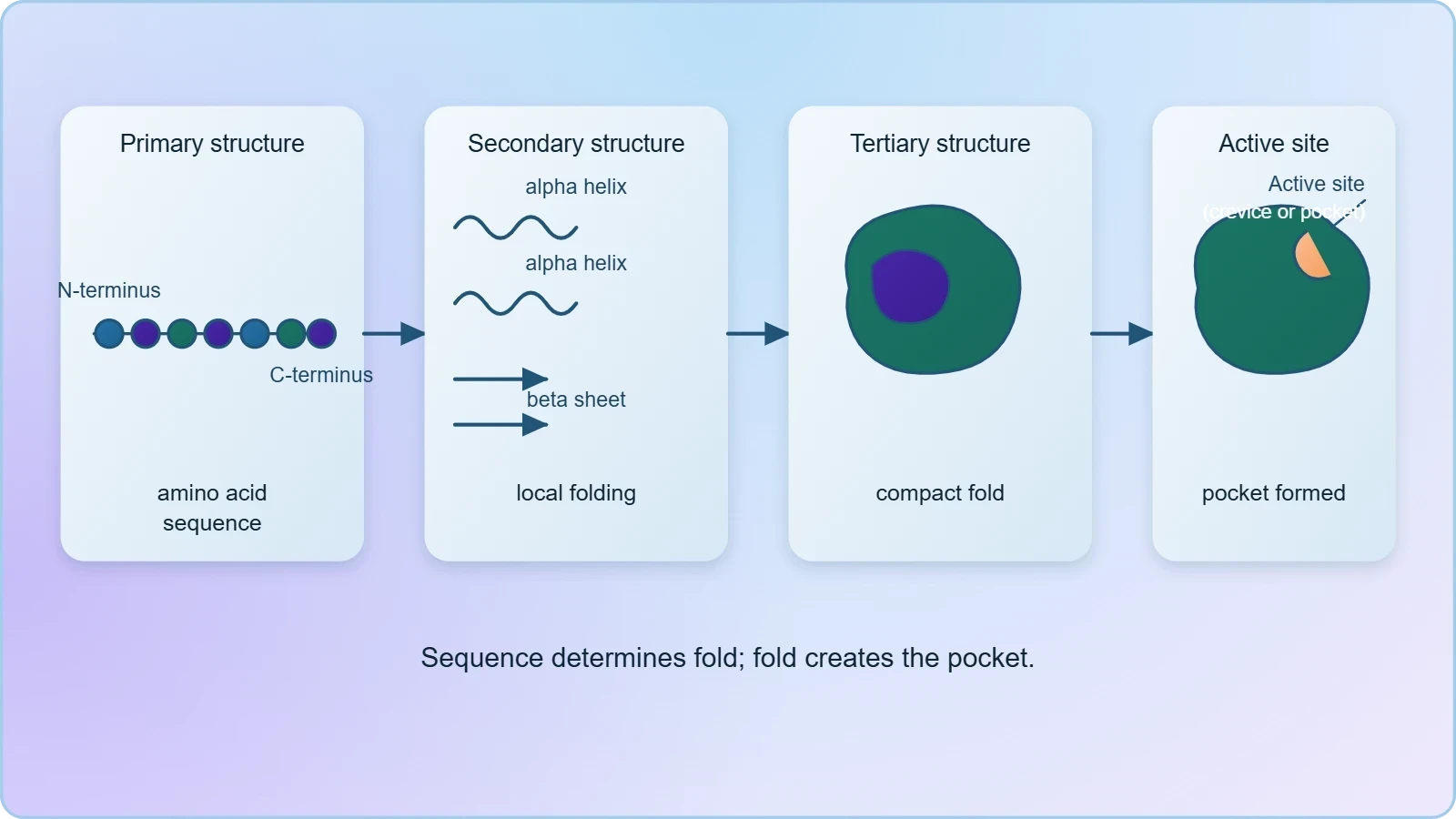
Almost all enzymes are proteins. This single sentence carries substantial weight, because it ties catalysis to the structural biology already covered. An enzyme, like any protein, has a primary structure — the amino acid sequence of the protein — and it also has secondary and tertiary structure. The catalytic capability of an enzyme is therefore not a property of its chemistry alone but of its architecture: the sequence dictates the fold, and the fold creates the functional surface. Recognising enzymes as proteins means recognising that anything which disrupts protein structure threatens catalysis itself.
The Protein Identity of Enzymes
Because enzymes are proteins, they inherit every structural level discussed earlier. The primary structure is the linear order of amino acids, running from the N-terminal amino acid to the C-terminal amino acid. Portions of the chain fold into right-handed helices and other secondary arrangements, and the long chain then folds upon itself like a hollow woollen ball to give the tertiary structure. That three-dimensional view is what matters here: tertiary structure is absolutely necessary for the many biological activities of proteins, and catalysis is foremost among those activities.
This continuity matters pedagogically. A learner who has just studied tertiary and quaternary structure already possesses the conceptual tools to understand why an enzyme works where it does. The chain criss-crosses itself, and in doing so it creates the surface geography on which catalysis depends. Quaternary structure, the arrangement of multiple folded subunits relative to one another, extends this logic to assemblies such as adult human haemoglobin, which consists of four subunits — two of α type and two of β type — though the catalytic lessons of this lesson rest chiefly on the tertiary fold.
Ribozymes: Nucleic Acids That Behave Like Enzymes
The rule that enzymes are proteins admits an exception worth stating plainly: there are some nucleic acids that behave like enzymes, and these are called ribozymes. The term itself is a compression of ribonucleic acid and enzyme, a naming convention that signals exactly what the molecule is — an RNA species possessing catalytic activity. For a beginner, the point is not to overturn the protein rule but to qualify it: protein catalysts dominate, yet catalysis is a capability that nucleic acids can also possess under the right structural circumstances.
Placing ribozymes beside proteins sharpens the definition of an enzyme. An enzyme is best understood as a catalyst of biological origin whose activity depends on a precise three-dimensional shape, whether that shape is built from amino acids or from nucleotides. The active-site logic developed in the next section applies to both: a folded molecule presents a pocket, and a substrate fits into it. Keeping ribozymes in view prevents the learner from equating "enzyme" too tightly with "protein" while still honouring the material's central claim that almost all enzymes are proteins.
The Active Site: A Pocket Built by Folding
When the tertiary structure is examined closely, the chain is seen to criss-cross itself, and hence many crevices or pockets are made. One such pocket is the active site. This is the material's central structural definition, and it deserves to be read slowly: the active site of an enzyme is a crevice or pocket into which the substrate fits. Enzymes, through their active site, catalyse reactions at a high rate. The active site is therefore not an abstract property but a physical feature of the folded molecule — a cavity with a particular shape, lined by particular chemical groups.
How the Fold Creates the Crevice
The logic runs directly from sequence to function. The amino acid sequence determines how the chain folds; the folding brings distant parts of the chain into proximity; and the resulting criss-crossing architecture leaves pockets on the surface and within the body of the molecule. The active site is one of these pockets, and its geometry is what allows a substrate to fit. Because the pocket arises from the tertiary fold, any change that alters the fold alters the pocket, and with it the enzyme's capacity to bind and catalyse.
This is why the phrase "tertiary structure is absolutely necessary" is not rhetorical. The catalytic power of an enzyme is inseparable from the three-dimensional arrangement of its chain. A learner should carry away a mental image: a long thread, folded into helices in places, folded upon itself overall, its surface interrupted by crevices. The active site is the most consequential of those crevices, the place where the chemistry of the substrate meets the chemistry of the enzyme and the reaction is accelerated.
Substrate Fit and Catalytic Rate
The active site's function is defined by fit. The substrate fits into the crevice or pocket, and through this interaction the enzyme catalyses reactions at a high rate. The material does not elaborate the binding mechanism here — that belongs to later study — but it establishes the essential relationship: pocket plus substrate equals catalysis at high rate. The rate enhancement is the observable consequence of the structural arrangement, and it is what distinguishes an enzyme-catalysed reaction from the same reaction run without the enzyme.
For the beginner, the important discipline is to keep structure and rate connected rather than treating them as separate topics. The active site is a structural feature; the high rate is its functional result. Every subsequent discussion of enzyme behaviour — temperature sensitivity, substrate specificity, catalytic efficiency — can be traced back to this pocket and the fold that creates it. The next section turns to the comparison that makes the enzyme's distinctiveness clearest: how it differs from an inorganic catalyst.
Enzyme Catalysts Versus Inorganic Catalysts
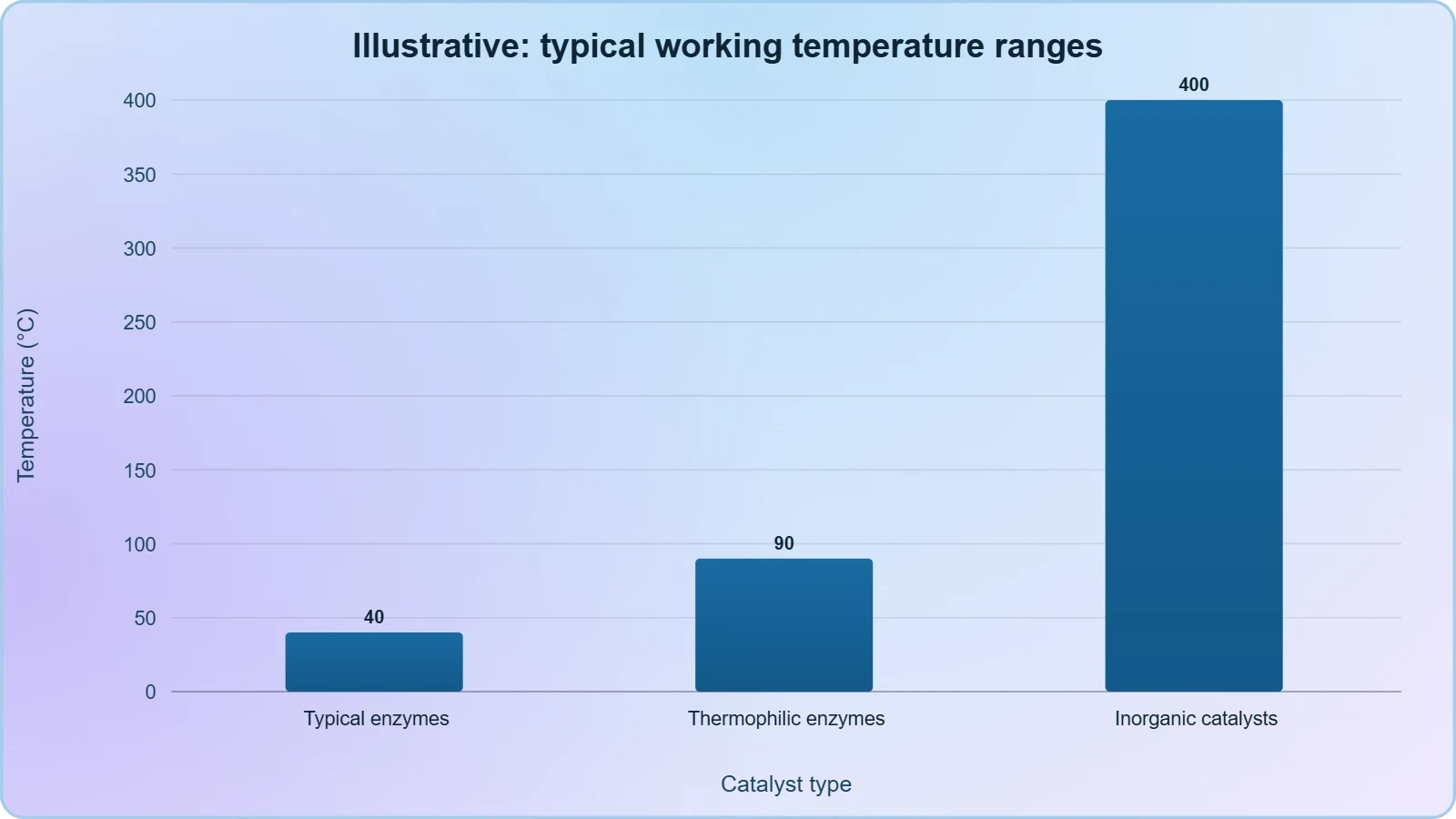
Enzyme catalysts differ from inorganic catalysts in many ways, but one major difference needs mention. Inorganic catalysts work efficiently at high temperatures and high pressures, while enzymes get damaged at high temperatures — say above 40°C. This contrast is the material's headline comparison, and it captures a fundamental difference in the conditions under which the two classes of catalyst operate. The inorganic catalyst thrives in harsh conditions; the enzyme, being a folded protein, is vulnerable to them, because heat can disrupt the very structure that creates its active site.
The Temperature and Pressure Contrast
The contrast is worth stating in operational terms. Industrial inorganic catalysis routinely proceeds at elevated temperature and pressure, conditions that would destroy most enzymes. Enzymes, by contrast, function within the moderate thermal range of living systems and are damaged above roughly 40°C. The reason is structural: an enzyme's activity depends on its tertiary fold, and heat threatens that fold. Where an inorganic catalyst's effectiveness may even improve with heat, an enzyme's effectiveness collapses once its structure is compromised.
This difference has practical consequences for how one thinks about biological catalysis. The enzyme is not a rugged mineral surface but a delicate molecular machine tuned to physiological conditions. Its sensitivity is not a defect but a consequence of its sophistication: the same folding that creates a precise active site also makes the molecule susceptible to thermal disruption. Understanding this prepares the learner for the temperature dependence of reaction rates discussed later, and for the thermophilic exception that follows.
Thermophilic Enzymes and Thermal Stability
The rule has a striking exception. Enzymes isolated from organisms that normally live under extremely high temperatures — for example, hot vents and sulphur springs — are stable and retain their catalytic power even at high temperatures, up to 80°–90°C. Thermal stability is thus an important quality of such enzymes isolated from thermophilic organisms. These enzymes achieve what ordinary enzymes cannot: they remain folded and functional in conditions that would damage their mesophilic counterparts.
This exception reinforces rather than undermines the structural argument. Thermophilic enzymes are still proteins whose activity depends on their fold; they simply possess folds that resist thermal disruption. The comparison with inorganic catalysts therefore becomes more nuanced: the general distinction holds, but the boundary is set by the enzyme's structural resilience rather than by a fixed temperature. For the learner, the takeaway is that thermal stability is a property of specific enzymes from specific organisms, not a universal feature of biological catalysis.
Chemical Reactions: Physical Change Versus Chemical Change
To understand enzymes, one must first understand a chemical reaction. Chemical compounds undergo two types of changes. A physical change simply refers to a change in shape without breaking of bonds; this is a physical process. Another physical process is a change in state of matter: when ice melts into water, or when water becomes a vapour, these are also physical processes. The defining criterion is bond integrity: as long as bonds are not broken, the change remains physical, however dramatic it may appear to the eye.
Defining the Chemical Reaction
When bonds are broken and new bonds are formed during transformation, this is called a chemical reaction. The material offers two illustrative equations. The first is inorganic: barium hydroxide reacting with sulphuric acid to yield barium sulphate and water. The second is organic: the hydrolysis of starch into glucose. In both cases, the rearrangement of bonds is what makes the change chemical rather than physical. The distinction is conceptual rather than merely descriptive, and it sets the stage for asking how fast such transformations proceed.
For the learner, the value of this definition lies in its precision. Melting ice changes appearance and state but preserves the water molecule; a chemical reaction does not. The hydrolysis of starch into glucose breaks glycosidic bonds and forms new ones, producing a genuinely different molecular species. Recognising this boundary is essential before discussing rate, because rate is a property of processes in general, but the enzyme's distinctive contribution is to the rate of chemical reactions specifically.
Rate as Product Formed per Unit Time
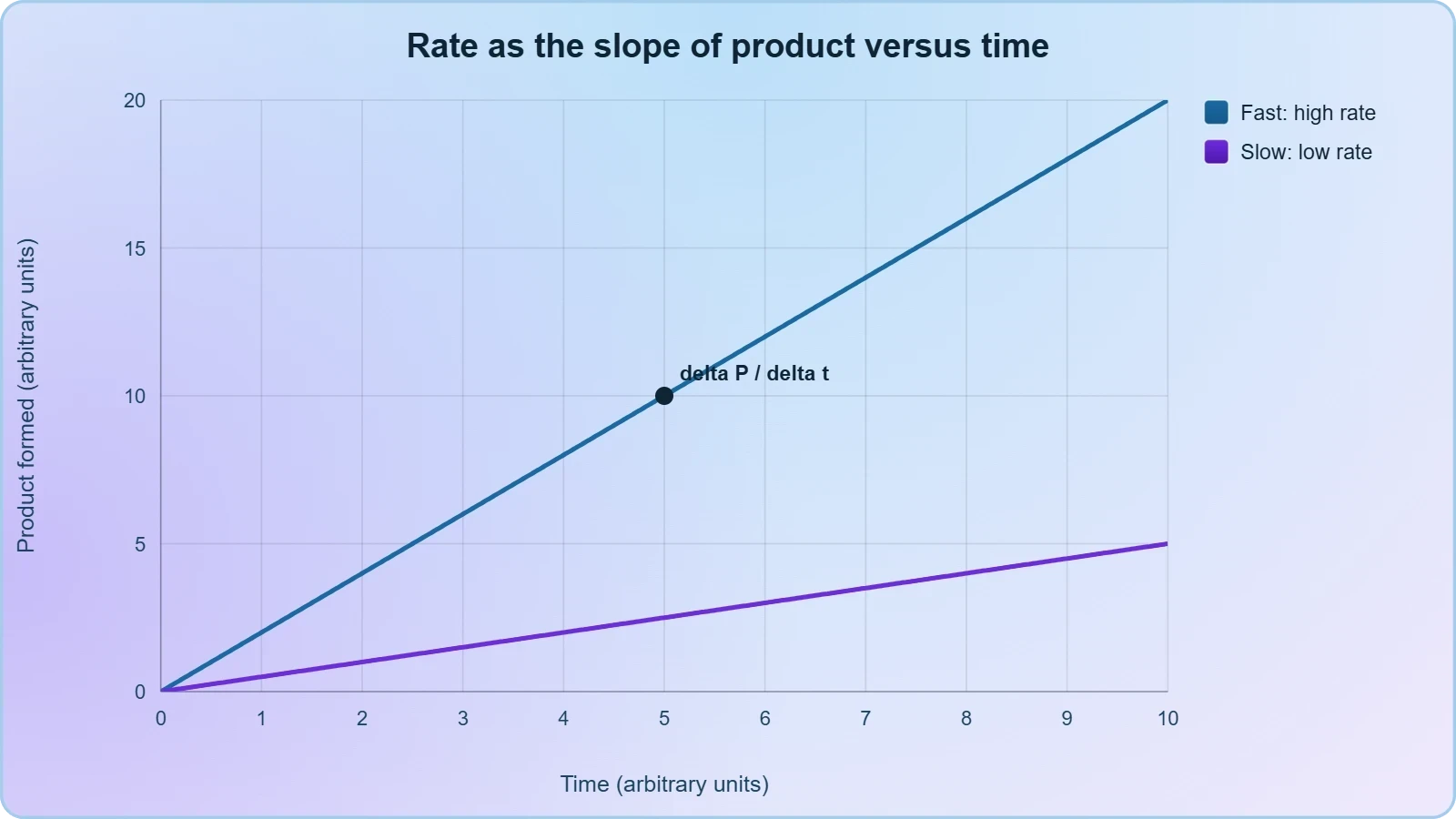
Rate of a physical or chemical process refers to the amount of product formed per unit time. The material expresses this compactly as the change in product divided by the change in time, written as a ratio of δP to δt. Rate can also be called velocity if the direction is specified. This definition is deliberately general: it applies to melting, to vaporisation, and to bond-rearranging reactions alike, which is why the material introduces it before turning to catalysis.
The formula rewards a moment's attention. The numerator is the amount of product formed; the denominator is the time taken. A larger numerator over the same time means a faster process, and the same product formed in less time likewise means a faster process. When the direction of the process is specified, the quantity may be called velocity. With this definition in hand, the learner can compare any two processes — catalysed and uncatalysed, warm and cold — on a single quantitative footing.
Temperature, Rate and the Carbonic Anhydrase Example
Rates of physical and chemical processes are influenced by temperature among other factors. A general rule of thumb is that rate doubles or decreases by half for every 10°C change in either direction. This rule gives the learner a usable quantitative intuition: warming a system by ten degrees roughly doubles its rate, and cooling it by ten degrees roughly halves it. The rule is explicitly a rule of thumb, an approximation rather than a law, but it captures the strong temperature dependence that characterises both physical and chemical processes.
The Ten-Degree Rule of Thumb
The rule's symmetry is worth noting: the same ten-degree interval produces a doubling in one direction and a halving in the other. This makes it a convenient mental tool for estimating how a process will respond to a change in thermal conditions. It also sets up the contrast with catalysis, because the rate enhancement produced by an enzyme is of an entirely different order from the modest factor-of-two changes produced by ten-degree temperature shifts. Catalysed reactions proceed at rates vastly higher than uncatalysed ones.
For the beginner, the important discipline is to keep the two effects distinct. Temperature modulates rate within a range; catalysis transforms the rate altogether. The ten-degree rule describes the former; the enzyme describes the latter. When enzyme-catalysed reactions are observed, the rate is vastly higher than the same reaction run without the enzyme. The carbonic anhydrase example makes this concrete, and it is the material's chosen illustration of catalytic power in action.
The Carbonic Anhydrase Reaction
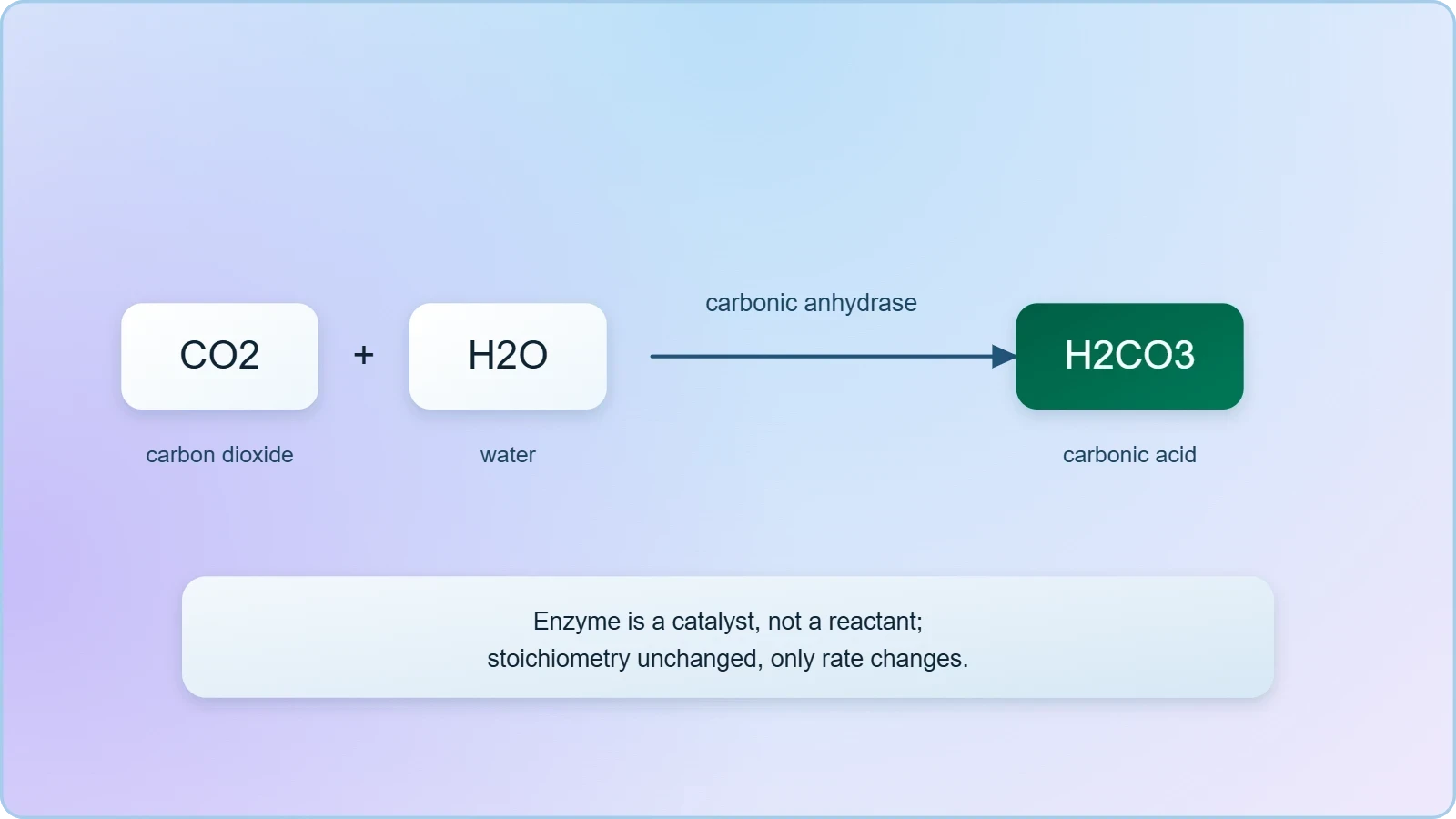
The example is the conversion of carbon dioxide and water into carbonic acid, catalysed by carbonic anhydrase. Written as an equation, carbon dioxide plus water yields carbonic acid, with carbonic anhydrase named above the arrow as the catalyst. The uncatalysed reaction proceeds slowly; the enzyme-catalysed reaction proceeds at a vastly higher rate. This single example carries the lesson's central claim about catalysis: the enzyme does not change the reactants or the products, but it transforms the speed at which the transformation occurs.
Read the equation carefully. On the left are carbon dioxide and water; on the right is carbonic acid. The arrow carries the enzyme's name, marking it as the catalyst rather than a reactant. Nothing about the stoichiometry changes; only the rate does. This is the cleanest possible demonstration of what an enzyme contributes, and it prepares the learner for the next lesson, which asks how enzymes bring about such high rates through metabolic pathways.
Rate Enhancement and the Limits of This Lesson
The material's treatment of rate is deliberately economical, and its economy is instructive. It defines rate, states the ten-degree rule of thumb, and asserts that catalysed reactions proceed at rates vastly higher than uncatalysed ones. It then offers carbonic anhydrase as the demonstration. What it does not do is explain the mechanism by which the enzyme achieves that enhancement. That omission is not an oversight but a boundary: the lesson establishes the phenomenon, and the following lesson explains how enzymes bring about such high rates within metabolic pathways.
What the Active Site Explains and What It Does Not
The active site explains where catalysis happens: in a crevice or pocket into which the substrate fits. It explains why enzymes are sensitive to heat: the pocket depends on the tertiary fold, and heat threatens that fold. It explains why thermophilic enzymes are remarkable: their folds resist what would damage ordinary enzymes. What it does not yet explain is the detailed chemistry of how the pocket accelerates bond rearrangement. That is the next lesson's territory, and the learner should approach it with the structural picture already firmly in place.
This division of labour is pedagogically sound. A learner who tries to absorb mechanism before structure tends to memorise without understanding. A learner who first grasps that the enzyme is a folded protein with a pocket, that the pocket admits the substrate, and that the result is a vastly higher rate, has the conceptual scaffolding on which mechanism can be built. The carbonic anhydrase equation is the anchor: reactants on the left, product on the right, enzyme above the arrow, rate transformed.
Preparing for Metabolic Pathways
The next lesson, on metabolic pathways and how enzymes bring about high rates, will take the active site as given and ask how it achieves its effect. The learner arriving with this lesson's vocabulary — active site, substrate, crevice or pocket, tertiary structure, rate, carbonic anhydrase — will find that discussion far more accessible. The material's order of ideas is itself a curriculum: structure first, then the active site, then the comparison with inorganic catalysts, then the definition of chemical reaction and rate, then the worked example.
That order repays respect. Each element prepares the next: the protein structure of the previous lesson prepares the active site; the active site prepares the comparison with inorganic catalysts; the definition of chemical reaction prepares the definition of rate; and the rate definition prepares the carbonic anhydrase example. A learner who follows the sequence arrives at the end of this lesson with a coherent, bounded understanding of what an enzyme is and what it does, ready to ask the mechanistic question that follows.
Going further
The name ribozyme combines ribonucleic acid and enzyme, reflecting that it is an RNA molecule with catalytic activity. This naming convention is a useful memory aid: the word itself announces the molecule's dual identity as a nucleic acid and a catalyst. It also reminds the learner that the boundary between "structural" nucleic acids and "catalytic" proteins is not absolute, and that RNA can, under the right folded circumstances, perform the kind of pocket-based catalysis described in this lesson.
Carbonic anhydrase helps remove carbon dioxide from tissues by converting it to carbonic acid. This physiological role gives the lesson's worked example a biological purpose beyond the equation: the enzyme's catalytic power is deployed to manage carbon dioxide in the body, converting it into a form that can be transported and processed. The reaction is therefore not an arbitrary illustration but a genuine physiological process, and the rate enhancement it displays is what makes the process effective at the pace living systems require.
Also Read
- No links available.
From our network :
- Mastering DB2 12.1 Instance Design: A Technical Deep Dive into Modern Database ArchitectureComprehensive guide to DB2 12.1 Instance Design. Explore architectural components, HADR setup, buffer pool tuning, and security policies for IBM DB2 12.1. Includes 10 functional SQL and Shell samples.
- 98% of Global MBA Programs Now Prefer GRE Over GMAT Focus EditionExplore why 98% of global MBA programs now prefer the GRE over GMAT Focus. Learn about the shorter GRE format, verbal logic importance, and strategic versatility for students.
- 10 Physics Numerical Problems with Solutions for IIT JEEPrepare for IIT JEE with 10 physics numerical problems, complete with detailed solutions and conceptual explanations. Ideal for mastering kinematics, thermodynamics, electromagnetism, and optics.
- Analyzing Trump Deportation Numbers Insights Into The 2026 Immigration Crackdown
- Trump Political Strategy How Geopolitical Stunts Serve As Media Diversions
- EV 2.0: The Solid-State Battery Breakthrough and Global Factory ExpansionDiscover the impact of the Solid-State Battery Breakthrough on the EV market. Learn about CATL and BYD stock growth, global factory expansion in Europe, and the future of EV 2.0 technology.
- Vite 6/7 'Cold Start' Regression in Massive Module GraphsIn-depth analysis of Vite 6/7 cold start regressions in massive module graphs. Learn about barrel file issues, pre-bundling optimizations, and how to improve Vite dev server performance.
- AI-Powered 'Precision Diagnostic' Replaces Standard GRE Score ReportsDiscover the new GRE Precision Diagnostic. Learn how AI-powered behavioral analytics and time-to-solve tracking are replacing standard GRE score reports to empower students.
- Mastering DB2 LUW v12 Tables: A Comprehensive Technical GuideComprehensive guide on DB2 LUW v12 tables. Explore CREATE TABLE syntax, BLU Acceleration, range partitioning, data types, and security features for IBM DB2 LUW v12.
RESOURCES
- The Central Role of Enzymes as Biological Catalysts - The Cell - NCBIncbi.nlm.nih.gov... enzymes—catalysts that increase the rate of virtually all the chemical reactions within cells ... active site of the enzyme and the reaction proceeds.…
- Structure and function of GDP-mannose-3',5'-epimerase - PubMedpubmed.ncbi.nlm.nih.govDec 28, 2005 ... Structure and function of GDP-mannose-3',5'-epimerase: an enzyme which performs three chemical reactions at the same active site · Authors.
- Biochemistry, Proteins Enzymes - StatPearls - NCBI Bookshelf - NIHncbi.nlm.nih.gov... enzyme in which a substrate binds to facilitate the catalyzed chemical reaction. ... chemistry of the active site on the enzyme. This means…
- Learn: Enzymes and the active site (article) - Khan Academykhanacademy.orgThe answer depends on the enzyme. Some enzymes speed up chemical reactions by bringing two substrates together in the right orientation. Others create an ...
- Enzyme Active Site - an overview | ScienceDirect Topicssciencedirect.comThe enzyme active site is defined as the specific region of an enzyme where substrate molecules bind, facilitating chemical reactions by lowering activation ...
- Enzymes: Moving at the Speed of Life - American Chemical Societyacs.orgEach enzyme molecule has a special place called the active site where another molecule, called the substrate, fits. ... Enzymes let chemical reactions in…
- 2.7.2: Enzyme Active Site and Substrate Specificitybio.libretexts.orgThere may be one or more substrates for each type of enzyme, depending on the particular chemical reaction. In some reactions, a single-reactant substrate…
- Function Of Enzymes In Catalyzing Biological Reactions - Jack Westinjackwestin.comEnvironmental conditions can affect an enzyme's active site and, therefore, the rate at which a chemical reaction can proceed. ... If the enzyme changes…
- Active site - Wikipediaen.wikipedia.orgIn biology and biochemistry, the active site is the region of an enzyme where substrate molecules bind and undergo a chemical reaction. The active…
- 6.10: Enzymes - Active Site and Substrate Specificitybio.libretexts.orgEnzymes catalyze chemical reactions by lowering activation energy barriers and converting substrate molecules to products.
- Stanford researchers map electric fields to help unravel how ...humsci.stanford.eduJul 26, 2022 ... In particular, scientists want to know what makes enzymes' active sites—the pocket-like region where the sped-up chemical reactions take place— ...
- Chemical Reactions and Enzymes - Enfield High Schoolenfieldhigh.sharpschool.comThe substrates bind to the enzyme on the active site. Page 29. Lesson Overview. Chemical Reactions and Enzymes. Enzymes. An enzyme-catalyzed reaction… ▫ The ...
- How is Gain Therapeutics targeting allosteric sites to create novel ...gaintherapeutics.comThe substrate must bind the active site, like a key in a lock, before any chemical reaction can take place. For some enzymes, this…
- Mechanism and Catalytic Site Atlas (M-CSA): a database of enzyme ...pmc.ncbi.nlm.nih.govNov 2, 2017 ... ... enzyme active sites and reaction mechanisms that can be ... Enzymes are the macromolecules that catalyze the chemical reactions…
- Generating new enzymes with complex active sites - Baker Labbakerlab.orgFeb 13, 2025 ... What is enzyme design? Enzymes are proteins that accelerate chemical reactions under mild conditions, far outperforming what even the best…