Every living cell runs thousands of chemical conversions each second, and almost none of them would proceed at a useful pace on their own. The chemistry of life is governed by molecules that are stable enough to persist but reactive enough to be transformed, and that tension is resolved by enzymes. This lesson examines two connected ideas: how individual enzyme-catalysed steps are strung together into metabolic pathways, and how enzymes lower the energy barrier that stands between a substrate and its product. The glucose-to-pyruvic-acid pathway serves as the central illustration, because it shows how a single sequence of reactions can branch into lactic acid, pyruvic acid or ethanol depending on conditions.
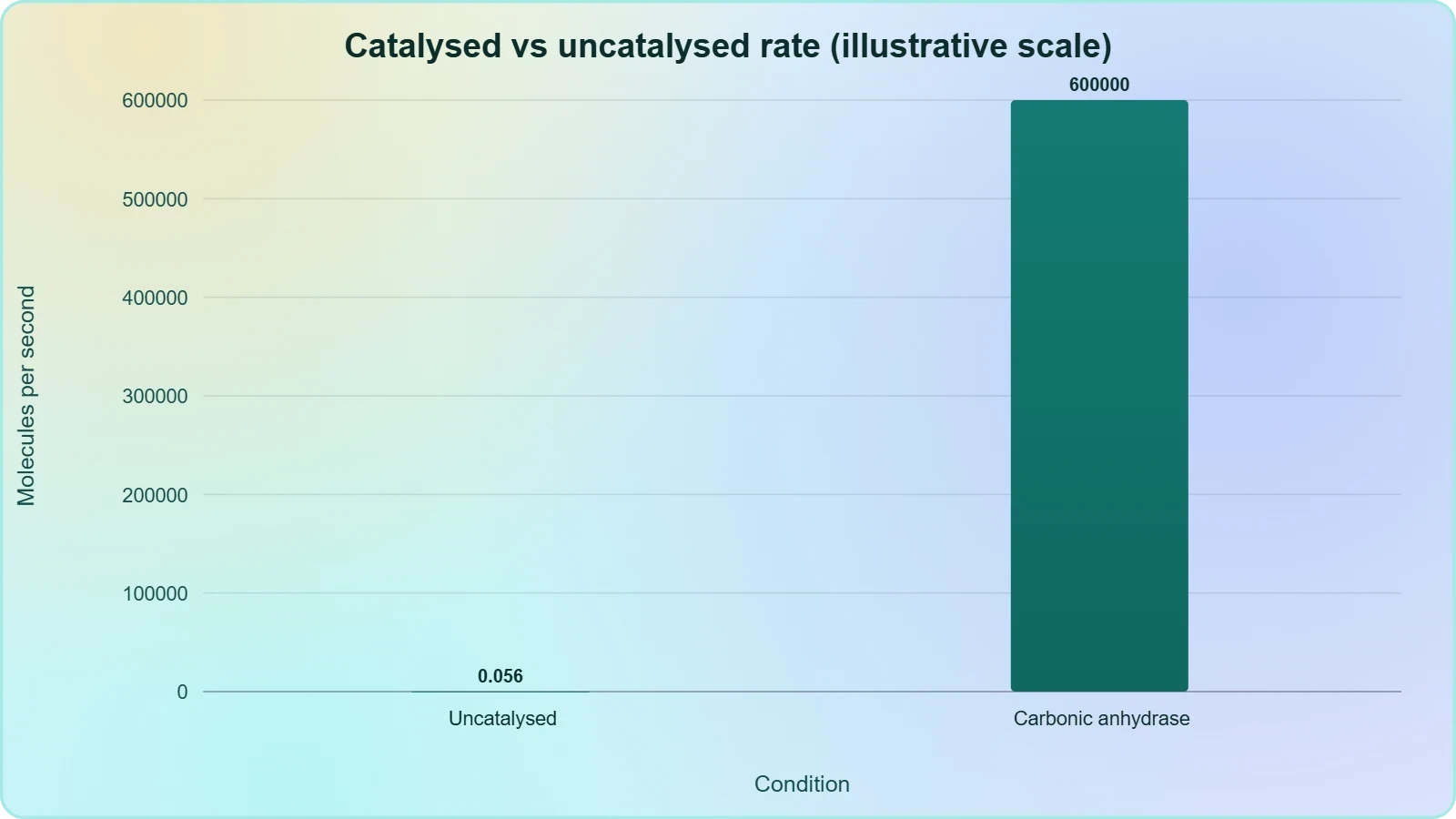
The quantitative case for enzyme power is startling. Without catalysis, the hydration of carbon dioxide proceeds at roughly 200 molecules per hour; with carbonic anhydrase present in the cytoplasm, about 600,000 molecules form every second. That is an acceleration of approximately ten million times, and it establishes the scale at which enzyme catalysis operates. From there, the lesson turns to the enzyme-substrate complex, the transient transition state, and the activation energy barrier that enzymes lower without altering the overall energy difference between substrate and product. These concepts prepare the ground for the following lesson on the nature of enzyme action and the factors that modify enzyme activity.
Understanding this material requires attention to three layers: the pathway as a whole, the individual catalytic event, and the energetic bookkeeping that connects them. A pathway is not a vague sequence but a defined set of steps, each catalysed by a specific enzyme or enzyme complex. The catalytic event itself involves binding, structural adjustment and bond rearrangement within a pocket on the protein. The energetics explain why the reaction needs help at all, and why the help does not change the destination, only the route. Held together, these three layers give a working picture of how metabolism achieves high rates under physiological conditions.
On This Page
The Scale of Enzyme Catalysis and the Definition of a Metabolic Pathway
The starting point for any discussion of metabolic pathways is the sheer magnitude of enzyme acceleration. The uncatalysed hydration of carbon dioxide is not a hypothetical slow reaction; it is a measured baseline of about 200 molecules of carbonic acid formed per hour. Introducing carbonic anhydrase, an enzyme found within the cytoplasm, raises the output to roughly 600,000 molecules per second. Converting units makes the comparison vivid: the enzyme accelerates the reaction rate by about ten million times. This figure is the clearest available demonstration that enzymes are not minor facilitators but the principal reason biochemical reactions occur on biologically relevant timescales.
From Single Reactions to Ordered Sequences
Thousands of types of enzymes exist, each catalysing a unique chemical or metabolic reaction. When a multistep chemical reaction has each of its steps catalysed by the same enzyme complex or by different enzymes, the sequence is called a metabolic pathway. The definition matters because it distinguishes a pathway from a mere collection of reactions: the steps are ordered, each one catalysed, and the product of one step becomes the substrate of the next. This arrangement allows a cell to control flux at multiple points and to route intermediates toward different destinations as circumstances demand.
The canonical example is the conversion of glucose to pyruvic acid, summarised as glucose yielding two molecules of pyruvic acid. Written with formulae, the overall transformation is C6H12O6 + O2 → 2C3H4O3 + 2H2O. This is not a single event but a metabolic pathway in which glucose becomes pyruvic acid through ten different enzyme-catalysed reactions. The number ten is worth holding onto: it illustrates how a modest overall change in molecular structure is decomposed into a series of small, controllable, enzyme-managed steps rather than one improbable leap.
Branching Outcomes Under Different Conditions
The same pathway, with one or two additional reactions, gives rise to a variety of metabolic end products. In skeletal muscle under anaerobic conditions, lactic acid is formed. Under normal aerobic conditions, pyruvic acid is formed. In yeast during fermentation, the same pathway leads to the production of ethanol, or alcohol. The lesson to draw is that different conditions yield different products from a shared sequence of reactions. The pathway is conserved; the fate of its endpoint is conditional. This is a fundamental principle of metabolic organisation, and it explains why the same starting material can support radically different physiological outcomes.
The Enzyme-Substrate Complex and the Transition State
To understand how enzymes achieve such high rates, the catalytic event itself must be examined closely. The chemical or metabolic conversion refers to a reaction, and the chemical that is converted into a product is called a substrate. Enzymes are proteins with three-dimensional structures that include an active site, and they convert a substrate (S) into a product (P). Symbolically this is written as S → P. The substrate must bind the enzyme at its active site within a given cleft or pocket, which means the substrate has to diffuse toward that site. There is therefore an obligatory formation of an enzyme-substrate complex, abbreviated ES, where E stands for enzyme.
Binding, Transformation and Release
The formation of the ES complex is a transient phenomenon. While the substrate is bound to the active site, a new structure of the substrate called the transition state structure is formed. Very soon afterward, once the expected bond breaking and bond making is completed, the product is released from the active site. In other words, the structure of the substrate is transformed into the structure of the product or products. The pathway of this transformation must pass through the transition state structure. This sequence, binding then transformation then release, is the physical core of catalysis and the reason the ES complex is indispensable.
There could be many more altered structural states between the stable substrate and the product. Implicit in this statement is the fact that all other intermediate structural states are unstable. Stability is something related to the energy status of the molecule or the structure, so the instability of intermediates is an energetic statement rather than a comment on their fleeting existence alone. The substrate does not glide smoothly from one stable form to another; it climbs through a region of elevated energy before descending to the product. This is why a graph of potential energy against progress of reaction is the natural way to represent the process.
Reading the Energy Diagram
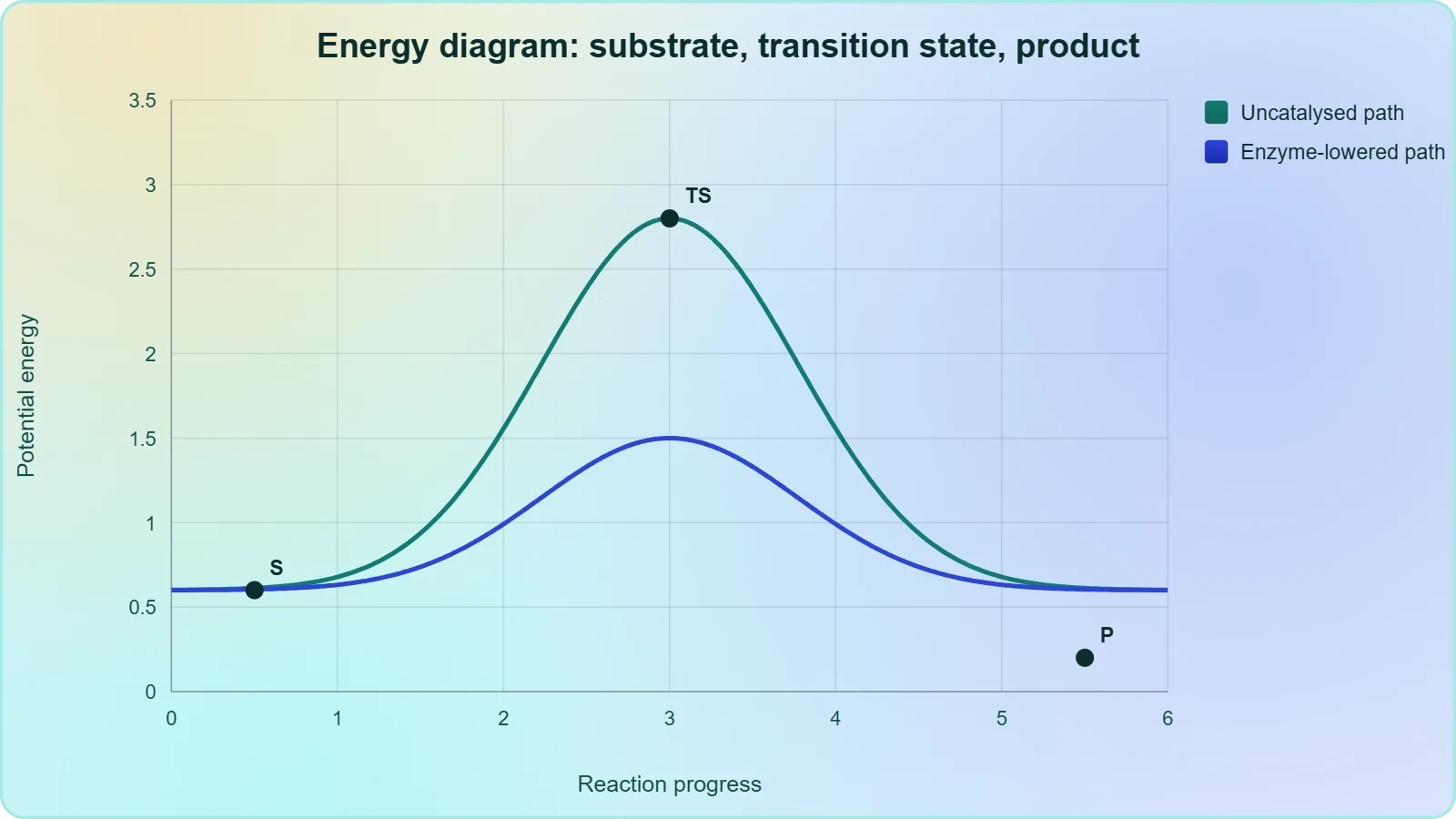
In the energy diagram, the y-axis represents the potential energy content and the x-axis represents the progression of the structural transformation, or states, through the transition state. Two features deserve attention. The first is the energy level difference between S and P. If P is at a lower level than S, the reaction is an exothermic reaction, and one need not supply energy by heating in order to form the product. The second is the peak itself. Whether the reaction is exothermic and spontaneous or endothermic and energy requiring, the substrate has to go through a much higher energy state, the transition state.
The difference in average energy content of S from that of this transition state is called the activation energy. This quantity is the barrier that stands between reactant and product, and it is the target of enzyme action. Enzymes eventually bring down this energy barrier, making the transition of S to P more easy. Crucially, lowering the barrier does not change the energy levels of S and P themselves; the overall energy difference, and therefore whether the reaction releases or requires energy, remains as it was. The enzyme changes the height of the climb, not the altitude of the destination.
Quantifying the Activation Energy Barrier
The activation energy is defined as the difference in average energy content between the substrate and the transition state. It can be expressed compactly as a difference of two energy levels, which makes the concept precise enough to calculate with. The enzyme does not remove this difference entirely; it reduces it, and the reduction is what translates into a faster rate. The relationship between barrier height and rate is exponential, so even a modest lowering of the barrier produces a large increase in the number of molecules that can surmount it in a given time.
For the carbon dioxide hydration reaction, the practical consequence of barrier reduction is the jump from about 200 molecules per hour to about 600,000 molecules per second. The overall energy difference between substrate and product is untouched by the enzyme, which is why the reaction remains the same reaction. What changes is the height of the hurdle that each molecule must clear. A useful way to hold both ideas together is to write the catalysed and uncatalysed barriers side by side and note that the catalysed barrier is smaller while the endpoints are identical.
Why the Barrier Matters More Than the Overall Energy Change
A reaction that releases energy is not automatically a fast reaction. The energy diagram makes this clear: even when P sits lower than S, the substrate must still pass over the transition state peak, and that peak may be high. The activation energy, not the overall energy difference, governs how many molecules can make the crossing at any moment. This is why enzymes are needed even for reactions that are thermodynamically favourable. The cell cannot simply wait for spontaneous conversion; it must lower the barrier so that conversion happens on a timescale compatible with life.
The distinction also explains why enzymes are described as bringing down the energy barrier rather than supplying energy. Supplying energy, for instance by heating, would raise the average energy of all molecules indiscriminately and could damage the cell. Lowering the barrier is a targeted intervention that affects only the specific reaction being catalysed. The enzyme therefore achieves high rates without disturbing the surrounding chemistry, which is precisely the kind of control a living system requires. This is the conceptual bridge to the next lesson, where the nature of enzyme action is examined in finer detail.
Connecting Energetics to Pathway Design
When a pathway contains ten enzyme-catalysed steps, each step has its own activation energy and its own enzyme to lower it. The pathway as a whole therefore proceeds at a rate set by its individual steps, and the cell can regulate flux by adjusting the enzymes at particular points. This is why metabolic pathways are described as ordered sequences of catalysed reactions rather than as single transformations. The energetics of each step, and the barrier-lowering role of each enzyme, together determine how quickly the entire sequence runs and where it can be slowed or accelerated.
The glucose-to-pyruvic-acid pathway illustrates the point at scale. Ten reactions, each with its own enzyme, carry glucose through a series of intermediate structural states toward pyruvic acid. The branching outcomes, lactic acid in anaerobic muscle, pyruvic acid under aerobic conditions, and ethanol in fermenting yeast, arise from additional reactions appended to the same core sequence. The energetics of the core steps remain the framework; the conditions determine which branch is taken. Pathway design and barrier lowering are thus two aspects of a single organising principle in metabolism.
The Catalytic Cycle: From ES Complex to Released Product
Each enzyme has a substrate binding site in its molecule so that a highly reactive enzyme-substrate complex is produced. This complex is short-lived and dissociates into its product or products and the unchanged enzyme, with an intermediate formation of the enzyme-product complex, abbreviated EP. The formation of the ES complex is essential for catalysis. The overall cycle can be written as E + S forming ES, which proceeds to EP, which then yields E + P. The enzyme emerges unchanged, which is why a single enzyme molecule can catalyse many rounds of the same reaction.
The Three Steps of the Catalytic Cycle
The catalytic cycle of an enzyme action can be described in three steps. First, the substrate binds to the active site of the enzyme, fitting into the active site. Second, the binding of the substrate induces the enzyme to alter its shape, fitting more tightly around the substrate. Third, the active site of the enzyme, now in close proximity to the substrate, breaks the chemical bonds of the substrate and the new enzyme-product complex is formed. These three steps describe the physical events that underlie the abstract S → P notation and connect the structural picture to the energetic one.
The second step deserves emphasis because it shows that the enzyme is not a rigid template. The binding of the substrate induces a change in the enzyme's shape, allowing it to fit more tightly around the substrate. This tighter fit brings catalytic groups into the correct position and helps strain the bonds that must be broken. The third step then completes the transformation: bonds are broken, new bonds are made, and the enzyme-product complex forms. The product is subsequently released, leaving the enzyme free to begin another cycle with a fresh substrate molecule.
Why the Cycle Must Be Transient
The ES complex is short-lived by design. If the enzyme held its substrate too tightly, the product would never be released and the enzyme would be permanently occupied, unable to catalyse further rounds. The transient nature of the complex is therefore a functional requirement, not an incidental detail. The cycle moves from ES to EP to free enzyme and product, and each transition is governed by the same energetic considerations discussed earlier. The enzyme lowers the barrier for each step while ensuring that the overall sequence remains reversible in principle and repeatable in practice.
The unchanged enzyme at the end of the cycle is the key to the high rates observed in cells. A single molecule of carbonic anhydrase can process substrate repeatedly, which is how a modest number of enzyme molecules sustains the formation of about 600,000 molecules of carbonic acid per second. The catalytic cycle is thus the mechanism that converts the barrier-lowering property of an enzyme into a sustained, high-throughput reaction rate. The next lesson examines the nature of enzyme action and the factors that affect enzyme activity, building directly on this cycle.
Pathway Logic and the Control of Metabolic Flux
A metabolic pathway is defined by the requirement that each step be catalysed, whether by the same enzyme complex or by different enzymes. This requirement is what allows a cell to regulate the pace of a sequence at multiple points. If every step were uncatalysed, the pathway would proceed at whatever rate the chemistry allowed, with no opportunity for adjustment. Because each step has its own enzyme, the cell can increase or decrease the amount or activity of particular enzymes and thereby direct the flow of intermediates toward the products it needs at that moment.
Shared Sequences and Conditional Endpoints
The glucose-to-pyruvic-acid pathway demonstrates how a shared sequence can serve multiple physiological purposes. The core ten reactions are common, but the endpoint depends on conditions: lactic acid in anaerobic skeletal muscle, pyruvic acid under normal aerobic conditions, and ethanol in yeast during fermentation. The pathway is therefore best understood as a trunk with conditional branches rather than a single fixed route. This architecture is economical, because the cell does not need to build an entirely separate sequence for each product; it reuses the core and appends the reactions appropriate to the situation.
The phrase one or two additional reactions is significant. It indicates that the divergence between outcomes is achieved with minimal additional machinery, which is consistent with the broader economy of metabolism. The same principle appears throughout biochemistry: a relatively small number of core pathways, each with a modest set of branch reactions, generates a large variety of end products. Recognising this pattern helps the learner see metabolic maps not as chaotic webs but as organised systems with shared trunks and regulated branches, each step catalysed and each branch conditional.
Preparing for the Next Lesson
The present lesson has established the pathway concept, the enzyme-substrate complex, the transition state, the activation energy barrier and the catalytic cycle. The next lesson examines the nature of enzyme action and the factors that affect enzyme activity, which requires all of these ideas as prerequisites. In particular, the notion that the enzyme alters its shape on binding, and the notion that the barrier is lowered rather than removed, will be essential when considering how temperature, pH and substrate concentration influence the rate of an enzyme-catalysed reaction.
It is worth consolidating the numbers and definitions before moving on. The uncatalysed rate of carbon dioxide hydration is about 200 molecules per hour; the catalysed rate is about 600,000 molecules per second; the acceleration is about ten million times. A metabolic pathway is a multistep chemical reaction in which each step is catalysed by the same enzyme complex or by different enzymes. The activation energy is the difference in average energy content between the substrate and the transition state. These statements form a compact summary of the lesson and a reliable foundation for what follows.
Going Further
A metabolic pathway behaves much like a factory assembly line. Each station performs one operation, and the partially finished item moves to the next station rather than being completed in a single act. The analogy clarifies why pathways are built from many catalysed steps: specialisation at each station allows precision, and it allows the line to be slowed or sped up at particular points without halting everything. It also explains why a single missing enzyme can disrupt an entire sequence, because the item cannot move past the station that is not working.
Activation energy is the energy needed to start a reaction, even when the overall reaction releases energy. A boulder perched above a valley illustrates the point: gravity will eventually bring it down, but a ridge must first be crossed. Enzymes lower that ridge. This is why a thermodynamically favourable reaction can still be slow in the absence of catalysis, and why the presence of the right enzyme is often the difference between a reaction that happens on a biological timescale and one that effectively does not happen at all.
Also Read
- No links available.
From our network :
- Mastering DB2 LUW v12 Tables: A Comprehensive Technical GuideComprehensive guide on DB2 LUW v12 tables. Explore CREATE TABLE syntax, BLU Acceleration, range partitioning, data types, and security features for IBM DB2 LUW v12.
- Mastering DB2 12.1 Instance Design: A Technical Deep Dive into Modern Database ArchitectureComprehensive guide to DB2 12.1 Instance Design. Explore architectural components, HADR setup, buffer pool tuning, and security policies for IBM DB2 12.1. Includes 10 functional SQL and Shell samples.
- Analyzing Trump Deportation Numbers Insights Into The 2026 Immigration Crackdown
- Trump Political Strategy How Geopolitical Stunts Serve As Media Diversions
- AI-Powered 'Precision Diagnostic' Replaces Standard GRE Score ReportsDiscover the new GRE Precision Diagnostic. Learn how AI-powered behavioral analytics and time-to-solve tracking are replacing standard GRE score reports to empower students.
- Vite 6/7 'Cold Start' Regression in Massive Module GraphsIn-depth analysis of Vite 6/7 cold start regressions in massive module graphs. Learn about barrel file issues, pre-bundling optimizations, and how to improve Vite dev server performance.
- 98% of Global MBA Programs Now Prefer GRE Over GMAT Focus EditionExplore why 98% of global MBA programs now prefer the GRE over GMAT Focus. Learn about the shorter GRE format, verbal logic importance, and strategic versatility for students.
- EV 2.0: The Solid-State Battery Breakthrough and Global Factory ExpansionDiscover the impact of the Solid-State Battery Breakthrough on the EV market. Learn about CATL and BYD stock growth, global factory expansion in Europe, and the future of EV 2.0 technology.
- 10 Physics Numerical Problems with Solutions for IIT JEEPrepare for IIT JEE with 10 physics numerical problems, complete with detailed solutions and conceptual explanations. Ideal for mastering kinematics, thermodynamics, electromagnetism, and optics.
RESOURCES
- The Central Role of Enzymes as Biological Catalysts - The Cell - NCBIncbi.nlm.nih.gov... enzyme, thereby lowering the required energy of activation. Figure 2.24 ... metabolic pathway inhibits the activity of an enzyme involved in its synthesis.
- Basics of Metabolic Reactions - PMC - NIHpmc.ncbi.nlm.nih.govEnzymes lower the activation energy to increase the rate of reaction but not ... ENZYMES CATALYZE METABOLIC PATHWAYS. Enzymes can be either a protein…
- Energy metabolism in health and diseases - Naturenature.comFeb 18, 2025 ... Activation of mTORC1 enhances metabolic pathways ... Mitochondrial energy metabolism disorders, such as decreased TCA cycle enzyme activity ...
- Enzymes: principles and biotechnological applications - PMC - NIHpmc.ncbi.nlm.nih.gov... energy levels of either the reactant or the product. Figure 3. Effect of an enzyme on reducing the activation energy required to start…
- 6.5 Enzymes - Biology 2e | OpenStaxopenstax.orgMar 28, 2018 ... ... biochemical reactions are controlled by activation energy, and enzymes ... enzyme's active site, effectively blocking this metabolic pathway.
- Protein acetylation effects on enzyme activity and metabolic pathway ...pubmed.ncbi.nlm.nih.govHence, it has been suggested that this covalent modification is a mechanism that might regulate diverse metabolic pathways by modulating enzyme activity, ...
- Enzymes and Metabolic Pathways - De Anza Collegedeanza.eduAbility of enzymes to lower activation energy due to structure. • Each type of enzyme has has a highly-ordered, characteristic 3-dimensional shape.
- Interaction between glutamate dehydrogenase (GDH) and L-leucine ...pubmed.ncbi.nlm.nih.govInteraction between glutamate dehydrogenase (GDH) and L-leucine catabolic enzymes: intersecting metabolic pathways ... Enzyme Activation / physiology ...
- Metabolic Pathways, Enzymes, and Metabolites - MDPImdpi.comOct 27, 2022 ... ... energy metabolism might reveal underlying molecular processes ... Cellular Targets for Activation by C-Myc Include the DNA Metabolism Enzyme ...
- Differential temperature sensitivity of intracellular metabolic ... - BGbg.copernicus.orgJun 16, 2023 ... ... enzyme activity, and between 26 and 37 ∘C extracellular enzyme activity was more temperature sensitive than intracellular metabolic processes.
- An enzyme activation network reveals extensive regulatory crosstalk ...link.springer.comMay 22, 2025 ... Enzyme activation can thus occur throughout metabolism, covering the majority of the metabolic pathways ... energy. Mol Cell 39:809–820. O ...
- General Biology Study Guide: Metabolic Pathways & Enzymes | Notespearson.comSucrase – catalyzes the hydrolysis of sucrose. Enzymes lower the activation energy needed for a reaction to occur, allowing reactions to proceed at cellular ...
- 4.1 Energy and Metabolism – Concepts of Zoology – Hawaiʻi Editionpressbooks-dev.oer.hawaii.eduSince the rates of biochemical reactions are controlled by activation energy, and enzymes ... Feedback Inhibition in Metabolic Pathways. Molecules can regulate ...
- Energy and Metabolism | Biology I - Lumen Learningcourses.lumenlearning.comIt is important to know that the chemical reactions of metabolic pathways do not take place on their own. Each reaction step is assisted…
- Microbial Metabolism: Catabolism, Anabolism, and Enzymes - Quizletquizlet.comJul 5, 2025 ... They significantly lower the activation energy required for reactions, thus speeding up the rate of metabolic processes. Enzymes are typically ...