Every living tissue is, at bottom, a chemical archive. Long before molecular biology had a name, investigators were grinding up plant and animal material, extracting it with water and with acid, and asking a deceptively simple question: what is actually inside? The answer turned out to be thousands upon thousands of organic compounds — amino acids, sugars, fatty acids, nucleotides, and a vast additional population of substances that appear in some organisms but not others. Learning to sort that chemical crowd into meaningful groups is one of the foundational skills of biology, and it is precisely the skill this lesson develops.
The sorting principle is elegant. Some molecules are universal: they turn up in animal tissue, plant tissue, fungal tissue and microbial cells alike, and each has a recognisable job in the ordinary business of staying alive. Others are far more selective, appearing in plants, fungi and microbes but largely absent from animal tissues, and their functions are often only partly understood. The first group carries the name primary metabolites; the second, secondary metabolites. This lesson explains why biomolecules can be called metabolites at all, then draws the distinction carefully, using the familiar examples — alkaloids, flavonoids, rubber, essential oils, antibiotics, pigments, scents, gums and spices — that give the second category its character.
Because this is Lesson 5 of a fifteen-part course on biomolecules, it stands on ground already prepared. The previous lesson dealt with nitrogen bases, nucleosides and nucleotides, so the small nitrogenous building blocks of nucleic acids are assumed knowledge here. The next lesson turns to biomacromolecules and the acid insoluble fraction, where molecular weight becomes the organising idea. What follows therefore concentrates on the metabolite distinction itself, its terminology, its examples, and the ecological and human significance that make secondary metabolites such a rewarding subject.
On This Page
Why Biomolecules Can Be Called Metabolites
The word metabolite carries an implication of activity, of something produced and consumed within a living system, and that implication is exactly why it fits the compounds found in organisms. A list of biomolecules drawn up from living tissue would run to thousands of organic compounds — amino acids, sugars, fatty acids, glycerol, nucleotides and many more — and every one of them participates in the chemical traffic of the cell. They are not inert passengers. They are made, broken down, rebuilt and exchanged, and the collective name for that traffic is metabolism. Calling the participants metabolites is therefore a statement about function, not merely about location.
This framing matters because it shifts attention from structure to process. A glucose molecule is interesting for what it is, but far more interesting for what it does: it is oxidised, stored, converted, and drawn upon when energy is needed. The same is true of an amino acid, which may be incorporated into a protein or stripped apart to supply carbon skeletons elsewhere. Recognising biomolecules as metabolites keeps the chemistry anchored to physiology, and it prepares the ground for the distinction that follows, since metabolites differ enormously in how widely they occur and how well their roles are understood.
The Universal Chemistry of Animal Tissues
When animal tissue is analysed, a characteristic set of compound categories emerges. The small molecular weight organic compounds of living tissues include sugars such as glucose and ribose, amino acids such as serine, glycine and alanine, fatty acids such as palmitic acid together with glycerol and the triglycerides they form, and the nitrogen bases, nucleosides and nucleotides that were the subject of the preceding lesson. Cholesterol and phospholipids such as lecithin belong to the same chemical survey. These categories appear consistently, and their presence defines what a biochemist expects to find when a sample of animal origin is examined.
What unites this list is not a single structural feature but a shared participation in core physiology. Sugars supply energy and carbon; amino acids build proteins; fatty acids and glycerol store energy and form membranes; nucleotides carry genetic information and shuttle chemical energy. Each category has an identifiable function and a known role in normal physiological processes. That combination — universal occurrence plus understood function — is the defining signature of a primary metabolite, and it is why the animal tissue survey reads as a catalogue of essentials rather than a curiosity cabinet.
What Changes When Plants, Fungi and Microbes Are Analysed
Move from animal tissue to plant, fungal or microbial cells and the chemical picture changes dramatically. The familiar primary metabolites are still there, but alongside them appear thousands of additional compounds that the animal survey simply did not show. Alkaloids, flavonoids, rubber, essential oils, antibiotics, coloured pigments, scents, gums and spices all fall into this expanded population. The sheer number is striking: the difference is not a handful of extras but an entire secondary chemical economy layered on top of the primary one, and it is this layer that gives plants and microbes much of their distinctive chemistry.
The contrast is best understood as a difference of breadth rather than of kind. Both groups are organic compounds built from the same elemental repertoire, and both are products of metabolism. What separates them is distribution and, to a significant degree, understanding. Primary metabolites are found across the categories shown in the standard survey of small molecular weight organic compounds in living tissues; secondary metabolites are the additional thousands seen when the survey is extended beyond animal material. That single observation — where the compounds appear — is the practical test the lesson asks you to apply.
The Primary Metabolites: Universal and Understood
Primary metabolites are the compounds that appear across all the categories of small molecular weight organic compounds found in living tissues, and in animal tissues one notices the presence of every one of those categories. This universality is the first thing to grasp. Sugars, amino acids, fatty acids, glycerol, nucleotides and the lipids of membranes are not optional extras for a particular lifestyle; they are the shared apparatus of life. A cell that lacked them would not be a simpler cell but a non-functional one, which is why their presence is so reliable a feature of any tissue sample examined.
The second defining feature is functional transparency. Primary metabolites have identifiable functions and play known roles in normal physiological processes. There is no mystery about why glucose is present or what an amino acid is for. This does not mean every detail is settled, but the broad picture is clear and teachable, and it is this clarity that makes the primary metabolites the natural starting point for any study of biomolecular chemistry. They establish the baseline against which the far more enigmatic secondary compounds can be measured.
Sugars, Amino Acids, Lipids and Nucleotides as Core Examples
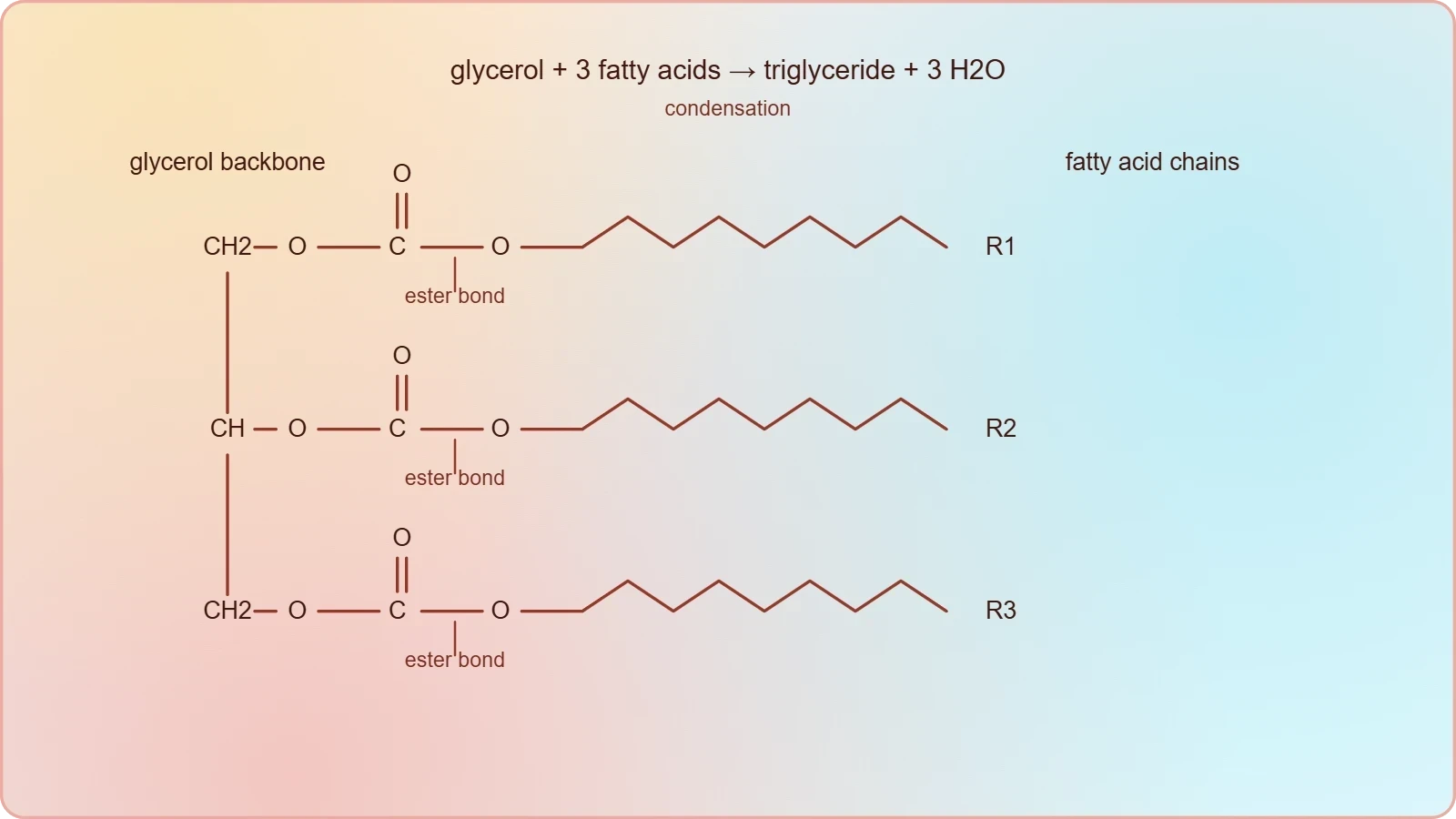
The standard survey of small molecular weight organic compounds in living tissues gives a compact inventory. Carbohydrates appear as sugars, with glucose written as ##C_6H_{12}O_6## and ribose as ##C_5H_{10}O_5##. Amino acids appear as serine, glycine and alanine. Lipids appear as fatty acids — palmitic acid, with its long hydrocarbon chain terminating in a carboxyl group — together with glycerol and the triglycerides formed when glycerol esterifies with three fatty acids. Cholesterol and phospholipids such as lecithin complete the lipid picture, and the nitrogen bases, nucleosides and nucleotides carry the nucleic acid chemistry forward from the previous lesson.
Each of these families illustrates the same principle in a different register. A triglyceride, for instance, is assembled from one glycerol and three fatty acids, and the notation ##R_1, R_2, R_3## simply marks the three acyl chains, which may differ. The structural logic is straightforward and the physiological purpose is clear: compact energy storage. Nucleotides such as adenylic acid combine a nitrogen base, a sugar and a phosphate, and their roles in information storage and energy transfer are well established. Nothing in this inventory is puzzling, and that is precisely the point.
Why Universality Is the Practical Test
For a learner, the most useful consequence of this definition is that it supplies a working test. Encounter an unfamiliar compound and ask where it occurs. If it belongs to the categories found across animal tissues and has a recognised physiological role, it is a primary metabolite. If it appears in the thousands of additional compounds seen in plant, fungal and microbial cells, it is a secondary metabolite. The test is not a substitute for chemical analysis, but it is a reliable first approximation and it keeps the two categories from blurring into one another.
This practical framing also explains why the distinction is introduced at this point in the course. The next lesson turns to biomacromolecules and the acid insoluble fraction, where molecular weight becomes the organising criterion and the boundary near one thousand daltons separates micromolecules from macromolecules. Understanding that primary metabolites are universal, small and functionally understood makes the subsequent discussion of size and solubility far easier to follow, because the chemical cast of characters is already familiar.
Secondary Metabolites: The Additional Chemical Wealth
Analysis of plant, fungal and microbial cells reveals thousands of compounds beyond the primary metabolites. Alkaloids, flavonoids, rubber, essential oils, antibiotics, coloured pigments, scents, gums and spices make up this second population, and their variety is extraordinary. Where the primary metabolites form a compact and predictable list, the secondary metabolites form an open-ended and chemically diverse collection. They are the reason a plant's chemistry is so much richer than an animal's, and they are the source of many of the substances that make plants commercially and medicinally interesting.

The honest caveat attached to this category is important and should not be softened. While primary metabolites have identifiable functions and known roles in normal physiological processes, the role or functions of all the secondary metabolites in their host organisms are not, at present, understood. Some are clearly useful to human welfare — rubber, drugs, spices, scents and pigments among them — and some have ecological importance. But the category is defined by what it is and where it occurs, not by a complete account of why the organism makes it.
Alkaloids, Flavonoids, Terpenoids and Essential Oils
Alkaloids are a prominent group, and the familiar examples are morphine and codeine. They are nitrogen-containing compounds with pronounced biological activity, which is why several have found use as drugs. Flavonoids belong with the pigments, and the pigment group more broadly includes carotenoids and anthocyanins, the compounds responsible for many of the colours seen in plant tissues. Terpenoids, represented by monoterpenes and diterpenes, form another large family, and essential oils such as lemon grass oil contribute the volatile scents that characterise aromatic plants.
These groups illustrate how secondary metabolism shades into properties we notice directly. A flower's colour, a herb's fragrance, the bitterness of a leaf — all trace back to compounds in this category. The lesson's list is deliberately representative rather than exhaustive, and it is worth treating the named examples as entry points rather than as a complete inventory. What matters is recognising the pattern: a set of chemically varied families, each with its own characteristic members, all produced alongside the primary metabolites rather than instead of them.
Toxins, Lectins, Drugs and Polymeric Substances
The category extends well beyond colour and scent. Toxins such as abrin and ricin are secondary metabolites with formidable biological potency. Lectins, of which concanavalin A is the named example, form another distinct group. Drugs such as vinblastin and curcumin are listed among the secondary metabolites, and polymeric substances including rubber, gums and cellulose complete the survey. The presence of cellulose in this list is a useful reminder that the category is defined by the source and context of the compound rather than by any single chemical property.
Grouping these together makes the point that secondary metabolites span an enormous range of molecular size and behaviour, from small volatile oils to large polymeric materials. It also shows why a single functional explanation will not cover them. A toxin, a pigment and a structural polymer serve utterly different purposes, if indeed their purposes in the host are known at all. The category is a chemical and ecological one, held together by occurrence and by the contrast with the universal primary metabolites.
Function, Uncertainty and Ecological Importance
The most intellectually honest sentence in this whole subject is the admission that we do not, at the moment, understand the role or functions of all the secondary metabolites in their host organisms. That is not a failure of the textbook but a statement about the state of knowledge. Some secondary metabolites have been studied intensively and their ecological roles are reasonably clear; others remain chemically characterised but functionally mysterious. A learner should carry this uncertainty forward rather than paper over it, because it is exactly the kind of open question that drives research.
What can be said with confidence is that many secondary metabolites are useful to human welfare. Rubber, drugs, spices, scents and pigments are the named examples, and each represents a different kind of usefulness: an industrial material, a pharmaceutical, a culinary flavouring, a fragrance, a colorant. Some secondary metabolites also have ecological importance, a point the lesson flags for later study. The combination of commercial value and ecological significance explains why this category attracts so much attention despite the gaps in understanding its functions.

Human Welfare and Commercial Value
The commercial dimension is easy to appreciate once the examples are named. Rubber is a polymeric secondary metabolite of enormous industrial importance, used in tyres, seals, gloves and countless other products. Spices and scents underpin entire trades, and pigments have been valued since antiquity for dyes and colourants. Drugs such as vinblastin and curcumin connect the category directly to medicine. Each of these represents a case where a compound produced by a plant or microorganism for reasons of its own turns out to serve a human purpose, often one the organism never had any interest in.
This is a useful corrective to the habit of assuming that biological compounds exist for human benefit. They do not. The usefulness is incidental, a happy convergence between the chemistry an organism evolved and the needs of people who learned to exploit it. Recognising that incidental quality deepens appreciation of the category: the value of rubber or of a spice is real, but it is not the reason the compound is made, and the organism's own reasons may be ecological, defensive or simply not yet understood.
Ecological Roles and Open Questions
Ecological importance is the theme the lesson leaves for later chapters, and it is worth anticipating why. A plant that invests energy in making a toxin, a bitter alkaloid or a pungent essential oil is usually doing so in a context of interaction — with herbivores, with competitors, with pollinators, with microbes. The chemistry is a form of communication or defence, and its significance only becomes visible when the organism is studied in its environment rather than in a flask. This is why the functions of secondary metabolites are often harder to pin down than those of primary metabolites.
The open questions are genuine. For any given secondary metabolite, one may ask what it does in the host, whether its production varies with circumstance, and what advantage it confers. Some answers are known, many are not, and the lesson is content to say so. For a beginner, this is a valuable lesson in scientific humility: a category can be well defined, richly exemplified and commercially important while still containing substantial unexplained territory. The next lesson moves to biomacromolecules, but the questions raised here remain open.
Going further
Two observations extend the lesson without altering it. The first concerns medicine. Many drugs in clinical use today were first encountered as secondary metabolites of plants or microorganisms, and the pattern is old and persistent: a compound made by an organism for its own ecological reasons turns out to have pharmacological value in humans. Morphine and codeine from the alkaloid group are early examples, and vinblastin, named among the drugs in this lesson's survey, belongs to the same tradition. The search for new secondary metabolites remains a live strategy in drug discovery.
The second concerns rubber. As a polymeric secondary metabolite, rubber is a striking case of commercial value arising from plant chemistry, and it illustrates how a single compound class can shape industries far removed from the organism that produces it. Neither observation changes the definitions or the examples given in the lesson; both simply show how far the consequences of secondary metabolism reach. The next lesson turns to biomacromolecules and the acid insoluble fraction, where the emphasis shifts from occurrence and function to molecular weight and solubility.
Working Through the Distinction: A Short Exercise
Definitions become secure only when they are applied, so it is worth working through a small exercise. Consider a compound reported from a plant extract. Ask first whether it belongs to the categories found across animal tissues — sugars, amino acids, fatty acids, glycerol, nucleotides, cholesterol, phospholipids. If it does, and if its physiological role is known, treat it as a primary metabolite. If it does not, and if it belongs among the thousands of additional compounds seen in plant, fungal and microbial cells, treat it as a secondary metabolite. The reasoning is short but it forces attention onto the two criteria that matter.
A second exercise is to classify the named examples from memory. Morphine and codeine are alkaloids; carotenoids and anthocyanins are pigments; monoterpenes and diterpenes are terpenoids; lemon grass oil is an essential oil; abrin and ricin are toxins; concanavalin A is a lectin; vinblastin and curcumin are drugs; rubber, gums and cellulose are polymeric substances. Each belongs to the secondary category. Glucose, ribose, serine, glycine, alanine, palmitic acid, glycerol and adenylic acid belong to the primary category. Sorting them repeatedly is the fastest route to fluency.
Common Misconceptions to Avoid
Several misconceptions recur. One is that secondary metabolites are unimportant because their functions are not fully understood; the commercial and ecological significance of rubber, drugs, spices, scents and pigments refutes this immediately. Another is that the categories are absolute chemical classes, when in fact they are defined by occurrence and context. A further error is to assume that secondary metabolites are absent from animals altogether; the lesson's claim is about the thousands of additional compounds seen in plant, fungal and microbial cells, not an absolute exclusion.
A final misconception concerns the word metabolite itself. It does not imply that a compound is a waste product or a breakdown fragment. Primary metabolites are central to physiology, and secondary metabolites are actively produced. Keeping the term tied to participation in metabolism, rather than to any notion of debris, prevents a great deal of confusion later when the course turns to macromolecules and the acid insoluble fraction. The vocabulary established here will be used repeatedly, so precision now pays dividends.
Preparing for Biomacromolecules
The next lesson introduces a different organising principle. Compounds in the acid soluble pool have molecular weights ranging from about 18 to around 800 daltons, while the acid insoluble fraction contains only four types of organic compounds — proteins, nucleic acids, polysaccharides and lipids — and all except lipids have molecular weights of ten thousand daltons and above. Molecules below one thousand daltons are micromolecules or simply biomolecules; those in the acid insoluble fraction are macromolecules or biomacromolecules. The shift from occurrence to size is the bridge between the two lessons.
Carrying the metabolite distinction into that discussion is useful. The primary metabolites encountered here are largely small molecules, and many of them are the monomers from which the macromolecules are built. The secondary metabolites, by contrast, span a wider size range, from volatile essential oils to polymeric rubber. Recognising this continuity makes the transition natural: the same chemical inventory is being sorted by a new criterion, and the categories learned here remain valid alongside the new ones.
Consolidating the Lesson
The lesson can be reduced to a handful of propositions. Biomolecules found in living organisms can be called metabolites because they participate in metabolism. In animal tissues, all the categories of small molecular weight organic compounds shown in the standard survey are present, and these are the primary metabolites. In plant, fungal and microbial cells, thousands of additional compounds appear — alkaloids, flavonoids, rubber, essential oils, antibiotics, coloured pigments, scents, gums and spices — and these are the secondary metabolites. Primary metabolites have identifiable functions; the functions of all secondary metabolites are not yet understood.
Around this core sit the supporting details. The named classes of secondary metabolites include pigments such as carotenoids and anthocyanins, alkaloids such as morphine and codeine, terpenoids such as monoterpenes and diterpenes, essential oils such as lemon grass oil, toxins such as abrin and ricin, lectins such as concanavalin A, drugs such as vinblastin and curcumin, and polymeric substances such as rubber, gums and cellulose. Many are useful to human welfare, and some have ecological importance. The next lesson moves to biomacromolecules and the acid insoluble fraction, where molecular weight takes over as the organising idea.
Key Terms at a Glance
Fluency in this topic depends on precise vocabulary. Metabolites are the biomolecules participating in metabolism. Primary metabolites are those found across all the categories in animal tissues, with identifiable functions and known roles in normal physiological processes. Secondary metabolites are the thousands of additional compounds seen in plant, fungal and microbial cells. Alkaloids, flavonoids, terpenoids, essential oils, toxins, lectins, drugs and polymeric substances are the named classes. Keeping these terms distinct prevents the category errors that plague examination answers.
Two further terms belong to the next lesson but are worth previewing. Micromolecules or simply biomolecules have molecular weights below one thousand daltons, and the acid soluble pool ranges from about 18 to around 800 daltons. Macromolecules or biomacromolecules are found in the acid insoluble fraction and comprise proteins, nucleic acids, polysaccharides and lipids, the last being an exception whose inclusion is explained by its behaviour rather than its size. Holding both vocabularies in mind makes the transition between lessons smooth.
Self-Check Questions
Test understanding with a few direct questions. Why can biomolecules be called metabolites? Which categories of compounds are found in animal tissues, and what name is given to them? What additional compounds appear when plant, fungal and microbial cells are analysed? What is known, and what is not known, about the functions of secondary metabolites? Which secondary metabolites are useful to human welfare, and which have ecological importance? Answering these without reference to notes is a reliable sign that the material has been absorbed rather than merely read.
A further set of questions looks forward. What molecular weight range characterises the acid soluble pool? Which four types of organic compounds occur in the acid insoluble fraction? Why are lipids included among the macromolecules despite their small size? These belong to the next lesson, but attempting them now reveals how the present material prepares the ground. The distinction between primary and secondary metabolites is not an isolated fact but a step in a sequence, and each step makes the next one easier to grasp.
Also Read
- No links available.
From our network :
- Vite 6/7 'Cold Start' Regression in Massive Module GraphsIn-depth analysis of Vite 6/7 cold start regressions in massive module graphs. Learn about barrel file issues, pre-bundling optimizations, and how to improve Vite dev server performance.
- Mastering DB2 12.1 Instance Design: A Technical Deep Dive into Modern Database ArchitectureComprehensive guide to DB2 12.1 Instance Design. Explore architectural components, HADR setup, buffer pool tuning, and security policies for IBM DB2 12.1. Includes 10 functional SQL and Shell samples.
- EV 2.0: The Solid-State Battery Breakthrough and Global Factory ExpansionDiscover the impact of the Solid-State Battery Breakthrough on the EV market. Learn about CATL and BYD stock growth, global factory expansion in Europe, and the future of EV 2.0 technology.
- 98% of Global MBA Programs Now Prefer GRE Over GMAT Focus EditionExplore why 98% of global MBA programs now prefer the GRE over GMAT Focus. Learn about the shorter GRE format, verbal logic importance, and strategic versatility for students.
- Trump Political Strategy How Geopolitical Stunts Serve As Media Diversions
- AI-Powered 'Precision Diagnostic' Replaces Standard GRE Score ReportsDiscover the new GRE Precision Diagnostic. Learn how AI-powered behavioral analytics and time-to-solve tracking are replacing standard GRE score reports to empower students.
- 10 Physics Numerical Problems with Solutions for IIT JEEPrepare for IIT JEE with 10 physics numerical problems, complete with detailed solutions and conceptual explanations. Ideal for mastering kinematics, thermodynamics, electromagnetism, and optics.
- Mastering DB2 LUW v12 Tables: A Comprehensive Technical GuideComprehensive guide on DB2 LUW v12 tables. Explore CREATE TABLE syntax, BLU Acceleration, range partitioning, data types, and security features for IBM DB2 LUW v12.
- Analyzing Trump Deportation Numbers Insights Into The 2026 Immigration Crackdown
RESOURCES
- Plant Metabolomics: An Overview of the Role of Primary and ... - PMCpmc.ncbi.nlm.nih.govMar 6, 2023 ... Primary metabolites are essential for the proper growth and development of plants and microorganisms. On the contrary, secondary metabolites are ...
- Plant Metabolomics: An Overview of the Role of Primary ... - PubMedpubmed.ncbi.nlm.nih.govMar 6, 2023 ... Among all, primary metabolites, such as amino acids, carbohydrates, lipids polyamines, and glycine betaine, are considered the major ...
- 17.1C: Primary and Secondary Metabolites - Biology LibreTextsbio.libretexts.orgNov 23, 2024 ... Key Points · Primary metabolites are considered essential to microorganisms for proper growth. · Secondary metabolites do not play a…
- Functional compensation of primary and secondary metabolites by ...pubmed.ncbi.nlm.nih.govIn conclusion, recently duplicated genes play an important role in the compensation of metabolic products only when the number of alternative pathways is small.
- Mass Spectral Data of Primary and Secondary Metabolites Changes ...nature.comMay 28, 2025 ... Solvent polarity is a critical factor in metabolite extraction from plants, influencing the recovery of primary and secondary metabolites.
- Plant Metabolites: primary vs. secondary | Anatomy and Physiologyebsco.comPrimary metabolites have functions that are essential to growth and development and are therefore present in all plants. In contrast, secondary metabolites are ...
- Examination of Primary and Secondary Metabolites Associated with ...mdpi.comMar 27, 2024 ... The primary metabolites vital for human sustenance are carbohydrates, lipids, proteins, and vitamins [3]. Compounds produced by plants in ...
- Influence of harvest time and cultivation region on primary and ...sciencedirect.comCarotenoids as secondary metabolites in fresh laver. Seven carotenoids (i.e, fucoxanthin, lutein, zeaxanthin, β-apo-8′-carotenal, β-cryptoxanthin, α-carotene ...
- Secondary metabolite - Wikipediaen.wikipedia.orgSecondary metabolites, also called specialised metabolites, secondary products, or natural products, are organic compounds produced by any lifeform, ...
- Primary and Secondary Metabolites | CK-12 Foundationflexbooks.ck12.orgNov 1, 2026 ... While primary metabolites are more uniform and essential, secondary metabolites are structurally complex and often have multiple functions that ...
- High-throughput quantification of more than 100 primary- and ...link.springer.comMay 26, 2016 ... ... secondary or primary metabolites, but rarely on multiple sectors of the plant metabolism. However, phytohormone pathways are also known…
- Functional Compensation of Primary and Secondary Metabolites by ...academic.oup.comThe remaining genes that caused changes in primary or secondary metabolites were classified into two groups: those inducing a small number (1–2) of metabolic ...
- Comparative Analysis of Primary and Secondary Metabolites in ...pubs.acs.orgMay 23, 2024 ... This study showed that bulb in vitro culture can be an efficient micropropagation method for N. tazetta and the production…
- Evaluating plant growth–defense trade-offs by modeling the ... - PNASpnas.orgCompared to primary metabolism, the growth–defense trade-off factor of secondary metabolites was almost twofold and significantly (Wilcoxon rank-sum test P- ...
- Effect of Methyl Jasmonate Treatment on Primary and Secondary ...frontiersin.orgWe performed targeted metabolomic analysis of the primary and secondary metabolites in substrate-grown and hydroponic Chinese chive leaves sprayed with MeJA (0, ...