Every living organism, from a microscopic bacterial paste to a towering forest tree, is assembled from the same basic inventory of chemical elements that make up the non-living world around us. This simple observation opens one of the most instructive questions in biology: if the raw ingredients are shared, what actually distinguishes the chemistry of life from the chemistry of a rock? Answering that question requires more than intuition. It requires a disciplined method of chemical analysis, one that can take a piece of plant tissue, animal tissue, or microbial paste and reduce it to a measurable list of elements and compounds. That method, and the reasoning behind it, forms the foundation of the entire study of biomolecules.
This lesson introduces the analytical thinking that underpins the chapter on biomolecules. It begins with elemental analysis, the procedure that reveals which elements are present in a sample and in what relative amounts, and it applies that procedure to two very different materials: living tissue and a sample of the earth's crust. The comparison that follows is subtle and often misunderstood, because the headline result is not a dramatic difference in kind but a quieter difference in proportion. From there, the lesson turns to the practical laboratory technique of grinding tissue in trichloroacetic acid to separate the acid-soluble pool from the acid-insoluble fraction, a separation that opens the door to the thousands of organic compounds found in living cells.
By the end of this lesson, you should be able to describe how elemental analysis is performed on biological material, explain why the elemental lists for living and non-living matter look so similar, and identify the specific elements whose relative abundance sets living organisms apart. You should also be able to walk through the grinding and filtration procedure step by step, naming the two fractions it produces and explaining what each one contains. These skills prepare you directly for the next lesson, which examines wet weight, dry weight, ash, and inorganic constituents in finer detail.
On This Page
- The Central Question: Are All Living Organisms Made of the Same Chemicals?
- From Elements to Organic Compounds: The Need for Chemical Analysis
- Separating the Slurry: Filtrate and Retentate
- Interpreting the Comparison: What the Evidence Actually Means
- Going Further: Background on the Analytical Tools
- Preparing for the Next Lesson: From Composition to Quantity
The Central Question: Are All Living Organisms Made of the Same Chemicals?
The biosphere displays an extraordinary diversity of living forms, and this diversity naturally prompts a fundamental question: are all living organisms built from the same chemicals, meaning the same elements and compounds? The question is deceptively simple, yet it governs the entire study of biomolecules. If every organism shares a common chemical toolkit, then the differences between species must lie in how those chemicals are arranged, combined, and used rather than in which chemicals exist at all. Establishing this point requires evidence, and the evidence comes from elemental analysis, a technique familiar from general chemistry but applied here to biological material with revealing results.
Applying Elemental Analysis to Living and Non-Living Samples
Elemental analysis, when performed on a plant tissue, an animal tissue, or a microbial paste, yields a list of elements such as carbon, hydrogen, oxygen, and several others, together with their respective content per unit mass of living tissue. The same analysis performed on a piece of the earth's crust, taken as an example of non-living matter, produces a strikingly similar list. This parallel is the heart of the lesson. The procedure does not require exotic equipment to understand conceptually; it requires only that we quantify which elements are present and how much of each the sample contains relative to its mass.
What makes this comparison scientifically powerful is its rigor. Rather than relying on impressions about what living things are "made of," the analysis produces numbers, and numbers can be compared directly. The content per unit mass gives a common basis for comparison across samples of very different origin. A microbial paste and a chunk of crust are reduced to the same kind of data, and only then can a fair judgment be made about whether life uses a distinctive chemical signature. This insistence on measurement over assumption is a habit worth carrying into every later topic in the course.
Reading the Two Lists Side by Side
When the two lists are placed side by side, the first observation is that in absolute terms, no differences can be made out. Every element present in a sample of earth's crust is also present in a sample of living tissue. This is a genuinely important result, because it tells us that life does not draw on a secret reserve of exotic elements unavailable to the non-living world. The periodic table available to a cell is the same periodic table available to a rock. Any claim that living matter is chemically special must therefore be argued on grounds other than the mere presence or absence of elements.
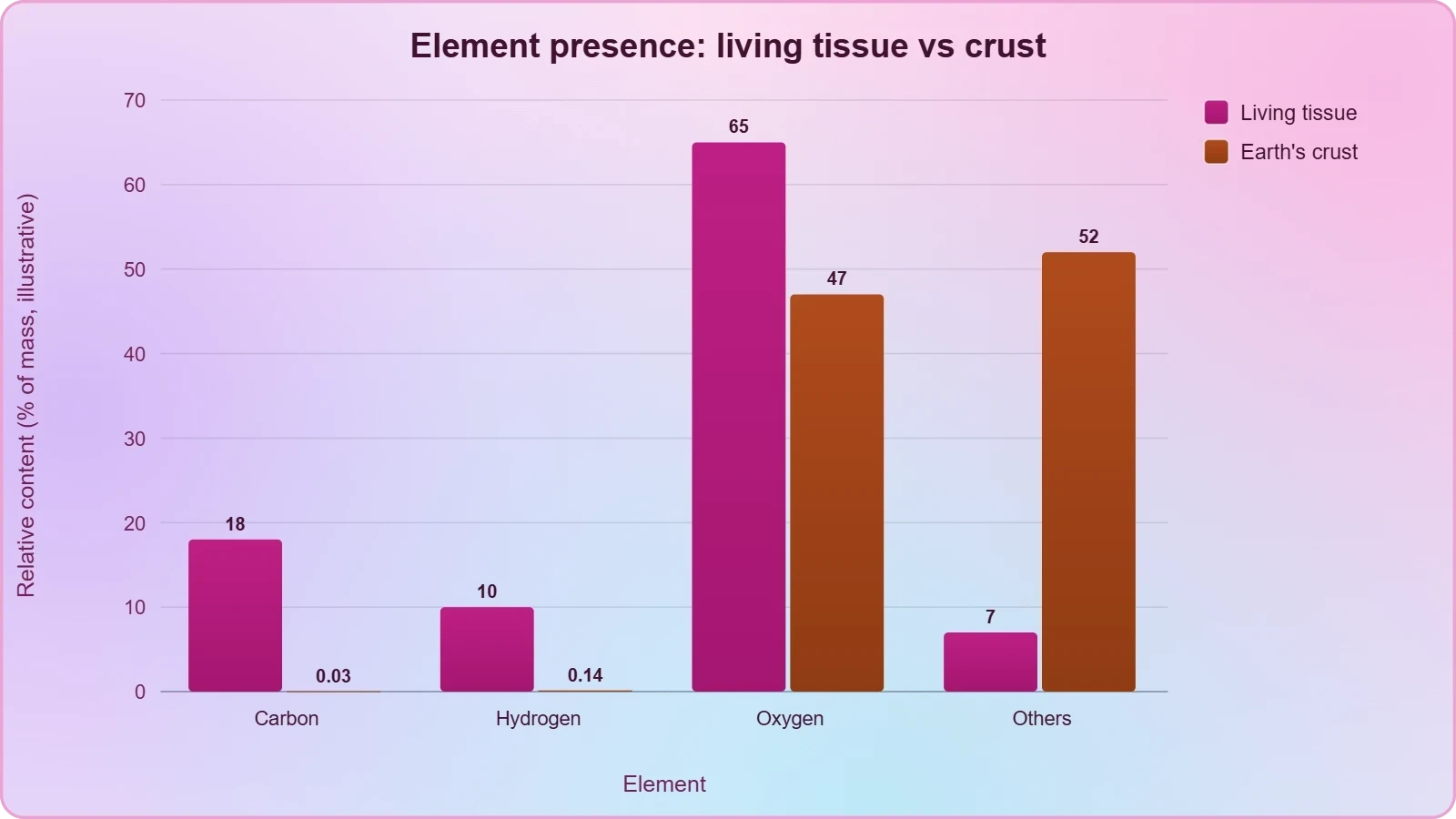
The second observation, however, changes the picture. A closer examination reveals that the relative abundance of carbon and hydrogen with respect to other elements is higher in any living organism than in the earth's crust. The difference is one of proportion, not of kind. This distinction between presence and abundance is exactly the kind of nuance that separates careful analysis from casual observation, and it sets up the quantitative comparisons that follow in later lessons on dry weight and ash content.
From Elements to Organic Compounds: The Need for Chemical Analysis
Knowing the elemental inventory of a tissue is only the first step. The natural next question is what type of organic compounds are found in living organisms, and how one goes about finding the answer. Elements alone do not describe a cell; carbon and hydrogen may be abundant, but they exist in living matter as parts of molecules, and it is the molecules that carry out the work of life. To move from elements to compounds, one must perform a chemical analysis of the tissue itself. This section explains the reasoning behind that analysis and the practical procedure that makes it possible.
Why a Simple Elemental List Is Not Enough
An elemental list tells us that carbon, hydrogen, oxygen, and other elements are present, and it tells us their content per unit mass. What it cannot tell us is how those elements are combined. The same atoms can form a sugar, an amino acid, a fatty acid, or a nucleotide, and each of these compounds behaves very differently in a living cell. The study of biomolecules therefore demands a method that separates and identifies compounds, not just elements. This is precisely why the chapter moves from elemental analysis to the chemical analysis of tissue, treating the two as consecutive stages of a single investigative strategy.
The logic mirrors the way chemistry itself progresses from composition to structure. First you establish what is there, then you determine how it is arranged. In biological material the challenge is greater because the mixture is enormously complex, containing thousands of different compounds at once. A method is needed that can divide this complexity into manageable portions before individual compounds can be studied. The grinding and filtration procedure described next does exactly that, splitting the tissue into two broad fractions that can each be examined separately.
The Grinding Procedure in Trichloroacetic Acid
To obtain an answer, one takes any living tissue, such as a vegetable or a piece of liver, and grinds it in trichloroacetic acid, written as ##\mathrm{Cl_3CCOOH}##, using a mortar and a pestle. The grinding breaks the tissue apart mechanically, while the acid acts chemically on the material. The result is a thick slurry, a uniform mixture in which the disrupted contents of the cells are suspended. This step is deliberately simple in its equipment, yet it is decisive, because it converts an intact tissue into a form from which soluble and insoluble components can be separated.
The choice of trichloroacetic acid is not arbitrary. It is a strong acid, and its presence ensures that the slurry is acidic throughout, which affects how different classes of compounds behave. Some materials dissolve readily under these conditions, while others do not. The mortar and pestle provide the mechanical disruption needed to expose the cell contents to the acid. Together, the mechanical and chemical actions prepare the tissue for the separation step that follows, and they do so without requiring the tissue to be dried or otherwise pre-treated.
Separating the Slurry: Filtrate and Retentate
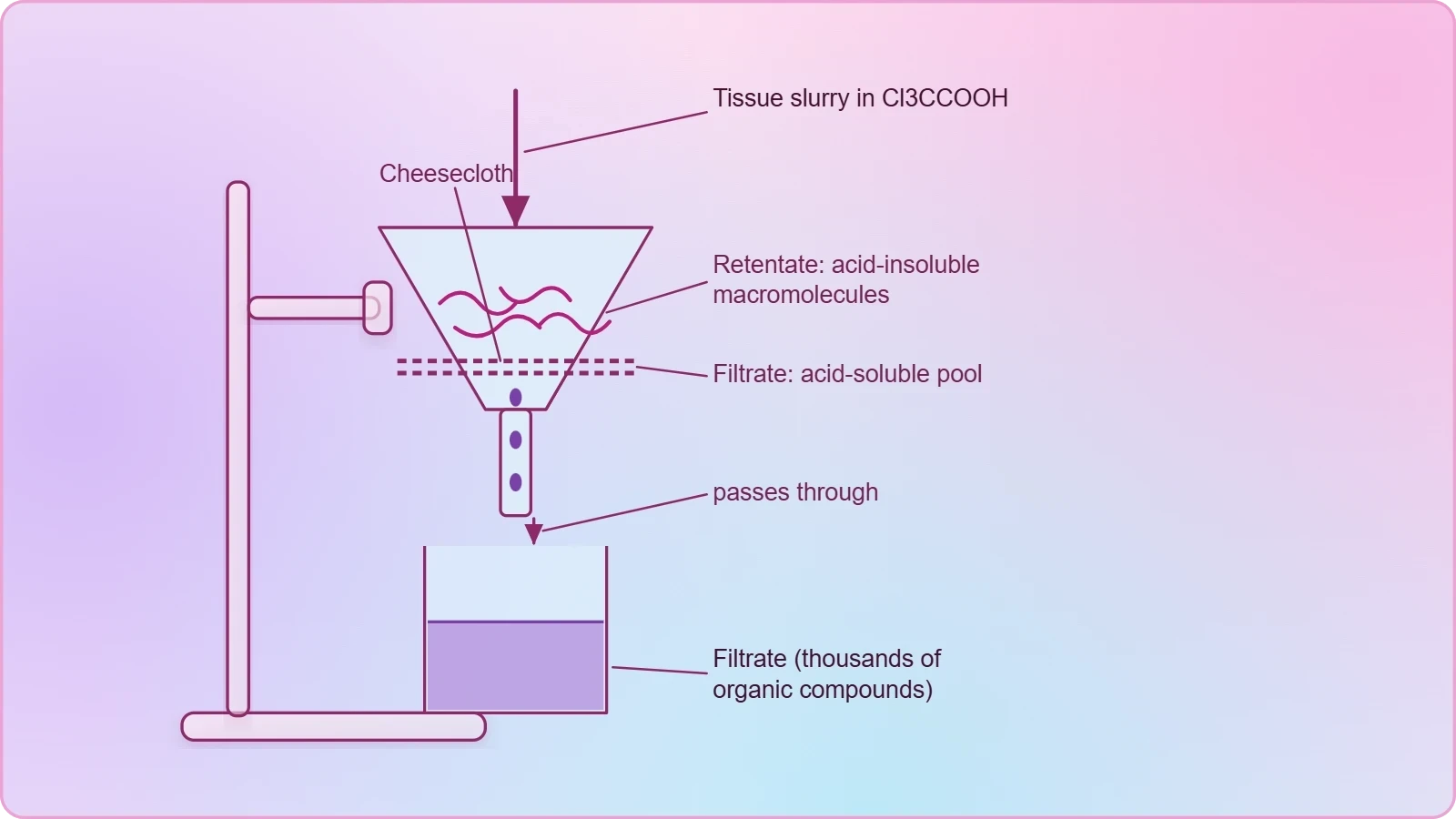
Once the thick slurry has been obtained, the next step is to strain it through a cheesecloth or cotton. This simple filtration divides the slurry into two distinct fractions, and the division is the conceptual pivot of the whole procedure. One fraction passes through the cloth and is called the filtrate, or more technically the acid-soluble pool. The other is retained by the cloth and is called the retentate, or the acid-insoluble fraction. Each fraction represents a different category of material, and each must be studied by its own appropriate methods. Understanding what each contains is essential before any further analysis can be meaningful.
The Acid-Soluble Pool: A Reservoir of Organic Compounds
The filtrate, or acid-soluble pool, is the portion of the tissue that dissolves in the trichloroacetic acid and passes through the filter. Scientists have found thousands of organic compounds in this acid-soluble pool. This single sentence carries enormous weight, because it reveals the sheer chemical richness of living tissue. The soluble fraction is not a simple solution of a few substances; it is a complex mixture containing a vast array of organic molecules. The number of compounds alone explains why separating and identifying individual biomolecules is such a demanding analytical task, and why the study of biomolecules requires careful, systematic methods.
The term "pool" is well chosen, because it suggests a collection of substances available within the cell, dissolved and mobile rather than locked into structure. Compounds in this pool can be extracted, separated, and characterised by further chemical techniques. The discovery of thousands of organic compounds in this fraction established that living matter is chemically far more intricate than its elemental list would suggest. It also motivates the rest of the course, which examines the major classes of these compounds, including proteins, polysaccharides, and nucleic acids, in the lessons that follow.
The Acid-Insoluble Fraction: The Retained Material
The retentate, or acid-insoluble fraction, is the material that does not dissolve in the acid and remains trapped in the cheesecloth or cotton. It represents the structural and macromolecular components of the tissue, the parts that resist dissolution under these conditions. The existence of this fraction is what makes the procedure a genuine separation rather than a mere extraction. By dividing the tissue into soluble and insoluble portions, the method allows each to be studied without interference from the other, and it prepares the ground for the later discussion of biomacromolecules, which are precisely the large, often insoluble molecules that dominate this fraction.
It is worth noting that the two fractions are complementary. Together they account for the material of the tissue, and neither alone gives a complete picture. The soluble pool reveals the small organic compounds, while the insoluble fraction holds the large structural molecules. A complete chemical understanding of a tissue therefore requires both. This complementarity is a recurring theme in biochemistry, where separation techniques are used to simplify complex mixtures before analysis, and it explains why the procedure is presented as the gateway to the study of biomacromolecules.
Interpreting the Comparison: What the Evidence Actually Means
The comparison between living tissue and earth's crust is easy to misread, and reading it correctly is a skill in itself. The temptation is to conclude either that life is chemically ordinary, since the same elements appear in both samples, or that life is chemically unique, since carbon and hydrogen are more abundant in organisms. Neither conclusion is quite right on its own. The evidence supports a more precise statement: living matter uses the same elements as non-living matter but distributes them differently, favouring carbon and hydrogen. This section examines how to interpret that finding and why it matters for the study of biomolecules.
Presence Versus Proportion: A Crucial Distinction
The distinction between presence and proportion is the interpretive key to the entire comparison. Presence tells us which elements are available; proportion tells us which elements are emphasised. In absolute terms, no difference in presence can be made out between the two lists, because every element in the crust sample also appears in the tissue sample. But the relative abundance of carbon and hydrogen with respect to other elements is higher in living organisms. This means the chemical signature of life is quantitative, expressed in ratios and proportions rather than in the appearance of novel elements.
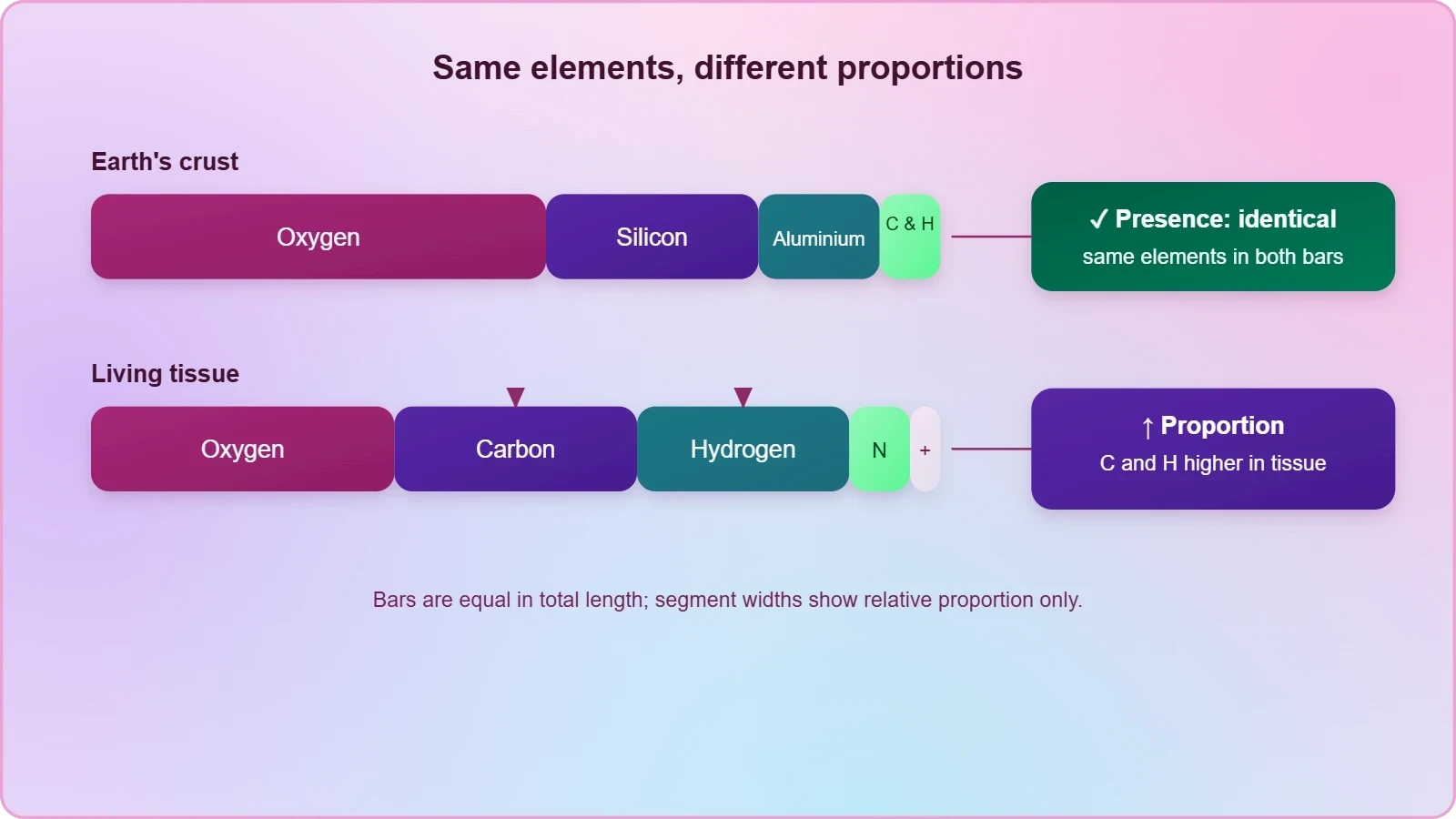
This distinction has practical consequences for how we study biomolecules. If life were distinguished by unique elements, the task would be to search for them. Since life is distinguished by proportions, the task is to measure and compare abundances, which is exactly what elemental analysis does. The emphasis on carbon and hydrogen also points toward the chemistry that follows, because these two elements are the backbone of organic compounds. Their higher relative abundance in living organisms is consistent with the fact that living matter is built largely from organic molecules.
Why This Comparison Matters for the Rest of the Course
The comparison establishes the premise on which the study of biomolecules rests. If all organisms share the same elements, then the diversity of life must arise from the diversity of compounds those elements form. The thousands of organic compounds in the acid-soluble pool, and the macromolecules of the insoluble fraction, are the real subject of the course. The elemental comparison is therefore not an end in itself but a foundation, a way of clearing away the misconception that living matter is made of fundamentally different substances and redirecting attention to the compounds that actually differ.
This framing also explains the order of topics that follows. Having established the elemental basis and the method of separation, the course can proceed to primary and secondary metabolites, then to biomacromolecules, proteins, polysaccharides, nucleic acids, protein structure, and enzymes. Each of these topics builds on the idea that living matter is chemically rich and organised. The comparison between living and non-living matter is the first step in that progression, and it prepares the learner for the more detailed quantitative treatment of wet weight, dry weight, and ash in the next lesson.
Going Further: Background on the Analytical Tools
The procedure described in this lesson rests on two well-established analytical approaches, and a brief background on each helps to place the material in a wider scientific context. The first is elemental analysis, the standard method for identifying which elements are present in a sample and in what amounts. The second is the use of trichloroacetic acid as a reagent for separating soluble from insoluble cell material. Neither background point changes the lesson's core content; both simply illuminate why the methods work as they do and why they remain standard tools in biochemistry.
Elemental Analysis as a Standard Approach
Elemental analysis is a standard analytical approach that identifies which elements are present and in what amounts. In practice, it may involve techniques that convert a sample into a form suitable for measurement, after which the quantity of each element is determined. The result is a quantitative profile, a list of elements with their respective content per unit mass. This is precisely the kind of profile that allows a fair comparison between living tissue and earth's crust, because both samples are described in the same units and on the same basis. The method's strength lies in its generality: it can be applied to almost any material, living or not.
Because the method is general, it is also impartial. It does not presuppose that living matter is special; it simply reports what is there. That impartiality is what makes the comparison in this lesson credible. If the analysis had been designed only for biological samples, the comparison with the crust would be suspect. Since the same approach applies to both, the resulting lists are directly comparable, and the finding that carbon and hydrogen are proportionally higher in living organisms carries genuine evidential weight rather than reflecting a methodological bias.
Trichloroacetic Acid in Biochemical Separation
Trichloroacetic acid is a strong acid commonly used in biochemistry to precipitate proteins and separate soluble from insoluble cell material. Its acidity disrupts the interactions that keep many large molecules in solution, causing them to come out of solution while smaller, more soluble compounds remain dissolved. This behaviour is exactly what the grinding procedure exploits: the acid-soluble pool passes through the filter, while the acid-insoluble fraction is retained. The reagent thus performs a dual role, acting both as the medium in which the tissue is ground and as the agent that drives the separation of the two fractions.
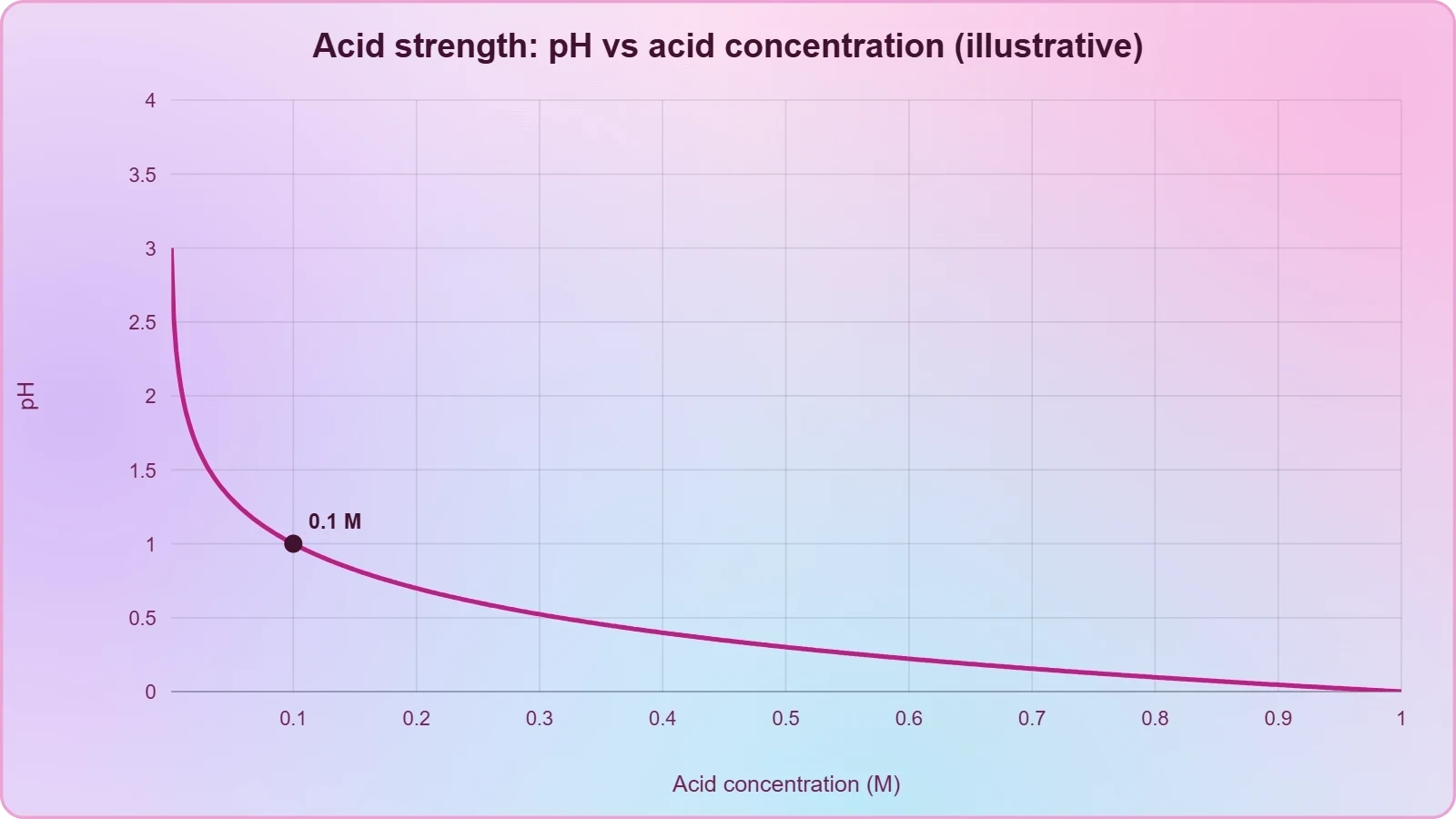
Understanding this dual role clarifies why the procedure is described as grinding in trichloroacetic acid rather than simply grinding in water. Water alone would disrupt the tissue mechanically but would not produce the same sharp division between soluble and insoluble material. The acid sharpens that division, making the two fractions more distinct and easier to study separately. This is a good example of how a well-chosen reagent can turn a crude physical separation into a chemically meaningful one, and it explains why the procedure has remained a standard starting point for analysing the composition of living tissue.
Preparing for the Next Lesson: From Composition to Quantity
This lesson has established two connected ideas. First, living and non-living matter share the same elements, but living organisms show a higher relative abundance of carbon and hydrogen. Second, living tissue can be separated into an acid-soluble pool and an acid-insoluble fraction by grinding in trichloroacetic acid and straining the resulting slurry. Together these ideas provide the conceptual and practical foundation for everything that follows. The next lesson moves from the qualitative question of what is present to the quantitative question of how much, examining wet weight, dry weight, ash, and inorganic constituents in detail.
Consolidating the Key Terms
Before moving on, it is worth consolidating the terminology introduced here. Elemental analysis is the procedure that yields a list of elements and their content per unit mass. The acid-soluble pool, or filtrate, is the portion that passes through the filter and contains thousands of organic compounds. The acid-insoluble fraction, or retentate, is the portion retained by the filter. Trichloroacetic acid, ##\mathrm{Cl_3CCOOH}##, is the reagent in which the tissue is ground. These terms recur throughout the course, and a firm grasp of them makes the later lessons on metabolites, macromolecules, and enzymes far easier to follow.
The relationship between the two fractions can be expressed simply. If the total material of the tissue is considered as a whole, then the soluble and insoluble portions together account for it, and neither alone is complete. This complementarity is a useful mental model for the rest of the course, where different classes of biomolecules are studied in turn but always as parts of a larger chemical system. Keeping this model in mind helps to prevent the common mistake of treating one fraction as more important than the other, when in fact both are essential to a full understanding of living matter.
Looking Ahead to Wet Weight, Dry Weight, and Ash
The next lesson takes up the quantitative side of the analysis. Wet weight refers to the mass of tissue as it is, including its water content, while dry weight refers to the mass remaining after water has been removed. Ash represents the inorganic residue left after the organic material has been burned away, and the inorganic constituents are the mineral elements that remain. These measurements build directly on the elemental comparison introduced here, because they allow the proportions of water, organic matter, and inorganic matter to be quantified and compared across tissues and organisms.
The transition is natural. Having learned that living matter is distinguished by the relative abundance of certain elements, the learner is now ready to ask how those elements are distributed among water, organic compounds, and inorganic salts. The grinding procedure and the two fractions provide the conceptual bridge, since the soluble pool and insoluble fraction correspond roughly to different categories of material that the later measurements will quantify. With this foundation in place, the course can proceed confidently to primary and secondary metabolites and then to the biomacromolecules that form the main subject of the chapter.
Also Read
- No links available.
From our network :
- 10 Physics Numerical Problems with Solutions for IIT JEEPrepare for IIT JEE with 10 physics numerical problems, complete with detailed solutions and conceptual explanations. Ideal for mastering kinematics, thermodynamics, electromagnetism, and optics.
- Mastering DB2 LUW v12 Tables: A Comprehensive Technical GuideComprehensive guide on DB2 LUW v12 tables. Explore CREATE TABLE syntax, BLU Acceleration, range partitioning, data types, and security features for IBM DB2 LUW v12.
- Mastering DB2 12.1 Instance Design: A Technical Deep Dive into Modern Database ArchitectureComprehensive guide to DB2 12.1 Instance Design. Explore architectural components, HADR setup, buffer pool tuning, and security policies for IBM DB2 12.1. Includes 10 functional SQL and Shell samples.
- Analyzing Trump Deportation Numbers Insights Into The 2026 Immigration Crackdown
- Vite 6/7 'Cold Start' Regression in Massive Module GraphsIn-depth analysis of Vite 6/7 cold start regressions in massive module graphs. Learn about barrel file issues, pre-bundling optimizations, and how to improve Vite dev server performance.
- Trump Political Strategy How Geopolitical Stunts Serve As Media Diversions
- 98% of Global MBA Programs Now Prefer GRE Over GMAT Focus EditionExplore why 98% of global MBA programs now prefer the GRE over GMAT Focus. Learn about the shorter GRE format, verbal logic importance, and strategic versatility for students.
- EV 2.0: The Solid-State Battery Breakthrough and Global Factory ExpansionDiscover the impact of the Solid-State Battery Breakthrough on the EV market. Learn about CATL and BYD stock growth, global factory expansion in Europe, and the future of EV 2.0 technology.
- AI-Powered 'Precision Diagnostic' Replaces Standard GRE Score ReportsDiscover the new GRE Precision Diagnostic. Learn how AI-powered behavioral analytics and time-to-solve tracking are replacing standard GRE score reports to empower students.
RESOURCES
- How to analyze chemical composition? | CK-12 Foundationflexbooks.ck12.orgMay 27, 2025 ... This lesson introduces the concept of chemical analysis of living tissues as outlined in the CBSE Class 11 Biology curriculum…
- Prediction of tissue composition of live dairy calves and carcasses ...sciencedirect.com2. Materials and methods · 2.1. Animals, housing and treatments · 2.2. Computed tomography scanning · 2.3. Image analysis · 2.4. Slaughtering, sampling and…
- biomolecules chapter 9 - NCERTncert.nic.in9.1 HOW TO ANALYSE CHEMICAL COMPOSITION? We can continue ... In summary if we represent the chemical composition of living tissue from abundance point…
- The Chemical Components of a Cell - Molecular Biology of ... - NCBIncbi.nlm.nih.govIn living tissues, it is only the electrons of an atom that undergo rearrangements. ... The Approximate Chemical Composition of a Bacterial Cell. All ...
- Biomolecules: Chemical Composition Analysis - BYJU'Sbyjus.comLet's take a glance at biomolecules and its chemical composition in living organisms. ... Take a piece of living tissue and crush and mix…
- Label-Free High-Resolution Photothermal Optical Infrared ...pubs.acs.orgNov 2, 2023 ... ... chemical tissue processing, altering structure and composition. ... Chemical Analysis in Fresh, Hydrated Living Tissues and Embryos. 136 ...
- How To Analyze Chemical Composition? - GeeksforGeeksgeeksforgeeks.orgAug 24, 2022 ... All the carbon compounds, that we get from living tissues, are called biomolecules. How to analyze the Chemical composition of…
- Quantitative magnetic resonance (QMR) method for bone and whole ...pubmed.ncbi.nlm.nih.govRepeated measures of whole-body composition were made using live and dead mice with different levels of fat by QMR and DEXA and by classic…
- Biology of Bone Tissue: Structure, Function, and Factors That ... - PMCpmc.ncbi.nlm.nih.govMoreover, we will briefly discuss the role of estrogen on bone tissue ... The chemical composition of the pericellular fluid has not been precisely…
- Analysis of body composition changes of swine during growth and ...pubmed.ncbi.nlm.nih.gov... composition of pigs. Quantitative tissue and chemical composition of 319 swine, representative of barrows and gilts from five commercial genetic populations ...
- Label-free 3D molecular imaging of living tissues using Raman ...nature.comSep 9, 2024 ... ... composition of biological tissue. Confocal Raman microspectroscopy has long been used to provide 3D images of the chemical composition…
- biomolecules chapter 9ssgopalganj.in9.1 HOW TO ANALYSE CHEMICAL COMPOSITION? We can continue ... In summary if we represent the chemical composition of living tissue from abundance point…
- A systematic review of pesticide exposure, associated risks ... - PMCpmc.ncbi.nlm.nih.govThis makes them effective against pests that feed or live on the plant tissues. ... Pesticides can be classified based on their nature, chemical…
- How to Analyse Chemical Composition - Biology - GyanGhargyanghar.inElemental analysis gives the elemental composition of living tissues - hydrogen, oxygen, chlorine, carbon and the rest. Analysis for compounds gives the kind of ...
- MeSH Qualifiers with Scope Notes - National Library of Medicine - NIHnlm.nih.govIt excludes the chemical analysis of tissues ... Used with drugs and exogenously administered chemical substances for their effects on living tissues and ...