Kingdom Plantae rewards a synoptic view. Across five great groups — algae, bryophytes, pteridophytes, gymnosperms and angiosperms — biology traces a single narrative of increasing terrestrial independence, tissue differentiation and reproductive sophistication. This closing lesson gathers that narrative into one coherent frame, restating the defining characteristics and reproductive strategies of each group so that the chapter's architecture becomes visible as a whole rather than a list of separate facts.
The review is deliberately comparative. Each group is positioned against its neighbours: algae remain largely aquatic and thalloid, bryophytes colonise soil yet still depend on water for sexual reproduction, pteridophytes introduce true vascular tissue, gymnosperms free the seed from an ovary wall, and angiosperms enclose both ovules and seeds within flowers and fruits. Holding these contrasts side by side is what transforms memorised detail into genuine understanding of plant evolution.
Because this is the final lesson of the course, the emphasis falls on consolidation. The material restates the classification of algae into Chlorophyceae, Phaeophyceae and Rhodophyceae, the liverwort–moss division of bryophytes, the sporophyte-dominated life of pteridophytes, the naked-seeded condition of gymnosperms, and the dicotyledon–monocotyledon split of angiosperms. Mastery here means being able to move fluently between these groups and explain why each occupies its particular place in the plant kingdom.
On This Page
- The Plant Kingdom as a Connected Whole
- Algae: Pigments, Storage and Reproduction
- Bryophytes: Amphibians of the Plant World
- Pteridophytes: The First True Vascular Plants
- Gymnosperms: The Naked-Seeded Plants
- Angiosperms: Flowers, Fruits and Two Classes
- Reproduction Restated: Water, Spores and Seeds
- Consolidating the Chapter Before Assessment
The Plant Kingdom as a Connected Whole
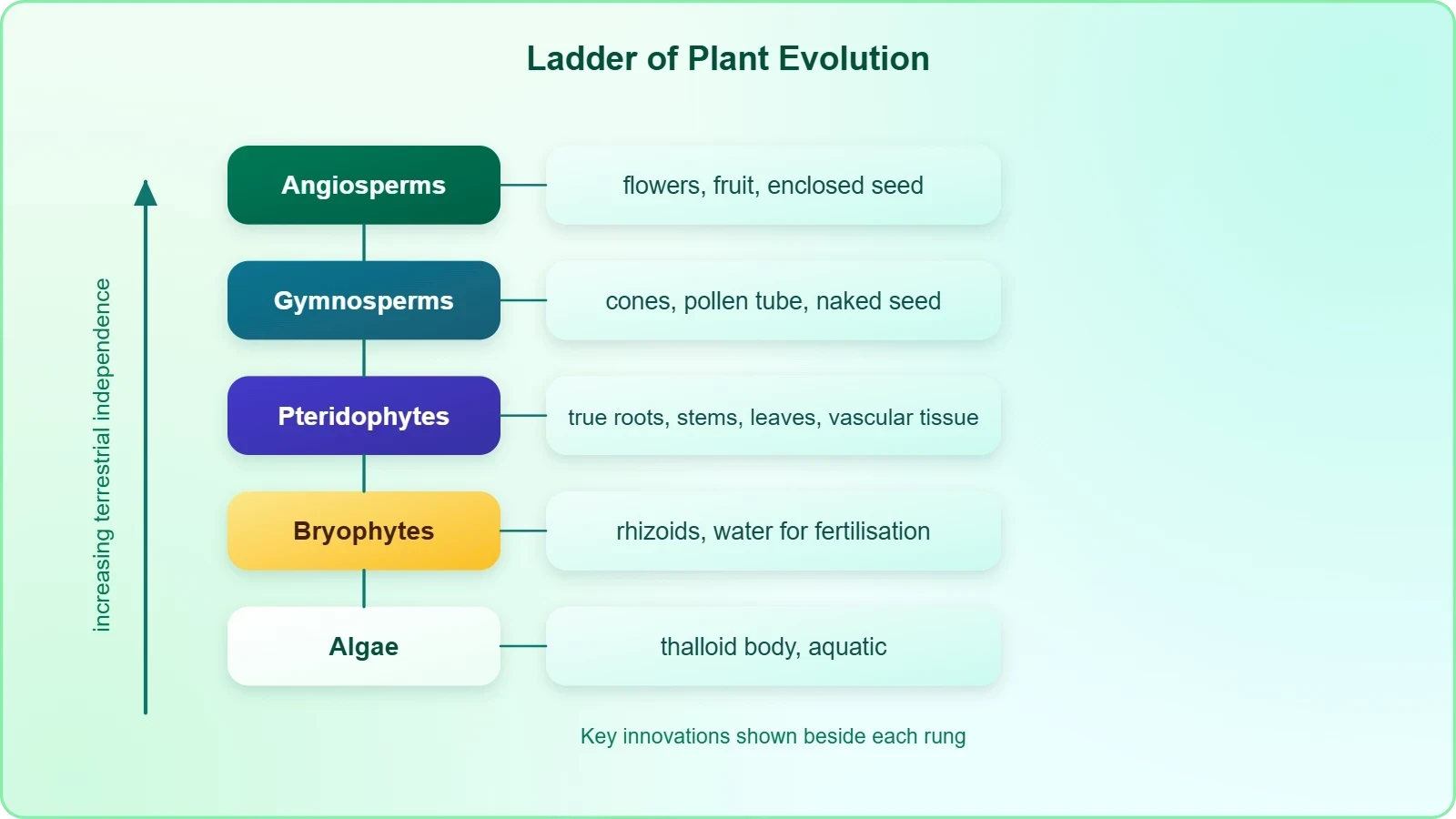
The plant kingdom comprises five major groups whose study forms a continuous story of adaptation. Algae, bryophytes, pteridophytes, gymnosperms and angiosperms each represent a distinct solution to the challenges of life on land, and the summary of the chapter is best read as a map of those solutions rather than a catalogue of isolated descriptions.
Five Groups, One Evolutionary Logic
Algae are chlorophyll-bearing, simple, thalloid, autotrophic and largely aquatic organisms. Bryophytes can live in soil but remain dependent on water for sexual reproduction. Pteridophytes are the first group with true roots, stems and leaves possessing well-differentiated vascular tissues, while gymnosperms and angiosperms complete the sequence through seed habit.
This progression is not merely chronological; it is functional. Each advance reduces dependence on standing water, improves transport and support, and protects the embryo. Recognising this logic allows a learner to predict, rather than merely recall, why a given group possesses the structures it does and why its reproductive cycle takes the form it takes.
Classification Systems and Their Basis
The course traced how plant classification moved from artificial systems to natural and then phylogenetic systems. The summary inherits that perspective: algae are grouped by pigment type and stored food, bryophytes by body form into liverworts and mosses, and angiosperms by cotyledon number into dicotyledons and monocotyledons.
Each of these divisions rests on observable, heritable characters. Pigments and storage products distinguish the three algal classes; thalloid, dorsiventral bodies separate liverworts from the upright, leafy axes of mosses; and the single cotyledon of monocotyledons contrasts with the pair found in dicotyledons.
Algae: Pigments, Storage and Reproduction
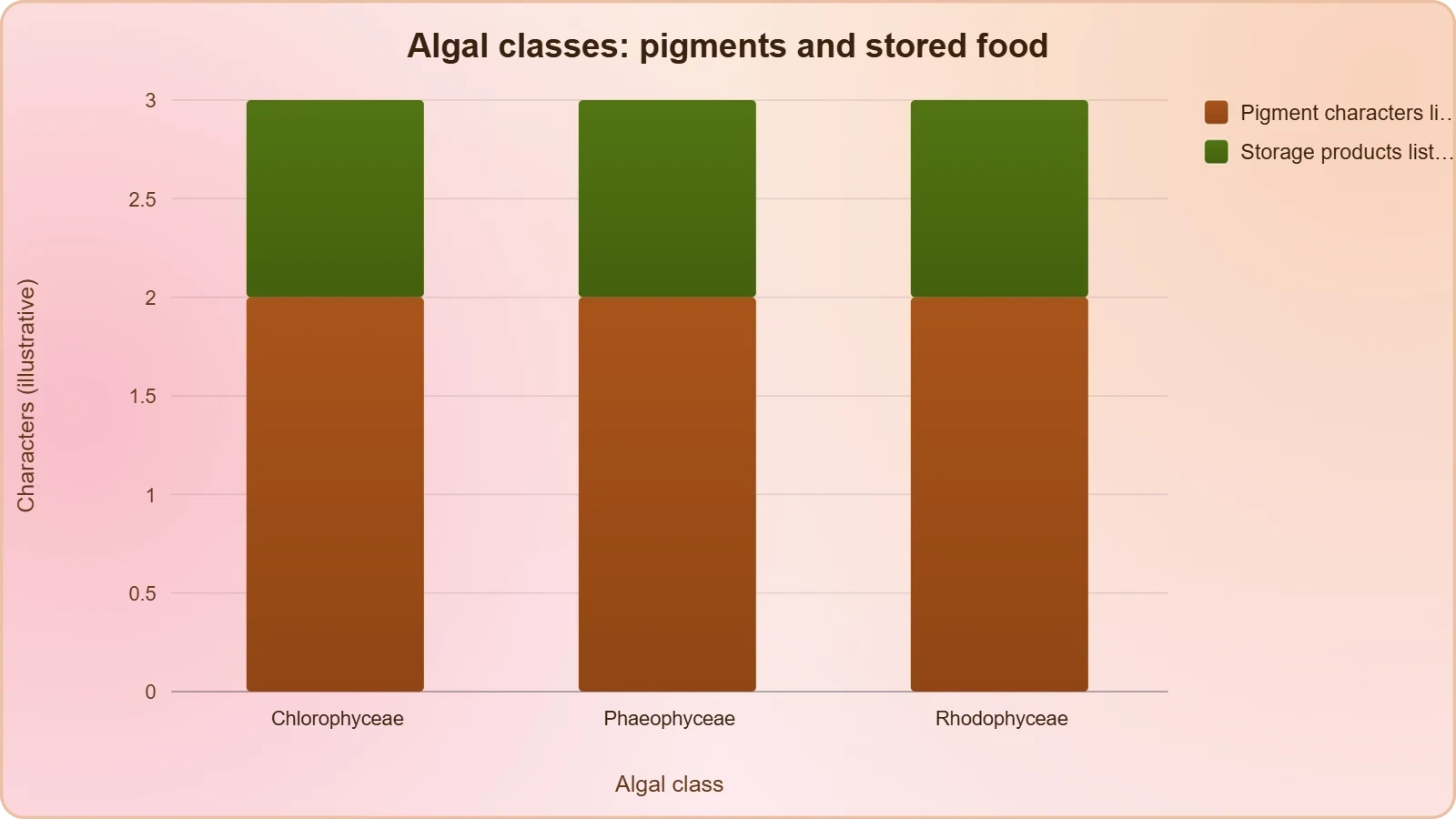
Algae open the survey because they establish the baseline against which every land plant is measured. Their body is thalloid and undifferentiated, their nutrition autotrophic, and their habitat predominantly aquatic. Yet within this simplicity lies real diversity, expressed most clearly in the three classes defined by pigment composition and the nature of stored food.
The Three Classes of Algae
Chlorophyceae, Phaeophyceae and Rhodophyceae are distinguished by the pigments they possess and the food they store. This dual criterion is the basis of algal classification, and it is the single most examinable idea in the group. The classes correspond broadly to green, brown and red algae respectively.
Reproduction in algae follows three routes. Vegetative reproduction occurs by fragmentation; asexual reproduction involves the formation of different types of spores; and sexual reproduction proceeds through gametes that may exhibit isogamy, anisogamy or oogamy. These three sexual patterns describe increasing differentiation between fusing gametes.
Reading the Algal Life Cycle
The gametes of algae fuse to form a zygote, and the pattern of gamete similarity or dissimilarity — isogamy, anisogamy, oogamy — signals the degree of sexual specialisation reached. This vocabulary recurs throughout the kingdom and is worth fixing firmly before moving to the land plants.
Because algae are largely aquatic, water is never a limiting factor for fertilisation. That freedom explains why the group never evolved the protective structures seen in later plants, and it sharpens the contrast when bryophytes are introduced as plants dependent on water despite living on land.
Bryophytes: Amphibians of the Plant World
Bryophytes occupy a pivotal position: they live on land yet cannot complete sexual reproduction without water. Their plant body is more differentiated than that of algae — thallus-like and prostrate or erect, attached to the substratum by rhizoids — and they possess root-like, leaf-like and stem-like structures rather than true organs.
Liverworts and Mosses
The bryophytes divide into liverworts and mosses. The plant body of liverworts is thalloid and dorsiventral, whereas mosses have upright, slender axes bearing spirally arranged leaves. This contrast in body form is the practical basis for distinguishing the two groups in the field.
In bryophytes the main plant body is gamete-producing and is called the gametophyte. It bears male sex organs called antheridia and female sex organs called archegonia. The fusion of male and female gametes produces a zygote, which develops into a multicellular sporophyte that generates haploid spores.
The Gametophyte–Sporophyte Cycle
The spores germinate to form gametophytes, completing the cycle. This alternation is the conceptual heart of bryophyte biology: the conspicuous green plant is haploid and sexual, while the dependent sporophyte is the spore-producing phase. Water is required for the transfer of male gametes to the archegonium.
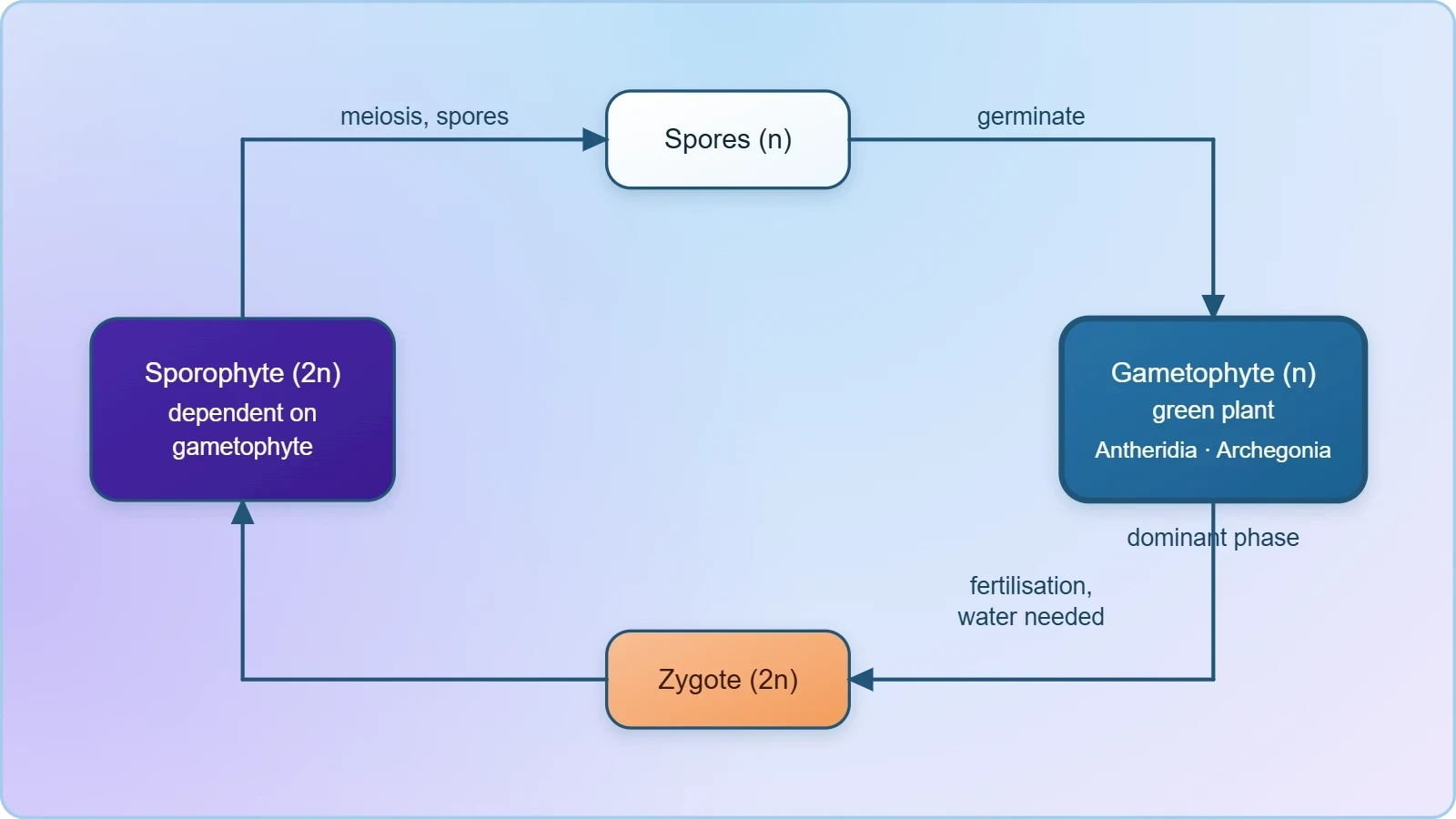
That dependence explains the habitats bryophytes favour and their modest stature. It also marks the boundary between them and the vascular plants that follow, where the sporophyte becomes dominant and the gametophyte is reduced to a small, independent or dependent structure.
Pteridophytes: The First True Vascular Plants
In pteridophytes the main plant is a sporophyte, and it is differentiated into true root, stem and leaves. These organs possess well-differentiated vascular tissues — the decisive innovation that allows greater height, better transport and structural support. The group therefore marks a genuine threshold in the plant kingdom.
Sporangia, Spores and Gametophytes
The sporophytes bear sporangia which produce spores. These spores germinate to form gametophytes, which require cool, damp places to grow. The gametophytes bear male and female sex organs called antheridia and archegonia respectively, mirroring the bryophyte arrangement but on a much smaller, free-living structure.
Water is still required for the transfer of male gametes to the archegonium, where the zygote forms after fertilisation. The zygote then produces a sporophyte. The dependence on moisture for fertilisation is thus retained even as vascular tissue liberates the plant from water for support and transport.
Why the Sporophyte Dominates
The shift in dominance from gametophyte to sporophyte is the defining reproductive change in pteridophytes. The familiar fern plant is diploid and spore-bearing; the gametophyte is a small, short-lived structure that must occupy damp ground. This inversion of emphasis prepares the way for seed plants.
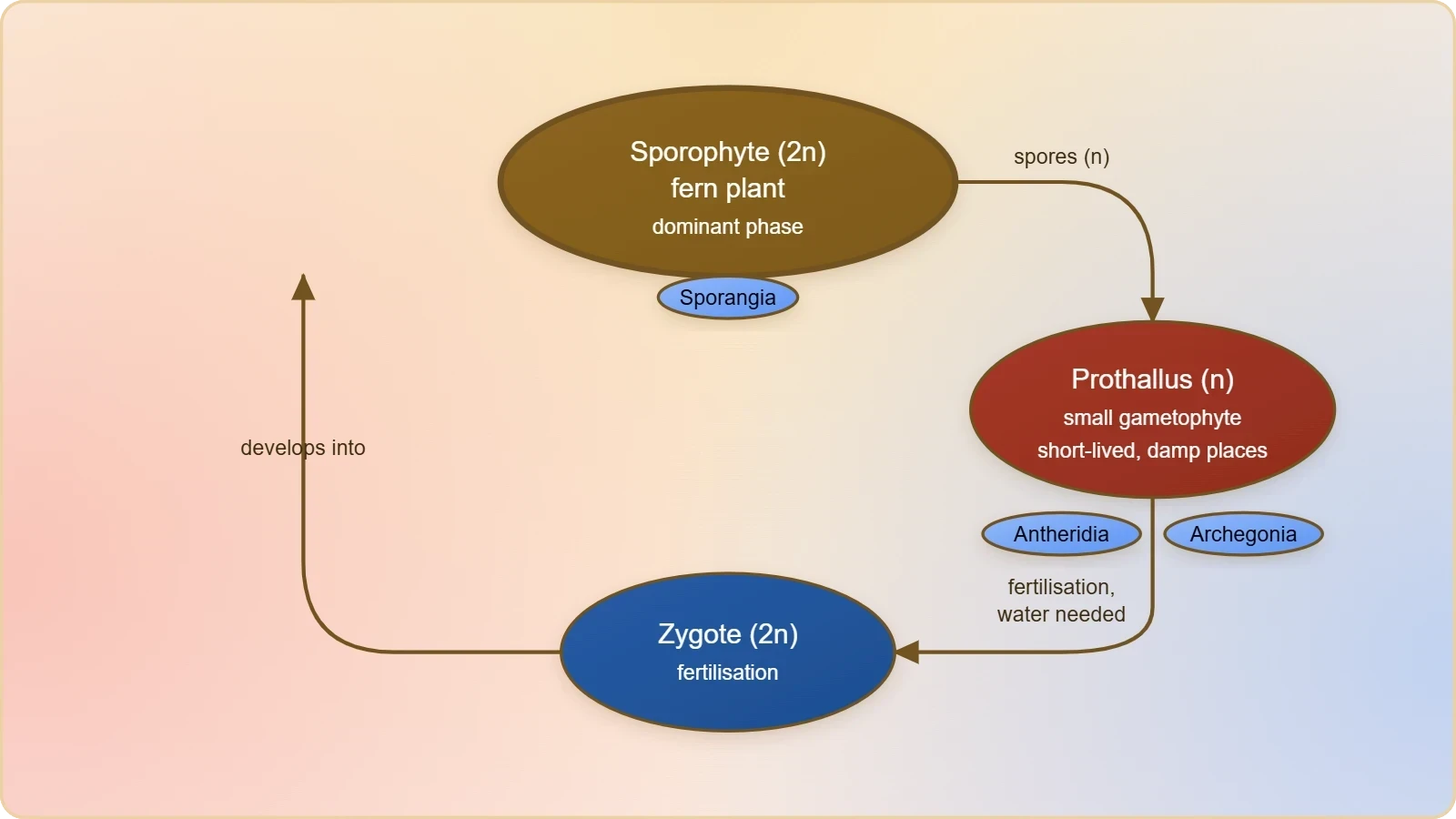
Understanding this inversion clarifies a common confusion. Learners often assume the visible plant is always the gametophyte, as in bryophytes. In pteridophytes, and in all seed plants thereafter, the visible plant is the sporophyte, and the gametophyte is reduced accordingly.
Gymnosperms: The Naked-Seeded Plants
Gymnosperms are the plants in which ovules are not enclosed by any ovary wall. After fertilisation the seeds remain exposed, and for this reason the group is described as naked-seeded. This single structural fact separates gymnosperms from angiosperms and defines the group's reproductive architecture.
Cones, Spores and Pollen
Gymnosperms produce microspores and megaspores in microsporangia and megasporangia, borne on sporophylls. The microsporophylls and megasporophylls are arranged spirally on an axis to form male and female cones respectively. The cone is therefore a compact axis bearing spore-producing leaves.
The pollen grain germinates and the pollen tube releases the male gamete into the ovule, where it fuses with the egg cell in the archegonium. Following fertilisation, the zygote develops into an embryo and the ovules develop into seeds. Water is no longer needed for gamete transfer.
From Ovule to Seed
The transition from ovule to seed is the central event of gymnosperm reproduction. Because the ovule is exposed, the developing seed remains naked on the cone scale. This arrangement protects the embryo while freeing reproduction from dependence on external water, a decisive advance over pteridophytes.
Note also that archegonia persist in gymnosperms, as the exercise material reminds us. Three groups bear archegonia — bryophytes, pteridophytes and gymnosperms — while angiosperms do not, a distinction that repays careful attention when revising the chapter.
Angiosperms: Flowers, Fruits and Two Classes
Unlike the gymnosperms, where the ovules are naked, in angiosperms the pollen grains and ovules develop in specialised structures called flowers, and the seeds are enclosed in fruits. This enclosure is the defining feature of flowering plants and the culmination of the chapter's reproductive narrative.
Scale, Habitat and Utility
Angiosperms are an exceptionally large group occurring in a wide range of habitats. They range in size from the smallest Wolffia to tall trees of Eucalyptus over one hundred metres high. They provide food, fodder, fuel, medicines and several other commercially important products.
This combination of diversity and utility makes the group economically central. The range from Wolffia to Eucalyptus illustrates how a single reproductive innovation — enclosure of ovules and seeds — can support an extraordinary breadth of form, habitat and human use.
Dicotyledons and Monocotyledons
Angiosperms are divided into two classes: the dicotyledons and the monocotyledons. This division, based on cotyledon number, closes the course and completes the classification of the plant kingdom. A dicotyledon and a monocotyledon are the two forms the chapter's final figure presents.
With this division the survey is complete. Five groups, one kingdom, and a classification that moves from pigment and stored food in algae to cotyledon number in angiosperms. The summary is the moment to see these criteria together and to test whether each group's characters can be recalled without prompting.
Reproduction Restated: Water, Spores and Seeds
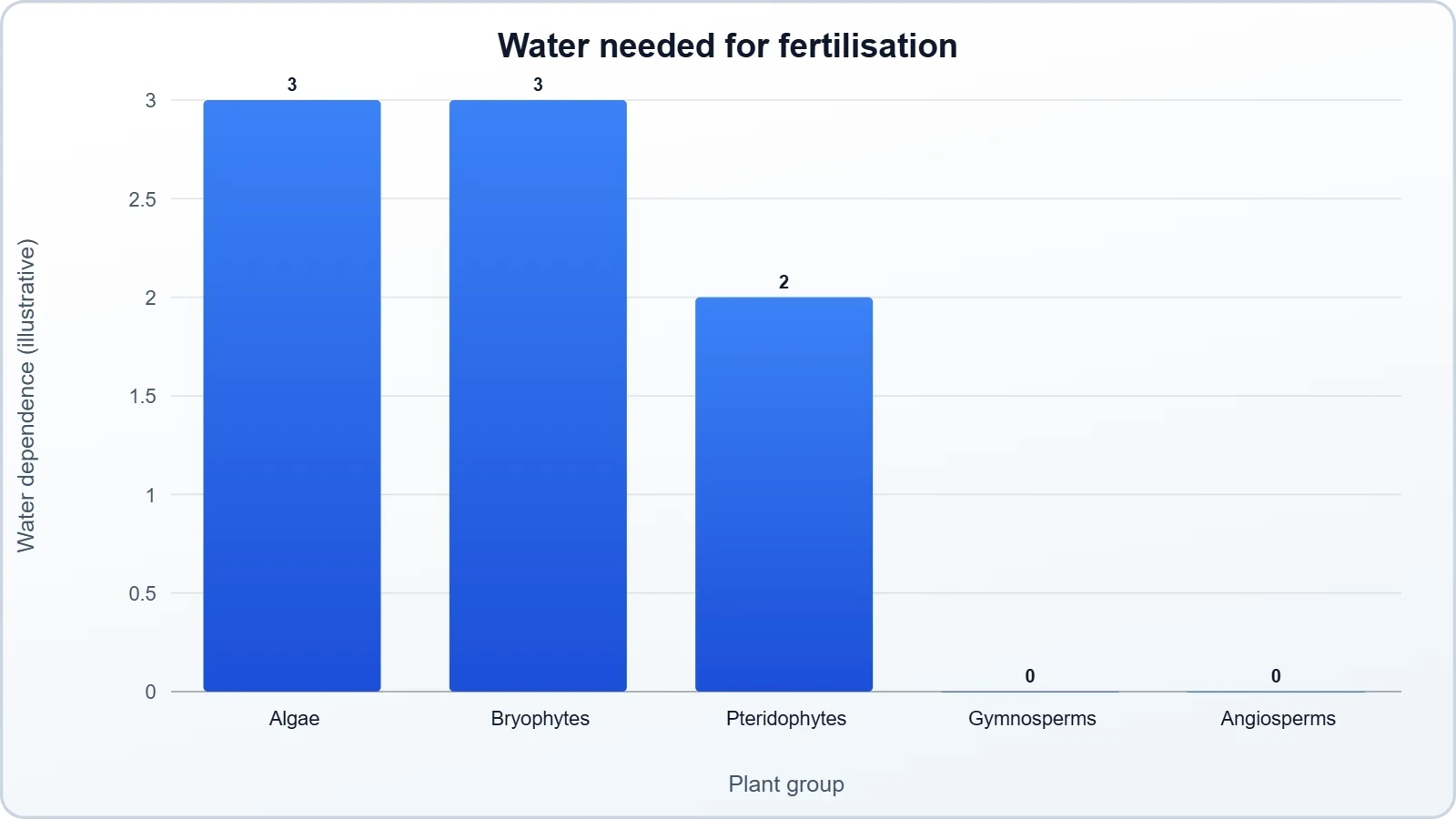
Reproduction is the thread that binds the five groups together. Algae release gametes into water freely; bryophytes and pteridophytes require water for the transfer of male gametes to the archegonium; gymnosperms and angiosperms deliver male gametes through a pollen tube, removing that dependence entirely.
Where Reduction Division Occurs
A recurring examination question asks when and where reduction division takes place across these groups. The answer follows from the life cycle: reduction division occurs at the point where the diploid sporophyte generation gives rise to haploid spores, whether in a liverwort, a moss, a fern, a gymnosperm or an angiosperm.
Ploidy questions follow the same logic. The protonemal cell of a moss, the leaf cell of a moss, the prothallus cell of a fern, the gemma cell of Marchantia and the ovum of a liverwort are haploid; the zygote of a fern and the meristem cell of a monocot are diploid.
Archegonia and the Seed Habit
Three groups of plants bear archegonia: bryophytes, pteridophytes and gymnosperms. Naming them and describing the life cycle of any one is a standard exercise, and it tests whether the alternation of generations has been understood rather than memorised as a diagram.
The seed habit, meanwhile, is the great reproductive innovation of gymnosperms and angiosperms alike. In gymnosperms the seed is naked; in angiosperms it is enclosed in a fruit. Both protect the embryo, and both free reproduction from the need for external water.
Consolidating the Chapter Before Assessment
A summary earns its place only if it changes how the material is held in memory. The five groups should now be retrievable as a sequence of increasing terrestrial independence, with each group's body form, vascular status, reproductive organs and seed condition attached to it as a coherent set rather than scattered facts.
Self-Testing the Key Distinctions
Begin with the basis of algal classification: pigment type and stored food. Then move to reduction division, asking where it occurs in the life cycle of a liverwort, a moss, a fern, a gymnosperm and an angiosperm. Finally, name the three groups that bear archegonia.
These three questions, drawn directly from the chapter's exercises, cover classification, life cycles and reproductive structures. Answering them without notes is a reliable test of whether the summary has done its work, and it exposes precisely which group still needs revisiting.
Looking Ahead
This lesson closes the course, but the plant kingdom continues to reward study. The distinctions established here — thallus versus true organs, gametophyte versus sporophyte dominance, naked versus enclosed seeds — recur throughout later botanical work and underpin every serious discussion of plant diversity.
Carry forward the vocabulary as well as the facts: isogamy, anisogamy, oogamy; antheridia and archegonia; microsporophylls and megasporophylls; dicotyledons and monocotyledons. Precision with these terms is what separates a confident account of the plant kingdom from a hesitant one.
Going further
Reviewing a chapter summary is an effective way to check that the main ideas of each plant group are connected before an examination. Rather than rereading each section in isolation, attempt to reconstruct the five-group sequence from memory, then verify against the tables above and note any gap.
Also Read
- No links available.
From our network :
- Mastering DB2 LUW v12 Tables: A Comprehensive Technical GuideComprehensive guide on DB2 LUW v12 tables. Explore CREATE TABLE syntax, BLU Acceleration, range partitioning, data types, and security features for IBM DB2 LUW v12.
- Vite 6/7 'Cold Start' Regression in Massive Module GraphsIn-depth analysis of Vite 6/7 cold start regressions in massive module graphs. Learn about barrel file issues, pre-bundling optimizations, and how to improve Vite dev server performance.
- Analyzing Trump Deportation Numbers Insights Into The 2026 Immigration Crackdown
- Mastering DB2 12.1 Instance Design: A Technical Deep Dive into Modern Database ArchitectureComprehensive guide to DB2 12.1 Instance Design. Explore architectural components, HADR setup, buffer pool tuning, and security policies for IBM DB2 12.1. Includes 10 functional SQL and Shell samples.
- Trump Political Strategy How Geopolitical Stunts Serve As Media Diversions
- AI-Powered 'Precision Diagnostic' Replaces Standard GRE Score ReportsDiscover the new GRE Precision Diagnostic. Learn how AI-powered behavioral analytics and time-to-solve tracking are replacing standard GRE score reports to empower students.
- 10 Physics Numerical Problems with Solutions for IIT JEEPrepare for IIT JEE with 10 physics numerical problems, complete with detailed solutions and conceptual explanations. Ideal for mastering kinematics, thermodynamics, electromagnetism, and optics.
- EV 2.0: The Solid-State Battery Breakthrough and Global Factory ExpansionDiscover the impact of the Solid-State Battery Breakthrough on the EV market. Learn about CATL and BYD stock growth, global factory expansion in Europe, and the future of EV 2.0 technology.
- 98% of Global MBA Programs Now Prefer GRE Over GMAT Focus EditionExplore why 98% of global MBA programs now prefer the GRE over GMAT Focus. Learn about the shorter GRE format, verbal logic importance, and strategic versatility for students.
RESOURCES
- plant kingdom chapter 3 - NCERTncert.nic.inIn this chapter, we will describe Algae, Bryophytes, Pteridophytes,. Gymnosperms and Angiosperms under Plantae. Let us also look at classification within ...
- Plant Kingdom = 5 major groups… but can you actually tell them ...instagram.comSep 12, 2026 ... Algae are. Comparison chart showing Algae, Bryophytes, Pteridophytes, Gymnosperms and Angiosperms side by side. Educational slide ...
- Knowledge of the plant kingdom among secondary students with ...link.springer.comMar 24, 2026 ... ... algae, fungi, bryophytes, pteridophytes, gymnosperms, angiosperms, and taxonomy. ... The analysis of students' knowledge of the plant kingdom ...
- Two groups. Both are land plants ☘️ Both reproduce ... - Instagraminstagram.comSep 21, 2026 ... ... Algae, Bryophytes, Pteridophytes, Gymnosperms and Angiosperms side by side. Educational slide highlighting three common Plant Kingdom mistakes.
- Plant Kingdom – Plantae - BYJU'Sbyjus.comExamples include green algae, red algae and brown algae. ... plants. E.g. Gymnosperms, Angiosperms. Also Read: Difference Between Bryophytes and Pteridophytes.
- Kingdom Plantae | CK-12 Foundation - FlexBooksflexbooks.ck12.orgPlants are classified into algae, bryophytes, pteridophytes, gymnosperms, and angiosperms based on structural and reproductive features. Algae are simple ...
- 5.9.1: Kingdom Plantae - Evolution and Phylogenybio.libretexts.org... ferns, gymnosperms, and angiosperms. Their evolutionary trajectory was relatively straight and monophyletic. In contrast, the other algae—red, brown, golden ...
- Overview of Plant Kingdom: Algae to Angiosperms | PDF - Scribdscribd.comThe document discusses different types of plants including algae, bryophytes, pteridophytes, gymnosperms and angiosperms. It provides details on their ...
- Plant classification: bryophytes, gymnosperms, angiosperms, and ...facebook.comDec 16, 2024 ... It displays a static infographic titled "Classification of Kingdom Plants" and lists the various types, such as algae, Bryophytes, pteridophytes ...
- Evolution of phenotypic disparity in the plant kingdom - Naturenature.comSep 4, 2023 ... ... algae, charophytes and bryophytes, early tracheophytes and lycophytes, ferns, seed plants and gymnosperms and early angiosperms.
- Major Plant Groups The plant kingdom can be broadly ... - Facebookfacebook.comAug 16, 2026 ... ... algae, Bryophytes, pteridophytes, gymnosperms, and angiosperms. The post's text further explains the diversity within the plant kingdom and ...
- plant kingdom chapter 3 - Aspirations Instituteaspirationsinstitute.comIn this chapter, we will describe Algae, Bryophytes, Pteridophytes,. Gymnosperms and Angiosperms under Plantae . Let us also look at classification within ...
- A phylogenetic approach for identifying new sources of ...nph.onlinelibrary.wiley.comAug 28, 2024 ... ... plant phylogeny including algae, bryophytes, pteridophytes, gymnosperms and angiosperms. Our phylogenetic signal analysis revealed that ...
- Biology, Biological Diversity, Seedless Plants, Early Plant Life | OERTXoertx.highered.texas.govMost biologists also consider green algae to be plants, although others exclude all algae from the plant kingdom. ... ferns, gymnosperms, and angiosperms. Their ...