Kingdom Plantae has never been a fixed list of organisms; it is a working hypothesis that botanists have revised whenever new evidence demanded it. Fungi, together with those members of Monera and Protista that possess cell walls, once sat comfortably inside the plant kingdom, but modern classification has removed them. Even the cyanobacteria, long called blue-green algae, are no longer treated as algae at all. What remains under Plantae is a set of five groups: Algae, Bryophytes, Pteridophytes, Gymnosperms and Angiosperms.
This lesson traces how that boundary shifted and, more importantly, how the systems used to sort plants within it evolved. Early schemes relied on habit, colour, leaf number and leaf shape, or on the structure of the androecium, and they were frankly artificial. Natural systems followed, weighing internal features such as ultrastructure, anatomy, embryology and phytochemistry. Present practice favours phylogenetic classification, built on evolutionary relationships and supported by numerical taxonomy, cytotaxonomy and chemotaxonomy.
Understanding this progression matters because every later lesson in the course depends on it. When you meet the life cycle of a fern or the reproductive biology of a gymnosperm, you are reading evidence that taxonomists themselves use to place organisms on the tree of life. The vocabulary of artificial, natural and phylogenetic systems is therefore not historical trivia; it is the grammar of plant classification.
On This Page
Redrawing the Boundaries of Kingdom Plantae
The starting point for any discussion of plant classification is the five kingdom system proposed by Whittaker in 1969, which divided living organisms into Monera, Protista, Fungi, Animalia and Plantae. That framework gave Plantae a recognisable identity, but it also inherited older groupings that later evidence would challenge. The plant kingdom of today is narrower and more precisely defined than the one Whittaker's generation inherited.
What Has Been Excluded and Why
Fungi were once treated as plants because they are sessile and possess cell walls, yet they are heterotrophic and lack chlorophyll, so they now stand in their own kingdom. Members of Monera and Protista that carry cell walls have likewise been removed from Plantae. The consequence is a kingdom defined by a combination of photosynthetic capacity and a distinctive cellular organisation rather than by superficial resemblance.
The most instructive casualty of this redrawing is the cyanobacterium. Long known as blue-green algae, it is a prokaryote and therefore belongs with Monera, not with the eukaryotic algae it superficially resembles. Students who continue to call it an alga inherit an error from an artificial system that grouped organisms by colour and habitat rather than by ancestry.
The Five Groups Retained Under Plantae
Within the revised kingdom, five groups are described: Algae, Bryophytes, Pteridophytes, Gymnosperms and Angiosperms. They are arranged in an order that broadly reflects increasing complexity of body form and of reproductive strategy, from simple thalloid organisms to seed-bearing plants with flowers. Each group receives detailed treatment in the lessons that follow.
This sequence is not arbitrary. Algae are chlorophyll-bearing, simple, thalloid, autotrophic and largely aquatic organisms, occurring in fresh water and marine environments as well as on moist stones, soils and wood. Bryophytes, pteridophytes, gymnosperms and angiosperms each add structural and reproductive innovations that the course will examine in turn.
Artificial Systems and Their Limits
The earliest systems of classification used only gross superficial morphological characters such as habit, colour, and the number and shape of leaves. They rested mainly on vegetative characters or on the structure of the androecium, the system associated with Linnaeus. Such schemes were artificial in the precise sense that they separated closely related species because they depended on a handful of characteristics.
Why Superficial Characters Mislead
An artificial system gives equal weightage to vegetative and sexual characteristics, and that is not acceptable. Vegetative characters are more easily affected by the environment, so two plants growing in different conditions may look unlike while remaining close relatives. Grouping by leaf shape therefore records habitat as much as heredity.
The practical cost is real. A classification that splits near relatives produces groups with no predictive power: knowing that a plant sits in a particular class tells you little about its anatomy, its embryology or its chemistry. The system describes appearance but fails to organise biological knowledge in any useful way.
Linnaeus and the Androecium
The Linnaean arrangement classified flowering plants largely by androecium structure, that is, by the number, fusion and disposition of stamens. It was workable and it was consistent, which explains its long currency, but it treated a single reproductive trait as decisive. Plants with similar stamens were placed together even when everything else about them differed.
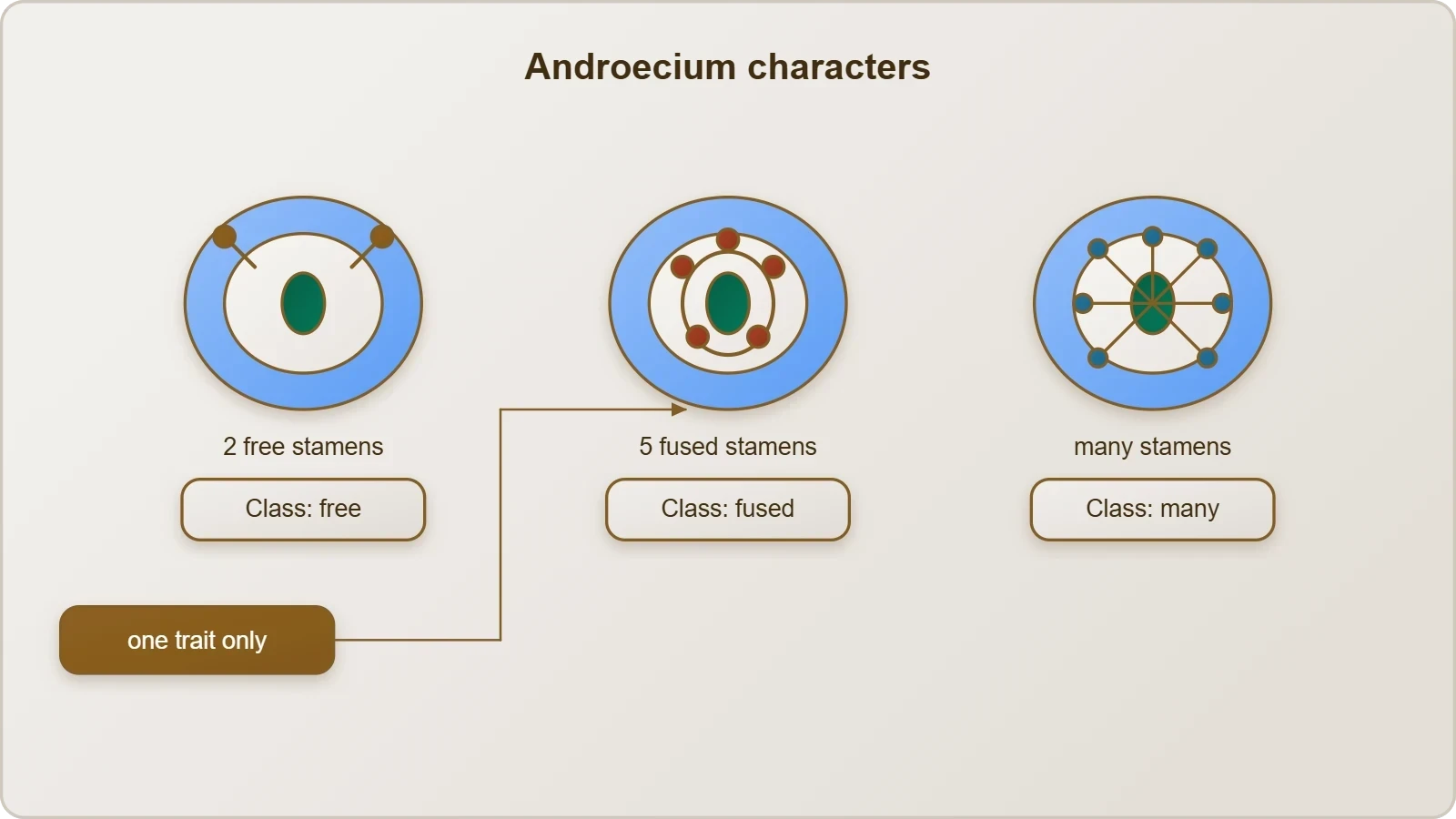
Recognising this limitation is not a dismissal of early taxonomy. Those systems established the discipline of consistent description and binomial naming on which later work depends. Their error lay in the weight given to a few characters, not in the ambition to classify at all.
Natural Systems and the Turn to Internal Evidence
Natural classification systems developed in response to these weaknesses. They were based on natural affinities among organisms and considered not only external features but also internal ones, including ultrastructure, anatomy, embryology and phytochemistry. The shift was from what a plant looks like to what a plant is made of and how it develops.
The Bentham and Hooker Contribution
Such a classification for flowering plants was given by George Bentham and Joseph Dalton Hooker, whose arrangement weighed a broad range of characters rather than a favoured few. By drawing on multiple lines of evidence, natural systems kept genuinely related species together and produced groups that behaved predictably. The approach remains a landmark in the history of plant taxonomy.
Natural systems also changed how taxonomists worked. Description became more thorough, comparison more deliberate, and the accumulation of anatomical and embryological data became part of the classificatory enterprise rather than an optional refinement. Classification moved closer to biology and further from mere cataloguing.
From Affinity to Ancestry
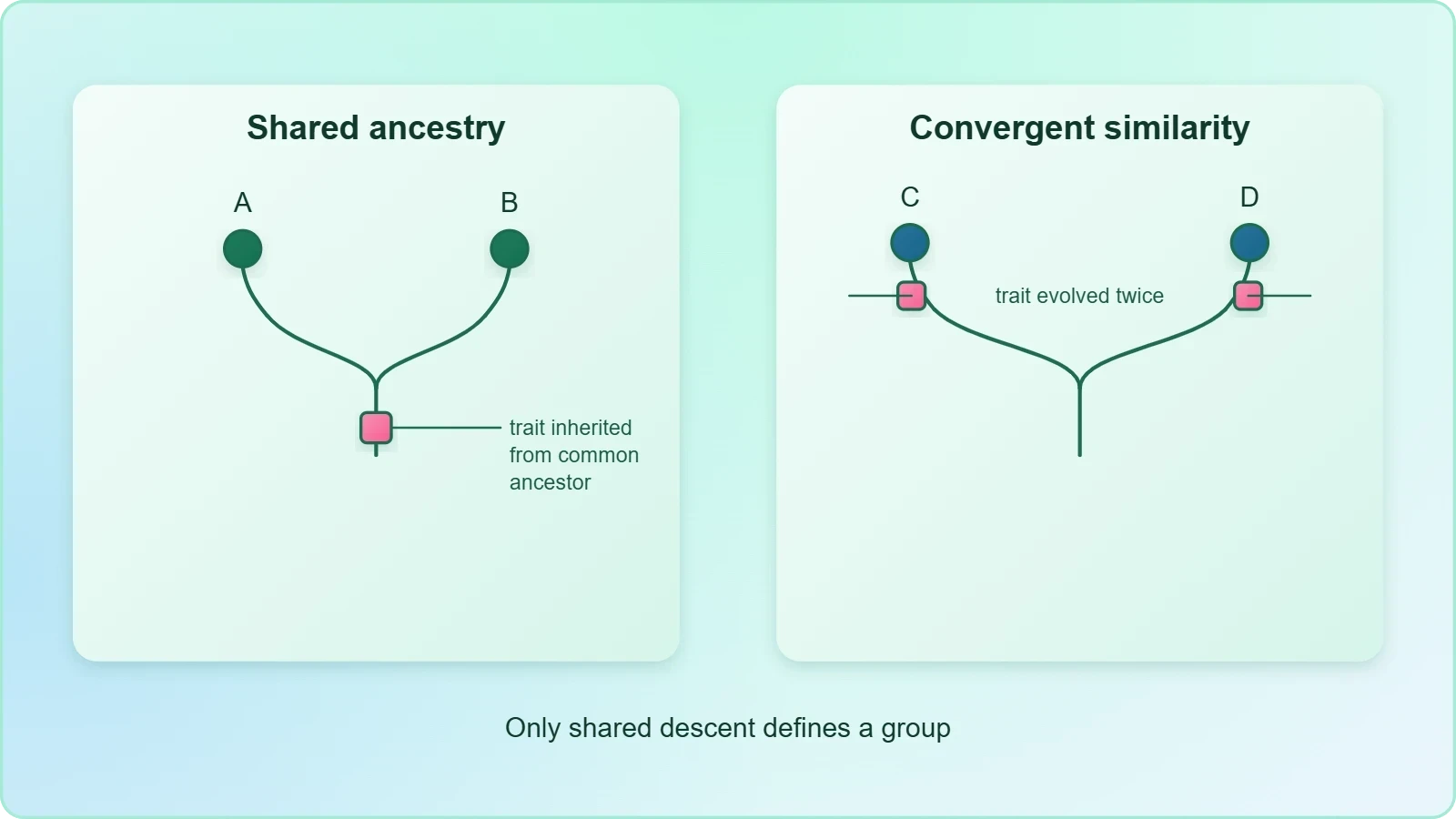
Natural affinity is a considerable advance, yet it still describes resemblance rather than cause. Two organisms may resemble each other because they share an ancestor, or because they have adapted to similar conditions. Distinguishing between these possibilities requires a framework that treats common descent as the organising principle, and that is what phylogenetic classification supplies.
Phylogenetic Classification and Common Ancestry
At present, phylogenetic classification systems based on evolutionary relationships between the various organisms are acceptable. The central assumption is straightforward: organisms belonging to the same taxa have a common ancestor. Classification thereby becomes a statement about history rather than a summary of appearance, and the groups it produces are intended to reflect descent.
Filling the Gaps Where Fossils Are Silent
Phylogenetic reasoning draws on information from many other sources to resolve difficulties in classification. These additional sources become more important when there is no supporting fossil evidence, because the direct historical record is unavailable. In such cases, comparison of living organisms must carry the argument, and the more independent lines of evidence agree, the firmer the conclusion.
This is why modern taxonomy is collaborative. A botanist working on chromosome behaviour, a chemist analysing secondary metabolites and a computer scientist processing character matrices may all contribute to a single classificatory decision. No one dataset is privileged; the aim is convergence of evidence on a common ancestry.
Reading a Phylogenetic Tree
A phylogenetic tree is a hypothesis about branching order, and its nodes represent ancestral populations rather than living species. Taxa that share a recent node are more closely related than taxa separated by many nodes, regardless of how similar they look. The diagram below expresses that logic in its simplest form, with a shared ancestor at the root.
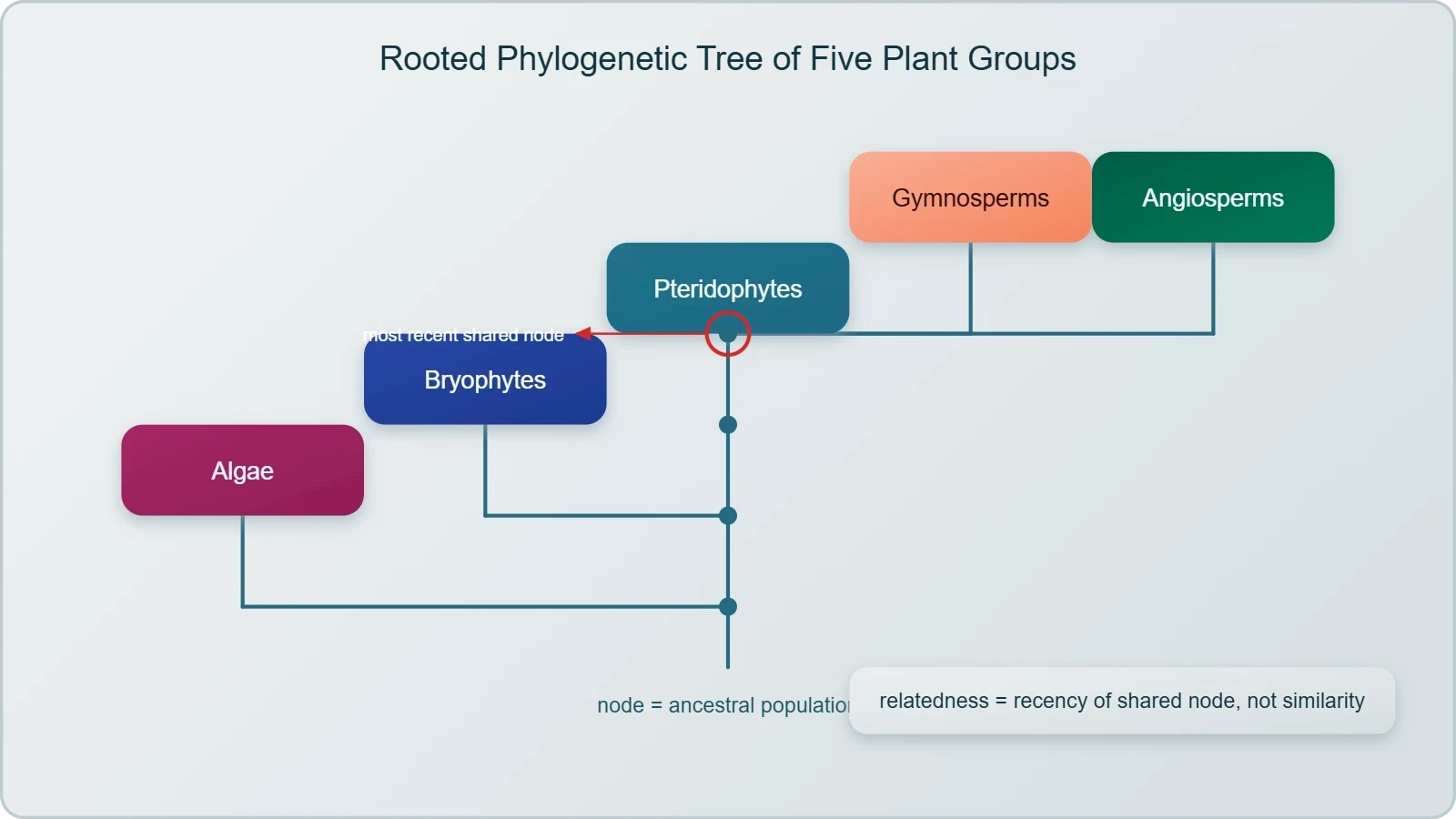
The equation is deliberately schematic, but it captures the operative principle. Relationship is defined by shared descent, and the characters that mark a group are those inherited from the ancestor at which that group originates. Similarity that arises independently, through adaptation to similar conditions, does not create relationship.
Numerical, Cyto- and Chemotaxonomy as Working Tools
Phylogenetic classification needs data, and three modern approaches supply it in quantity. Numerical taxonomy, cytotaxonomy and chemotaxonomy each address a different kind of evidence, and together they allow taxonomists to resolve confusions that morphology alone cannot settle. The lesson now turns to what each method measures and what it contributes.
Numerical Taxonomy and Equal Weighting
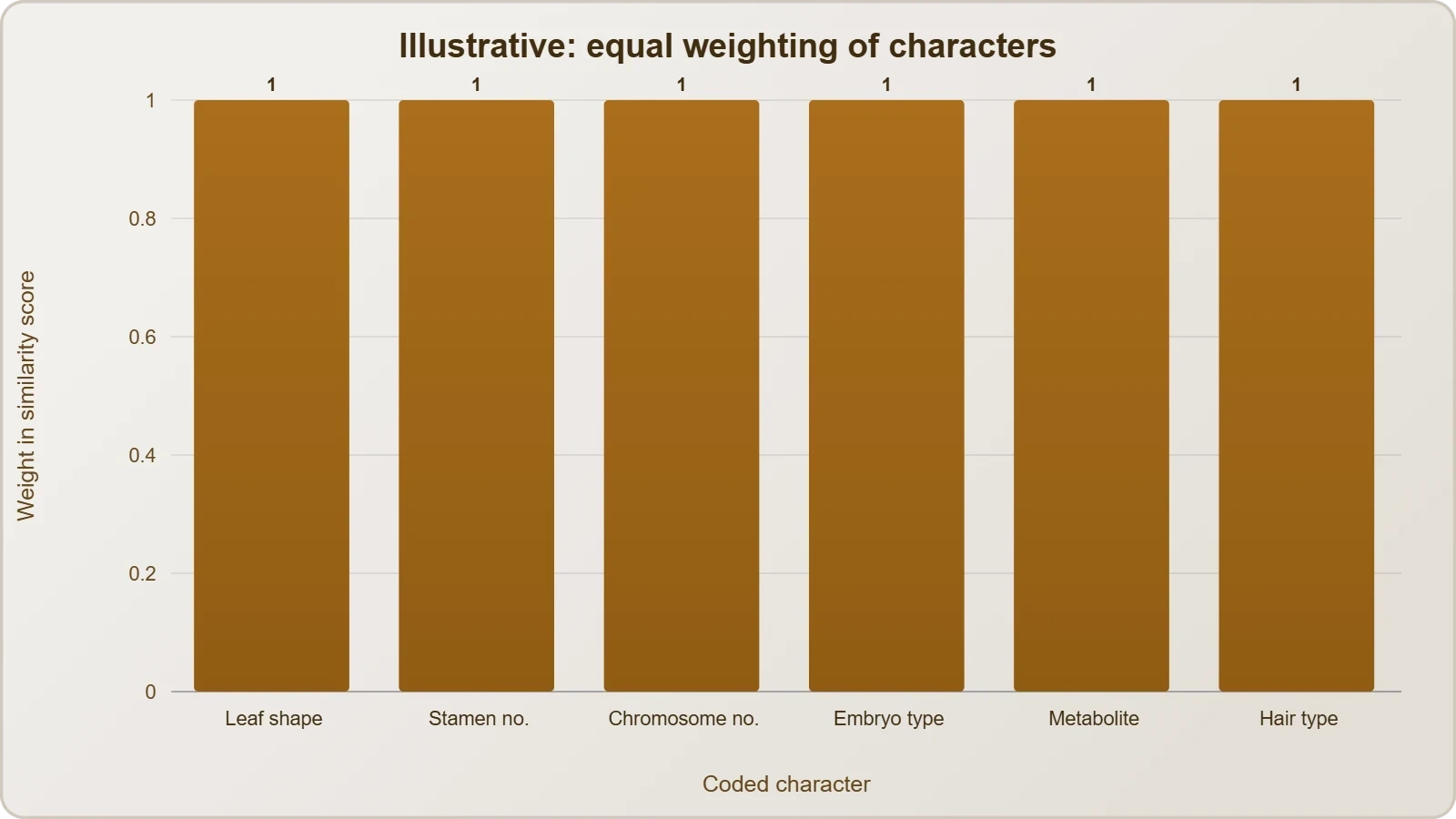
Numerical taxonomy, now easily carried out using computers, is based on all observable characteristics. Number and codes are assigned to all the characters and the data are then processed. In this way each character is given equal importance, and at the same time hundreds of characters can be considered in a single analysis, which no manual method could manage.
The equal weighting is the methodological heart of the approach. Because no character is privileged in advance, the result is not prejudiced by a taxonomist's opinion about which trait matters most. The following sketch shows the elementary idea of coding characters and comparing the resulting profiles.
# Numerical taxonomy: code characters, then compare profiles
characters = ["leaf_shape", "stamen_number", "chromosome_count", "habit"]

profiles = {
    "species_A": [1, 2, 3, 0],
    "species_B": [1, 2, 3, 1],
    "species_C": [0, 1, 2, 1],
}

def similarity(a, b):
    matches = sum(1 for x, y in zip(a, b) if x == y)
    return matches / len(a)

for name, profile in profiles.items():
    if name != "species_A":
        score = similarity(profiles["species_A"], profile)
        print(name, round(score, 2))
Each character contributes one comparison, so a long list of characters dilutes the influence of any single one. That is precisely the advantage the method claims: hundreds of characters can be considered, and each is given equal importance in the final assessment of similarity.
Cytological and Chemical Evidence
Cytotaxonomy is based on cytological information such as chromosome number, structure and behaviour. Chemotaxonomy uses the chemical constituents of the plant to resolve confusions. Both are used by taxonomists these days, and both extend classification beyond what can be seen with the naked eye or measured with a ruler.
Chromosome behaviour during division can reveal relationships invisible in mature form, while chemical constituents provide an independent line of evidence that is unaffected by the growing environment. When morphological, cytological and chemical data point the same way, the resulting classification is far more secure than any single source could make it.
Angiosperm Classification and the Concerns Behind It
Classification within angiosperms illustrates the concerns that shaped classification systems generally. The earliest schemes used gross superficial morphological characters such as habit, colour, and the number and shape of leaves, and they were based mainly on vegetative characters or on androecium structure. The problems that followed are the same problems examined above, seen at close range.
From Artificial Splits to Natural Groupings
Because artificial systems separated closely related species, they fragmented the angiosperms into groups that did not correspond to biological reality. Natural systems answered by weighing natural affinities and internal features, and the Bentham and Hooker classification of flowering plants stands as the representative example. The trajectory within angiosperms therefore mirrors the trajectory of the kingdom as a whole.
This parallel is worth holding in mind. The same argument that removed cyanobacteria from the algae also reorganised the flowering plants, and for the same reason: characters that respond readily to environment cannot bear the whole weight of classification. Internal evidence, from anatomy to chemistry, carries more information about ancestry.
Preparing for the Groups Ahead
With the framework established, the five groups can now be examined in sequence. The next lesson turns to Algae, describing their general characteristics, their reproduction and their importance, beginning with the chlorophyll-bearing, simple, thalloid, autotrophic organisms that open the survey. Each subsequent lesson adds a group and its distinctive biology.
The classification principles covered here will recur throughout. When a life cycle is described or a reproductive structure named, the question of affinity and ancestry is never far away. Holding the three systems in mind, artificial, natural and phylogenetic, makes the detail of each group easier to place and easier to remember.
Going Further
Phylogenetic classification arranges organisms according to their evolutionary history, so groups that share a recent common ancestor are placed together. This is the practical meaning of the assumption that organisms in the same taxa have a common ancestor, and it explains why a phylogenetic tree is read by nodes rather than by overall resemblance. Two species may look alike and still sit far apart.
Why Computation Changed the Method
Numerical taxonomy is practical today because computers can compare hundreds of characters at once, which is exactly the advantage the chapter describes. Before such processing was routine, equal weighting of many characters was a theoretical ideal rather than a working method. The machine made the ideal operational, and it did so without altering the underlying principle.
That principle, that each character is given equal importance while hundreds are considered, remains the reason numerical taxonomy is trusted as a first pass. It produces an unbiased summary of overall similarity, which phylogenetic analysis can then interpret in the light of ancestry and independent cytological or chemical evidence.
Consolidating the Lesson
The argument of this lesson can be stated compactly. Plantae has been narrowed by excluding Fungi and cell-walled Monera and Protista, five groups remain within it, and the systems used to order them have moved from artificial through natural to phylogenetic. Numerical, cytological and chemical methods now supply the evidence that such systems require.
Carry that structure into the next lesson. Algae are chlorophyll-bearing, simple, thalloid, autotrophic and largely aquatic organisms, and their study will show how form, reproduction and habitat interact in a group that sits at the base of the plant kingdom as it is now defined.
Also Read
- No links available.
From our network :
- Vite 6/7 'Cold Start' Regression in Massive Module GraphsIn-depth analysis of Vite 6/7 cold start regressions in massive module graphs. Learn about barrel file issues, pre-bundling optimizations, and how to improve Vite dev server performance.
- 98% of Global MBA Programs Now Prefer GRE Over GMAT Focus EditionExplore why 98% of global MBA programs now prefer the GRE over GMAT Focus. Learn about the shorter GRE format, verbal logic importance, and strategic versatility for students.
- Mastering DB2 12.1 Instance Design: A Technical Deep Dive into Modern Database ArchitectureComprehensive guide to DB2 12.1 Instance Design. Explore architectural components, HADR setup, buffer pool tuning, and security policies for IBM DB2 12.1. Includes 10 functional SQL and Shell samples.
- 10 Physics Numerical Problems with Solutions for IIT JEEPrepare for IIT JEE with 10 physics numerical problems, complete with detailed solutions and conceptual explanations. Ideal for mastering kinematics, thermodynamics, electromagnetism, and optics.
- EV 2.0: The Solid-State Battery Breakthrough and Global Factory ExpansionDiscover the impact of the Solid-State Battery Breakthrough on the EV market. Learn about CATL and BYD stock growth, global factory expansion in Europe, and the future of EV 2.0 technology.
- AI-Powered 'Precision Diagnostic' Replaces Standard GRE Score ReportsDiscover the new GRE Precision Diagnostic. Learn how AI-powered behavioral analytics and time-to-solve tracking are replacing standard GRE score reports to empower students.
- Trump Political Strategy How Geopolitical Stunts Serve As Media Diversions
- Mastering DB2 LUW v12 Tables: A Comprehensive Technical GuideComprehensive guide on DB2 LUW v12 tables. Explore CREATE TABLE syntax, BLU Acceleration, range partitioning, data types, and security features for IBM DB2 LUW v12.
- Analyzing Trump Deportation Numbers Insights Into The 2026 Immigration Crackdown
RESOURCES
- Difference between artificial and natural classification systemsbiology.lifeeasy.orgPhylogenetic systems of classification attempt to reflect? asked in ... plant-kingdom · syngamy · triple-fusion. 1 answer. Difference between isogamy and ...
- Biological Classification Mcqs - BYJU'Sbyjus.comKingdom Fungi; Kingdom Plantae; Kingdom Animalia. Biological classification is of three types – artificial, natural and phylogenetic. The biological ...
- SYSTEMS OF CLASSIFICATION- Artificial System, Natural System ...slideshare.netSYSTEMS OF CLASSIFICATION- Artificial System, Natural System, Phylogenetic System ... Divisions: The plant kingdom was divided into three main divisions: 1.
- Characteristics of Kingdom Plantae | PDF | Spore | Plant Reproductionscribd.com... classification of the Plant Kingdom, highlighting features such ... It discusses various classification systems including artificial, natural, phylogenetic ...
- Building PlantID: India's Plant Taxonomy Startup - Apar Academyaparacademy.comCompare artificial, natural, and phylogenetic classification systems and their limitations; Explain the role of numerical taxonomy, cytotaxonomy, and ...
- Overview of Plant Classification Systems | PDF - Scribdscribd.com1) Artificial classification system. 2) Natural classification system Phylogenetic Natural Classification Classification 3) Phylogenetic classification system ...
- plant kingdom chapter 3 - NCERTncert.nic.inSuch a classification for flowering plants was given by George Bentham and. Joseph Dalton Hooker. At present phylogenetic classification systems based on.
- Plant Classification: Comprehensive Guide to Taxonomy, Divisions ...houseofphysicsnotes.blogspot.comDec 24, 2025 ... The three main types of classification systems are artificial, natural, and phylogenetic. ... plant kingdom. For more biology and science ...
- Mapping of specialized metabolite terms onto a plant phylogeny ...pubmed.ncbi.nlm.nih.govJul 8, 2024 ... ... plant chemical diversity and enable system-level views of nature's millions of years of chemical experimentation. Keywords: artificial ...
- The Plant Kingdom | by Hemant Bhushan - Mediummedium.comSep 11, 2023 ... Under Plantae: Algae; Bryophyte; Pteridophyte; Gymnosperm; Angiosperm. Why 'Artificial System of Classification' is not acceptable? Natural ...
- E-RESOURCE - Udai Pratap Autonomous Collegeupcollege.ac.inTopic:Artificial, Natural and Phylogenetic, Bentham and ... The earliest system of classification were artificial systems and the system of this nature.
- The Prokaryote-Eukaryote Dichotomy: Meanings and Mythology - PMCpmc.ncbi.nlm.nih.gov... natural classification as the kingdom ... natural versus artificial classification of bacteria (44). Could one have a natural, phylogenetic classification?
- phenetic classification systems - Plant Taxonomy - Biology 308employees.csbsju.eduAug 20, 2007 ... Artificial and phenetic (also called 'natural') classifications (see below) are based on phenetic relationships. Phylogenetic (ancestral or ...
- [Solved] Place these taxonomic classification systems in chronologicatestbook.coma) Whittaker's five-kingdom system b) Linnaeus's artificial system c) Bentham and Hooker's natural system d) Engler and Prantl's phylogenetic system e) APG ...
- Plant Taxonomy: Definition, Terms, Classifications - Microbe Notesmicrobenotes.comApr 19, 2024 ... Classification done based on evolutionary characteristics is phylogenetic classification. Different Systems of Classification. Artificial System ...