Long before anyone wrote a formal rulebook for biology, people were already sorting the living world around them. Early observers grouped organisms by what those organisms could do for them — which plants fed a household, which animals pulled a plough, which herbs eased a fever. This practical, use-driven instinct is the true origin of classification, and it remains a useful reminder that taxonomy grew out of human need rather than abstract curiosity.
This lesson traces that intellectual arc from use-based grouping to the enlarged, evolution-aware discipline we now call systematics. It builds directly on the processes of characterisation, identification, classification and nomenclature established earlier, and it prepares the ground for the ranked categories that follow. The emphasis throughout stays on definitions, terminology and the widening scope of a science that Linnaeus himself helped name.
Students at the intermediate level will find here a careful account of why systematics is more than cataloguing. It is the study of relationships, and relationships demand evidence — structure, development, cellular organisation and ecological context. By the end, the distinction between a convenient category and a biological entity should feel sharp and defensible.
On This Page
- Why the Earliest Classifications Were Built on Use
- From Convenient Categories to the Scientific Term Taxon
- The Rise of Systematics and the Latin Root Systema
- Classification as a Hierarchy of Steps and Ranks
- Species as the Fundamental Unit of Classification
- Reading the Enlarged Scope as a Widening of Method
- Consolidating the Lesson Before the Hierarchy
Why the Earliest Classifications Were Built on Use
Human beings have always been interested in knowing more and more about the various kinds of organisms, particularly with reference to their own use. In early days, human beings needed to find sources for their basic needs of food, clothing and shelter. Hence, the earliest classifications were based on the 'uses' of various organisms.
This origin matters because it explains the shape of early knowledge systems. A farmer did not need a phylogeny; he needed to know which seed germinated in which season. A healer needed to distinguish a medicinal root from a poisonous one. Use was the organising principle, and it worked well enough for survival.
The Logic of Utility as an Organising Principle
Grouping by use produces categories that are immediately legible: edible, medicinal, fibrous, venomous, draught-worthy. Such categories are convenient and memorable, and they map neatly onto daily decisions. They are, however, anthropocentric — they describe the organism's relationship to us rather than the organism's relationship to other organisms.
This is not a flaw so much as a stage. Every science begins with the phenomena that press hardest on human life, and biology began with hunger, cold and illness. The use-based scheme was the first honest attempt to reduce overwhelming diversity to something a single mind could hold.
What Use-Based Grouping Could Not Explain
Utility tells us nothing about shared ancestry. Two medicinal plants may sit in the same early category while being utterly unrelated, and two close relatives may be split because one is useful and the other is not. The scheme therefore could not support questions about relationships, which is precisely the question that came next.
Once curiosity shifted from "what can this do for me" to "how is this connected to that", a different discipline was required. The transition was not a rejection of earlier classifications but an enlargement of ambition, and the vocabulary had to grow accordingly.
From Convenient Categories to the Scientific Term Taxon
Since it is nearly impossible to study all the living organisms, it is necessary to devise some means to make this possible. This process is classification. Classification is the process by which anything is grouped into convenient categories based on some easily observable characters.
We easily recognise groups such as plants or animals, dogs, cats or insects. The moment we use any of these terms, we associate certain characters with the organism in that group. Think of a dog and you see dogs, not cats; say "mammals" and you picture animals with external ears and body hair.
Categories at Very Different Levels
All these — dogs, cats, mammals, wheat, rice, plants, animals — are convenient categories we use to study organisms. The scientific term for these categories is taxa. Crucially, taxa can indicate categories at very different levels: plants form a taxon, and wheat is also a taxon.
Animals, mammals and dogs are all taxa, yet a dog is a mammal and mammals are animals. The same word therefore covers nested ranks of very different breadth, and recognising that nesting is the first step toward understanding hierarchy.
Taxonomy and the Four Basic Processes
Based on characteristics, all living organisms can be classified into different taxa, and this process of classification is taxonomy. External and internal structure, along with the structure of the cell, development process and ecological information, are essential and form the basis of modern taxonomic studies.
Hence characterisation, identification, classification and nomenclature are the processes that are basic to taxonomy. Each is a distinct operation, and together they form the working sequence that any taxonomist follows when confronting an unfamiliar specimen.
The Rise of Systematics and the Latin Root Systema
Human beings were, since long, not only interested in knowing more about different kinds of organisms and their diversities, but also the relationships among them. This branch of study was referred to as systematics. The word systematics is derived from the Latin word 'systema', which means systematic arrangement of organisms.
Linnaeus used Systema Naturae as the title of his publication, a choice that signals exactly what the discipline promised: an orderly, reasoned arrangement rather than a loose list. The title itself became a statement of method, and the method outlived the book.
Relationships as the Central Question
What distinguishes systematics from mere classification is the object of its curiosity. Classification asks how to group; systematics asks how groups are related. The second question is deeper, because it requires evidence of connection rather than mere resemblance in a single convenient character.
This is why systematics takes into account evolutionary relationships between organisms. Two organisms that look alike may be distantly related, and two that look different may be close kin. Only relationship, not appearance alone, can adjudicate between these possibilities.
An Enlarged Scope, Not a Replacement
The scope of systematics was later enlarged to include identification, nomenclature and classification. Note the direction of the movement: enlargement, not substitution. The older processes were absorbed into a broader framework rather than discarded as obsolete.
This absorption is the intellectual hinge of the lesson. Use-based grouping did not vanish in disgrace; it was subsumed into a discipline that could answer the questions utility could not. The vocabulary widened, and with it the explanatory power of the whole enterprise.
Classification as a Hierarchy of Steps and Ranks
Classification is not a single step process but involves hierarchy of steps in which each step represents a rank or category. Since the category is a part of overall taxonomic arrangement, it is called the taxonomic category, and all categories together constitute the taxonomic hierarchy.
Each category, referred to as a unit of classification, in fact represents a rank and is commonly termed as taxon, with the plural taxa. The terminology is precise here: category denotes the rank, while taxon denotes the actual group of organisms occupying that rank.
Insects as a Concrete Illustration
Insects represent a group of organisms sharing common features like three pairs of jointed legs. It means insects are recognisable concrete objects which can be classified, and thus were given a rank or category. The group is real, observable and defensible on morphological grounds.
Remember, groups represent category, and category further denotes rank. Each rank or taxon represents a unit of classification. These taxonomic groups and categories are distinct biological entities and not merely morphological aggregates, a distinction worth holding firmly.
Placing an Organism in Its Proper Category
Taxonomical studies of all known organisms have led to the development of common categories such as kingdom, phylum or division for plants, class, order, family, genus and species. All organisms, including those in the plant and animal kingdoms, have species as the lowest category.
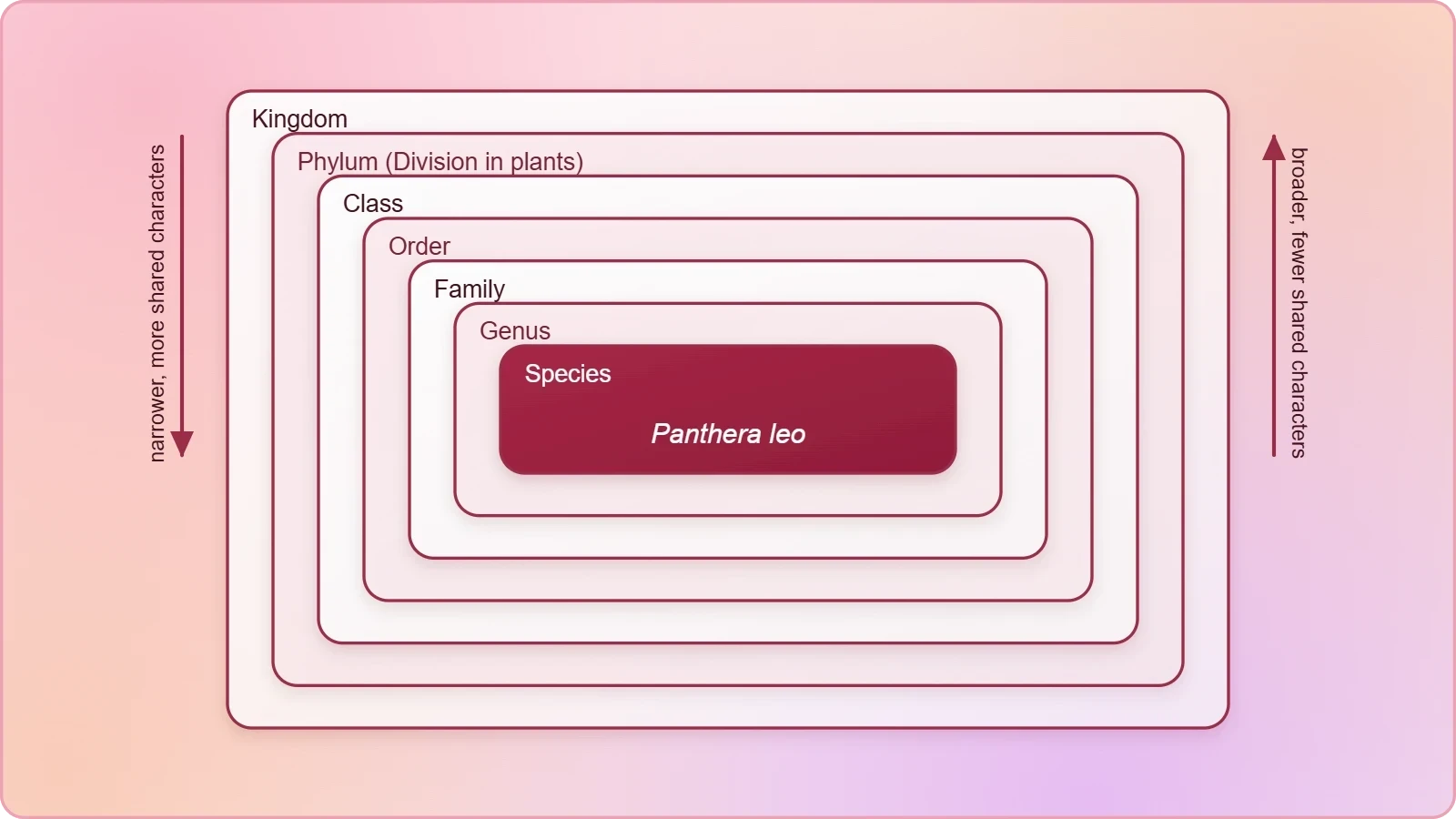
How, then, does one place an organism in these categories? The basic requirement is knowledge of the characters of an individual or group. This helps in identifying similarities and dissimilarities among individuals of the same kind as well as of other kinds.
Species as the Fundamental Unit of Classification
Taxonomic studies consider a group of individual organisms with fundamental similarities as a species. One should be able to distinguish one species from the other closely related species based on the distinct morphological differences that separate them in practice.
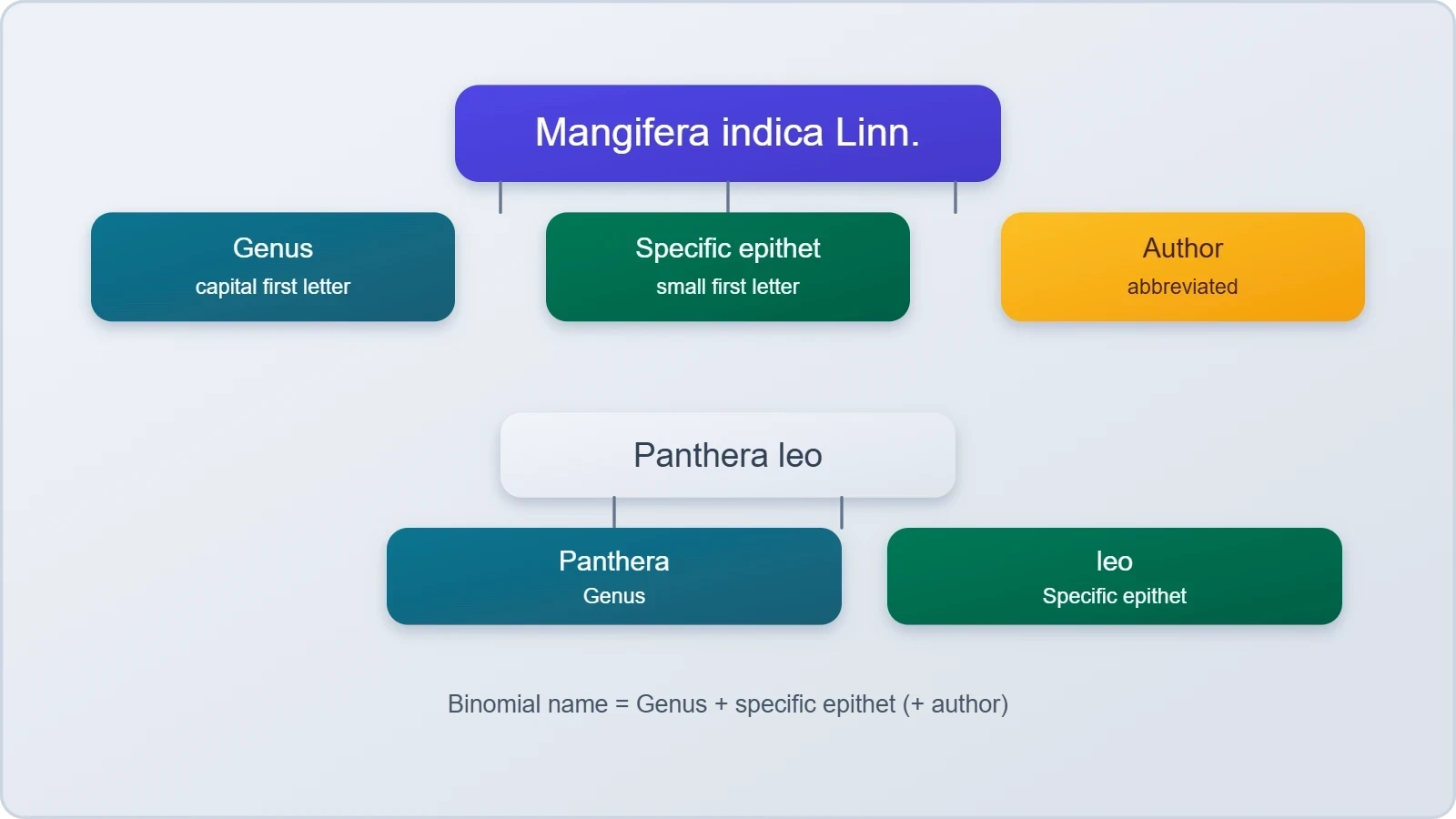
Consider Mangifera indica, Solanum tuberosum (potato) and Panthera leo (lion). All three names — indica, tuberosum and leo — represent the specific epithets, while the first words Mangifera, Solanum and Panthera are genera and represent another higher level of taxon or category.
Genus, Specific Epithet and the Binomial Form
Each genus may have one or more than one specific epithet representing different organisms, but having morphological similarities. For example, Panthera has another specific epithet called tigris, and Solanum includes species like nigrum and tuberosum.
The binomial convention follows a fixed pattern. The first word denoting the genus starts with a capital letter while the specific epithet starts with a small letter, as illustrated by Mangifera indica. This typographic discipline is not decorative; it prevents ambiguity.
Author Citation and the Abbreviated Name
The name of the author appears after the specific epithet, that is, at the end of the biological name, and is written in an abbreviated form. For example, Mangifera indica Linn. indicates that this species was first described by Linnaeus.
Author citation is a small but powerful device. It records provenance, credits the original describer, and allows later revisions to be traced. In a discipline built on cumulative evidence, such traceability is essential rather than pedantic.
Reading the Enlarged Scope as a Widening of Method
The enlarged scope of systematics can be read as a widening of method rather than a change of subject. Identification, nomenclature and classification were not invented anew; they were gathered under a single intellectual roof and made answerable to evolutionary relationships.
This gathering has consequences for how we teach and practise the discipline. A name is no longer merely a label; it is a hypothesis about relationship. A category is no longer merely a convenient box; it is a claim about shared history that must survive scrutiny.
Why Evolutionary Relationships Change the Standard
When relationship becomes the criterion, resemblance alone loses authority. Convergent forms can mimic one another without kinship, and cryptic relatives can differ outwardly while sharing deep ancestry. Systematics therefore demands multiple lines of evidence before it commits.
This is why external and internal structure, cell organisation, development and ecological information all matter. Each contributes independent testimony, and agreement among them strengthens the arrangement. Disagreement is equally informative, flagging where further study is required.
From Use to Relationship: A Continuum of Purpose
The movement from use-based grouping to systematics is best understood as a continuum of purpose. Early classifications served immediate survival; later ones serve explanation. Both are legitimate, and the second does not invalidate the first.
What changed is the question being asked. Once the question became "how are these related", the answer required a method capable of testing relationship. Systematics supplied that method, and in doing so enlarged the scope of everything taxonomy could attempt.
Consolidating the Lesson Before the Hierarchy
Three ideas now stand together. First, the earliest classifications were based on the uses of organisms, reflecting the basic needs of food, clothing and shelter. Second, interest in relationships gave rise to systematics, derived from the Latin 'systema'. Third, the scope of systematics was enlarged to include identification, nomenclature and classification.
Around these ideas sit the working definitions that the next lesson will assume. Classification groups organisms into convenient categories based on easily observable characters. Taxa are those categories, and they exist at very different levels, from plants down to dogs. Taxonomy is the process of classifying based on characteristics.
A Compact Summary of Terms
Characterisation, identification, classification and nomenclature are the processes basic to taxonomy. A species is a group of individual organisms with fundamental similarities, distinguishable from close relatives by distinct morphological differences. Genus and specific epithet together form the binomial name.
The binomial convention is fixed: genus capitalised, specific epithet in lower case, author abbreviated at the end. Mangifera indica Linn. demonstrates all three rules at once. These conventions travel with the discipline and will reappear wherever names are used.
Preparing for the Ranked Categories
The next lesson works through the taxonomic categories from species to kingdom, using examples of plants and animals. Everything established here — the meaning of taxon, the hierarchy of steps, the distinction between category and group — becomes the scaffolding for that ascent.
What remains is to see how the ranks nest and how an organism is placed within them. The knowledge of characters, already identified as the basic requirement, will do the work. With that foundation laid, the hierarchy can be climbed with confidence.
Going further
The link between the word systematics and the Latin 'systema' is more than etymology; it is a statement of intent. Linnaeus chose Systema Naturae as his title because the promise was systematic arrangement, and the same root idea still governs how the discipline describes itself today.
It is also worth noting that the shift from use-based grouping to systematics is presented as a widening of scope, not as a rejection of earlier classifications. The practical categories of food, clothing and shelter were not declared wrong; they were absorbed into a larger framework that could also address relationships.
Also Read
- No links available.
From our network :
- Mastering DB2 12.1 Instance Design: A Technical Deep Dive into Modern Database ArchitectureComprehensive guide to DB2 12.1 Instance Design. Explore architectural components, HADR setup, buffer pool tuning, and security policies for IBM DB2 12.1. Includes 10 functional SQL and Shell samples.
- AI-Powered 'Precision Diagnostic' Replaces Standard GRE Score ReportsDiscover the new GRE Precision Diagnostic. Learn how AI-powered behavioral analytics and time-to-solve tracking are replacing standard GRE score reports to empower students.
- Trump Political Strategy How Geopolitical Stunts Serve As Media Diversions
- 98% of Global MBA Programs Now Prefer GRE Over GMAT Focus EditionExplore why 98% of global MBA programs now prefer the GRE over GMAT Focus. Learn about the shorter GRE format, verbal logic importance, and strategic versatility for students.
- Analyzing Trump Deportation Numbers Insights Into The 2026 Immigration Crackdown
- Mastering DB2 LUW v12 Tables: A Comprehensive Technical GuideComprehensive guide on DB2 LUW v12 tables. Explore CREATE TABLE syntax, BLU Acceleration, range partitioning, data types, and security features for IBM DB2 LUW v12.
- EV 2.0: The Solid-State Battery Breakthrough and Global Factory ExpansionDiscover the impact of the Solid-State Battery Breakthrough on the EV market. Learn about CATL and BYD stock growth, global factory expansion in Europe, and the future of EV 2.0 technology.
- 10 Physics Numerical Problems with Solutions for IIT JEEPrepare for IIT JEE with 10 physics numerical problems, complete with detailed solutions and conceptual explanations. Ideal for mastering kinematics, thermodynamics, electromagnetism, and optics.
- Vite 6/7 'Cold Start' Regression in Massive Module GraphsIn-depth analysis of Vite 6/7 cold start regressions in massive module graphs. Learn about barrel file issues, pre-bundling optimizations, and how to improve Vite dev server performance.
RESOURCES
- Unravelling the myotonic dystrophy type 1 clinical spectrum - PubMedpubmed.ncbi.nlm.nih.govSep 21, 2016 ... ... systematic registry-based study with implications for disease classification ... The present study has used the DM-Scope registry to assess ...
- Systematic Survey of Large Language Model Evaluation: Methods ...link.springer.comJul 31, 2026 ... The second dimension, assessment scope, characterizes the breadth ... Researchers can use the taxonomy and the provided checklists to ...
- The extended scope of neuroimaging and prospects in brain atrophy ...sciencedirect.comThis systematic review was conducted using a meta-narrative approach by highlighting and contrasting ways in which researchers studied brain atrophy and its ...
- The scope and extent of literature that maps threats to species globallylink.springer.comJul 9, 2022 ... This systematic map represents a catalogue of threat mapping evidence at any spatial scale available for immediate use in threat…
- Commission simplifies rules on sustainability and EU investmentsec.europa.euFeb 25, 2025 ... Reduce the burden of the EU Taxonomy reporting obligations and limit it to the largest companies (corresponding to the scope…
- Large Language Models for Health Care Text Classification - JMIR AIai.jmir.orgFeb 11, 2026 ... ... classification tasks in the eligible papers included in this systematic review. ... In the scope of clinical and medical…
- Agentic AI and Large Language Models for Autonomous IoT ... - MDPImdpi.com... the systematic-review scope. They include the canonical methodology papers ... the protocol omits and why the taxonomy is robust to the omission. This ...
- Determining the scope of the review and the questions it will addresscochrane.orgTowards a taxonomy of logic models in systematic reviews and health technology assessments: a priori, staged, and iterative approaches. Research Synthesis ...
- Submissions | Zootaxa - Magnolia Pressmapress.comAll types of taxonomic papers are considered, including theories and methods of systematics ... the scope of the journal are occasionally published. Guest editors ...
- Evaluating Large Language Models in Cybersecurity: A Systematic ...mdpi.comMultimodal and Physical/Hardware Attacks: The research scope is strictly constrained to source code, binary assembly, system logs, and textual Cyber Threat ...
- An Overview of Corporate Sustainability Reporting Legislation in the ...tandfonline.comCompanies in the scope of the Taxonomy Regulation must apply it in their ... its narrow scope: it currently only applies to large EU-listed…
- Systematic review of scope and quality of electronic patient record ...pmc.ncbi.nlm.nih.govIn other countries the ICPC (international classification of primary care) codes were more widely used. ICD (international classification of diseases) codes ...
- Large Language Models for Software Engineering: A Systematic ...arxiv.orgMar 10, 2024 ... In this paper, we adopt the LLM scope division and taxonomy introduced by Pan et al. (Pan et al., 2023b)…
- A Systematic Survey on Large Language Models for Evolutionary ...ui.adsabs.harvard.edu... taxonomy through benchmark systematization, baseline comparisons, and ... For brevity, we use the term optimization throughout to denote this scope.
- A Systematic Survey on Large Language Models for Algorithm Designarxiv.orgJan 2, 2026 ... Overview of the Survey Structure: Scope, Taxonomy of LLM Roles, Stages of Algorithm Design, Applications, Open Challenges and Future Directions.