Every serious study of the living world begins with a practical admission: no single mind, and no single laboratory, can examine the millions of organisms that share this planet. The human response to that impossibility is one of the oldest intellectual habits we possess — we sort. We gather the overwhelming into the manageable by grouping things according to characters we can see, touch and compare. That simple act, performed deliberately and then written down, becomes the foundation on which the whole edifice of biology rests.
This lesson examines the machinery behind that habit. It looks at classification as a process, at the categories produced by that process, and at the scientific discipline that governs both. Along the way, the familiar examples of dogs, mammals, wheat and rice are used to show something subtle: the same word "taxon" can describe a group at wildly different levels of inclusiveness. A dog is a taxon; so is a mammal; so is an animal. Understanding why is the first real step toward thinking like a taxonomist.
The discussion then widens to the four processes that underpin taxonomy — characterisation, identification, classification and nomenclature — and closes by distinguishing taxonomy from systematics, a distinction that will matter greatly in the lesson that follows. By the end, the reader should be able to explain not merely what taxonomists produce, but how they produce it, and why each stage depends on the one before it.
On This Page
Why Classification Becomes Necessary
The starting point is a limitation so obvious that it is easily overlooked. Studying all living organisms is nearly impossible, and any honest account of biological knowledge must begin there. Classification is the practical answer to that limitation, a means devised to make the study of life feasible rather than merely aspirational. Without it, observation would remain scattered and incomparable.
The Definition and Its Everyday Logic
Classification is the process by which anything is grouped into convenient categories based on some easily observable characters. The definition is deliberately modest. It does not demand deep theory or laboratory equipment; it asks only for characters that can be seen and shared. Convenience and observability, not hidden essence, are the working criteria at this stage.
The everyday examples make the logic vivid. We recognise plants or animals, dogs, cats or insects without hesitation, and the moment we use any of these terms we associate certain characters with the organism in that group. Say "dog" and the mind supplies dogs, not cats. Say "Alsatian" and the picture sharpens further. The category is doing real cognitive work.
Observable Characters as the Working Basis
The same principle operates in plants. Speak of "wheat" and the picture in each mind is of wheat plants, not of rice or any other plant. The word carries a bundle of observable features — habit, grain, leaf form — that lets a listener place the organism correctly. Language itself, in this sense, is a first, informal taxonomy.
These convenient categories are the raw material of scientific classification. They are not yet rigorous, but they are not arbitrary either; they encode genuine similarities that repeated observation has confirmed. The task of taxonomy is to take this informal sorting and give it precision, consistency and a name that everyone can use.
Taxa: Categories at Very Different Levels
The scientific term for these convenient categories is taxa. The word is short, but it carries an important warning. Taxa can indicate categories at very different levels, and recognising that fact is essential before any hierarchy can be understood. A taxon is simply a group that has been formally recognised and named; its rank is a separate question.
Plants, Wheat and the Range of Taxa
"Plants" forms a taxon. "Wheat" is also a taxon. Both are legitimate groups, yet they sit at very different levels of inclusiveness. One gathers an enormous range of organisms; the other gathers a narrow set of cultivated grasses. The label "taxon" applies to both without contradiction, because it names the group, not its size.
This is the point at which beginners often stumble. They assume a taxon must be a small, specific group, perhaps a species. The material corrects that assumption directly. A taxon may be vast or tiny, provided it is a recognised category based on shared characters. Size is a property of rank, not of taxonhood.
The Dog, the Mammal and the Animal
The animal example makes the hierarchy concrete. "Animals", "mammals" and "dogs" are all taxa, yet a dog is a mammal and mammals are animals. The three terms therefore represent taxa at different levels, nested one inside another. Each level adds characters and narrows the membership.
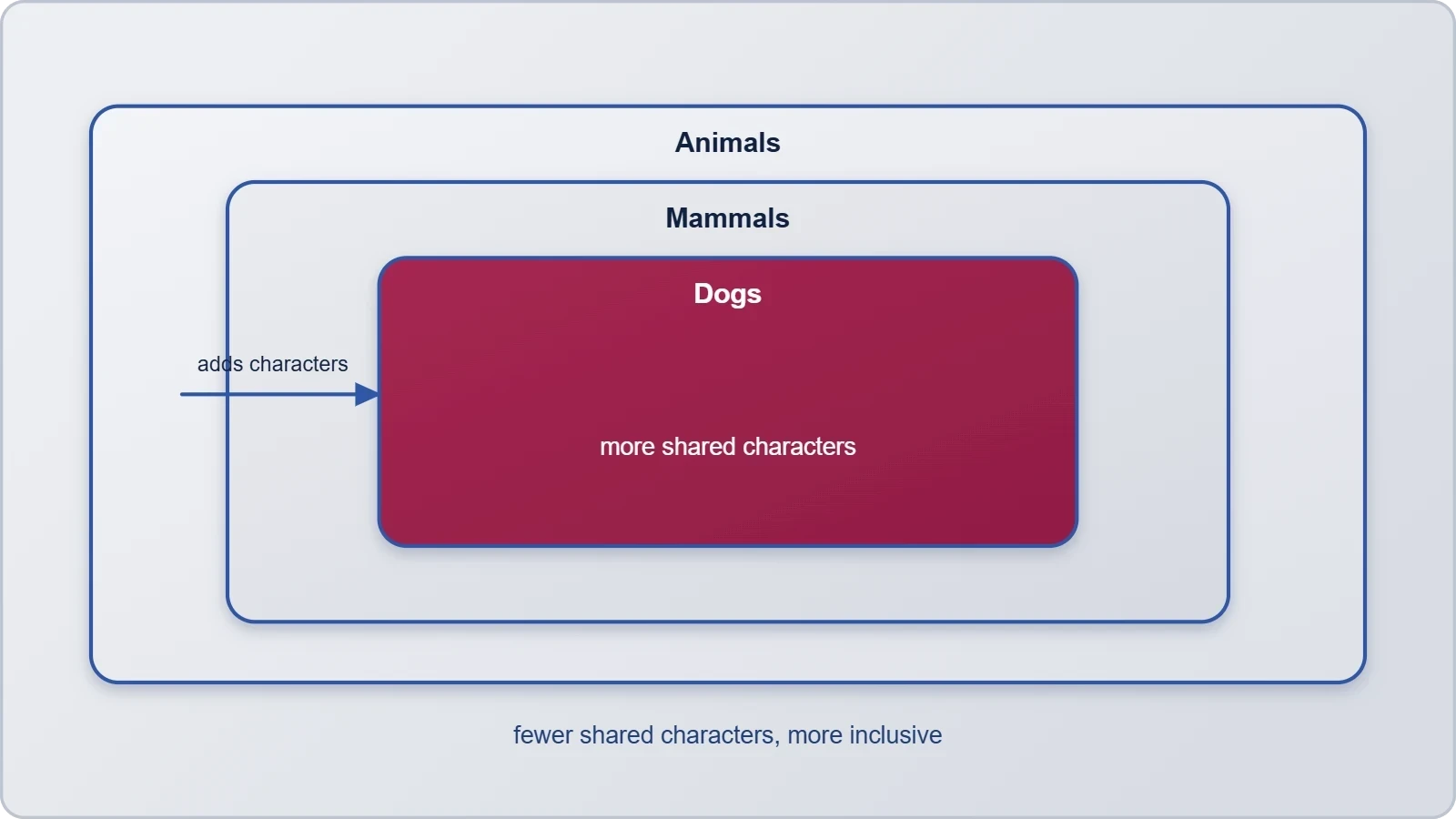
This nesting is the structural insight of the lesson. Once a reader sees that dogs sit within mammals and mammals within animals, the entire logic of taxonomic categories becomes intuitive. The categories are not rival labels for the same thing; they are successive refinements, each capturing a different degree of shared character.
Taxonomy as the Process of Classification
Based on characteristics, all living organisms can be classified into different taxa, and this process of classification is taxonomy. The definition is compact but demanding. It insists that classification be grounded in characteristics, not convenience alone, and that it be a process — something performed, repeated and revised — rather than a static list.
What Modern Taxonomic Studies Rest On
External and internal structure, along with the structure of the cell, development process and ecological information of organisms, are essential and form the basis of modern taxonomic studies. The list is worth pausing over. It moves from what is visible to what requires instruments, from adult form to developmental history, from the organism alone to its place in an ecosystem.
This breadth explains why taxonomy is a science rather than a filing system. A classification built only on external appearance would be fragile; one supported by cellular structure, development and ecology is far more stable. Modern taxonomic studies therefore draw on many kinds of evidence, and each kind strengthens the conclusions drawn from the others.
From Convenience to Evidence
The early categories described in this lesson were convenient and observable. Modern taxonomy retains that practicality but adds evidential depth. The shift is not a rejection of the old approach but an extension of it: the same observable characters remain useful, now corroborated by internal and developmental data that the naked eye cannot supply.
For a student, the practical consequence is clear. When classifying an organism, one should ask not only "what does it look like?" but also "how is it built inside, how does it develop, and where does it live?" These questions together produce a classification that can withstand scrutiny and revision.
The Four Processes Basic to Taxonomy
Characterisation, identification, classification and nomenclature are the processes that are basic to taxonomy. The sentence reads like a list, but it is really a sequence. Each process prepares the ground for the next, and skipping any one of them weakens the whole. Together they describe the complete working method of the discipline.
Characterisation and Identification
Characterisation comes first: the organism's features are described and recorded, from external form to internal structure, cell structure, development and ecological context. Identification follows, matching the characterised organism against known groups to determine what it is. Only after these two steps can a defensible classification be proposed.
The order matters because identification without characterisation would be guesswork. A name assigned before the characters are properly described is a label without support. The discipline therefore insists on description first, recognition second, and only then the placement of the organism within a category.
Classification and Nomenclature
Classification then groups the identified organism into the appropriate taxon, and nomenclature supplies the formal name according to agreed rules. The previous lesson established those rules, including the capitalisation of the genus and the abbreviated author citation, as in Mangifera indica Linn. Nomenclature is thus the final, public step.
What emerges is a chain of dependencies. Characterisation feeds identification, identification feeds classification, and classification feeds nomenclature. A name is meaningful only because the three earlier processes have been performed. This is why taxonomy is described as a set of processes rather than a single act of naming.
Taxonomy Is Not Something New
Taxonomy is not something new. Human beings have always been interested in knowing more and more about the various kinds of organisms, particularly with reference to their own use. The discipline has ancient roots in practical need, and acknowledging that history clarifies why classification took the forms it did.
Use as the Earliest Criterion
In early days, human beings needed to find sources for their basic needs of food, clothing and shelter. Hence, the earliest classifications were based on the "uses" of various organisms. Edible versus poisonous, useful versus harmful, timber versus fuel — these were the first working categories, and they were entirely practical.
Such classifications were not wrong so much as limited. They served survival admirably but could not support comparison across regions or generations. The shift toward observable characters, described earlier in this lesson, was a genuine advance: it made categories portable, teachable and independent of local custom.
From Use to Relationship
Human beings were, since long, not only interested in knowing more about different kinds of organisms and their diversities, but also the relationships among them. This branch of study was referred to as systematics. The interest in relationship, not merely in utility, marks the transition from folk sorting to scientific inquiry.
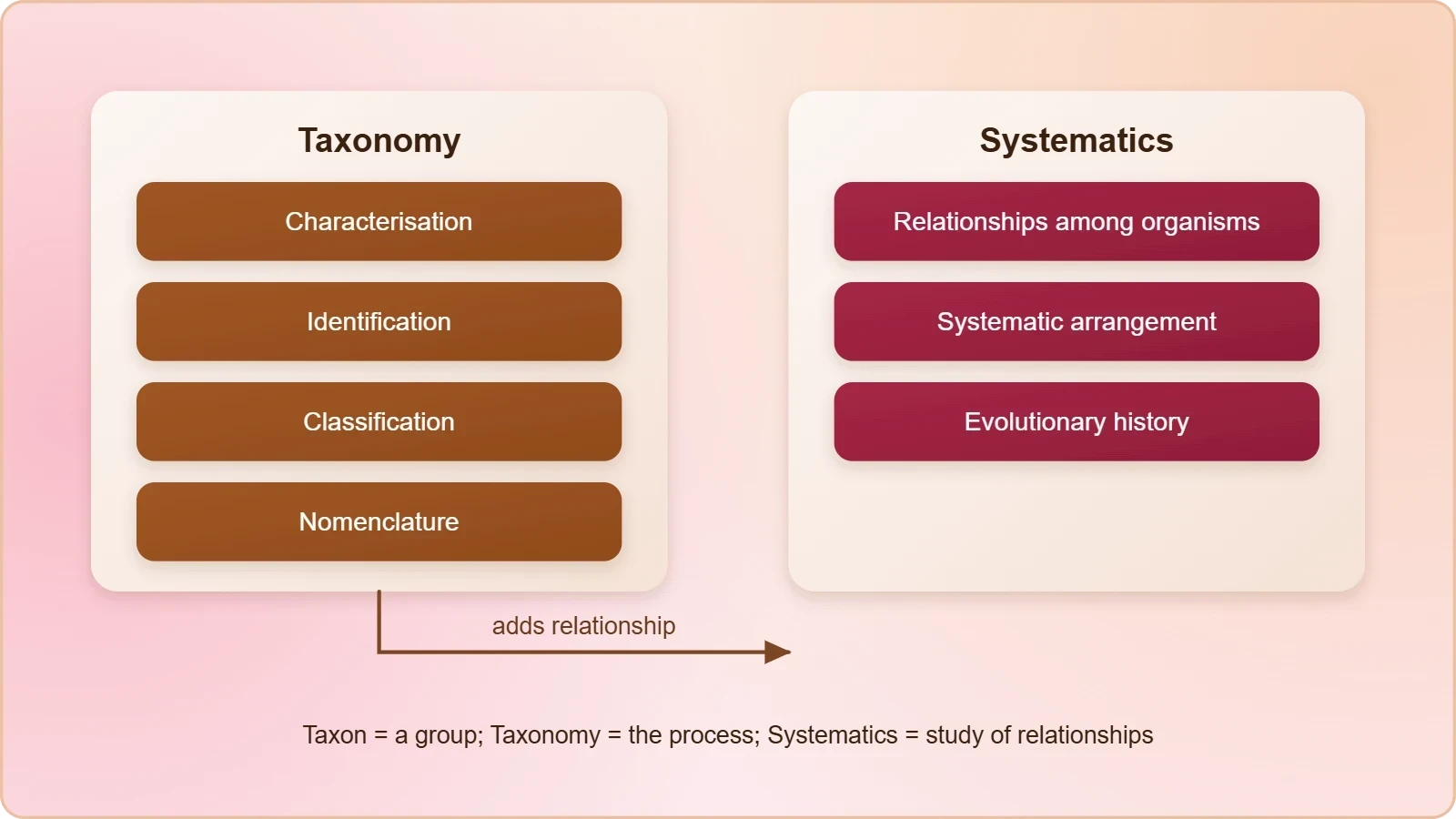
The word systematics is derived from the Latin word "systema", which means systematic arrangement of organisms. That etymology captures the ambition precisely: not a heap of labels but an arrangement, ordered and coherent. The next lesson takes up this enlarged scope in detail, building directly on the processes established here.
Going Further
The dog example deserves a second look because it does more work than it first appears. A dog is a mammal and mammals are animals, which is exactly how the material illustrates taxa at different levels. The nesting is not a curiosity; it is the model for every taxonomic hierarchy a student will later encounter, from species upward to kingdom.
Why the Impossibility Argument Matters
Classification is described as necessary because studying all living organisms is nearly impossible. That argument is worth taking seriously rather than treating as a rhetorical flourish. It explains why taxonomy is a tool of scale: it converts an unmanageable population of organisms into a manageable set of categories that can be sampled, compared and taught.
Once the argument is accepted, the four processes follow naturally. If we cannot study everything, we must describe what we can, identify it against what is known, place it in a category, and name it so others can find it. The method is a direct consequence of the limitation, not an arbitrary convention imposed on biology.
A Note on Terminology
Students should keep three terms distinct. A taxon is a group; taxonomy is the process of classifying into taxa; systematics is the study of relationships among organisms. The material uses all three precisely, and blurring them causes confusion later, especially when the enlarged scope of systematics is introduced.
The distinction also clarifies why nomenclature is listed as a separate process. Naming is not classifying; it is the public registration of a classification already made. A name without a classification behind it is empty, while a classification without a name cannot be communicated. Both are needed, and both depend on characterisation and identification.
Also Read
- No links available.
From our network :
- 10 Physics Numerical Problems with Solutions for IIT JEEPrepare for IIT JEE with 10 physics numerical problems, complete with detailed solutions and conceptual explanations. Ideal for mastering kinematics, thermodynamics, electromagnetism, and optics.
- Vite 6/7 'Cold Start' Regression in Massive Module GraphsIn-depth analysis of Vite 6/7 cold start regressions in massive module graphs. Learn about barrel file issues, pre-bundling optimizations, and how to improve Vite dev server performance.
- Mastering DB2 LUW v12 Tables: A Comprehensive Technical GuideComprehensive guide on DB2 LUW v12 tables. Explore CREATE TABLE syntax, BLU Acceleration, range partitioning, data types, and security features for IBM DB2 LUW v12.
- AI-Powered 'Precision Diagnostic' Replaces Standard GRE Score ReportsDiscover the new GRE Precision Diagnostic. Learn how AI-powered behavioral analytics and time-to-solve tracking are replacing standard GRE score reports to empower students.
- Trump Political Strategy How Geopolitical Stunts Serve As Media Diversions
- Mastering DB2 12.1 Instance Design: A Technical Deep Dive into Modern Database ArchitectureComprehensive guide to DB2 12.1 Instance Design. Explore architectural components, HADR setup, buffer pool tuning, and security policies for IBM DB2 12.1. Includes 10 functional SQL and Shell samples.
- 98% of Global MBA Programs Now Prefer GRE Over GMAT Focus EditionExplore why 98% of global MBA programs now prefer the GRE over GMAT Focus. Learn about the shorter GRE format, verbal logic importance, and strategic versatility for students.
- EV 2.0: The Solid-State Battery Breakthrough and Global Factory ExpansionDiscover the impact of the Solid-State Battery Breakthrough on the EV market. Learn about CATL and BYD stock growth, global factory expansion in Europe, and the future of EV 2.0 technology.
- Analyzing Trump Deportation Numbers Insights Into The 2026 Immigration Crackdown
RESOURCES
- Taxonomy (biology) - Wikipediaen.wikipedia.orgClassifying organisms. Main article: Taxonomic rank. Biological classification is a critical component of the taxonomic process. As a result, it informs the ...
- Soil Taxonomy - Natural Resources Conservation Servicenrcs.usda.govThe second edition of Soil Taxonomy: A Basic System of. Soil Classification ... processes extend to depths greater than 200 cm, the lower limit…
- Towards a taxonomy of Bacteria and Archaea based on interactive ...pubmed.ncbi.nlm.nih.govThe current methods used for taxonomic classification require significant laboratory experimentation, and generally will not produce interactive databases.
- What is Taxonomy? - Convention on Biological Diversitycbd.intJun 4, 2010 ... Using morphological, behavioural, genetic and biochemical observations, taxonomists identify, describe and arrange species into classifications, ...
- IDTAXA: a novel approach for accurate taxonomic classification of ...pubmed.ncbi.nlm.nih.govAug 9, 2018 ... Sequence classification is a critical component of this process, whereby sequences are assigned to a reference taxonomy containing known ...
- Taxonomic classification of DNA sequences beyond ... - PNASpnas.orgHere we present BERTax, a deep neural network program based on natural language processing to precisely classify the superkingdom and phylum of DNA sequences ...
- Evaluation of taxonomic classification and profiling methods for long ...link.springer.comDec 13, 2022 ... The identification of microbial species in environmental communities is an essential task in microbiology. Shotgun metagenomic sequencing (or ...
- An updated classification of meditation methods using principles of ...frontiersin.orgThe first criterion is quite simple, but is perhaps the most important—the fundamental taxonomic principle that all classification proposals require a cogent ...
- CPT Appendix S: Taxonomy for artificial intelligence in medical ...ama-assn.orgSep 17, 2026 ... Taxonomy for Artificial Intelligence in Medical Services and Procedures ... The software's taxonomic classification is determined based on its ...
- Taxonomy based performance metrics for evaluating taxonomic ...link.springer.comJun 11, 2019 ... Taxonomic assignment using 16S and 18S rRNA gene classification. A fundamental step in microbiota studies is taxonomic assignment, in which…
- SILVA taxonomyarb-silva.de... procedure to provide every sequence entry with a taxonomic classification down to genus level. The manual taxonomic curation process starts with the ...
- biological classification - Students | Britannica Kids | Homework Helpkids.britannica.comIn biology, classification is the process ... The species is the most fundamental unit in taxonomy and ranks at the base of the biological…
- Taxonomy | Definition, Examples, Levels, & Classification | Britannicabritannica.comOct 25, 2026 ... Taxonomic methods involve specimen collection, comparison with known ... basic unit of biological classification. He tempered the ...
- New concepts and methods for phylogenetic taxonomy ... - Biotaxabiotaxa.orgFeb 26, 2021 ... Keywords: Amphibia, Lissamphibia, classification, phylogeny, cladonomy, ergotaxonomy, taxonomic concepts, taxonomic category, Code ...
- Optimizing taxonomic classification of marker-gene amplicon ... - PMCpmc.ncbi.nlm.nih.govWe show that the QIIME 2 classifiers provided in q2-feature-classifier match or outperform the classification accuracy of the widely used QIIME 1 methods for ...