Every field biologist eventually confronts the same quiet problem: the plant growing behind a village school in Kerala carries one name, the same species in a Brazilian market carries another, and a herbarium sheet from 1890 carries a third. Local names are warm, useful and deeply human, but they travel badly. Nomenclature exists precisely to solve this friction, giving each organism a single, stable label that any trained person anywhere on earth can recognise, verify and reuse without ambiguity.
This lesson examines that standardising machinery at its foundations. It explains why naming depends on correct description and identification, how separate international codes govern plants and animals, and why the two-component name devised by Carolus Linnaeus has survived centuries of scientific scrutiny. The mango, Mangifera indica, serves throughout as the working example, because its name neatly displays the genus and the specific epithet in the order biologists expect.
By the close, you should be able to explain the relationship between identification and nomenclature, distinguish the botanical and zoological codes, decompose any binomial name into its parts, and state the formatting conventions that signal a name's Latin origin. These skills underpin every later discussion of taxonomic categories, author citations and the universal rules that follow in the next lesson.
On This Page
- Why Standard Names Are Necessary in Biology
- The Two International Codes Governing Scientific Names
- Binomial Nomenclature and the Contribution of Carolus Linnaeus
- Universal Rules of Nomenclature and Latin Conventions
- Identification, Description and the Integrity of the Record
- Going Further: Why International Agreement Matters
Why Standard Names Are Necessary in Biology
As exploration continues, new organisms are identified constantly, even in regions long considered familiar. Each discovery sharpens the problem of reference: without a shared vocabulary, two researchers may discuss the same organism under different local labels and never realise their agreement. Standardisation converts a scattered collection of regional names into a single, internationally legible record that accumulates rather than fragments.
The Confusion Created by Local Names
Local names vary from place to place, and sometimes within a single country, so the same organism may carry several unrelated labels while one label may describe entirely different organisms in different regions. This instability makes comparison, record-keeping and collaborative study unreliable. A standardised name removes that ambiguity by attaching one fixed label to one precisely defined organism.
The process of establishing such names is called nomenclature. Crucially, naming is only possible when the organism has been described correctly and when we know exactly which organism the name is attached to. That act of determining identity is identification, and it must precede naming, because a name without a verified referent is merely a word.
Identification as the Prerequisite for Naming
Identification answers the question of what an organism is; nomenclature answers the question of what it should be called. The two are sequential, not interchangeable. A specimen must first be matched against known descriptions and diagnostic features before any scientific name can be responsibly applied to it, and misidentification propagates errors through every subsequent record.
This is why the source material insists that description should enable people in any part of the world to arrive at the same name. A well-written description functions as a shared instrument of recognition, allowing an observer in one continent to reach the same conclusion as a taxonomist in another, using only the organism and the published account.
The Two International Codes Governing Scientific Names
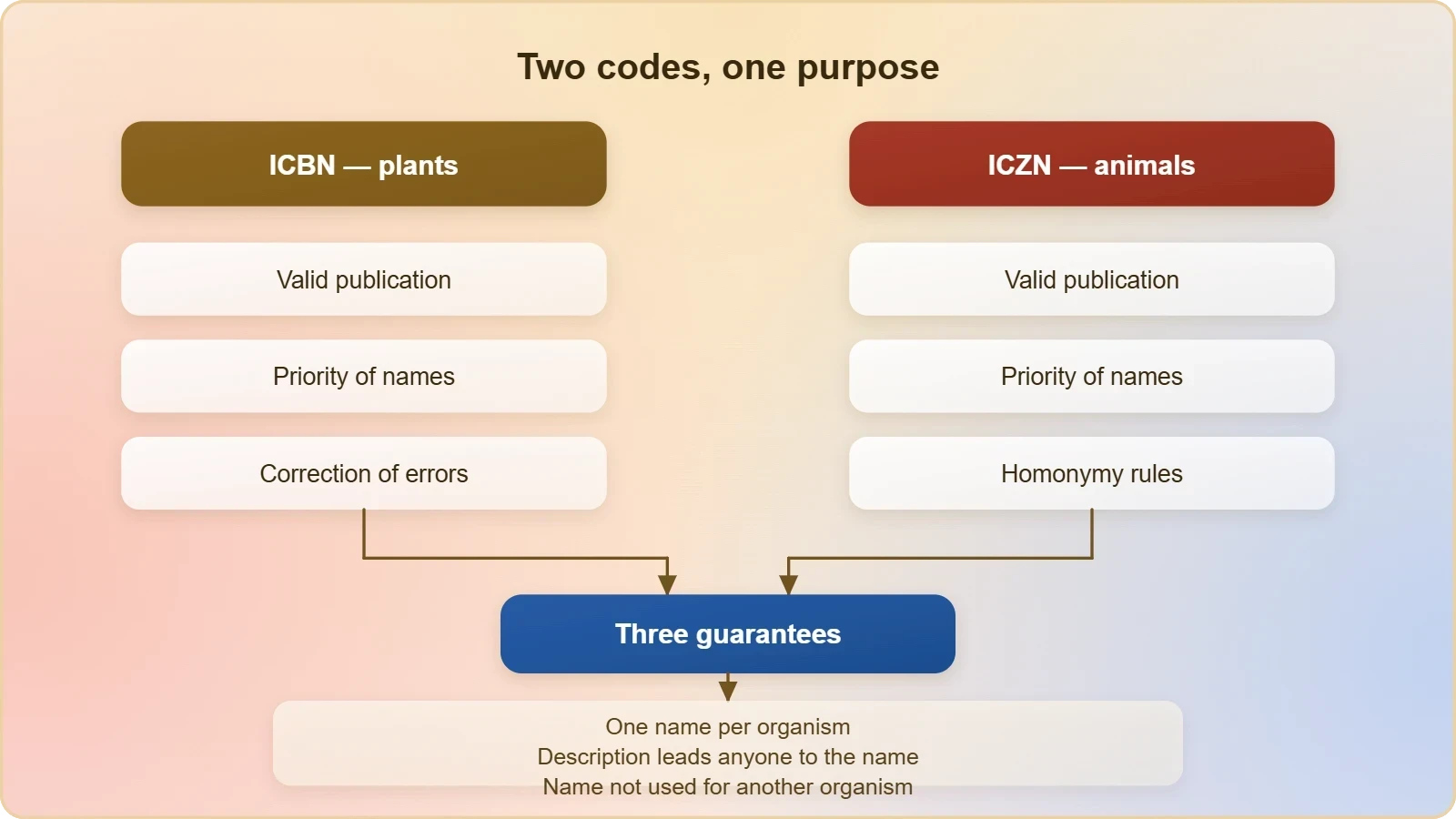
Scientists did not invent naming rules arbitrarily; they established procedures through collective agreement so that a scientific name would be acceptable to biologists everywhere. Two separate codes emerged because plants and animals require distinct conventions. For plants, scientific names rest on agreed principles and criteria provided in the International Code for Botanical Nomenclature, universally abbreviated as ICBN.
The International Code for Botanical Nomenclature
The ICBN supplies the principles and criteria that govern plant names, ensuring consistency across herbaria, floras and journals worldwide. It defines how names are validly published, how priority is determined, and how names may be corrected when errors are discovered. Because the code is agreed internationally, a botanist in Tokyo and a botanist in Nairobi apply identical standards.
Animal taxonomists, working independently, evolved their own framework, the International Code of Zoological Nomenclature, or ICZN. The separation reflects genuine biological and historical differences between the disciplines, yet the underlying purpose is identical: to guarantee that each organism carries one name and that the name has not already been used for some other known organism.
The International Code of Zoological Nomenclature
The ICZN performs for animals what the ICBN performs for plants, providing a rulebook that stabilises names across the enormous diversity of animal life. It addresses homonymy, the reuse of a name for a different organism, and ensures that descriptions are sufficient for anyone, anywhere, to arrive at the same identification. Both codes therefore serve the same end through parallel machinery.
Together, the two codes deliver three guarantees. Each organism has only one name; a proper description enables people in any part of the world to reach that name; and the name has not been applied to any other known organism. These guarantees are what make a scientific name genuinely portable across borders, languages and generations of researchers.
Binomial Nomenclature and the Contribution of Carolus Linnaeus
Each scientific name contains two components: the generic name and the specific epithet. This system of providing a name with two components is called binomial nomenclature, and it was given by Carolus Linnaeus. Biologists all over the world practise it today because the two-word format proved convenient, compact and remarkably stable across disciplines and centuries.
The Generic Name and the Specific Epithet
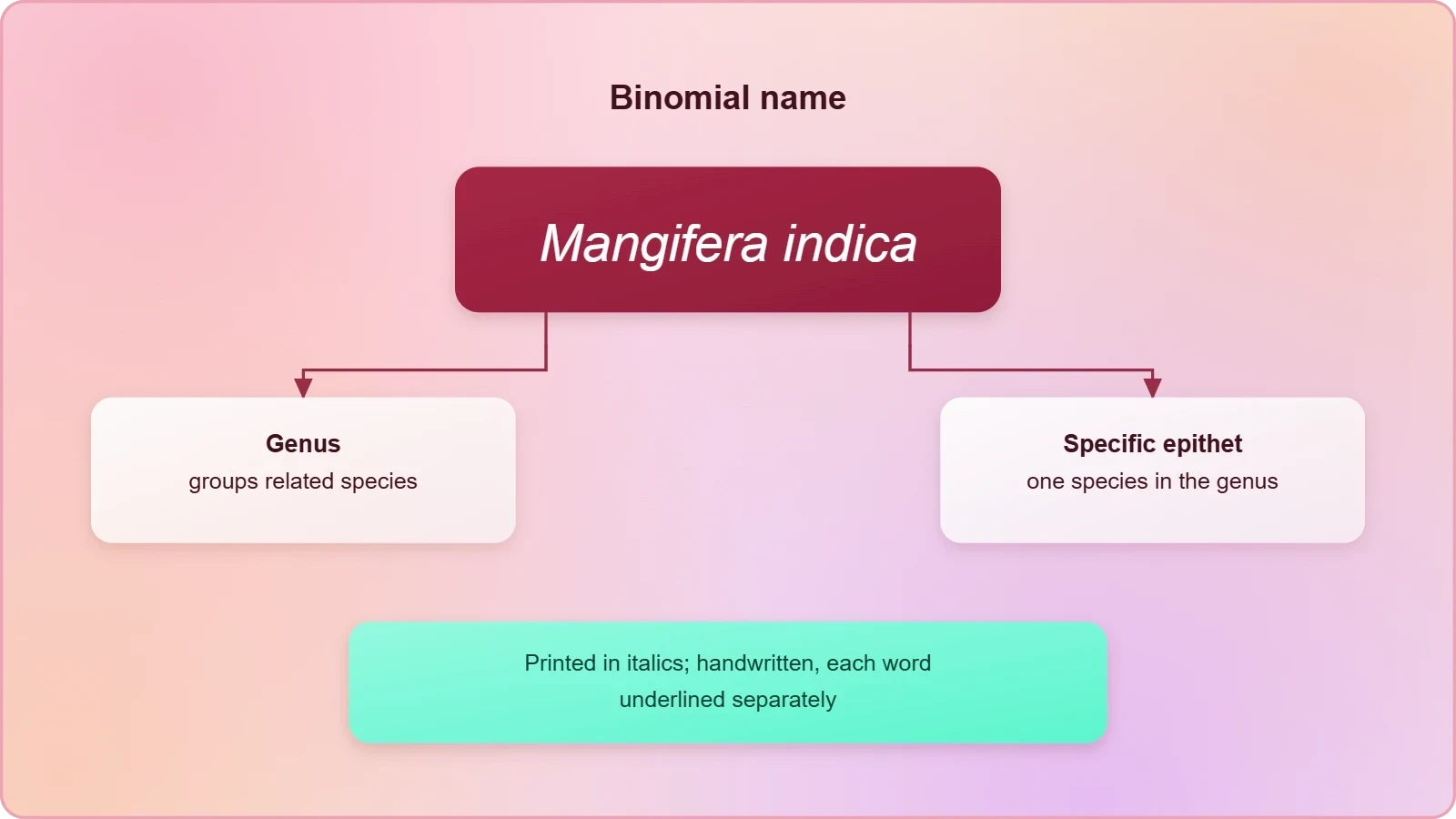
The first word in a biological name represents the genus, while the second component denotes the specific epithet. The genus groups together closely related species, and the epithet narrows the reference to one particular species within that genus. Together the pair forms a complete, unambiguous identifier that no single word could supply.
Consider the mango, whose scientific name is written as Mangifera indica. Here Mangifera represents the genus, while indica is a particular species, or specific epithet. The structure is transparent once recognised: a broad grouping followed by a precise qualifier, exactly as the two-component system intends.
Why the Two-Component Format Proved Convenient
A single word cannot simultaneously indicate relationship and identity, but two words can. The genus situates the organism among its relatives, while the epithet distinguishes it from those relatives. This dual function explains why the format spread so widely and why it remains the backbone of biological naming after more than two centuries of use.
The convenience is practical as well as conceptual. Two components are short enough to write repeatedly in field notes, distinctive enough to avoid collision with other names, and flexible enough to accommodate the millions of organisms still being identified. Linnaeus gave biology a naming grammar that scales gracefully with discovery.
Universal Rules of Nomenclature and Latin Conventions
Beyond the two-component structure, several universal rules govern how biological names are written. These conventions are not decorative; they encode information about origin, rank and relationship. Mastering them ensures that a name written in a notebook, a journal or an examination answer carries the same meaning and signals the same scientific literacy to every reader.
Latin as the Language of Biological Names
Biological names are generally in Latin and written in italics. They are Latinised or derived from Latin irrespective of their origin, so a species first described in India, Japan or Peru still receives a Latin or Latinised name. Latin's historical role as a scholarly lingua franca made it the natural choice for a naming system intended to cross linguistic boundaries.
This Latin foundation explains why the same name can be read, if not always pronounced identically, by researchers across the world. The name does not belong to any modern nation or language community; it belongs to the international scientific enterprise, which is precisely why it can serve as a neutral and durable reference.
Italics, Underlining and Word Order
Both words in a biological name, when handwritten, are separately underlined, or printed in italics, to indicate their Latin origin. The first word represents the genus, while the second denotes the specific epithet. Word order is therefore fixed and meaningful, and reversing it would misrepresent the relationship the name encodes.
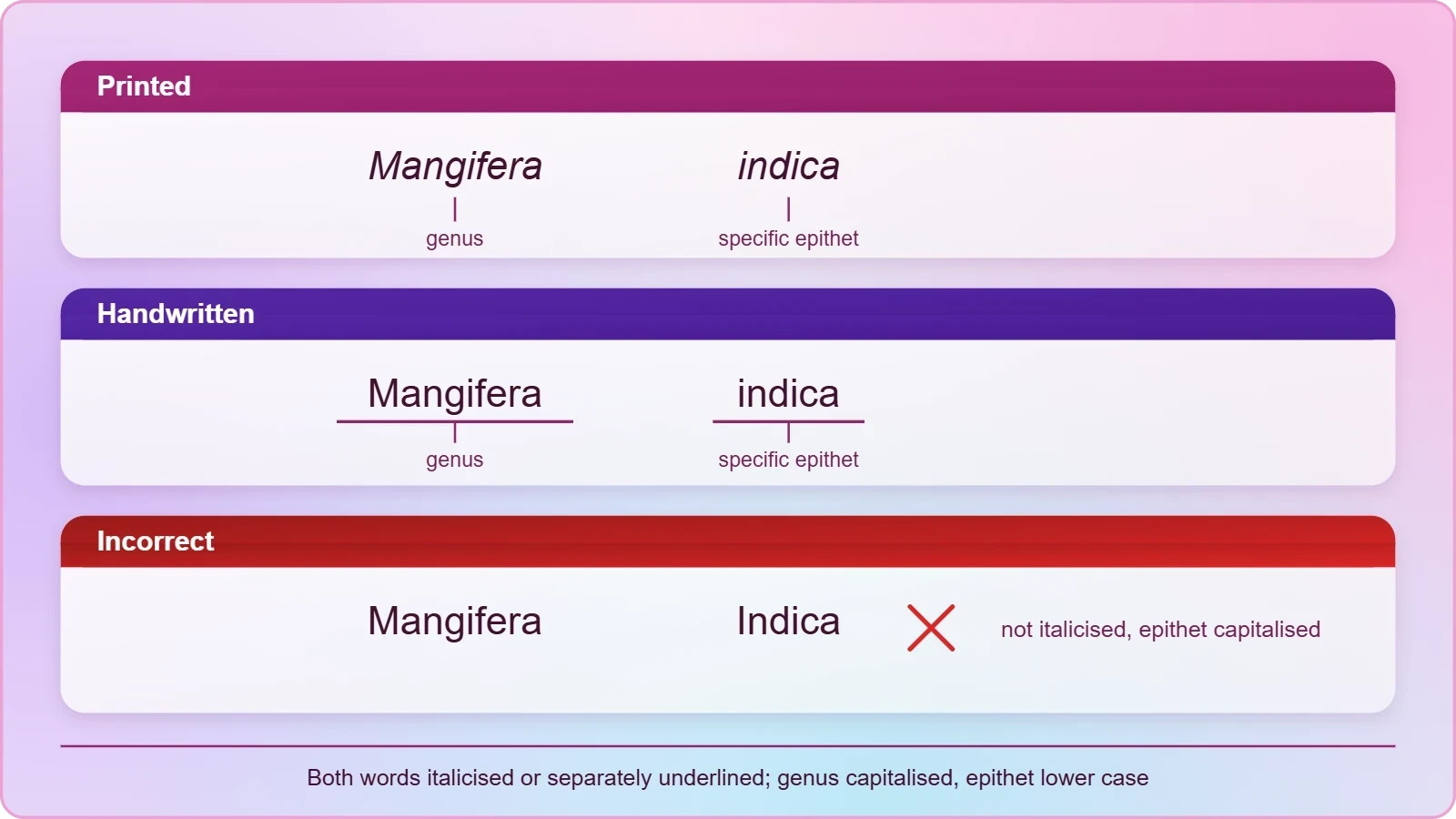
These formatting rules are simple but consequential. An examiner, editor or reviewer reads italics and underlining as a signal that the writer understands the conventions of biological nomenclature. Omitting them is not a trivial slip; it suggests unfamiliarity with the standards that make names internationally intelligible.
Identification, Description and the Integrity of the Record
Nomenclature depends entirely on accurate identification, and identification depends on adequate description. The chain is unforgiving: a poor description leads to uncertain identification, which produces a misapplied name, which corrupts every record that inherits it. This is why the codes place such emphasis on the quality and completeness of published descriptions rather than on names alone.
How Description Enables Global Agreement
A description should enable people in any part of the world to arrive at the same name for a given organism. That requirement is demanding, because it means the description must capture diagnostic features clearly enough to survive translation, differing expertise and varying conditions of observation. Vague descriptions fail this test and generate divergent identifications.
When descriptions meet the standard, something remarkable happens: independent observers converge on the same conclusion without direct communication. The name becomes a shared inference rather than a private opinion. This convergence is the practical proof that nomenclature is functioning as intended, and it is why careful descriptive writing is treated as a scientific obligation.
Preventing Duplicate and Misapplied Names
The codes also ensure that a name has not been used for any other known organism. Without this safeguard, the same label could attach to two different species, and the resulting confusion would be almost impossible to untangle once published. Priority rules and careful record-keeping protect the integrity of the accumulated literature.
Each organism therefore has only one valid name, and each name points to only one organism. This one-to-one correspondence is the quiet achievement of the entire system. It allows databases, herbaria, museums and field guides to interoperate, and it allows a name written a century ago to remain meaningful today.
Going Further: Why International Agreement Matters
The codes are best understood as agreed principles and criteria acceptable to biologists all over the world, rather than as legislation imposed by any authority. Their force comes from collective acceptance. Because practitioners voluntarily adhere to the same standards, a scientific name can be used internationally with confidence, and a publication from one country can be read and applied in another without translation of its taxonomic content.
The Practical Reach of a Shared Standard
This voluntary consensus explains why a name coined in one century remains usable in the next. Researchers inherit a stable vocabulary and can build upon it rather than renegotiating terms with every generation. The result is cumulative knowledge: each new description adds to a shared structure instead of creating a parallel, incompatible one.
In Mangifera indica, the genus Mangifera and the specific epithet indica together illustrate how the standard operates at the smallest scale. Two words, governed by agreed rules, carry enough information to identify one species unambiguously for any biologist, anywhere, using nothing more than the name itself.
Preparing for Author Citations and Further Rules
The conventions covered here form the foundation for the rules that follow, including the author citation that records who first validly published a name. Understanding the two-component structure and the role of the codes makes those later conventions intelligible rather than arbitrary. Each rule builds on the assumption that names must be stable, verifiable and internationally legible.
Students preparing for examinations should therefore practise decomposing names, applying italics and underlining correctly, and explaining the distinction between identification and nomenclature in precise language. These are not merely formatting exercises; they demonstrate command of the conceptual architecture that underpins all of biological classification.
Also Read
- No links available.
From our network :
- Mastering DB2 LUW v12 Tables: A Comprehensive Technical GuideComprehensive guide on DB2 LUW v12 tables. Explore CREATE TABLE syntax, BLU Acceleration, range partitioning, data types, and security features for IBM DB2 LUW v12.
- EV 2.0: The Solid-State Battery Breakthrough and Global Factory ExpansionDiscover the impact of the Solid-State Battery Breakthrough on the EV market. Learn about CATL and BYD stock growth, global factory expansion in Europe, and the future of EV 2.0 technology.
- 98% of Global MBA Programs Now Prefer GRE Over GMAT Focus EditionExplore why 98% of global MBA programs now prefer the GRE over GMAT Focus. Learn about the shorter GRE format, verbal logic importance, and strategic versatility for students.
- Mastering DB2 12.1 Instance Design: A Technical Deep Dive into Modern Database ArchitectureComprehensive guide to DB2 12.1 Instance Design. Explore architectural components, HADR setup, buffer pool tuning, and security policies for IBM DB2 12.1. Includes 10 functional SQL and Shell samples.
- Analyzing Trump Deportation Numbers Insights Into The 2026 Immigration Crackdown
- 10 Physics Numerical Problems with Solutions for IIT JEEPrepare for IIT JEE with 10 physics numerical problems, complete with detailed solutions and conceptual explanations. Ideal for mastering kinematics, thermodynamics, electromagnetism, and optics.
- Vite 6/7 'Cold Start' Regression in Massive Module GraphsIn-depth analysis of Vite 6/7 cold start regressions in massive module graphs. Learn about barrel file issues, pre-bundling optimizations, and how to improve Vite dev server performance.
- AI-Powered 'Precision Diagnostic' Replaces Standard GRE Score ReportsDiscover the new GRE Precision Diagnostic. Learn how AI-powered behavioral analytics and time-to-solve tracking are replacing standard GRE score reports to empower students.
- Trump Political Strategy How Geopolitical Stunts Serve As Media Diversions
RESOURCES
- International Commission on Zoological Nomenclatureiczn.orgThe International Commission on Zoological Nomenclature (ICZN) acts as ... scientific names of animals. The ICZN is responsible for producing the ...
- Binomial nomenclature - Wikipediaen.wikipedia.orgBefore the adoption of the modern binomial system of naming species, a scientific name ... The International Code of Zoological Nomenclature (ICZN) governs the ...
- Binomial Nomenclature and Its Rules Study Guide - Quizletquizlet.comJun 4, 2025 ... ICBN (International Code of Botanical Nomenclature): Governs the naming of plants and fungi, ensuring that each species has a unique…
- What is binomial nomenclature in scientific naming? - Facebookfacebook.comOct 25, 2026 ... 0 Governed by ICBN (Plants) Linnaeus Plant names follow CBN rules. ... In the International Code of Zoological Nomenclature (ICZN),…
- Binomial Nomenclature Study Guide | Quizletquizlet.comSep 18, 2025 ... Example: The scientific name for humans is Homo sapiens, where Homo is the genus and sapiens is the species. This…
- Recontextualising the style of naming in nomenclature - Naturenature.comNov 18, 2021 ... ... binomial nomenclature should be revised and adjusted by the scientific governing bodies. We highlighted the current emphasis on Latinisation ...
- International Code of Botanical Nomenclature (ICBN)jagiroadcollegelive.co.inPrinciple 5: Scientific names of taxonomic groups are treated as Latin regardless of their derivation. Principle 6:The rules of nomenclature are retroactive ...
- Glossary - Global Names Architectureglobalnames.orgSep 24, 2015 ... Previously known as International Code of Botanical Nomenclature (ICBN) ... Some scientific names are regulated by the codes of nomenclature…
- Binomial Nomenclature: Understanding Organism Naming Rules ...studocu.comThis document discusses binomial nomenclature and its significance in the scientific naming ... al Nomenclature (ICZN). It is the system of naming animals ...
- Understanding Binomial Nomenclature | PDF | Genus - Scribdscribd.com... Nomenclature (ICZN) for animals to standardize naming globally . ... Binomial nomenclature is the scientific system of naming organisms using two ...
- Nomenclature in FishBase - Royal Museum for Central Africaafricamuseum.beBinomial nomenclature: The scientific naming of species whereby each species ... 5 of the ICZN, the scientific name of a species is a combination…
- Understanding Binomial Nomenclature | PDF | Genus - Scribdscribd.comThese are rules that govern scientific names. • International Code of Zoological Nomenclature (ICZN): governs the naming of animals (Came into effect in 1758)…
- Stop using racist, unethical, and inappropriate names in taxonomypnas.orgOct 30, 2024 ... When Carl Linnaeus invented binomial nomenclature in the 18th century, it provided a universal language for scientists.
- ICZN.pptxslideshare.net... scientific name. The ICZN has six main principles including binomial nomenclature, priority, coordination, and typification to determine the correct ...