On This Page
Understanding Fundamental Quantities
The Nature of Base Quantities
Fundamental quantities act as the bedrock of the entire physical measurement system. These quantities are independent of each other and cannot be expressed in terms of other physical parameters. Scientists recognize seven specific base quantities that define the physical world.
Mass, length, time, electric current, thermodynamic temperature, amount of substance, and luminous intensity constitute these primary building blocks. Each base quantity possesses a unique, internationally accepted unit. These units serve as the reference points for all other complex physical measurements.
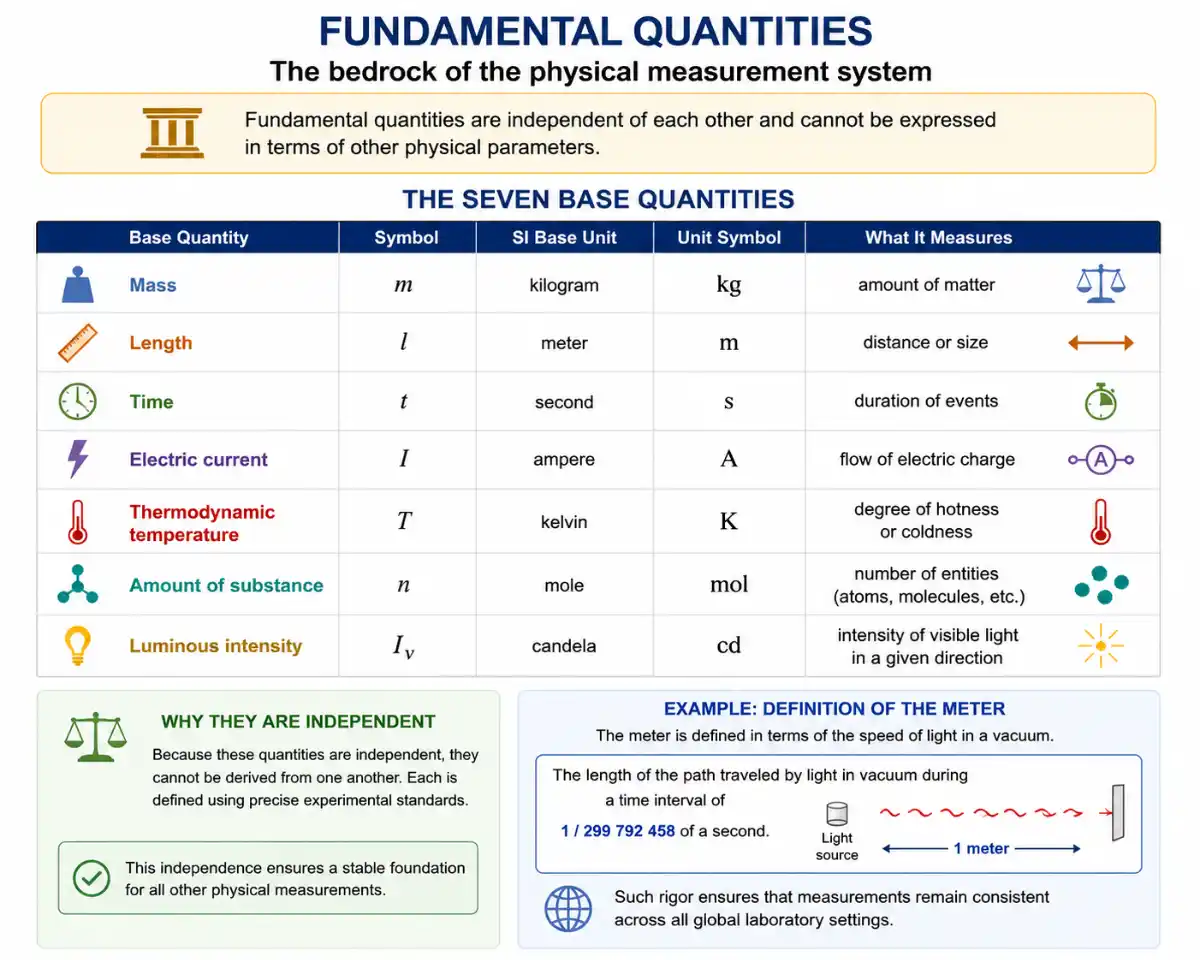
Because these quantities remain independent, researchers define them through precise experimental standards. For instance, the definition of a meter connects to the speed of light in a vacuum. Such rigor ensures that measurements remain consistent across all global laboratory settings.
When you encounter a new physical problem, always identify the base components first. By isolating mass, length, or time within an equation, you simplify the path toward finding the correct solution. This practice prevents errors during complex multi-step physics calculations.
Students must memorize these seven base units to succeed in competitive exams. Developing an intuitive grasp of these standards allows you to categorize physical phenomena effectively. Mastering this foundation is the first step toward becoming a proficient experimental physics student.
Defining Standard Base Units
Every base quantity requires a standardized unit to ensure universal communication. The SI system mandates specific units like the kilogram for mass and the second for time. These standards provide a common language for scientists across every single nation.
The kilogram represents the mass of the international prototype, while the second corresponds to atomic oscillations. These definitions undergo periodic updates to improve precision. Maintaining these high standards is crucial for modern engineering, space exploration, and advanced medical diagnostic equipment.
Without agreed-upon units, experimental results would lack credibility. If different laboratories used varying standards for length or time, data comparison would become impossible. Therefore, the global scientific community invests heavily in maintaining these stable, reproducible, and highly accurate reference units.
Consider the importance of consistency in high-stakes environments like particle accelerators. Here, even a minute variation in the standard unit of current or time leads to catastrophic data loss. Reliable standards protect the integrity of every scientific discovery made today.
As a student, you should view these units as fixed constants in your equations. When you see a unit like the Kelvin or the Mole, recognize its role as a fundamental pillar. This perspective simplifies your approach to complex physics.
Building Derived Units
Constructing Units from Formulas
Derived quantities emerge when we combine base quantities through mathematical operations. By using physical formulas, you can construct the unit of any derived quantity. This process involves multiplying or dividing base units according to the specific definition of the quantity.
For example, velocity is defined as displacement divided by time. Since displacement uses the meter and time uses the second, the unit for velocity becomes meters per second. This systematic approach eliminates the need to memorize long lists of units.
To derive the unit of force, we use Newton’s second law, which relates force to mass and acceleration. Acceleration itself is a derived quantity representing the rate of change of velocity. By substituting these definitions, you reveal the base components.
This method works for every physical concept, including work, energy, and power. Whenever you face a formula, break it down into its constituent base parts. This habit transforms your understanding of physics from passive memorization into active logical problem solving.
Practice deriving units for pressure, density, and momentum regularly. The more you manipulate these algebraic expressions, the faster you will identify mistakes in your work. This skill is indispensable for solving complex problems during JEE and NEET examinations quickly.
Examples of Derived Units
The following table illustrates how we construct common derived units using base standards. By observing these relationships, you can see how fundamental quantities weave together to describe the behavior of matter, energy, and motion in our physical universe daily.
| Quantity | Formula | SI Unit |
|---|---|---|
| Area | Length × Width | m² |
| Density | Mass / Volume | kg/m³ |
| Force | Mass × Acceleration | kg·m/s² |
Area represents a simple two-dimensional calculation involving length squared. Volume extends this logic to three dimensions, resulting in cubic meters. These geometric quantities form the basis for understanding more advanced physical concepts like fluid dynamics and structural stress analysis calculations.
Momentum involves the product of mass and velocity, while impulse relates force to time. Both concepts share deep connections, which become obvious when you analyze their units. Recognizing these links helps you predict how different physical systems will behave together.
Work and energy share the same units because they represent the same physical capacity. Power, defined as the rate of doing work, introduces the time factor. Each step in this derivation process reinforces your internal mental model of physics.
By mastering these derivations, you gain the ability to check the validity of any equation. If the units on the left side of your equation do not match the right side, you know immediately that your derivation contains a mistake.
Supplementary Quantities
Understanding Angles and Solid Angles
Beyond the seven base quantities, the SI system defines two supplementary quantities. These are the plane angle and the solid angle. Unlike base quantities, these are dimensionless ratios, yet they serve a vital role in describing geometry and radiation physics.
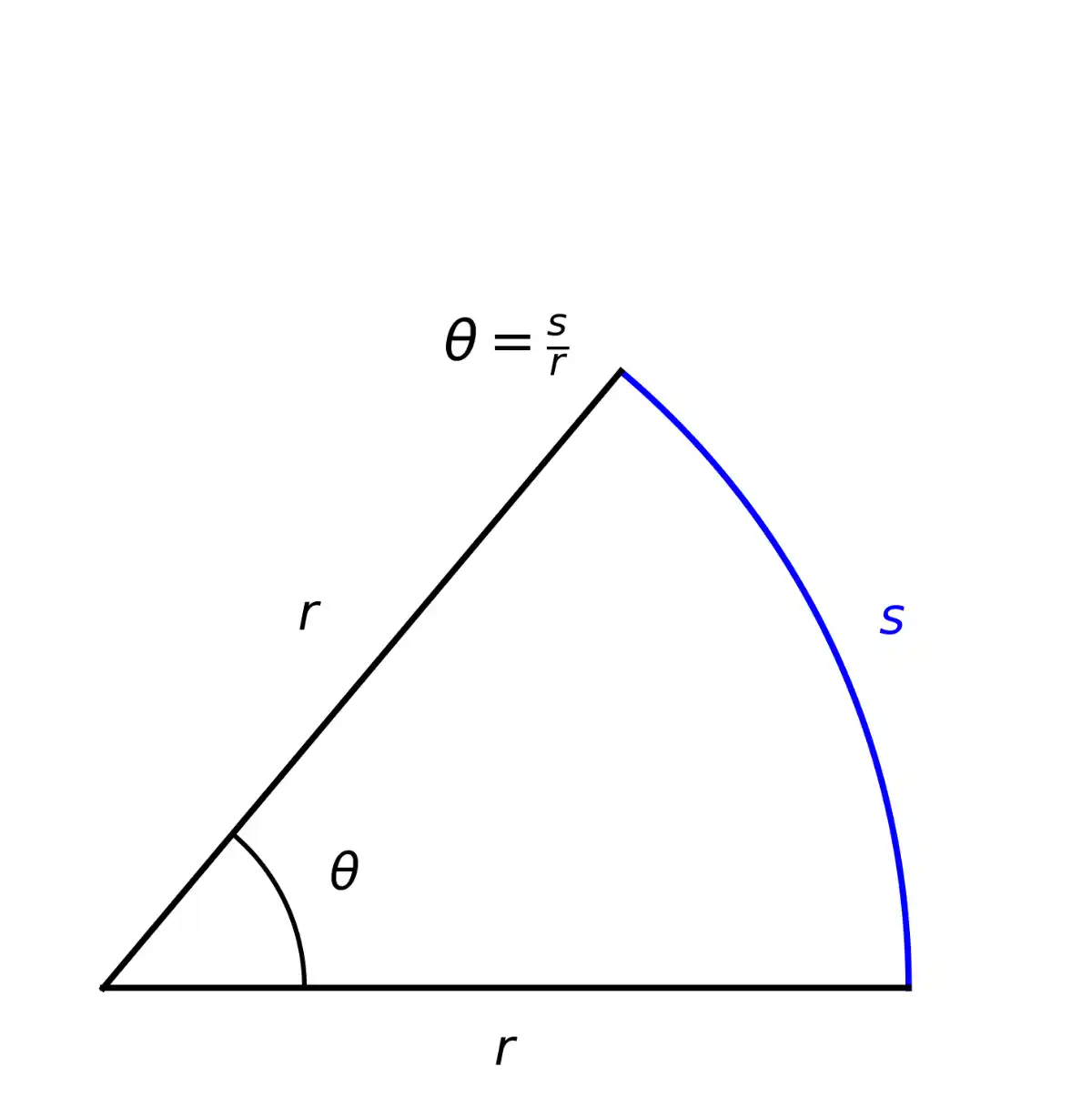
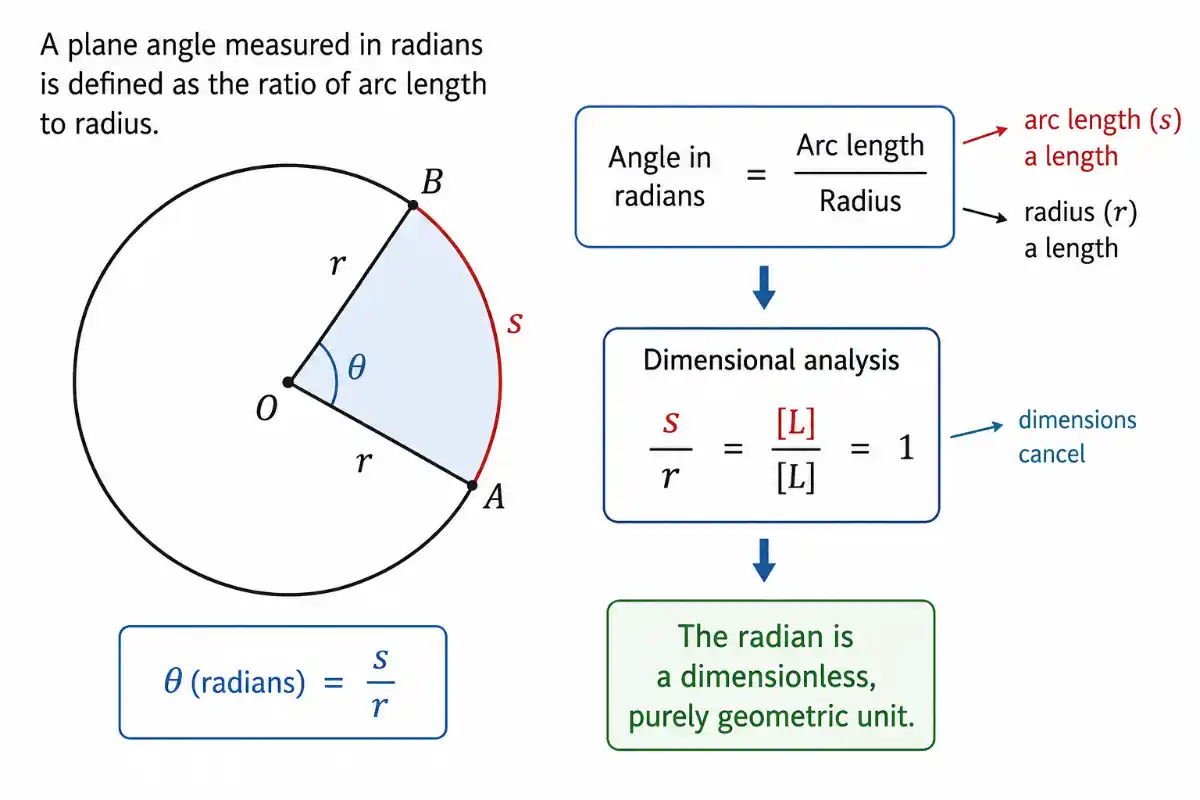
The plane angle is measured in radians, defined as the ratio of arc length to radius. Because both arc length and radius are lengths, their ratio cancels out the dimensions. This leaves the radian as a purely geometric unit of measure.
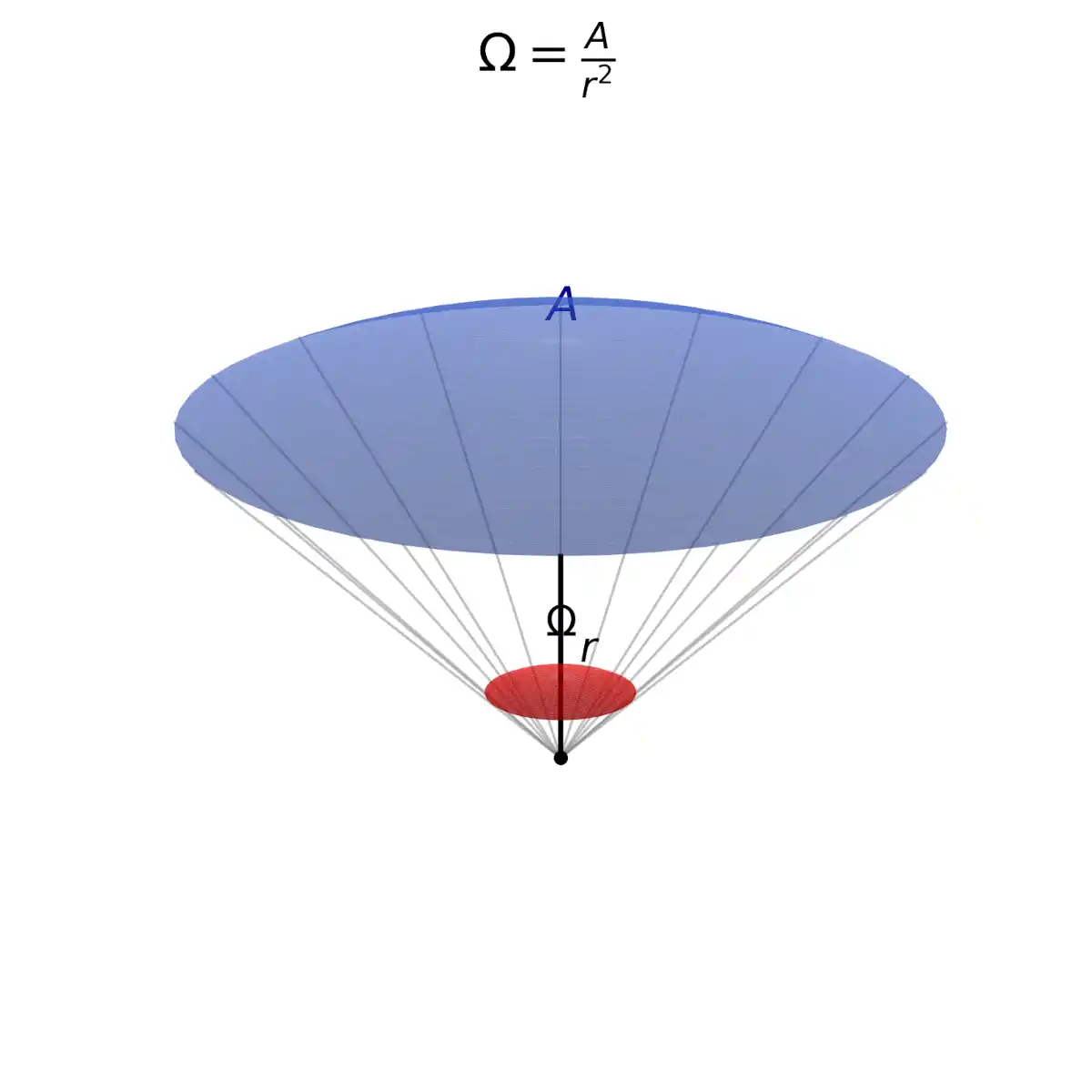
The solid angle, measured in steradians, describes the three-dimensional spread of a cone. It is defined as the ratio of the surface area on a sphere to the square of its radius. Like the radian, the steradian is dimensionless.
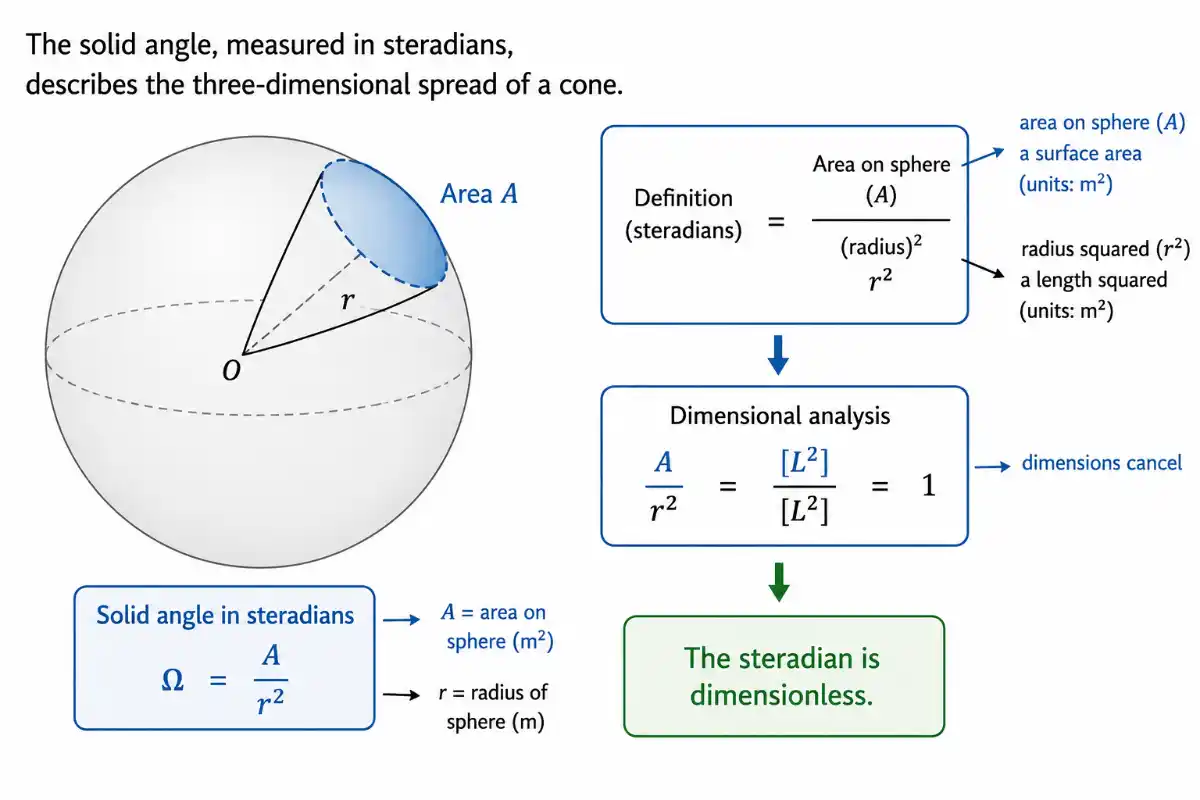
These quantities are unique because they do not depend on mass, time, or electric current. They focus purely on spatial orientation and configuration. You will encounter them frequently when studying optics, wave propagation, and the distribution of light from sources.
Despite being dimensionless, you must include these units in your calculations to maintain clarity. Labeling an angle as radians or degrees provides essential context for your final answer. Treat these supplementary units as formal descriptors for your geometric results.
Role of Supplementary Units
Supplementary units bridge the gap between pure geometry and physical measurement. They allow scientists to quantify how light, sound, or flux spreads through space. Without these units, describing the intensity of a light bulb or a satellite signal would fail.
In physics, we often treat angles as dimensionless because they do not have base dimensions. However, they are essential for defining physical relationships like rotational speed or torque. Using them correctly ensures your mathematical models accurately reflect real-world physical spatial phenomena.
When you calculate the angular velocity of a rotating object, remember that the angle contributes to the units of the final result. The radian per second is the standard unit for angular frequency. This unit carries physical meaning in rotation.
Always verify if your formula requires radians or degrees before starting your calculations. Most physics formulas assume the use of radians because they are natural units for circular motion. Using degrees in these formulas will lead to significant calculation errors.
By mastering supplementary units, you round out your knowledge of the SI system. You now understand the base, derived, and supplementary pillars. This complete framework prepares you to analyze any physical equation with confidence, accuracy, and deep conceptual clarity.
Practical Applications and Analysis
Identifying Errors through Units
Unit analysis serves as a powerful diagnostic tool for identifying errors in your work. Whenever you finish a calculation, perform a quick check of the units. If the dimensions do not align, you have likely missed a physical term.
Consider an equation where you add velocity to acceleration. Since their units differ, this operation is physically impossible. Such checks prevent you from producing nonsensical results in high-pressure exam environments. Always ensure you only add quantities with identical units.
This technique is particularly useful in complex problems involving multiple physical variables. By tracking the units through each algebraic step, you can verify that your intermediate values remain correct. This verification process builds confidence in your final exam answers.
Many students lose marks by forgetting to convert units before plugging them into formulas. Always ensure every quantity is in the same system, preferably SI, before proceeding. A common mistake is mixing centimeters with meters or grams with kilograms.
Table two below provides a quick reference for common unit conversions. Keeping these relationships in mind will save you time and prevent careless errors. Frequent practice with these conversions will make the process second nature during your physics exams.
| Conversion | Factor | Note |
|---|---|---|
| 1 cm | 0.01 m | Length |
| 1 g | 0.001 kg | Mass |
| 1 km/h | 5/18 m/s | Velocity |
Strategic Learning for Competitive Exams
Success in JEE and NEET physics requires a disciplined approach to unit management. Do not treat units as an afterthought; view them as an integral part of the physical identity of every variable. This perspective changes how you study.
Focus on understanding the origin of each unit rather than memorizing them. When you see a new formula, derive the unit yourself. This active engagement reinforces your memory and deepens your conceptual understanding of how physical laws are constructed.
Use your knowledge of dimensions to eliminate incorrect options in multiple-choice questions. Often, only one answer choice will have the correct dimensional formula. This strategy can help you find the right answer even if you forgot the specific formula.
Practice with past paper problems that focus on unit conversion and dimensional consistency. These questions are designed to test your attention to detail. By mastering these basics, you gain a significant advantage over students who rely only on rote memorization.
Finally, maintain a neat and organized notebook where you record the units for every constant you encounter. Having a personal reference guide for constants like the Gravitational Constant or Planck’s constant will streamline your study sessions and boost your performance.
RESOURCES
- How do you make sense of derived units?? : r/AskPhysics - Redditreddit.comJan 11, 2025 ... Derived units represent relationships between physical quantities, combining fundamental units to describe new phenomena. Multiplying units ...
- Fundamental and Derived Units of Measurement - BYJU'Sbyjus.comThe units of measurement derived from the seven base units specified by the International System of Units are known as SI derived units. They…
- Write following derived units in terms of fundamental units. Newton ...brainly.inApr 12, 2022 ... Derived units are units that can be represented in terms of fundamental units. The fundamental unit of mass=kg. The fundamental…
- SI units: fundamental and derived - ScienceDirect.comsciencedirect.comSep 1, 2005 ... The fundamental units can be combined algebraically to create derived units. Derived units are expressed as multiplications or divisions of ...
- Understanding Fundamental and Derived Units of Measurementvedantu.comFundamental units measure independent physical quantities, while derived units express quantities created by algebraic combinations of fundamental units. If you ...
- SI Units | NIST - National Institute of Standards and Technologynist.govApr 12, 2010 ... NIST provides values and a searchable bibliography for the fundamental physical constants. ... Together the base units and derived units…
- What are fundamental units and derived units? - Quoraquora.comJun 23, 2016 ... The fundamental physical units are mass, length or extension, and time. The majority of derived units, like force and energy…
- Difference Between Fundamental Unit and Derived Unitdifference.minaprem.comApr 17, 2020 ... Fundamental units are all those units of Metric System which are independent of any other unit (including themselves).
- Fundamental and Derived Units Study Guide - Quizletquizlet.comAug 8, 2024 ... Derived units are dependent on fundamental units and are derived from them through mathematical operations. They are used to express…
- joule, watt, hertz, second, Pascal, Kelvin, mole, Newton? - Quoraquora.comMay 18, 2020 ... Can you point out the fundamental and derived units from the units given below: joule, watt, hertz, second, Pascal, Kelvin,…
- Fundamental & Derived Units in Physics | DP IB Physics Revision ...savemyexams.comNov 18, 2025 ... Express derived units in terms of SI units · All units can be derived from the seven fundamental SI units…
- International System of Units - Wikipediaen.wikipedia.orgThe seven defining constants are the most fundamental feature of the definition of the system of units. ... Derived units apply to some derived…
- Quantity Calculus, Fundamental Constants, and SI Units - PMCpmc.ncbi.nlm.nih.govDerived Unit Relationships. For convenience and ease of understanding, certain units derived from the seven SI base units have been given special names and ...
- Time, Length, and Mass Are Derived Quantities - SCIRPscirp.orgThese derived units can be expressed in terms of fundamental units, such as acceleration, area, energy, force, power, velocity and volume.
- Fundamental And Derived Units Of Measurement | SATHEE JEEsathee.iitk.ac.inDerived units are units that are expressed in terms of fundamental units. For example, the unit of velocity , meter per second (m/s), is…
0 Comments