On This Page
Understanding the Concept of Dimensions
Dimensions represent the qualitative nature of a physical quantity without considering its magnitude or the specific unit used for measurement. They identify the fundamental physical nature of any quantity, acting as the foundation of all equations in physics.
When we analyze physical phenomena, we must look past the numerical values to see how base quantities combine. Dimensions act as a hidden grammar, ensuring that we only compare or combine quantities that share the exact same physical nature.
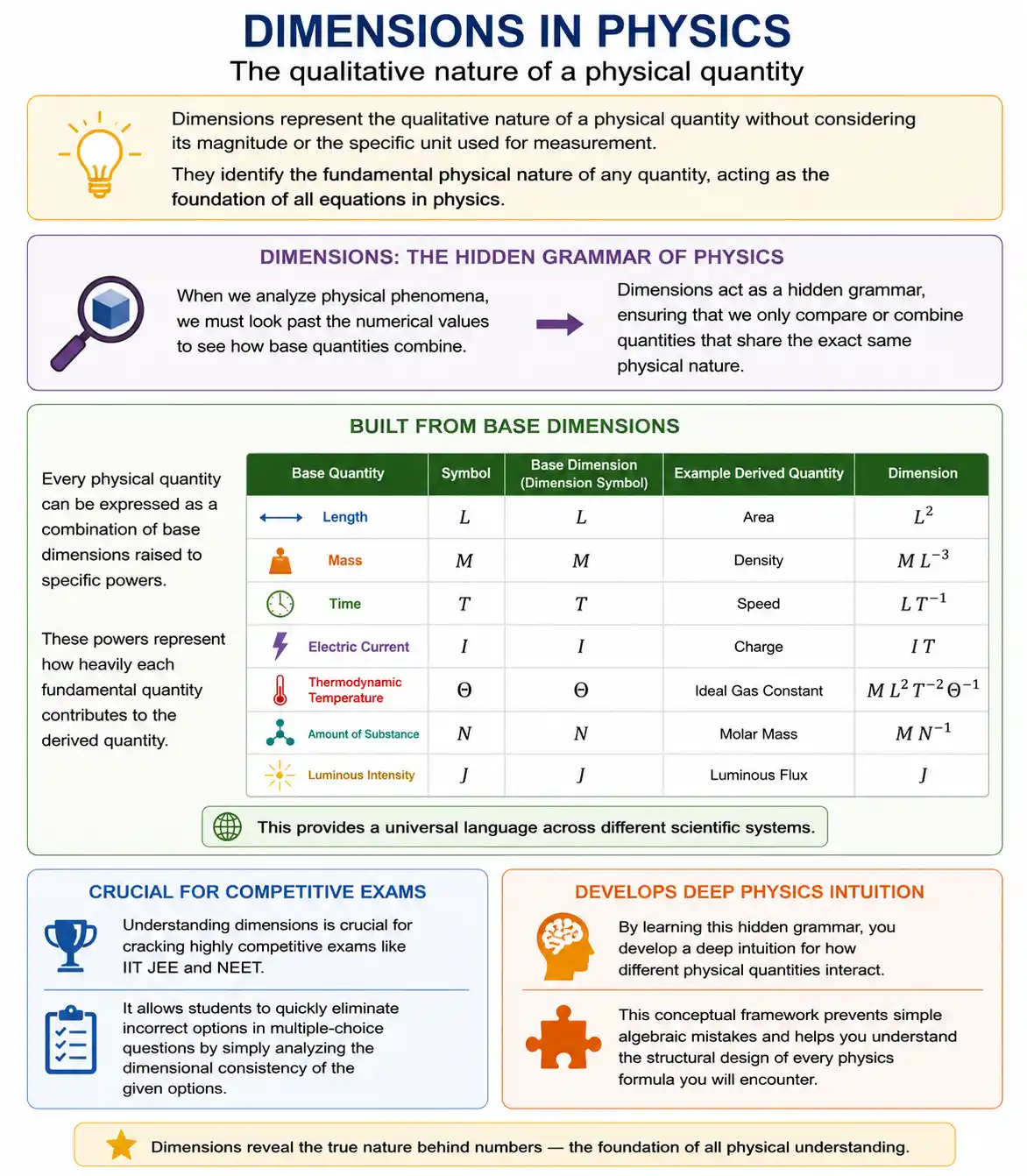
Every physical quantity can be expressed as a combination of base dimensions raised to specific powers. These powers represent how heavily each fundamental quantity contributes to the derived quantity, providing a universal language across different scientific systems.
Understanding dimensions is crucial for cracking highly competitive exams like IIT JEE and NEET. It allows students to quickly eliminate incorrect options in multiple-choice questions by simply analyzing the dimensional consistency of the given options.
By learning this hidden grammar, you develop a deep intuition for how different physical quantities interact. This conceptual framework prevents simple algebraic mistakes and helps you understand the structural design of every physics formula you will encounter.
The Core Meaning of Dimensions
The dimension of a physical quantity is defined as the power to which the fundamental quantities must be raised to represent it. It tells us how a quantity is constructed from basic entities like mass, length, and time.
For instance, speed is calculated as distance divided by time, which means it depends on length and time. Therefore, we say that speed has one dimension in length and minus one dimension in the physical quantity of time.
We write these dimensions using square brackets to distinguish them from standard algebraic variables in equations. This notation clearly indicates that we are analyzing the underlying physical nature rather than performing a specific numerical calculation or measurement.
No matter how large or small a physical quantity is, its dimensional formula remains completely unchanged. A microscopic distance and the vast radius of the observable universe both share the exact same single dimension of physical length.
Mastering this concept helps you view physics equations as structural relationships rather than mere memory tasks. This analytical perspective is the first major step toward solving complex, multi-concept problems in advanced physics examinations successfully.
Difference Between Units and Dimensions
Many students confuse units with dimensions, but they are fundamentally different concepts in physics. While a dimension represents the qualitative nature of a quantity, a unit represents the quantitative scale chosen to measure that specific physical quantity.
For example, the dimension of force is always the same regardless of how you measure it. However, the unit of force can be Newtons in the SI system, dynes in the CGS system, or pounds in daily life.
Units depend entirely on the chosen system of measurement and can change based on regional or scientific preferences. Dimensions, however, are absolute physical properties that remain completely invariant across all systems of units developed by human scientists.
You can convert one unit to another using numerical conversion factors based on mathematical ratios. But you can never change the fundamental dimension of a physical quantity, as it is hardwired into the laws of the universe.
Recognizing this difference helps you avoid common traps in JEE and NEET numerical problems. It ensures you maintain dimensional consistency while performing complex unit conversions during multi-step calculations in thermodynamics, mechanics, and electrodynamics.
The Seven Fundamental Dimensions of Physics
Physics relies on seven fundamental physical quantities that serve as the building blocks for all other measurements. These base quantities are considered independent of one another, meaning none of them can be derived from the other six.
These seven quantities are mass, length, time, electric current, thermodynamic temperature, amount of substance, and luminous intensity. Each is assigned a unique capital letter symbol enclosed in square brackets to represent its core dimension in physics equations.
By combining these seven base dimensions using algebraic rules, we can construct the dimensional formula for any known physical quantity. This systematic approach allows us to classify the entire universe of physical phenomena using just seven basic dimensions.
For most classical mechanics problems, we only need the dimensions of mass, length, and time to describe motion. However, as we progress to electromagnetism and thermodynamics, we must introduce current and temperature to complete our dimensional analysis.
Understanding these base dimensions is essential for building a strong foundation in physics. It helps you see the underlying unity among diverse topics, from the mechanical motion of planets to the microscopic behavior of electric charges.
The Seven Base Dimensions
The seven base dimensions are represented by specific uppercase symbols that must be memorized by every physics student. Mass is represented by ##[M]##, length by ##[L]##, and time by the symbol ##[T]## in standard dimensional analysis.
Electric current is denoted by ##[A]## or ##[I]##, while thermodynamic temperature is represented by ##[K]## or ##[\theta]##. The amount of substance uses ##[mol]##, and luminous intensity is represented by ##[Cd]## in standard scientific notation.
These symbols are the alphabet of the hidden grammar of physics, allowing us to write expressions clearly. They provide a standardized way to analyze equations, ensuring that scientists worldwide can communicate physical relationships without any ambiguity.
In competitive exams, questions often test your familiarity with these base symbols in unusual contexts. Knowing how to express complex electrical or thermal quantities in terms of these seven basic dimensions is a highly valuable exam skill.
Let us summarize these seven fundamental quantities, their standard SI units, and their dimensional symbols in a clear format. This structured reference will help you quickly recall the basic building blocks of dimensional analysis during practice sessions.
| Physical Quantity | SI Unit | Dimensional Symbol |
|---|---|---|
| Mass | kilogram (kg) | [M] |
| Length | meter (m) | [L] |
| Time | second (s) | [T] |
| Electric Current | ampere (A) | [A] |
| Temperature | kelvin (K) | [K] |
| Amount of Substance | mole (mol) | [mol] |
| Luminous Intensity | candela (cd) | [Cd] |
Dimensional Representation Using Powers
We represent the dimensions of any derived physical quantity as a product of the base dimensions raised to appropriate powers. This mathematical expression is called the dimensional formula of that specific physical quantity in scientific literature.
A general dimensional formula is written in the standard form ##[M^a L^b T^c A^d K^e]##. Here, the exponents ##a##, ##b##, ##c##, ##d##, and ##e## are the actual dimensions of the physical quantity.
For example, the dimensional formula for area is written as ##[M^0 L^2 T^0]##, showing it depends only on length. The zero exponents indicate that mass and time have no influence on the measurement of physical area.
Writing the zero exponents is a formal convention that maintains a consistent structure across different formulae. It helps students quickly identify which fundamental quantities are absent from a particular physical relationship during complex derivations.
Let us look at a simple algebraic derivation to see how these exponents are calculated step by step. This process demonstrates how we combine the dimensions of simpler quantities to find the dimensional formula of a more complex one.
Deriving Dimensional Formulae for Physical Quantities
Deriving dimensional formulae is an active skill that requires you to connect physical definitions with base dimensions. Instead of memorizing long tables of formulae, you should learn to derive them using basic high-school physics equations.
If you know the formula for a quantity, you can easily find its dimensions by replacing each term. This systematic method ensures accuracy and helps you reconstruct forgotten dimensional formulae during high-pressure situations in exams.
For instance, if you remember that force equals mass times acceleration, you can easily find its dimensions. You simply combine the dimension of mass with the derived dimension of acceleration to get the final dimensional formula.
This derivation process reinforces your understanding of the physical relationships between different quantities in mechanics. It shows you how complex concepts are built step-by-step from the most basic measurements of space, time, and matter.
Let us explore how we can derive the dimensional formulae for some of the most common physical quantities. We will start with basic mechanics and then move toward more advanced thermodynamic and electromagnetic quantities.
Deriving Mechanics Formulae
Mechanics is the perfect starting point for practicing dimensional derivations because the equations are highly intuitive. Most quantities in mechanics can be expressed using only the three base dimensions of mass, length, and time.
Let us derive the dimensions of velocity, which is defined as the rate of change of displacement. Since displacement is a length and time is ##[T]##, the dimensional formula for velocity is easily written as ##[M^0 L^1 T^{-1}]##.
Acceleration is the rate of change of velocity, which means we divide velocity by time again. This simple step gives us the dimensional formula for acceleration, which is represented as ##[M^0 L^1 T^{-2}]##.
Using these basic building blocks, we can now find the dimensions of force by multiplying mass and acceleration. This yields the highly famous dimensional formula ##[M^1 L^1 T^{-2}]##, which appears in many physics equations.
Let us write a mathematical example to show how we derive the dimensions of work and kinetic energy. This example will prove that different forms of energy share the exact same dimensional formula in physics.
Deriving Thermodynamic and Electromagnetic Formulae
When we move beyond mechanics, we must introduce additional fundamental dimensions like temperature and electric current. This expansion allows us to analyze thermal energy, electrical circuits, and magnetic fields using the same dimensional principles.
For example, electric charge is defined as the product of electric current and time. Using our base symbols, we can express the dimensional formula of charge simply as ##[M^0 L^0 T^1 A^1]##, often written as ##[AT]##.
Potential difference or voltage is defined as work done per unit charge during electrical transport. By dividing the dimensions of work by those of charge, we obtain the dimensional formula ##[M^1 L^2 T^{-3} A^{-1}]##.
Similarly, resistance can be derived using Ohm's law, which states that resistance equals voltage divided by current. This yields the dimensional formula ##[M^1 L^2 T^{-3} A^{-2}]##, a common question in engineering entrance tests.
Let us summarize some of these key derived quantities and their dimensional formulae in a structured table. This will serve as an excellent quick-reference tool for your daily JEE and NEET preparation.
| Physical Quantity | Formula Relation | Dimensional Formula |
|---|---|---|
| Force | Mass × Acceleration | [M1 L1 T-2] |
| Work / Energy | Force × Displacement | [M1 L2 T-2] |
| Pressure | Force / Area | [M1 L-1 T-2] |
| Electric Charge | Current × Time | [M0 L0 T1 A1] |
The Role of Dimensionless Quantities and Homogeneity
Not all physical quantities possess dimensions, and understanding these dimensionless entities is crucial for advanced physics. These quantities usually arise as ratios of two similar physical quantities, causing their dimensions to cancel out completely.
The Principle of Homogeneity is another fundamental rule that governs all valid physical equations. It states that we can only add, subtract, or equate physical quantities if they possess the exact same dimensional formula.
This principle acts as a powerful diagnostic tool for checking the mathematical correctness of any physical equation. If the dimensions on both sides of an equation do not match, the equation is physically impossible and incorrect.
However, we must remember that dimensional correctness does not guarantee complete physical correctness of an equation. Numerical constants, which are dimensionless, cannot be verified or determined using the methods of dimensional analysis alone.
Let us explore why certain quantities like angles are dimensionless and how we can apply the homogeneity principle to solve complex algebraic problems. This will complete our study of the hidden grammar of physics.
Why Angles and Ratios are Dimensionless
An angle is defined as the ratio of arc length to the radius of a circle in geometry. Since both arc length and radius are measured in units of length, their dimensions cancel each other out entirely.
Therefore, we write the dimensional formula of an angle as ##[M^0 L^0 T^0]##, making it completely dimensionless. However, it still possesses a unit called the radian, showing that dimensionless quantities can have units.
Other common dimensionless quantities include relative density, refractive index, and strain in mechanical materials. These quantities compare similar properties, resulting in a pure numerical ratio that carries no physical dimensions.
Trigonometric functions like sine, cosine, and tangent, as well as exponential and logarithmic functions, must always have dimensionless arguments. You cannot calculate the sine of five kilograms; the input must be a pure number.
This rule is incredibly useful when solving advanced problems involving wave equations or decaying exponential processes. It allows you to set up simple dimensional equations to find unknown constants hidden inside complex mathematical functions.
Checking Equations with the Principle of Homogeneity
The Principle of Homogeneity states that terms separated by addition, subtraction, or equality signs must have identical dimensions. This rule ensures that we do not perform physically meaningless operations, like adding mass to a length.
For example, in the kinematic equation ##s = ut + \dfrac{1}{2}at^2##, each term must represent a length. By checking the dimensions of each individual term, we can easily verify if the entire equation is dimensionally consistent.
Let us analyze the term ##ut##, which is velocity multiplied by time. Multiplying ##[L T^{-1}]## by ##[T]## yields ##[L]##, which perfectly matches the dimension of displacement on the left side of our equation.
Similarly, the term ##\dfrac{1}{2}at^2## combines acceleration and time squared. Multiplying ##[L T^{-2}]## by ##[T^2]## also yields ##[L]##, confirming that all three terms in the equation share the exact same dimension of length.
Let us look at a solved problem where we use this principle to find the dimensions of unknown constants in a given equation. This is a highly popular question pattern in both JEE and NEET examinations.
RESOURCES
- Dimensional Analysis | High School Physics - YouTubeyoutube.comJul 1, 2022 ... This video explains what dimensional analysis is and how to use it with a few example questions. Suitable for High…
- Dimensional Analysis : r/Mcat - Redditreddit.comApr 16, 2018 ... 33 votes, 24 comments. Hey everyone, So I'll be blunt. I suck at physics. I keep going through trying to…
- Dimensional analysis : r/AskPhysics - Redditreddit.comAug 31, 2015 ... Dimensional analysis serves so many purposes. One of which is predicting/anticipating what the answer should look like (roughly) for a ...
- 5: Dimensional Analysis - Physics LibreTextsphys.libretexts.orgMar 16, 2025 ... The dimension of a physical quantity is just an expression of the base quantities from which it is derived.
- Dimensional Analysis: A Secret Weapon in Physics - Matt Strasslerprofmattstrassler.comJun 21, 2022 ... The trick, called “dimensional analysis” or “unit analysis” or “dimensional reasoning”, involves requiring consistency among units, sometimes called “ ...
- Dimensional analysis - Wikipediaen.wikipedia.orgChecking for dimensional homogeneity is a common application of dimensional analysis, serving as a plausibility check on derived equations and computations. It ...
- Dimensional Analysis in Mathematics - MathOverflowmathoverflow.netMay 2, 2011 ... Dimensional analysis can be viewed as the study of graded objects in algebra. The grading then corresponds to "counting the…
- Fundamental question about dimensional analysisphysics.stackexchange.comMar 27, 2011 ... Taylor is like Log, Exp and others to be applyed to dimensionless variables. When apply Taylor to a function of…
- Dimensional Analysis Tutorial - Department of Physicsphysics.uoguelph.caThis self-instruction unit deals with dimensional analysis, which is a useful method for determining the units of a variable in an equation.
- What justifies dimensional analysis? - Physics Stack Exchangephysics.stackexchange.comFeb 7, 2014 ... Dimensional analysis, and the notion that quantities with different units cannot be equal, is often used to justify very specific…
- Dimensional Analysis — Isaac Scienceisaacscience.orgDimensional analysis is the use of a set of units to establish the form of an equation, or more often, to check that the…
- Regularization, Renormalization, and Dimensional Analysis - arXivarxiv.orgHigh Energy Physics - Phenomenology. arXiv:0812.3578 (hep-ph). [Submitted on 18 Dec 2008 (v1), last revised 20 Aug 2017 (this version, v2)] ...
- Chapter 2 Units, Dimensional Analysis, Problem Solving, and ...lehman.eduThis is the basis of many useful approximations in physics calculations. The steradian [sr] is the unit of solid angle that, having its vertex…
- Dissecting Physics Reasoning in Small Language Models: A Multi ...arxiv.orgMay 27, 2025 ... Abstract page for arXiv paper 2505.20707: Dissecting Physics Reasoning in Small Language Models: A Multi-Dimensional Analysis from an ...