On This Page
Understanding Physical Quantities

Physics is an experimental science that relies on precise observations of natural phenomena. We translate these observations into mathematical laws by measuring specific properties. A physical quantity is any property that we can measure quantitatively with a standard instrument.
Without measurement, our understanding of the physical universe remains purely subjective and incomplete. Quantitative data allows scientists to test hypotheses and formulate mathematical equations. Therefore, measurement is the bridge connecting physical reality with theoretical frameworks in science.
Every physical law we study in classical or modern mechanics links measurable quantities. For example, Newton's laws of motion relate the measurable quantities of force, mass, and acceleration. These relationships form the core of all physical analysis.

Measuring a physical quantity involves comparing it with a pre-defined standard value. This standard must be universally accepted and easily reproducible under different experimental conditions. The process of comparison yields a clear, objective value that anyone can verify.
In competitive exams like JEE and NEET, conceptual clarity begins with these definitions. Students must recognize that every variable in a physics equation represents a measurable aspect of nature. Mastering this concept is crucial for solving advanced numerical problems.
Defining Measurable Properties

A measurable property is any characteristic of an object or phenomenon that we can quantify. This includes fundamental properties like length, mass, time, electric current, and thermodynamic temperature. We use specialized instruments to assign numerical values to these properties.
Quantifying these properties allows us to describe the physical state of a system. For instance, we describe a moving car using its velocity, mass, and kinetic energy. These measurable variables help us predict the future state of the system.
In contrast, properties that we cannot measure objectively do not qualify as physical quantities. Physics excludes non-measurable concepts because they cannot be verified through experimental testing. Consequently, scientific progress depends entirely on our ability to measure properties accurately.
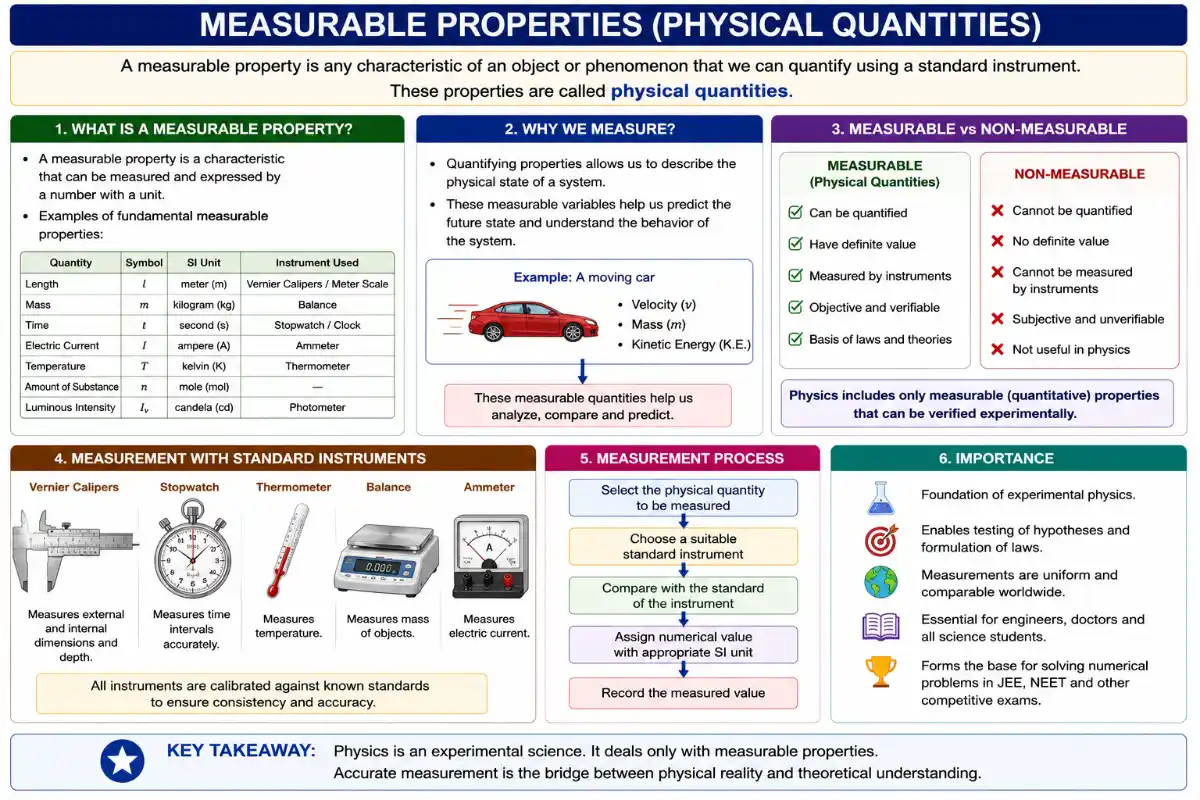
Standard instruments like vernier calipers, stopwatches, and thermometers help us quantify these variables. Each instrument is calibrated against a known standard to ensure consistency. This calibration guarantees that measurements taken globally remain uniform and comparable.
Aspiring engineers and medical professionals must appreciate this experimental foundation of physics. Understanding how we define and measure properties simplifies the transition to complex topics. This knowledge forms the bedrock of experimental physics questions in competitive exams.
Distinguishing Physical from Qualitative Descriptions

It is essential to distinguish between physical quantities and qualitative descriptions of nature. Qualitative terms like beautiful, hot-feeling, or heavy-looking depend entirely on human perception. Because these descriptions are subjective, they cannot be used to formulate scientific laws.
For example, describing an object as heavy-looking does not provide useful scientific information. Instead, we must measure its mass using a physical scale to get a precise value. This objective measurement eliminates human bias and provides reliable experimental data.

Similarly, saying water feels hot is a subjective observation that varies between individuals. Measuring the temperature with a thermometer provides an objective physical quantity in Kelvin or Celsius. This distinction is vital for maintaining scientific rigor in experimental observations.
The table below highlights the difference between qualitative descriptions and physical quantities. It shows how subjective observations are converted into objective, measurable parameters. This conversion is the first step in analyzing any physical system scientifically.
| Qualitative Description | Physical Quantity | Standard Instrument |
|---|---|---|
| The object feels very heavy | Mass | Digital Balance |
| The room is quite warm | Temperature | Thermometer |
| The car is moving fast | Speed | Speedometer |
Recognizing this distinction helps students avoid conceptual errors during laboratory experiments and exams. It teaches them to focus on quantifiable variables rather than intuitive descriptions. This analytical mindset is critical for solving complex mechanical and thermodynamic problems.
The Mathematics of Measurement
Measurement is fundamentally mathematical, requiring a structured format to express physical values. Every complete measurement consists of two distinct parts: a numerical value and a unit. Writing a number without its corresponding unit makes the measurement physically meaningless.
The numerical value represents how many times the standard unit fits into the quantity. The unit is the chosen standard of reference used for comparison. Together, they communicate the exact magnitude of the physical parameter being analyzed.
For example, expressing the length of a rod as simply twenty-five is incomplete. We must specify whether it is twenty-five centimeters, meters, or kilometers to be clear. The unit provides the essential context that gives meaning to the number.
In scientific calculations, treating units as algebraic variables prevents common arithmetic mistakes. This practice ensures that we only combine quantities that share the same physical nature. It also simplifies the process of converting values between different measurement systems.
This mathematical structure forms the basis of dimensional analysis and unit conversions. Students must practice writing units alongside numbers in every step of their calculations. This habit reduces simple errors and builds strong problem-solving skills for exams.
The Fundamental Formula of Measurement
The relationship between a physical quantity, its numerical value, and its unit is constant. We express this relationship mathematically using a simple algebraic equation that applies to all measurements. This formula is the foundation of all unit conversion techniques.
Let ##Q## represent the physical quantity being measured, ##n## be the numerical value, and ##u## be the unit. The magnitude of the physical quantity remains constant regardless of the unit system we choose to express it.
Therefore, we write the fundamental relation as ##Q = n \cdot u##. If we measure the same quantity using two different units, ##u_1## and ##u_2##, the corresponding numerical values will be ##n_1## and ##n_2##.
This yields the conversion equation ##n_1 u_1 = n_2 u_2##, which shows an inverse relationship. As the size of the measurement unit decreases, the corresponding numerical value must increase proportionally to maintain the same physical magnitude.
Let us look at a simple mathematical application of this fundamental formula. This example demonstrates how to calculate an unknown numerical value when converting between two different units of length. It illustrates the inverse relationship between unit size and numerical value.
Unit Systems and Numerical Scaling
Throughout scientific history, different regions developed unique systems of units for measurement. The most common historical systems include the CGS, the FPS, and the MKS systems. Each system uses different base units for length, mass, and time.
The modern standard is the International System of Units, abbreviated as the SI system. It provides a globally unified framework that simplifies scientific communication across countries. Using SI units ensures consistency in research, engineering, and academic examinations worldwide.
When we switch between these systems, the numerical values scale according to the unit conversion factors. Understanding these scaling factors is crucial for solving physics problems accurately. It prevents students from mixing incompatible units during complex multi-step calculations.
The table below lists the base units of different historical and modern systems. It highlights how each system defines the primary measurements of mechanics. Familiarity with these systems is essential for decoding classical physics problems in exams.
| System of Units | Length Unit | Mass Unit | Time Unit |
|---|---|---|---|
| CGS (Centigrade-Gram-Second) | Centimeter (cm) | Gram (g) | Second (s) |
| FPS (Foot-Pound-Second) | Foot (ft) | Pound (lb) | Second (s) |
| SI (International System) | Meter (m) | Kilogram (kg) | Second (s) |
Mastering numerical scaling is a core skill for JEE and NEET candidates. Many exam questions deliberately mix units to test a student's attention to detail. Converting all variables to SI units before calculating prevents these systematic errors.
Physical Equations versus Pure Mathematics
A major difference exists between a pure mathematical equation and a physical equation. Mathematical equations deal with abstract numbers that do not carry physical meaning or units. In contrast, physical equations represent relationships between real, measurable quantities.
In pure mathematics, the equation ##y = 2x## is valid for any real numbers. In physics, however, the variables must have compatible dimensions for the equation to make sense. We cannot add or equate quantities that represent different physical properties.
For instance, adding five kilograms of mass to three meters of length is physically impossible. A mathematical expression allows this addition, but a physical equation strictly forbids it. This restriction is governed by the fundamental principle of dimensional homogeneity.
Every physical equation must balance both numerically and dimensionally across all its terms. The units on the left-hand side must match the units on the right-hand side. This requirement acts as a built-in safety check for scientific calculations.
Understanding this distinction helps students appreciate why dimensional analysis is so powerful. It allows us to verify the structural correctness of a formula without knowing its exact numerical constants. This concept is a cornerstone of advanced physical analysis.
The Role of Dimensional Integrity
Dimensional integrity means that the dimensions of a physical equation must be consistent throughout. Every term separated by a plus, minus, or equality sign must have the same physical dimensions. This rule ensures that the equation describes a valid relationship.
We represent dimensions using primary symbols for mass, length, time, and other base quantities. For example, the dimensions of velocity are length divided by time, written as ##[LT^{-1}]##. This dimensional formula remains constant regardless of the unit system used.
If an equation violates dimensional integrity, it is physically incorrect, even if it is mathematically elegant. Therefore, testing the dimensions of a newly derived formula is the first step in scientific validation. It saves researchers from pursuing invalid theoretical models.
Let us analyze a classic physics equation to verify its dimensional integrity. We will examine the kinematic equation for displacement to show how each term shares identical dimensions. This process demonstrates the practical application of dimensional consistency.
This proof shows how dimensional analysis helps confirm the algebraic structure of physical laws. Students should use this method whenever they derive a new formula during an exam. It provides a quick way to double-check their algebraic work.
Why Units Prevent Calculation Failures
Paying close attention to units is one of the easiest ways to avoid calculation failures. Many engineering disasters and academic errors occur because of mismatched units in calculations. Keeping track of units throughout a problem ensures that the final answer is correct.
When solving complex physics problems, students often focus only on the numerical values. This approach makes it easy to overlook necessary conversion factors, leading to incorrect results. Writing units alongside numbers helps maintain focus on the physical reality.
Furthermore, units can guide you toward the correct formula when you forget it. By analyzing the units of the given values, you can reconstruct the algebraic relationship needed. This technique is highly effective under exam pressure.
For instance, if you need to find pressure and are given force and area, their units help. Force is in Newtons, and area is in square meters, which leads directly to the formula of force divided by area.
Developing a strong habit of unit tracking builds confidence and precision in scientific calculations. It transforms unit conversion from a memory task into a logical, step-by-step process. This discipline is essential for success in advanced engineering and medical studies.
Measurement Strategy for Competitive Exams
Mastering measurement concepts is a high-yield strategy for scoring well in competitive exams. Questions on units, dimensions, and error analysis appear regularly in both JEE and NEET papers. These topics are straightforward but require absolute precision to master.
Many students lose marks not because they misunderstand difficult concepts, but due to careless unit mistakes. A solid foundation in measurement helps prevent these avoidable errors across all chapters. It serves as an essential tool for every topic in physics.
Competitive exams test your ability to apply these principles under tight time constraints. Therefore, you must develop quick, reliable methods for verifying units and dimensions during calculations. Regular practice helps make these verification steps second nature.
Additionally, experimental physics questions often focus on the limitations of real measuring instruments. Understanding least count, zero error, and percentage error is essential for these practical-based questions. These concepts connect theoretical formulas with actual laboratory measurements.
This final section focuses on practical strategies and common traps in exam questions. We will look at typical errors and learn how to use dimensional analysis to solve problems efficiently. These techniques will help you maximize your exam performance.
Common Pitfalls in JEE and NEET Physics
One of the most common student mistakes is writing numerical answers without units. In competitive exams, options often feature the same numerical value with different units to test your attention. Always double-check the unit of your final calculated answer.
Another major pitfall is confusing a physical quantity with its measurement unit. For example, some students mistakenly think that "kg" is a physical quantity rather than a unit of mass. Keeping this distinction clear prevents conceptual confusion.
Many candidates also assume that the numerical value of a physical quantity is fixed. They forget that the numerical value changes whenever the measurement unit changes, as shown by our fundamental formula. Remembering this relationship is key to accurate conversions.
Finally, students often treat unit conversion as a memory task rather than a logical process. Trying to memorize every conversion factor leads to mistakes under stress. Instead, learn to derive conversions step-by-step using fundamental dimensional equations.
Recognizing these common traps is the first step toward avoiding them in exams. By practicing mindfully, you can eliminate these errors and improve your overall physics score. This attention to detail separates top-scoring students from the rest.
Applying Dimensional Homogeneity to Problem Solving
The principle of homogeneity is a powerful tool for solving multiple-choice questions quickly. When faced with a complex formula, you can often eliminate incorrect options by checking their dimensions. This method saves valuable time during competitive examinations.
If an option has dimensions that do not match the target quantity, it is incorrect. You can discard it immediately without performing any algebraic derivations or calculations. This elimination strategy is highly effective for difficult, multi-variable problems.
Let us look at a practical example of using dimensional analysis to solve an exam-style problem. We will determine the unknown power of a variable in a physical relationship by matching dimensions. This technique is a favorite of exam paper setters.
This example demonstrates how dimensional analysis helps us derive relationships between physical variables. It provides a structured, logical way to solve complex physics problems without deep theoretical derivations. This method is an invaluable tool for competitive examinations.
In conclusion, mastering the fundamentals of measurement, units, and dimensions is essential. These core concepts form the foundation of all physics and are critical for exam success. Dedicating time to learning them thoroughly pays off throughout your academic journey.
RESOURCES
- Why does so many physicists explain the measurement problem like ...reddit.comJan 11, 2022 ... I also love to geek out on the Space Time youtube channel, even though my understanding of particle physics is…
- Physical Measurement Laboratory | NISTnist.govHis election recognizes his extraordinary contributions to physics and quantum science, including pioneering advances in optical atomic clocks, precision ...
- National report supports measurement innovation to aid commercial ...pppl.govMar 2, 2026 ... It was chaired by Luis Delgado-Aparicio, head of advanced projects at the DOE's Princeton Plasma Physics Laboratory (PPPL), and co-chaired ...
- Physics-based virtual coherence scanning interferometer for surface ...light-am.comFinally, we demonstrate the experimental validation of the virtual instrument, followed by virtual measurements and error predictions for several typical ...
- Direct neutrino-mass measurement with sub-electronvolt sensitivitynature.comFeb 14, 2022 ... Here we report the upper limits on effective electron anti-neutrino mass, m ν , from the second physics run of…
- Introductory physics lab instructors' perspectives on measurement ...link.aps.orgMay 6, 2021 ... Introductory physics lab instructors value a range of measurement uncertainty topics beyond basic statistical ideas like mean and standard ...
- CMC-KUHNKE End Measurement Gauge EMS-3200industrialphysics.comDiscover the End Measurement Gauge from CMC-KUHNKE, providing the highest quality of testing equipment. Enquire at Industrial Physics today.
- What is the most precise physical measurement ever performed?physics.stackexchange.comAug 16, 2019 ... Carrying the fame of being one of the most precisely verified propositions in physics, the ratio of the gravitational to…
- Rasch analysis in physics education research: Why measurement ...link.aps.orgJul 3, 2019 ... Rasch measurement parallels physical measurement processes by constructing and using linear person and item measures that are independent of the ...
- Muon g-2 announces most precise measurement of the magnetic ...news.fnal.govJun 3, 2025 ... “The anomalous magnetic moment, or g–2, of the muon is important because it provides a sensitive test of the Standard…
- Electronics for Physics Measurement - UCLA General Catalogcatalog.registrar.ucla.eduBroad introduction to analog and digital electronics from practical viewpoint, followed by examination of typical circuits for scientific instrumentation and ...
- 1: Units and Measurement - Physics LibreTextsphys.libretexts.orgFeb 20, 2022 ... Physics is about trying to find the simple laws that describe all natural phenomena using a vast range of mass,…
- Caltech / Ph118 - Physics of Measurementits.caltech.eduCourse Description: This course will provide an introduction to concepts and principles of physical measurements that are crucial to experimental research. This ...
- Clinical Physics and Physiological Measurement - IOPscienceiopscience.iop.orgClinical Physics and Physiological Measurement is the previous name for the journal Physiological Measurement. Volumes 1 to 13 of Physiological Measurement can ...
- NA62 Collaboration refines measurement of rare particle decayhome.cernMar 4, 2026 ... Thanks to this 'theoretical cleanliness', this particular kaon decay is extremely sensitive to new physics beyond the Standard Model but,…
0 Comments