Measurement is the quiet grammar of physics: before a single law can be tested, a quantity must be named, standardised, and reported with honest precision. This closing lesson of the Units and Measurement course gathers every thread — the seven SI base units, the discipline of significant figures, the architecture of dimensional formulae, and the logic of error analysis — into one coherent review. It is written for the advanced CBSE Class 11 learner who has already wrestled with the problem-solving session and now needs consolidation rather than novelty.
The purpose here is not to repeat earlier derivations but to compress them into a working instrument. You will find a complete formula sheet, a structured summary of concepts, a full-length practice test with an answer key, and practical guidance on examination timing. Alongside these, the lesson draws explicit bridges to kinematics and the laws of motion, showing how dimensional reasoning and significant-figure discipline become indispensable tools the moment motion enters the picture.
Assessment, properly understood, is a measurement of understanding — and it obeys the same rules as any other measurement. It carries uncertainty, it demands the right instrument, and it rewards honest reporting. Treat this review as a calibration exercise: identify where your conceptual precision is reliable, where the first uncertain digit lies, and where further practice must be concentrated before the board examination.
On This Page
- The Architecture of SI Units and the Logic of Standards
- Significant Figures, Scientific Notation, and Order of Magnitude
- Dimensions, Dimensional Formulae, and the Principle of Homogeneity
- Error Analysis and the Reporting of Measurements
- Practice Test: A Full-Length Assessment with Answer Key
- Examination Strategy, Time Management, and Looking Ahead
The Architecture of SI Units and the Logic of Standards
Every physical quantity is expressed as a numerical measure accompanied by a unit, and that unit is an internationally accepted reference standard chosen by convention rather than by nature. The elegance of the system lies in economy: although physical quantities are innumerable, a small set of base units suffices because all others are interrelated. Units of fundamental quantities are called base units, while those of derived quantities are combinations of them.
From CGS and FPS to the Modern SI
Earlier eras used the CGS, FPS (British), and MKS systems, with centimetre, gram, and second; foot, pound, and second; and metre, kilogram, and second respectively. The Système International d'Unités, developed by the BIPM and revised by the General Conference on Weights and Measures in November 2018, is now the internationally accepted scheme for scientific, technical, industrial, and commercial work. Its decimal structure makes conversions simple and convenient.
The 2018 revision was conceptually profound: the base units are now defined through fixed numerical values of fundamental constants rather than material artefacts. The metre follows from the speed of light in vacuum, ##c = 299792458## m s⁻¹; the kilogram from the Planck constant ##h = 6.62607015 \times 10^{-34}## J s; the second from the caesium-133 hyperfine frequency ##\Delta\nu_{cs} = 9192631770## Hz. This anchors measurement to nature itself.
Base Units, Supplementary Units, and Prefixes
SI recognises seven base units: metre, kilogram, second, ampere, kelvin, mole, and candela. Two further units describe angles — the radian for plane angle, defined as the ratio of arc length to radius, and the steradian for solid angle, the ratio of intercepted spherical area to the square of the radius. Both are dimensionless, a fact of real consequence in dimensional analysis.
Derived units may carry special names, and common prefixes express multiples and sub-multiples compactly. The mole deserves particular care: one mole contains exactly ##6.02214076 \times 10^{23}## elementary entities, and those entities — atoms, molecules, ions, electrons — must always be specified. Units outside SI, such as the litre or the electron volt, remain retained for general use.
Significant Figures, Scientific Notation, and Order of Magnitude
Every measurement carries error, so a reported result must indicate its precision. The reliable digits plus the first uncertain digit are the significant figures. A pendulum period of 1.62 s has three significant figures: 1 and 6 are certain, 2 is uncertain. Reporting more digits than this is superfluous and misleading, since it falsely advertises precision the instrument never possessed.
The Rules and Their Subtleties
All non-zero digits are significant, as are zeros between two non-zero digits. For numbers less than one, zeros to the right of the decimal but left of the first non-zero digit are not significant. Trailing zeros without a decimal point are not significant, whereas trailing zeros with a decimal point are. A change of units never alters the count.
The classic trap is the trailing zero. A length of 4.700 m has four significant figures, but written as 4700 mm it appears to have two. Scientific notation resolves this ambiguity completely: ##4.700 \times 10^{3}## mm makes clear that all zeros in the base number are significant. The power of ten is irrelevant to the count.
Order of Magnitude and Exact Numbers
In scientific notation a number is written as ##a \times 10^{b}## with ##1 \le a < 10##. Rounding a to 1 or 10 gives the order of magnitude ##10^{b}##. The Earth's diameter, ##1.28 \times 10^{7}## m, is of order ##10^{7}## m; a hydrogen atom, ##1.06 \times 10^{-10}## m, of order ##10^{-10}## m — a difference of seventeen orders of magnitude.
Multiplying and dividing factors that are neither rounded numbers nor measured values are exact and carry infinite significant digits. In ##r = d/2## or ##s = 2\pi r##, the 2 is exact. Similarly, defined conversion factors such as 1 inch = 2.54 cm are exact by definition, so they never limit the precision of a calculation.
Dimensions, Dimensional Formulae, and the Principle of Homogeneity
Dimensions describe the qualitative nature of a physical quantity — its dependence on length, mass, time, electric current, temperature, amount of substance, and luminous intensity. The dimensional formula expresses this dependence using symbols M, L, T, A, K, mol, and cd. Velocity, for instance, has dimensions ##[M^{0}L^{1}T^{-1}]##, while force has ##[M^{1}L^{1}T^{-2}]##.
Building and Reading Dimensional Formulae
Derived quantities inherit dimensions from their defining equations. Work is force times displacement, giving ##[M^{1}L^{2}T^{-2}]##; pressure is force per area, giving ##[M^{1}L^{-1}T^{-2}]##. Angles are dimensionless because they are ratios of two lengths, which is why angular velocity shares the dimensions of frequency, ##[T^{-1}]##, despite being conceptually distinct.
The principle of homogeneity states that every term in a physically valid equation must have the same dimensions. This is a powerful filter: an equation that fails homogeneity is certainly wrong, though an equation that passes may still be wrong by a dimensionless factor. It is a necessary but not sufficient condition for correctness.
Applications and Their Limits
Dimensional analysis converts units between systems, checks equations, and derives relations when the physics is known up to dimensionless constants. The period of a simple pendulum, for example, can be shown to depend on ##\sqrt{l/g}## by dimensions alone, though the factor ##2\pi## must come from dynamics. It cannot, however, determine dimensionless constants or trigonometric and exponential dependencies.
A frequent error is to add quantities of different dimensions, or to forget that arguments of trigonometric, logarithmic, and exponential functions must be dimensionless. Equally common is treating the radian as carrying dimensions. Careful students annotate every step with its dimensional formula, catching inconsistencies before they propagate into a final answer.
We Also Published
Error Analysis and the Reporting of Measurements
No measurement is exact. Errors are classified as systematic, arising from instrument calibration or flawed technique and biasing results in one direction, or random, fluctuating unpredictably and partially cancelling over many trials. Gross errors stem from human blunders. Recognising the type of error determines the remedy: calibration for systematic bias, repetition and averaging for random scatter.
Absolute, Relative, and Percentage Error
The absolute error is the magnitude of the difference between the measured and true value. The mean absolute error of several readings estimates the uncertainty. Relative error is the ratio of absolute error to the measured value, and percentage error multiplies this by 100. Reporting ##\Delta a## alongside ##a## communicates precision honestly.
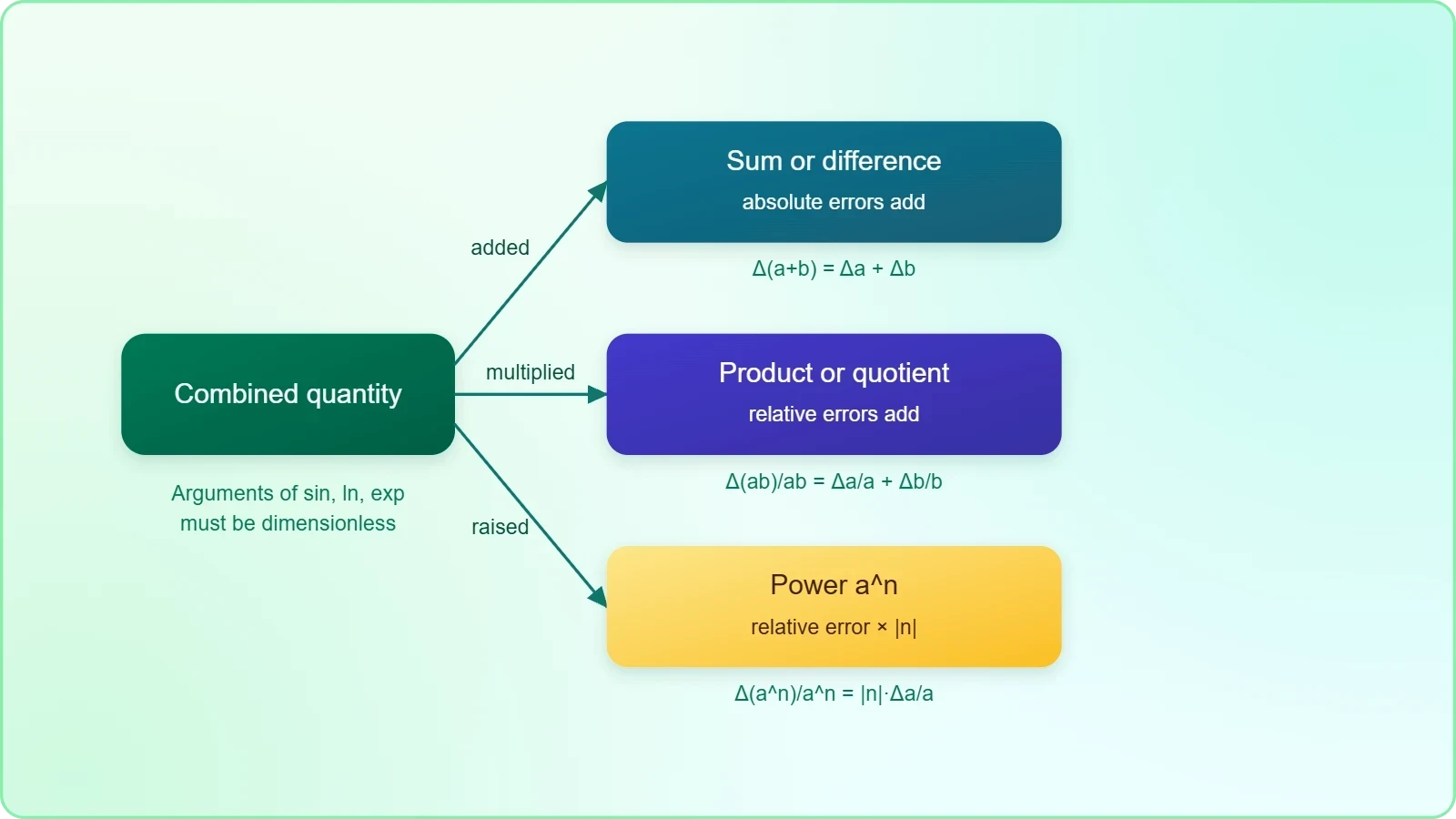
When quantities combine, errors propagate. For sums and differences, absolute errors add. For products and quotients, relative errors add. For a quantity raised to a power ##n##, the relative error is multiplied by ##|n|##. These rules follow from the linear approximation of differentials and hold for small errors.
Least Count and Instrument Choice
The least count is the smallest measurement an instrument can resolve, and it sets the precision of every reading. A vernier calliper with least count 0.01 cm reports two decimal places; a metre scale reports to 0.1 cm. Choosing an instrument finer than the required precision wastes effort, while choosing one too coarse destroys accuracy.
Zero error is a systematic defect in which the instrument reads non-zero when the true value is zero. It must be measured and subtracted from every reading. In practical examinations, identifying and correcting zero error is often worth marks, and neglecting it is among the most common sources of lost credit.
Practice Test: A Full-Length Assessment with Answer Key
This practice test mirrors the structure of a board examination, blending conceptual recall with numerical reasoning. Attempt it under timed conditions — ninety minutes for the full set — and mark yourself honestly against the key. The questions deliberately revisit every section of the course, so a pattern of errors will reveal precisely where revision should concentrate.
Section A: Conceptual and Short-Answer Questions
Answer briefly, in one or two sentences each. Define the least count of an instrument and state its role in determining significant figures. Explain why the radian is dimensionless. Distinguish between systematic and random errors with one example each. State the principle of homogeneity and explain why it cannot prove an equation correct.
Further questions ask you to convert 4.700 m into centimetres and millimetres while preserving significant figures, to express the Earth's diameter in scientific notation and state its order of magnitude, and to explain why the mole requires specification of elementary entities. Each answer should be precise and free of superfluous digits.
Section B: Numerical Problems
A simple pendulum's period is measured five times as 1.62, 1.63, 1.61, 1.64, and 1.62 s. Compute the mean, the mean absolute error, and the percentage error, reporting the result with correct significant figures. Then use dimensional analysis to derive the dependence of the period on length and gravitational acceleration.
A rectangle measures ##(5.0 \pm 0.1)## cm by ##(3.0 \pm 0.1)## cm. Calculate its area and the uncertainty in that area, applying the rule for products. Finally, check the dimensional consistency of ##v^{2} = u^{2} + 2as## and identify any term that would violate homogeneity if the equation were miswritten.
Examination Strategy, Time Management, and Looking Ahead
Success in this chapter depends less on memorisation than on disciplined procedure. Read each numerical question twice, list the given data with units, and identify the target quantity before touching the calculator. Carry units through every step, round only at the end, and report the final answer with the correct number of significant figures. These habits prevent the majority of avoidable errors.
Managing the Clock and the Paper
Allocate roughly one minute per mark, reserving ten minutes at the end for checking. Answer conceptual questions first to secure easy marks, then move to numericals. If a problem stalls, mark it and return later; a fresh perspective often dissolves the difficulty. Keep a personal error log of every mistake you make in practice, and review it before each test.
For practical examinations, rehearse the reading of vernier and screw-gauge scales until the least count and zero correction become automatic. Write observations in a neat table with units in the column headings, and always state the least count of the instrument used. Examiners reward clarity and correct reporting as much as the numerical result itself.
Bridges to Kinematics and the Laws of Motion
This chapter is the foundation on which all later mechanics rests. In kinematics, dimensional reasoning will verify equations such as ##v = u + at##, and significant figures will govern how you report displacement and velocity. In the laws of motion, the dimensional formula of force, ##[M^{1}L^{1}T^{-2}]##, becomes the basis for defining the newton and analysing momentum change.
Error analysis reappears in every experiment you will perform, from timing a trolley on an inclined plane to measuring the extension of a spring. The discipline of reporting ##a \pm \Delta a## is not a formality; it is the language in which experimental physics speaks. Master it here, and every subsequent laboratory session becomes more rigorous and more rewarding.
As you close this course, take a moment to reflect on how far your reasoning has travelled. You began by asking what a unit is; you end able to interrogate an equation for dimensional consistency, to propagate uncertainty through a calculation, and to judge whether a reported result is honest. That capacity for critical evaluation is the real outcome of this chapter, and it will serve you long after the examination.
Further study can deepen this foundation: the NCERT textbook exercises, previous years' board papers, and standard reference texts on experimental physics all reward careful reading. Work through the practice test once more under timed conditions, review your error log, and step into kinematics with confidence. Measurement is where physics begins, and you have now measured your own understanding with precision.
From our network :
- How to Print Cheaply: Cutting the Cost per PageA practical, measured guide to lowering what each printed page costs — duplex and draft modes, third-party ink, yield mathematics, and knowing when a new printer beats refills.
- Trump Political Strategy How Geopolitical Stunts Serve As Media Diversions
- EV 2.0: The Solid-State Battery Breakthrough and Global Factory ExpansionDiscover the impact of the Solid-State Battery Breakthrough on the EV market. Learn about CATL and BYD stock growth, global factory expansion in Europe, and the future of EV 2.0 technology.
- Where to Put Your Wireless Router for Better CoverageA practical, physics-grounded guide to router placement: why the centre of the home beats the corner, how walls and metal sap signal, and how to run a simple survey that proves the improvement.
- 98% of Global MBA Programs Now Prefer GRE Over GMAT Focus EditionExplore why 98% of global MBA programs now prefer the GRE over GMAT Focus. Learn about the shorter GRE format, verbal logic importance, and strategic versatility for students.
- Analyzing Trump Deportation Numbers Insights Into The 2026 Immigration Crackdown
- AI-Powered 'Precision Diagnostic' Replaces Standard GRE Score ReportsDiscover the new GRE Precision Diagnostic. Learn how AI-powered behavioral analytics and time-to-solve tracking are replacing standard GRE score reports to empower students.
- Do You Need a New Router or Is Your Internet Plan the Problem?A practical comparison of the signs that point to router limits versus signs your broadband speed or provider is the bottleneck, so you can decide what to replace before spending money.
- 10 Physics Numerical Problems with Solutions for IIT JEEPrepare for IIT JEE with 10 physics numerical problems, complete with detailed solutions and conceptual explanations. Ideal for mastering kinematics, thermodynamics, electromagnetism, and optics.
RESOURCES
- Measurement properties of the pressure biofeedback unit ... - PubMedpubmed.ncbi.nlm.nih.govMeasurement properties of the pressure biofeedback unit in the evaluation of transversus abdominis muscle activity: a systematic review. Physiotherapy. 2011 ...
- Validity and reliability of inertial measurement units for ... - PMCpmc.ncbi.nlm.nih.govMay 14, 2025 ... By addressing this gap, our study provides a more detailed evaluation of IMUs in gait assessment, offering insights that can…
- Assessment and Classroom Learningassess.ucr.eduJul 28, 2006 ... ABSTRACT This article is a review of the literature on classroom formative assessment ... classroom assessment, Journal of Educational Measurement ...
- A Systematic Review of the Measurement Properties of Face, Legs ...pmc.ncbi.nlm.nih.govApr 8, 2023 ... However, further studies are still needed to provide more robust evidence. Keywords: children, FLACC scale, infants, pain assessment, systematic ...
- A Review of Gait Analysis Using Gyroscopes and Inertial ... - MDPImdpi.comMay 31, 2025 ... Wearable Inertial Measurement Units for Assessing Gait in Real-World Environments. Front. Physiol. 2020, 11, 90. [Google Scholar] [CrossRef] ...
- What Works Clearinghouse Procedures and Standards Handbook ...ies.ed.gov... units of assignment smaller than a school or units of measurement ... means of the baseline measure specified in the review protocol as…
- Math | Khan Academykhanacademy.orgMeasuring angles · Area and perimeter · Units of measurement · Represent ... units for comprehensive course overview and helpful prerequisite review articles.
- Review Validity and reliability of inertial measurement units used to ...sciencedirect.comThis spreadsheet tabulated author names and publication date, study design, participants, technology and methods, lumbar spine assessment procedure, validity ...
- Chapter 25: Assessing risk of bias in a non-randomized studycochrane.orgReview authors should specify important confounding domains and co-interventions of concern in their protocol. At the start of a ROBINS-I assessment of a study, ...
- 1.5.1 The IRS Balanced Performance Measurement Systemirs.gov... evaluation and review, measure evaluation should meet an especially rigorous set of standards. In determining the appropriateness of a specific course of ...
- Chapter 6: Choosing effect measures and computing estimates of ...cochrane.org... measure from other studies in the review. However, the appropriateness of ... Cochrane News 1997b; 11: 11–12. Deeks JJ, Altman DG, Bradburn MJ ...
- A Critical Review of Research on Student Self-Assessment - Frontiersfrontiersin.orgEffects of an SWH approach and self-evaluation on sixth grade students' learning and retention of an electricity unit. Int. J. Prog. Educ.11, 32–49. Google ...
- A Systematic Review and Meta-Analysis of a Measure of Staff/Child ...journals.plos.orgThe quality of staff/child interactions as measured by the Classroom Assessment Scoring System (CLASS) in Early Childhood Education and Care (ECEC) programs ...
- CMS External Quality Review (EQR) Protocols - Medicaidmedicaid.gov... Review Information Systems Underlying Network Adequacy Monitoring ......................... 217. Activity 4: Validate Network Adequacy Assessment Data ...