Every physical quantity carries a hidden signature — a compact statement of the fundamental natures it is built from. A velocity is a length divided by a time; a force is a mass multiplied by a length and divided by a time squared. Strip away the numbers, the units, and the particular system of measurement, and what remains is the dimension of the quantity: a pure statement of quality rather than magnitude. This lesson develops that idea with the rigour expected of an advanced Class 11 learner, moving from the definition of the seven base dimensions to the construction of dimensional formulae for a wide range of mechanical quantities.
Building directly on the preceding study of uncertainty and error analysis, the discussion here shifts from how precisely a quantity is measured to what kind of quantity it is. Dimensions answer that second question. They allow a physicist to check whether an equation is even possible, to convert a relationship from one system of units to another, and to predict the form of a physical law before any experiment is performed. The treatment below preserves the standard NCERT terminology and notation, then extends it with worked derivations, a reference table of common formulae, and the pitfalls that trip up even careful students.
By the end, you should be able to read a defining equation and extract its dimensional formula in a single pass, recognise dimensionless quantities such as angles and refractive index, and apply the principle of dimensional homogeneity to test the consistency of expressions. These skills prepare the ground for the next lesson, where dimensional formulae are assembled into full dimensional equations and used as a problem-solving instrument.
On This Page
- The Nature of Dimensions and the Seven Base Quantities
- Deriving Dimensional Formulae from Defining Equations
- A Reference Table of Dimensional Formulae
- Dimensional Homogeneity and the Logic of Equations
- Common Mistakes and Advanced Points
- Preparing for Dimensional Equations
- Worked Practice: From Definition to Dimension
The Nature of Dimensions and the Seven Base Quantities
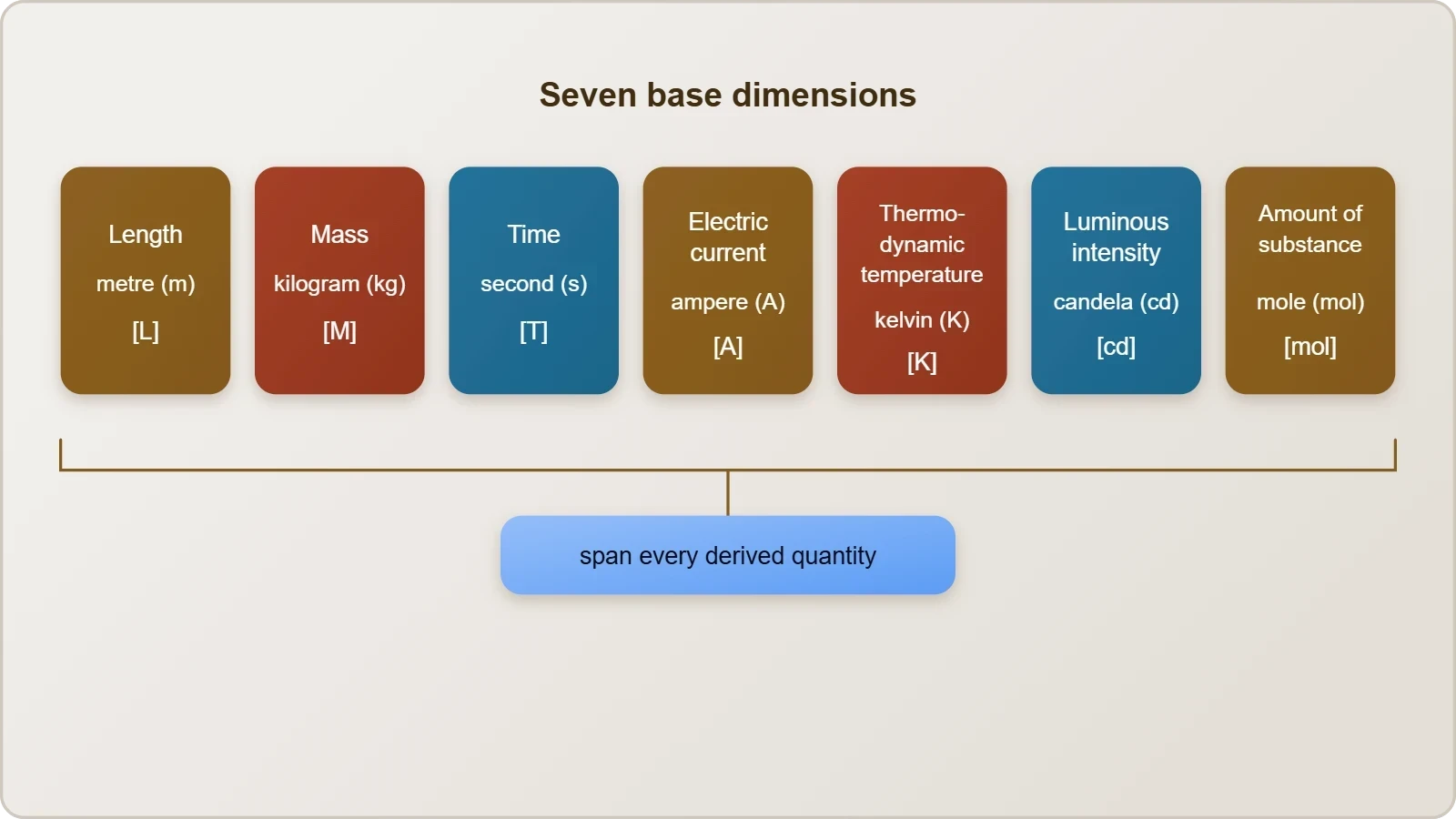
The nature of a physical quantity is described by its dimensions. Every derived quantity can be expressed as some combination of seven fundamental or base quantities, and these seven are called the dimensions of the physical world. They are written inside square brackets, a notation that signals we are dealing with the dimensions of a quantity rather than its value.
The seven base dimensions are length [L], mass [M], time [T], electric current [A], thermodynamic temperature [K], luminous intensity [cd], and amount of substance [mol]. Each corresponds to one base quantity in the International System, and together they span every measurable phenomenon in physics, from the swing of a pendulum to the glow of a distant star.
Dimensions as Exponents of Base Quantities
Formally, the dimensions of a physical quantity are the powers, or exponents, to which the base quantities are raised to represent that quantity. Volume, being the product of three lengths, carries the dimension [L³]; because it does not involve mass or time, it is said to possess zero dimension in mass and zero dimension in time. The exponent zero is meaningful, not decorative.
This exponent language is what makes dimensions so powerful. A quantity with dimension [M L T⁻²] has one dimension in mass, one in length, and minus two in time. The negative exponent is not an error; it records division by time squared. Reading exponents correctly is the first fluency an advanced student must acquire.
Dimensions Are Independent of the System of Units
A crucial property deserves emphasis: dimensions are independent of the system of units. Whether a length is measured in metres, centimetres, or light-years, its dimension remains [L]. Changing the unit changes the numerical magnitude and the unit label, but never the dimensional signature, because the dimension records the kind of quantity, not its size.
This independence is precisely why dimensional reasoning travels so freely across contexts. A formula derived in SI remains dimensionally valid in the cgs system or in any other coherent system. The magnitudes are not considered in a dimensional representation at all; only the quality of the type of physical quantity enters, which is why initial velocity, final velocity, average velocity, and speed all share the dimension [L T⁻¹].
Deriving Dimensional Formulae from Defining Equations
The expression that shows how and which of the base quantities represent the dimensions of a physical quantity is called its dimensional formula. To obtain one, you begin with the defining equation of the quantity, substitute the dimensions of each constituent quantity, and simplify the exponents. The procedure is mechanical but demands care with definitions.
Consider volume: it is length multiplied by breadth multiplied by height, three lengths in all, so its dimensional formula is [M⁰ L³ T⁰]. Consider force: it is mass times acceleration, and acceleration is length divided by time squared, giving [M L T⁻²]. Each step follows from the equation that defines the quantity, never from guesswork.
Worked Derivations for Common Quantities
Take momentum, defined as mass times velocity. Velocity is length over time, so momentum carries [M] × [L T⁻¹] = [M L T⁻¹]. Take pressure, defined as force per unit area: force is [M L T⁻²] and area is [L²], so pressure is [M L⁻¹ T⁻²]. The division by area flips the sign of the length exponent.
Take work or energy, defined as force times displacement: [M L T⁻²] × [L] = [M L² T⁻²]. Take power, energy per unit time: [M L² T⁻²] divided by [T] gives [M L² T⁻³]. Notice how each new quantity inherits and modifies the exponents of its parents, building a family tree of dimensions.
Angles and Dimensionless Quantities
Some quantities carry no dimensions at all. A plane angle is defined as the ratio of arc length to radius, so its dimension is [L]/[L] = [M⁰ L⁰ T⁰], a pure number. The radian is therefore dimensionless, and so is the steradian for solid angle. This is why trigonometric functions can accept angles as arguments.
Many other quantities are dimensionless by construction: refractive index, strain, relative density, and the coefficient of friction are all ratios of like quantities. Their dimensional formula is [M⁰ L⁰ T⁰]. Recognising dimensionless quantities matters, because they can appear as arguments of exponential and logarithmic functions, which demand pure numbers.
We Also Published
A Reference Table of Dimensional Formulae
Fluency with dimensions comes from familiarity with a core set of formulae. The table below gathers the dimensional formulae of common mechanical quantities, all expressed in terms of [M], [L], and [T]. Use it as a working reference, but always be ready to re-derive any entry from its defining equation rather than relying on memory alone.
Reading the table as a family tree is instructive. Area and volume differ only in the length exponent; velocity and acceleration differ only in the time exponent; force and pressure differ only in the length exponent. Once you see these patterns, memorisation gives way to recognition, and unfamiliar quantities become derivable rather than mysterious.
Dimensional Homogeneity and the Logic of Equations
The principle of dimensional homogeneity states that every term in a physically valid equation must have the same dimensions. You cannot add a length to a time, nor equate a force to an energy. This principle is the foundation of dimensional analysis, and it is the reason only those physical equations that are dimensionally consistent can possibly be correct.
Homogeneity is a necessary condition, not a sufficient one. A dimensionally consistent equation may still be wrong by a numerical factor or a missing dimensionless constant. But an equation that fails homogeneity is certainly wrong, which makes the test a fast and reliable filter for errors in derivations and in examination answers alike.
Testing an Equation for Consistency
Consider the familiar relation for the period of a simple pendulum, ##T = 2\pi\sqrt{L/g}##. The right-hand side has dimensions of ##\sqrt{L/(L T^{-2})} = \sqrt{T^{2}} = T##, matching the left-hand side. The dimensionless factor ##2\pi## is invisible to the test, which is exactly why homogeneity cannot fix numerical constants.
Now test a suspect equation such as ##v = u + at^{2}##. The term ##at^{2}## has dimensions [L T⁻²] × [T²] = [L], while ##v## has [L T⁻¹]. The terms disagree, so the equation is dimensionally inhomogeneous and therefore incorrect. The correct form, ##v = u + at##, passes immediately.
Why Homogeneity Works
Homogeneity works because physical laws must hold regardless of the units chosen. If an equation mixed incompatible dimensions, rescaling one base unit would break the equality, contradicting the independence of physical law from the system of units. The principle is thus a direct consequence of that independence, not an arbitrary rule of thumb.
This reasoning also explains why transcendental functions such as ##e^{x}## and ##\ln x## require dimensionless arguments. The exponential of a length would change its value under a change of unit, which is physically impossible. Whenever you see such a function in a derivation, the argument must reduce to [M⁰ L⁰ T⁰].
Common Mistakes and Advanced Points
Even strong students stumble on a handful of recurring errors. The most frequent is confusing a unit with a dimension: the metre is a unit, [L] is a dimension, and writing "the dimension of length is metre" is a category mistake. Dimensions are written in square brackets and never carry unit symbols inside them.
A second common slip is forgetting that dimensions ignore magnitude and sign. A displacement of −5 m and one of +5 m share the dimension [L]. Similarly, the dimensional formula of a quantity does not distinguish between its instantaneous, average, or initial values, because all share the same quality of type.
Pitfalls in Deriving Formulae
When deriving a dimensional formula, always start from the correct defining equation. Angular velocity, for instance, is angle per unit time, and since angle is dimensionless, its dimension is [T⁻¹], not [L T⁻¹]. Students who confuse angular velocity with linear velocity produce the wrong exponent and carry the error forward.
Another pitfall is mishandling exponents during division. Dividing by a quantity subtracts its exponents; thus force per area reduces the length exponent from +1 to −1, giving pressure [M L⁻¹ T⁻²]. Careful bookkeeping of signs prevents most errors, and a final homogeneity check catches the rest.
Dimensions Beyond Mechanics
In mechanics, all quantities reduce to [L], [M], and [T], but the full dimensional framework includes [A], [K], [cd], and [mol]. Electric charge, for example, is current multiplied by time, giving [A T]. Thermodynamic quantities introduce [K], and photometric quantities introduce [cd], each extending the reach of dimensional reasoning.
Advanced applications exploit this reach. Dimensional analysis can predict the form of a physical law up to a dimensionless constant, a technique known as Rayleigh's method, and it underpins the construction of dimensionless groups such as the Reynolds number. These ideas recur throughout physics and engineering, and they begin with the simple act of writing a quantity's dimensions.
Preparing for Dimensional Equations
This lesson has established the vocabulary and grammar of dimensions: the seven base quantities, the exponent notation, the derivation of dimensional formulae from defining equations, and the principle of homogeneity. Each idea is a building block. The next step is to assemble these blocks into complete dimensional equations and to use them as a systematic problem-solving tool.
Before moving on, consolidate the essentials. Be able to state the seven base dimensions from memory, derive the dimensional formula of any common mechanical quantity in under a minute, and test any equation for homogeneity on sight. These competencies are the true measure of mastery, and they will be assumed in the lesson that follows.
One further refinement is worth carrying forward. Because dimensions ignore magnitude, a dimensional formula cannot distinguish between a quantity and its average or instantaneous value, nor between a vector and its magnitude. This is a limitation to respect, not to fight; it is precisely what makes dimensional reasoning so general and so portable across the whole of physics.
Worked Practice: From Definition to Dimension
Practice cements the method. Below are three derivations that exercise the full procedure, each starting from a defining equation and ending with a clean dimensional formula. Attempt each one before reading the solution, then compare your exponent bookkeeping with the worked steps.
The first is the spring constant, defined by Hooke's law as force per unit extension. Force is [M L T⁻²] and extension is a length [L], so the spring constant carries [M T⁻²]. The length exponents cancel, leaving a quantity that depends on mass and time but not on length.
Gravitational Constant and Planck's Constant
Newton's law of gravitation gives ##F = G m_1 m_2 / r^{2}##, so ##G = F r^{2}/(m_1 m_2)##. Substituting dimensions, ##G## carries [M L T⁻²] × [L²] / [M²] = [M⁻¹ L³ T⁻²]. This is a demanding formula, and it is worth verifying by homogeneity once more before trusting it.
Planck's constant comes from ##E = h\nu##, so ##h = E/\nu##. Energy is [M L² T⁻²] and frequency is [T⁻¹], giving ##h## the dimension [M L² T⁻¹]. The same dimension belongs to angular momentum, a coincidence that reflects a deep physical connection rather than an accident of notation.
Checking the Results
Every derivation should end with a homogeneity check. Substitute the derived formula back into the original equation and confirm that both sides match. For the spring constant, force equals constant times extension: [M T⁻²] × [L] = [M L T⁻²], which matches force exactly. The check is quick and catches sign errors.
This habit of verification is the mark of a careful physicist. It costs seconds and saves marks. In the next lesson, these individual formulae become the raw material for dimensional equations, where the same discipline of derivation and checking will be applied to entire relationships rather than single quantities.
With these derivations complete, the conceptual map is clear. Dimensions describe the nature of a quantity, dimensional formulae encode that nature in exponents, and homogeneity governs which equations are possible. The next lesson formalises these into dimensional equations and extends them into the powerful technique of dimensional analysis.
Finally, remember that dimensions are a language of quality, not quantity. They tell you what a thing is, never how much of it there is. Master that distinction, and the rest of dimensional analysis follows naturally, with the next lesson ready to put these tools to work on real physical relationships.
These examples show the test in action across familiar territory. Each verdict follows from comparing exponents term by term, and each reinforces the central lesson: dimensions constrain the form of physical law with remarkable economy, using nothing more than three letters and a set of exponents.
From our network :
- 10 Physics Numerical Problems with Solutions for IIT JEEPrepare for IIT JEE with 10 physics numerical problems, complete with detailed solutions and conceptual explanations. Ideal for mastering kinematics, thermodynamics, electromagnetism, and optics.
- How to Print Cheaply: Cutting the Cost per PageA practical, measured guide to lowering what each printed page costs — duplex and draft modes, third-party ink, yield mathematics, and knowing when a new printer beats refills.
- EV 2.0: The Solid-State Battery Breakthrough and Global Factory ExpansionDiscover the impact of the Solid-State Battery Breakthrough on the EV market. Learn about CATL and BYD stock growth, global factory expansion in Europe, and the future of EV 2.0 technology.
- 98% of Global MBA Programs Now Prefer GRE Over GMAT Focus EditionExplore why 98% of global MBA programs now prefer the GRE over GMAT Focus. Learn about the shorter GRE format, verbal logic importance, and strategic versatility for students.
- Trump Political Strategy How Geopolitical Stunts Serve As Media Diversions
- Analyzing Trump Deportation Numbers Insights Into The 2026 Immigration Crackdown
- AI-Powered 'Precision Diagnostic' Replaces Standard GRE Score ReportsDiscover the new GRE Precision Diagnostic. Learn how AI-powered behavioral analytics and time-to-solve tracking are replacing standard GRE score reports to empower students.
- Where to Put Your Wireless Router for Better CoverageA practical, physics-grounded guide to router placement: why the centre of the home beats the corner, how walls and metal sap signal, and how to run a simple survey that proves the improvement.
- Do You Need a New Router or Is Your Internet Plan the Problem?A practical comparison of the signs that point to router limits versus signs your broadband speed or provider is the bottleneck, so you can decide what to replace before spending money.
RESOURCES
- Dimensional analysis doc Complete Guidewww2.american-usa.comIt involves studying the dimensions of physical quantities?such as length, mass, time, temperature, charge, etc.?and ensuring that equations are dimensionally ...
- Dimensional Formulas for Class 11 Physics | PDF | Torque - Scribdscribd.comDimensional Formulae of Physical Quantities · Heat energy/temperature Heat Energy Mass temperature Heat energy/mass · Heat energy thickness Area temperature time.
- Dimensional Formulae and Dimensional Equationsflexbooks.ck12.orgNov 1, 2026 ... Since dimensions of force are [M L T ] [M L T − 2 ] and displacement is [L] [L]…
- Dimensions of Physical Quantities in Physics | PDF - Scribdscribd.comDimensional analysis can be used to check equations, obtain dimensions of derived quantities, and convert between units. The dimensions of 7 fundamental ...
- Dimensional analysis - Wikipediaen.wikipedia.orgIn engineering and science, dimensional analysis of different physical quantities is the analysis of their physical dimension or quantity dimension, ...
- The Metaphysics of Quantities and Their Dimensions - MITweb.mit.eduGDP's dimension formula contains only letters for fundamental physical quantities: ... dimensional formulas might play, in addition to that of defining dimension ...
- Chapter 1 UNITS AND DIMENSIONSgppanchkula.ac.inDimensional formula SI& CGS unit of Physical Quantities. Sr. No. Physical Quantity Formula. Dimensions Name of S.I unit. 1. Force. Mass × acceleration [M1L1T-2] ...
- 1.4 Dimensional Analysis | University Physics Volume 1courses.lumenlearning.comIn general, the dimension of any physical quantity can be written as L a M b T c I d Θ e N f…
- Units and Dimensions are the language of Physics. Mastering ...facebook.comJun 21, 2026 ... ... Dimensional Analysis," which lists various physical quantities and their corresponding dimensional formulas. The formulas include length ...
- Dimensional Formula Of Physical Quantities - Pinterestpinterest.comFeb 12, 2019 ... Learn about the dimensional formula of physical quantities and how to calculate them. This informative guide will help you understand…
- Dimensional Formulae of Physical Quantitiesp.urbanpro.comPhysical Quantity. Relationship with other physical quantities. Remark. Dimensional. Formula. 1. Area. Length × breadth. [M0 L2 T0]. 2. Volume. Length × breadth ...
- DIMENSIONAL FORMULA: A handy reference for the most common ...facebook.comJun 29, 2026 ... Key Points • Every physical quantity can be expressed in terms of fundamental quantities • Dimensions are independent of numerical…
- Units, Physical Quantities & Dimensional Analysis - Pearsonpearson.comDimension: The nature of a physical quantity, expressed in terms of basic quantities (e.g., [L] for length, [M] for mass, [T] for time). Dimensional…
- Learn various dimensions of physical quantities - Unacademyunacademy.comDimensions of Physical Quantities List · Area = Breadth × Length = L× L = L²= [M⁰L²T⁰] · Volume = Length× Height× Breadth= L×L×L…
- Units, Physical Quantities, and Vectors: Fundamental Conceptspearson.com... (length), M (mass), T (time). Example: The dimension of velocity is , since velocity is distance divided by time. Dimensional Formula: The expression…