Significant figures are the grammar of experimental physics: they tell the reader how much of a reported number is actually known. Most students learn the basic counting rules and the multiplication and addition conventions, then assume the subject is finished. It is not. The genuinely difficult territory begins where ordinary measured quantities end — with exact numbers that carry infinite precision, with logarithms and antilogarithms whose significant figures behave in a counterintuitive way, and with trigonometric functions whose precision is inherited from an angle rather than from a length.
This lesson, the twentieth in a twenty-five-part advanced course on units and measurement for CBSE Class 11, builds directly on the earlier treatment of constants and dimensional analysis. It assumes you already know how to count significant figures in a measured value and how to apply the multiplication and addition rules. What follows extends those rules to the special cases that appear constantly in chemistry, acoustics, astronomy and engineering, and it supplies worked examples, practice problems and the common errors that examiners deliberately plant.
The central idea is simple to state and surprisingly hard to apply: precision is a property of the measurement, not of the arithmetic. A calculator will happily return eleven decimal places for a density computed from two modest measurements, and every one of those extra digits is fiction. Learning to recognise exact numbers, to propagate precision through logarithms and exponentials, and to resist the temptation to over-report intermediate results is what separates a competent physics student from a careful one.
On This Page
- Exact Numbers: The Quantities That Carry Infinite Precision
- Arithmetic Revisited: Multiplication, Division and the Decimal-Place Rule
- Rounding Off: The Even-Digit Convention and Intermediate Precision
- Logarithms and Antilogarithms: Precision in the Mantissa
- Trigonometric Functions and the Precision of Angles
- Practice, Pitfalls and the Discipline of Honest Reporting
Exact Numbers: The Quantities That Carry Infinite Precision
An exact number is a value known with complete certainty, possessing an unlimited or infinite number of significant figures. Exact numbers never limit the precision of a calculation, because they introduce no uncertainty of their own. They arise from three distinct sources: pure counting, defined conversion factors, and the integer or rational coefficients embedded in physical formulae. Recognising them is the first skill this lesson demands.
Counting Numbers and Defined Constants
If a laboratory bench holds twelve identical resistors, the number twelve is exact. It is not "12.0" or "12.00"; it is precisely twelve, and it does not restrict the significant figures of any result derived from it. The same logic applies to the ##n## in the pendulum period formula ##T = 2\pi\sqrt{L/g}##, where ##n## is an exact counting number, and to the ##2## and ##\pi## in that same expression.
Defined constants are exact by international agreement. Since the 2019 redefinition of the SI base units, the speed of light in vacuum is fixed at exactly ##c = 299\,792\,458\ \text{m s}^{-1}##, the Planck constant at exactly ##6.626\,070\,15 \times 10^{-34}\ \text{J s}##, and the elementary charge at exactly ##1.602\,176\,634 \times 10^{-19}\ \text{C}##. These are not measurements; they are definitions, and they carry infinite significant figures.
Conversion factors within a single system are likewise exact. There are exactly ##100\ \text{cm}## in ##1\ \text{m}##, exactly ##60\ \text{s}## in ##1\ \text{min}##, and exactly ##3600\ \text{s}## in ##1\ \text{h}##. When you convert ##4.237\ \text{g}## to kilograms by multiplying by ##10^{-3}##, the factor ##10^{-3}## is exact and the result retains all four significant figures of the original mass.
Why the Distinction Matters in Practice
Consider a student measuring the period of a simple pendulum. She counts twenty oscillations and divides the total time by twenty. The divisor is exact, so the precision of the period is governed entirely by the stopwatch reading. If the total time is ##40.2\ \text{s}## (three significant figures), the period is ##2.01\ \text{s}##, not ##2.010\ \text{s}##. The exact divisor neither helps nor harms.
The opposite error is equally common. Students sometimes treat a defined constant as though it were a measurement and round it prematurely. Replacing ##c## with ##3 \times 10^8\ \text{m s}^{-1}## is a legitimate approximation for rough work, but it is not the exact value, and in precise calculations it introduces an error of about ##0.07\%##. The reference material notes this rounding explicitly, and the distinction should be kept firmly in mind.
Arithmetic Revisited: Multiplication, Division and the Decimal-Place Rule
Before extending the rules to logarithms, it is worth restating the two arithmetic conventions with full rigour, because the logarithm rules are built on them. The reference material is precise on this point, and the distinction between counting significant figures and counting decimal places is the single most frequent source of error in student work.
Multiplication and Division: Governed by Significant Figures
In multiplication or division, the final result retains as many significant figures as appear in the original number with the fewest significant figures. The classic illustration is density: a mass of ##4.237\ \text{g}## (four significant figures) divided by a volume of ##2.51\ \text{cm}^3## (three significant figures) yields, by raw arithmetic, ##1.68804780876\ \text{g cm}^{-3}##. Reporting eleven decimal places would be absurd when the inputs carry far less precision.
The correct result is ##1.69\ \text{g cm}^{-3}##, rounded to three significant figures because the volume measurement is the limiting quantity. The same principle governs the light-year calculation: the speed of light given as ##3.00 \times 10^8\ \text{m s}^{-1}## (three significant figures) multiplied by one year of ##3.1557 \times 10^7\ \text{s}## (five significant figures) gives ##9.47 \times 10^{15}\ \text{m}##, reported to three significant figures.
Addition and Subtraction: Governed by Decimal Places
In addition or subtraction, the final result retains as many decimal places as appear in the number with the fewest decimal places. Adding ##436.32\ \text{g}##, ##227.2\ \text{g}## and ##0.301\ \text{g}## gives ##663.821\ \text{g}## arithmetically, but the least precise measurement, ##227.2\ \text{g}##, is known only to one decimal place. The result must therefore be rounded to ##663.8\ \text{g}##.
The subtraction example is equally instructive. The difference ##0.307\ \text{m} - 0.304\ \text{m} = 0.003\ \text{m} = 3 \times 10^{-3}\ \text{m}## retains only one significant figure, because the subtraction of two numbers known to three decimal places leaves a result known to three decimal places, and that result happens to contain a single significant digit. Writing ##3.00 \times 10^{-3}\ \text{m}## would falsely imply three-figure precision.
Applying the multiplication rule to an addition problem is a serious conceptual error. Writing ##664\ \text{g}## for the sum above, or ##3.00 \times 10^{-3}\ \text{m}## for the difference, misrepresents the precision of the measurement. The decimal-place rule exists precisely because addition and subtraction preserve absolute uncertainty rather than relative uncertainty, and the two conventions must never be interchanged.
We Also Published
Rounding Off: The Even-Digit Convention and Intermediate Precision
Rounding is the mechanical step that converts a computed value into a reportable one, and the conventions are stricter than most students realise. The reference material sets out the standard rules, and the tie-breaking case involving the digit five deserves particular attention because it is examined frequently and applied inconsistently.
The Rules for Uncertain Digits
If the insignificant digit to be dropped is greater than five, the preceding digit is raised by one: ##2.746## becomes ##2.75## when rounded to three significant figures. If the digit is less than five, the preceding digit is left unchanged: ##1.743## becomes ##1.74##. These two cases are uncontroversial and universally applied.
The difficult case arises when the digit to be dropped is exactly five. The convention is that if the preceding digit is even, the five is simply dropped; if the preceding digit is odd, it is raised by one. Thus ##2.745## rounded to three significant figures becomes ##2.74##, because the preceding digit four is even, while ##2.735## becomes ##2.74##, because the preceding digit three is odd.
This even-digit rule, sometimes called the banker's rounding convention, avoids the systematic upward bias that would accumulate if every trailing five were rounded up. In a long series of measurements, always rounding five upward inflates the mean slightly; alternating up and down keeps the accumulated error centred on zero.
Carrying Extra Digits Through Intermediate Steps
In any involved or complex multi-step calculation, retain one digit more than the significant digits in intermediate steps, and round to the proper number of significant figures only at the end. Rounding at every stage introduces cumulative error that can shift the final digit, particularly in calculations involving several multiplications or divisions in sequence.
The reference material illustrates the opposite practice with the speed of light: the value ##2.99792458 \times 10^8\ \text{m s}^{-1}## is often rounded to ##3 \times 10^8\ \text{m s}^{-1}## for computation. That rounding is a deliberate approximation for convenience, not a model for how intermediate results should be handled. The distinction between a justified approximation and careless premature rounding is worth internalising.
Logarithms and Antilogarithms: Precision in the Mantissa
Logarithms occupy a special place in significant-figure analysis because their structure separates a number into two parts with entirely different precision roles. A logarithm written as ##\log x = a + b##, where ##a## is the integer characteristic and ##b## is the decimal mantissa, carries its significant figures in the mantissa alone. The characteristic merely locates the decimal point and is not counted.
The Rule and Its Justification
The number of significant figures in a logarithm equals the number of significant figures in its argument. If ##x = 4.237##, which has four significant figures, then ##\log_{10} x = 0.6271##, reported with four digits in the mantissa. The leading zero before the decimal point is the characteristic and is not counted; the four digits after it are the significant figures.
The justification is mathematical. The integer part of a base-10 logarithm fixes only the order of magnitude of the argument, while the fractional part encodes the actual digits. A change in the mantissa's last digit corresponds to a relative change in the argument, so the mantissa's precision directly mirrors the argument's precision. This is why the rule is stated in terms of significant figures rather than decimal places.
Antilogarithms reverse the relationship. If a logarithm is known to four significant figures in its mantissa, the antilogarithm carries four significant figures. Thus ##\text{antilog}(0.6271) = 4.237##, and the count is preserved in both directions. The rule is symmetric, and students who understand the symmetry rarely make errors.
Chemistry: pH and pOH
The pH of a solution is defined as ##\text{pH} = -\log_{10}[\text{H}^+]##, where the hydrogen-ion concentration is expressed in moles per litre. If a concentration is measured as ##2.51 \times 10^{-4}\ \text{mol L}^{-1}##, it carries three significant figures, so the pH must be reported with three digits in its mantissa: ##\text{pH} = 3.600##.
Note carefully that the digit before the decimal point in the pH, the three, is the characteristic and is not counted. The three significant figures are the digits 6, 0 and 0. Reporting the pH as ##3.6## would imply only one significant figure in the concentration, and reporting it as ##3.6000## would claim precision the measurement never had. Examiners test this distinction relentlessly.
The same logic governs pOH, pKa and pKb. A dissociation constant of ##1.8 \times 10^{-5}## yields ##\text{p}K_a = 4.74##, with two significant figures in the mantissa matching the two in the constant. The characteristic four is not a significant figure; it simply tells you the constant lies between ##10^{-5}## and ##10^{-4}##.
Physics: Decibels and Other Logarithmic Scales
Sound intensity level in decibels is defined as ##L = 10\log_{10}(I/I_0)##, where ##I_0 = 10^{-12}\ \text{W m}^{-2}## is the reference intensity. If an intensity ratio is known to three significant figures, the level in decibels is reported with three digits in its mantissa. A ratio of ##2.51 \times 10^{4}## gives ##L = 44.0\ \text{dB}##, with two significant figures in the mantissa matching the two in the ratio.
The same structure appears in the Richter scale for earthquake magnitude, in stellar magnitude, and in the logarithmic scales used for optical density and signal-to-noise ratio. In every case the integer part of the logarithm is a positional marker and the decimal part carries the measurement's precision. Recognising this pattern once makes all of these scales intelligible.
Trigonometric Functions and the Precision of Angles
Trigonometric functions introduce a subtler case, because the precision of a sine, cosine or tangent is inherited from the angle rather than from a length. The rule is that the number of significant figures in the value of a trigonometric function is determined by the number of significant figures in the angle, with the additional caveat that the sensitivity of the function to the angle varies across its range.
Angles and Their Significant Figures
An angle measured as ##30.0^\circ## carries three significant figures, so ##\sin 30.0^\circ = 0.500## should be reported to three significant figures. An angle measured as ##30^\circ## carries only two, and the sine should be reported as ##0.50##. The precision of the angle propagates directly into the function value, and the reporting must reflect it.
The situation is complicated by the behaviour of the derivative. Near ##0^\circ## and ##180^\circ##, the sine function changes slowly with angle, so a small uncertainty in the angle produces a very small uncertainty in the sine. Near ##90^\circ##, the sine changes slowly again, but the cosine changes rapidly. The precision of a trigonometric result therefore depends on both the angle's precision and its position on the curve.
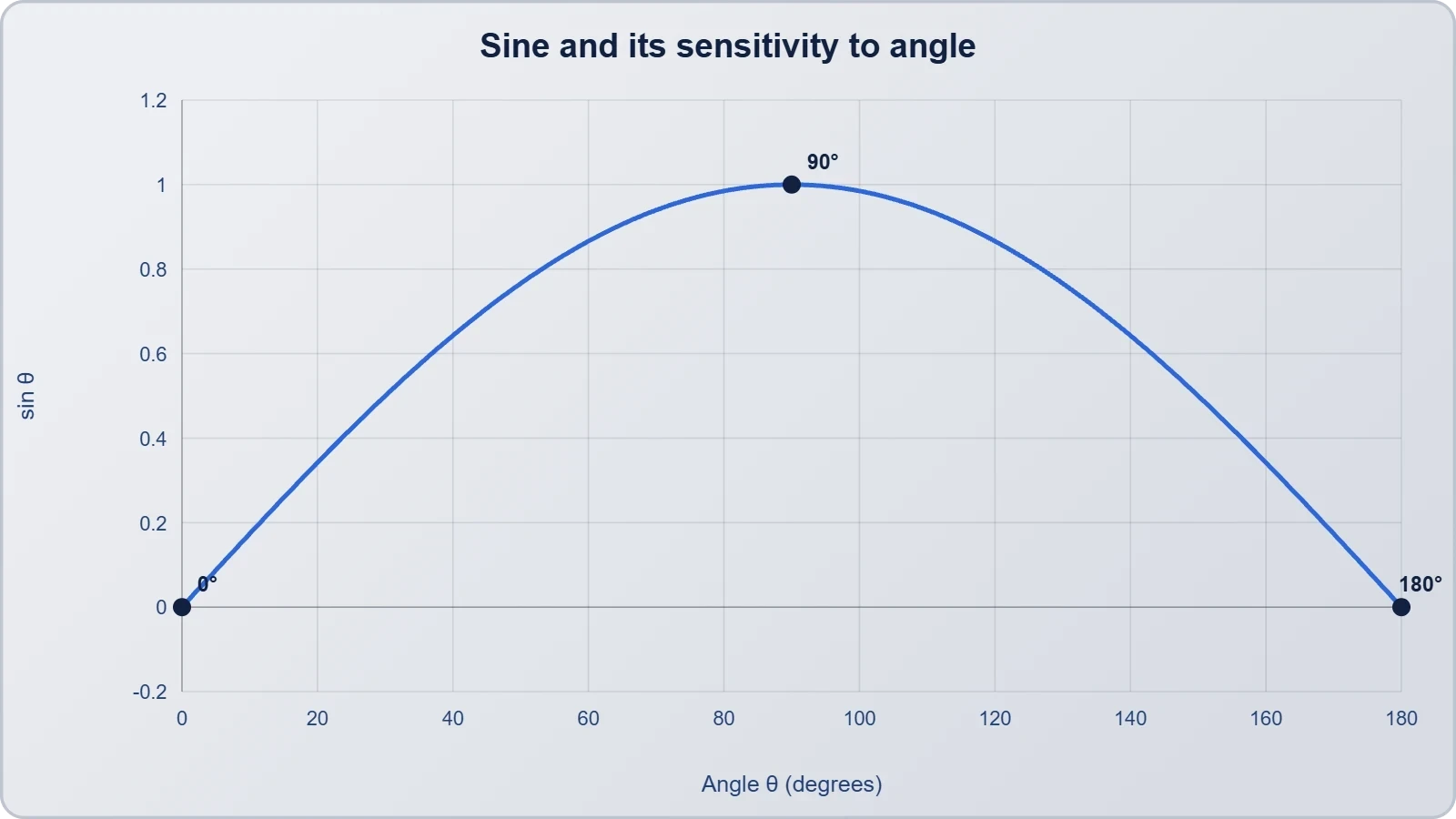
A practical rule of thumb is to compute the function, then estimate the uncertainty using the derivative: ##\delta(\sin\theta) \approx |\cos\theta|\,\delta\theta##, with ##\delta\theta## expressed in radians. This first-order propagation gives a defensible uncertainty estimate and prevents the naive assumption that significant figures transfer unchanged across the entire range.
Small-Angle Approximations and Their Limits
For small angles measured in radians, ##\sin\theta \approx \theta## and ##\tan\theta \approx \theta##. These approximations are exact to first order and are used constantly in optics, pendulum theory and wave physics. Their validity depends on the size of ##\theta## relative to the precision required: at ##\theta = 0.10\ \text{rad}##, the error in the approximation is about ##0.17\%##, which is acceptable for three-figure work.
The significant-figure implications are important. If an angle is known to three significant figures and is small, the small-angle approximation preserves those three figures in the result. If the angle is large, the approximation fails entirely and the full trigonometric function must be evaluated. Recognising when the approximation is legitimate is part of the same precision discipline this lesson develops.
Practice, Pitfalls and the Discipline of Honest Reporting
The rules in this lesson are easy to state and easy to violate under examination pressure. What follows is a set of practice problems drawn from the chemistry and physics contexts already discussed, together with the errors that most frequently appear in student answers. Working through them deliberately is the surest way to internalise the conventions.
Worked Practice Problems
Problem 1. A solution has ##[\text{H}^+] = 6.3 \times 10^{-5}\ \text{mol L}^{-1}##. Report the pH to the correct number of significant figures. The concentration carries two significant figures, so the pH must carry two digits in its mantissa: ##\text{pH} = -\log_{10}(6.3 \times 10^{-5}) = 4.20##. The characteristic four is not counted.
Problem 2. The sound intensity level of a source is measured as ##72.0\ \text{dB}##. What is the intensity ratio ##I/I_0##, and to how many significant figures should it be reported? The mantissa of the decibel value carries three significant figures, so the antilogarithm carries three: ##I/I_0 = 10^{7.20} = 1.58 \times 10^{7}##.
Problem 3. Evaluate ##\log_{10}(2.745 \times 10^{3})## and report the result correctly. The argument has four significant figures, so the mantissa must have four digits. The logarithm is ##3.4385##, and the characteristic three is not counted. Note that the rounding of the argument itself follows the even-digit convention.
Problem 4. A pendulum of length ##1.000\ \text{m}## (four significant figures) has a measured period of ##2.01\ \text{s}## (three significant figures). Compute ##g## and report it correctly. Using ##g = 4\pi^2 L / T^2##, the exact factors ##4## and ##\pi^2## do not limit precision, so the result is governed by the period: ##g = 9.77\ \text{m s}^{-2}##, to three significant figures.
Common Mistakes and How to Avoid Them
The most frequent error is counting the characteristic of a logarithm as a significant figure. A pH of ##4.20## has two significant figures, not three, and a decibel level of ##72.0\ \text{dB}## has three, not four. Students who count the integer part systematically over-report precision by one digit, and examiners penalise this consistently.
A second error is rounding intermediate results too aggressively. Carrying one extra digit through a multi-step calculation and rounding only at the end prevents the cumulative drift that can shift the final digit. A third error is treating exact numbers as though they were measurements, which leads to spurious limits on precision that the data do not justify.
A fourth error is applying the multiplication rule to an addition problem, or vice versa. The decimal-place rule for addition and subtraction and the significant-figure rule for multiplication and division are not interchangeable, and the reference material's explicit warning on this point is worth memorising. A fifth error is over-reporting precision in intermediate steps and then rounding at the end, which gives a false impression of accuracy in the working.
The discipline this lesson teaches extends well beyond the examination hall. In research, engineering and clinical measurement, the honest reporting of precision is a matter of professional integrity: a result quoted to more digits than the instrument can support is not merely untidy, it is misleading. The conventions for exact numbers, logarithms and trigonometric functions exist to keep that honesty systematic.
The next lesson turns to dimensional analysis and similarity, where the focus shifts from the precision of individual measurements to the structural relationships between physical quantities. The habits developed here, particularly the refusal to over-report precision and the careful tracking of which quantities are exact, will carry directly into that material. Mastering the special cases now makes the dimensional reasoning to come considerably more secure.
From our network :
- AI-Powered 'Precision Diagnostic' Replaces Standard GRE Score ReportsDiscover the new GRE Precision Diagnostic. Learn how AI-powered behavioral analytics and time-to-solve tracking are replacing standard GRE score reports to empower students.
- Trump Political Strategy How Geopolitical Stunts Serve As Media Diversions
- 98% of Global MBA Programs Now Prefer GRE Over GMAT Focus EditionExplore why 98% of global MBA programs now prefer the GRE over GMAT Focus. Learn about the shorter GRE format, verbal logic importance, and strategic versatility for students.
- How to Print Cheaply: Cutting the Cost per PageA practical, measured guide to lowering what each printed page costs — duplex and draft modes, third-party ink, yield mathematics, and knowing when a new printer beats refills.
- Do You Need a New Router or Is Your Internet Plan the Problem?A practical comparison of the signs that point to router limits versus signs your broadband speed or provider is the bottleneck, so you can decide what to replace before spending money.
- Where to Put Your Wireless Router for Better CoverageA practical, physics-grounded guide to router placement: why the centre of the home beats the corner, how walls and metal sap signal, and how to run a simple survey that proves the improvement.
- EV 2.0: The Solid-State Battery Breakthrough and Global Factory ExpansionDiscover the impact of the Solid-State Battery Breakthrough on the EV market. Learn about CATL and BYD stock growth, global factory expansion in Europe, and the future of EV 2.0 technology.
- 10 Physics Numerical Problems with Solutions for IIT JEEPrepare for IIT JEE with 10 physics numerical problems, complete with detailed solutions and conceptual explanations. Ideal for mastering kinematics, thermodynamics, electromagnetism, and optics.
- Analyzing Trump Deportation Numbers Insights Into The 2026 Immigration Crackdown
RESOURCES
- Significant figures - Wikipediaen.wikipedia.orgSignificant figures, also referred to as significant digits, are specific digits within a number that is written in positional notation that carry both ...
- Significant Figures - UCalgary Chemistry Textbookchem-textbook.ucalgary.ca... significant figures, that is, to the exact number of people? People are ... Numbers that were the direct answer to a logarithmic calculation…
- Inaccurate Logarithm in Python - math - Stack Overflowstackoverflow.comMay 31, 2009 ... IEEE double floating point numbers have 52 bits of precision. Since 10^15 < 2^52 < 10^16, a double has between…
- Precision and representation issues — mpmath 1.3.0 documentationmpmath.orgThe logarithmic accuracy roughly equals the number of correct bits or digits in the result ... Sums and products of floating-point numbers are exact…
- “The Lost Art of Logarithms”: Chapter 1lostartoflogarithms.comI mentioned earlier that this ruler is precise to “three significant digits ... These numbers both have three significant digits, but they are vastly…
- Everything You Need To Know About Significant Figures For ...matrix.edu.auJul 28, 2020 ... ... number of significant figures of the least precise value used in the calculation. ... The number of significant figures…
- MATHEMATICS Grades Pre-Kindergarten to 12doe.mass.edu(Include two-digit x four-digit numbers and, three-digit x three-digit ... Significant figures (digits). A way of describing how precisely a number is ...
- Do you round off insignificant digits in the middle of a calculation?physics.stackexchange.comMay 5, 2013 ... Significant digits is a convention that only affects how you write numbers, not what the numbers actually are. So you…
- Scientific Calculator - Trig, Logarithms & Advanced Math - CalcTrailcalctrail.com4 days ago ... Auto shows up to ten significant digits; switch Format to Fix, Sci or Eng to set the digits. At whole…
- Basic Guidelines for Reporting Non-Clinical Data - NCBI - NIHncbi.nlm.nih.govOct 1, 2019 ... provide consistency in keeping all result values to the same number of significant digits. The concept of using negative log-transformed…
- C2 Mathematics: Logarithm Problems | PDF | Equations - Scribdscribd.comlog3 a + log3 b = 2. Give your answers as exact numbers. (6). 7. (a) ... To evaluate x in 3x = 5…
- Scientific notation and significant figures - Student Academic Successmonash.edurepresent the digits that convey how precise a measurement is. Consider measuring the height of a person. One might use a measuring tape to…
- Significant Figures Calculator and Counter (Sig Fig)sigfigscalculator.comOften, leading zeroes or trailing zeroes can be removed and the number remains just as accurate (004 means the same as 4, for example).…
- math — Mathematical functions — Python 3.15.2 documentationdocs.python.orgmath — Mathematical functions¶ ; signbit(x). Check if x is a negative number ; ulp(x). Value of the least significant bit of x ;…
- 1.3 The Language of Physics: Physical Quantities and Unitsopenstax.orgMar 26, 2020 ... ... number of significant digits in the least precise measured value. ... log-log plot (Figure 1.29 (b)). Log-log plots are…