The International System of Units, universally abbreviated as SI from the French Système International d'Unités, is the architectural backbone of every quantitative statement in physics. It is not merely a list of names to memorise; it is a carefully negotiated treaty among nations, laboratories, and scientific disciplines that guarantees a measurement taken in one country can be trusted in another. For the advanced Class 11 learner, understanding SI means understanding why a metre is a metre and how that certainty is preserved across decades of technological change.
This lesson examines the seven base units that anchor the entire system, together with the two supplementary units that describe plane and solid angles. It traces how each unit is defined through fixed numerical values of fundamental constants, a shift formalised in 2019 that replaced physical artefacts with constants of nature. Beyond definitions, the discussion explores practical realisation, the Kibble balance, the custodial role of the BIPM, and the everyday and scientific contexts where these units quietly govern accuracy.
Because the previous lesson established why measurement matters and how unit systems evolved, this lesson builds directly on that foundation. It prepares the ground for derived units and SI prefixes by showing that every complex unit ultimately rests on seven precisely defined pillars. Mastery here means being able to state a definition, explain its physical basis, and recognise where precision in that definition becomes decisive for advanced technology.
On This Page
- The Seven SI Base Quantities and Their Units
- The 2019 Redefinition: Constants Replace Artefacts
- Supplementary Units: Radian and Steradian
- Practical Realisation and the Role of the BIPM
- Common Mistakes and Advanced Dimensional Reasoning
- Everyday and Scientific Contexts for SI Units
- Consolidating the Seven Pillars
The Seven SI Base Quantities and Their Units
The SI rests on exactly seven base quantities, each with a single base unit and a unique symbol. These are length, mass, time, electric current, thermodynamic temperature, amount of substance, and luminous intensity. Every other unit in physics, from the newton to the farad, is constructed from these seven through multiplication and division, which is why they are called base units rather than fundamental units.
What distinguishes a base unit is not that it is somehow more real than a derived unit, but that the system chooses it as an independent reference. The choice is conventional yet deliberate: it minimises redundancy and keeps the number of independent definitions small. Recognising this convention helps students see SI as a designed logical structure rather than a natural law.
Length, Mass, and Time: The Mechanical Foundation
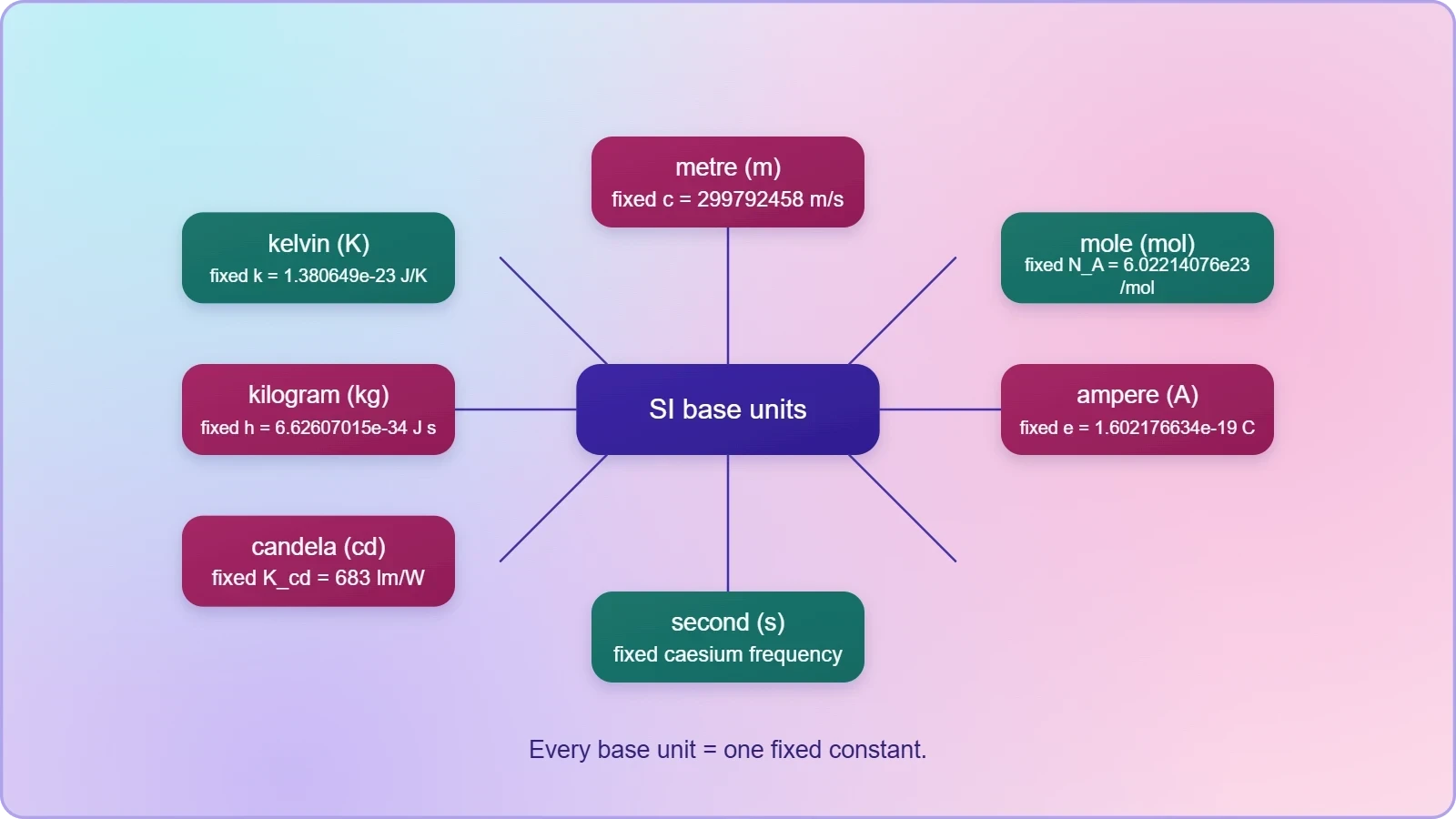
The metre is defined by fixing the speed of light in vacuum at exactly 299792458 metres per second. The second, in turn, is defined by the caesium-133 hyperfine transition frequency, fixed at 9192631770 hertz. Together these two definitions make the metre a derived consequence of a constant of nature and an atomic clock frequency, eliminating the old platinum-iridium bar entirely.
The kilogram, historically the last artefact-based unit, is now defined by fixing the Planck constant at 6.62607015×10⁻³⁴ joule-seconds. Because the joule-second reduces to kg m² s⁻¹, and the metre and second are already defined, the kilogram follows uniquely. This definition ties mass to quantum mechanics rather than to a lump of metal stored near Paris.
Current, Temperature, Amount, and Luminous Intensity
The ampere is defined by fixing the elementary charge at 1.602176634×10⁻¹⁹ coulomb, where the coulomb equals one ampere-second. The kelvin is defined by fixing the Boltzmann constant at 1.380649×10⁻²³ joule per kelvin. Both definitions convert a previously operational standard into a statement about a fundamental constant, making the units reproducible anywhere in the universe.
The mole is defined by fixing the Avogadro constant at 6.02214076×10²³ per mole, so one mole contains exactly that many elementary entities. The candela is defined by fixing the luminous efficacy of monochromatic radiation at 540×10¹² hertz to 683 lumens per watt. Luminous intensity thus connects radiometry to human vision through a precisely agreed physiological weighting.
We Also Published
The 2019 Redefinition: Constants Replace Artefacts
On 20 May 2019, the General Conference on Weights and Measures enacted the most sweeping revision of SI since its creation. Four base units, the kilogram, ampere, kelvin, and mole, were redefined in terms of fixed numerical values of the Planck constant, elementary charge, Boltzmann constant, and Avogadro constant respectively. The metre, second, and candela had already been constant-based, so the revision completed a decades-long transition.
The motivation was reproducibility. Artefacts such as the international prototype kilogram can drift, be damaged, or be inaccessible, whereas a constant of nature is identical everywhere and forever. By anchoring units to constants, any sufficiently equipped laboratory can realise the unit independently, without shipping a physical standard across borders. This is a profound shift from material standards to quantum standards.
Why the Kilogram Was the Hardest Case
The kilogram was the last base unit tied to a manufactured object, a platinum-iridium cylinder kept at Sèvres. Comparisons over a century revealed tiny drifts between the prototype and its official copies, on the order of tens of micrograms. Such drift is negligible for commerce but unacceptable for precision physics, so a constant-based definition became essential.
The chosen route fixes the Planck constant, which links energy to frequency through ##E = h\nu##. Because energy and frequency are measurable with extraordinary accuracy, inverting the relation yields mass. The practical instrument for this inversion is the Kibble balance, which balances gravitational force against electromagnetic force and thereby measures mass in terms of electrical quantities traceable to h.
Realising the New Definitions in Practice
Practical realisation means the concrete procedure a national laboratory follows to produce a unit of stated uncertainty. For the kilogram, the Kibble balance measures the current and voltage needed to counterbalance a test mass, and the product of these electrical quantities, calibrated against quantum standards, yields the mass. The result is traceable directly to h.
For the ampere, single-electron pumps and quantum Hall resistance standards allow current to be realised from e. For the kelvin, acoustic gas thermometry and Johnson noise thermometry link temperature to k. For the mole, the definition simply counts entities, so the Avogadro constant becomes an exact bridge between microscopic count and macroscopic amount.
Supplementary Units: Radian and Steradian
Beyond the seven base units, SI recognises two units for angles: the radian for plane angle and the steradian for solid angle. The radian is defined as the ratio of arc length to radius, ##\theta = s/r##, while the steradian is the ratio of intercepted spherical area to the square of the radius, ##\Omega = A/r^2##. Both are pure ratios of lengths, so both are dimensionless.
Because they are dimensionless, radian and steradian are technically derived units rather than base units, even though they are often listed separately as supplementary units. Their dimensionless character means angular quantities can appear or disappear in dimensional analysis without contradiction, a subtlety that trips many students. Recognising this prevents errors when checking equations involving rotation or radiation.
Why Angles Are Dimensionless
An angle measures a ratio of two lengths, so its dimensions cancel completely. This is why angular velocity has dimensions of inverse time, ##\omega = \theta/t##, with no length dimension attached. Similarly, solid angle carries no dimensions, so radiant intensity and related quantities inherit dimensions only from the physical quantities involved, not from the angle itself.
This dimensionless nature is not a mathematical quirk but a practical convenience. It allows trigonometric functions to accept pure numbers, permits the small-angle approximation ##\sin\theta \approx \theta##, and lets rotational formulas share structure with linear ones. Students who treat angles as dimensional often misapply dimensional analysis to rotational mechanics.
Applications in Science and Engineering
The radian underpins all of calculus involving trigonometric functions, since derivatives such as ##\dfrac{d}{dx}\sin x = \cos x## hold only when x is in radians. The steradian quantifies solid angle in radiometry, antenna theory, and astrophysics, where it describes how much of the sky a detector or beam covers. Both units are indispensable in fields from optics to satellite communication.
In everyday contexts, angles are often quoted in degrees, but scientific computation almost always converts to radians. A telescope's field of view, a laser beam's divergence, and a loudspeaker's radiation pattern are all naturally expressed in steradians. The supplementary units thus bridge intuitive geometry and rigorous physical measurement.
Practical Realisation and the Role of the BIPM
Definitions on paper are only useful if laboratories can turn them into physical measurements. Practical realisation is the documented procedure by which a national metrology institute produces a unit with a stated uncertainty. The International Bureau of Weights and Measures, or BIPM, coordinates this global effort, maintains the SI brochure, and organises international comparisons so that laboratories worldwide agree.
The BIPM, established by the Metre Convention of 1875 and based near Paris, does not itself define units by decree; it facilitates consensus among member states. National institutes such as NIST in the United States or NPL in the United Kingdom realise the units locally and participate in key comparisons. This distributed network ensures that a kilogram measured in one nation matches a kilogram measured in another.
From Kibble Balance to Atomic Clocks
The Kibble balance realises the kilogram by comparing mechanical and electrical power. In one phase, a coil moves through a magnetic field, generating a voltage proportional to velocity; in another, a current through the same coil produces a force balancing the test mass. Combining the two phases eliminates the magnetic field geometry, yielding mass in terms of h.
Atomic clocks realise the second by locking an oscillator to the caesium hyperfine transition. Modern optical clocks, using strontium or ytterbium, achieve fractional uncertainties near 10⁻¹⁸, far surpassing caesium. These advances push the frontier of timekeeping and, because the metre depends on the second, they also refine length measurement.
Precision as an Engine of Technology
Precision in unit definition is not an academic luxury; it directly enables technology. Satellite navigation depends on atomic-clock timing, since a nanosecond error corresponds to roughly thirty centimetres of position error. Semiconductor manufacturing relies on nanometre-level length metrology, and electrical power grids depend on accurate current and voltage standards.
Medical imaging, particle physics, and telecommunications all inherit their accuracy from the SI chain. When the kilogram was redefined, the change was imperceptible in daily trade but vital for quantum-based electrical metrology. Precision at the base propagates upward, making advanced technology possible and keeping international commerce fair.
Common Mistakes and Advanced Dimensional Reasoning
Students frequently confuse base units with derived units, assuming the newton or joule is somehow less fundamental. In truth, derived units are equally valid; they simply express combinations of the seven base units. Another common error is treating the radian and steradian as dimensional, which leads to incorrect dimensional checks in rotational and radiometric problems.
A subtler mistake is memorising the numerical values of constants without understanding their role. The numbers are exact by definition, but the physics lies in why those constants were chosen. Advanced learners should be able to explain, for example, why fixing h defines mass rather than energy, and why the mole's definition counts entities rather than weighing them.
Worked Example: Checking a Definition
Suppose a student claims the kilogram can be defined by fixing the Avogadro constant alone. Dimensional reasoning refutes this: NA has units of inverse mole, which involves amount of substance, not mass. The kilogram requires a constant carrying mass dimensions, which is why h, with units of kg m² s⁻¹, is the correct anchor.
Consider verifying the ampere definition dimensionally. The elementary charge has units of coulomb, and one coulomb equals one ampere-second, so ##e = I \cdot t##. Fixing e in coulombs therefore fixes the ampere once the second is defined. This chain of dependencies illustrates how the seven units interlock logically.
Dimensional Analysis with Base Units
Dimensional analysis expresses any physical quantity as a product of base dimensions raised to powers. For instance, force has dimensions ##[M L T^{-2}]##, and energy has ##[M L^2 T^{-2}]##. Checking that both sides of an equation share dimensions is a powerful way to catch algebraic errors before numerical substitution.
Advanced problems often require constructing a quantity from given variables. If a period depends on length and gravitational acceleration, dimensional reasoning suggests ##T \propto \sqrt{L/g}##, since only this combination yields time. Such reasoning does not give the constant of proportionality but narrows the form decisively.
Everyday and Scientific Contexts for SI Units
SI units permeate daily life in ways most people never notice. A litre of fuel, a kilogram of rice, a five-kilometre run, and a twenty-ampere household circuit all rest on the seven base units. Weather forecasts report temperature in kelvin for science and Celsius for the public, but both trace to the same Boltzmann-based definition. Commerce, health, and transport depend on these units being identical everywhere.
In scientific research, the stakes are higher. Particle accelerators measure energies in electron-volts traceable to the joule, which itself reduces to base units. Astronomical distances use the metre scaled by prefixes, while chemical laboratories count particles through the mole. Each discipline leans on the same seven pillars, which is precisely why SI became universal.
From Laboratory to Industry
Semiconductor fabrication demands length control at the nanometre and electrical control at the level of single charges. Pharmaceutical dosing relies on the mole and the kilogram to guarantee that a milligram means the same in every country. Aviation depends on precise time and pressure standards, and power generation depends on accurate current and temperature measurement.
These industrial applications justify the enormous effort invested in metrology. A tiny uncertainty in a base unit can propagate into measurable error in a manufactured product or a clinical dose. The 2019 redefinition, though invisible in daily life, strengthens the reliability of every one of these chains.
Preparing for Derived Units and Prefixes
With the seven base units established, the next lesson naturally extends them into derived units such as the newton, pascal, and volt. Those units are simply products and quotients of the base units, and their definitions inherit the precision of the constants discussed here. SI prefixes then allow convenient scaling from the femtometre to the terametre.
Understanding base units deeply makes derived units intuitive rather than arbitrary. A student who knows that the volt reduces to kg m² s⁻³ A⁻¹ can reason about electrical quantities from first principles. This is the payoff of the present lesson: a foundation on which all subsequent measurement physics is built.
Consolidating the Seven Pillars
The seven SI base units form a coherent, constant-anchored system that replaced fragile artefacts with reproducible physics. Each definition fixes a numerical value of a fundamental constant, allowing any equipped laboratory to realise the unit independently. The radian and steradian complete the picture as dimensionless supplementary units describing angle.
For the advanced Class 11 student, the essential skill is not memorising constants but understanding the logic of the system. Knowing why h defines mass, why e defines current, and why angles carry no dimensions prepares the way for derived units, prefixes, and the error analysis that follows in later lessons.
From our network :
- EV 2.0: The Solid-State Battery Breakthrough and Global Factory ExpansionDiscover the impact of the Solid-State Battery Breakthrough on the EV market. Learn about CATL and BYD stock growth, global factory expansion in Europe, and the future of EV 2.0 technology.
- Trump Political Strategy How Geopolitical Stunts Serve As Media Diversions
- 98% of Global MBA Programs Now Prefer GRE Over GMAT Focus EditionExplore why 98% of global MBA programs now prefer the GRE over GMAT Focus. Learn about the shorter GRE format, verbal logic importance, and strategic versatility for students.
- Do You Need a New Router or Is Your Internet Plan the Problem?A practical comparison of the signs that point to router limits versus signs your broadband speed or provider is the bottleneck, so you can decide what to replace before spending money.
- How to Print Cheaply: Cutting the Cost per PageA practical, measured guide to lowering what each printed page costs — duplex and draft modes, third-party ink, yield mathematics, and knowing when a new printer beats refills.
- Analyzing Trump Deportation Numbers Insights Into The 2026 Immigration Crackdown
- Where to Put Your Wireless Router for Better CoverageA practical, physics-grounded guide to router placement: why the centre of the home beats the corner, how walls and metal sap signal, and how to run a simple survey that proves the improvement.
- AI-Powered 'Precision Diagnostic' Replaces Standard GRE Score ReportsDiscover the new GRE Precision Diagnostic. Learn how AI-powered behavioral analytics and time-to-solve tracking are replacing standard GRE score reports to empower students.
- 10 Physics Numerical Problems with Solutions for IIT JEEPrepare for IIT JEE with 10 physics numerical problems, complete with detailed solutions and conceptual explanations. Ideal for mastering kinematics, thermodynamics, electromagnetism, and optics.
RESOURCES
- 2019 revision of the SI - Wikipediaen.wikipedia.orgIn 2019, four of the seven SI base units specified in the International System of Quantities were redefined in terms of natural physical constants, ...
- SI Redefinition | NISTnist.govThe SI — the modern metric system — has seven base units from which all other measurement units can be derived. On May 20,…
- The redefinition of the SI units - NPL - National Physical Laboratorynpl.co.ukFrom 20 May 2019 four of the base units acquired new definitions: the kilogram, ampere, kelvin and mole. The definitions of the other three…
- Kilogram: The Future - NISTnist.govMay 14, 2018 ... ... kilogram — along with three other SI units — was redefined in November 2018. Starting on May 20, 2019,…
- the science community has voted! All of the SI units will be defined ...reddit.comNov 16, 2018 ... kilogram is a base unit but fails to be prefix-less ... 2019 redefinition of SI base units: As of May…
- What technology is needed for an individual to reproduce the current ...physics.stackexchange.comMar 31, 2022 ... With the 2019 redefinition of the SI base units, I wonder what kind of technology is needed to reproduce the…
- 2019 redefinition of SI base units: As of May 20, 2019, the kilogram ...reddit.comMay 21, 2019 ... The kilogram is the last SI unit to be changed from an artefact-definition to one based on physical phenomena. So,…
- Physical kilogram is officially dead - Naturenature.comMay 20, 2019 ... 20 May 2019. Physical kilogram is officially dead. Definitions of four basic scientific units, including the kilogram and the kelvin,…
- How to Define the Units of the Revised SI Starting from Seven ...pmc.ncbi.nlm.nih.govAs part of a revision to the International System of Units (SI) approved in 2018 and to take effect in May 2019, the seven…
- Redefinition of the Mole in the Revised International System of Units ...pubs.acs.orgAug 31, 2021 ... Prior to 2019, three SI base units were defined in terms of fundamental ... kilogram and of any other SI…
- The kilogram - EURAMETeuramet.orgUNIT OF THE MONTH May 2019: Kilogram. 20 May 2019 - Today, new definitions of the SI base measurement units come into force. So,…
- The SI - BIPMbipm.orgThe seven SI base units ; s. second time ; m. metre length ; kg. kilogram mass ; A. ampere electric current ; K…
- The revision of the SI—the result of three decades of ... - IOP Scienceiopscience.iop.orgJun 28, 2019 ... Although several base units had been redefined since the inception of the SI, ... redefinition of the kilogram was that…
- SI Brochure - 9th ed./version 4.01 EN - BIPMbipm.organy of the 29 SI units with special names with the exception of the base unit kilogram, which ... redefinition of one or more…