Angles are among the most quietly consequential quantities in all of physics, yet they are also among the most misunderstood. Every time an astronomer reports the angular diameter of a distant galaxy, an optician specifies the beam spread of a laser, or a lighting engineer calculates how much luminous flux lands on a desk, the underlying mathematics rests on two deceptively simple geometric ratios: the plane angle and the solid angle. These ratios convert raw lengths and areas into pure numbers, and that purity is precisely what makes them so powerful across every branch of measurement science.
This lesson examines how plane angles and solid angles are defined, why the radian and the steradian behave unlike every other SI unit, and how their dimensionless character allows them to slip silently through dimensional equations without leaving a trace. Building on the dimensional reasoning developed in the previous lesson, we will derive the solid angle formula, compute the total solid angle of a sphere, and trace these ideas into radiometry, photometry, and observational astronomy. The treatment is rigorous but grounded in worked examples and practical cautionary notes.
By the end, you should be able to move fluently between arc lengths, radii, intercepted areas, and steradian measures, and to recognise when an angle is being used as a genuine physical quantity rather than a mere bookkeeping device. That distinction matters enormously in advanced problem solving, where a misplaced radian can corrupt an entire calculation.
On This Page
- Defining the Plane Angle Through the Radian
- Constructing the Solid Angle and the Steradian
- Worked Calculations with Solid Angles
- Solid Angles in Radiometry and Photometry
- Common Errors and Dimensional Pitfalls
- Angles as Bridges to Advanced Physics
- Precision, Significant Figures, and Angular Reporting
- Consolidating the Angular Framework
Defining the Plane Angle Through the Radian
The plane angle measures the opening between two rays meeting at a common vertex, and the SI quantifies it through the radian. Imagine a circle of radius ##r## centred at the vertex, with the two rays cutting an arc of length ##s## from that circle. The angle subtended at the centre is defined as the ratio of arc length to radius, a construction that anchors the entire system of angular measurement.
The Geometric Definition and Its Consequences
The defining relation is elegantly compact: the plane angle ##\theta## equals the arc length divided by the radius, written as ##\theta = s/r##. Because both quantities are lengths, their ratio is a pure number, and the radian carries no physical dimension whatsoever. One radian corresponds to an arc whose length exactly equals the radius, a geometric condition that occurs at roughly 57.3 degrees.
This definition immediately yields the familiar circumference result. A complete revolution traces an arc equal to the circumference ##2\pi r##, so the full angle equals ##2\pi r / r = 2\pi## radians. Half a revolution gives ##\pi## radians, a quarter gives ##\pi/2##, and the conversion to degrees follows from setting ##2\pi## rad equal to 360°, giving the exact factor ##180/\pi \approx 57.2958## degrees per radian.
A subtle but vital point deserves emphasis: the radian is not a length, a time, or any other base quantity. It is a ratio of two lengths, and ratios of like quantities are dimensionless by construction. This is why angular velocity ##\omega## has SI units of ##\text{s}^{-1}## rather than ##\text{rad s}^{-1}## in strict dimensional terms, and why the radian can appear or vanish in equations without violating dimensional homogeneity.
Why Dimensionlessness Is Not Trivial
Students often treat the radian as a unit that can be casually inserted or deleted, and in practice this flexibility is legitimate precisely because the radian is dimensionless. However, the numerical value still matters enormously. The small-angle approximation ##\sin\theta \approx \theta## holds only when ##\theta## is expressed in radians, not degrees, because the Taylor expansion ##\sin\theta = \theta - \theta^3/6 + \cdots## assumes the radian measure.
Consider a pendulum of length ##L## swinging through a small angle. The arc displacement is ##s = L\theta##, and the restoring force component involves ##\sin\theta \approx \theta##. If you mistakenly insert a degree value, the resulting period formula collapses by a factor of roughly 57, a catastrophic error that dimensional analysis alone cannot catch because the angle is dimensionless either way.
Constructing the Solid Angle and the Steradian
Where the plane angle measures an opening in two dimensions, the solid angle measures the opening of a cone or pyramid in three dimensions. The construction mirrors the planar case but replaces arc length with intercepted area. Picture a sphere of radius ##r## centred at the apex of a cone; the cone's surface carves out a patch of area ##A## on the sphere, and the solid angle is the ratio of that area to the square of the radius.
The Formula and the Steradian Unit
The solid angle ##\Omega## is defined as ##\Omega = A/r^2##, where ##A## is the area intercepted on the spherical surface and ##r## is the sphere's radius. The SI unit is the steradian, symbol sr, and just as the radian is a ratio of lengths, the steradian is a ratio of an area to a squared length, making it equally dimensionless.
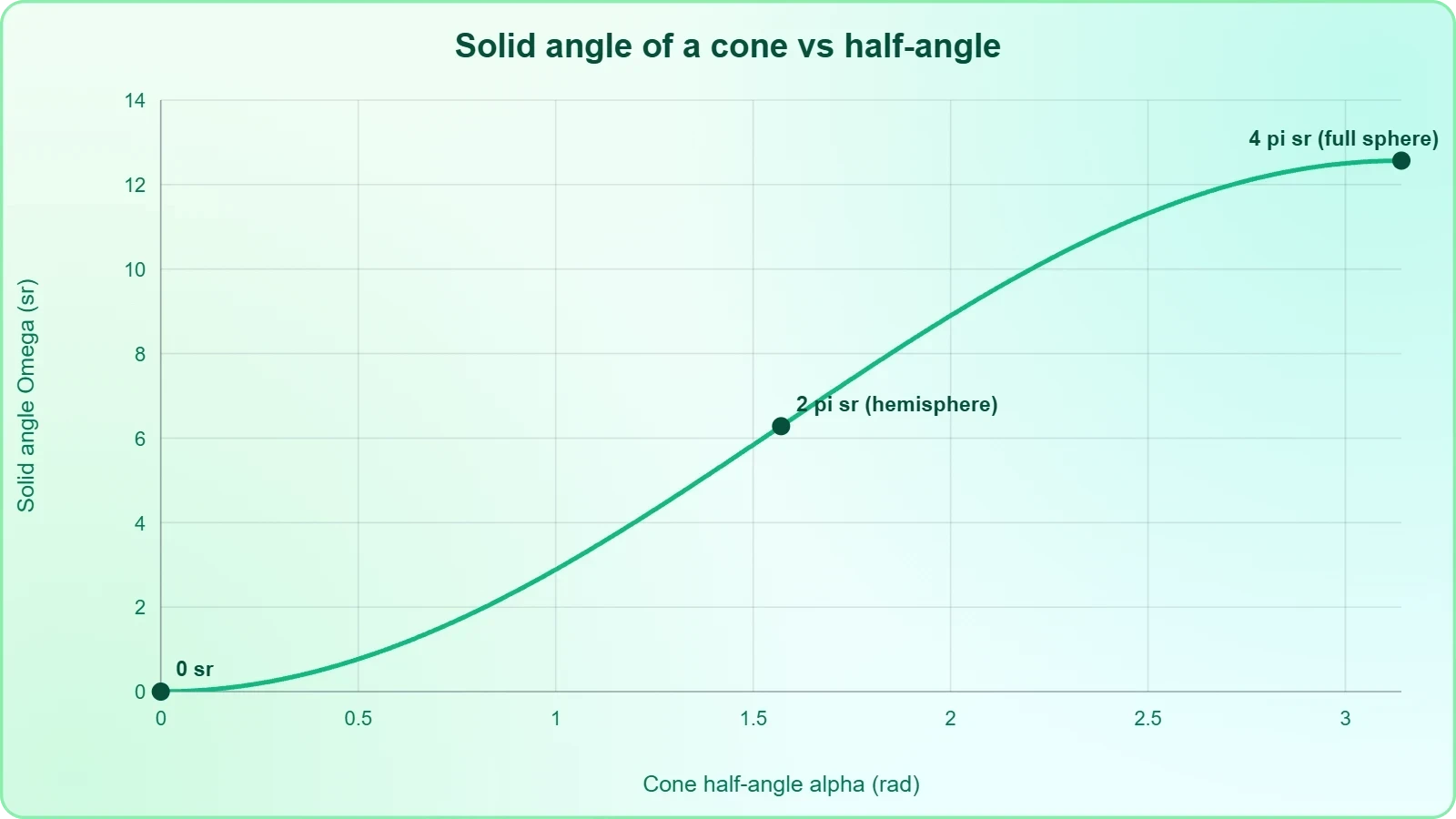
One steradian corresponds to an intercepted area equal to ##r^2##, the area of a square whose side equals the sphere's radius. Because the sphere's total surface area is ##4\pi r^2##, the entire sphere subtends a solid angle of ##4\pi## steradians at its centre, approximately 12.566 sr. This total is a fixed geometric constant, independent of the sphere's size.
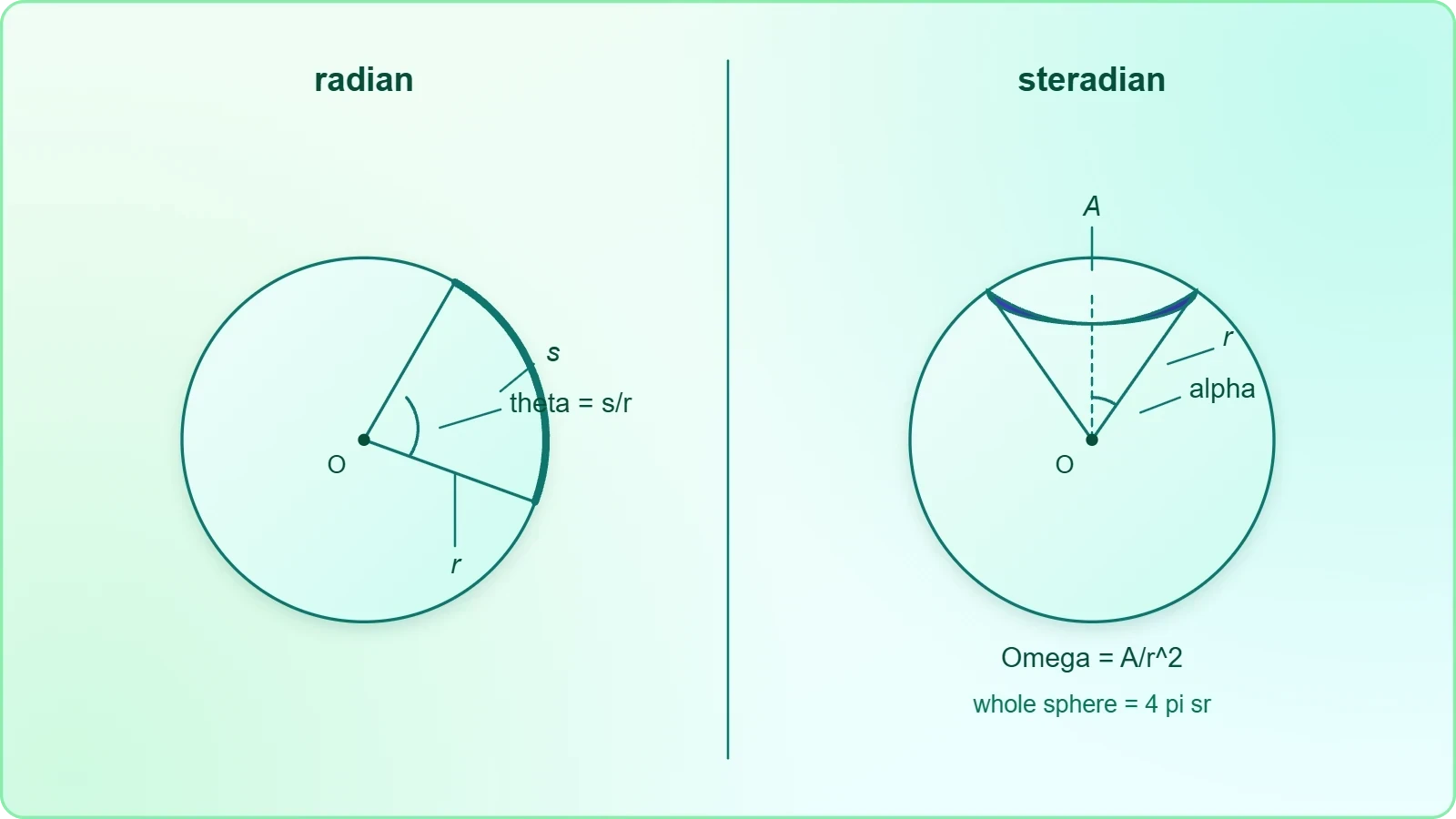
For a cone of half-angle ##\alpha##, the intercepted spherical cap has area ##2\pi r^2(1 - \cos\alpha)##, so the solid angle is ##\Omega = 2\pi(1 - \cos\alpha)## steradians. This formula proves indispensable in antenna theory, where the beam solid angle of a directional antenna determines its gain, and in radiometry, where it governs how much power a detector receives from an extended source.
Supplementary Units and Their Status in SI
The radian and steradian occupy a peculiar position in the International System. Historically classified as "supplementary units," they were reclassified in 1995 as dimensionless derived units, formally expressed as the ratio of identical quantities. This means the radian equals one metre per metre and the steradian equals one square metre per square metre, both reducing to the pure number one.
This status explains why angles can be multiplied into equations without disturbing dimensional balance, and why the SI brochure treats them as special names for the number one. It also explains a common examination trap: a quantity like angular momentum has dimensions ##[\text{M L}^2 \text{T}^{-1}]##, identical to linear momentum times length, because the radian contributes nothing dimensionally.
Worked Calculations with Solid Angles
Numerical fluency with solid angles separates students who merely recognise the formula from those who can deploy it. The calculations below progress from the trivial to the astronomically relevant, and each illustrates a different facet of the ##\Omega = A/r^2## relationship. Pay attention to how the radius cancels in every case, a direct consequence of the ratio's dimensionless nature.
Sphere, Hemisphere, and Octant
The full sphere subtends ##4\pi## sr at its centre, as established. A hemisphere, being half the surface, subtends ##2\pi## sr. An octant, one-eighth of the sphere, subtends ##\pi/2## sr. These results follow immediately from proportional surface areas and require no integration, which is the practical beauty of the steradian definition.
Now consider a detector of area ##1\ \text{cm}^2## placed ##2\ \text{m}## from a small source. The solid angle it subtends at the source is ##\Omega = (10^{-4}\ \text{m}^2)/(2\ \text{m})^2 = 2.5\times10^{-5}## sr. This tiny value explains why distant sources deliver so little power to a detector, a fact central to photometry and radiation dosimetry.
Angular Size of the Moon and Astronomical Applications
The Moon has a physical radius of about ##1.737\times10^6## m and sits roughly ##3.84\times10^8## m from Earth. Its angular radius is therefore ##\theta \approx 1.737\times10^6 / 3.84\times10^8 \approx 4.52\times10^{-3}## rad, or about 0.259°, giving an angular diameter near 0.52°, close to the Sun's and the reason total solar eclipses are possible.
Its solid angle follows from the small-angle cap formula ##\Omega \approx \pi\theta^2##, yielding approximately ##6.4\times10^{-5}## sr. The Sun, despite being 400 times wider, sits 400 times farther, so it subtends almost the same solid angle. Astronomers routinely use such measures to compute the fraction of sky occupied by a survey or the flux collected by a telescope.
We Also Published
Solid Angles in Radiometry and Photometry
Radiometry quantifies electromagnetic radiation in absolute physical terms, while photometry weights that radiation by the human eye's sensitivity. Both disciplines lean heavily on the steradian because they must describe how much power flows from a source into a given direction, and direction in three dimensions is precisely what solid angle captures. Without it, quantities like radiance and luminance would be undefined.
Radiance, Irradiance, and the Steradian
Radiance ##L## is power per unit area per unit solid angle, with SI units of ##\text{W m}^{-2}\text{ sr}^{-1}##. Irradiance ##E## is power per unit area, in ##\text{W m}^{-2}##. The bridge between them involves integrating radiance over the solid angle subtended by the source, a procedure that appears throughout optics, remote sensing, and thermal engineering.
For a Lambertian surface, radiance is independent of viewing direction, and the total exitance relates to radiance by ##M = \pi L##, where the factor ##\pi## arises from integrating ##\cos\theta## over the hemisphere of solid angle ##2\pi## sr. This is a classic result that confuses beginners precisely because the ##\pi## comes from angular integration, not from a circle's geometry.
Luminous Intensity and the Candela
The candela, one of the seven SI base units, is defined as luminous intensity in a given direction, with units of candela equal to lumens per steradian. A source emitting one lumen uniformly into one steradian has an intensity of one candela. This definition ties the steradian directly to a base unit, a rare and instructive coupling.
Practical lighting design depends on this relationship. A spotlight rated at 1000 cd delivers 1000 lm into each steradian of its beam; if the beam spans 0.1 sr, the total flux is 100 lm. Engineers use such calculations to specify luminaires, verify illuminance on work surfaces, and comply with workplace lighting standards.
Common Errors and Dimensional Pitfalls
Because angles are dimensionless, errors involving them rarely announce themselves through dimensional mismatch. A student who writes ##\omega = 2\pi f## in degrees per second will produce a numerically wrong answer that still carries the correct dimensions, making the mistake invisible to routine checks. Vigilance must therefore come from habit and from explicit unit tracking.
Mixing Degrees and Radians
The most frequent error is substituting degree values into formulas derived for radians. The small-angle approximation, the arc length relation ##s = r\theta##, and the pendulum period all assume radian measure. A useful safeguard is to convert every angle to radians at the start of a calculation and to state the conversion explicitly in your working.
A second trap involves calculator modes. Trigonometric functions return different values depending on whether the device is set to degrees or radians, and silent mode errors have derailed countless examinations. Always verify the mode before entering a computation, and sanity-check results against known values such as ##\sin 30^\circ = 0.5##.
Misapplying the Steradian
Solid angle errors often stem from confusing area with projected area. The ##\Omega = A/r^2## formula assumes the area is perpendicular to the radius vector; for tilted surfaces, a cosine factor must be included. Ignoring this leads to overestimates of collected flux and is a classic mistake in radiometry and antenna design.
Another pitfall is treating the steradian as if it had dimensions. Some students attempt to cancel it against a length or area, producing nonsensical units. The correct mental model is that the steradian is a pure number, a label reminding us that the quantity describes angular extent rather than linear or areal size.
Angles as Bridges to Advanced Physics
The dimensionless character of angular measures makes them unusually portable across physics. In rotational mechanics, angular displacement, velocity, and acceleration all carry the radian implicitly, and the moment of inertia relation ##\tau = I\alpha## works seamlessly because ##\alpha## contributes no dimensions. This portability is not a coincidence but a direct consequence of the ratio definition.
Rotational Mechanics and Wave Physics
Angular frequency ##\omega## in simple harmonic motion appears in ##x = A\cos(\omega t)##, where the argument ##\omega t## must be dimensionless. Since ##t## carries time, ##\omega## must carry inverse time, and the radian is understood to be present but dimensionally silent. This is why the unit of ##\omega## is written ##\text{rad s}^{-1}## for clarity but reduces to ##\text{s}^{-1}##.
In wave physics, the phase ##\phi = kx - \omega t## must likewise be dimensionless, forcing the wave number ##k## to carry inverse length. The radian threads through these expressions as a reminder that the argument represents an angle, yet it never disturbs the dimensional bookkeeping that the previous lesson established.
Astronomy, Antennas, and Beyond
Astronomers measure source sizes in steradians and square degrees, survey volumes in steradian-radians, and telescope throughput in étendue, which combines area and solid angle. Antenna engineers specify beam solid angle to compute gain via ##G = 4\pi/\Omega_{\text{beam}}##, a formula that directly links angular extent to signal strength.
Even particle physics uses solid angle: detector coverage is quoted as a fraction of ##4\pi## sr, and cross-sections are expressed per unit solid angle. The steradian thus functions as a universal currency for describing directional extent, from the microscopic to the cosmic, and mastery of it pays dividends across the entire physics curriculum.
Precision, Significant Figures, and Angular Reporting
Angular measurements inherit all the significant-figure discipline established earlier in this course. A theodolite reading of 30°15′ carries four significant figures, while a telescope's angular resolution quoted as 0.001″ implies far greater precision. Reporting an angle with more digits than the instrument supports is a common and avoidable error.
Propagating Uncertainty in Angular Calculations
When an angle is derived from length measurements, its relative uncertainty follows from the ratio definition. If ##\theta = s/r##, then the fractional uncertainty in ##\theta## is the sum in quadrature of the fractional uncertainties in ##s## and ##r##. This is a direct application of error propagation to a dimensionless ratio.
For solid angles, the situation is more sensitive because ##\Omega = A/r^2## involves the radius squared. A one percent uncertainty in ##r## produces roughly a two percent uncertainty in ##\Omega##, a doubling that students frequently overlook. Careful experimenters therefore measure the radius with particular care when solid angles are the target quantity.
Instrumental Resolution and Angular Limits
Every optical instrument has a diffraction-limited angular resolution given approximately by ##\theta_{\min} \approx 1.22\lambda/D##, where ##\lambda## is wavelength and ##D## is aperture diameter. This radian-valued limit sets the smallest solid angle an instrument can meaningfully resolve, and it explains why larger telescopes see finer detail.
Reporting an angular size smaller than this limit is physically meaningless, regardless of how many digits the software displays. Recognising such limits is part of scientific maturity, and it connects the abstract geometry of this lesson to the concrete realities of laboratory and observatory practice.
Consolidating the Angular Framework
The radian and steradian complete the SI's treatment of angular extent, and their dimensionless nature is not a quirk but a logical necessity. Both arise as ratios of like quantities, and both reduce to the pure number one. Understanding this frees you from the confusion that surrounds angular units and prepares you for the redefinition of the base units in the next lesson.
Key Takeaways and Self-Check
You should now be able to define the radian as ##s/r## and the steradian as ##A/r^2##, compute the solid angle of a sphere as ##4\pi## sr, and apply the small-angle cap formula to astronomical sources. You should also recognise the steradian's role in radiance, luminance, and antenna gain, and avoid the common errors catalogued above.
A useful self-check is to derive the solid angle of a hemisphere from first principles and confirm it equals ##2\pi## sr. If you can do this without consulting notes, and explain why the result is independent of the sphere's radius, you have internalised the core of this lesson and are ready for the metrological refinements that follow.
From our network :
- Where to Put Your Wireless Router for Better CoverageA practical, physics-grounded guide to router placement: why the centre of the home beats the corner, how walls and metal sap signal, and how to run a simple survey that proves the improvement.
- 98% of Global MBA Programs Now Prefer GRE Over GMAT Focus EditionExplore why 98% of global MBA programs now prefer the GRE over GMAT Focus. Learn about the shorter GRE format, verbal logic importance, and strategic versatility for students.
- Do You Need a New Router or Is Your Internet Plan the Problem?A practical comparison of the signs that point to router limits versus signs your broadband speed or provider is the bottleneck, so you can decide what to replace before spending money.
- 10 Physics Numerical Problems with Solutions for IIT JEEPrepare for IIT JEE with 10 physics numerical problems, complete with detailed solutions and conceptual explanations. Ideal for mastering kinematics, thermodynamics, electromagnetism, and optics.
- EV 2.0: The Solid-State Battery Breakthrough and Global Factory ExpansionDiscover the impact of the Solid-State Battery Breakthrough on the EV market. Learn about CATL and BYD stock growth, global factory expansion in Europe, and the future of EV 2.0 technology.
- AI-Powered 'Precision Diagnostic' Replaces Standard GRE Score ReportsDiscover the new GRE Precision Diagnostic. Learn how AI-powered behavioral analytics and time-to-solve tracking are replacing standard GRE score reports to empower students.
- Analyzing Trump Deportation Numbers Insights Into The 2026 Immigration Crackdown
- How to Print Cheaply: Cutting the Cost per PageA practical, measured guide to lowering what each printed page costs — duplex and draft modes, third-party ink, yield mathematics, and knowing when a new printer beats refills.
- Trump Political Strategy How Geopolitical Stunts Serve As Media Diversions
RESOURCES
- Why do we measure plane angle in radians and solid angle in ...physics.stackexchange.comJun 19, 2023 ... Moreover, there are 2π radians, and the circumference of the unit circle is 2π. Likewise for solid angle, the surface…
- Steradian - Wikipediaen.wikipedia.orgThe steradian (symbol: sr) or square radian is the unit of solid angle in the International System of Units (SI). It is used in…
- If I square a measure in radians, is the result measured in steradians?math.stackexchange.comJul 6, 2016 ... The radian measures an angle in the plane (2 dimensional space). The steradian measures a vertex in 3 dimensional space.
- Solid angle - Wikipediaen.wikipedia.orgIn geometry, a solid angle (symbol: Ω) is a measure of the amount of the field of view from some particular point that a…
- Why is it necessary for steradians to be measured with square ...math.stackexchange.comJan 3, 2025 ... A steradian is a unit of solid angle, and square degrees are a different a unit of solid angle. Just…
- On the status of plane and solid angles in the International ... - arXivarxiv.orgNov 8, 2018 ... ... angle – the radian, and a unit of solid angle – the steradian. In ... If a radian measure…
- SP 330 - Section 5 | NISTnist.govAug 27, 2019 ... ... solid angle is steradian, unit symbol sr. The plane angle, expressed in radian, between two lines originating from a…
- Is there a way of measuring angles in 3D? : r/askscience - Redditreddit.comMay 2, 2015 ... The radian the standard unit for angles. The steradian is the standard unit for solid angles.
- On the status of plane and solid angles in the International System of ...fisherp.mit.eduAug 8, 2020 ... Keywords: plane angle, solid angle, radian, steradian ... Therefore they have different units of measurement, the radian and the steradian,…
- ELI5: What is a solid angle? : r/explainlikeimfive - Redditreddit.comMar 2, 2017 ... Solid angles and steradians are the answer to I get that, if you want to measure the size of a…
- Angles in the SI - a practical dimensional metrologist viewpointiopscience.iop.orgJan 29, 2026 ... The SI units of plane angle (radian) and solid angle (steradian) have ... the angle is measured in radians), the…
- safe_2_12_solid_anglemath_research.uct.ac.za1: The definition of a solid angle. The plane angle is measured in radians (rad), while the solid angle is measured in steradians (sr).…
- MA 323A Combinatorial Geometry!origametry.netPlane angles are measured in either degrees of radians. But how do we measure solid angles? One way is to measure the solid angle's…
- Solid Angle - David Templin's Blogdavidtemplin.nameDec 23, 2024 ... ... angular measurement in radians expresses the length of the arc that subtends the angle. Thus, in units of radians,…
- Understanding Radiance (Brightness), Irradiance and Radiant Fluxenergetiq.com... radian [rad] describes angles in a two-dimensional plane. The total solid ... (left) Steradian [sr] is a unit for measuring solid angles (Ω)…