Menstruation is a biological rhythm that accompanies roughly half of the human population for several decades of life, yet it remains one of the most heavily mythologised processes in reproductive biology. The menstrual phase itself, lasting three to five days, results from the breakdown of the endometrial lining and its blood vessels, forming a liquid that exits through the vagina. This is a normal physiological event governed by the rise and fall of pituitary and ovarian hormones, not a sign of illness, impurity, or imbalance. Understanding hygiene and dismantling misconceptions therefore belongs alongside the hormonal mechanics of the cycle, because accurate knowledge protects health and reduces stigma.
This lesson builds directly on the phases and hormonal control of the menstrual cycle and prepares the ground for fertilisation, where the fate of the released ovum is decided. Here the focus shifts from endocrine choreography to practical management: how to maintain hygiene safely, why access to clean water and sanitation matters, and how cultural myths about menstrual blood and the hymen distort behaviour and harm wellbeing. Each misconception is examined against physiological evidence, and clinical risks such as toxic shock syndrome are placed in proper perspective. The aim is a coherent, accurate understanding that serves both examination performance and everyday life.
Learners preparing for senior secondary and early undergraduate assessments will find the material aligned with core syllabus content while extending into public health and clinical reasoning. The lesson deliberately avoids repeating the follicular, ovulatory, and luteal phases in detail, assuming that foundation is secure. Instead, it treats hygiene as a measurable health practice, myth-correction as applied biology, and the hymen as an anatomical structure frequently misrepresented. By the end, you should be able to explain menstrual hygiene management with confidence and correct common falsehoods using evidence rather than assertion.
On This Page
Menstrual Blood as a Normal Physiological Fluid
Menstrual fluid is a mixture of blood, endometrial tissue, mucus, and vaginal secretions, shed when the corpus luteum degenerates in the absence of fertilisation. Its composition is unremarkable in biological terms: it contains the same blood components found elsewhere in the body, along with tissue debris from the disintegrating endometrium. Nothing in this mixture is toxic, infectious by nature, or spiritually contaminating. The idea that menstrual blood is impure is a cultural construct with no physiological basis, and it has historically justified exclusion of menstruating people from kitchens, places of worship, and social life. Recognising the fluid as ordinary tissue breakdown is the first step toward rational hygiene practice.
The Composition and Purpose of Menstrual Flow
The endometrium thickens during the follicular phase under rising oestrogen and is maintained by progesterone from the corpus luteum during the luteal phase. When fertilisation does not occur, the corpus luteum degenerates, progesterone falls, and the endometrial lining disintegrates, releasing blood and tissue through the vagina over three to five days. This shedding is not the body expelling a "toxin" but the controlled renewal of a tissue bed prepared for implantation. The volume is typically modest, averaging around thirty to forty millilitres per cycle, though wide variation is normal. Understanding this purpose reframes menstruation as maintenance rather than contamination.

Because the flow is simply shed endometrium and blood, it carries no special hazard to others and requires no ritual purification beyond ordinary washing. The vagina is self-cleaning through its acidic secretions and commensal flora, so internal douching is unnecessary and can disrupt the protective microbiome. External hygiene, by contrast, is genuinely useful: washing the vulva with clean water removes surface residue and prevents odour and irritation. The distinction between internal self-regulation and external cleanliness is central to sound menstrual hygiene management and corrects the impulse to "clean inside" that many myths encourage.
Why the Impurity Myth Persists
Beliefs that menstruating people are ritually unclean appear across many cultures and often trace to pre-scientific associations between blood and harm. Once such beliefs take root, they acquire social force independent of evidence, shaping expectations about cooking, worship, and contact. Biology offers a direct rebuttal: menstrual fluid is sterile within the uterus and contains no substance capable of harming others through ordinary contact. Documenting this clearly matters because stigma delays care-seeking, discourages open discussion, and can push adolescents toward unsafe practices. Education that names the myth and replaces it with physiology is a public health intervention in its own right.
Teachers and health workers can reinforce the correction by using precise language: menstrual fluid, endometrial shedding, physiological process. Avoiding euphemisms reduces the sense of secrecy that sustains stigma. When learners can describe the hormonal cascade that produces menstruation, the notion of impurity loses its foothold, because the phenomenon is explained rather than mysterious. This lesson's placement after the hormonal phases is deliberate: the endocrine explanation is the strongest antidote to superstition, and it prepares students to discuss fertilisation without residual confusion about what the uterus is doing each month.
Practical Menstrual Hygiene Management
Hygiene during menstruation is straightforward but consequential. The reference guidance is clear: take a bath and clean yourself regularly, use sanitary napkins or clean homemade pads, and change them every four to five hours as required. Used napkins should be wrapped in paper and disposed of properly, never thrown into toilet drainpipes or left in open areas, and hands should be washed with soap after handling. These steps prevent odour, skin irritation, and infection while protecting sanitation systems. The underlying principle is simple: keep the external genital area clean, keep absorbent materials fresh, and dispose of waste responsibly.
Choosing and Changing Absorbent Products
Sanitary napkins, tampons, menstrual cups, and clean cloth pads all serve the same function: absorbing or collecting flow while keeping the vulva reasonably dry. Whatever the product, the key variables are cleanliness and timely change. Napkins and cloth pads should be changed every four to five hours or sooner if saturated, because prolonged moisture macerates skin and encourages bacterial overgrowth. Cloth pads must be washed thoroughly with soap and dried in sunlight before reuse. Tampons require particular attention to change frequency, a point developed below in the discussion of toxic shock syndrome. Product choice is personal; hygiene discipline is not optional.
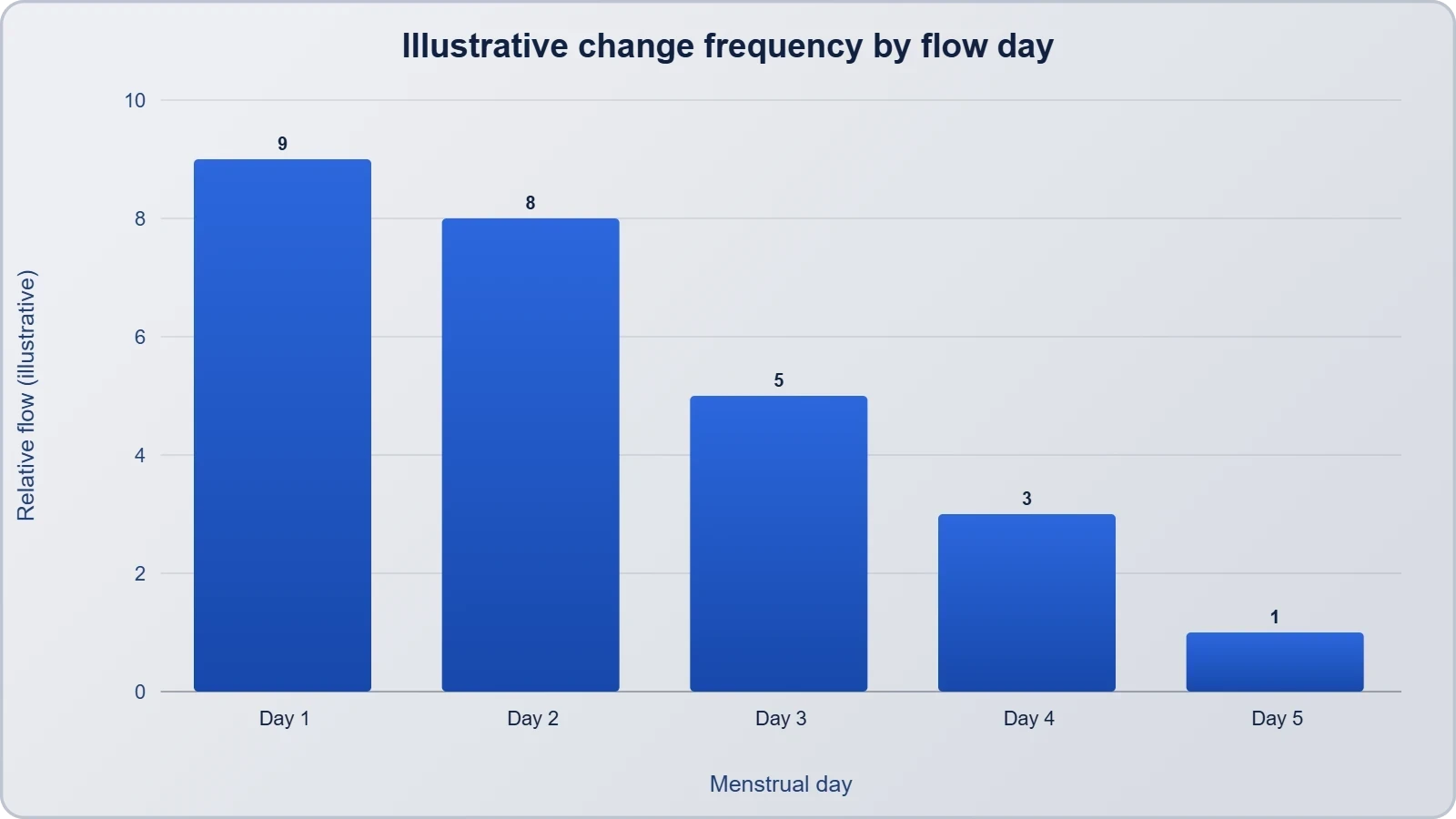
Changing frequency interacts with flow intensity, which varies across the three to five days of the menstrual phase. The first days are typically heavier, so more frequent changes may be needed, while later days allow longer intervals. Learners should understand that "every four to five hours" is a practical benchmark rather than a rigid rule, adjustable to need but never stretched to the point of saturation. Keeping spare products available, washing hands before and after changing, and avoiding scented sprays or powders on the vulva are simple habits that prevent most hygiene-related complaints. These practices are inexpensive and effective.
Disposal, Washing, and Environmental Responsibility
Disposal deserves explicit attention because improper practice harms both public health and infrastructure. Wrapping used napkins in paper and placing them in a bin keeps waste contained; flushing them can block drains and overwhelm sewage systems, while discarding in open areas creates nuisance and hygiene hazards. Handwashing with soap after handling used products interrupts faecal-oral and contact transmission routes. Schools and workplaces should provide bins in cubicles, running water, and soap, because individual discipline depends on available facilities. Environmental responsibility also favours reusable options where washing is feasible, reducing the volume of disposable waste generated each cycle.
Waste management is a collective as well as personal responsibility. Municipal systems designed without menstrual waste in mind often clog, and informal disposal in fields or water bodies spreads contamination. Education should therefore pair personal hygiene with civic awareness: know where waste goes, use bins, and advocate for adequate facilities in schools. For learners, this connects biology to public health and environmental science, showing that a physiological process has infrastructural implications. The lesson's practical framing prepares students to discuss menstrual hygiene management as a system of products, facilities, behaviours, and disposal rather than a private matter alone.
Water, Sanitation, and Menstrual Hygiene Management
Menstrual hygiene management depends on infrastructure as much as knowledge. Clean water for washing, private spaces for changing, soap, and safe disposal bins are the material conditions that make hygiene possible. Where these are absent, even well-informed individuals face impossible choices, and adolescents may miss school during menstruation. The World Health Organization and UNICEF frame menstrual hygiene management as a public health and gender equity issue, linking it to water, sanitation, and hygiene services. Recognising this shifts responsibility from individual blame to systemic provision, and it explains why schools and workplaces must be designed with menstruation in mind.
The Role of Clean Water and Private Facilities
Water serves several functions: washing the vulva, cleaning reusable cloth pads, and maintaining general cleanliness during the menstrual phase. Without a reliable supply, cloth pads cannot be washed safely, and disposable products accumulate as waste. Privacy matters equally, because changing a pad or tampon requires a secure space, and lack of privacy discourages timely change. Soap is essential for handwashing after handling used products. Together, water, soap, privacy, and disposal constitute the minimum package for dignified menstrual hygiene, and their absence is a recognised barrier to education and employment for menstruating individuals.
Schools illustrate the stakes clearly. When toilets lack water, soap, bins, or locking doors, students may avoid attending during their period, and the cumulative effect on learning is significant. Interventions that provide these facilities alongside education show measurable improvements in attendance and comfort. The biological lesson therefore connects to policy: hygiene is not merely a personal habit but a service that institutions must supply. Learners can evaluate their own school or workplace against this checklist and advocate for improvements, turning physiological knowledge into practical citizenship and reinforcing that menstruation is a normal process deserving normal infrastructure.
Hygiene as a Public Health Priority
Poor menstrual hygiene is associated with skin irritation, discomfort, and increased susceptibility to reproductive tract infections, particularly when products are worn too long or cloth is not properly washed and dried. These outcomes are preventable with basic resources and education. Public health programmes increasingly integrate menstrual hygiene into broader water, sanitation, and hygiene strategies, recognising that reproductive health cannot be separated from environmental conditions. The lesson's emphasis on access complements the individual practices described earlier: knowledge without facilities is insufficient, and facilities without knowledge are underused. Both are necessary for effective menstrual hygiene management.
Framing hygiene as a public health priority also counters the silence that surrounds menstruation. Open discussion in schools, workplaces, and health services normalises the topic and reduces the shame that leads to unsafe practices. Teachers can model accurate vocabulary, and health workers can provide products and guidance without embarrassment. For examination purposes, learners should be able to explain why clean water, sanitation, and hygiene services are essential to menstrual health, and to describe the consequences of inadequate access. This connects the physiology of the menstrual phase to the social determinants of health, a perspective increasingly tested in modern biology curricula.
Correcting Common Myths About Menstruation
Misconceptions about menstruation circulate widely and often survive because they are rarely examined against evidence. Common claims include that menstrual blood is impure, that bathing during menstruation is harmful, that menstruating people should avoid certain foods or activities, and that cycle length must be exactly twenty-eight days. Each can be corrected with physiology. Menstrual fluid is ordinary tissue breakdown; bathing is hygienic and safe; diet and exercise need not change except for comfort; and normal cycle length varies considerably. Correcting these myths is not merely polite correction but a health intervention, because false beliefs can lead to avoidance of hygiene, unnecessary restriction, and delayed care.

Myths About Bathing, Diet, and Activity
The belief that bathing during menstruation is dangerous has no physiological basis and is actively counterproductive, since washing maintains cleanliness and comfort. Similarly, claims that cold water, certain foods, or physical activity disrupt menstruation are unsupported; exercise can even ease cramps through endorphin release. Variations in flow, cycle length, and symptoms are normal, and a cycle need not be exactly twenty-eight days to be healthy. What matters clinically is a consistent pattern and the absence of warning signs such as extremely heavy bleeding or severe pain. Learners should be able to distinguish normal variation from symptoms that warrant medical assessment.
Another persistent myth holds that menstruation signals weakness or incapacity. In reality, most people continue normal activities throughout their cycle, and the hormonal fluctuations involved are part of healthy endocrine function. Fatigue or cramps may occur, but they are manageable and not evidence of frailty. Correcting this myth matters for equity, because assumptions of incapacity can justify exclusion from school, work, or sport. The physiological framing is powerful here: cyclic menstruation between menarche and menopause is an indicator of a normal reproductive phase, as the reference material states, not a disorder to be hidden or treated as illness.
Myths About the Hymen and Virginity
The hymen is a thin fold of mucous membrane at the vaginal opening, and its appearance varies enormously between individuals. It is not a reliable indicator of sexual activity: it can stretch or tear through sport, cycling, or tampon use, and many people are born with minimal or absent hymenal tissue. The equation of an intact hymen with virginity is therefore biologically unsound and has caused serious social harm. Correcting this misconception requires clear anatomy teaching, because the myth persists through ignorance rather than evidence. Learners should be able to describe hymenal variation and explain why it cannot certify sexual history.
This correction has practical consequences for hygiene education, since fear of damaging the hymen can discourage tampon use and lead to unsafe alternatives. Understanding that the hymen is variable and not a marker of virtue removes a barrier to informed product choice. It also challenges the double standards that surround adolescent sexuality, replacing judgement with accurate biology. In examinations, questions may ask students to evaluate claims about the hymen, and the strongest answers cite anatomical variation and the absence of any reliable correlation with sexual activity. The lesson thus combines myth-correction with exam-ready reasoning and ethical clarity.
Toxic Shock Syndrome and Product Safety
Toxic shock syndrome is a rare but serious condition caused by bacterial toxins, historically associated with prolonged use of high-absorbency tampons. Symptoms include sudden high fever, rash, vomiting, diarrhoea, dizziness, and muscle aches, and the condition requires urgent medical attention. The risk is reduced by changing tampons every four to six hours, never leaving one in for more than eight hours, using the lowest absorbency adequate for flow, and alternating with pads. Because the syndrome is uncommon, it is easily overlooked, so awareness of symptoms is important. The lesson's hygiene guidance gains clinical weight when this risk is understood.
Recognising Symptoms and Reducing Risk
The underlying mechanism involves colonisation by toxin-producing bacteria, often Staphylococcus aureus, in a favourable environment created by a retained tampon. Early recognition matters because progression can be rapid. Learners should know the warning signs and the simple behavioural rules that minimise risk: timely changes, appropriate absorbency, and alternating products. These measures do not require abandoning tampons, only using them correctly. Framing the risk accurately avoids both complacency and alarmism, and it reinforces the broader principle that hygiene products are medical devices requiring informed use rather than casual handling.
Product safety extends beyond tampons to any inserted or absorbent item. Menstrual cups require cleaning and sterilisation between uses, and cloth pads require thorough washing and drying. Scented products can irritate sensitive tissue and should be avoided. The unifying principle is that anything worn internally or against mucous membranes must be kept clean and changed on schedule. For examinations, students may be asked to explain the association between tampon use and toxic shock syndrome, and the strongest answers link bacterial toxin production to prolonged retention and describe preventive behaviour. This connects hygiene practice to microbiology and clinical reasoning.
When to Seek Medical Advice
Certain menstrual symptoms warrant professional assessment rather than reassurance. Extremely heavy bleeding that soaks through protection hourly, severe pain unrelieved by ordinary measures, cycles that stop unexpectedly outside pregnancy, and signs of infection such as fever or abnormal discharge all merit medical attention. The reference material notes that lack of menstruation may indicate pregnancy but can also arise from stress, poor health, or other underlying causes, which is why persistent absence should be investigated. Knowing when to seek help is part of hygiene literacy, and it prevents both unnecessary anxiety and dangerous delay.
Health-seeking behaviour is shaped by stigma, and people who have internalised myths about impurity may hesitate to discuss menstrual problems. Creating a climate of accurate vocabulary and normal expectations encourages timely consultation. Teachers and health workers can signpost services and reassure learners that reproductive health concerns are ordinary medical matters. This lesson therefore closes the loop between physiology, hygiene, myth-correction, and clinical safety, preparing students for the next topic, fertilisation, with a clear understanding of the uterine environment and the importance of reproductive health. The knowledge is practical, examinable, and directly relevant to wellbeing.
Building a Coherent Understanding for Exams and Life
This lesson has moved from the physiology of menstrual fluid to the practicalities of hygiene, the infrastructure that enables it, the myths that obstruct it, and the clinical risks that demand vigilance. The unifying thread is that menstruation is a normal, hormone-driven process whose management depends on knowledge, resources, and social attitudes. Learners should now be able to explain why menstrual blood is not impure, describe safe hygiene practices and their recommended frequency, justify the importance of clean water and sanitation, correct common myths about bathing and the hymen, and recognise the warning signs of toxic shock syndrome and other conditions requiring care.
Consolidating Key Concepts
For examination preparation, the strongest answers combine mechanism with application. A question on menstrual hygiene should mention the breakdown of the endometrial lining, the need for clean absorbent materials changed every four to five hours, proper disposal, and handwashing. A question on myths should cite physiological evidence rather than mere assertion. A question on toxic shock syndrome should link bacterial toxins to prolonged tampon retention and list preventive behaviours. Structuring answers around these elements demonstrates both recall and reasoning, which is what examiners reward.
Beyond examinations, the lesson equips learners to act. Knowing that hygiene depends on water, soap, privacy, and disposal enables advocacy for better facilities in schools and workplaces. Knowing that myths are false enables respectful correction in families and communities. Knowing the warning signs enables timely care-seeking. These are transferable capabilities that extend far beyond the syllabus, and they illustrate why reproductive biology deserves careful, evidence-based teaching. The next lesson on fertilisation will build on this foundation, examining how sperm and ovum meet in the ampullary region and what determines whether a cycle ends in menstruation or pregnancy.
Preparing for Fertilisation
The menstrual phase occurs only if the released ovum is not fertilised, and the endometrium is shed when the corpus luteum degenerates and progesterone falls. If fertilisation occurs, the corpus luteum is maintained and the endometrium supports implantation, so menstruation stops during pregnancy. This contrast is the bridge to the next lesson, where the fusion of sperm and ovum in the ampullary region is examined in detail. Understanding the uterine environment and the hormonal conditions that sustain it makes the events of fertilisation and implantation easier to grasp, and it reinforces why menstrual hygiene and reproductive health are continuous concerns rather than isolated topics.

Learners should leave this lesson with a clear mental model: hormones build and maintain the endometrium, its breakdown produces menstruation, hygiene keeps the process safe, and myths distort behaviour when evidence is absent. That model supports accurate answers in assessments and informed decisions in daily life. The material has deliberately avoided repeating the follicular, ovulatory, and luteal phases in depth, assuming that foundation from the previous lesson, and has instead extended into public health, clinical safety, and myth-correction. This progression reflects the course design, moving from gametes and cycles toward fertilisation, pregnancy, and childbirth with steadily increasing practical relevance.
Also Read
- No links available.
From our network :
- Vite 6/7 'Cold Start' Regression in Massive Module GraphsIn-depth analysis of Vite 6/7 cold start regressions in massive module graphs. Learn about barrel file issues, pre-bundling optimizations, and how to improve Vite dev server performance.
- AI-Powered 'Precision Diagnostic' Replaces Standard GRE Score ReportsDiscover the new GRE Precision Diagnostic. Learn how AI-powered behavioral analytics and time-to-solve tracking are replacing standard GRE score reports to empower students.
- 10 Physics Numerical Problems with Solutions for IIT JEEPrepare for IIT JEE with 10 physics numerical problems, complete with detailed solutions and conceptual explanations. Ideal for mastering kinematics, thermodynamics, electromagnetism, and optics.
- Analyzing Trump Deportation Numbers Insights Into The 2026 Immigration Crackdown
- Trump Political Strategy How Geopolitical Stunts Serve As Media Diversions
- EV 2.0: The Solid-State Battery Breakthrough and Global Factory ExpansionDiscover the impact of the Solid-State Battery Breakthrough on the EV market. Learn about CATL and BYD stock growth, global factory expansion in Europe, and the future of EV 2.0 technology.
- Mastering DB2 LUW v12 Tables: A Comprehensive Technical GuideComprehensive guide on DB2 LUW v12 tables. Explore CREATE TABLE syntax, BLU Acceleration, range partitioning, data types, and security features for IBM DB2 LUW v12.
- 98% of Global MBA Programs Now Prefer GRE Over GMAT Focus EditionExplore why 98% of global MBA programs now prefer the GRE over GMAT Focus. Learn about the shorter GRE format, verbal logic importance, and strategic versatility for students.
- Mastering DB2 12.1 Instance Design: A Technical Deep Dive into Modern Database ArchitectureComprehensive guide to DB2 12.1 Instance Design. Explore architectural components, HADR setup, buffer pool tuning, and security policies for IBM DB2 12.1. Includes 10 functional SQL and Shell samples.
RESOURCES
- Menstrual health hygiene, awareness, myths, and health-seeking ...pmc.ncbi.nlm.nih.govNov 27, 2025 ... Appearance-related behaviors were also influenced by menstrual myths: “We are told by our elders not to look at ourselves in…
- Menstrual hygiene knowledge and practices among female senior ...pubmed.ncbi.nlm.nih.govApr 26, 2025 ... Generally, female students had good MHM knowledge and practices with few misconceptions. The study underscores the importance of enhancing ...
- Menstruation and Menstrual Hygiene: Analyzing the Gaps in ... - PMCpmc.ncbi.nlm.nih.govApr 17, 2025 ... In many low- and middle-income countries (LMICs), menstruation is surrounded by misconceptions and inadequate management practices. This study ...
- Menstrual hygiene management and school absenteeism among ...pubmed.ncbi.nlm.nih.gov... misconceptions, malpractices and challenges ... Only a third of the girls used sanitary napkins as menstrual absorbent during their last menstruation.
- 11 Period Myths and Facts | 700 Children's Blognationwidechildrens.org11 Period Myths and Facts. Feb 24, 2025 · You must have a period. · Periods are supposed to be · You can't get…
- FAST FACTS: Nine things you didn't know about menstruation - Unicefunicef.orgA lack of information about menstruation leads to damaging misconceptions ... Cavill, Module One: Menstrual Hygiene - The Basics, in Menstrual hygiene ...
- New Book Busts Myths About Menstruation Spread By Public Health ...npr.orgJan 30, 2019 ... ... the misconceptions about menstrual health that Bobel investigates in her book. Myth 1: Girls in Africa skip school during…
- Myths and Facts: Menstrual Hygiene - Initialinitial.comOct 14, 2024 ... Myths and Facts: Menstrual Hygiene · Menstruation is a natural process experienced by millions of women every day. · Myth…
- Evidence from a multi-method survey among adolescent schoolgirls ...journals.plos.orgOct 22, 2020 ... This study aimed to examine the menstrual knowledge, sociocultural restrictions, and barriers to menstrual hygiene management in school ...
- 8 Period Myths We Need to Set Straight - Healthlinehealthline.comNot only women get periods, and the United Nations called menstrual hygiene a public health issue in 2014. 16 Reasons Why Your Period Is…
- Developing a Holistic Menstrual Health Program - Splash.orgsplash.orgMay 27, 2021 ... ... the common myths and misconceptions surrounding menstruation. ... menstrual hygiene management; it requires involvement from everyone across the ...
- Cultural taboos and misinformation about menstrual health ...sciencedirect.comManaging menstruation with dignity and hygiene remains a pressing challenge worldwide: The World Bank estimates that over 500 million women lack access to ...
- Myths and Challenges Regarding Menstrual Hygiene among ...pjph.orgDec 28, 2023 ... This study aims to identify myths surrounding menstrual hygiene among young girls in Islamabad and recognize the challenges they face…
- Facilities and Misconceptions Concerning Menstrual Health and ...scirp.netDiscover the facilities and misconceptions surrounding menstrual health and hygiene management among young people in Nigeria. Gain insights on water access, ...