Pollen grains are the male gametophytes of flowering plants, and their journey from a dehisced anther to a receptive stigma is governed by a single, unforgiving constraint: they must reach that landing platform before they lose viability. Once shed, a pollen grain carries no reserve of time beyond what its chemistry and its environment allow, and the interval it can survive varies enormously across species. In some cereals such as rice and wheat, viability is lost within thirty minutes of release; in certain members of Rosaceae, Leguminosae and Solanaceae, grains remain capable of germination for months. This lesson examines that variability, the environmental factors that shape it, and the practical consequences that follow from it.
The same grains that carry the male gametes also carry a public-health burden. Pollen from many species provokes severe allergies and bronchial afflictions, often progressing to chronic respiratory disorders such as asthma and bronchitis. Parthenium, or carrot grass, arrived in India as a contaminant with imported wheat and has since become ubiquitous, and its pollen is a notorious allergen. Yet pollen is also a nutrient-rich substance, marketed in Western countries as tablets and syrups and claimed to improve the performance of athletes and race horses. Understanding pollen grains therefore requires holding three perspectives at once: the reproductive, the medical and the commercial.
Finally, the lesson turns to storage. Just as the semen and sperm of many animals, including humans, can be preserved for artificial insemination, pollen grains of a large number of species can be stored for years in liquid nitrogen at minus 196 degrees Celsius. Such stored pollen functions as a pollen bank, analogous to a seed bank, and serves crop breeding programmes. Building on the stamen, microsporangium and pollen grain structures established in the previous lesson, this treatment prepares the ground for the pistil, megasporangium and embryo sac that follow.
On This Page
Viability: The Narrow Window Between Shedding and Stigma
Viability is the central biological fact of this lesson, and it is best stated plainly: when once pollen grains are shed, they have to land on the stigma before they lose viability if they are to bring about fertilisation. There is no second chance and no repair mechanism available to a grain stranded on a petal or carried past its target. The period for which pollen grains remain viable is highly variable and, to some extent, depends on the prevailing temperature and humidity. That dependence is what makes the window short in some species and remarkably long in others, and it is the variable that storage technology must manipulate.
The Range of Viability Across Species
The extremes are striking and worth committing to memory. In some cereals such as rice and wheat, pollen grains lose viability within thirty minutes of their release, which places an extraordinary premium on synchrony between anther dehiscence and stigma receptivity in those crops. At the other end of the scale, some members of Rosaceae, Leguminosae and Solanaceae maintain viability for months. Between these poles lie the majority of species, whose grains persist for hours or days depending on conditions. The practical lesson for a student is that no single figure describes pollen viability; the species and the environment together determine it.

Temperature and humidity are the two environmental levers named in the material, and their influence explains why the same species can behave differently in different seasons and climates. High temperatures and dry air accelerate the desiccation and metabolic decline that end viability, while cooler, more humid conditions slow that decline. This is precisely the logic that later justifies cryopreservation: if ordinary environmental conditions govern how long a grain survives, then engineering an extreme and stable environment should extend survival dramatically. The pollen bank is that engineering applied at scale.
Why the Window Matters for Fertilisation
The brevity of the window in cereals has direct consequences for how those plants must organise their reproduction. Where pollen survives only thirty minutes, the anther and the stigma of a compatible flower must be active at almost the same moment, and any mismatch between pollen release and stigma receptivity results in failure. This is one reason why the material notes that complete autogamy in a normal flower which opens and exposes its anthers and stigma is rather rare: such flowers require synchrony in pollen release and stigma receptivity, and the anthers and stigma should also be closely positioned. Viability, in other words, shapes floral architecture and breeding behaviour.
For the learner, the concept also connects backward to the previous lesson and forward to the next. The two-celled or three-celled condition of the mature grain, with its vegetative cell and generative cell, describes what is being kept alive during the viable period. The stigma, described in the following lesson as the landing platform for pollen grains, is the destination that gives the window its meaning. Viability is thus the bridge between the male gametophyte and the female structures, and it is the reason pollination cannot be treated as a purely mechanical transfer.
Allergy: When Pollen Becomes a Health Burden
Pollen grains of many species cause severe allergies and bronchial afflictions in some people, often leading to chronic respiratory disorders such as asthma and bronchitis. This is not a marginal curiosity appended to the reproductive story; it is a significant public-health dimension of the same structures. The grain's tough outer wall, built of sporopollenin, allows it to persist in the air and to reach the respiratory tract intact, where its proteins trigger immune responses in susceptible individuals. The very durability that preserves pollen as fossils also makes it a persistent airborne irritant.
Parthenium and the Allergen Problem
Parthenium, or carrot grass, is the material's named example, and its history is instructive. It came into India as a contaminant with imported wheat and has become ubiquitous in occurrence, and it causes pollen allergy. The species illustrates how an accidental introduction can convert a local plant into a widespread allergen, and it explains why allergists and botanists often discuss the same plant from different angles. For learners, Parthenium is a memorable case that ties together taxonomy, invasion biology and clinical medicine in a single organism, and it deserves to be remembered by both its common names.
The clinical vocabulary matters here. Allergies and bronchial afflictions are distinct from the reproductive function of pollen, yet they arise from the same physical properties. A grain small enough to be wind-borne, tough enough to survive desiccation, and protein-rich enough to nourish a growing tube is, by the same token, well suited to lodge in airways and provoke sensitisation. Recognising this dual identity prevents the common mistake of treating pollen allergy as unrelated to the botany of the anther, when in fact the two are consequences of one structure.

Pollen as a Nutrient and Commercial Product
Against the allergic burden sits a commercial and nutritional story. Pollen grains are rich in nutrients, and it has become a fashion in recent years to use pollen tablets as food supplements. In Western countries, a large number of pollen products in the form of tablets and syrups are available in the market. Pollen consumption has been claimed to increase the performance of athletes and race horses. The word claimed is doing important work in that sentence, and a careful reader should notice that the material reports the claim without endorsing it.
This commercial dimension is worth examining critically. The nutrient richness of pollen is not in doubt, but the leap from nutrient content to enhanced athletic performance is a claim rather than a demonstrated effect, and the material presents it as such. Students preparing for examinations should be able to state both halves accurately: that pollen products are marketed as supplements, and that performance benefits are asserted rather than established. That distinction between what is claimed and what is shown is a habit of mind worth carrying into every later lesson on reproduction and biotechnology.
Pollen Banks: Storing the Male Gametophyte
The storage solution described in the material borrows directly from animal reproductive technology. You may have heard of storing semen or sperms of many animals, including humans, for artificial insemination; in the same spirit, it is possible to store pollen grains of a large number of species for years in liquid nitrogen at minus 196 degrees Celsius. Such stored pollen can be used as pollen banks, similar to seed banks, in crop breeding programmes. The analogy is deliberate and useful: a pollen bank is to the male gametophyte what a seed bank is to the embryo, a repository of genetic material held outside the field.
The Physics and Chemistry of Cryopreservation
The temperature involved is worth pausing over. Liquid nitrogen at minus 196 degrees Celsius is cold enough to arrest essentially all metabolic and enzymatic activity, which is precisely why the viability clock stops. The dependence of viability on temperature and humidity, noted earlier, is here pushed to an extreme: by removing heat and free water, the grain is held in a suspended state rather than allowed to age. The sporopollenin-rich exine, already one of the most resistant organic materials known, provides the physical durability that makes such handling feasible for a large number of species.
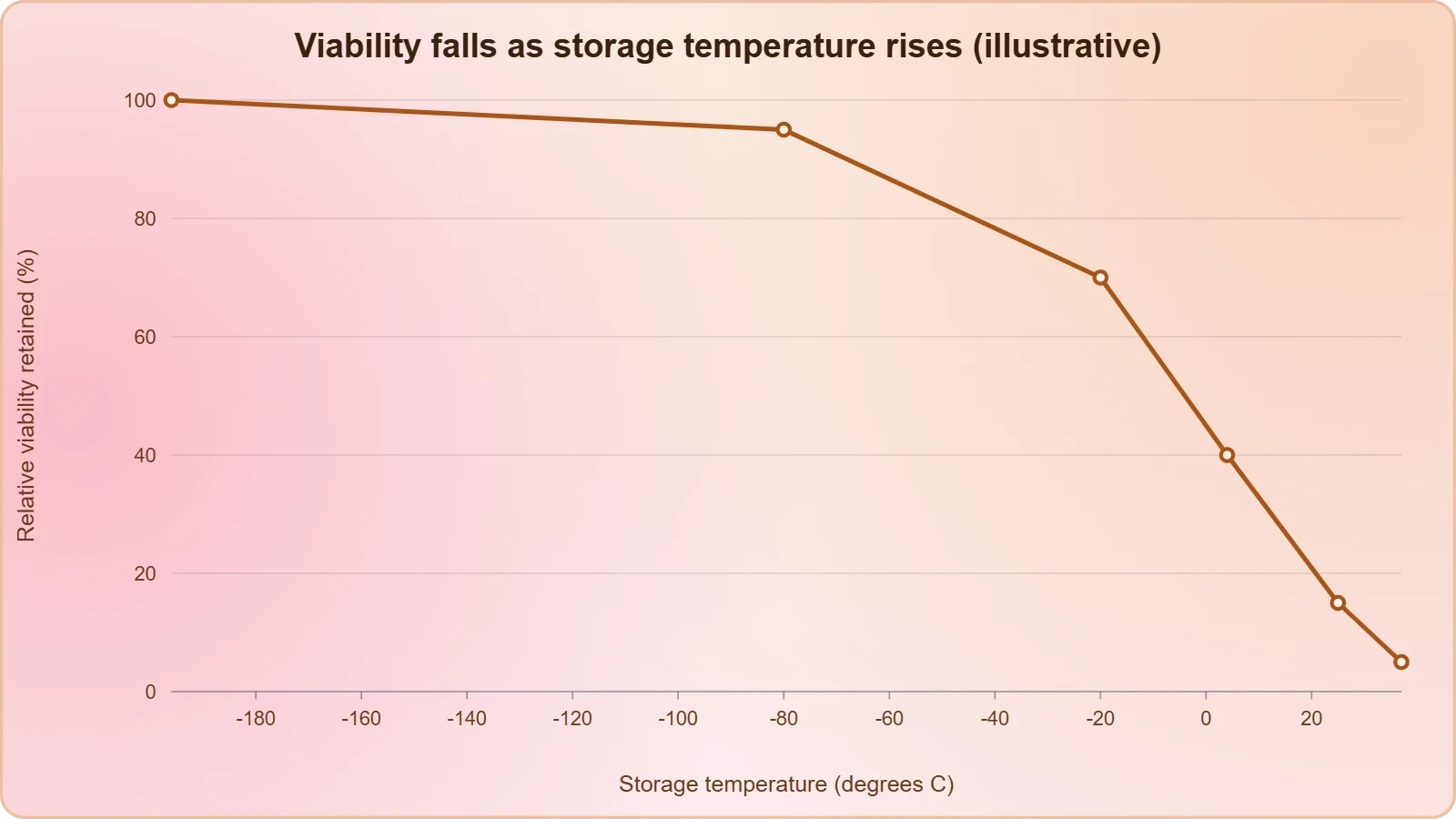
It is important to be precise about what the material does and does not claim. It states that pollen grains of a large number of species can be stored for years in liquid nitrogen, not that every species can be. The qualifier matters, because recalcitrant grains with high moisture content may resist such treatment. The student should therefore record the technique as a powerful but not universal tool, and should connect it to the underlying principle that viability is a function of environmental conditions rather than a fixed property of the species.
Why Breeders Value Stored Pollen
The agricultural rationale is straightforward once the breeding context is understood. Crop breeding programmes frequently need to cross plants that flower at different times or in different places, and a pollen bank removes the tyranny of synchrony. Stored pollen can be drawn upon when the female parent is receptive, extending the breeder's control over when and with what a cross is made. The material places this squarely within crop breeding programmes, and the comparison with seed banks signals that pollen storage is part of the same infrastructure of genetic resource management that underpins modern agriculture.
This is also where the lesson begins to point forward. The next lesson turns to the pistil, megasporangium and embryo sac, and the value of a pollen bank is realised only when stored grains are placed on a receptive stigma and a pollen tube is guided into the synergid. The filiform apparatus, the germ pores and the two-celled or three-celled condition of the grain all become relevant at that moment. Storage is not an end in itself; it is the preservation of a capability that the female structures will later put to use.
Reading Viability Through the Grain's Structure
The properties discussed in this lesson are not arbitrary; they follow from the architecture of the grain established earlier. Pollen grains are generally spherical, measuring about 25 to 50 micrometres in diameter, with a prominent two-layered wall. The hard outer layer, the exine, is made of sporopollenin, one of the most resistant organic materials known, able to withstand high temperatures and strong acids and alkali, with no enzyme that degrades sporopollenin so far known. That resistance explains both the fossil record and the feasibility of long-term storage, and it frames the grain as a structure built for endurance.
Germ Pores, Intine and the Living Interior
The exine is not uniformly impermeable. It has prominent apertures called germ pores where sporopollenin is absent, and these are the points through which the pollen tube will eventually emerge. Beneath the exine lies the intine, a thin and continuous layer made up of cellulose and pectin, and the cytoplasm is surrounded by a plasma membrane. When the grain is mature it contains two cells, the vegetative cell and the generative cell; the vegetative cell is bigger, has abundant food reserve and a large irregularly shaped nucleus, while the generative cell is small, spindle shaped, with dense cytoplasm and a nucleus, floating in the vegetative cell's cytoplasm.
In over 60 per cent of angiosperms, pollen grains are shed at this two-celled stage; in the remaining species, the generative cell divides mitotically to give rise to the two male gametes before pollen grains are shed, producing the three-celled stage. This detail matters for viability because what must be preserved during storage is a living, organised cell system, not merely a resistant shell. The food reserve in the vegetative cell and the integrity of the plasma membrane are as essential to survival as the sporopollenin armour, and the germ pores are the planned exits that must remain functional.

From Fossil Record to Field Practice
Because of sporopollenin, pollen grains are well preserved as fossils, and the exine exhibits a fascinating array of patterns and designs. That same durability underpins the practical uses described in this lesson: the persistence of grains in air that makes them allergens, and the resistance that makes cryopreservation possible. A single material property thus links palaeobotany, public health and agricultural technology. Recognising this unity is the intellectual payoff of the lesson, and it is the kind of connection that turns a list of facts into an understanding of why the facts hold together.
The variety of architecture across species, in sizes, shapes, colours and designs, is best appreciated by sprinkling pollen from an opened anther of Hibiscus onto a drop of water on a glass slide and observing it under a microscope. That simple exercise connects the abstract properties to visible form, and it prepares the student for the structural detail of the ovule and embryo sac in the next lesson, where the female counterpart of this remarkable grain awaits.
Working Through the Numbers and the Vocabulary
Several quantities in this lesson reward careful handling. The grain diameter of 25 to 50 micrometres can be expressed in metres to make the scale concrete, and the storage temperature of minus 196 degrees Celsius can be converted to kelvin. These conversions are not decorative; they train the habit of moving between units that examination questions and laboratory protocols both demand. The viability figures, thirty minutes for rice and wheat against months for certain Rosaceae, Leguminosae and Solanaceae, are best treated as orders of magnitude rather than precise constants, since the material itself ties them to temperature and humidity.
Unit Conversions Worth Practising
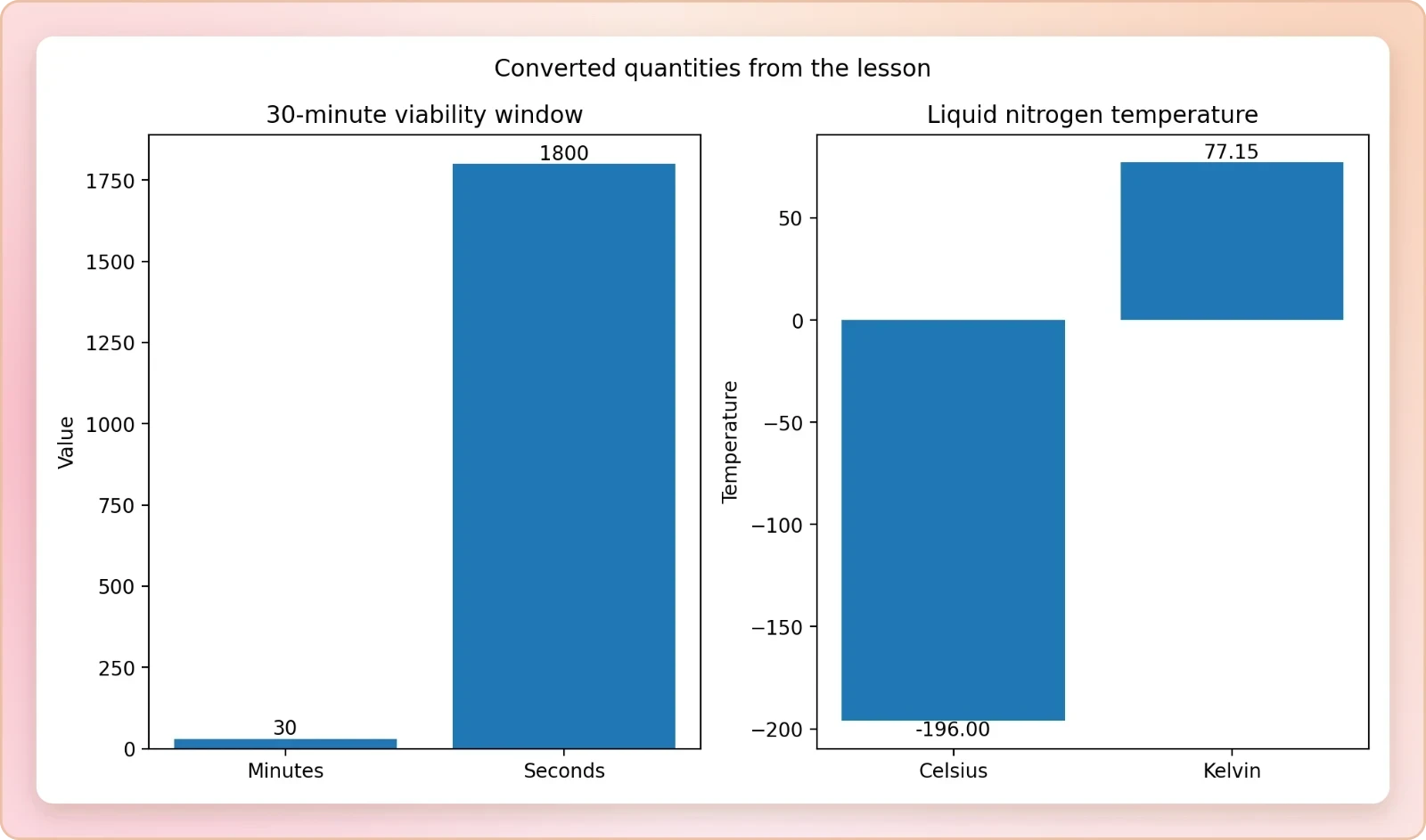
A grain of 25 micrometres is ##25 \times 10^{-6}## metres, and one of 50 micrometres is ##50 \times 10^{-6}## metres, so the range spans ##2.5 \times 10^{-5}## to ##5.0 \times 10^{-5}## metres. The liquid nitrogen temperature converts as follows, using the relation between Celsius and kelvin:
That value, roughly 77 kelvin, is the working temperature of a pollen bank, and stating it in kelvin is standard practice in cryobiology. The thirty-minute viability of rice and wheat pollen corresponds to ##30 \times 60 = 1800## seconds, a useful figure when comparing against the months-long persistence of other species, which may be expressed in days or hours for comparison. Converting between these scales makes the enormous spread of viability tangible and prepares students for quantitative questions on pollination timing.
A Small Script for Viability Arithmetic
Learners comfortable with programming can consolidate the arithmetic in a short script that converts the lesson's figures and compares the extremes. The code below is illustrative only; it encodes the numbers stated in the material and performs the conversions described above, so that the relationships can be checked quickly and reused when revising.
# Pollen viability and storage: unit conversions from the lesson
cereal_viability_minutes = 30          # rice and wheat
cereal_viability_seconds = cereal_viability_minutes * 60

liquid_nitrogen_celsius = -196
liquid_nitrogen_kelvin = liquid_nitrogen_celsius + 273.15

grain_diameter_um = (25, 50)           # micrometres
grain_diameter_m = tuple(d * 1e-6 for d in grain_diameter_um)

print("Cereal viability (s):", cereal_viability_seconds)
print("Liquid nitrogen (K):", round(liquid_nitrogen_kelvin, 2))
print("Grain diameter (m):", grain_diameter_m)
Running such a script returns 1800 seconds, approximately 77.15 kelvin, and a diameter range of ##2.5 \times 10^{-5}## to ##5.0 \times 10^{-5}## metres. The exercise is modest, but it reinforces the lesson's central quantitative claims and gives students a reusable tool for checking their own working. More importantly, it demonstrates that biological data are amenable to the same careful arithmetic as physical data, a point worth carrying into the study of the ovule and embryo sac that follows.
Going further
Pollen banks, like seed banks, store pollen for use in crop breeding programmes, and the parallel is more than rhetorical. Both institutions exist to hold genetic diversity outside the field, to insure against loss and to make material available when a breeding cross requires it. A seed bank preserves embryos within seeds; a pollen bank preserves male gametophytes in liquid nitrogen. Together they give breeders a measure of independence from season and geography, and they illustrate how reproductive biology becomes agricultural infrastructure when the underlying constraints of viability are understood and manipulated.
Parthenium, or carrot grass, came into India as a contaminant with imported wheat and is now widespread. The case is a compact lesson in invasion biology: a species introduced accidentally, without intent and largely unnoticed, can spread until it is ubiquitous and then impose a persistent public-health cost through its allergenic pollen. It also shows why the study of pollen is not confined to the anther. Quarantine, seed hygiene and allergen surveillance are all downstream of the same biology, and the Parthenium story connects the laboratory slide to the field, the clinic and the policy office.
Also Read
- No links available.
From our network :
- Analyzing Trump Deportation Numbers Insights Into The 2026 Immigration Crackdown
- Mastering DB2 12.1 Instance Design: A Technical Deep Dive into Modern Database ArchitectureComprehensive guide to DB2 12.1 Instance Design. Explore architectural components, HADR setup, buffer pool tuning, and security policies for IBM DB2 12.1. Includes 10 functional SQL and Shell samples.
- AI-Powered 'Precision Diagnostic' Replaces Standard GRE Score ReportsDiscover the new GRE Precision Diagnostic. Learn how AI-powered behavioral analytics and time-to-solve tracking are replacing standard GRE score reports to empower students.
- Mastering DB2 LUW v12 Tables: A Comprehensive Technical GuideComprehensive guide on DB2 LUW v12 tables. Explore CREATE TABLE syntax, BLU Acceleration, range partitioning, data types, and security features for IBM DB2 LUW v12.
- 98% of Global MBA Programs Now Prefer GRE Over GMAT Focus EditionExplore why 98% of global MBA programs now prefer the GRE over GMAT Focus. Learn about the shorter GRE format, verbal logic importance, and strategic versatility for students.
- 10 Physics Numerical Problems with Solutions for IIT JEEPrepare for IIT JEE with 10 physics numerical problems, complete with detailed solutions and conceptual explanations. Ideal for mastering kinematics, thermodynamics, electromagnetism, and optics.
- EV 2.0: The Solid-State Battery Breakthrough and Global Factory ExpansionDiscover the impact of the Solid-State Battery Breakthrough on the EV market. Learn about CATL and BYD stock growth, global factory expansion in Europe, and the future of EV 2.0 technology.
- Trump Political Strategy How Geopolitical Stunts Serve As Media Diversions
- Vite 6/7 'Cold Start' Regression in Massive Module GraphsIn-depth analysis of Vite 6/7 cold start regressions in massive module graphs. Learn about barrel file issues, pre-bundling optimizations, and how to improve Vite dev server performance.
RESOURCES
- Abiotic pollutants and solar radiation involved in Cupressaceae ...nature.comAug 13, 2026 ... Atmospheric pollutants, including particulate matter, nitrogen oxides, ozone, and carbon monoxide, can alter pollen grain viability and promote ...
- Pollen - Wikipediaen.wikipedia.orgPollen is a powdery substance produced by most types of flowers of seed plants for the purpose of sexual reproduction. It consists of pollen…
- how are pollen preserved in pollen banks explain how are such ...brainly.inAug 18, 2019 ... In viable conditions, pollen banks are used to store pollen grains for a very long period.
- Climate Change and Future Pollen Allergy in Europe - PMC - NIHpmc.ncbi.nlm.nih.gov... pollen level (grains per cubic meter), adjusting for study population. ... Ozone affects pollen viability and NAD(P)H oxidase release from Ambrosia artemisiifolia ...
- Pollen banks are playing a very important role in promoting plant ...brainly.inFeb 11, 2020 ... These pollen grains are stored in a pollen bank in viable condition. ... allergens etc. Explore all similar answers. arrow…
- Stamen, Microsporangium and Pollen Grain | CK-12 Foundationflexbooks.ck12.orgSuch pollen banks are extremely valuable in crop breeding programmes, enabling the preservation and use of pollen from desirable plant varieties. Allergies and ...
- Palyno-Morphological Characteristics as a Systematic Approach in ...pmc.ncbi.nlm.nih.govOct 5, 2022 ... A total of 25 slides of pollen grains were prepared for the light microscopic study to determine the pollen viability.…
- Pollen Grain: Structure, Diagram, Types, Function & Formationpw.liveDec 16, 2025 ... Factors like temperature and humidity strongly affect viability. Pollen Storage (Pollen Banks):. For preservation purposes, especially in plant ...
- Meteorological conditions, climate change, new emerging factors ...link.springer.comJul 14, 2015 ... ... viability of both macrophage-like cells [5], and alveolar ... Concentrations of major grass group 5 allergens in pollen grains…
- Structure and Function of Anther | PDF | Pollen | Organisms - Scribdscribd.comcause pollen allergy. • In cyperaceae family only one functional pollen grain is formed from a pollen mother cell. e.g. Cyperus. VIABILITY OF POLLEN…
- Common Ragweed Allergy Under Global Change Linking Invasion ...mdpi.comPollutants may adhere to pollen grains, forming pollen-particle complexes and potentially amplifying allergenic effects. At the same time, high humidity, ...
- Development of a graphene field effect transistor-based immersible ...sciencedirect.com... viability of the cells after serum sensitization and allergen ... pollen grains, releasing particles into the atmosphere that carry airborne allergens.
- Respiratory Allergy to Conifers - HAL-Pasteurpasteur.hal.scienceJul 8, 2022 ... Pinaceae is mentioned as poorly allergenic in the RNSA data bank despite a huge amount of pollen produced. ... allergen…
- repro in plants Flashcards - Quizletquizlet.comIn some cereals such as rice and wheat, pollen grains lose viability within ... Such stored pollen can be used as pollen banks, similar…
- Pollen dictionary construction based on supervised comparative ...dl.acm.orgPollen is one of the most common allergens. When pollen grains or spores in the air enter the respiratory tract, they release proteins that…