Sexual reproduction in flowering plants depends on the transfer of pollen from anther to stigma, yet the very architecture of a flower can work against that transfer when the same blossom sheds and receives pollen simultaneously. Continued self-pollination carries a measurable biological cost, known as inbreeding depression, because repeated fusion of closely related gametes narrows genetic variation and weakens the vigour of successive generations. Flowering plants have therefore evolved a repertoire of outbreeding devices: structural, temporal and physiological mechanisms that discourage self-pollination while encouraging cross-pollination. This lesson examines those devices in detail, moving from the timing of pollen release and stigma receptivity through the spatial arrangement of floral parts, the biochemical barrier of self-incompatibility, and the decisive role of unisexual flowers in monoecious and dioecious plants.
The material at hand frames these devices within the broader account of angiosperm reproduction, where the flower is the seat of sexual reproduction, the androecium of stamens represents the male reproductive organs, and the gynoecium of pistils represents the female reproductive organs. Against that background, outbreeding devices appear not as isolated curiosities but as evolutionary answers to a specific problem: how to prevent the male and female gametophytes of one flower from fusing with each other when cross-fertilisation offers genetic advantages. Each device interrupts the selfing pathway at a different point, and together they illustrate how floral form and function are tuned to reproductive strategy.
Understanding these mechanisms also prepares the ground for what follows. Once pollen has been delivered to a compatible stigma, the events of pollen-pistil interaction take over, and the distinction between compatible and incompatible pollen becomes central. The devices described here determine which pollen arrives, and self-incompatibility in particular determines which pollen is permitted to germinate and grow. The lesson therefore builds directly on the preceding discussion of animal agents of pollination and sets the stage for the molecular dialogue between pollen and pistil.
On This Page
The Problem of Continued Self-Pollination
Self-pollination is not inherently impossible for a flowering plant; many species manage it routinely, and in certain circumstances it guarantees seed set when pollinators are scarce. The difficulty is that continued self-pollination results in inbreeding depression, a decline in vigour and fertility across generations that arises because the offspring inherit two nearly identical sets of alleles. Genetic variation, the raw material on which selection acts, is reduced, and deleterious recessive traits that would otherwise remain hidden can become expressed. The material is explicit on this point: continued self-pollination results in inbreeding depression, and flowering plants have developed devices to discourage self-pollination and encourage cross-pollination.
The evolutionary logic is straightforward. Cross-pollination mixes gametes from different individuals, producing new genetic combinations and leading to variations among the progeny. These variations are the basis on which populations adapt to changing environments, resist disease, and colonise new areas. A species that relies exclusively on selfing sacrifices that adaptive flexibility. Outbreeding devices are the mechanisms by which plants avoid this sacrifice, and they operate at the level of floral timing, floral architecture, cellular recognition and sexual organisation. Each device is a different solution to the same underlying problem of maintaining genetic diversity.
Why Inbreeding Depression Matters
Inbreeding depression is best understood as the phenotypic consequence of reduced heterozygosity. When pollen from a flower fertilises the ovules of the same flower, or of a genetically identical flower, the resulting zygote receives alleles that are closely related. Over successive generations of selfing, homozygosity increases, and the progeny may show reduced stature, lower seed set, poorer germination and greater susceptibility to stress. The material treats this as the reason outbreeding devices exist, and it is worth appreciating that the devices are not perfect: many plants retain the capacity for selfing as a fallback, deploying their outbreeding mechanisms with varying degrees of stringency.
The balance between selfing and outcrossing is therefore a matter of degree rather than an absolute switch. A plant that flowers when pollinators are abundant may rely on cross-pollination, while the same species may set seed by selfing when pollinators fail. Outbreeding devices tilt the odds toward cross-pollination without necessarily abolishing selfing altogether. This nuance matters for interpreting the mechanisms that follow, because each device represents a partial barrier whose effectiveness depends on the ecological context in which the plant reproduces.
The Genetic Consequences of Outcrossing
Outcrossing generates new genetic combinations, and the material links this directly to the variations that allow plants to colonise new areas. The connection is worth stating precisely: sexual reproduction produces offspring that differ from their parents and from one another, and this diversity is what enables a population to respond to selection. A seed produced by cross-pollination carries a novel combination of alleles, and the resulting seedling may possess traits that neither parent expressed. Over many generations, this reshuffling is what allows lineages to adapt.
The contrast with apomixis, discussed later in the course, sharpens the point. Apomictic seeds are produced without fertilisation and yield progeny that are genetically identical to the parent, effectively clones. Outcrossing does the opposite, generating variation at the cost of breaking up favourable combinations. Outbreeding devices are the mechanisms that keep a sexually reproducing species on the outcrossing side of this trade-off, and their study is therefore inseparable from the study of genetic diversity in plant populations.
Asynchrony of Pollen Release and Stigma Receptivity
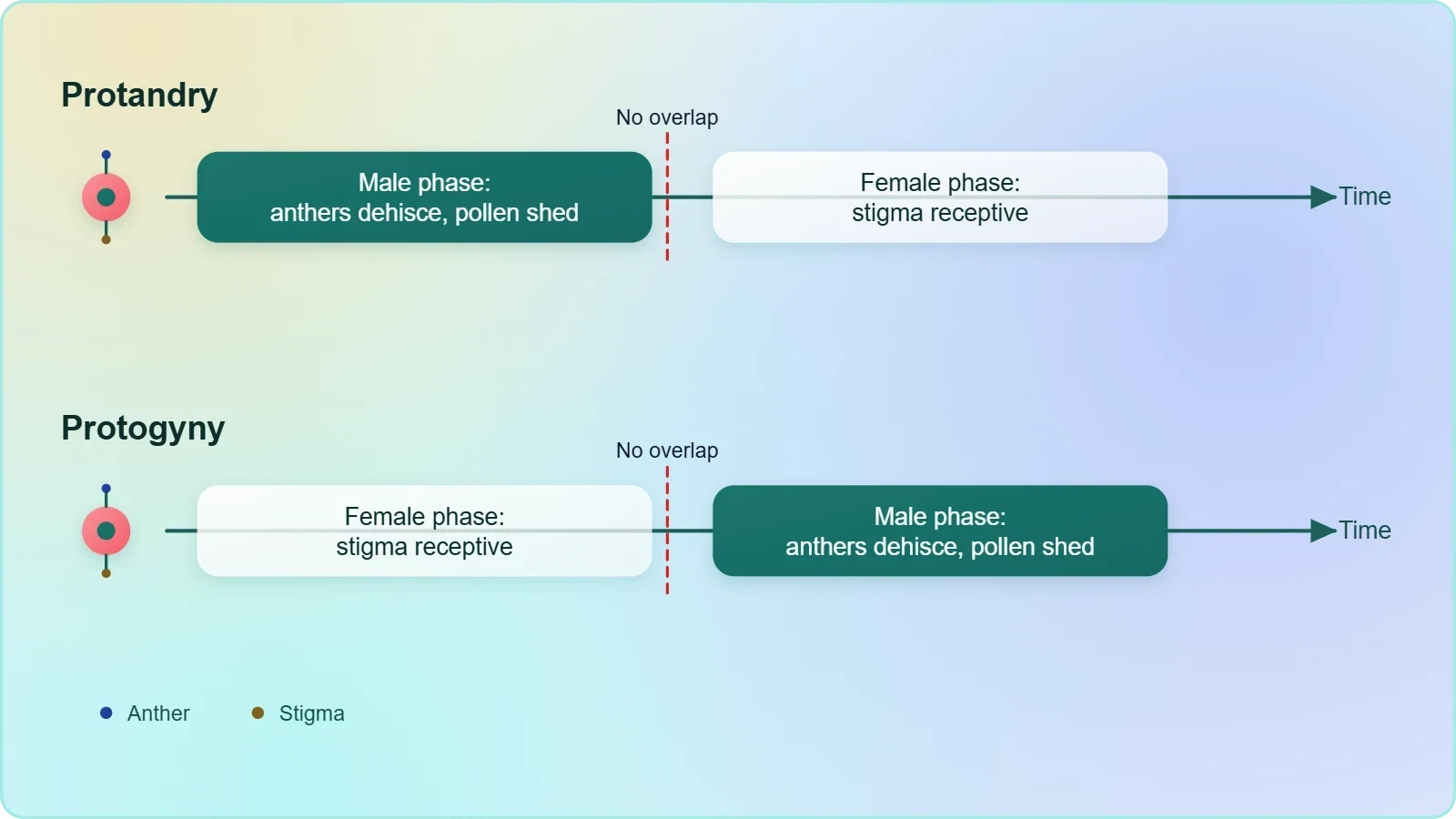
The first device described in the material is temporal: asynchrony of pollen release and stigma receptivity. In many flowers the anthers shed their pollen at a time when the stigma of the same flower is not yet receptive, or the stigma becomes receptive only after the anthers have finished shedding. The two events are separated in time, so that pollen from a given flower is unlikely to land on a receptive stigma of that same flower. The device is simple and effective, and it requires no special cellular machinery beyond the developmental timing of the floral organs.
This temporal separation is often described as dichogamy, and it can take two forms. When the anthers mature and release pollen before the stigma becomes receptive, the condition is called protandry; when the stigma becomes receptive before the anthers shed pollen, it is called protogyny. In either case the effect is the same: the flower passes through a male phase and a female phase that do not overlap, so that self-pollination within the flower is avoided while cross-pollination with other flowers remains possible. The material presents asynchrony as one of the principal devices by which flowering plants discourage self-pollination.
Protandry and Protogyny in Practice
Protandry is common in flowers where the anthers dehisce early and the stigma matures later. A visiting pollinator arriving during the male phase picks up pollen and carries it away; by the time the same flower enters its female phase, its own pollen has already been removed, and any pollen it receives is likely to have come from another flower. Protogyny reverses the sequence, with the stigma receptive first and the anthers shedding later. Both arrangements achieve the same end, and both depend on the pollinator population to move pollen between flowers that are in complementary phases.
The effectiveness of asynchrony depends on the synchrony of the population as a whole. If all the flowers of a plant open and pass through their phases at the same time, a pollinator moving between them may still transfer pollen from a male-phase flower to a female-phase flower of the same plant. The device works best when individual flowers within an inflorescence, or individual plants within a population, are at different stages. This is why asynchrony is often combined with other devices, and why the material lists it alongside structural and physiological mechanisms rather than presenting it as sufficient on its own.
Timing as a Barrier to Selfing
The temporal device has an important practical consequence for plant breeders and for the interpretation of pollination biology. A flower that is protandrous cannot easily self-pollinate, and a breeder wishing to make a controlled cross must take account of the phase in which the flower finds itself. The material's emphasis on asynchrony therefore connects directly to the later discussion of emasculation and bagging, techniques that manipulate floral timing and structure to control pollination. Understanding when pollen is shed and when the stigma is receptive is the foundation of any controlled pollination programme.
From an ecological perspective, asynchrony also influences the kinds of pollinators a plant attracts. A flower that presents pollen and nectar over an extended period, with the male and female phases separated, may attract pollinators repeatedly and thereby increase the chance of cross-pollination. The device thus operates at the intersection of developmental biology and pollinator behaviour, and its study requires attention to both the internal timing of the flower and the external movements of its visitors.
Different Positions of Anther and Stigma
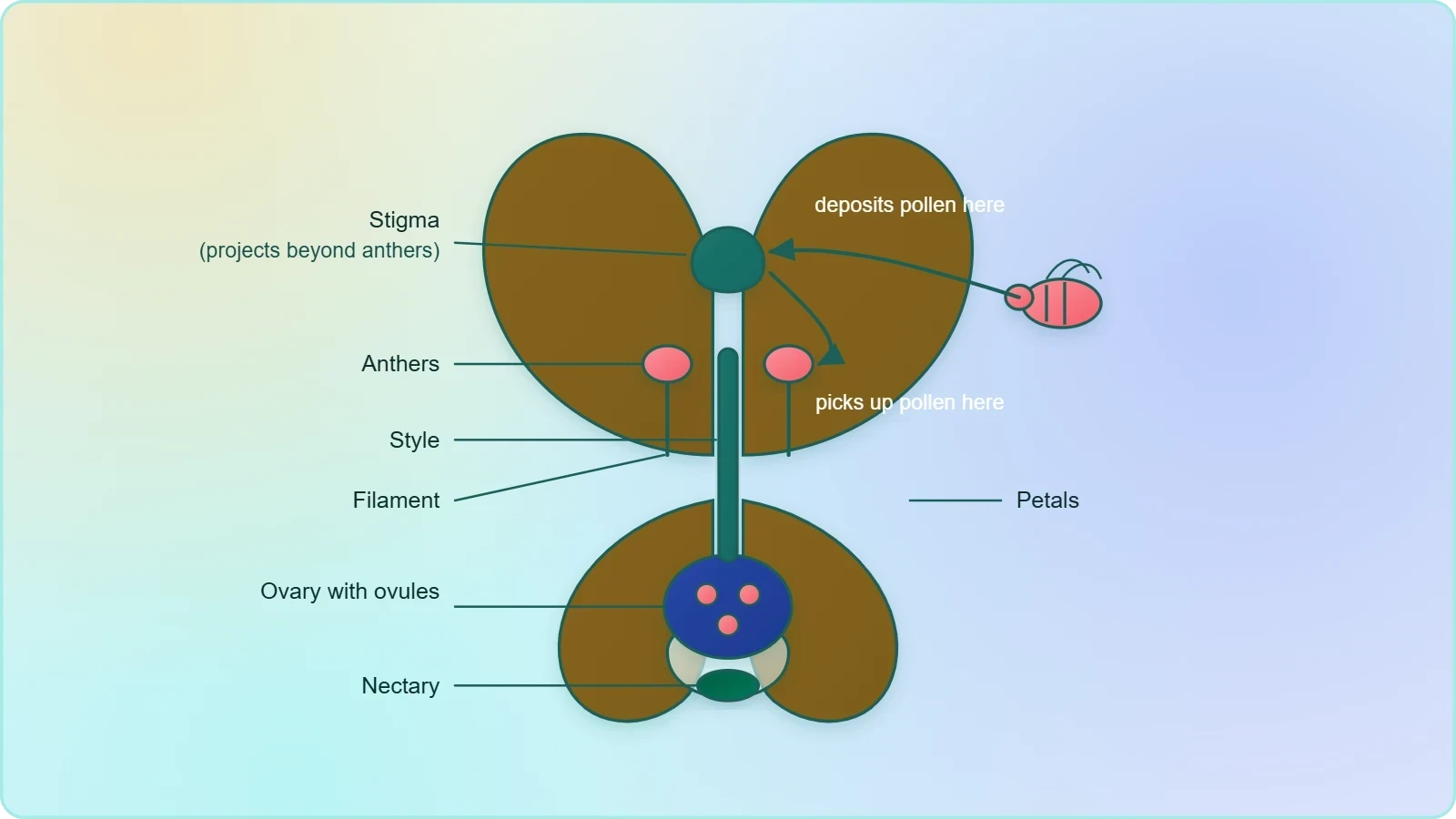
The second device is spatial: the anther and stigma are positioned differently within the flower, so that pollen from the anther is unlikely to be deposited on the stigma of the same flower. The material describes this as different positions of anther and stigma, and it is one of the most easily observed of the outbreeding devices. In some flowers the stigma is placed above the anthers, in others below, and in still others the two are separated laterally. The arrangement ensures that a pollinator's body contacts the anther and the stigma at different points, reducing the chance of self-transfer.
The spatial device is often described as herkogamy, and it can be remarkably precise. In some species the stigma projects beyond the anthers so that a visiting insect must brush past the stigma before reaching the pollen, picking up pollen from another flower on the way in and depositing it before picking up the flower's own pollen on the way out. In other species the anthers are positioned to deposit pollen on a part of the pollinator's body that does not contact the stigma. The result is a mechanical separation of the male and female functions within a single flower.
Structural Separation Within the Flower
The structural arrangement of anther and stigma is closely tied to the morphology of the pollinator. A flower pollinated by a long-tongued bee may place its anthers and stigma at positions that correspond to the bee's body, while a flower pollinated by a hovering moth may adopt a different geometry. The material's account of different positions of anther and stigma is therefore not merely a description of floral anatomy but a statement about the functional fit between flower and pollinator. The separation of the two organs is a device that works through the behaviour of the animal that visits the flower.
In some flowers the structural separation is combined with a change in the position of the stigma over time, so that the stigma moves into the path of the pollinator after the anthers have shed their pollen. This combination of spatial and temporal devices is more effective than either alone, and it illustrates how outbreeding mechanisms can be layered. The material lists different positions of anther and stigma as a distinct device, but in practice it frequently operates in concert with asynchrony and with the physiological barrier of self-incompatibility.
Herkogamy and Pollinator Fit
The precision of herkogamy is best appreciated by considering the path a pollinator takes through a flower. An insect entering a flower with a projecting stigma contacts the stigma first, depositing pollen it has carried from a previous visit, and then contacts the anthers, picking up fresh pollen. The sequence is reversed on the next flower, and the result is a directed transfer of pollen between flowers rather than within them. The device depends on the pollinator's consistent behaviour, and it is therefore most effective in flowers that attract a narrow range of visitors with predictable movements.
Where pollinators are generalists, the structural separation of anther and stigma may be less reliable, and plants often supplement it with other devices. The material's treatment of different positions of anther and stigma should therefore be read as one element in a suite of mechanisms, each contributing to the overall bias against self-pollination. The spatial arrangement is the most visible of these mechanisms, but its effectiveness is always contingent on the ecological setting in which the flower operates.
Self-Incompatibility
The third device is physiological: self-incompatibility. The material identifies self-incompatibility as one of the devices by which flowering plants discourage self-pollination, and it is the most decisive of them because it operates after pollen has landed on the stigma. In self-incompatible species, pollen from the same plant fails to germinate on the stigma or fails to grow a pollen tube through the style, so that self-pollination does not lead to seed formation. The barrier is biochemical, and it allows the plant to reject its own pollen while accepting pollen from genetically different individuals.
The material's exercise section asks directly why self-pollination does not lead to seed formation in self-incompatible species, and the answer lies in this recognition system. The stigma and style are able to distinguish between compatible and incompatible pollen, and the incompatible grains are inhibited. This inhibition is part of the broader phenomenon of pollen-pistil interaction, which the material defines as all events from the landing of pollen grains on the stigma until the pollen tube enters the embryo sac when the pollen is compatible, or pollen inhibition when the pollen is incompatible. Self-incompatibility is thus the physiological expression of that interaction.
Recognition and Rejection
The recognition system that underlies self-incompatibility is one of the most studied phenomena in plant reproductive biology. The stigma carries molecules that can identify pollen as self or non-self, and the pollen carries corresponding molecules that are recognised by the stigma. When the two match, the pollen is rejected; when they differ, the pollen is accepted and permitted to germinate. The material does not elaborate the molecular details, but it establishes the essential point: self-incompatibility is a device that prevents self-fertilisation by blocking the growth of self-pollen.
The consequence for the plant is a strong bias toward cross-pollination. Even if a pollinator deposits self-pollen on the stigma, the incompatibility reaction prevents that pollen from reaching the ovules. The device therefore complements the temporal and spatial mechanisms described earlier: where those reduce the likelihood that self-pollen arrives, self-incompatibility ensures that self-pollen which does arrive is not permitted to fertilise. The combination provides a robust barrier against inbreeding.
Consequences for Seed Set
Self-incompatibility has practical implications that extend beyond the individual flower. In a self-incompatible species, a solitary plant cannot set seed on its own, and successful reproduction requires the presence of a genetically different individual nearby. This requirement shapes the breeding systems of populations and influences the spacing and abundance of plants in a community. It also matters for agriculture, where orchards of self-incompatible fruit trees must be interplanted with compatible polliniser varieties to ensure adequate fruit set.
The material's treatment of self-incompatibility is deliberately concise, but its implications are far-reaching. The device is a clear example of how a physiological mechanism can enforce outcrossing even when the floral architecture would permit selfing. It also illustrates the general principle that outbreeding devices operate at multiple levels, from the timing of development to the molecular recognition of pollen, and that the effectiveness of the whole system depends on the coordination of these levels.
Unisexual Flowers: Monoecious and Dioecious Plants
The fourth device is organisational: unisexual flowers. When a flower bears only stamens or only pistils, self-pollination within that flower is impossible, because the male and female organs are not present together. The material describes unisexual flowers in monoecious and dioecious plants as one of the devices by which flowering plants discourage self-pollination and encourage cross-pollination. The device operates at the level of the whole plant, and its effectiveness depends on whether the male and female flowers are borne on the same individual or on different individuals.
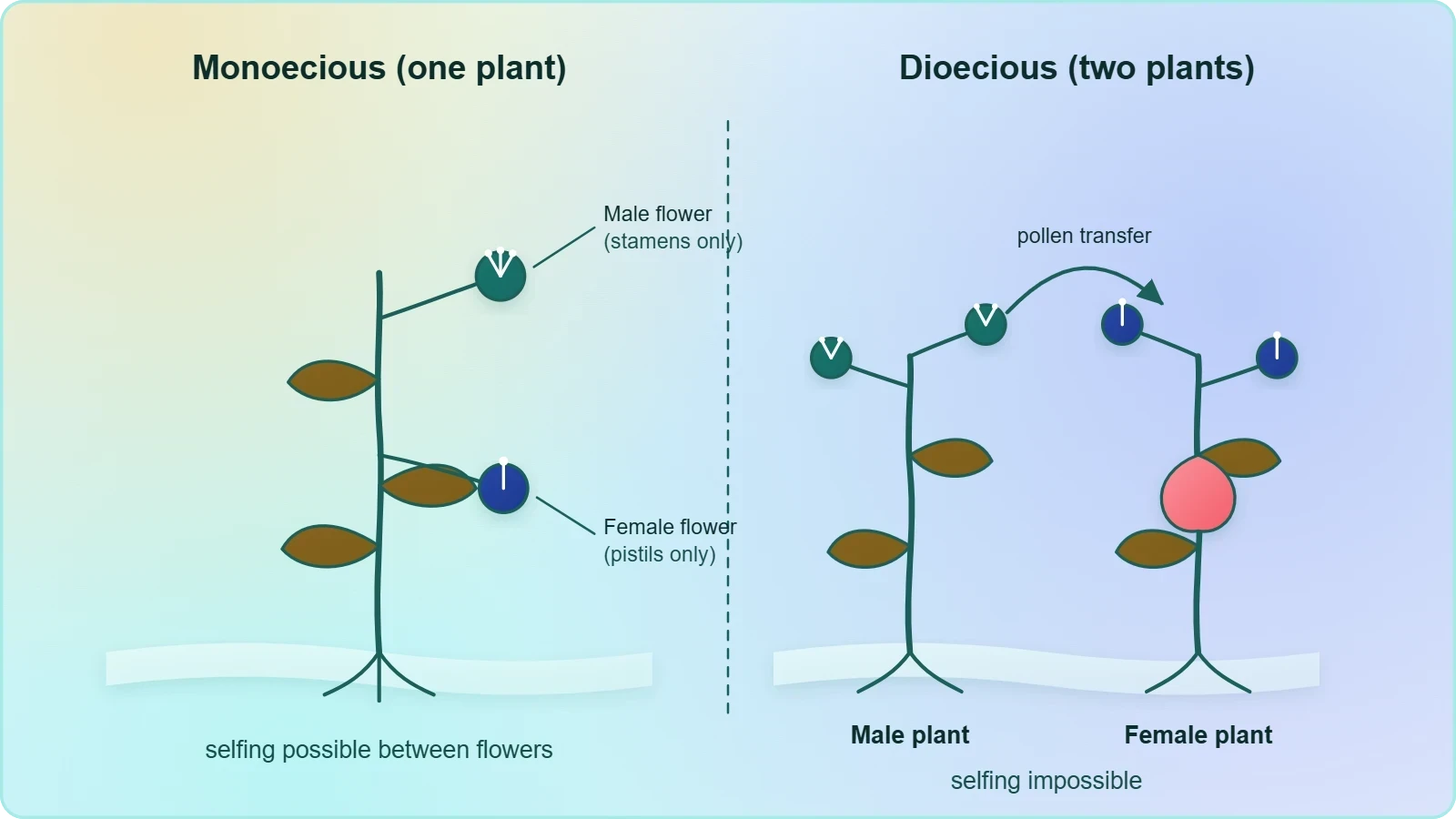
In monoecious plants, both male and female flowers are present on the same plant. The separation of the sexes into different flowers prevents self-pollination within a single flower, but it does not prevent pollen from a male flower on one branch from reaching a female flower on another branch of the same plant. Cross-pollination is encouraged, but selfing between flowers of the same individual remains possible. The material presents monoecious plants as one of the two arrangements of unisexual flowers, and the distinction from dioecious plants is important for understanding the strength of the barrier.
Monoecious Plants
In a monoecious plant, the male and female flowers are separate but share the same individual. The arrangement eliminates the possibility of self-pollination within a flower, since no flower contains both stamens and pistils, but it leaves open the possibility of pollen transfer between flowers of the same plant. The material's account of unisexual flowers in monoecious plants therefore describes a partial device: it discourages selfing by removing the hermaphroditic flower, but it does not eliminate geitonogamy, the transfer of pollen between flowers of the same individual.
The effectiveness of the monoecious arrangement depends on the spatial and temporal separation of the male and female flowers. If the male flowers are borne on different parts of the plant from the female flowers, or if they mature at different times, the chance of pollen transfer between them is reduced. The material does not elaborate these details, but it establishes the essential point: monoecious plants have unisexual flowers, and this arrangement is one of the devices that discourage self-pollination and encourage cross-pollination.
Dioecious Plants
In a dioecious plant, male and female flowers are present on different plants. The arrangement is the strongest of the unisexual devices, because a plant bearing only male flowers cannot receive pollen, and a plant bearing only female flowers cannot donate it. Self-pollination between flowers of the same individual is therefore impossible, and cross-pollination requires the transfer of pollen from a male plant to a female plant. The material presents dioecious plants as the more complete expression of the unisexual strategy, and the distinction from monoecious plants is one of the key comparisons in the lesson.
The dioecious arrangement has consequences for population structure and for agriculture. Because a female plant depends entirely on pollen from a male plant, the sex ratio of the population and the distance between individuals affect reproductive success. In cultivated species, dioecy complicates orchard design, since polliniser plants must be included to supply pollen. The material's treatment of dioecious plants is brief, but it captures the essential feature: the separation of the sexes onto different individuals is a decisive device against self-pollination.
Integrating the Devices and Looking Ahead
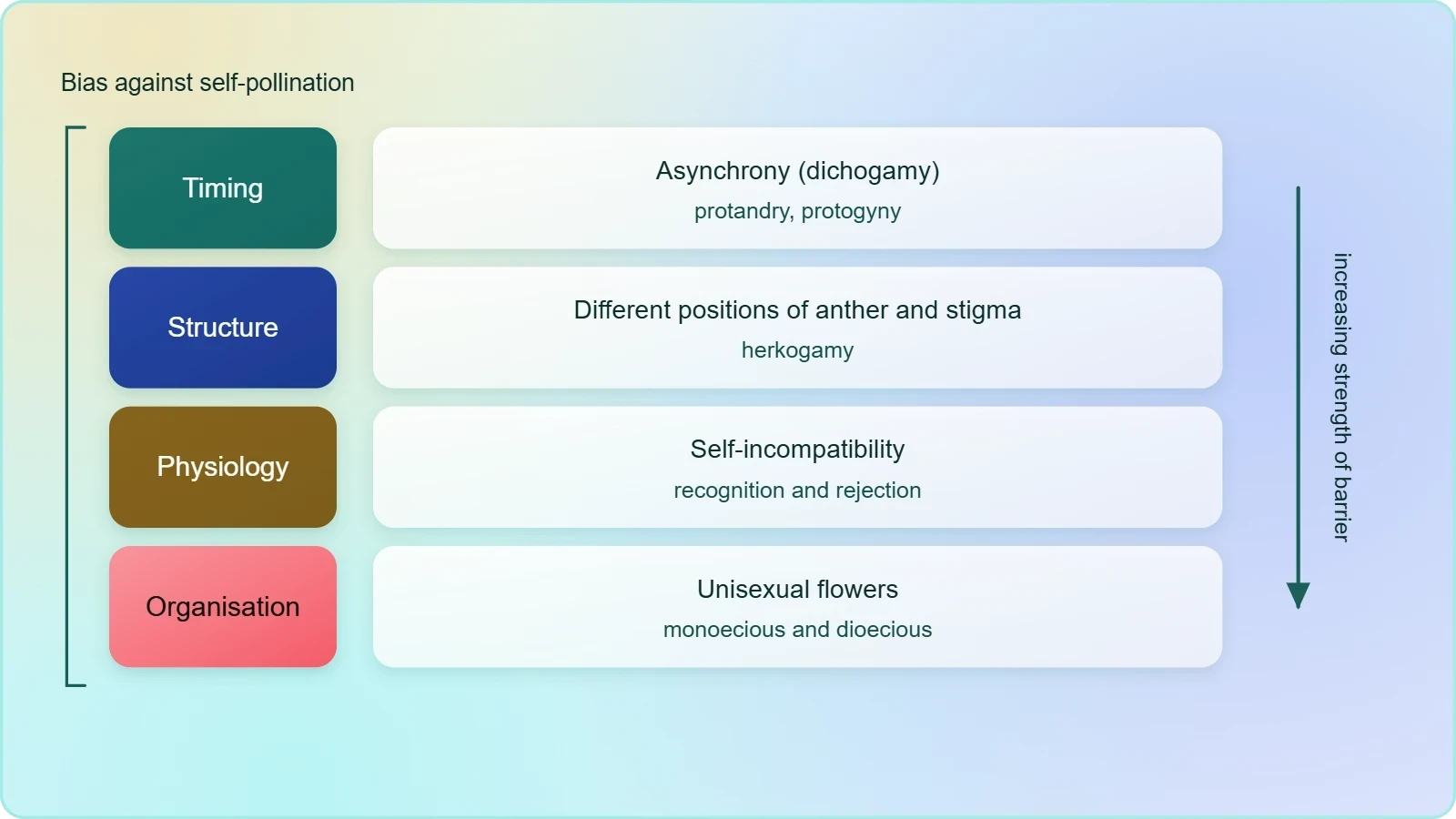
The four devices described in this lesson operate at different levels of biological organisation, and their integration is what gives flowering plants a robust bias against self-pollination. Asynchrony works through developmental timing, different positions of anther and stigma through floral architecture, self-incompatibility through cellular recognition, and unisexual flowers through the sexual organisation of the whole plant. No single device is universally effective, and most plants combine several, so that the failure of one is compensated by another. The material presents these devices as a set, and the set is best understood as a coordinated system rather than a list of independent mechanisms.
The integration has a practical dimension as well. Plant breeders manipulate these devices to control pollination, using techniques such as emasculation and bagging to prevent unwanted selfing and to make controlled crosses. The material's exercises ask about the bagging technique and about emasculation, and both depend on an understanding of the devices described here. A breeder who knows when pollen is shed, where the stigma is positioned, and whether the species is self-incompatible can design a pollination programme that achieves the desired cross with minimal contamination.
From Outbreeding to Pollen-Pistil Interaction
The devices described here determine which pollen reaches the stigma and whether it is permitted to function. Once a compatible pollen grain has landed, the events of pollen-pistil interaction begin: the grain germinates, the pollen tube grows through the style, enters the ovule and discharges two male gametes in one of the synergids. The material defines pollen-pistil interaction as all events from the landing of pollen grains on the stigma until the pollen tube enters the embryo sac when the pollen is compatible, or pollen inhibition when the pollen is incompatible. The next lesson takes up this sequence in detail.
The connection between outbreeding devices and pollen-pistil interaction is therefore direct. Self-incompatibility is the point at which the two topics meet, since it is both an outbreeding device and a component of the pollen-pistil interaction. The temporal and spatial devices determine the composition of the pollen load on the stigma, while the physiological device determines which grains in that load are accepted. Together they set the conditions under which double fertilisation, the formation of endosperm and embryo, and the development of seed can proceed.
Going further
Castor and maize are examples of monoecious plants, in which both male and female flowers are present on the same plant. In maize the male flowers are borne in the tassel at the top of the plant and the female flowers in the ear lower down, so that the two sexes are spatially separated as well as being in different flowers. Castor bears separate male and female flowers on the same inflorescence. These examples illustrate how the monoecious arrangement described in the material is realised in familiar crop plants.
Papaya is an example of a dioecious plant, in which male and female flowers are present on different plants. A papaya plant bears either male flowers or female flowers, and fruit is produced only on the female plants after pollination from a male plant. The dioecious arrangement is the strongest of the unisexual devices, and papaya illustrates its practical consequence: a population must contain both sexes for reproduction to occur, and the sex of an individual cannot be determined from its flowers until they open.
Key Terms and Consolidation
The terminology of this lesson repays careful consolidation. Inbreeding depression is the decline in vigour and fertility that follows continued self-pollination. Asynchrony of pollen release and stigma receptivity is the temporal separation of the male and female phases of a flower. Different positions of anther and stigma is the spatial separation of the two organs within the flower. Self-incompatibility is the physiological rejection of self-pollen, and unisexual flowers are those that bear only stamens or only pistils. Monoecious plants bear both male and female flowers on the same plant, while dioecious plants bear them on different plants.
These terms are the vocabulary in which the material describes the devices by which flowering plants discourage self-pollination and encourage cross-pollination. Mastery of the vocabulary is not an end in itself but a means of following the argument: that continued selfing is costly, that plants have evolved mechanisms to avoid it, and that these mechanisms operate at several levels. The exercises in the material ask learners to mention two strategies evolved to prevent self-pollination and to explain self-incompatibility, and both questions can be answered directly from the terms and concepts set out here.
Checking Understanding
A useful way to consolidate the lesson is to work through the material's own questions. Why does self-pollination not lead to seed formation in self-incompatible species? Because the incompatibility reaction inhibits the self-pollen before it can reach the ovules. What are two strategies evolved to prevent self-pollination? Asynchrony of pollen release and stigma receptivity, and different positions of anther and stigma, among others. These questions test whether the learner can connect the device to its mechanism and its consequence, which is the standard the material sets.
The learner should also be able to distinguish between the devices and to explain why they are not mutually exclusive. A single flower may be protandrous, herkogamous and self-incompatible at once, and a monoecious plant may combine unisexual flowers with asynchrony. The integration of devices is the rule rather than the exception, and the ability to describe how several devices act together is a mark of a secure understanding of the topic. The material's summary of the broader reproductive account provides the context in which this integration makes sense.
Preparing for Pollen-Pistil Interaction
The lesson closes by preparing the ground for the next topic. The devices described here determine which pollen arrives on the stigma and whether it is accepted, and the next lesson follows the accepted pollen grain through germination, tube growth and the discharge of male gametes. The material's definition of pollen-pistil interaction as all events from the landing of pollen grains on the stigma until the pollen tube enters the embryo sac, or pollen inhibition when the pollen is incompatible, makes the connection explicit. Self-incompatibility is the bridge between the two lessons.
With the outbreeding devices in place, the learner is ready to follow the compatible pollen grain on its journey. The pollen grain germinates on the stigma, the pollen tube grows through the style, enters the ovules and finally discharges two male gametes in one of the synergids. The events that follow, including double fertilisation and the formation of endosperm and embryo, depend on the successful completion of this journey. The devices studied here are the gatekeepers that determine which grains are permitted to make it.
Also Read
- No links available.
From our network :
- Vite 6/7 'Cold Start' Regression in Massive Module GraphsIn-depth analysis of Vite 6/7 cold start regressions in massive module graphs. Learn about barrel file issues, pre-bundling optimizations, and how to improve Vite dev server performance.
- 10 Physics Numerical Problems with Solutions for IIT JEEPrepare for IIT JEE with 10 physics numerical problems, complete with detailed solutions and conceptual explanations. Ideal for mastering kinematics, thermodynamics, electromagnetism, and optics.
- 98% of Global MBA Programs Now Prefer GRE Over GMAT Focus EditionExplore why 98% of global MBA programs now prefer the GRE over GMAT Focus. Learn about the shorter GRE format, verbal logic importance, and strategic versatility for students.
- Mastering DB2 LUW v12 Tables: A Comprehensive Technical GuideComprehensive guide on DB2 LUW v12 tables. Explore CREATE TABLE syntax, BLU Acceleration, range partitioning, data types, and security features for IBM DB2 LUW v12.
- Trump Political Strategy How Geopolitical Stunts Serve As Media Diversions
- Mastering DB2 12.1 Instance Design: A Technical Deep Dive into Modern Database ArchitectureComprehensive guide to DB2 12.1 Instance Design. Explore architectural components, HADR setup, buffer pool tuning, and security policies for IBM DB2 12.1. Includes 10 functional SQL and Shell samples.
- Analyzing Trump Deportation Numbers Insights Into The 2026 Immigration Crackdown
- EV 2.0: The Solid-State Battery Breakthrough and Global Factory ExpansionDiscover the impact of the Solid-State Battery Breakthrough on the EV market. Learn about CATL and BYD stock growth, global factory expansion in Europe, and the future of EV 2.0 technology.
- AI-Powered 'Precision Diagnostic' Replaces Standard GRE Score ReportsDiscover the new GRE Precision Diagnostic. Learn how AI-powered behavioral analytics and time-to-solve tracking are replacing standard GRE score reports to empower students.
RESOURCES
- List two outbreeding devices that flowering plants have developed to ...brainly.inJun 24, 2019 ... The outbreeding devices in flowering plants that encourages cross pollination are: Dicliny: Flowers are unisexual so that self pollination is ...
- Outbreeding Devices in Flowering Plants - Pollination - Scribdscribd.comOutbreeding. Devices in Flowering Plants Outbreeding devices are mechanisms that promote cross-pollination, the transfer of pollen from the anther of one ...
- Plant mating systems: self-incompatibility and evolutionary ...pubmed.ncbi.nlm.nih.govSep 13, 2017 ... Flowering plants have evolved diverse mechanisms that promote outcrossing. The most widespread of these outbreeding devices are ...
- Outbreeding Devices in Flowering Plants - Pollination - Scribdscribd.comThe document discusses outbreeding devices in flowering plants, which are mechanisms that promote cross-pollination and prevent self-pollination to maintain ...
- Explain different outbreeding devices developed by flowering plantsaskfilo.comDifferent Outbreeding Devices Developed by Flowering Plants · Dichogamy. The stamens and pistils mature at different times. · Herkogamy. Physical separation of ...
- Outbreeding Devices in Plants: Types, Mechanisms & Examplesallen.inDefinition: Outbreeding devices are mechanisms or features in flowers that prevent self-pollination and encourage cross-pollination. · They act as barriers to ...
- Sexual Reproduction in Flowering Plants: Structured Study Notespearson.comOutbreeding Devices. Plants have evolved mechanisms to prevent self-pollination and encourage genetic diversity: Temporal separation: Pollen release and ...
- Out breeding devices .pptx.pdf Class XII - Slideshareslideshare.netFlowering plants have developed several outbreeding devices to prevent inbreeding depression that can occur from self-pollination.
- Multiple-allelomorph Incompatibility of Pollen and - jstorjstor.orgoften of less fundamental evolutionary significance. II. Comparison of Outbreeding Devices in Gymnosperms and. Angiosperms. There appear to be two main ...
- Class 12 Biology Understand how flowering plants prevent selffacebook.comJul 15, 2026 ... Class 12th || Lec 05 || Sexual Rep in flowering plant || #NEET #BSC #Cuet #pollination #outbreeding devices #artifical #hybridisation…
- THE evolution of outbreeding in plants - Naturenature.comobvious of the outbreeding devices, they may well be present in many more ... flowering plants. From taxonomic evidence he concludes that dicecious.
- Plant mating systems: self-incompatibility and evolutionary ...sciencedirect.comFlowering plants have evolved diverse mechanisms that promote outcrossing. The most widespread of these outbreeding devices are self-incompatibility systems ...
- Pollen-pistil interaction - Outbreeding devices - BYJU'Sbyjus.comJan 23, 2020 ... This prevents self-pollination; even though the flower is hermaphrodite. Self-incompatibility: Incompatibility within a flower (or plant) ...
- Make a list of any three out breeding devices that flowering plants ...sarthaks.comOct 11, 2018 ... Outbreeding devices : (i) In order to avoid self-pollination, cross-pollination is encouraged in plants as follows:.
- lebo101.pdf - NCERTncert.nic.inOutbreeding Devices : Majority of flowering plants produce hermaphrodite flowers and pollen grains are likely to come in contact with the stigma of the…