Animal pollination represents one of the most consequential partnerships in the living world, a relationship in which flowering plants trade food for the faithful transfer of male gametes. Where wind and water scatter pollen blindly, animals deliver it with precision, carrying grains from anther to stigma across distances and between individual flowers. This lesson examines the range of animal pollinating agents — bees, butterflies, flies, beetles, wasps, ants, moths, birds and bats — and establishes why insects, and particularly bees, dominate as biotic pollinators. It also explores the floral rewards that sustain these visitors, the sticky pollen characteristic of animal-pollinated flowers, and the specialised relationships that bind certain plants to particular animals.
The material builds directly on the preceding lesson on abiotic pollination. Having established that wind- and water-pollinated flowers squander enormous quantities of pollen and depend on chance, we now turn to the opposite strategy: economy of pollen, precision of delivery, and an elaborate system of incentives. Animal-pollinated flowers invest in nectar, in conspicuous petals, in scent and in adhesive pollen, all of which serve to attract and reward animal couriers. Understanding these agents is essential preparation for the next lesson on outbreeding devices, because the behaviour of pollinators shapes how plants avoid self-fertilisation.
This lesson follows the course's established terminology and order of ideas, treating the range of animal agents, the dominance of bees, floral rewards, sticky pollen and specialised mutualisms such as that between the moth and Yucca. A short "Going further" block adds well-established background on foul-odour flowers and on pollen and nectar robbers, clearly separated from the core material. Learners at intermediate to advanced level should leave able to classify animal pollinators, explain the economics of animal pollination, and describe at least one specialised plant–animal relationship in detail.
On This Page
The Range of Animal Pollinating Agents
Animal pollination, or zoophily, draws on an astonishing diversity of visitors. The material identifies bees, butterflies, flies, beetles, wasps, ants, moths, birds and bats as the principal animal agents, and notes that insects, particularly bees, are the dominant biotic pollinators. This dominance is not accidental: insects are numerous, mobile, energetically demanding and frequently hairy, making them ideal couriers for pollen. Among insects, bees stand apart because they actively collect pollen as a food source for their larvae, which brings them into repeated contact with anthers and stigmas. The sheer scale of insect pollination underpins a large share of global food crop production.
Insect Pollinators and Their Diversity
Within the insects, the material lists bees, butterflies, flies, beetles, wasps, ants and moths as distinct categories of pollinating agent. Each group approaches flowers with different sensory priorities and different behaviours, and this diversity is reflected in the flowers that court them. Butterflies and moths, for instance, are attracted by colour and scent and possess long proboscises suited to deep-throated flowers, while beetles are often associated with more open, bowl-shaped blooms. Flies are drawn to a wide range of odours, and wasps and ants contribute to pollination in more incidental ways. The material's enumeration establishes that animal pollination is not a single phenomenon but a spectrum of interactions.

The dominance of bees within this spectrum deserves emphasis. Bees are the most important biotic pollinators because they depend on floral resources for both adult nutrition and larval provisioning, and because many species exhibit floral constancy, visiting the same flower type repeatedly. This constancy improves the efficiency of pollen transfer between conspecific flowers. The material's statement that insects, particularly bees, are the dominant biotic pollinators is therefore a claim about both abundance and effectiveness. Learners should appreciate that the bee's central role rests on its foraging biology, its body covering and its social organisation, all of which amplify its value as a courier.
Vertebrate Pollinators: Birds and Bats
Beyond insects, the material includes birds and bats among animal pollinating agents. These vertebrates operate at a different scale, often transporting larger pollen loads over greater distances and visiting flowers that are correspondingly robust and generous in their rewards. Bird-pollinated flowers are frequently large, vividly coloured and rich in dilute nectar, while bat-pollinated flowers tend to open at night and offer copious nectar and sturdy structures capable of withstanding a visitor's weight. The inclusion of birds and bats in the material's list signals that zoophily extends well beyond the insect world and that vertebrate pollinators play significant ecological roles, particularly in tropical and subtropical regions.

For learners, the vertebrate examples reinforce a general principle: the identity of the pollinating agent shapes floral form. A flower adapted to a hovering bird or a nocturnal bat cannot be understood in isolation from its visitor. The material's simple enumeration of birds and bats thus opens onto a broader comparative logic, in which floral architecture, reward chemistry and timing of anthesis all track the sensory capacities and behaviour of the animal partner. This comparative habit of mind is precisely what the course seeks to cultivate as it moves from agents to outbreeding devices.
Floral Rewards: Nectar and Pollen
Animal pollination is a transaction, and the material is explicit that flowers offer rewards to secure it. Nectar and pollen are the two principal currencies. Nectar is a sugar-rich secretion that fuels the energetic flight of bees, butterflies, moths, birds and bats, while pollen itself is harvested by many bees as a protein source for developing larvae. These rewards convert a flower from a passive structure into a resource worth visiting repeatedly. The material's emphasis on floral rewards establishes the economic logic of zoophily: the plant pays in food, and the animal delivers gametes. This reciprocity distinguishes animal pollination sharply from the indiscriminate dispersal characteristic of wind and water.
Nectar as an Energy Currency
Nectar functions as the primary energy reward in most animal-pollinated systems. Its sugar content sustains the high metabolic demands of flight, particularly in bees, whose foraging trips require substantial caloric expenditure. Because nectar is renewable, a flower can continue to attract visitors over an extended period, and the rate at which it is secreted can be tuned to the energetic needs of the intended pollinator. The material treats nectar as a defining feature of animal-pollinated flowers, and this framing is pedagogically useful: it directs attention to the physiological exchange that underlies the ecological partnership. Learners should recognise that nectar production represents a genuine metabolic cost to the plant, one justified by the reliability of animal-mediated pollen transfer.
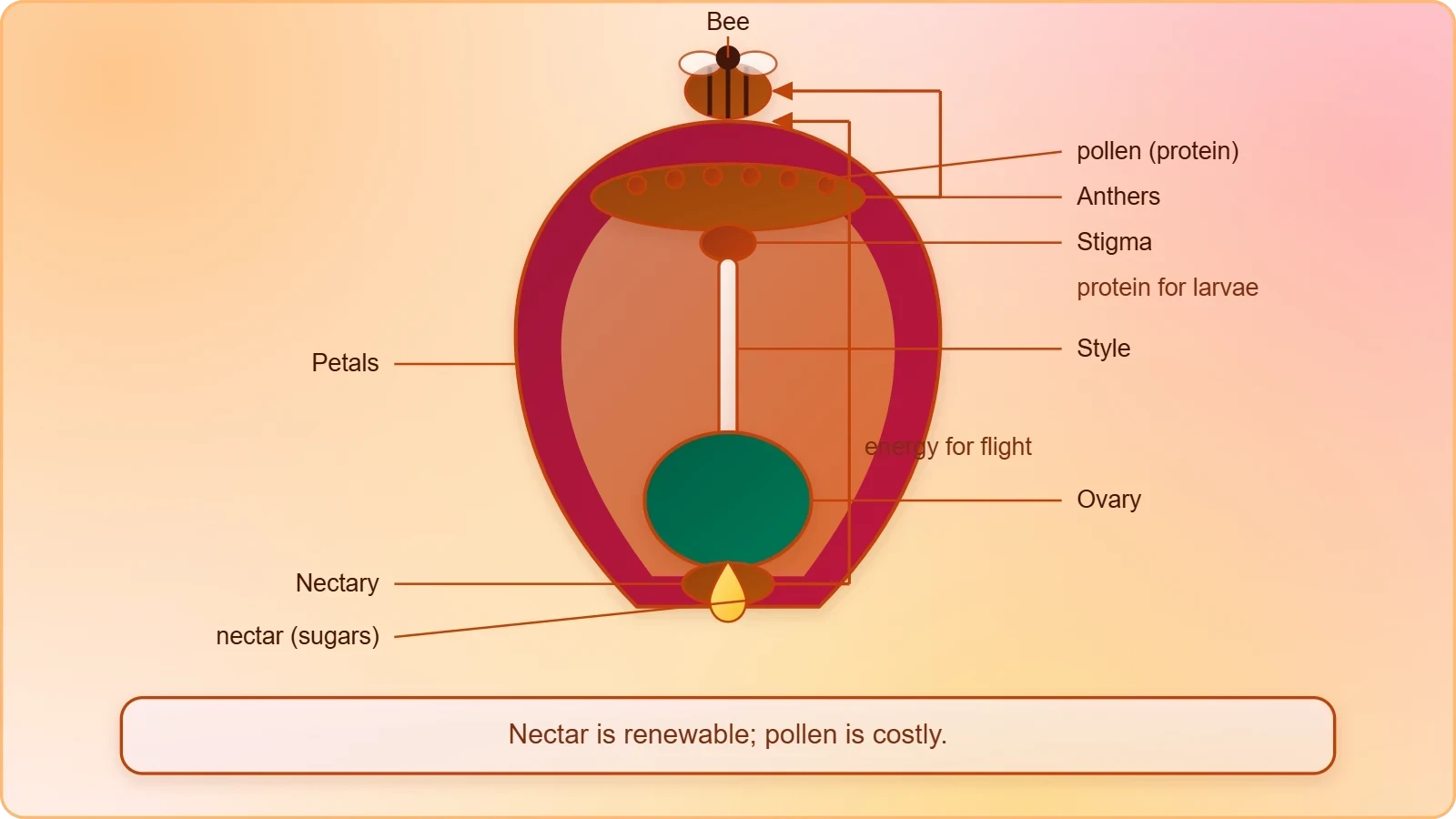
The relationship between nectar and pollinator behaviour also explains why animal-pollinated flowers can afford to produce relatively little pollen compared with wind-pollinated species. Where wind pollination demands vast quantities of pollen to compensate for chance losses, animal pollination substitutes reward for volume. The plant invests in nectar to ensure that a smaller quantity of pollen reaches the right stigma. This trade-off between reward and pollen economy is one of the central insights of the lesson, and it connects directly to the sticky pollen discussed below. Nectar, in short, is the mechanism by which plants purchase precision.
Pollen as a Protein Reward
Pollen serves a dual purpose in animal pollination: it is the male gametophyte destined for the stigma, and it is also a nutritious reward in its own right. Many bees collect pollen deliberately, packing it into specialised structures for transport to the nest, where it provisions larvae. This dual role creates a tension that the plant must manage, since pollen consumed as food is pollen unavailable for fertilisation. The material acknowledges pollen as a floral reward alongside nectar, and this recognition is important for understanding why certain flowers produce abundant pollen even though animal pollination is generally pollen-economical. The balance struck between reward and reproductive function varies across species and shapes floral design.
For learners, the dual role of pollen illustrates a broader principle of co-evolution: the same structure can serve reproduction and nutrition simultaneously, and the resulting tension drives diversification in floral form and pollen presentation. Flowers may conceal pollen, release it in controlled doses, or offer sterile "feeding" anthers alongside fertile ones. The material's brief mention of pollen as a reward thus opens onto a rich field of study. It also reinforces the lesson's central theme, that animal pollination is a negotiated exchange in which both partners extract value and both are shaped by the terms of the bargain.
Sticky Pollen and the Mechanics of Animal Transfer
The material draws attention to the sticky pollen of animal-pollinated flowers, a feature that distinguishes them from the dry, dusty pollen of wind-pollinated species. Stickiness is a functional necessity: pollen must adhere to the body of a visiting animal and remain there until the stigma of another flower is contacted. This adhesive quality, often conferred by a viscous pollenkit or by surface sculpturing, ensures that grains are not simply dislodged in flight. The material's mention of sticky pollen is brief but pivotal, because it links the reward economy of the flower to the physical mechanics of gamete transfer. Without adhesion, the entire system of animal-mediated pollination would collapse.
Adhesion and Pollen Vectors
Sticky pollen is adapted to the surfaces it must cling to: the branched hairs of bees, the scales of butterfly wings, the feathers of birds and the fur of bats. Each of these surfaces presents different challenges, and the chemistry of pollen adhesion has evolved accordingly. The material's emphasis on stickiness therefore reflects a general principle of functional morphology, in which the properties of the pollen grain are matched to the properties of the animal vector. Learners should appreciate that stickiness is not a trivial detail but a design feature that makes zoophily possible. It is the physical counterpart to the behavioural fidelity of the pollinator.

This adhesive strategy also explains why animal-pollinated flowers can produce far less pollen than their wind-pollinated counterparts. A sticky grain that reaches an animal is likely to reach a stigma; a dry grain released into the air is overwhelmingly likely to be lost. The material's contrast between sticky animal-borne pollen and the wasteful dispersal of abiotic pollination is thus a lesson in reproductive economy. By investing in adhesion and reward, the plant converts a small pollen budget into a high probability of fertilisation. This economy is the thread that connects the present lesson to the preceding one on wind and water.
From Anther to Stigma: Precision Delivery
The combination of sticky pollen and a motivated visitor produces a delivery system of remarkable precision. An animal arriving for nectar or pollen brushes against the anthers, picks up adhesive grains, and carries them to the next flower of the same species, where the stigma presents a receptive surface. The material's account of animal pollination implies this sequence without belabouring it, and learners should be able to reconstruct the pathway from anther to stigma. Precision delivery is the payoff of the entire reward-and-adhesion system, and it is what allows animal-pollinated plants to maintain genetic continuity across scattered individuals within a population.
Precision also has consequences for the plant's breeding system, which is why this lesson prepares the ground for the next. When a pollinator moves faithfully between flowers of the same species, it promotes cross-pollination, but when it moves between flowers of the same plant, it may promote self-pollination. The behaviour of the animal therefore interacts with the plant's own outbreeding devices, the subject of the following lesson. The material's treatment of animal agents thus sits within a larger argument about how flowering plants balance the benefits of animal-mediated delivery against the risks of inbreeding.
Specialised Relationships: The Moth and the Yucca
Among the many plant–animal partnerships, the material singles out the relationship between the moth and Yucca as an example of specialisation. This is a mutualism of unusual intimacy, in which the moth pollinates the yucca while depending on it for the completion of its own life cycle. Such relationships illustrate how far co-evolution can proceed: the plant and the animal become so closely attuned that neither can easily persist without the other. The material's choice of this example is instructive because it moves beyond general statements about bees and flowers to a specific, well-documented case. Learners should study it as a model of how specialised pollination systems function and why they are ecologically fragile.
Obligate Mutualism and Co-evolution
The yucca–moth relationship is typically obligate, meaning that each partner relies on the other for reproduction. The moth visits the yucca flower, collects pollen deliberately, and deposits it on the stigma of another flower, while also laying eggs in the ovary. The developing larvae consume some of the seeds, but the plant retains enough to reproduce. This arrangement is a finely balanced bargain, and it exemplifies the reciprocal adaptation that characterises specialised pollination. The material's reference to the moth and Yucca thus serves as a concrete illustration of the general principle that animal pollination is a co-evolved exchange, not a one-sided exploitation.
Specialisation of this kind carries risks as well as benefits. An obligate mutualist is vulnerable to the decline of its partner, and the loss of either species can cascade through the system. The material does not dwell on these risks, but they follow naturally from the example and are worth noting as a bridge to broader ecological thinking. For learners, the yucca case demonstrates that the precision of animal pollination is purchased at the cost of dependence. The same intimacy that makes delivery reliable also makes the system brittle, a tension that recurs throughout the study of plant–animal interactions.
Other Noteworthy Specialisations
Beyond the yucca and its moth, the material's broader list of animal agents implies a wide range of specialised relationships. Certain figs depend on particular wasps, some orchids mimic the appearance or scent of female insects to attract males, and various tropical flowers are tailored to specific birds or bats. These examples share the logic of the yucca case: a narrow partnership yields efficient pollen transfer but ties the plant's fortunes to a single animal lineage. The material's emphasis on the moth and Yucca is therefore representative rather than exhaustive, and learners should generalise the principle to the many specialisations documented in the botanical literature.
The study of such specialisations also illuminates the diversity of floral form. Flowers that court particular animals evolve shapes, colours, scents and reward schedules matched to their partners' senses and behaviours. The material's account of animal pollination thus connects floral morphology to animal behaviour in a single explanatory framework. This connection is one of the most satisfying insights of the course, and it prepares learners for the next lesson, where the focus shifts from attracting pollinators to preventing them from delivering pollen to the wrong stigma.
Going Further: Additional Context on Animal Pollination
The core material establishes the range of animal agents, the dominance of bees, the role of nectar and pollen as rewards, the stickiness of animal-borne pollen and the specialised case of the moth and Yucca. A few well-established observations from the wider botanical literature can deepen this picture without altering the material's claims. These additions are offered as background and should be read as extensions of the lesson rather than as part of its central argument. They illustrate the same principles of reward, attraction and co-evolution that the material develops, and they help learners appreciate the full diversity of animal pollination strategies.
Foul Odours and Unusual Attractants
Some flowers pollinated by flies and beetles secrete foul odours to attract these animals. These scents, which may resemble decaying matter, dung or carrion, draw insects that are ordinarily associated with such substrates, and the flowers often mimic the appearance of rotting material as well. This strategy expands the range of animal agents beyond the nectar-seeking bees and butterflies, showing that pollination rewards need not always be pleasant to human senses. The principle remains the same: the flower offers an attractant matched to the sensory world of its visitor. Learners should recognise that foul odours are simply another currency in the economy of animal pollination.
The existence of such flowers also reminds us that pollination syndromes are diverse and that no single model captures every case. A beetle drawn to a fetid odour is as legitimate a pollinator as a bee drawn to sweet nectar, and the flowers that court it are correspondingly adapted. This broadening of perspective is valuable for learners who might otherwise equate animal pollination with bees alone. The material's list of agents already includes flies and beetles, and the foul-odour strategy explains how such insects can be recruited reliably. It is a useful complement to the core lesson.
Pollen and Nectar Robbers
Pollen and nectar robbers are floral visitors that consume pollen or nectar without bringing about pollination. They may bite through the base of a flower to reach nectar, bypassing the anthers and stigma, or they may collect pollen without contacting the receptive surfaces. Robbers thus exploit the reward economy without delivering the service for which it was designed. Their existence highlights the fact that animal pollination is not a perfectly enforced contract but an arena of competing interests. Plants evolve defences and counter-strategies, and the balance between mutualists and robbers shapes floral design over evolutionary time.

For learners, the concept of robbing clarifies why flowers invest in structures that guide visitors along particular paths, such as tubular corollas, landing platforms and concealed nectaries. These features increase the likelihood that a visitor will contact the reproductive organs while collecting its reward. The material's emphasis on rewards and sticky pollen is thus complemented by an awareness that not every visitor is a pollinator. Recognising robbers sharpens the distinction between floral visitors and effective pollinators, a distinction that matters greatly in the study of plant reproduction and in the management of pollinator-dependent crops.
Consolidating the Lesson and Looking Ahead
The lesson has surveyed the animal agents of pollination, from the dominant bees to the vertebrate birds and bats, and has examined the rewards that secure their service. It has explained why animal-pollinated flowers produce sticky pollen and why this adhesion is essential to precision delivery. It has also presented the moth and Yucca as a model of specialised mutualism, and it has added background on foul-odour flowers and on pollen and nectar robbers. Together these elements establish that animal pollination is an economy of reward and precision, in which floral form is shaped by the senses and behaviour of animal partners. This understanding is the foundation for the next lesson on outbreeding devices.
Key Takeaways for Learners
Learners should be able to list the animal pollinating agents named in the material and to explain why insects, particularly bees, are the dominant biotic pollinators. They should be able to describe nectar and pollen as floral rewards, explain the stickiness of animal-borne pollen, and recount the specialised relationship between the moth and Yucca. They should also be able to distinguish effective pollinators from robbers and to recognise that foul odours can serve as legitimate attractants. These competencies prepare the ground for the next lesson, in which the focus shifts to the devices that prevent self-pollination and promote outbreeding.
A useful way to consolidate the lesson is to compare animal pollination with the abiotic strategies studied previously. The comparison sharpens the logic of reward and adhesion, and it clarifies why animal-pollinated plants can afford to be economical with pollen. Learners might also reflect on the ecological fragility of specialised mutualisms, a theme that connects the yucca case to broader questions of conservation. The material's emphasis on the dominance of bees and on the diversity of animal agents provides a solid foundation for these reflections, and it sets up the next lesson's discussion of outbreeding devices with a clear sense of how pollinators shape plant reproduction.
Preparing for Outbreeding Devices
The behaviour of pollinators is not always favourable to the plant. An animal may visit several flowers on the same plant, depositing pollen on stigmas that are too closely related, or it may revisit a flower it has already visited. The next lesson examines the devices by which flowering plants prevent self-pollination and encourage cross-pollination, including temporal separation of anther and stigma maturity, spatial separation of the reproductive organs, and self-incompatibility. The present lesson's account of animal agents provides the behavioural context for those devices, since the movements of pollinators determine the opportunities for both selfing and outcrossing. Learners should carry forward the idea that animal pollination is a partnership whose terms the plant must continually manage.
With this foundation in place, the course proceeds to the mechanisms that safeguard genetic diversity. The material's treatment of animal pollination, rewards, sticky pollen and specialised mutualisms is thus not an isolated topic but a stage in a larger argument about how flowering plants achieve reliable sexual reproduction. The next lesson builds directly on this stage, and learners who have mastered the present material will be well prepared to understand why outbreeding devices matter and how they operate in concert with the animals that carry pollen between flowers.
Also Read
- No links available.
From our network :
- Analyzing Trump Deportation Numbers Insights Into The 2026 Immigration Crackdown
- 98% of Global MBA Programs Now Prefer GRE Over GMAT Focus EditionExplore why 98% of global MBA programs now prefer the GRE over GMAT Focus. Learn about the shorter GRE format, verbal logic importance, and strategic versatility for students.
- 10 Physics Numerical Problems with Solutions for IIT JEEPrepare for IIT JEE with 10 physics numerical problems, complete with detailed solutions and conceptual explanations. Ideal for mastering kinematics, thermodynamics, electromagnetism, and optics.
- Vite 6/7 'Cold Start' Regression in Massive Module GraphsIn-depth analysis of Vite 6/7 cold start regressions in massive module graphs. Learn about barrel file issues, pre-bundling optimizations, and how to improve Vite dev server performance.
- Mastering DB2 LUW v12 Tables: A Comprehensive Technical GuideComprehensive guide on DB2 LUW v12 tables. Explore CREATE TABLE syntax, BLU Acceleration, range partitioning, data types, and security features for IBM DB2 LUW v12.
- Trump Political Strategy How Geopolitical Stunts Serve As Media Diversions
- Mastering DB2 12.1 Instance Design: A Technical Deep Dive into Modern Database ArchitectureComprehensive guide to DB2 12.1 Instance Design. Explore architectural components, HADR setup, buffer pool tuning, and security policies for IBM DB2 12.1. Includes 10 functional SQL and Shell samples.
- EV 2.0: The Solid-State Battery Breakthrough and Global Factory ExpansionDiscover the impact of the Solid-State Battery Breakthrough on the EV market. Learn about CATL and BYD stock growth, global factory expansion in Europe, and the future of EV 2.0 technology.
- AI-Powered 'Precision Diagnostic' Replaces Standard GRE Score ReportsDiscover the new GRE Precision Diagnostic. Learn how AI-powered behavioral analytics and time-to-solve tracking are replacing standard GRE score reports to empower students.
RESOURCES
- The Importance of Pollinators - USDAusda.govPollinators like honeybees, butterflies, birds, bats and other animals are hard at work providing vital but often unnoticed services. They pollinate crops ...
- About Pollinatorspollinator.orgBirds, bats, bees, butterflies, beetles, and other small mammals that pollinate plants are responsible for bringing us one out of every three bites of…
- About Pollinators - Pollinators (U.S. National Park Service)nps.govJun 13, 2025 ... But many plants need help from insects and animals like bees, butterflies, birds, bats, and even some small mammals. Pollinators…
- Bees, birds, butterflies, bats: NSF helping keep pollinators ...nsf.govJun 18, 2024 ... Long-term data on bees themselves is helping to fill out missing knowledge of how various species respond to climate change,…
- Why are pollinating bats, birds, bees, butterflies, and other animals ...usgs.govIf so, you depend on pollinators. Wherever flowering plants flourish, pollinating bees, birds, butterflies, bats and other animals are hard at work, providing ...
- Who Are the Pollinators? | US Forest Servicefs.usda.govBats · Bees · Beetles · Birds · Butterflies · Flies · Moths · Unusual Animal ... But recently scientists have observed that many…
- Seven insect heroes of pollination | Natural History Museumnhm.ac.ukAlthough honeybees get most of the credit, at least 1,500 insect species pollinate plants in the UK. In some parts of the world, birds,…
- Pollination - Wikipediaen.wikipedia.orgPollinating agents can be animals such as insects, for example bees, beetles or butterflies; birds, and bats; water; wind; and even plants themselves.
- What are the main types of pollination agents? - Facebookfacebook.comJul 31, 2026 ... Key Agents of Pollination Biotic (Living Agents): Many animals serve as pollinators, including bees, butterflies, moths, birds, and even bats.
- Pollinator Protection | doee - DC.govdoee.dc.gov... butterflies, birds, flies and small mammals, including bats.Insects and ... bee species. Learn more>>. Pollinator Protection in the District. Beekeepers ...
- Overview of Bee Pollination and Its Economic Value for Crop ... - PMCpmc.ncbi.nlm.nih.gov... animal pollinators like bats, moths, hoverflies, birds, bees, butterflies, wasps, thrips, and beetles. Cultivated plants are typically pollinated by animals.
- Science: Pollinators - California Department of Fish and Wildlifewildlife.ca.govWhile bees might be the most well-known, other insects, including butterflies, flies, moths, beetles, and wasps, also pollinate. Birds, bats, other small ...
- Wildlife Refuges Are No Place for a Bee-Killing Pesticide - Earthjusticeearthjustice.orgSep 20, 2017 ... ... species, including fish, birds, butterflies ... “By harming pollinators like bees and butterflies and natural pest control agents like…
- An Introduction to Insect Pollination - faculty.ucr.edufaculty.ucr.eduVarious animals such as bats, birds, mollusks, insects and humans are frequent pollinators. ... bees, male bees, bee flies, moths, butterflies and hummingbirds.
- Arizona Pollinatorsazstateparks.comLet's talk about the birds and the bees… bats, butterflies, moths, flies, and all the insects and other animals that serve as pollinators!