Artificial hybridisation is the deliberate, controlled crossing of two plants chosen by a breeder, and it stands as one of the most consequential techniques in the whole of applied plant science. Where nature relies on wind, water, insects or chance to move pollen, the breeder intervenes and decides precisely which pollen grain reaches which stigma. The purpose is not novelty for its own sake but the combination of desirable traits from parents that may belong to different species or even different genera. To achieve that combination reliably, the breeder must eliminate every source of unwanted pollen and shield the receptive stigma from contamination until the chosen cross has been made.
Two operations make this control possible, and they are the twin pillars of the lesson that follows. Emasculation is the removal of the anthers from a flower before they shed pollen, so that the flower cannot pollinate itself. Bagging is the enclosure of the emasculated flower, or of a flower awaiting pollination, in a protective cover that excludes foreign pollen carried by wind, insects or accident. Together they convert an open, promiscuous flower into a closed experimental system in which the breeder alone determines parentage. The procedure differs depending on whether the female parent bears bisexual flowers or unisexual flowers, and the lesson examines both cases in turn.
This lesson builds directly on the preceding study of pollen–pistil interaction, where the journey from pollen landing to pollen tube entry was traced, and it prepares the ground for double fertilisation, the next event in the reproductive sequence. Understanding how a breeder manipulates pollination deepens appreciation of the natural mechanisms already described: compatibility, inhibition, germination and tube growth. The techniques discussed here are not abstractions; they underpin hybrid seed production, crop improvement and the agricultural value of phenomena such as apomixis. The material that follows preserves the terminology and order of ideas established in the source, with a short separate block of background added where it aids comprehension.
On This Page
The Rationale for Artificial Hybridisation
A breeder interested in crossing different species or genera cannot leave the outcome to natural pollinating agents, because those agents deliver an unpredictable mixture of pollen from many sources. Artificial hybridisation is the answer: the breeder selects the parents, controls the transfer, and records the cross. The technique is central to plant breeding programmes because it allows traits such as disease resistance, yield, quality or environmental tolerance to be brought together from distinct genetic backgrounds. The essential requirement is that only the desired pollen should be used, and that the stigma of the female parent should be protected from contamination by unwanted pollen.
Why Control Matters in a Breeding Programme
The value of a cross depends entirely on knowing both parents with certainty. If a stray pollen grain from an unknown source reaches the stigma, the resulting seed carries uncertain parentage and the breeder's careful selection is wasted. Artificial hybridisation therefore demands strict exclusion of foreign pollen at every stage, from the moment the flower opens until fertilisation is assured. This is why the two operations of emasculation and bagging are treated as inseparable companions: one removes the flower's own pollen supply, the other blocks every external supply. Together they guarantee that the only pollen available to the stigma is the pollen the breeder deliberately applies.
The logic extends beyond a single flower. A breeding programme may involve hundreds of crosses, each requiring the same discipline, and any lapse in bagging or emasculation compromises the entire batch. The breeder must also consider the timing of anther dehiscence, the receptivity of the stigma, and the behaviour of pollinating agents in the field. The technique is thus both a laboratory skill and a field discipline, demanding observation as much as manual dexterity. Mastery of these small operations is what separates a reliable hybridisation programme from an unreliable one.
The Two Operations Defined
Emasculation is the removal of anthers from a flower, and it is employed when and because a plant breeder needs to prevent self-pollination in the flower that is to serve as the female parent. Bagging is the technique of enclosing the flower in a bag, and it is useful in a plant breeding programme because it protects the stigma from contamination by unwanted pollen. The two definitions are simple, but their implications are profound: emasculation removes the internal source of pollen, while bagging excludes the external sources. Neither alone is sufficient, and the breeder who performs only one leaves the cross open to failure.
These operations are performed on the female parent, the plant that will bear the seed. The male parent contributes pollen that is collected separately and applied deliberately. The distinction between the two roles is fundamental to the whole procedure, and it determines which flowers are emasculated and which are merely bagged or left for pollen collection. The breeder must identify the female parent clearly before any operation begins, because the sequence of emasculation, bagging and pollination follows from that decision.
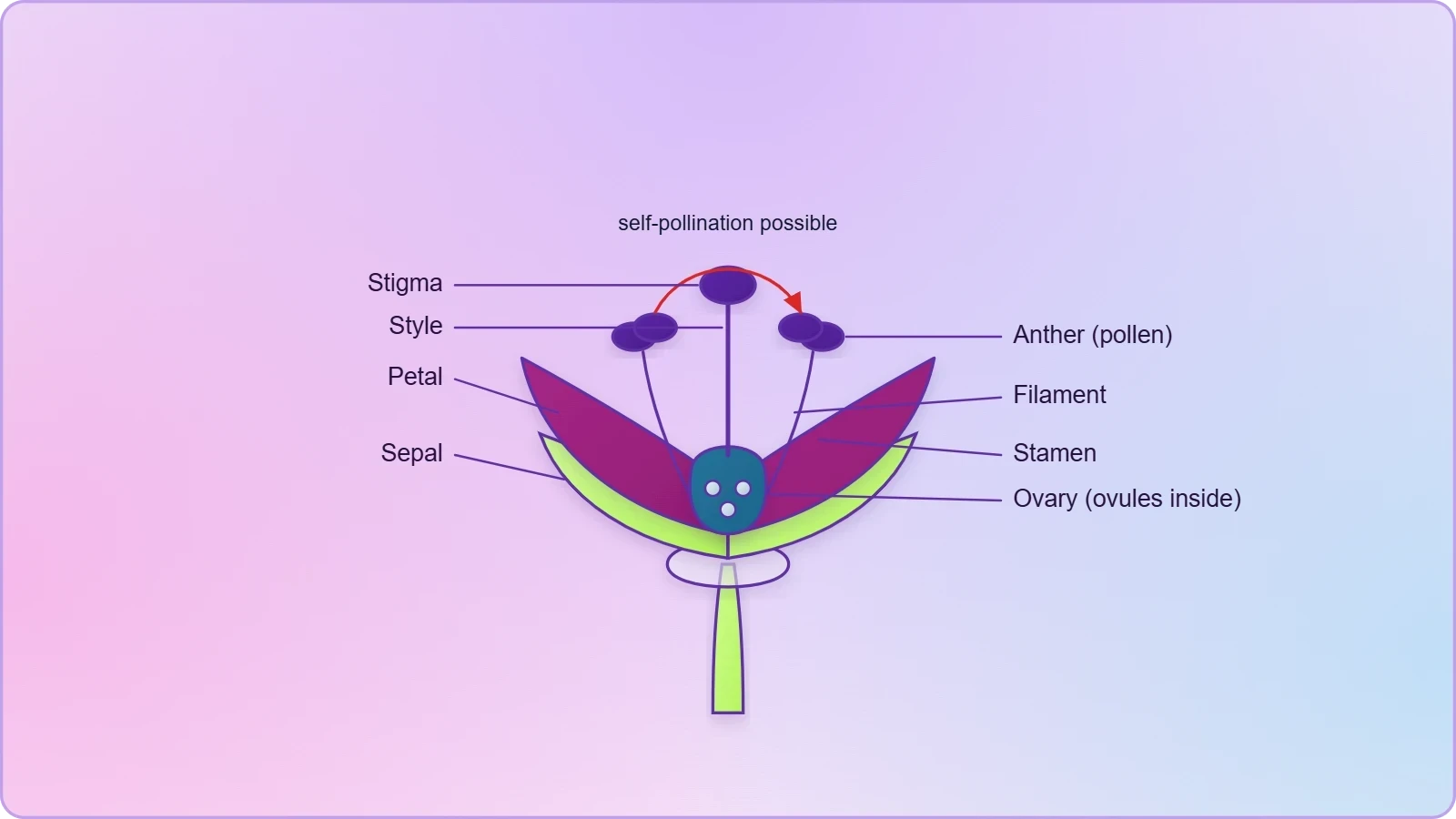
Emasculation: Removing the Anthers
Emasculation addresses the flower's own capacity to self-pollinate. In a bisexual flower, the anthers and the stigma are present together, and pollen from the anthers can readily reach the stigma of the same flower. If the breeder wishes to use that flower as the female parent, the anthers must be removed before they shed their pollen. The operation is therefore performed at a precise moment: early enough that no pollen has been released, yet late enough that the flower is mature enough to proceed. Timing is the crux of the technique, and a flower emasculated too late has already lost its value as a controlled female parent.
The Procedure for Bisexual Flowers
In bisexual flowers, the breeder removes the anthers from the flower bud before the anther dehisces, taking care not to injure the stigma or the ovary. The flower is then bagged to protect the stigma from contamination. Because the anthers are gone, the flower cannot self-pollinate, and because the bag is in place, no foreign pollen can arrive. The stigma remains receptive and ready for the chosen pollen, which is applied later. The sequence is deliberate and orderly: emasculate, bag, and then pollinate with the desired pollen when the stigma is ready.
The care required in handling is considerable. The stigma must remain undamaged, because a wounded stigma may fail to receive pollen or may become infected. The ovary must remain intact, because it is the structure that will develop into the fruit and seed. The breeder works with precision, often on flowers small enough to demand steady hands and good light. Every flower treated in this way becomes a controlled female parent, and the quality of the eventual seed depends on the quality of this early manual work.
Why Timing and Care Determine Success
The critical constraint is anther dehiscence, the moment the anther opens and releases pollen. Emasculation must precede this event, because once pollen is shed the flower may already have self-pollinated. The breeder therefore inspects buds rather than fully open flowers, judging maturity by size and appearance. A bud that is too young may not yet have a receptive stigma; a bud that is too old may have shed pollen already. The window is narrow, and recognising it is a skill acquired through practice and careful observation of the species being handled.
Care also extends to the tools and the environment. Forceps are used to remove the anthers cleanly, and the work is done in conditions that minimise stray pollen. The breeder avoids touching the stigma and avoids carrying pollen from one flower to another on hands or instruments. These precautions may seem minor, but in a programme involving many crosses they are the difference between reliable data and ambiguous results. The discipline of emasculation is thus as much about restraint and cleanliness as about the physical act of removal.
Bagging: Shielding the Stigma
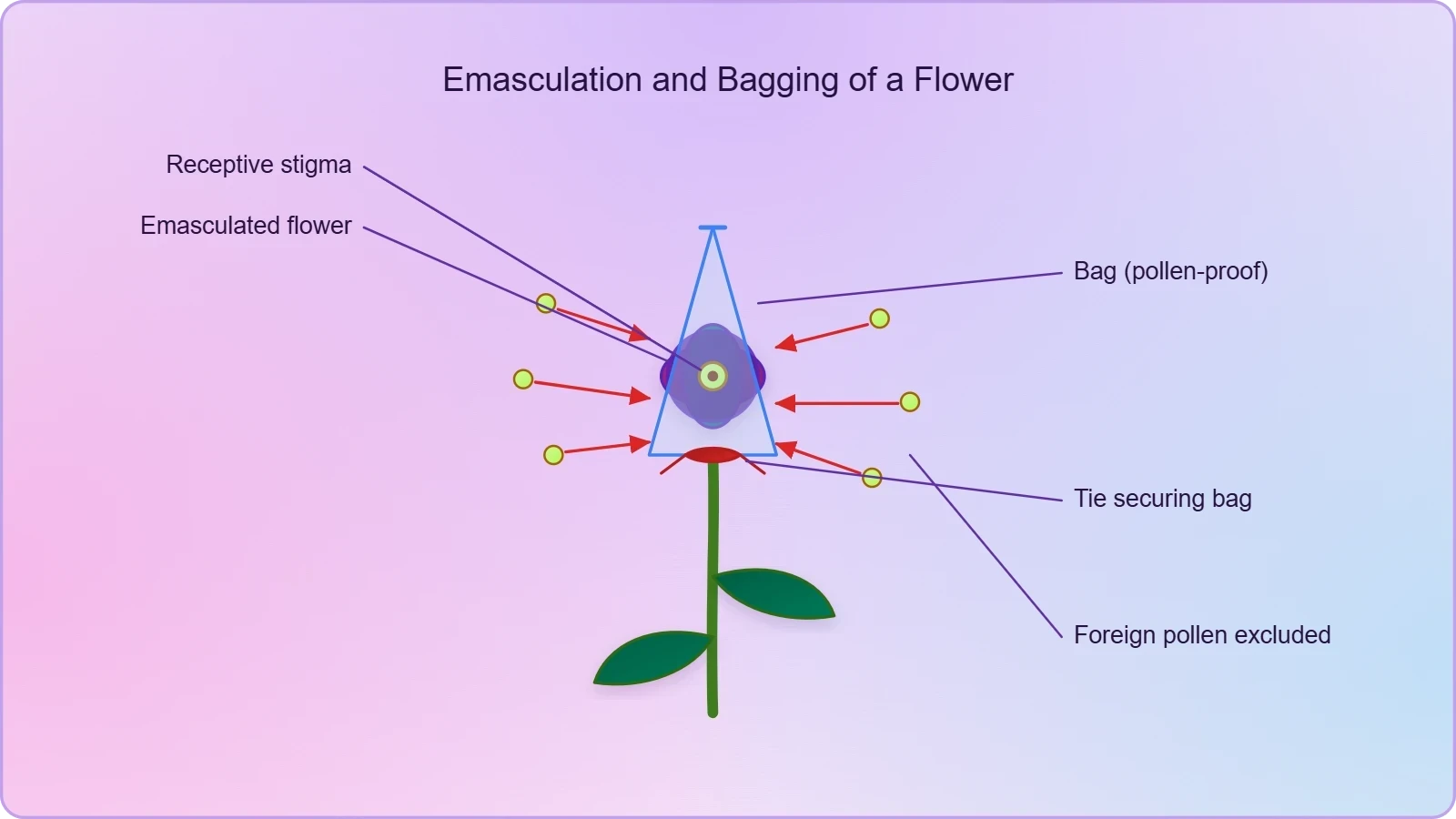
Bagging completes what emasculation begins. Once the anthers are removed, the flower still stands open to the world, and wind or insects can deliver foreign pollen to the receptive stigma. The bag encloses the flower and excludes that pollen, protecting the stigma from contamination. The technique is useful in a plant breeding programme precisely because it preserves the purity of the intended cross. Without bagging, emasculation would be a half-measure, and the breeder could never be certain that the seed harvested carried only the chosen parentage.
The Protective Function of the Bag
The bag acts as a physical barrier, and its effectiveness depends on being properly secured and appropriately chosen. It must allow the flower to breathe while excluding pollen, and it must remain in place until the risk of contamination has passed. In practice, the bag is tied around the stem or the pedicel so that no gap admits pollen-bearing air or insects. The breeder inspects the bag regularly, because a torn or displaced cover defeats the entire purpose. The bag is a simple device, but its role in guaranteeing parentage is indispensable.
Bagging also protects against more than pollen. It can shield the developing flower from insect damage and from accidental contact, and it marks the flower clearly as part of a controlled cross. In a field where many flowers look alike, the bag is a visible record of the breeder's intention. When the time comes to apply the chosen pollen, the bag is opened carefully, the pollen is transferred, and the bag is replaced. The flower remains enclosed until fertilisation is assured, after which the bag may be removed or retained according to the programme's practice.
Combining Emasculation with Bagging
The two operations are complementary and sequential. Emasculation removes the internal source of pollen; bagging excludes the external sources. A flower that is emasculated but not bagged remains vulnerable to contamination. A flower that is bagged but not emasculated may still self-pollinate within the bag, because its own anthers are present. Only when both operations are performed does the breeder achieve full control. This is why the lesson treats them as a single procedure rather than as two independent techniques, and why the breeder's checklist pairs them at every step.
The combined procedure also defines the moment of pollination. Once the flower is emasculated and bagged, the breeder waits for the stigma to become receptive, then opens the bag and applies the chosen pollen, and finally re-bags the flower. The sequence of emasculation, bagging, pollination and re-bagging is the complete cycle of artificial hybridisation for a bisexual flower. Each step depends on the one before it, and any omission weakens the chain. The breeder who follows the sequence faithfully obtains seed of known parentage, which is the whole object of the exercise.
Working with Unisexual Female Parents
Not all flowers carry both male and female structures. In unisexual flowers, the male and female organs are borne on separate flowers, and the procedure for artificial hybridisation simplifies accordingly. If the female parent bears only pistillate flowers, there are no anthers to remove, and emasculation becomes unnecessary. The breeder need only bag the female flowers to protect the stigma from unwanted pollen, and then apply the chosen pollen when the stigma is receptive. The principle remains the same, but the labour is reduced because the flower's own pollen supply is absent by nature.
When Emasculation Is Unnecessary
The absence of anthers in a pistillate flower removes the risk of self-pollination within that flower, so the breeder can proceed directly to bagging. This is a significant practical advantage, because emasculation is delicate work and any injury to the flower carries a cost. In species with unisexual flowers, the breeder identifies the female plants, bags the female flowers before they open, and waits for receptivity. The bag alone provides the necessary protection, and the chosen pollen is applied through a controlled opening in the cover. The procedure is simpler, but the objective is identical: seed of known parentage.
The breeder must still be certain that the flower is genuinely female and not a bisexual flower mistaken for a unisexual one. Careful observation of the species is essential, because the presence of even a few anthers would reintroduce the risk of self-pollination. In some plants, unisexual flowers occur on separate plants, while in others they occur on the same plant in different positions. The breeder's knowledge of the species' floral biology determines the correct procedure, and the lesson's emphasis on distinguishing bisexual from unisexual parents reflects this practical reality.
Adapting the Procedure to the Species
The general rule is straightforward: emasculate bisexual flowers, bag unisexual female flowers, and in both cases protect the stigma until the chosen pollen has been applied. Beyond this rule, the breeder adapts to the species at hand, considering the size of the flower, the number of flowers per plant, the timing of receptivity, and the behaviour of local pollinating agents. The technique is not a rigid formula but a disciplined approach that respects the biology of each plant. This adaptability is what makes artificial hybridisation both a science and a craft, requiring knowledge of floral structure as well as manual skill.
The lesson's treatment of both cases ensures that learners can recognise which procedure applies to a given plant. A breeder who understands the distinction between bisexual and unisexual flowers can plan the work efficiently, allocating effort where it is needed and avoiding unnecessary handling where it is not. This understanding also connects back to earlier lessons on flower structure and forward to the events of double fertilisation, which follow once the chosen pollen has been applied and the pollen tube has grown to the embryo sac.
From Controlled Cross to Seed
Once the chosen pollen has been applied to the protected stigma, the events described in the preceding lesson on pollen–pistil interaction take over. If the pollen is compatible, it germinates on the stigma, and the resulting pollen tube grows through the style, enters the ovule and discharges two male gametes in one of the synergids. The breeder's control ends at the stigma; from that point, the plant's own biology governs the outcome. The value of emasculation and bagging is that they ensure the pollen initiating these events is precisely the pollen the breeder intended, so the resulting seed carries the desired parentage.
What the Breeder Can and Cannot Control
The breeder controls the identity of the pollen and the protection of the stigma, but cannot control the internal events of fertilisation. Compatibility, germination, tube growth and the fusion events proceed according to the plant's own mechanisms. This division of responsibility is important: the technique of artificial hybridisation is a way of setting the conditions for a chosen cross, not a way of forcing fertilisation. If the chosen pollen is incompatible with the stigma, the cross will fail despite perfect emasculation and bagging. The breeder's skill lies in choosing compatible parents and in providing the conditions under which the natural process can succeed.
Understanding this boundary also prepares the learner for the next lesson on double fertilisation. The pollen tube's journey and the discharge of male gametes are the bridge between the breeder's controlled pollination and the formation of the zygote and endosperm. The seed that eventually develops is the product of both the breeder's intervention and the plant's own reproductive machinery. Artificial hybridisation is therefore best understood as a partnership between human intention and plant biology, and the techniques of emasculation and bagging are the means by which the human side of that partnership is expressed.
Preparing for Double Fertilisation
The controlled cross sets the stage for the two fusion events that define angiosperm reproduction. Syngamy produces the diploid zygote, and triple fusion produces the triploid primary endosperm nucleus in the primary endosperm cell. The zygote develops into the embryo, and the primary endosperm cell forms the endosperm tissue, with endosperm formation always preceding embryo development. These events, described in the next lesson, are the culmination of the process that emasculation and bagging have made possible. The breeder who has controlled pollination has, in effect, chosen the parents of the zygote and the endosperm that will follow.
This connection gives the present lesson its place in the larger course. The study of sexual reproduction in flowering plants moves from flower structure through gametophyte development, pollination and pollen–pistil interaction, and now to the breeder's control of pollination. Each stage builds on the last, and each prepares for the next. The techniques of artificial hybridisation are not an isolated practical appendix but an application of the reproductive biology already studied, and they lead naturally into the events of double fertilisation that complete the story of seed formation.
Going Further
The material establishes the purpose and sequence of emasculation and bagging; a little additional background sharpens the picture. Emasculation is the removal of anthers from a flower bud before the anther dehisces, using a pair of forceps. The emphasis on the bud and on the timing before dehiscence is what makes the operation meaningful, because once the anther has opened, pollen may already have reached the stigma. The forceps allow precise removal without crushing the surrounding floral parts, and the breeder works carefully to leave the stigma and ovary intact and ready for the chosen pollen.
Practical Notes on the Two Operations
Bagging protects the stigma of emasculated flowers from unwanted pollen. This simple statement captures the protective logic of the technique: the bag is a barrier, and its value lies in what it excludes. In practice, the bag must be secured so that no pollen-bearing air or insect can enter, and it must remain in place until the risk of contamination has passed. The breeder opens the bag only to apply the chosen pollen and then closes it again. These practical details reinforce the lesson's central point that emasculation and bagging are complementary operations, each necessary and neither sufficient alone.
These background notes do not alter the material's account; they clarify the physical actions behind the terms. The learner who understands both the purpose and the practice of emasculation and bagging is equipped to follow the breeder's reasoning and to appreciate why the technique is described as ensuring that only the desired pollen is used and that the stigma is protected from contamination. With this foundation, the next lesson on double fertilisation can be approached with a clear sense of how the controlled cross leads to the formation of seed.
Also Read
- No links available.
From our network :
- Mastering DB2 LUW v12 Tables: A Comprehensive Technical GuideComprehensive guide on DB2 LUW v12 tables. Explore CREATE TABLE syntax, BLU Acceleration, range partitioning, data types, and security features for IBM DB2 LUW v12.
- Mastering DB2 12.1 Instance Design: A Technical Deep Dive into Modern Database ArchitectureComprehensive guide to DB2 12.1 Instance Design. Explore architectural components, HADR setup, buffer pool tuning, and security policies for IBM DB2 12.1. Includes 10 functional SQL and Shell samples.
- 98% of Global MBA Programs Now Prefer GRE Over GMAT Focus EditionExplore why 98% of global MBA programs now prefer the GRE over GMAT Focus. Learn about the shorter GRE format, verbal logic importance, and strategic versatility for students.
- Trump Political Strategy How Geopolitical Stunts Serve As Media Diversions
- EV 2.0: The Solid-State Battery Breakthrough and Global Factory ExpansionDiscover the impact of the Solid-State Battery Breakthrough on the EV market. Learn about CATL and BYD stock growth, global factory expansion in Europe, and the future of EV 2.0 technology.
- Analyzing Trump Deportation Numbers Insights Into The 2026 Immigration Crackdown
- 10 Physics Numerical Problems with Solutions for IIT JEEPrepare for IIT JEE with 10 physics numerical problems, complete with detailed solutions and conceptual explanations. Ideal for mastering kinematics, thermodynamics, electromagnetism, and optics.
- AI-Powered 'Precision Diagnostic' Replaces Standard GRE Score ReportsDiscover the new GRE Precision Diagnostic. Learn how AI-powered behavioral analytics and time-to-solve tracking are replacing standard GRE score reports to empower students.
- Vite 6/7 'Cold Start' Regression in Massive Module GraphsIn-depth analysis of Vite 6/7 cold start regressions in massive module graphs. Learn about barrel file issues, pre-bundling optimizations, and how to improve Vite dev server performance.
RESOURCES
- Emasculation and bagging are the two important steps ... - Brainly.inbrainly.inJul 26, 2019 ... Emasculation and bagging are the two important steps carried during artificial hybridisation to obtain superior varieties of desired plants.
- Emasculation and Bagging in Pollination | PDF - Scribdscribd.comMagnifying Glass. Emasculation is the process of artificial hybridization in which the stamens from the female flowers are removed from bisexual flowers in ...
- Given below are the events that are observed in an artificial ... - Allenallen.inGiven below are the events that are observed in an artificial hybridisation programme. ... **Bagging (Step 3)**: Once emasculation is done, the flower is…
- Emasculation and Bagging for Pollination | PDF | Flowers - Scribdscribd.comControlled pollination is a plant breeding technique used to produce progeny with desired traits from known parent plants. It involves transferring pollen ...
- Mention the advantages of emasculation and bagging in artificial ...askfilo.comMar 22, 2025 ... Text solution. Concepts: Emasculation, Bagging, Artificial hybridisation, Unisexual flowers, Bisexual flowers. Explanation: Emasculation ...
- Optimization of grape artificial hybrid pollination technology process ...pmc.ncbi.nlm.nih.govSep 22, 2025 ... Finally, hang a tag on the fruiting branch, marking the hybrid combination and emasculation date ( Figure 9E ). Adjusting…
- A Preliminary Study of Apomictic Characteristics of 'Mianli' (Pyrus ...journals.ashs.org3. Seed development of 'Mianli'. (A) Natural pollination. (B) Artificial pollination. (C) Emasculation with bagging and ...
- Mention the advantages of emasculation and bagging in artificial ...learn.careers360.comDec 10, 2020 ... Mention the advantages of emasculation and bagging in artificial hybridization in plants bearing unsexual, and bisexual flowers.
- Explain the process of emasculation and bagging of class 12 ...vedantu.comThis process of emasculation is done during artificial hybridisation. Plant breeders perform emasculation process in bisexual flowers by crossing a ...
- Study on Flowering Dynamics and Pollination Habits of ... - PMCpmc.ncbi.nlm.nih.govFeb 26, 2025 ... savatieri, when subjected to artificial emasculation and bagging ... hybridization. The experimental results confirmed that M. savatieri ...
- Some flowers, selected for artifical hybridization, do not require ...learn.careers360.comMay 17, 2020 ... Some flowers, selected for artifical hybridization, do not require emasculation but bagging is essential for them. Give reason.
- Notes on Artificial Hybridisation Plants - Unacademyunacademy.comBagging. Pollen bagging is the process of protecting emasculated flowers from being contaminated by unwanted pollen grains. Despite the fact that the flower is ...
- What is the purpose of bagging the emasculated flowers prior to and ...quora.comDec 24, 2020 ... Emasculation is a method of “Artificial Hybridization” generally used to promote cross pollination in plants and avoid self pollination. This…
- Outbreeding Devices and Artificial Hybridisation - Xylem Learningxylemlearning.comOct 13, 2026 ... Learn about outbreeding devices, protandry, protogyny, self-incompatibility, emasculation, bagging and the steps of artificial ...
- Emasculation and bagging are the two important steps carried ...shaalaa.comApr 4, 2020 ... Emasculation and bagging are the two important steps carried during artificial hybridization to obtain superior varieties of desired plants.