Pollination is the transfer of pollen grains from the anther of a stamen to the stigma of a carpel, and it is the quiet logistical bridge between the flower that produces male gametophytes and the ovule that shelters the female gametophyte. Every flowering plant must solve this problem, yet the solutions are strikingly varied. Broadly, the agents that carry pollen fall into two families: abiotic agents, meaning wind and water, which are non-living physical carriers, and biotic agents, meaning animals, which are living couriers that visit flowers in search of food or other rewards. This lesson concentrates on the two abiotic agents and on the structural adaptations that make them work.
What makes the abiotic strategy so instructive is its economy and its risk. Wind and water are free and inexhaustible, but they are also indiscriminate: they cannot be aimed at a particular stigma, and they carry pollen away from the target as readily as toward it. Plants that rely on them therefore compensate with enormous quantities of pollen and with floral architecture that exposes stamens and stigmas to moving air or moving water. Only a small proportion of flowering plants use abiotic agents at all, which tells us that the strategy, though ancient and widespread in certain habitats, is a specialised one rather than the general rule.
This lesson builds directly on the previous discussion of chasmogamous and cleistogamous flowers, where the emphasis fell on whether a flower opens and exposes itself to cross-pollination. Here we follow the pollen once it is released, examining the specific adaptations of wind-pollinated flowers and the distinctive features of water-pollinated plants such as Vallisneria, Hydrilla and Zostera. It also prepares the ground for the next lesson, in which animals take over as the dominant biotic couriers.
On This Page
The Two Abiotic Agents and Their Place Among Flowering Plants
Flowering plants employ two abiotic agents, wind and water, alongside one biotic agent, animals. The first point to fix firmly is proportion: only a small proportion of plants use abiotic agents. Wind is by far the more common of the two, while water pollination is a narrow speciality confined to a modest number of aquatic species. This asymmetry matters because it frames everything that follows. The adaptations we are about to study are not curiosities at the margins of plant biology; they are the finely tuned solutions of lineages that have committed to a particular physical carrier and paid its price in pollen.
Abiotic pollination is best understood as a numbers game played against uncertainty. Because the carrier cannot be directed, the probability that any single pollen grain reaches a compatible stigma is very low. The plant's response is to raise the number of grains released and to increase the receptive surface that might intercept them. In parallel, the flower sheds the costly apparatus of animal attraction, since petals, nectar and scent would be wasted expenditure when no visitor is expected. The result is a flower that looks plain but functions as a precision instrument for handling air or water currents.

Why Abiotic Strategies Are a Minority
The minority status of abiotic pollination follows from its inefficiency. A plant that depends on animals can, in effect, direct its pollen to a stigma of the same species, because a visitor tends to move between similar flowers. A plant that depends on wind or water enjoys no such guarantee. The pollen budget must therefore be inflated enormously, and the flower must be positioned and shaped so that the odds, though small for each grain, become acceptable in aggregate. Species that can afford this expenditure thrive; those that cannot are better served by animal visitors.
There is also a geographical dimension to the pattern. Wind pollination is characteristic of open, exposed habitats and of communities where individuals of the same species grow close together in stands, so that airborne pollen has a reasonable chance of landing on the right stigma. Water pollination is restricted to the aquatic habit, where the medium itself is the carrier. Neither strategy is inherently superior; each is a fit between floral design and the physical environment in which the plant lives.
The Logic of Compensation in Floral Design
Compensation is the organising principle of abiotic floral design. Where the carrier is unreliable, the flower invests in exposure and abundance rather than in attraction. Stamens are positioned so that even a slight movement of air or water shakes pollen loose; stigmas are enlarged and feathery so that they comb the passing medium. The flower is typically small, unscented and without nectar, because these features serve visitors that will never come. Every gram of resource saved on petals is redirected into pollen production or into the receptive apparatus of the stigma.
This reallocation is visible in the overall silhouette of the flower. Wind-pollinated flowers often hang or project so that the anthers stand clear of surrounding foliage, and the stigma spreads like a plume to intercept grains carried on the breeze. The design is functional rather than ornamental, and once the principle is grasped, the appearance of such flowers becomes legible as a set of engineering decisions rather than a lack of beauty.

Adaptations of Wind-Pollinated Flowers
Wind-pollinated flowers display a coherent set of adaptations that can be read as a single design philosophy: expose the pollen, enlarge the target, and abandon attraction. The flowers are typically small and inconspicuous, lacking the showy petals that would advertise them to animals. They produce no nectar and no scent, since neither would serve any purpose in the absence of visitors. What they do possess is an abundance of pollen and a stigma built to catch it. These features recur across unrelated wind-pollinated groups, which is itself evidence that they are functional solutions rather than accidents of ancestry.
The most conspicuous feature is the sheer quantity of pollen. Wind-pollinated species release pollen in prodigious amounts, far exceeding what an animal-pollinated species would need, because the overwhelming majority of grains are lost. The pollen itself is typically small, light and dry, so that it remains airborne rather than clumping, and the anthers are borne on long filaments that project the pollen sacs into the moving air. When the anther dehisces, the grains are simply shaken free by the slightest breeze, and the flower's task is done.
Exposed Stamens and Feathery Stigmas
Exposure is achieved through the architecture of the stamens. The filaments are long and slender, holding the anthers well clear of the perianth and often beyond the surrounding foliage, so that the pollen is released into unobstructed air. The anthers themselves are versatile, swinging freely so that wind readily dislodges the grains. This arrangement is the floral equivalent of a weather vane: it does not direct the pollen, but it ensures that the pollen is available to whatever current passes. The result is a flower that functions as a passive but efficient pollen dispenser.
The stigma is the receiving half of the system, and in wind-pollinated flowers it is correspondingly enlarged. It is often feathery, branched or plumose, presenting a large and divided surface that combs the air for passing grains. The feathery branches increase the chance that a grain carried on the breeze will be intercepted and retained. Together, the exposed anther and the feathery stigma form a matched pair: one broadcasts, the other collects, and both are shaped by the physics of moving air rather than by the preferences of a visitor.

Reduced Perianth and the Absence of Rewards
The reduction of the perianth is a direct consequence of the strategy. Petals exist to attract, and where there is nothing to attract, they are an unnecessary expense. Wind-pollinated flowers therefore tend to have small, greenish or dull-coloured perianth parts, or none at all. Nectar and scent are likewise absent, since both are rewards offered to animals. The resources saved are redirected into pollen production and into the receptive apparatus of the stigma, which is precisely where the strategy demands investment. The plain appearance of such flowers is thus a sign of efficiency, not of neglect.
This economy extends to the arrangement of the inflorescence. Many wind-pollinated plants bear numerous small flowers in dense clusters, so that a single gust can release pollen from many anthers at once and present a large collective stigma surface to the air. The cluster, rather than the individual flower, becomes the functional unit of pollination. This aggregation further improves the odds in a system where every individual event is a matter of chance, and it explains why such plants often appear as conspicuous plumes or tassels rather than as isolated blooms.
Water-Pollinated Plants: Vallisneria, Hydrilla and Zostera
Water pollination is the rarer of the two abiotic strategies and is confined to a limited number of aquatic plants. Three examples anchor the account: Vallisneria, Hydrilla and Zostera. Each illustrates a different way in which the water medium can be exploited to bring male gametophytes into contact with receptive stigmas. What unites them is the complete absence of any animal intermediary and the subordination of floral form to the movement of water. What distinguishes them is the precise mechanism by which pollen is released, transported and captured beneath or upon the surface.
The central difficulty of water pollination is that water is a denser and more turbulent medium than air, and pollen grains do not travel through it in the same way. Plants have therefore evolved two broad solutions. In one, the pollen is released at the surface and travels as a floating film or raft to reach a stigma that is held at the water surface. In the other, the pollen is released underwater and drifts as fine threads or grains until it is intercepted by submerged stigmas. The three named genera allow us to see both solutions in operation.
Surface Transport in Vallisneria and Hydrilla
In Vallisneria, the female flower is borne on a long stalk that brings it to the surface of the water, where it opens and presents its stigma. The male flowers are released from the parent plant and float freely on the surface, where they open and shed their pollen. The pollen grains then drift across the surface film until they reach the stigma of a floating female flower. The entire transfer depends on the calm surface layer, and the plant's reproductive success is tied to the physical behaviour of that thin boundary between water and air.
Hydrilla illustrates a related but distinct arrangement. Here too the pollen is liberated at the water surface, where it travels as a floating layer to reach stigmas that are presented at the surface. The flowers are small and unshowy, consistent with the general rule that abiotic pollination dispenses with attraction. In both genera, the surface of the water functions as the transport corridor, and the floral parts are positioned to exploit it. The strategy is elegant in its economy: no visitor is required, and the medium itself performs the delivery.
Submerged Transfer in Zostera
Zostera, the eelgrass, takes the second route. Its flowers remain submerged, and pollination occurs entirely underwater. The pollen is released into the water in the form of fine, thread-like grains that drift with the currents until they encounter a stigma. The stigmas are long and slender, presenting an extended surface to the moving water, much as feathery stigmas present a large surface to moving air. This is the underwater analogue of wind pollination: the same principle of enlarging the receptive surface, applied to a denser medium.
The contrast between Zostera and the surface-pollinated genera is instructive. In Vallisneria and Hydrilla, the water surface is the highway and the flowers must reach it; in Zostera, the water column itself is the highway and the flowers remain below. Both arrangements solve the same problem, and both demonstrate that water pollination is not a single mechanism but a family of solutions united by the use of water as the carrier and by the absence of any animal intermediary.
Reading Floral Form as a Response to the Carrier
Once the two abiotic strategies are placed side by side, a general principle emerges: floral form is a response to the physical carrier. Wind and water differ in density, in the way they move, and in the surfaces they present, and the flowers that exploit them differ accordingly. Yet the underlying logic is identical. In both cases the plant enlarges the receptive surface, releases pollen in quantity, and abandons the apparatus of attraction. The differences are differences of engineering, not of purpose, and recognising this helps the learner predict what a flower pollinated by a given agent will look like.
This predictive habit is one of the most useful outcomes of studying pollination. A flower that is small, greenish, unscented and equipped with feathery stigmas and dangling anthers can be confidently assigned to wind. A submerged aquatic with long slender stigmas and thread-like pollen can be assigned to water. The features are not arbitrary; each one follows from the demands of the carrier. Learning to read them is learning to see the flower as a working device rather than merely a decorative object.
Convergence Across Unrelated Lineages
The recurrence of the same features in unrelated wind-pollinated groups is a striking demonstration of convergent evolution. Grasses, and many trees of temperate forests, have independently arrived at reduced perianths, exposed anthers and plumose stigmas because these are the features that work when pollen travels on air. The similarity is not inherited from a common ancestor but produced by a common problem. This is precisely why the adaptations are worth learning as a set: they are the predictable consequences of a particular physical situation.
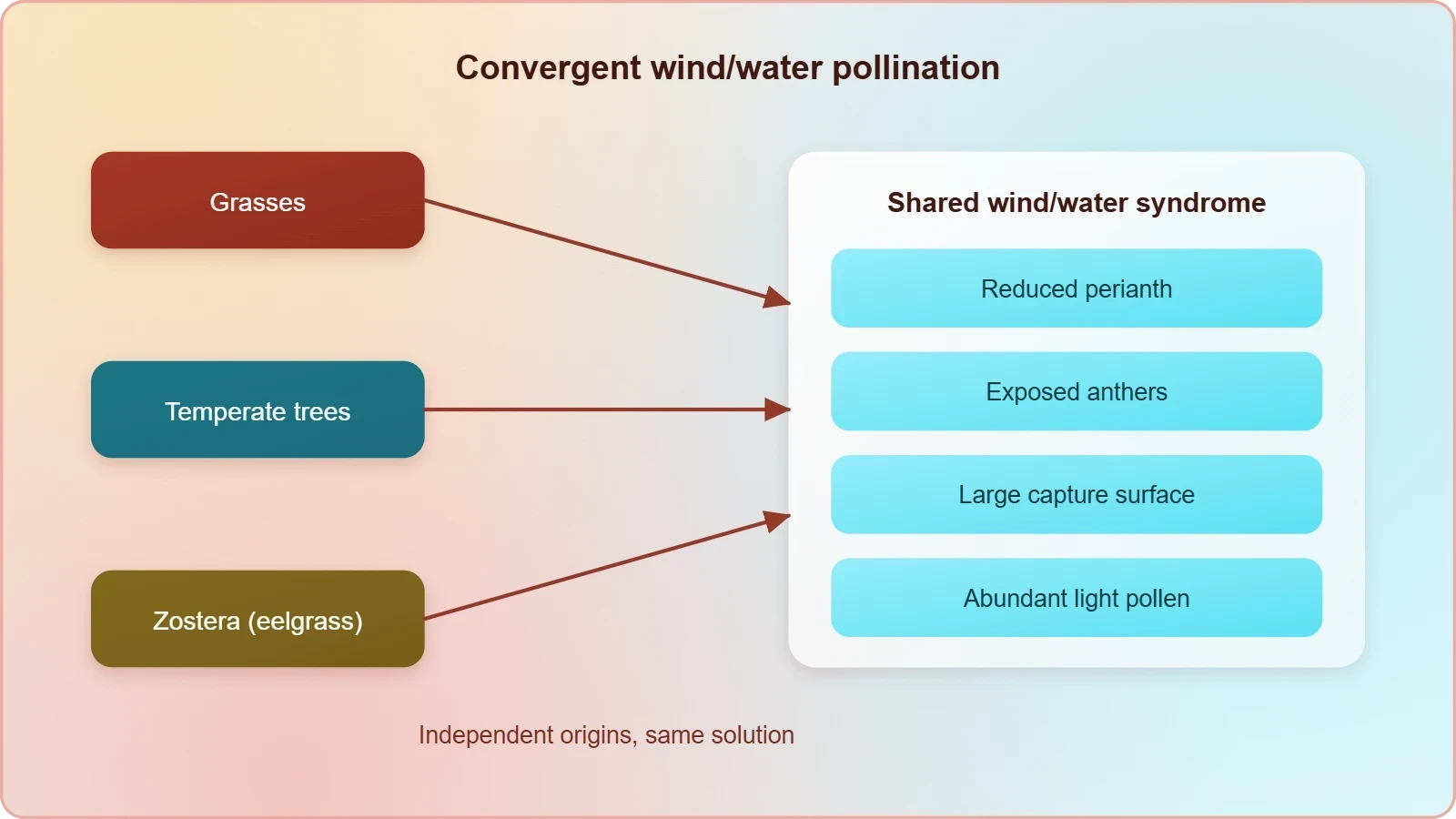
The same reasoning applies underwater. Zostera is not closely related to the wind-pollinated grasses, yet its long stigmas and fine pollen echo their feathery stigmas and dry grains. The medium differs, but the principle of enlarging the capture surface is the same. Convergence of this kind is one of the clearest signs that a trait is functional, and it gives the learner a reliable guide for interpreting unfamiliar flowers encountered in the field.
What the Abiotic Strategy Costs and Buys
The costs of abiotic pollination are real and substantial. Enormous quantities of pollen are wasted, since most grains never reach a stigma of the same species. Reproduction is at the mercy of weather: a still, humid day or a calm stretch of water can sharply reduce success. And because the carrier is indiscriminate, there is no guarantee that the pollen will reach a compatible partner rather than a foreign stigma or bare ground. These are serious disadvantages, and they explain why only a small proportion of plants rely on abiotic agents.
What the strategy buys is independence. No pollinator need be present, no nectar need be secreted, and no elaborate advertisement need be maintained. In open habitats where wind is reliable, or in aquatic habitats where water is the only available medium, this independence is decisive. The plant escapes the vulnerability of depending on the seasonal availability of animals. The trade is a familiar one in biology: reliability purchased at the price of waste, and independence purchased at the price of precision.
Going further
Two observations extend the picture without altering it. First, wind pollination is quite common in grasses, which is why grasses are the standard example of the strategy in the field. Their reduced flowers, exposed anthers and feathery stigmas are the features described above, and their abundance in open habitats makes them easy to observe. Second, in a majority of aquatic plants such as water hyacinth and water lily, the flowers emerge above the water and are pollinated by insects or wind rather than by water itself. Water pollination, in other words, is the exception even among aquatics.
These points are worth keeping in mind because they prevent a common misunderstanding. The presence of a plant in water does not imply that water is its pollinating agent. Most aquatic plants still rely on the air or on animals, and only a minority, such as Vallisneria, Hydrilla and Zostera, have committed to the water medium. The distinction between habitat and pollinating agent is a useful discipline, and it sharpens the appreciation of the specialised mechanisms described in this lesson.
Consolidating the Lesson and Looking Ahead
The lesson can be reduced to a compact set of propositions. Flowering plants use two abiotic agents, wind and water, and one biotic agent, animals, and only a small proportion of plants use abiotic agents. Wind-pollinated flowers are small and inconspicuous, lack nectar and scent, produce abundant light dry pollen, expose their anthers on long filaments and present feathery stigmas to the air. Water-pollinated plants such as Vallisneria, Hydrilla and Zostera exploit the water medium, some at the surface and some below it, and all dispense with animal visitors. These propositions, once fixed, make the appearance of any abiotic-pollinated flower legible.
The next lesson turns to the biotic agent, animals, and to the very different floral economy that animal pollination demands. Where wind and water require exposure and abundance, animals require attraction and reward, and the flower must invest in petals, scent and nectar to secure a visitor's attention. The contrast with the present lesson is sharp and instructive, and it is best appreciated with the abiotic strategy firmly in mind. The learner who understands why wind-pollinated flowers are plain will understand equally well why animal-pollinated flowers are not.
Key Terms to Retain
Several terms from this lesson deserve to be carried forward. Abiotic agents are the non-living carriers, wind and water; biotic agents are the living carriers, animals. Wind-pollinated flowers are characterised by small size, absence of nectar and scent, abundant dry pollen, exposed anthers and feathery stigmas. Water-pollinated plants include Vallisneria, Hydrilla and Zostera, and the distinction between surface transport and submerged transport is worth remembering. These terms will recur in later lessons on pollination and fertilisation, and they anchor the vocabulary of the subject.
It is also worth noting what this lesson has deliberately not covered. The details of pollen-pistil interaction, double fertilisation and the subsequent development of endosperm, embryo and seed belong to other lessons in the sequence, and the animal agents of pollination are reserved for the next. The present lesson has confined itself to the two abiotic carriers and to the floral adaptations that make them effective. Keeping these boundaries clear prevents confusion and allows each mechanism to be studied on its own terms before the larger picture is assembled.
Questions for Self-Check
A learner can test understanding with a few direct questions. Why do wind-pollinated flowers produce so much pollen, and why is the pollen small and dry? What is the function of a feathery stigma, and how does it relate to the physics of moving air? How does Vallisneria bring its male and female flowers together, and how does Zostera achieve the same end while remaining submerged? Why is water pollination described as a minority strategy even among aquatic plants? Answering these questions in full requires the learner to connect structure to function, which is the central skill the lesson aims to develop.
Finally, the learner should be able to explain why only a small proportion of plants use abiotic agents. The answer lies in the trade-off between independence and precision: abiotic pollination frees the plant from dependence on animals but wastes enormous quantities of pollen and leaves success to the weather. Species in open, windy habitats or in aquatic environments can afford this trade; others cannot. Grasping that trade-off is the real objective of the lesson, and it prepares the ground for the animal agents that follow.
Also Read
- No links available.
From our network :
- Vite 6/7 'Cold Start' Regression in Massive Module GraphsIn-depth analysis of Vite 6/7 cold start regressions in massive module graphs. Learn about barrel file issues, pre-bundling optimizations, and how to improve Vite dev server performance.
- Mastering DB2 12.1 Instance Design: A Technical Deep Dive into Modern Database ArchitectureComprehensive guide to DB2 12.1 Instance Design. Explore architectural components, HADR setup, buffer pool tuning, and security policies for IBM DB2 12.1. Includes 10 functional SQL and Shell samples.
- 98% of Global MBA Programs Now Prefer GRE Over GMAT Focus EditionExplore why 98% of global MBA programs now prefer the GRE over GMAT Focus. Learn about the shorter GRE format, verbal logic importance, and strategic versatility for students.
- Trump Political Strategy How Geopolitical Stunts Serve As Media Diversions
- EV 2.0: The Solid-State Battery Breakthrough and Global Factory ExpansionDiscover the impact of the Solid-State Battery Breakthrough on the EV market. Learn about CATL and BYD stock growth, global factory expansion in Europe, and the future of EV 2.0 technology.
- AI-Powered 'Precision Diagnostic' Replaces Standard GRE Score ReportsDiscover the new GRE Precision Diagnostic. Learn how AI-powered behavioral analytics and time-to-solve tracking are replacing standard GRE score reports to empower students.
- Analyzing Trump Deportation Numbers Insights Into The 2026 Immigration Crackdown
- 10 Physics Numerical Problems with Solutions for IIT JEEPrepare for IIT JEE with 10 physics numerical problems, complete with detailed solutions and conceptual explanations. Ideal for mastering kinematics, thermodynamics, electromagnetism, and optics.
- Mastering DB2 LUW v12 Tables: A Comprehensive Technical GuideComprehensive guide on DB2 LUW v12 tables. Explore CREATE TABLE syntax, BLU Acceleration, range partitioning, data types, and security features for IBM DB2 LUW v12.
RESOURCES
- Wind and Water Pollination - USDA Forest Servicefs.usda.govWind pollinated plants include grasses and their cultivated cousins, the cereal crops, many trees, the infamous allergenic ragweeds, and others. All release ...
- What is pollination and its importance in plant reproduction - Facebookfacebook.comMay 12, 2026 ... AGENTS OF POLLINATION the Water Insects Transfer (Xenogamy) ... This transfer can be facilitated by various agents, including wind, water ...
- Pollination | CK-12 Foundationflexbooks.ck12.orgSep 7, 2026 ... Insects, wind, water, birds, bats, and humans can act as pollinating agents. Insect-pollinated flowers are usually colourful, fragrant, and ...
- Pollination | Definition, Process, Types, Agents Of, & Facts - Britannicabritannica.com5 days ago ... In flowering plants, these are (roughly in order of diminishing importance) insects, wind, birds, mammals, and water. See also major…
- An Introduction to Insect Pollination - faculty.ucr.edufaculty.ucr.eduAlthough gravity, wind, water, mollusks, birds, bats and humans are agents of pollination, it is often possible to manipulate insects in their performance ...
- A time tree for the evolution of insect, vertebrate, wind, and water ...nph.onlinelibrary.wiley.comAug 11, 2023 ... Water pollination evolved from wind pollination, with no reversals. ... Subscription Agents · Advertisers & Corporate Partners. Connect with ...
- What are the agents of pollination in flowers? - Quoraquora.comJun 9, 2016 ... Wind pollination is called anemophily. Similarly water is called hydrophily, insects entemophily, other animals zoophily, birds ornithophily.
- Pollination - Wikipediaen.wikipedia.orgPollinating agents can be animals such as insects, for example bees, beetles or butterflies; birds, and bats; water; wind; and even plants themselves.
- What are three agents that can carry out pollination? - Quoraquora.comNov 22, 2017 ... There are many plants that are wind-pollinated such as most conifers, grasses and oaks - and many more. Water. Water…
- The Long Journey of Pollen Tube in the Pistil - PubMedpubmed.ncbi.nlm.nih.govNov 9, 2018 ... ... agents, such as pollinators, wind, and even water, to arrive to a receptive stigma. The complex process of pollination…
- Pollination | Anatomy and Physiology | Research Starters - EBSCOebsco.com... pollination, where pollen is transferred between different plants. Cross-pollination often relies on external agents such as wind, water, or animals ...
- About Pollinatorspollinator.orgThis can happen through self-pollination, wind and water pollination, or through the work of vectors that move pollen within the flower and from bloom…
- Pollinator - an overview | ScienceDirect Topicssciencedirect.comWind and insects are the main external agents of pollination but water, birds, and mammals (primarily bats) are also pollinators. Of the insects, bees…
- Read the following statements and find out the incorrect ... - Allenallen.ina. Plants use two abiotic (wind and water) and one biotic (animals) agent to achieve pollination. b. Majority of plants use abiotic agents for ...
- What are the agents of pollination? - Homework.Study.comhomework.study.comThe agents of pollination are animals, wind, and water. The most common agents of pollination are winged insects such as butterflies, bees, and flies.