Photosynthesis rarely proceeds at its theoretical maximum in a living leaf, and the gap between what the machinery could do and what it actually achieves is largely written by two environmental variables: temperature and water. Having established in the previous lesson that carbon dioxide is the major limiting factor for photosynthesis, we now turn to the two factors that modulate how efficiently that CO₂ is captured and processed. Temperature governs the enzymatic dark reactions with particular severity, while water exerts its influence less through chemistry than through the plant's own architecture and behaviour. Together they explain why the same species photosynthesises vigorously on one day and sluggishly on another.
The treatment here follows a precise logic. The dark reactions, being enzymatic, are temperature controlled; the light reactions are also temperature sensitive but affected to a much lesser extent. The C₄ plants respond to higher temperatures and show higher rates of photosynthesis, while C₃ plants have a much lower temperature optimum. Water, though a reactant in the light reaction, acts mainly through its effect on the plant: water stress closes stomata, reducing CO₂ availability, and makes leaves wilt, reducing surface area and metabolic activity. Each of these statements carries quantitative and ecological consequences that repay close reading.
This lesson sits deliberately between the CO₂ discussion and the closing summary of the course. It does not revisit the saturation curves of C₃ and C₄ plants in detail, nor the Calvin cycle enzymology already covered; instead it asks how temperature and water reshape the responses we have already mapped. By the end, you should be able to explain why tropical plants carry a higher temperature optimum than temperate species, why a wilting leaf is not merely a cosmetic problem, and why water's role as a factor is described as indirect rather than direct.
On This Page
Temperature and the Enzymatic Dark Reactions
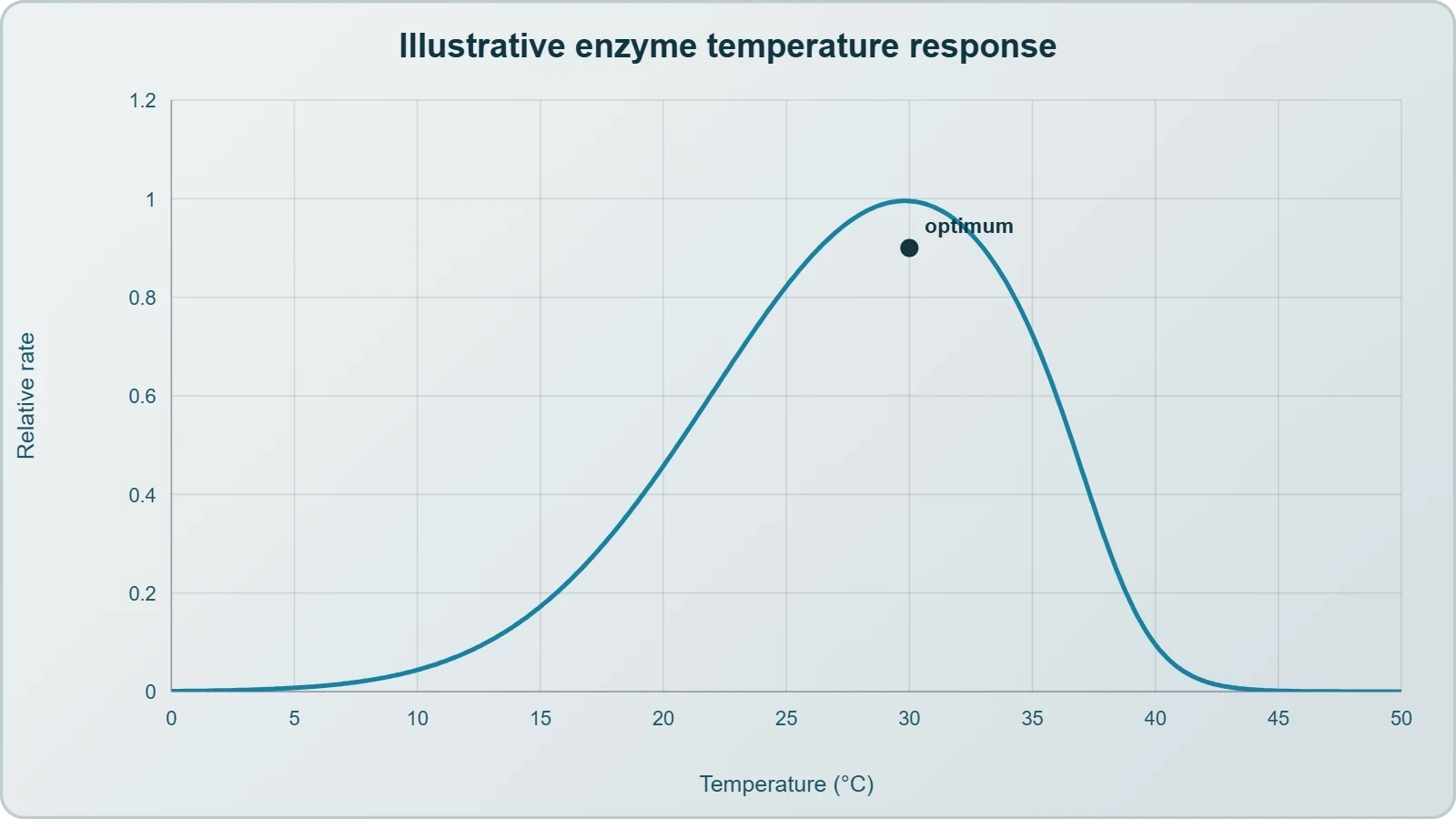
The central claim of the material is unambiguous: the dark reactions being enzymatic are temperature controlled. Every step of the Calvin cycle is catalysed by a protein enzyme, and enzymes are exquisitely sensitive to temperature because their catalytic power depends on a precise three-dimensional shape. As temperature rises within a physiological range, molecular collisions increase and the rate of carboxylation accelerates. Beyond an optimum, the same thermal energy begins to distort the enzyme's active site, and the rate falls sharply. This is why temperature is treated as a controlling factor for carbon fixation rather than a mere background condition.
Why the Light Reactions Are Less Affected
Though the light reactions are also temperature sensitive, they are affected to a much lesser extent. The reason lies in their physical rather than chemical character: the absorption of photons by chlorophyll and the transfer of excited electrons through the photosystems depend on light and on the arrangement of pigment-protein complexes, not on the collision frequency of substrate molecules. Temperature therefore nudges these events, but it does not govern them the way it governs an enzyme-catalysed reaction. The material states this contrast plainly, and it is worth holding onto: the dark reactions carry the temperature dependence of photosynthesis.
This asymmetry has a practical consequence for how we interpret a leaf's performance. On a hot day, the light reactions may continue to generate ATP and NADPH at close to full capacity while the Calvin cycle struggles to consume them, because its enzymes are past their optimum. The result is an imbalance between energy supply and carbon fixation. Recognising that the two halves of photosynthesis respond differently to the same variable is the first step towards understanding the temperature optima of whole plants, which differ markedly between C₃ and C₄ species.
Optima Differ Between C₃ and C₄ Plants
The material draws a clear distinction: the C₄ plants respond to higher temperatures and show higher rates of photosynthesis, while C₃ plants have a much lower temperature optimum. This is not a marginal difference but a defining ecological contrast. C₄ plants, with their Kranz anatomy and preliminary carboxylation in mesophyll cells, sustain carbon gain at temperatures that would suppress C₃ performance. The C₃ pathway, by contrast, reaches its best rates at more moderate warmth and declines as the mercury climbs further, consistent with the greater temperature sensitivity of its enzymatic steps.
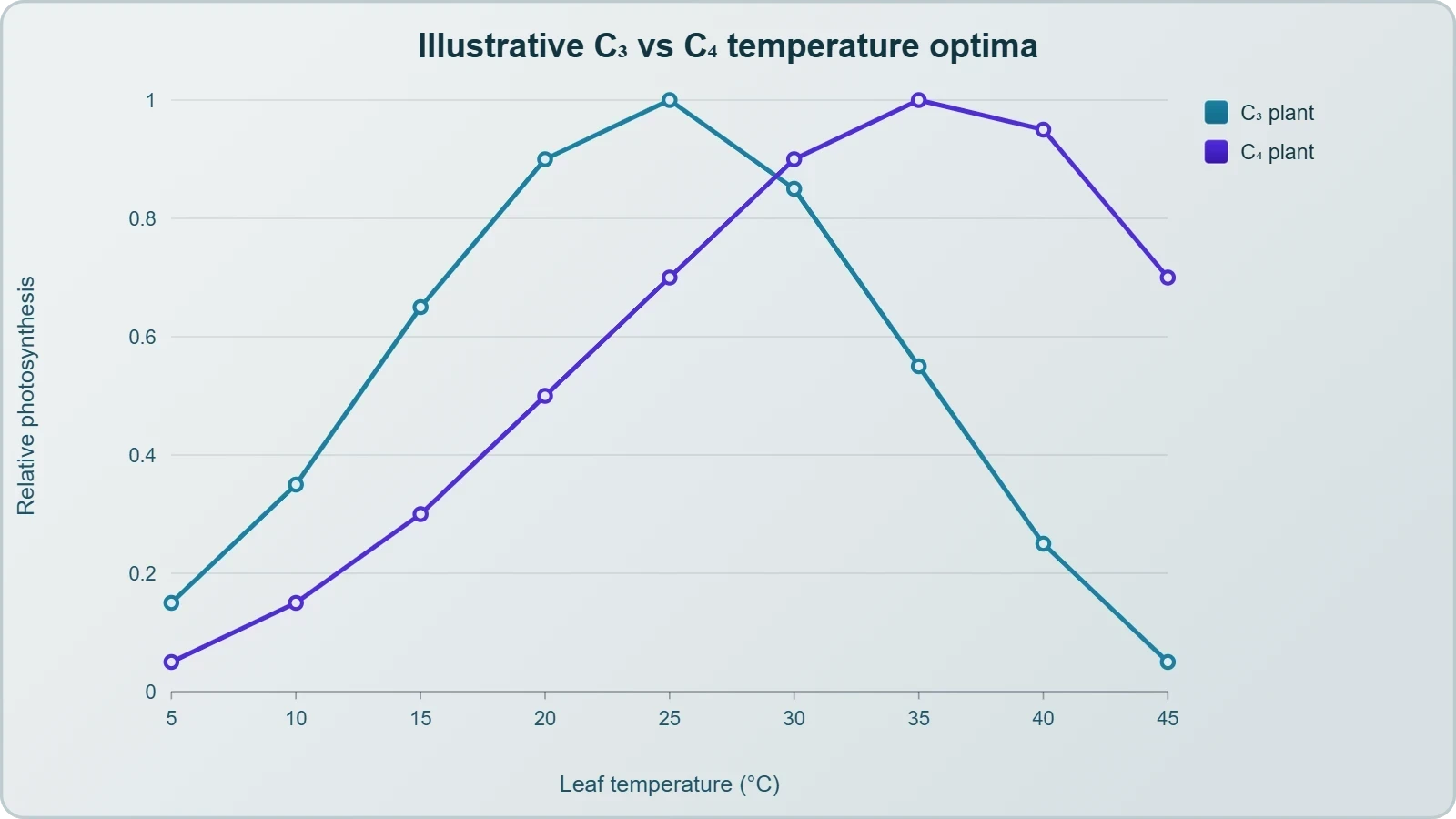
The temperature optimum for photosynthesis of different plants also depends on the habitat to which they are adapted. Tropical plants have a higher temperature optimum than plants adapted to temperate climates. This is adaptation in the strict sense: populations have tuned their enzymatic machinery, membrane composition and stomatal behaviour to the thermal regime they experience. A temperate crop transplanted to the tropics may photosynthesise poorly not because light or CO₂ is lacking, but because its dark reactions are calibrated for cooler conditions. Habitat, temperature optimum and photosynthetic pathway together form a coherent picture.
Water as a Factor: An Indirect Influence
Water occupies a curious position among the factors affecting photosynthesis. It is, after all, one of the reactants in the light reaction, split at photosystem II to supply electrons and release oxygen. Yet the material is explicit that the effect of water as a factor is more through its effect on the plant, rather than directly on photosynthesis. This distinction matters because it reframes water from a chemical input into an ecological and physiological constraint. When we say water limits photosynthesis, we are usually describing what water scarcity does to the leaf as an organ, not a shortage of substrate for photolysis.
Stomatal Closure and CO₂ Availability
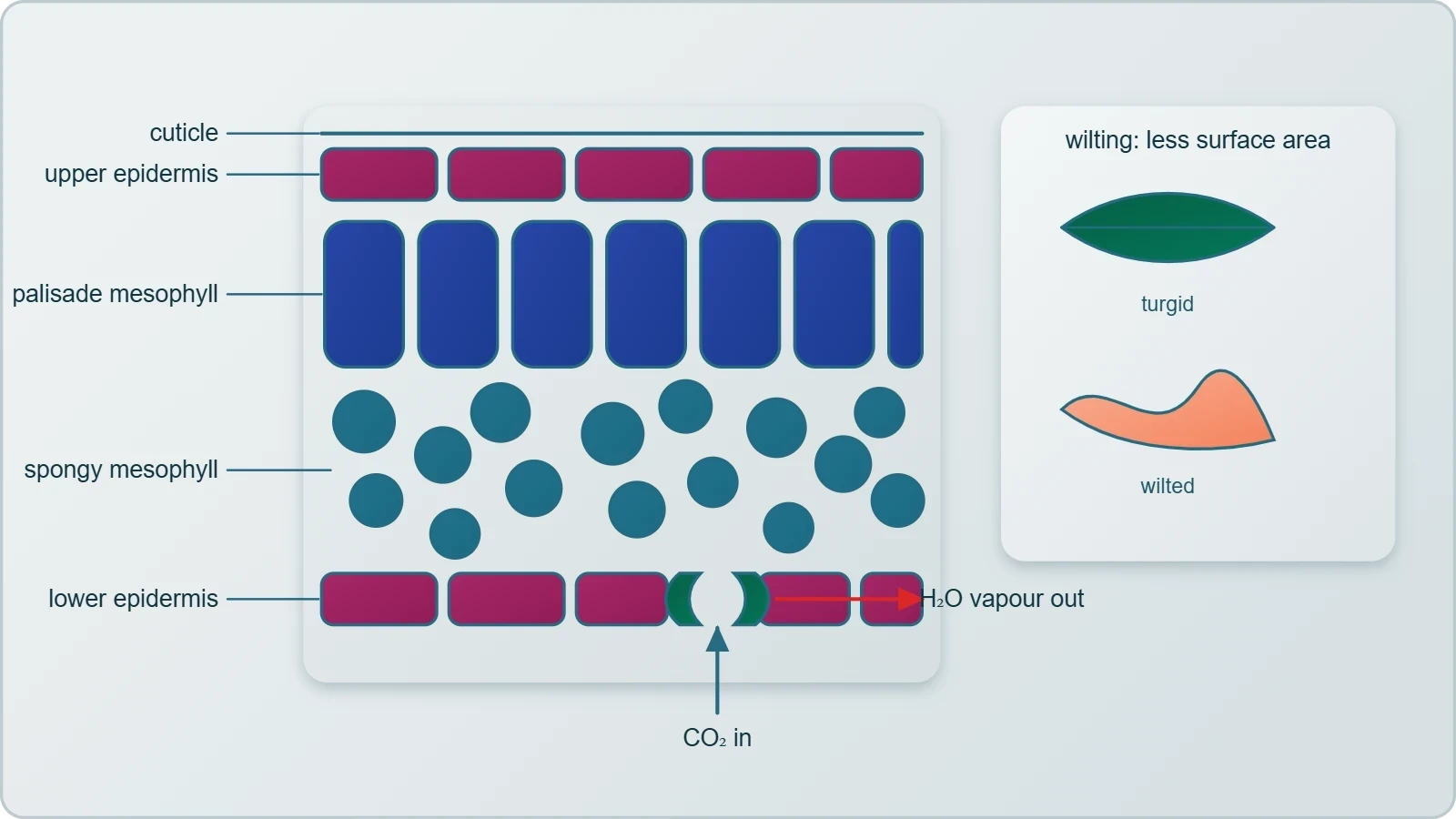
Water stress causes the stomata to close, hence reducing the CO₂ availability. This is the primary route by which drought suppresses carbon gain. Stomata are the regulated pores through which CO₂ diffuses into the leaf interior, and their aperture is the leaf's main control over gas exchange. When water is scarce, the plant closes them to conserve water vapour, accepting a reduction in CO₂ supply as the price. The consequence is a decline in the substrate for carboxylation, which links this lesson directly to the previous discussion of CO₂ concentration as the major limiting factor.
The logic is worth stating as a chain: water stress, then stomatal closure, then reduced CO₂ availability, then lower rates of photosynthesis. Each link is supported by the material, and the chain explains why drought and low atmospheric CO₂ can produce similar depressions in carbon fixation even though their causes are entirely different. It also explains why irrigation can restore photosynthetic rates rapidly, before any new leaf growth occurs: reopening stomata reconnects the Calvin cycle to its carbon supply.
Wilting, Surface Area and Metabolic Activity
Besides stomatal closure, water stress also makes leaves wilt, thus reducing the surface area of the leaves and their metabolic activity as well. Wilting is a loss of turgor, the internal water pressure that holds leaf tissues rigid and flat. A wilted leaf presents less area to incoming light, so interception of radiant energy falls. The material adds a second consequence, a reduction in metabolic activity, which reflects the broader dependence of cellular processes on a hydrated, organised cytoplasm. Water stress therefore attacks photosynthesis from two directions at once: less CO₂ in, and less light captured and processed.
These two effects compound each other. A leaf that has closed its stomata and lost turgor is simultaneously starved of carbon and deprived of the structural posture needed to harvest light efficiently. This is why prolonged water stress produces damage out of proportion to the simple arithmetic of reduced gas exchange. The material's phrasing, that water acts more through its effect on the plant than directly on photosynthesis, captures this systemic character precisely and should be quoted in any examination answer on the topic.
Reading Temperature and Water Together
Temperature and water do not act in isolation, and the material's structure invites us to consider them jointly. A hot, dry day combines a temperature that pushes the dark reactions past their optimum with a water deficit that closes stomata and wilts leaves. The two stresses reinforce each other: stomatal closure limits CO₂ supply precisely when the enzymatic machinery is least able to use it efficiently, and wilting reduces the light-capturing surface just as irradiance is at its peak. Understanding this interaction is what separates a list of factors from a working model of leaf performance.
Habitat as the Integrating Concept
The statement that the temperature optimum depends on the habitat to which a plant is adapted provides the integrating concept. Habitat bundles temperature and water availability into a single selective regime. Tropical plants, adapted to warmth, carry a higher temperature optimum; temperate plants, adapted to cooler and often wetter conditions, carry a lower one. C₄ plants, responding to higher temperatures with higher rates, are correspondingly prominent in hot environments. The factors are environmental, but the responses are evolutionary, and the two are read together through the lens of adaptation.
For the learner, this suggests a disciplined way to answer questions. Rather than listing temperature and water as separate bullets, describe how each acts, through which mechanism, and with what ecological consequence. Temperature acts chiefly on the enzymatic dark reactions, with the light reactions affected to a much lesser extent. Water acts chiefly through stomatal closure and wilting. The C₃ and C₄ contrast and the habitat-dependent optima then follow naturally as consequences rather than as memorised facts.
Preparing for the Course Summary
This lesson completes the survey of external factors. The previous lesson established carbon dioxide as the major limiting factor, with its low atmospheric concentration between 0.03 and 0.04 per cent and the differing saturation behaviour of C₃ and C₄ plants. The present lesson adds temperature and water, the former controlling the enzymatic dark reactions and the latter acting indirectly through the plant. What remains is to draw the threads together: light, CO₂, temperature and water, each with its own mechanism and its own interaction with the photosynthetic pathway a plant possesses.
The next lesson, the summary of photosynthesis in higher plants, will consolidate the entire course, from the early experiments and the site of photosynthesis through the pigments, the light reaction and electron transport, the Z scheme, chemiosmosis and the Calvin cycle, to the C₄ pathway, photorespiration and the factors we have now examined. Carry forward the two principles established here: that enzymatic steps carry the temperature dependence, and that water's influence is exercised through the plant's anatomy and behaviour rather than through its chemistry alone.
Going Further
Two pieces of background help the material settle into place. First, stomata are small pores on the leaf surface through which CO₂ enters and water vapour leaves the plant. Their dual role explains the dilemma at the heart of the water discussion: the same aperture that admits carbon must be narrowed to retain water, so the plant is always trading one resource against the other. Second, enzymes are proteins that catalyse reactions and typically work best within a certain temperature range, which is why temperature affects the enzymatic dark reactions so strongly. Outside that range, catalytic efficiency falls.
Enzyme Behaviour and the Shape of the Temperature Curve
The temperature response of an enzyme-catalysed reaction is characteristically asymmetric. Rates rise with temperature as collisions become more frequent, peak at an optimum, and then fall steeply as the protein begins to lose its functional shape. This shape explains why the material speaks of a temperature optimum rather than a simple increase. It also explains why the optimum is a property of the plant's habitat: enzymes from tropical species retain function at temperatures that would impair their temperate counterparts, a difference acquired over generations of selection.
A useful way to express the dependence is through the temperature coefficient of the reaction rate, conventionally written as ##Q_{10}##, the factor by which a rate increases for a 10 °C rise within the physiological range. For enzymatic processes it typically lies between about 2 and 3, though it falls towards 1 as the optimum is approached and becomes negative beyond it. The relationship can be summarised as:
where ##R_1## and ##R_2## are the reaction rates at temperatures ##T_1## and ##T_2##. The equation is a formal statement of what the material describes in words: the dark reactions accelerate with warmth up to an optimum and then decline. It also clarifies why the light reactions, being less dependent on enzyme catalysis, show a flatter thermal response. The contrast between a steep enzymatic curve and a shallow photochemical one is the quantitative shadow of the sentence that the dark reactions are temperature controlled while the light reactions are affected to a much lesser extent.
Modelling the Combined Effect of Temperature and Water
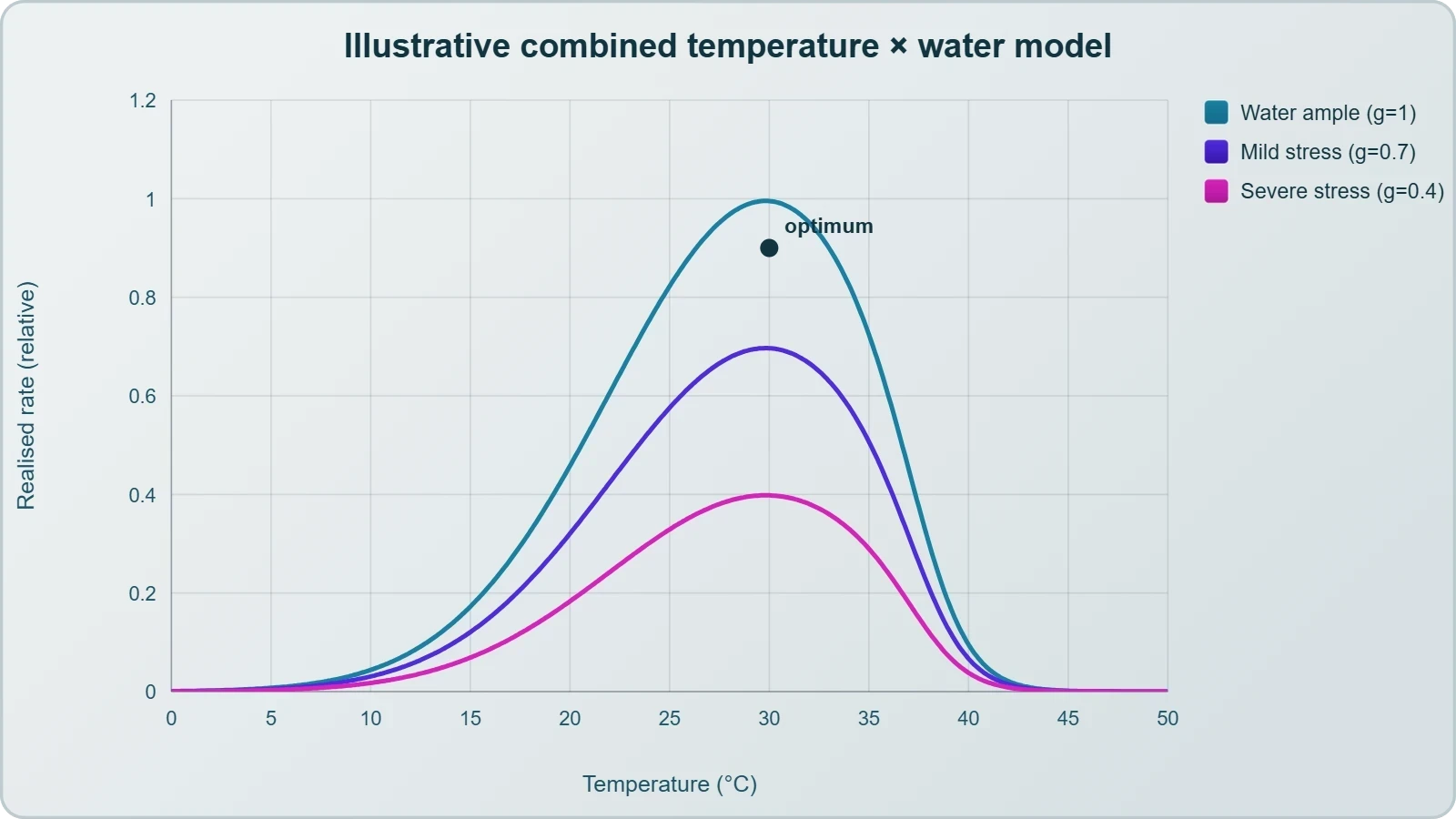
For learners who wish to see how the two factors combine, a simple multiplicative model is instructive. If the potential rate under optimal conditions is ##P_{max}##, the realised rate can be written as the product of a temperature response function and a water-stress function:
Here ##f(T)## peaks at the habitat-appropriate optimum and declines on either side, while ##g(W)## falls from 1 towards 0 as water stress closes stomata and wilts leaves. The model is deliberately simple, but it reproduces the qualitative behaviour the material describes: a hot, dry day depresses both functions at once, whereas a warm, well-watered day allows both to approach their maxima. A short script can illustrate the arithmetic of such a model without any claim to predictive precision.
def temperature_response(temp, optimum, width=8.0):
    # Simple symmetric peak around the habitat optimum
    return max(0.0, 1.0 - abs(temp - optimum) / width)

def water_response(stress):
    # stress ranges from 0 (well watered) to 1 (severe)
    return max(0.0, 1.0 - stress)

def realised_rate(p_max, temp, optimum, stress):
    return p_max * temperature_response(temp, optimum) * water_response(stress)

# C3 plant, cooler optimum; C4 plant, warmer optimum
print(realised_rate(100, 30, optimum=22, stress=0.2))
print(realised_rate(100, 30, optimum=35, stress=0.2))
Running this comparison shows the C₄ plant retaining a higher realised rate at 30 °C, consistent with its response to higher temperatures, while the C₃ plant performs better nearer its lower optimum. The exercise is not a substitute for the material's statements but a way of internalising them: temperature sets the shape of the response, water scales it down, and the pathway determines where the peak lies.
Common Misconceptions to Avoid
Several errors recur in answers on this topic, and the material's careful phrasing guards against each of them. The first is to claim that water limits photosynthesis mainly because it is a reactant in the light reaction. The material explicitly corrects this: the effect of water as a factor is more through its effect on the plant, rather than directly on photosynthesis. The second is to treat temperature as affecting both halves of photosynthesis equally. In fact the dark reactions are temperature controlled, while the light reactions are temperature sensitive but affected to a much lesser extent. Precision on these points distinguishes a strong answer.
Temperature, Light and the Limits of Each Statement
A third misconception concerns light. The material notes that incident light beyond a point causes the breakdown of chlorophyll and a decrease in photosynthesis. This is a reminder that factors have upper as well as lower limits, and that the same is true of temperature: warmth accelerates the dark reactions only up to an optimum, beyond which the enzymatic machinery suffers. Learners sometimes present temperature as uniformly beneficial, which contradicts the very notion of an optimum. The C₃ and C₄ contrast, and the habitat dependence of optima, both presuppose that too much heat is as problematic as too little.
A fourth error is to assume that C₄ plants simply photosynthesise faster at all temperatures. The material is more careful: C₄ plants respond to higher temperatures and show higher rates, while C₃ plants have a much lower temperature optimum. The advantage is conditional on warmth. At moderate temperatures the comparison may narrow or reverse. Reading the qualifiers, higher temperatures and much lower optimum, is essential; they define the conditions under which the contrast holds and prevent the overgeneralisation that examiners penalise.
Water Stress and the CO₂ Connection
A final misconception is to treat water stress and low CO₂ as unrelated phenomena. The material links them directly: water stress causes the stomata to close, hence reducing the CO₂ availability. The previous lesson established that carbon dioxide is the major limiting factor for photosynthesis, with atmospheric concentrations between 0.03 and 0.04 per cent. Water stress therefore acts by making an already limiting resource even less available. This is why drought symptoms in the field so closely resemble the effects of CO₂ limitation, and why the two lessons belong together in any coherent account of photosynthetic limitation.
Wilting adds a further dimension that is easily overlooked. The reduction in leaf surface area and in metabolic activity is not a subtle effect; it changes the leaf's capacity to intercept light and to sustain the biochemistry that uses it. An answer that mentions only stomatal closure is incomplete. The material presents wilting as a distinct consequence, and a full response should include both the stomatal and the wilting routes, together with the reminder that water's direct role as a reactant is comparatively minor as a limiting factor.
Practice and Consolidation
Consolidation should test mechanism rather than recall alone. A learner who can explain why the dark reactions carry the temperature dependence, why the light reactions do not, why C₄ plants respond to higher temperatures, and why water acts indirectly has understood the lesson. The questions below are framed to draw out those explanations. Where a numerical value appears, it should be quoted as the material gives it: the atmospheric CO₂ range of 0.03 to 0.04 per cent, for instance, belongs to the previous lesson but is useful context for the water discussion.
Short Answer Questions
First, state the temperature relationship of the two halves of photosynthesis and explain the difference. Second, explain why C₄ plants show higher rates at elevated temperature while C₃ plants have a much lower optimum. Third, describe two ways in which water stress reduces photosynthesis, naming stomatal closure and wilting. Fourth, explain why the temperature optimum of a tropical plant differs from that of a temperate plant. Fifth, account for the statement that water's effect as a factor is more through the plant than directly on photosynthesis. Each answer should be three to five sentences, mechanism first, consequence second.
Longer Discussion Prompts
For extended practice, consider a leaf on a hot, dry afternoon. Describe how temperature and water jointly constrain its photosynthetic rate, referring to the enzymatic dark reactions, stomatal closure, reduced CO₂ availability and wilting. Then compare a C₃ crop with a C₄ crop grown side by side in the same field, explaining how their temperature optima and responses to water stress might differ. Finally, connect the discussion to the previous lesson by explaining how water stress compounds the limitation imposed by low atmospheric CO₂, and anticipate how the course summary will integrate light, CO₂, temperature and water into a single account.
Also Read
- No links available.
From our network :
- 98% of Global MBA Programs Now Prefer GRE Over GMAT Focus EditionExplore why 98% of global MBA programs now prefer the GRE over GMAT Focus. Learn about the shorter GRE format, verbal logic importance, and strategic versatility for students.
- Mastering DB2 LUW v12 Tables: A Comprehensive Technical GuideComprehensive guide on DB2 LUW v12 tables. Explore CREATE TABLE syntax, BLU Acceleration, range partitioning, data types, and security features for IBM DB2 LUW v12.
- Analyzing Trump Deportation Numbers Insights Into The 2026 Immigration Crackdown
- AI-Powered 'Precision Diagnostic' Replaces Standard GRE Score ReportsDiscover the new GRE Precision Diagnostic. Learn how AI-powered behavioral analytics and time-to-solve tracking are replacing standard GRE score reports to empower students.
- Mastering DB2 12.1 Instance Design: A Technical Deep Dive into Modern Database ArchitectureComprehensive guide to DB2 12.1 Instance Design. Explore architectural components, HADR setup, buffer pool tuning, and security policies for IBM DB2 12.1. Includes 10 functional SQL and Shell samples.
- 10 Physics Numerical Problems with Solutions for IIT JEEPrepare for IIT JEE with 10 physics numerical problems, complete with detailed solutions and conceptual explanations. Ideal for mastering kinematics, thermodynamics, electromagnetism, and optics.
- Vite 6/7 'Cold Start' Regression in Massive Module GraphsIn-depth analysis of Vite 6/7 cold start regressions in massive module graphs. Learn about barrel file issues, pre-bundling optimizations, and how to improve Vite dev server performance.
- EV 2.0: The Solid-State Battery Breakthrough and Global Factory ExpansionDiscover the impact of the Solid-State Battery Breakthrough on the EV market. Learn about CATL and BYD stock growth, global factory expansion in Europe, and the future of EV 2.0 technology.
- Trump Political Strategy How Geopolitical Stunts Serve As Media Diversions
RESOURCES
- Resources will be updated soon.