Photosynthesis is the physico-chemical process by which green plants use light energy to drive the synthesis of organic compounds, and it stands as the primary source of all food on earth while also releasing oxygen into the atmosphere. Before any learner can follow the machinery of chloroplasts, electron transport or the Calvin cycle, they must first be secure in the three requirements that earlier classes established through simple, repeatable experiments: chlorophyll, light and carbon dioxide. This lesson revisits those foundational demonstrations with the precision they deserve, treating them not as childish exercises but as the evidential bedrock on which the entire chapter rests.
The logic of these experiments is beautifully economical. A variegated leaf, or a leaf partly masked with black paper, tests the role of chlorophyll and light in a single stroke, because starch appears only where green tissue meets illumination. A leaf partly enclosed with potassium hydroxide-soaked cotton tests the role of carbon dioxide, because the enclosed portion is starved of ##CO_2## and consequently fails the starch test. Together, the two demonstrations isolate each variable and confirm that photosynthesis, measured through its starch signature, demands all three factors simultaneously.
What follows is a structured walk through this material, moving from the starch test itself to the reasoning that converts a colour change into a conclusion, and then to the quantitative relationships that govern how these three factors interact. The lesson closes by preparing the ground for the historical experiments of Priestley and Ingenhousz, which asked a different and larger question: what does a plant do to the air around it? Mastery of the present lesson makes that next step intelligible rather than mysterious.
On This Page
- The Three Requirements Established by Simple Experiments
- The Carbon Dioxide Demonstration and Its Logic
- Chlorophyll as the Green Pigment of the Leaf
- Starch as the Detectable Signature of Carbon Fixation
- How the Three Factors Interact in Practice
- Going Further: A Note on the Pigment and the Gas
- Consolidating the Evidence and Its Limits
The Three Requirements Established by Simple Experiments
Simple experiments carried out in earlier classes have shown that chlorophyll, the green pigment of the leaf, light and carbon dioxide are required for photosynthesis to occur. This trio is not a list to be memorised but a set of variables that can each be manipulated independently, and the elegance of the classical demonstrations lies in how cleanly they separate one factor from another. When a result changes only because one factor changed, the conclusion is secure; when several factors shift at once, the conclusion is worthless. The experiments described here obey that discipline.
The Variegated Leaf and the Masked Leaf
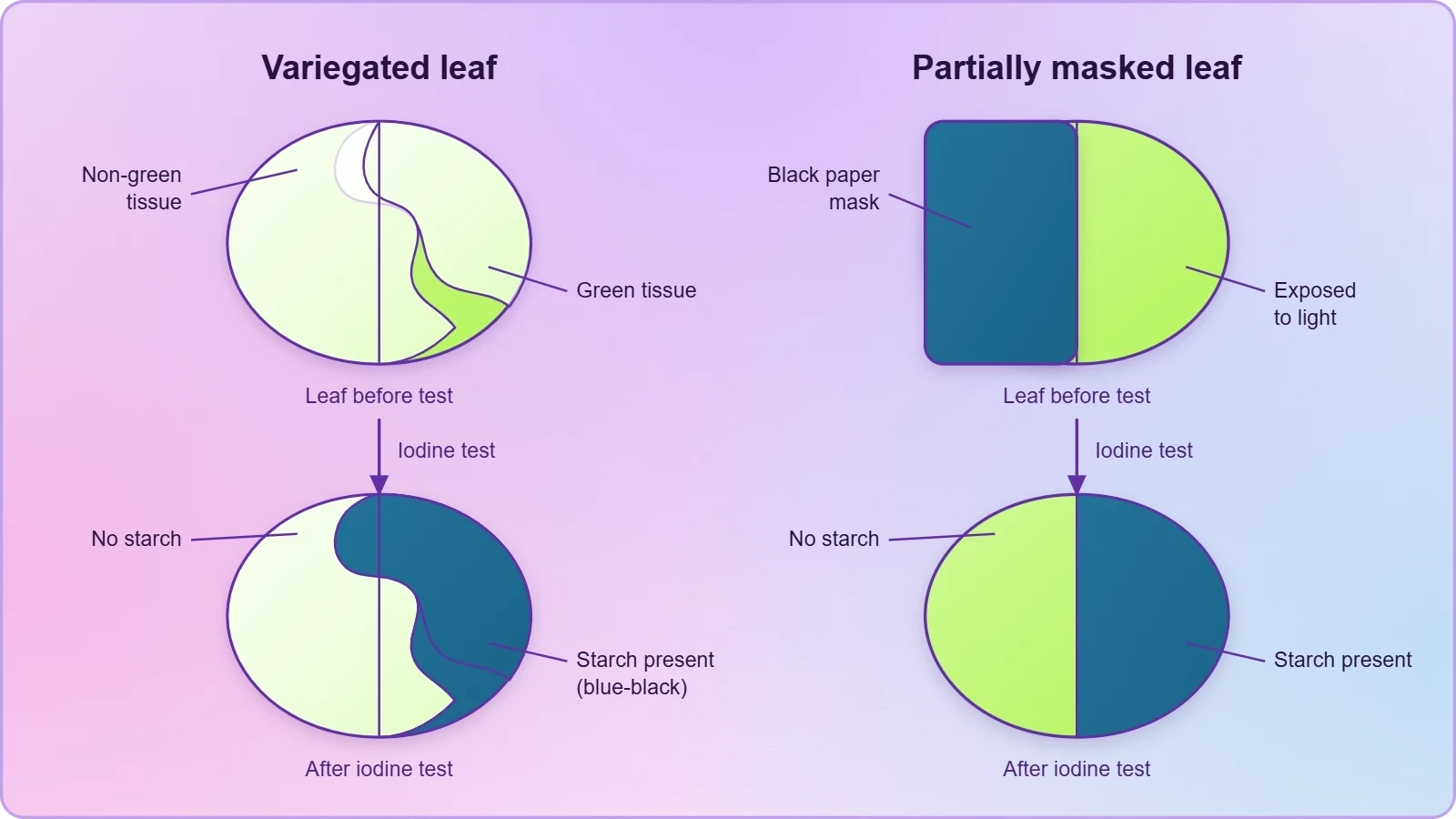
The first demonstration looks for starch formation in two kinds of leaf: a variegated leaf, which carries patches of non-green tissue alongside green tissue, and a leaf that was partially covered with black paper before being exposed to light. In both cases the leaf is later tested for the presence of starch. The variegated leaf isolates chlorophyll, since light reaches green and non-green regions alike but only the green regions can absorb it usefully. The masked leaf isolates light, since chlorophyll is present everywhere but the covered portion receives none.
On testing these leaves for starch, it becomes clear that photosynthesis occurred only in the green parts of the leaves in the presence of light. The result is a double confirmation delivered by a single technique. Where tissue is green and illuminated, starch accumulates; where either condition fails, it does not. The experiment therefore establishes that chlorophyll and light are jointly necessary, and it does so without requiring any measurement beyond the detection of starch, a substance that serves as a convenient and stable record that carbon fixation has taken place.
Reading the Result Correctly
A subtle point deserves emphasis: the experiment detects starch, not photosynthesis directly. Starch is the visible, testable consequence of a chain of reactions that begins with light absorption and ends with the storage of fixed carbon. Its presence is therefore evidence, not proof in the strictest sense, and its absence must be interpreted with care. A leaf that fails the starch test might have photosynthesised and then exported its sugars elsewhere, which is why the classical protocol uses a leaf that has been suitably prepared so that accumulated starch reflects recent activity in the tissue under examination.
This habit of reasoning, distinguishing between the phenomenon observed and the process inferred, is exactly what the chapter will demand later when electron transport is described through indirect measurements. The learner who understands why the starch test works, and what its limits are, is already thinking like an experimental biologist. The variegated and masked leaf demonstrations are thus not merely facts to recall but a first lesson in experimental design, control of variables and the cautious interpretation of evidence.
The Carbon Dioxide Demonstration and Its Logic
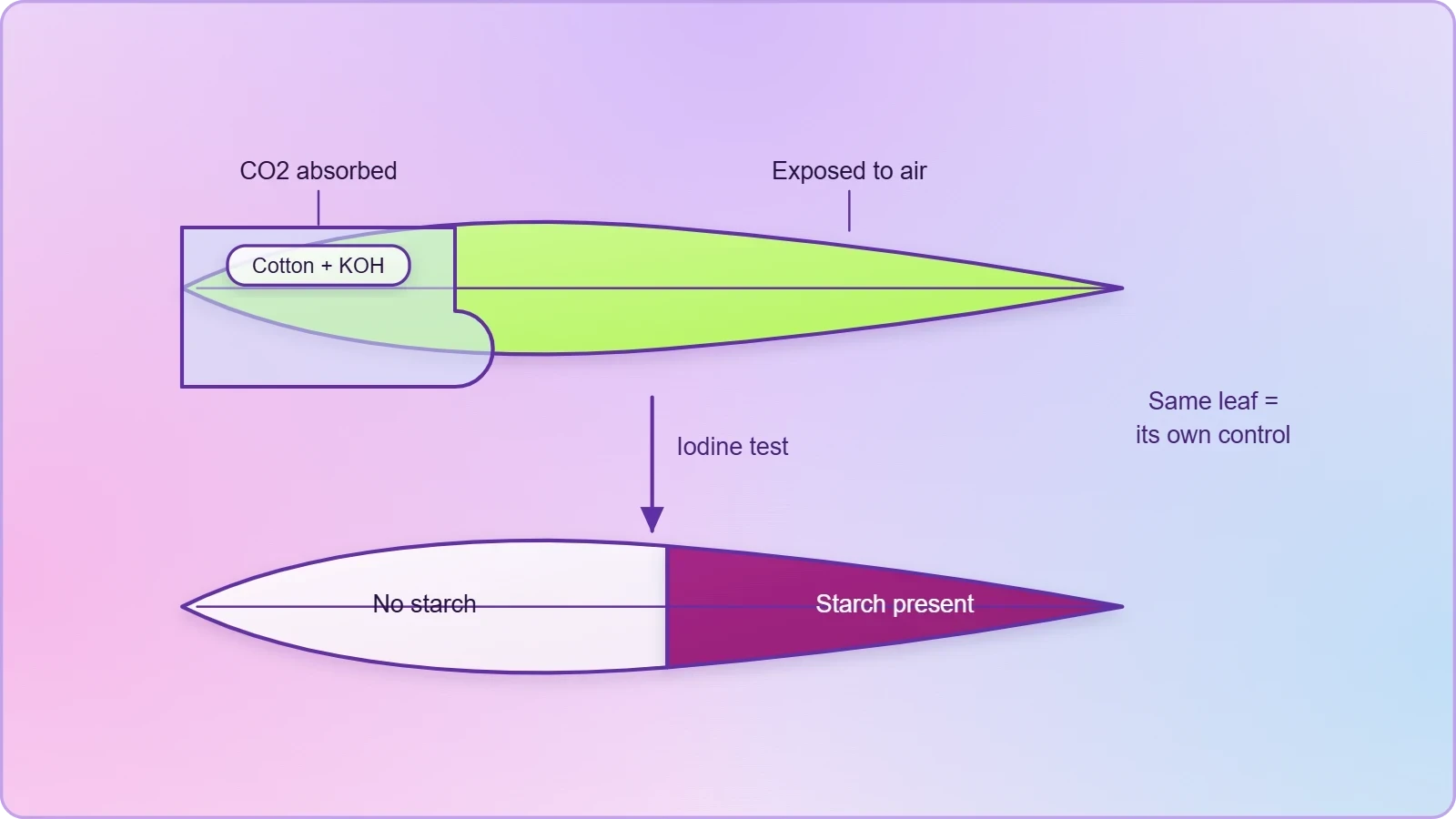
The second classical experiment addresses the third requirement. A part of a leaf is enclosed in a test tube containing some potassium hydroxide-soaked cotton, which absorbs carbon dioxide, while the other half of the same leaf remains exposed to air. The setup is then placed in light for some time. Because both halves share the same leaf, the same chlorophyll and the same illumination, the only difference between them is the availability of ##CO_2##, and any difference in outcome can be attributed to that single variable with confidence.
Why Potassium Hydroxide Matters
Potassium hydroxide is a strong absorber of carbon dioxide, and its role in the setup is to create a local atmosphere depleted of ##CO_2## around the enclosed portion of the leaf. The exposed half continues to experience normal air, in which carbon dioxide is present at the modest concentration that plants normally draw upon. The design is a chemical intervention rather than a physical barrier, and this is its strength: light passes freely into the tube, so illumination is not confounded with the treatment. Only the carbon supply differs between the two regions of the leaf.
When the two parts of the leaf are later tested for the presence of starch, the exposed part tests positive while the portion inside the tube tests negative. The conclusion follows directly: carbon dioxide was required for photosynthesis. The negative result is meaningful precisely because the positive result occurred on the same leaf under the same light, ruling out any suggestion that the enclosed tissue was simply too young, too old or otherwise incapable of fixing carbon.
Reconstructing the Inference
Learners are often asked to explain how this conclusion could be drawn, and the answer is a compact exercise in controlled comparison. The leaf supplies its own control, since the untreated half demonstrates that the tissue is competent to photosynthesise under the given conditions. The treated half differs only in the absence of ##CO_2##. Since starch fails to appear there, and since starch is the detectable product of carbon fixation, the deprivation of ##CO_2## must be the cause of the failure. No other variable was altered, so no other explanation is available.
This reasoning pattern recurs throughout the chapter. When the C4 pathway is later contrasted with the Calvin cycle, or when photorespiration is explained as a consequence of the enzyme rubisco binding oxygen instead of carbon dioxide, the same logic applies: identify the variable, hold everything else constant, and read the outcome. The potassium hydroxide experiment is therefore a template as much as a fact, and its apparent simplicity conceals a genuinely rigorous structure of inference that repays close attention.
Chlorophyll as the Green Pigment of the Leaf
Chlorophyll is described in the material simply as the green pigment of the leaf, and that plain definition is worth pausing over. The greenness is not incidental decoration but the visible signature of a molecule tuned to absorb light in the visible region, and the experiment with the variegated leaf exploits precisely this correspondence. Where chlorophyll is present, the tissue is green and can capture light energy; where it is absent, as in the pale patches of a variegated leaf, the tissue cannot, and no starch accumulates there even under full illumination.
Green Tissue as the Site of Activity
The conclusion that photosynthesis occurred only in the green parts of the leaves in the presence of light carries an implicit statement about location. The capacity to photosynthesise is not distributed uniformly through the plant body but is confined to tissues that contain the pigment. This observation prepares the way for the later question of where photosynthesis takes place within the cell, a question the chapter answers by identifying the chloroplast as the organelle concerned. For the present lesson, the essential point is that pigment and function travel together.
It is also worth noting what the variegated leaf demonstrates about the relationship between structure and capability. The non-green patch is not dead tissue; it is living leaf that lacks the pigment. Its failure to accumulate starch is therefore a functional deficit rather than a sign of damage, and this distinction matters when interpreting any negative result in biology. The tissue was competent in every respect except the one that had been removed, which is exactly what a well-designed experiment requires.
Light as the Energy Source
Light enters the account as the energy source that drives the synthesis of organic compounds, and the masked-leaf experiment isolates its contribution cleanly. When part of a leaf is covered with black paper, chlorophyll remains present throughout, yet starch appears only where light reached the tissue. The conclusion is that illumination is not merely helpful but necessary, and the demonstration makes the point without any need for instrumentation. The covered region serves as the control that proves the illuminated region's success was not automatic.
This result also establishes the direction of the causal arrow. Light is not produced by the plant; it is captured and converted. The chapter will later describe the light reaction as the stage in which light energy is transformed, and the electron transport chain as the mechanism that carries the transformation forward. The masked-leaf experiment is the simplest possible statement of that principle, and it remains the most persuasive because anyone can repeat it with a leaf, some paper and a suitable test for starch.
Starch as the Detectable Signature of Carbon Fixation
Both classical demonstrations rely on the same readout: the presence or absence of starch. Understanding why starch was chosen, and what its detection actually involves, sharpens the interpretation of every result in this lesson. Starch is an insoluble storage carbohydrate, and it accumulates in leaf tissue when the rate of carbon fixation exceeds the rate at which sugars are exported. It is therefore a cumulative record of photosynthetic activity over the period before testing, which makes it convenient for experiments conducted over hours rather than seconds.
From Sugar to Storage
The organic compounds produced through photosynthesis are the starting material for a range of downstream products, and starch represents one branch of that metabolism. Because it is stored rather than immediately consumed, it persists in the tissue long enough to be detected reliably. A leaf that has photosynthesised in a region will contain starch in that region, and a leaf that has not will not. The test thus converts an invisible biochemical event into a visible outcome, which is the essential trick of the classical plant physiology demonstration.
This conversion is not without its subtleties. The amount of starch present depends on the balance between synthesis and export, so a leaf that is actively exporting sugars might show less starch than one that is not, even if both have photosynthesised at similar rates. The classical protocol manages this by choosing conditions and timing that allow accumulation to reflect activity in the region of interest. Learners should appreciate that the technique is robust but not infinitely sensitive, and that its proper use requires attention to these practical details.
Interpreting Positive and Negative Results
A positive starch test in a green, illuminated region tells us that carbon fixation has occurred there. A negative test in a non-green region, or in a darkened region, or in a region deprived of ##CO_2##, tells us that it has not. The pairing of positive and negative results within a single leaf is what gives the demonstrations their force, because it eliminates variation between individual plants as an explanation. The same leaf, the same age, the same history, and yet different outcomes depending on the treatment applied to each part.
This is the essence of a controlled experiment, and it is worth stating explicitly because the principle will be assumed throughout the remainder of the chapter. When the light reaction is dissected into photosystems and the Calvin cycle into its stages, the evidence for each step comes from experiments of exactly this character, comparing treated and untreated material under otherwise identical conditions. The starch test is the learner's first encounter with that logic, and it is a good one.
How the Three Factors Interact in Practice
Having established that chlorophyll, light and ##CO_2## are each required, the natural next question concerns how they combine. A requirement is a threshold, not a rate, and the rate of photosynthesis responds to the availability of each factor in a characteristic way. When one factor is in short supply, it limits the overall rate regardless of how abundant the others may be, a principle the chapter later formalises as Blackman's Law of Limiting Factors. The experiments in this lesson are the qualitative foundation for that quantitative law.
Limiting Factors in the Classical Sense
Consider a leaf that is well supplied with chlorophyll and illuminated brightly but deprived of carbon dioxide, as in the potassium hydroxide setup. Photosynthesis does not proceed at a reduced rate in proportion to the ##CO_2## available; it effectively stops, because the substrate for carbon fixation is absent. Conversely, a leaf with ample ##CO_2## but no light cannot begin the process at all, since the energy-capturing stage has nothing to capture. Each factor is necessary, and the least available one sets the ceiling on the whole.
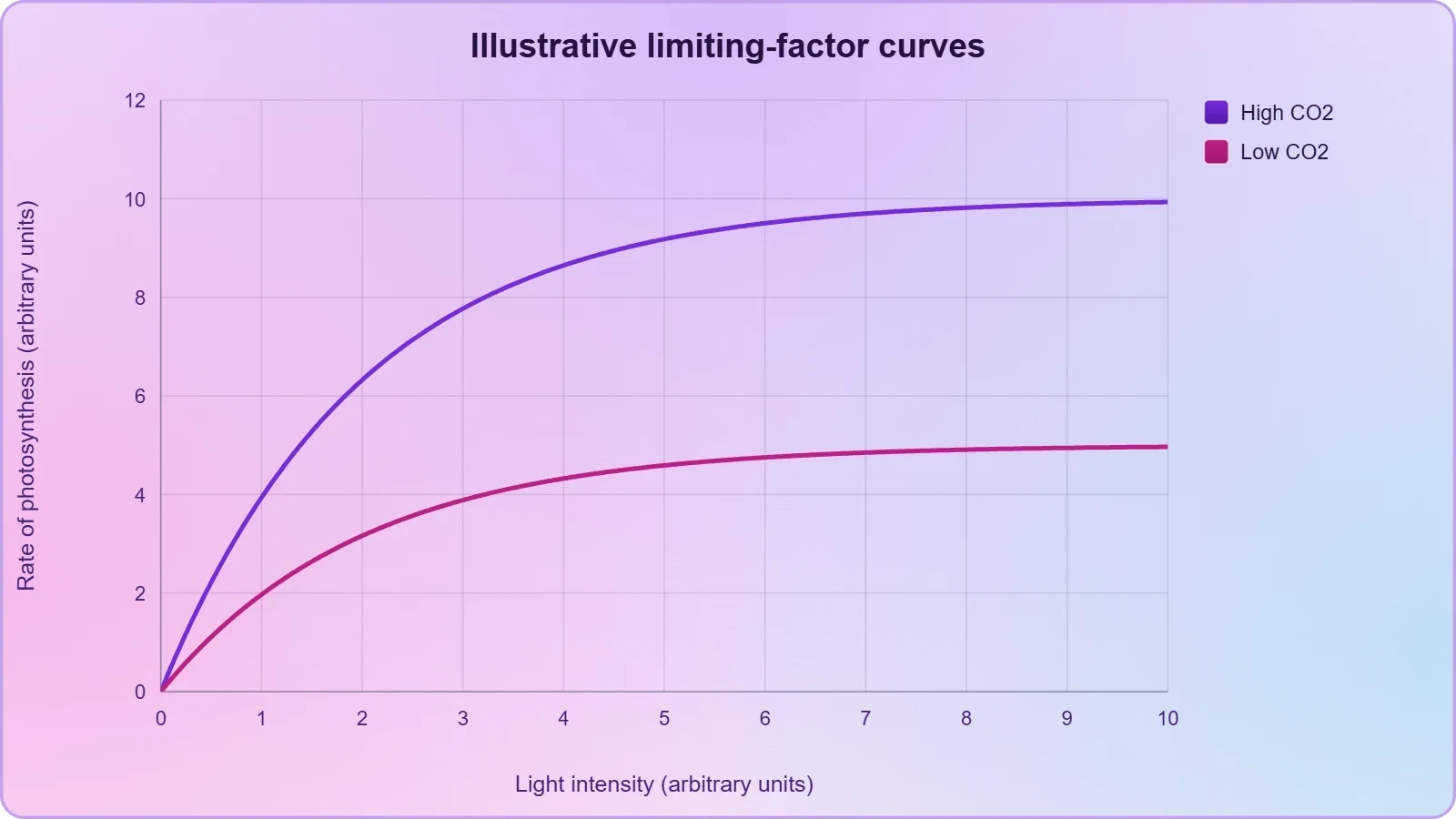
This is why the three demonstrations are presented together rather than in isolation. Each removes one factor and observes the consequence, and the pattern of results reveals a system in which no single component can substitute for another. The learner who grasps this is prepared for the later discussion of factors affecting photosynthesis, where light intensity, carbon dioxide concentration and temperature are treated as variables that shift the rate along a curve rather than as simple on-off switches.
Preparing for the Historical Experiments
The experiments in this lesson answer the question of what is required. They do not yet address the question of what the plant does to the air around it, which is the question that occupied the natural philosophers of the eighteenth century. That is the subject of the next lesson, where Joseph Priestley's observations on candles, mice and mint plants, and Jan Ingenhousz's demonstration that sunlight is essential and that only the green parts release oxygen, will extend the story from requirements to products.
The transition is logical. Once we know that light, chlorophyll and ##CO_2## are needed, it becomes reasonable to ask what emerges from the process and how the surrounding atmosphere is altered. The classical demonstrations provide the vocabulary and the experimental habits needed to follow that inquiry, and they ensure that when Priestley's bell jar is described, the learner understands exactly which variables are in play and why his conclusions, though framed in the language of his time, pointed toward the chemistry we now describe.
Going Further: A Note on the Pigment and the Gas
Beyond the material itself, a few well-established points help the learner connect these demonstrations to the wider subject. Chlorophyll is not a single substance but a family of related pigments, and the green colour of leaves reflects their absorption profile in the visible spectrum. The precise chemistry of these pigments belongs to a later lesson, but it is worth knowing that the greenness observed in the variegated leaf experiment is a direct consequence of molecular structure rather than an arbitrary marker of health.
Why Green and Not Some Other Colour
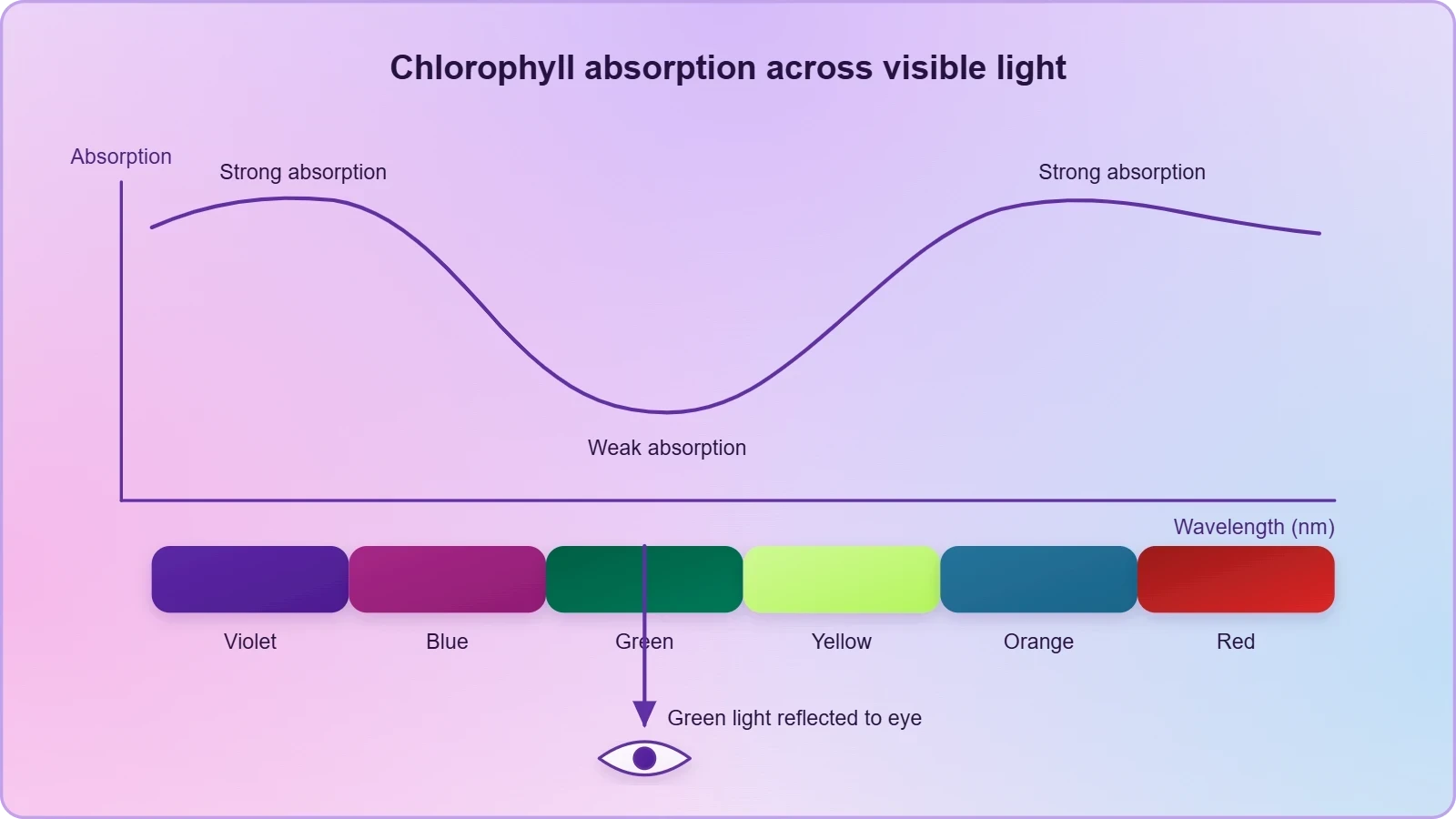
The pigment absorbs strongly in the blue and red regions of the spectrum and reflects green light, which is why leaves appear green to the human eye. This is a useful piece of background because it explains why the variegated leaf works as a test: the pale patches lack the pigment and therefore cannot harvest the light that falls on them, no matter how bright the illumination. The experiment is thus a visible demonstration of an invisible molecular property, and the connection between colour and function is one of the most elegant in plant biology.
It is also worth noting that carbon dioxide is present in air at a modest concentration, and that the potassium hydroxide in the classical setup removes it by chemical absorption rather than by physical exclusion. This distinction matters because it explains why the treatment is so effective: the absorber continuously removes ##CO_2## from the enclosed air, maintaining a steep gradient that keeps the local concentration near zero for the duration of the experiment. The design is simple, but the chemistry behind it is sound.
Looking Ahead
The next lesson turns to Priestley and Ingenhousz, whose experiments asked what plants do to the air. Priestley observed that a candle burning in a closed space soon gets extinguished and that a mouse would soon suffocate, concluding that a burning candle or an animal that breathes the air somehow damages it. When he placed a mint plant in the same bell jar, the mouse stayed alive and the candle continued to burn, leading him to hypothesise that plants restore to the air whatever breathing animals and burning candles remove.
Ingenhousz then showed, using a similar setup placed once in the dark and once in sunlight, that sunlight is essential for the plant process that purifies the air. In an elegant experiment with an aquatic plant, he observed that in bright sunlight small bubbles formed around the green parts while in the dark they did not, and he later identified these bubbles as oxygen. That is where the story continues, and the present lesson has prepared the ground for it.
Consolidating the Evidence and Its Limits
The demonstrations examined in this lesson are among the oldest in plant physiology, yet they retain their pedagogical power because they are transparent. Nothing is hidden behind instrumentation; a leaf, a mask, a tube of potassium hydroxide-soaked cotton and a test for starch are sufficient to establish that chlorophyll, light and ##CO_2## are required. The learner who can reconstruct the reasoning from first principles, rather than merely recalling the conclusion, has acquired something more durable than a fact: a method for interrogating biological systems.
What the Experiments Do Not Show
It is important to be clear about the boundaries of the evidence. The starch test does not reveal the mechanism of photosynthesis, the identity of the pigments beyond their colour, or the sequence of reactions that connect light absorption to carbon fixation. It establishes requirements, not pathways. Those pathways are the subject of the lessons that follow, where the light reaction, electron transport and the Calvin cycle are described in their proper detail. The present lesson is deliberately modest in scope, and its modesty is a virtue.
Nor do the experiments quantify. They tell us that a factor is necessary, not how much of it is needed or how the rate responds to varying supply. That quantitative dimension arrives later with the discussion of factors affecting photosynthesis, where light intensity, ##CO_2## concentration and temperature are treated as continuous variables. The qualitative foundation laid here is nonetheless essential, because a rate curve is meaningless without a prior understanding of what the rate is measuring and which inputs it depends upon.
A Final Synthesis
Three factors, three demonstrations, one conclusion: photosynthesis requires chlorophyll, light and carbon dioxide, and the absence of any one of them prevents the accumulation of starch in leaf tissue. The variegated and masked leaves isolate the first two, the potassium hydroxide setup isolates the third, and the internal control provided by the untreated half of each leaf secures the inference. This is the content of the lesson, and it is also a model of how biological knowledge is built from simple, repeatable observations.
With these requirements established, the stage is set for the historical experiments that asked a larger question. Priestley's bell jar, the candle, the mouse and the mint plant; Ingenhousz's aquatic plant and its bubbles of oxygen in bright sunlight; these will show that plants do not merely consume the factors identified here but transform the atmosphere around them. The learner who has followed the present lesson will meet those experiments with the vocabulary and the sceptical habits they demand, and will see them as a continuation rather than a fresh start.
Also Read
- No links available.
From our network :
- 10 Physics Numerical Problems with Solutions for IIT JEEPrepare for IIT JEE with 10 physics numerical problems, complete with detailed solutions and conceptual explanations. Ideal for mastering kinematics, thermodynamics, electromagnetism, and optics.
- Analyzing Trump Deportation Numbers Insights Into The 2026 Immigration Crackdown
- Mastering DB2 LUW v12 Tables: A Comprehensive Technical GuideComprehensive guide on DB2 LUW v12 tables. Explore CREATE TABLE syntax, BLU Acceleration, range partitioning, data types, and security features for IBM DB2 LUW v12.
- Mastering DB2 12.1 Instance Design: A Technical Deep Dive into Modern Database ArchitectureComprehensive guide to DB2 12.1 Instance Design. Explore architectural components, HADR setup, buffer pool tuning, and security policies for IBM DB2 12.1. Includes 10 functional SQL and Shell samples.
- Trump Political Strategy How Geopolitical Stunts Serve As Media Diversions
- EV 2.0: The Solid-State Battery Breakthrough and Global Factory ExpansionDiscover the impact of the Solid-State Battery Breakthrough on the EV market. Learn about CATL and BYD stock growth, global factory expansion in Europe, and the future of EV 2.0 technology.
- Vite 6/7 'Cold Start' Regression in Massive Module GraphsIn-depth analysis of Vite 6/7 cold start regressions in massive module graphs. Learn about barrel file issues, pre-bundling optimizations, and how to improve Vite dev server performance.
- AI-Powered 'Precision Diagnostic' Replaces Standard GRE Score ReportsDiscover the new GRE Precision Diagnostic. Learn how AI-powered behavioral analytics and time-to-solve tracking are replacing standard GRE score reports to empower students.
- 98% of Global MBA Programs Now Prefer GRE Over GMAT Focus EditionExplore why 98% of global MBA programs now prefer the GRE over GMAT Focus. Learn about the shorter GRE format, verbal logic importance, and strategic versatility for students.
RESOURCES
- Resources will be updated soon.