Every account of photosynthesis eventually has to answer a deceptively simple question: where, physically, does the work happen? The answer is not a single point but a division of space and duty inside the plant cell. Photosynthesis takes place in the green leaves of plants, and also in other green parts of the plant body, within organelles called chloroplasts that sit inside the mesophyll cells of the leaf. Understanding this arrangement is what turns a chemical equation into a picture of a working factory, with separate rooms for capturing light and for building sugar.
This lesson examines that factory closely. It begins with the leaf and the mesophyll cell, then moves inside the chloroplast to the membranous system of grana and stroma lamellae and the matrix called stroma. From there it traces the clear division of labour: the membrane system traps light energy and synthesises ATP and NADPH, while enzymatic reactions in the stroma synthesise sugar, which in turn forms starch. The lesson also explains why the two sets of reactions carry the names light reactions and dark reactions, and why that second name must be read with care.
Because this lesson builds on the early experiments of von Sachs, Engelmann and van Niel, it assumes you already know that light, chlorophyll and carbon dioxide are the essential requirements. What it adds is location and organisation. By the end, you should be able to describe the chloroplast's internal geography, explain which structure performs which task, and state precisely what the term dark reactions does and does not mean. That foundation prepares the ground for the next lesson, on the types of pigments involved.
On This Page
The Green Leaf and Other Photosynthetic Parts of the Plant
Asked where photosynthesis occurs, most learners answer "in the green leaf" or "in the chloroplasts," and both answers are correct as far as they go. The green leaf is the principal site, but photosynthesis also takes place in other green parts of the plant. Any tissue that carries chlorophyll and receives light can, in principle, contribute. The leaf remains the dominant organ because its broad, thin form exposes a large surface to incident light while allowing gases to move freely in and out.
Within the leaf, the relevant cells are the mesophyll cells, which contain a large number of chloroplasts. These cells form the photosynthetic tissue in the interior of the leaf, and their chloroplasts are the organelles where the light-driven steps occur. The sheer number of chloroplasts per mesophyll cell matters: it multiplies the light-absorbing surface many times over, so that a single leaf behaves as a dense array of tiny photochemical reactors rather than as one uniform sheet of pigment.

Why Chloroplast Position Inside the Cell Matters
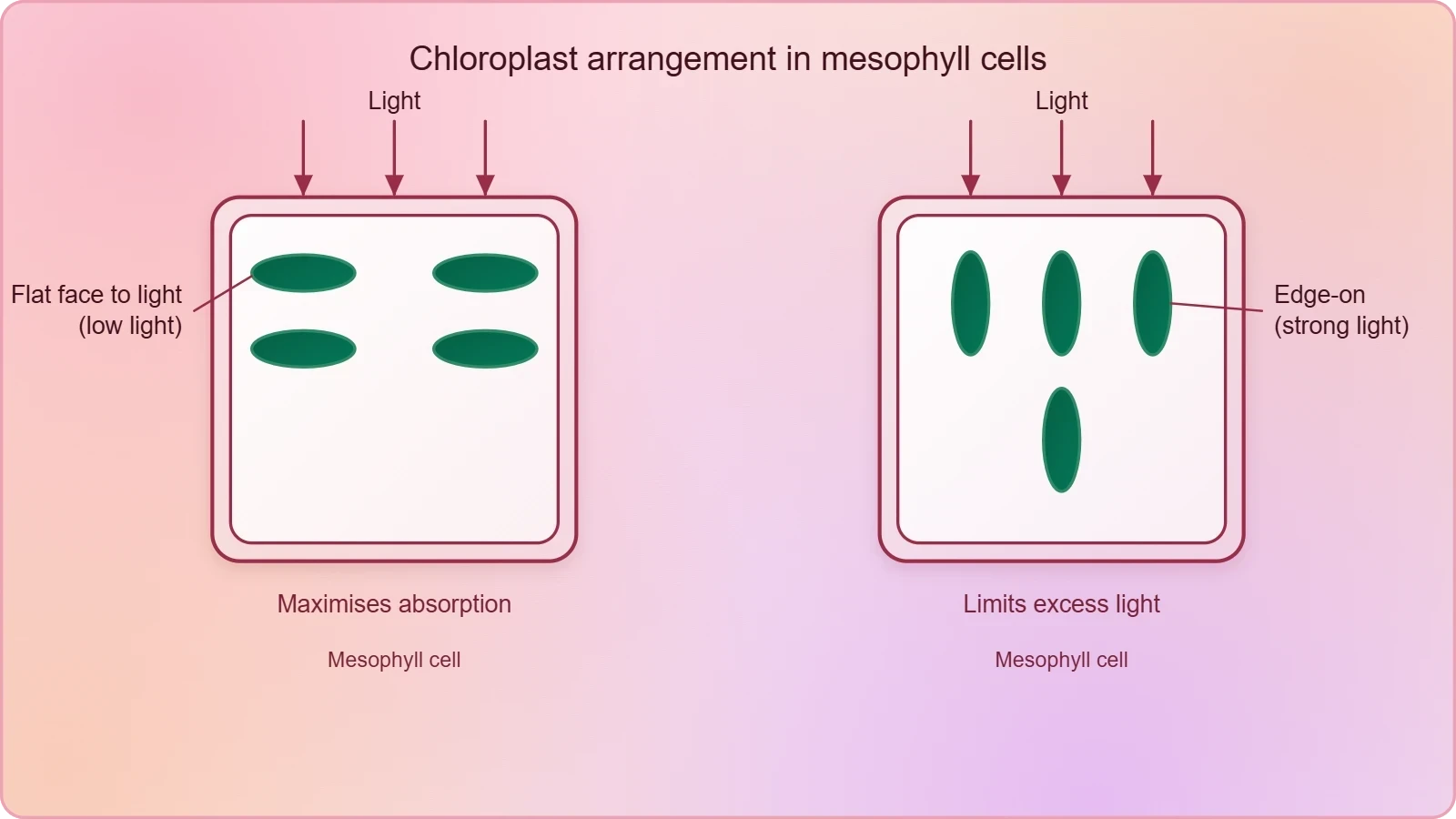
Chloroplasts are not scattered at random. They usually align themselves along the walls of the mesophyll cells in such a way that they receive the optimum quantity of incident light. This is a positional strategy, not a chemical one, and it shows that the cell manages its photosynthetic machinery spatially. By hugging the cell wall, a chloroplast shortens the path that light travels through the cell and reduces the chance that neighbouring structures absorb or scatter the beam before it reaches the pigment.
The orientation of the chloroplast's flat surfaces is equally deliberate. When the flat surfaces lie parallel to the cell walls, the chloroplast presents its broadest face to the incoming light, which is advantageous when light is scarce. When the surfaces stand perpendicular to the incident light, the chloroplast exposes a narrower profile, which is advantageous when light is intense. The plant thus adjusts the geometry of its organelles to the light environment, a quiet form of regulation that precedes any biochemical adjustment.
Light, Chlorophyll and Carbon Dioxide as Prerequisites
The location only becomes meaningful when linked to the requirements established earlier in the course. Chlorophyll supplies the pigment that absorbs light; light supplies the energy; carbon dioxide supplies the carbon that eventually appears in sugar. Remove any one of the three and the process halts, no matter how perfectly the chloroplast is positioned. Location, in other words, is the stage on which these three requirements meet, not a substitute for any of them.
This is why the leaf's architecture is so consequential. A thin, flat lamina with abundant air spaces delivers carbon dioxide to the mesophyll cells and lets light penetrate to the chloroplasts inside them. The green colour of the leaf is simply the visible signature of chlorophyll held within those chloroplasts. When you look at a leaf, you are looking at the outer surface of a light-harvesting system whose working parts are microscopic and densely packed.
Inside the Chloroplast: Grana, Stroma Lamellae and Stroma
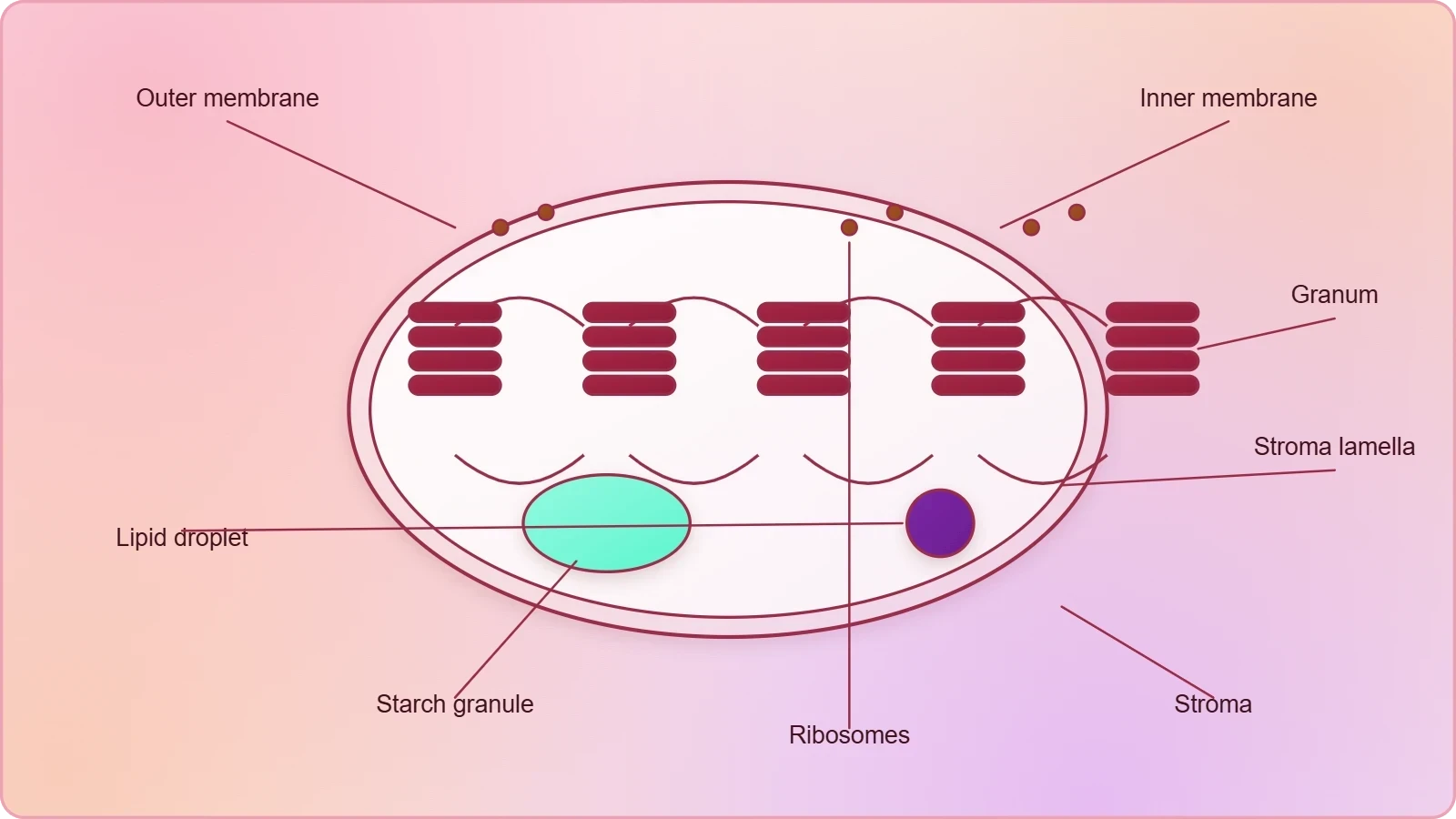
Within the chloroplast there is a membranous system consisting of grana, the stroma lamellae, and the matrix known as the stroma. The grana are stacks of membrane, and the stroma lamellae are the membrane connections that run through the stroma between them. The stroma is the fluid matrix in which these membranes are suspended. A diagrammatic representation of an electron micrograph of a chloroplast section shows these features together with the outer membrane, the inner membrane, ribosomes, starch granules and lipid droplets.
The outer and inner membranes form the envelope that bounds the organelle. Inside that boundary, the membrane system and the stroma occupy distinct regions, and this physical separation is the whole point. A chloroplast is not a bag of mixed enzymes; it is a compartmentalised structure in which membranes and matrix are set apart so that incompatible or sequential tasks can proceed without interfering with one another. The arrangement of grana, lamellae and stroma is therefore the anatomical basis of the division of labour that follows.
The Membrane System as the Light-Trapping Apparatus
The membrane system is responsible for trapping the light energy and also for the synthesis of ATP and NADPH. Both tasks belong to the same structural element because both depend on the same kind of machinery embedded in the membrane: pigment molecules that absorb photons and protein complexes that move electrons and pump protons. The grana, with their stacked membranes, pack a large area of this machinery into a small volume, while the stroma lamellae extend the membrane network through the rest of the organelle.
Because the membrane system performs the light-driven work, it is the site of the photochemical reactions. The energy of absorbed light is converted, through electron transport, into the chemical energy carried by ATP and NADPH. These two molecules are the currency that the rest of photosynthesis spends. The membrane system therefore does not make sugar itself; it manufactures the energy carriers and reducing power that make sugar synthesis possible elsewhere in the organelle.
The Stroma as the Site of Sugar Synthesis
In the stroma, enzymatic reactions synthesise sugar, which in turn forms starch. The stroma is the matrix surrounding the grana and lamellae, and it holds the enzymes of the carbon reactions. These enzymes do not absorb light directly. Instead, they use the ATP and NADPH produced by the membrane system to fix carbon dioxide into carbohydrate. The sugar formed in this way can then be converted into starch, which appears in the chloroplast as starch granules.
The presence of starch granules in the chloroplast is a visible record of the stroma's activity. Ribosomes are also found there, and lipid droplets as well, which reminds us that the chloroplast is a living organelle with its own protein synthesis and storage functions. But for the purposes of photosynthesis, the essential point is that the stroma is where the products of the light reactions are consumed and where carbohydrate first appears.
The Division of Labour Between Membranes and Stroma
There is a clear division of labour within the chloroplast, and it is worth stating in a single sentence before unpacking it. The membrane system is responsible for trapping the light energy and also for the synthesis of ATP and NADPH. In the stroma, enzymatic reactions synthesise sugar, which in turn forms starch. Two locations, two sets of tasks, one continuous process. The membrane system gathers and converts energy; the stroma spends that energy on building carbohydrate. Neither half can operate for long without the other.
This division explains why the chloroplast must be a structured organelle rather than a homogeneous solution. If the light-driven electron transport machinery and the carbon-fixing enzymes were freely mixed, the products of one set could interfere with the other, and the sequential logic of the process would be lost. Compartmentalisation allows the membrane system to generate ATP and NADPH in one region while the stroma draws on those molecules in another, coupling the two stages through the shared pool of intermediates.
Light Reactions: The Photochemical Work of the Membranes
The set of reactions performed by the membrane system is called the light reactions, or photochemical reactions, because these reactions are directly light driven. Light absorbed by the pigments in the membranes initiates electron transport, and the energy of the electrons is captured in the chemical bonds of ATP and NADPH. The phrase "directly light driven" is the defining criterion: remove the light and these reactions stop almost immediately, because light is not merely a trigger but the source of energy itself.
The products of the light reactions are precisely the two molecules named in the division of labour. ATP carries usable chemical energy, and NADPH carries reducing power, the ability to donate electrons to other molecules. Together they constitute the output of the membrane system and the input to the stroma. In the next lessons these reactions will be followed in detail through the electron transport chain; here the essential point is simply where they occur and what they produce.
Dark Reactions: Carbon Reactions That Still Depend on Light
The latter set of reactions, performed in the stroma, is not directly light driven but is dependent on the products of the light reactions, namely ATP and NADPH. By convention these are called dark reactions, or carbon reactions, to distinguish them from the photochemical set. The name is a convenience of classification, not a description of when the reactions happen. It records the fact that these reactions do not themselves absorb photons, while quietly acknowledging their dependence on the molecules that do.
This is exactly where a common misreading arises, and the material addresses it directly. The term dark reactions should not be construed to mean that they occur in darkness or that they are not light-dependent. In a living leaf, the carbon reactions run in the light, powered by a steady supply of ATP and NADPH from the membranes. If the light is switched off, the supply of these carriers soon falls, and the carbon reactions stall. They are light-dependent in the indirect sense, even though light does not drive them directly.
Following the Products: From ATP and NADPH to Sugar and Starch
The division of labour becomes clearer when the products are followed across the boundary between membrane and matrix. The membrane system synthesises ATP and NADPH; the stroma consumes them. In the stroma, enzymatic reactions use these molecules to synthesise sugar, and that sugar in turn forms starch. The sequence is directional: light energy becomes chemical energy in the membranes, chemical energy becomes carbohydrate in the stroma, and surplus carbohydrate becomes storage material in the form of starch granules visible within the organelle.
This chain of conversions is the reason the two halves of the chloroplast must remain coupled. If the stroma's demand for ATP and NADPH falls, the membrane system's output has nowhere to go; if the membrane system's output falls, the stroma's enzymes lose their fuel. The chloroplast is therefore best imagined as a partnership between a power station and a workshop, sharing a common pool of energy carriers and adjusting their rates to one another.
Starch as the Visible Record of Carbon Fixation
Starch granules are among the structures visible in a section of chloroplast, alongside ribosomes and lipid droplets. Their presence is a direct consequence of the stroma's work: sugar synthesised there is converted into starch, which accumulates as a solid deposit. For the observer, this is convenient, because starch offers a visible marker of photosynthetic activity. A chloroplast that has been fixing carbon shows its product in tangible form, stored within the same organelle that made it.
The conversion of sugar to starch also serves a physiological purpose. Starch is osmotically less active than the soluble sugars from which it is built, so storing carbohydrate in this form allows the chloroplast to accumulate large amounts of energy-rich material without disturbing the water balance of the cell. The starch granule is thus both a record of past photosynthesis and a reserve for future needs, held inside the very organelle that produced it.
Reading the Chloroplast Diagram Correctly
A diagrammatic representation of an electron micrograph of a chloroplast section labels the outer membrane, the inner membrane, the stromal lamella, the grana, the stroma, ribosomes, a starch granule and a lipid droplet. Each label corresponds to a real structural feature, and reading the diagram correctly means associating each feature with its role. The grana and stromal lamella belong to the membrane system; the stroma is the matrix; the starch granule is the stored product; the ribosomes and lipid droplet belong to the organelle's general metabolism.
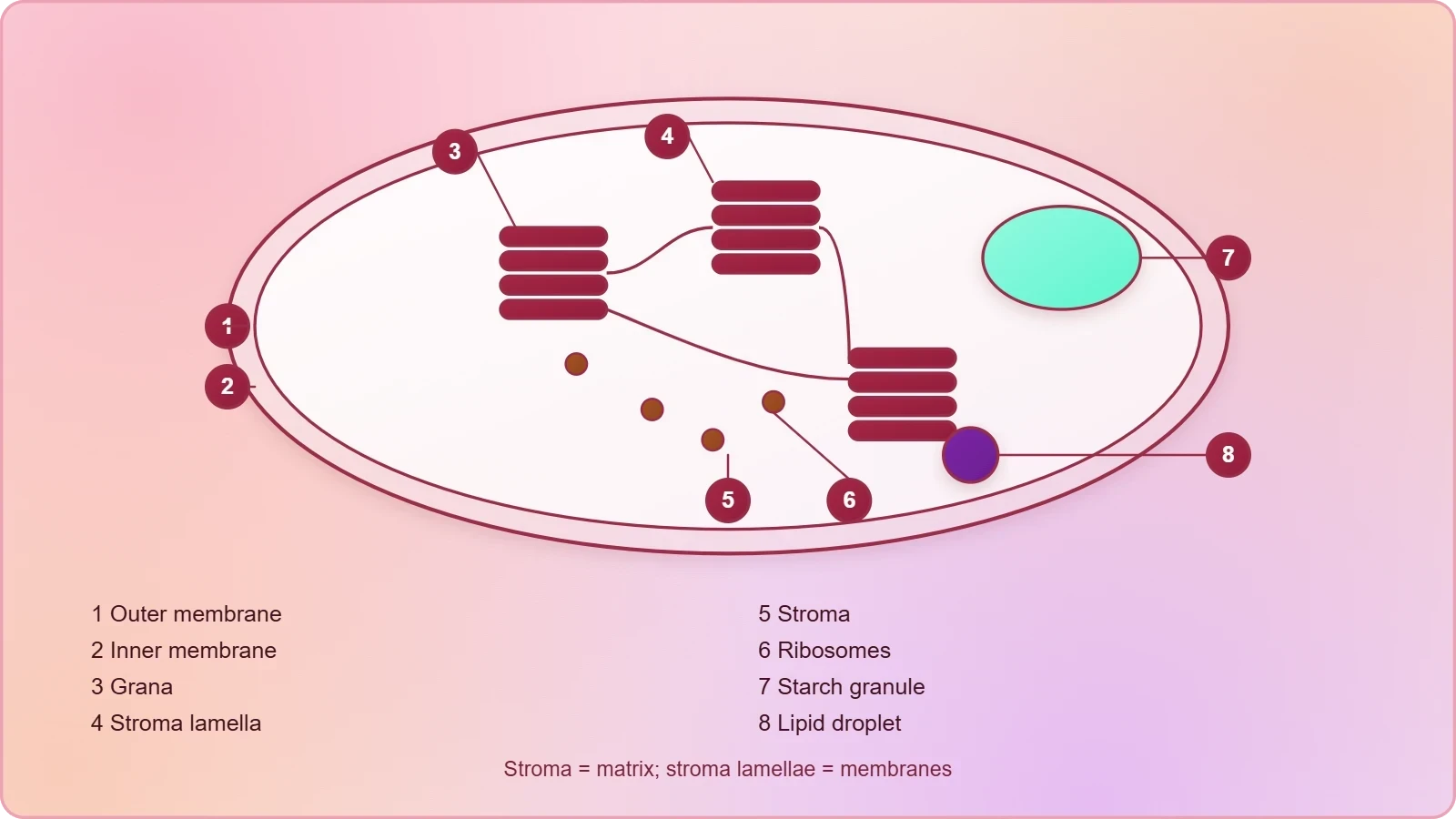
Learners often confuse the stroma with the stroma lamellae because the names are similar. Keep them distinct: the stroma is the matrix, a fluid-filled space, while the stroma lamellae are membranes that traverse that space. The grana are stacks of membrane, not separate compartments floating in the stroma. With these distinctions firm, the diagram becomes a functional map rather than a list of unfamiliar words, and the division of labour can be read directly from the picture.
Why Compartmentalisation Makes the Process Work
The chloroplast's internal arrangement is not incidental decoration; it is the mechanism by which two chemically different jobs proceed simultaneously. The membrane system traps light energy and synthesises ATP and NADPH, while the stroma runs enzymatic reactions that synthesise sugar. Because these tasks occupy separate spaces, the products of the first can accumulate and be delivered to the second in an orderly way. Compartmentalisation converts a potentially chaotic mixture of reactions into a coordinated sequence with a clear beginning, middle and end.
There is also a practical advantage for the student. Once the division of labour is understood, the later lessons on electron transport and the carbon cycle have a natural home. The Z scheme belongs to the membranes; the Calvin cycle belongs to the stroma. Remembering where each process occurs makes the details easier to place and harder to confuse. The geography of the chloroplast is therefore not preliminary material to be skipped but the framework on which everything else hangs.
Connecting Structure to the Lessons Ahead
The next lesson turns to the pigments involved in photosynthesis, asking how many types there are and what each contributes. That question follows naturally from this one, because the pigments are embedded in the membrane system whose structure has just been described. The chlorophyll that absorbs light is held within the grana and lamellae, and its arrangement there determines how efficiently photons are captured and passed to the reaction centres. Structure and pigment chemistry are two views of the same apparatus.
Later lessons will trace the light reaction and electron transport, chemiosmosis, the Calvin cycle, the C4 pathway and photorespiration, and finally the factors affecting photosynthesis. Each of these topics presupposes the map drawn here. When the course reaches Blackman's Law of Limiting Factors, for instance, the reasoning will concern which of several inputs constrains the rate of a process whose stages are spatially separated. The chloroplast, in short, is the setting for the entire remainder of the course.
Common Misconceptions About Location and Naming
Three misconceptions recur. The first is that photosynthesis happens only in leaves; in fact it also occurs in other green parts of the plant. The second is that the chloroplast is a uniform compartment; in reality it contains a membrane system and a stroma with distinct duties. The third, and most persistent, is that dark reactions occur in darkness. The material is explicit that this name should not be construed to mean the reactions occur in darkness or that they are not light-dependent. Correcting these three points removes most of the confusion surrounding the topic.
A fourth, subtler error is to treat the names as descriptions of mechanism rather than as conventions. The terms light reactions and dark reactions are labels adopted by convention to distinguish two sets of reactions; the alternative names, photochemical reactions and carbon reactions, are often more informative. Using the alternative names alongside the conventional ones keeps the underlying logic visible and prevents the vocabulary from obscuring the biology. Precision with names is, in this subject, a form of precision with ideas.
Going Further
Beyond the core account, two points of background help to consolidate the picture. Mesophyll cells are the main photosynthetic cells in the interior of a leaf, and their chloroplasts are the organelles where the light-driven steps occur. This is why the leaf's internal tissue, rather than its outer skin, is the focus of attention when locating photosynthesis. The mesophyll is not merely a passive container for chloroplasts; its arrangement, with air spaces and cell walls, is adapted to deliver light and carbon dioxide to the organelles within.
The second point concerns the starch granules visible in the chloroplast. These are a storage form of the sugar made in the stroma, and their presence is a reliable indicator that carbon fixation has been taking place. Starch is not a by-product but a reserve, accumulated when production exceeds immediate demand and drawn upon when it does not. Recognising this completes the chain from light absorption in the membranes to stored carbohydrate in the matrix, and shows how the chloroplast manages its output over time.
Consolidating the Lesson
The lesson can be reduced to a compact set of statements. Photosynthesis takes place in the green leaves and other green parts of plants, in the chloroplasts of mesophyll cells. Within the chloroplast there is a membranous system of grana and stroma lamellae, together with the matrix called stroma. The membrane system traps light energy and synthesises ATP and NADPH. In the stroma, enzymatic reactions synthesise sugar, which in turn forms starch. The first set are light reactions, or photochemical reactions; the second are called dark reactions, or carbon reactions, by convention.
Each of these statements will be expanded in the lessons that follow, but their combination already answers the question posed at the outset. Photosynthesis takes place in a specific organelle, within a specific cell type, within a specific organ, and the organelle itself is divided into regions with distinct responsibilities. Holding that structure in mind makes the biochemistry intelligible, because every reaction can be assigned to a place. The next lesson asks how many types of pigments are involved, and the answer will be found in the membranes just described.
Also Read
- No links available.
From our network :
- AI-Powered 'Precision Diagnostic' Replaces Standard GRE Score ReportsDiscover the new GRE Precision Diagnostic. Learn how AI-powered behavioral analytics and time-to-solve tracking are replacing standard GRE score reports to empower students.
- Mastering DB2 LUW v12 Tables: A Comprehensive Technical GuideComprehensive guide on DB2 LUW v12 tables. Explore CREATE TABLE syntax, BLU Acceleration, range partitioning, data types, and security features for IBM DB2 LUW v12.
- Vite 6/7 'Cold Start' Regression in Massive Module GraphsIn-depth analysis of Vite 6/7 cold start regressions in massive module graphs. Learn about barrel file issues, pre-bundling optimizations, and how to improve Vite dev server performance.
- 10 Physics Numerical Problems with Solutions for IIT JEEPrepare for IIT JEE with 10 physics numerical problems, complete with detailed solutions and conceptual explanations. Ideal for mastering kinematics, thermodynamics, electromagnetism, and optics.
- 98% of Global MBA Programs Now Prefer GRE Over GMAT Focus EditionExplore why 98% of global MBA programs now prefer the GRE over GMAT Focus. Learn about the shorter GRE format, verbal logic importance, and strategic versatility for students.
- EV 2.0: The Solid-State Battery Breakthrough and Global Factory ExpansionDiscover the impact of the Solid-State Battery Breakthrough on the EV market. Learn about CATL and BYD stock growth, global factory expansion in Europe, and the future of EV 2.0 technology.
- Analyzing Trump Deportation Numbers Insights Into The 2026 Immigration Crackdown
- Trump Political Strategy How Geopolitical Stunts Serve As Media Diversions
- Mastering DB2 12.1 Instance Design: A Technical Deep Dive into Modern Database ArchitectureComprehensive guide to DB2 12.1 Instance Design. Explore architectural components, HADR setup, buffer pool tuning, and security policies for IBM DB2 12.1. Includes 10 functional SQL and Shell samples.
RESOURCES
- Resources will be updated soon.