Photosynthesis in higher plants is best understood not as a single event but as a coordinated relay of energy and matter, in which light captured at the thylakoid membrane is ultimately spent on building sugar in the stroma. This closing lesson draws the threads of the course together, tracing the route from the absorption of light by pigments in the antenna to the regeneration of RuBP in the Calvin cycle, and showing how each stage depends on the one before it. The aim is consolidation rather than novelty: every idea gathered here has been developed in earlier lessons, and the task now is to see the architecture whole.
The summary that follows respects the order of ideas established throughout the course. It begins with the leaf and its stomata, moves inward to the mesophyll chloroplasts, distinguishes the membrane-bound light reaction from the carbon-fixing reactions of the stroma, and then follows electrons through PS II and PS I to NADPH and ATP. From there it turns to RuBisCO, the oxygenation reaction that makes photorespiration wasteful in C3 plants, and the C4 pathway that separates initial fixation from the Calvin cycle in bundle sheath cells. Read as a sequence, these steps form one continuous account of how a green plant feeds itself.
Because this is the nineteenth lesson of twenty, it deliberately avoids re-teaching the fine detail of temperature and water as limiting factors, which belonged to the previous session, and it does not rehearse the exercise work reserved for the review that follows. Instead, it offers a structural map: the two stages, their locations, their inputs and outputs, and the logic that binds them. Learners who can reproduce this map from memory, and explain why each arrow points where it does, will be well prepared for the exercises on C3 and C4 plants, pigments and limiting factors that conclude the course.
On This Page
The Leaf as the Organ of Photosynthesis
Green plants make their own food by photosynthesis, and the organ that carries out this work is, in most higher plants, the leaf. Carbon dioxide from the atmosphere is taken in through stomata and used for making carbohydrates, principally glucose and starch. Photosynthesis takes place only in the green parts of the plant, mainly the leaves, which is why a non-green tissue cannot sustain the process however well it is supplied with water and minerals. This external simplicity conceals an internal division of labour that the rest of the lesson will unpack.
Entry of Carbon Dioxide Through Stomata
The stoma is the gateway through which the carbon substrate of photosynthesis enters the plant. Carbon dioxide diffuses from the atmosphere into the leaf through these pores, and the same pores allow the oxygen released by water splitting to escape. The leaf therefore manages a continuous exchange with the air around it, and the rate of that exchange shapes how much carbon is available for fixation. In the summary account, the stoma is simply the route by which atmospheric CO2 reaches the sites of carbohydrate synthesis.
Once inside the leaf, CO2 must travel to the mesophyll cells, where the chloroplasts responsible for CO2 fixation are concentrated. The mesophyll cells contain a large number of chloroplasts, and this abundance is what makes the leaf the principal photosynthetic organ. The pathway from air to stroma is thus a short but essential prelude to the biochemistry: without stomatal entry and mesophyll delivery, the enzymes of carbon fixation would have no substrate, and the light-driven machinery would have nothing to reduce.
Chloroplasts and the Division of Labour Within
Within the chloroplast, the membranes are the sites for the light reaction, while the chemosynthetic pathway occurs in the stroma. This single sentence from the summary carries the whole spatial logic of photosynthesis: the thylakoid membranes host the pigment-protein complexes that capture light and move electrons, and the stroma hosts the enzymatic cycle that fixes carbon. The two compartments are physically distinct but functionally inseparable, because the products of the membrane reactions are the currency spent in the stroma.
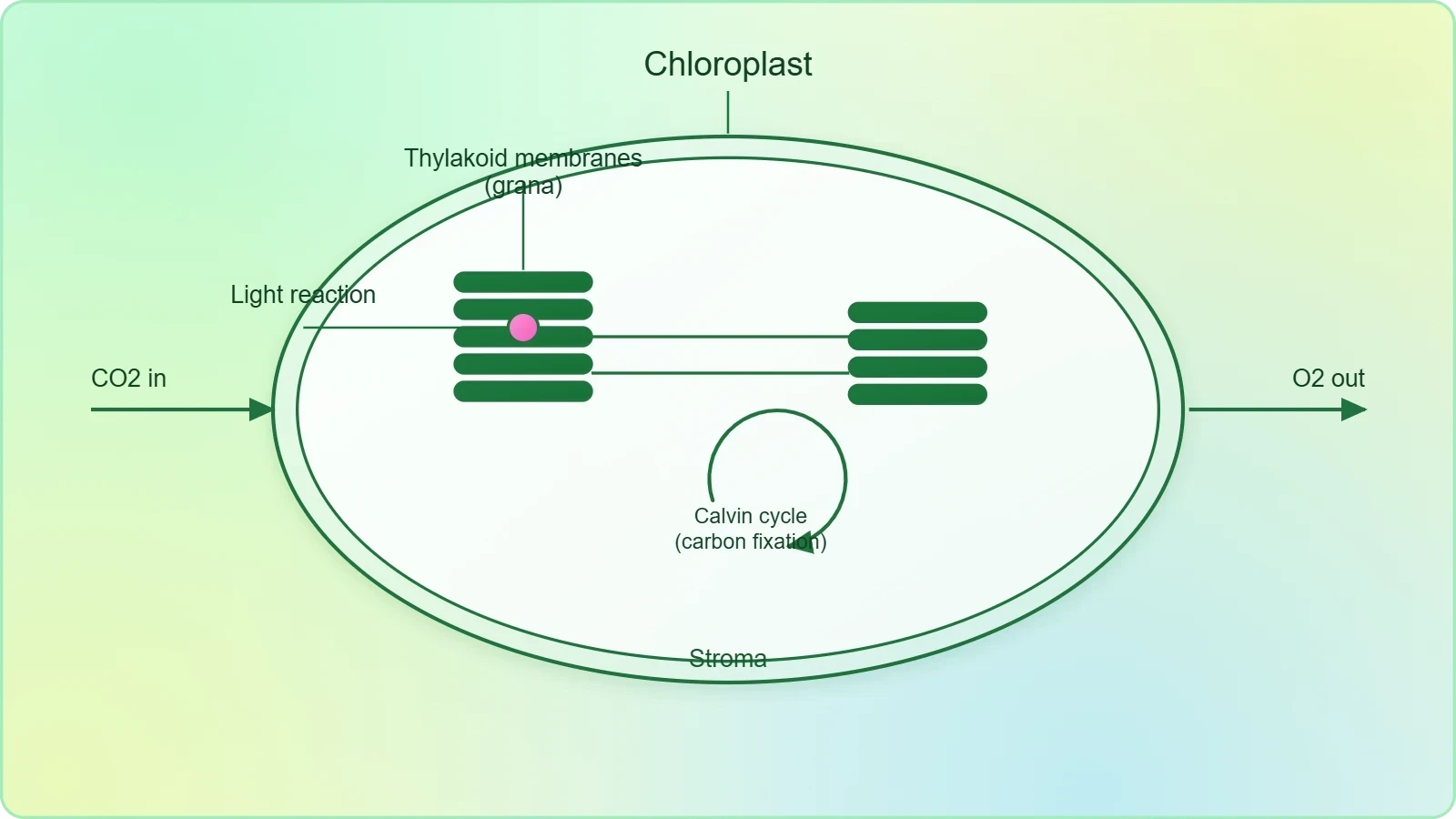
This arrangement explains why the chloroplast is described as the organelle responsible for CO2 fixation rather than merely a container for chlorophyll. Its internal membranes are folded into thylakoids, increasing the surface available for light capture, while the surrounding stroma provides the aqueous environment in which RuBisCO and the other Calvin cycle enzymes operate. Keeping the two stages in separate compartments allows the plant to build a proton gradient across the thylakoid membrane without dissipating it into the stroma, a point developed in the next section.
The Light Reaction: Pigments, Photosystems and Electron Flow
In the light reaction, light energy is absorbed by the pigments present in the antenna and funnelled to special chlorophyll a molecules called reaction centre chlorophylls. There are two photosystems, PS I and PS II, each with its own reaction centre. PS I has a 700 nm absorbing chlorophyll a, P700, at its reaction centre, while PS II has a P680 reaction centre that absorbs red light at 680 nm. After absorbing light, electrons are excited and transferred through PS II and PS I and finally to NAD, forming NADH, and during this process a proton gradient is created across the membrane of the thylakoid.
Antenna Pigments and the Reaction Centres P680 and P700
The antenna pigments act as a collective light-harvesting array, absorbing photons across a range of wavelengths and passing the excitation inward until it reaches the reaction centre. There, the specialised chlorophyll a molecules P680 and P700 perform the actual charge separation that begins electron transport. The numbers in their names record the wavelengths at which they absorb most strongly: P680 in PS II absorbs red light at 680 nm, and P700 in PS I absorbs at 700 nm. The slight difference in absorption is a useful fingerprint for distinguishing the two photosystems.
It is worth emphasising that the antenna does not itself chemistry; it gathers and delivers. The reaction centre chlorophyll is where the energy of many absorbed photons is concentrated into a single electron transfer, and this concentration is what gives the light reaction its directionality. Because PS II and PS I have different reaction centres, they can be arranged in series, with electrons passing from one to the other along the transport chain. The table below records the essential identities of the two photosystems as the summary presents them.
From Excited Electrons to NADH and Oxygen
After absorbing light, electrons are excited and transferred through PS II and PS I and finally to NAD, forming NADH. The transfer is not a single jump but a passage along carriers embedded in the thylakoid membrane, and it is this passage that creates a proton gradient across the membrane. Splitting of water molecules is associated with PS II, resulting in the release of O2, protons and transfer of electrons to PS II. The oxygen we breathe is therefore a by-product of restoring the electrons that light has driven away from the reaction centre.
The sequence has a satisfying internal logic. PS II loses electrons when P680 is excited, and water splitting replenishes them while releasing oxygen and protons. The electrons then travel to PS I, where a second excitation lifts them to a sufficiently reducing potential to be passed to NAD. The proton gradient, meanwhile, accumulates as a store of potential energy. The table below sets out the inputs and outputs of the light reaction as a compact ledger, which is a useful revision device before the carbon-fixing stage is considered.
Chemiosmosis and the Synthesis of ATP
The breakdown of the proton gradient due to movement through the F0 part of the ATPase enzyme releases enough energy for synthesis of ATP. This is the chemiosmotic step, and it converts the electrochemical potential stored across the thylakoid membrane into the chemical bond energy of ATP. The protons that accumulate on one side of the membrane return through the enzyme, and the energy released by that return is captured rather than wasted. The light reaction thus produces two distinct currencies, ATP and NADH, both of which the stroma will later spend.
The Proton Gradient Across the Thylakoid Membrane
The gradient arises during electron transport, as protons are released on one side of the membrane and consumed on the other. Its magnitude is a measure of how much light energy has been converted into stored potential, and it is the immediate link between the electron transport chain and ATP synthesis. Because the membrane is the site of the light reaction, the gradient is confined to the thylakoid system, and the stroma remains the destination for the ATP once it is made. This spatial separation is what allows the two stages to proceed without interfering with each other.
The relationship between the gradient and the ATP made can be expressed compactly. The free energy stored in the proton motive force is proportional to the proton gradient and the membrane potential, and the synthesis of ATP is driven by the return of protons through the enzyme:
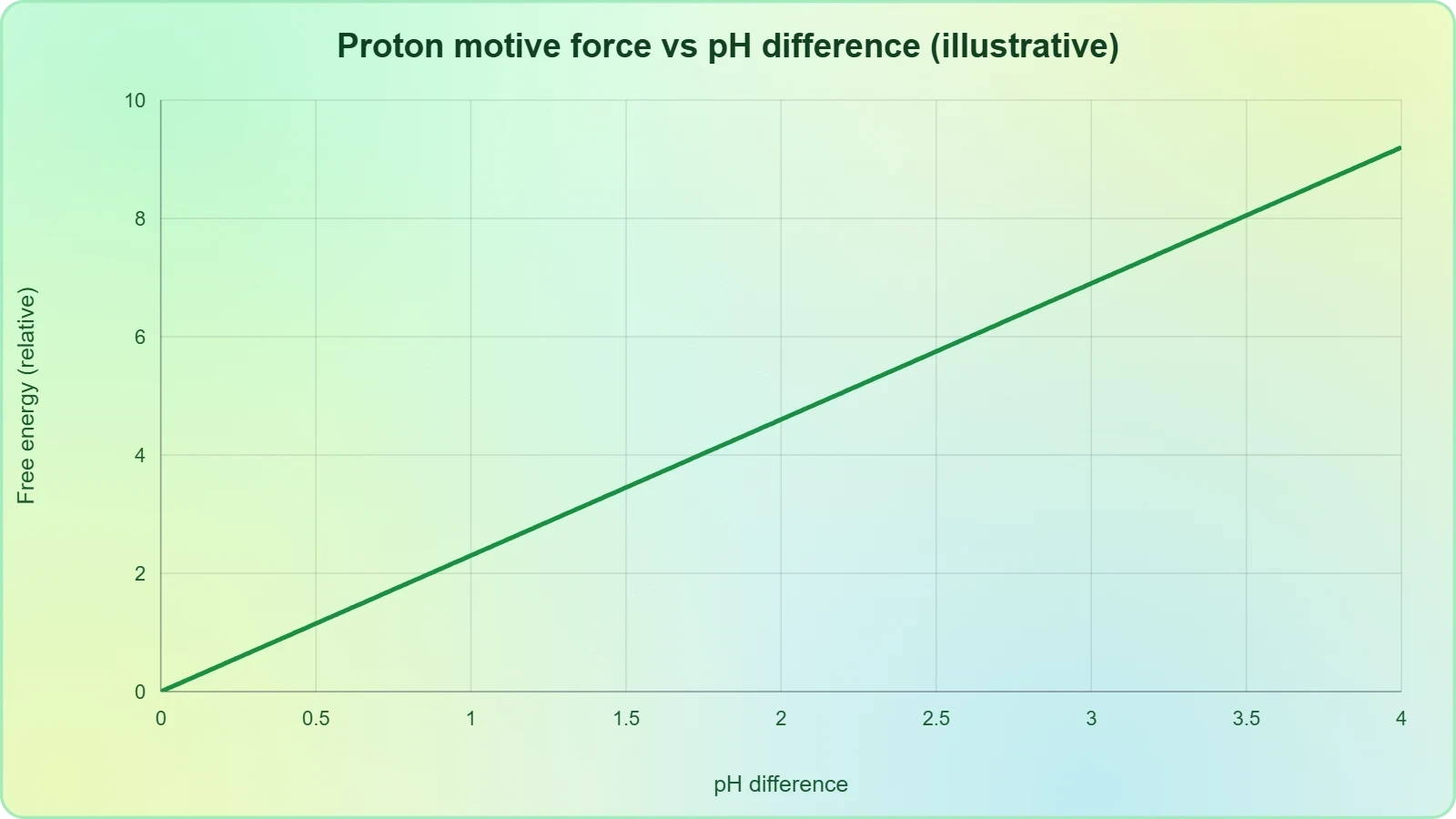
Here ##\Delta\psi## is the membrane potential, ##\Delta pH## the pH difference across the thylakoid membrane, and ##n## the number of protons translocated. The equation is a formal statement of what the summary describes in words: a gradient exists, and its breakdown through the F0 part of the ATPase enzyme releases enough energy for synthesis of ATP. Learners need not memorise the expression, but recognising it as the quantitative face of chemiosmosis helps connect the descriptive account to the underlying thermodynamics.
Why the Two Currencies Matter
ATP and NADH are not interchangeable in the carbon fixation cycle; each performs a specific role. NADH supplies the reducing power needed to convert the three-carbon PGA into sugar, while ATP supplies the phosphoryl groups that drive the same conversions and the regeneration of RuBP. The light reaction therefore produces both in the membrane, and the stroma consumes both in the cycle. This division of labour is the reason the two stages must be tightly coordinated: a shortage of either currency stalls carbon fixation even when CO2 is plentiful.
The coordination is achieved through shared intermediates and feedback, though the summary states it simply as utilisation of the ATP and NADH synthesised in the light reaction. For revision purposes, it is enough to hold the pairing in mind: light reaction makes ATP and NADH; carbon fixation spends them. The table below pairs each product with its destination, which is a convenient way to check understanding before moving to the Calvin cycle itself.
The Carbon Fixation Cycle in the Stroma
In the carbon fixation cycle, CO2 is added by the enzyme RuBisCO to a 5-carbon compound, RuBP, which is converted to 2 molecules of 3-carbon PGA. This is then converted to sugar by the Calvin cycle, and the RuBP is regenerated. During this process the ATP and NADH synthesised in the light reaction are utilised. The cycle is therefore a regeneration loop rather than a linear pathway: RuBP is both the starting material and the final product, and the sugar that leaves the loop is the net gain.
RuBisCO, RuBP and the Formation of PGA
RuBisCO is the enzyme that adds CO2 to RuBP, and its centrality to the cycle is hard to overstate. The reaction joins a five-carbon acceptor with one carbon of CO2 and yields two molecules of the three-carbon compound PGA. Because the acceptor is regenerated later in the cycle, a small quantity of RuBP can support the fixation of many CO2 molecules in succession. The summary presents this as the defining step of carbon fixation, and it is the point at which inorganic carbon becomes organic.
The stoichiometry of the cycle can be written compactly to show how many turns are needed for one sugar. Three turns of the cycle fix three CO2 molecules and yield one molecule of the three-carbon sugar phosphate, with the remaining carbon returning to RuBP:
This is the arithmetic behind the phrase "converted to sugar by the Calvin cycle, and the RuBP is regenerated". The cycle consumes ATP and NADH at the reduction and regeneration steps, which is why the two stages of photosynthesis are inseparable. Learners who can state the carbon count, the enzyme and the products have the essential skeleton of the cycle, and the finer enzymatic detail belongs to the earlier lessons of the course.
Regeneration of RuBP and the Net Gain of Sugar
The regeneration of RuBP is what makes the cycle sustainable. Without it, the acceptor would be exhausted after a single fixation and carbon fixation would stop. The cycle therefore devotes part of its output to rebuilding the five-carbon acceptor, and only the surplus carbon leaves as sugar. This is why the net yield of carbohydrate is smaller than a naive count of fixed CO2 might suggest, and why the cycle is described as fixing carbon rather than simply producing glucose.
The sugar produced is principally glucose and starch, the carbohydrates named in the summary as the products of photosynthesis. Glucose is the immediate soluble sugar, while starch is its storage form, and both are built from the three-carbon intermediates of the cycle. The table below summarises the carbon flow through the cycle in a form suitable for quick revision, pairing each stage with its carbon count and its requirement for ATP and NADH.
Photorespiration and the C4 Pathway
RuBisCO also catalyses a wasteful oxygenation reaction in C3 plants: photorespiration. This is the complication that the summary places immediately after the Calvin cycle, and it explains why some plants have evolved an alternative arrangement. In C3 plants, the same enzyme that fixes CO2 can also accept oxygen, and the products of that reaction do not yield sugar. The result is a loss of fixed carbon and energy, which is why photorespiration is described as wasteful rather than merely alternative.
The Wasteful Oxygenation Reaction in C3 Plants
Photorespiration arises because RuBisCO does not perfectly discriminate between its two gaseous substrates. When oxygen rather than CO2 enters the active site, the reaction proceeds along a pathway that consumes energy and releases carbon without producing carbohydrate. The summary states the point plainly: RuBisCO also catalyses a wasteful oxygenation reaction in C3 plants. The consequence is that C3 plants lose some of the carbon they have fixed, particularly under conditions that favour oxygenation over carboxylation.
This is not a flaw in the plant so much as a property of the enzyme, and it sets the stage for the C4 solution. The table below contrasts the two pathways as the summary presents them, keeping the comparison at the level of first products and sites of the Calvin cycle. It is a revision aid rather than a full treatment, since the detailed comparison of C3 and C4 plants belongs to the review lesson that follows.
The C4 Pathway and Bundle Sheath Cells
Some tropical plants show a special type of photosynthesis called the C4 pathway. In these plants the first product of CO2 fixation, which takes place in the mesophyll, is a 4-carbon compound. In the bundle sheath cells the Calvin pathway is carried out for the synthesis of carbohydrates. The arrangement separates the initial capture of carbon from the cycle that builds sugar, and this separation is the defining feature of C4 photosynthesis as the summary describes it.
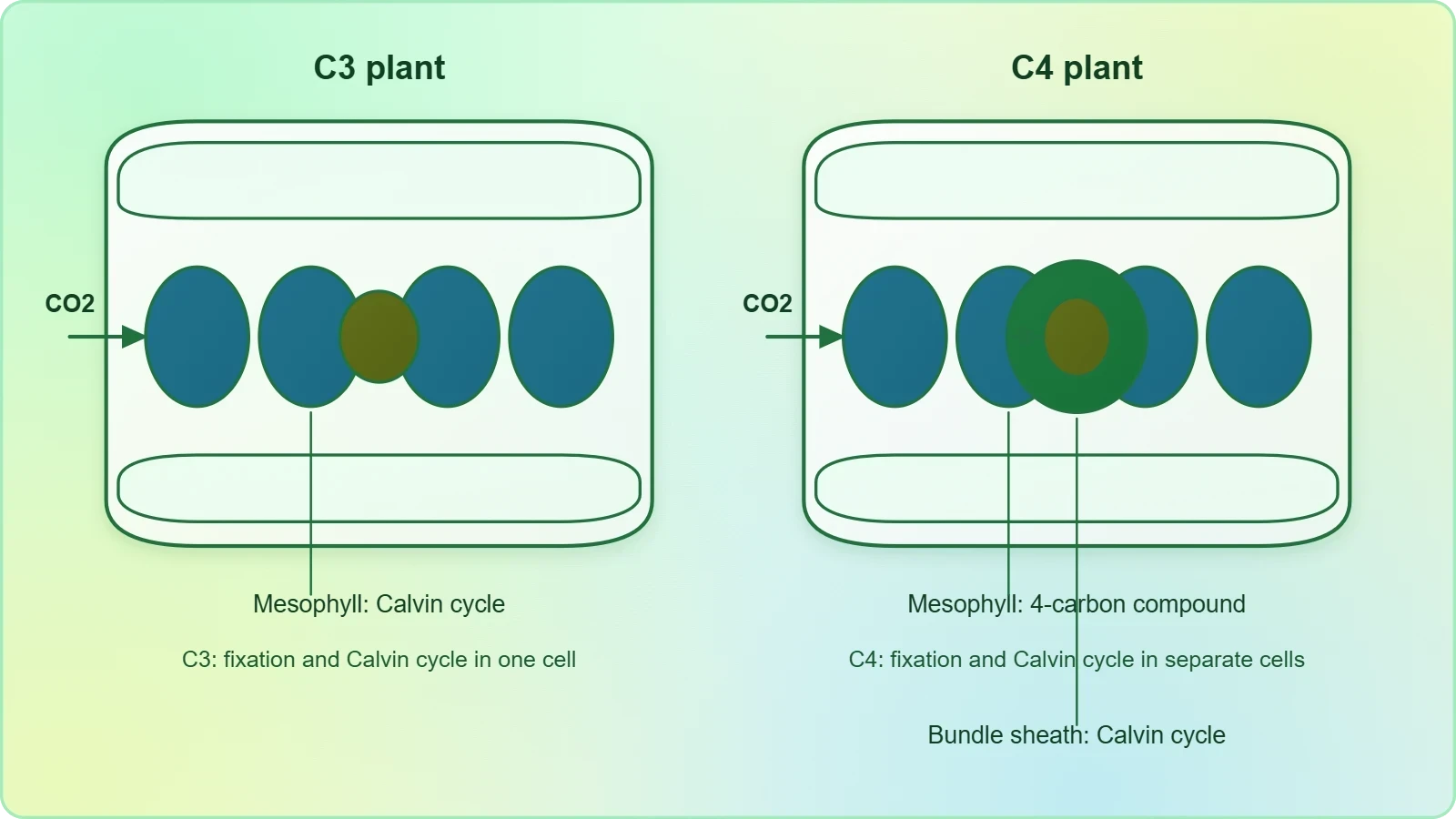
The spatial division has a clear consequence: the Calvin pathway operates in cells where CO2 can be supplied efficiently, which is why C4 plants can be highly productive despite the small number of cells carrying out the biosynthetic cycle. The summary notes that only a few cells in a C4 plant carry out the Calvin pathway, yet the plant remains productive, and this apparent paradox is one of the exercises reserved for the review lesson. For now, the essential point is the two-part structure: mesophyll fixation to a 4-carbon compound, then bundle sheath carbohydrate synthesis.
Reading the Summary as a Connected Whole
A summary is a good place to check that each part of the pathway connects to the next, from light absorption to sugar synthesis. Read in sequence, the account moves from the leaf and its stomata, to the mesophyll chloroplasts, to the thylakoid membranes where pigments funnel energy to P680 and P700, to the proton gradient and ATP synthesis, and finally to the stroma where RuBisCO fixes CO2 and the Calvin cycle regenerates RuBP. Each step supplies the next, and the whole is held together by the two currencies, ATP and NADH.
Checking the Chain from Photon to Sugar
The chain can be tested by asking what fails if any link is removed. Without stomatal entry, CO2 never reaches RuBisCO; without antenna pigments, the reaction centres receive no excitation; without water splitting, PS II cannot replenish its lost electrons; without the proton gradient, ATP is not made; without RuBP regeneration, the cycle stalls after one fixation. Each of these dependencies is stated or implied in the summary, and rehearsing them is an efficient way to consolidate the lesson.
The table below presents the chain as a sequence of dependencies, which is useful for self-testing before the review lesson. It is deliberately compact, since the purpose is to prompt recall rather than to introduce new content. Learners who can fill in the right-hand column from memory have a secure grasp of the summary's logic.
Going further
The summary uses the term chemosynthetic pathway for the carbon-fixing reactions that occur in the stroma, and it is worth noting this usage explicitly so that it is not confused with chemosynthesis in the ecological sense. In the context of this course, the phrase refers to the enzymatic sequence of carbon fixation, the Calvin cycle, which proceeds in the stroma using the ATP and NADH made in the light reaction. Keeping the terminology straight is part of reading the summary accurately.
A second point for reflection is the value of tracing the pathway end to end. Many learners can recite the individual steps but struggle to explain why the light reaction must precede carbon fixation, or why photorespiration is wasteful. Answering those questions requires holding the whole chain in view, from the photon absorbed by the antenna to the sugar that leaves the cycle. The exercises that follow in the next lesson will test exactly this kind of connected understanding, so the present summary is best treated as a map to be redrawn from memory rather than a list to be memorised.
Also Read
- No links available.
From our network :
- 10 Physics Numerical Problems with Solutions for IIT JEEPrepare for IIT JEE with 10 physics numerical problems, complete with detailed solutions and conceptual explanations. Ideal for mastering kinematics, thermodynamics, electromagnetism, and optics.
- Analyzing Trump Deportation Numbers Insights Into The 2026 Immigration Crackdown
- EV 2.0: The Solid-State Battery Breakthrough and Global Factory ExpansionDiscover the impact of the Solid-State Battery Breakthrough on the EV market. Learn about CATL and BYD stock growth, global factory expansion in Europe, and the future of EV 2.0 technology.
- Trump Political Strategy How Geopolitical Stunts Serve As Media Diversions
- Mastering DB2 LUW v12 Tables: A Comprehensive Technical GuideComprehensive guide on DB2 LUW v12 tables. Explore CREATE TABLE syntax, BLU Acceleration, range partitioning, data types, and security features for IBM DB2 LUW v12.
- 98% of Global MBA Programs Now Prefer GRE Over GMAT Focus EditionExplore why 98% of global MBA programs now prefer the GRE over GMAT Focus. Learn about the shorter GRE format, verbal logic importance, and strategic versatility for students.
- Vite 6/7 'Cold Start' Regression in Massive Module GraphsIn-depth analysis of Vite 6/7 cold start regressions in massive module graphs. Learn about barrel file issues, pre-bundling optimizations, and how to improve Vite dev server performance.
- Mastering DB2 12.1 Instance Design: A Technical Deep Dive into Modern Database ArchitectureComprehensive guide to DB2 12.1 Instance Design. Explore architectural components, HADR setup, buffer pool tuning, and security policies for IBM DB2 12.1. Includes 10 functional SQL and Shell samples.
- AI-Powered 'Precision Diagnostic' Replaces Standard GRE Score ReportsDiscover the new GRE Precision Diagnostic. Learn how AI-powered behavioral analytics and time-to-solve tracking are replacing standard GRE score reports to empower students.
RESOURCES
- Resources will be updated soon.