Joseph Priestley's experiments of 1770 mark the moment when the study of photosynthesis acquired its first controlled, repeatable logic. Before Priestley, the relationship between plants and air was a matter of speculation; after him, it became a question that could be tested with a candle, a mouse, a mint sprig and a sealed glass vessel. What makes his work so instructive for the modern learner is not the elegance of his apparatus but the discipline of his reasoning: he isolated a variable, observed a change, and proposed a mechanism that later investigators could refine. This lesson reconstructs that reasoning step by step, because understanding how the conclusion was reached matters as much as remembering the conclusion itself.
The second figure in this story, Jan Ingenhousz, supplied the ingredient Priestley's account lacked. Where Priestley had shown that plants restore air fouled by burning or breathing, Ingenhousz demonstrated that the restoration depends on sunlight and occurs only in the green parts of the plant. His aquatic-plant experiment, in which bubbles formed around green tissue in bright light but not in darkness, converted a general observation about "purified air" into a specific, localised, light-dependent process. Together, the two men established the experimental foundations on which the light reaction, the pigments and the gas-exchange equations of later lessons all rest.
This lesson builds directly on the preceding discussion of chlorophyll, light and carbon dioxide, and it prepares the ground for the work of von Sachs, Engelmann and van Niel that follows. The emphasis throughout is on experimental design: what was enclosed, what was varied, what was observed, and what could legitimately be concluded. Learners who follow the sequence carefully will find that the historical experiments are not quaint curiosities but compact models of scientific method, each one isolating a single factor so that its contribution to photosynthesis becomes visible.
On This Page
The Intellectual Context of Eighteenth-Century Air
To appreciate what Priestley achieved, one must first appreciate how little was settled about air in 1770. Air was widely treated as a single elementary substance, and the notion that it could be altered in quality by combustion or respiration was still novel. Priestley's own discovery of oxygen in 1774 came after the plant experiments, which means his initial interpretation of "damaged" and "restored" air was framed without knowledge of the gas that would eventually explain it. This chronology matters pedagogically: the experiment preceded the theory, and the conclusion was drawn from observable behaviour rather than from chemical identity.
The vocabulary of the period reflects this uncertainty. Investigators spoke of air being "fouled" or "purified," of a candle being "extinguished" and a mouse being "suffocated," without naming the gases responsible. Modern learners, who know that combustion consumes oxygen and produces carbon dioxide, must deliberately set that knowledge aside to follow the historical argument. The lesson asks for exactly this suspension: read the observations as Priestley recorded them, then notice how the later identification of oxygen and carbon dioxide retroactively explains what he saw.
The Bell Jar as an Experimental Enclosure
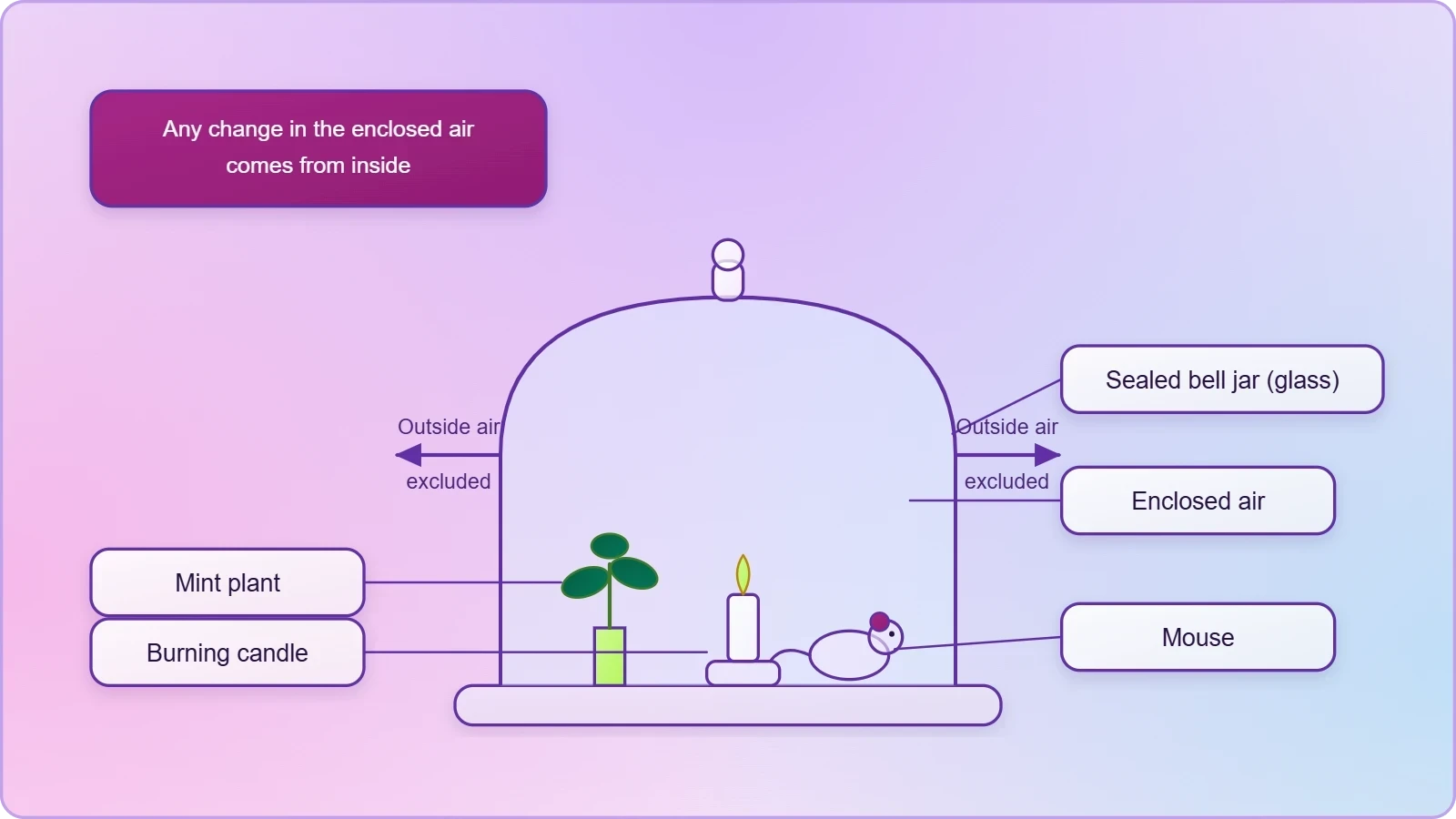
The bell jar is the central piece of apparatus in this lesson, and its function deserves careful attention. A bell jar is a glass vessel shaped like a bell, placed over the experimental subject to create a small, enclosed atmosphere that can be observed without being opened. Its transparency allows continuous visual monitoring, while its seal prevents exchange with the surrounding room air. Every conclusion Priestley drew depends on this enclosure: without it, the air inside would mix freely with the outside atmosphere and no change in quality could be attributed to the candle, the animal or the plant.
The design constraint that follows from the enclosure is equally important. Once the jar is sealed, the experimenter cannot reach inside to relight a candle or to inspect the subject directly. Priestley therefore had to devise ways of testing whether a candle would still burn after several days without disturbing the setup, and the lesson invites learners to think through the possible solutions. This is a genuine problem in experimental design, and it illustrates how apparatus limitations shape the questions a scientist can ask.
Combustion, Respiration and the Idea of Damaged Air
Priestley's first observation was that a candle burning in a closed space soon gets extinguished. His second was that a mouse placed in a closed space soon suffocates. The parallel between the two is the conceptual heart of the experiment: both a flame and a breathing animal consume something from the air and leave it unfit for further use. Priestley expressed this by saying that a burning candle or an animal that breathes the air somehow damages it. The word "somehow" is significant, because it marks the boundary of what the experiment could establish.
What the observation does establish is a shared effect. Combustion and respiration, however different they appear, both render the enclosed air incapable of supporting flame or life. This is a comparative result, and it invites the inference that the two processes draw on a common component of air. The lesson does not require learners to name that component, only to recognise that the comparison generates a testable hypothesis about what plants might restore.
Priestley's Hypothesis and the Logic of Restoration
Having established that flames and animals damage enclosed air, Priestley performed the decisive step: he placed a mint plant in the same bell jar. The result was that the mouse stayed alive and the candle continued to burn. From this he hypothesised that plants restore to the air whatever breathing animals and burning candles remove. The hypothesis is remarkable for its symmetry. It does not merely assert that plants are beneficial; it specifies a complementary relationship in which the plant reverses a specific alteration produced by combustion and respiration.
The logic deserves to be unpacked because it is the template for much of the experimental work that follows in this course. Priestley had two conditions that produced a common effect, namely damaged air, and one condition that reversed that effect. The reversal was produced by a living plant, which means the restorative capacity is a property of the organism rather than of the vessel or the seal. The hypothesis therefore predicts that the plant must be present and active for restoration to occur, a prediction that Ingenhousz would later test by varying light and by separating green from non-green tissue.
Designing the Test Without Breaking the Seal
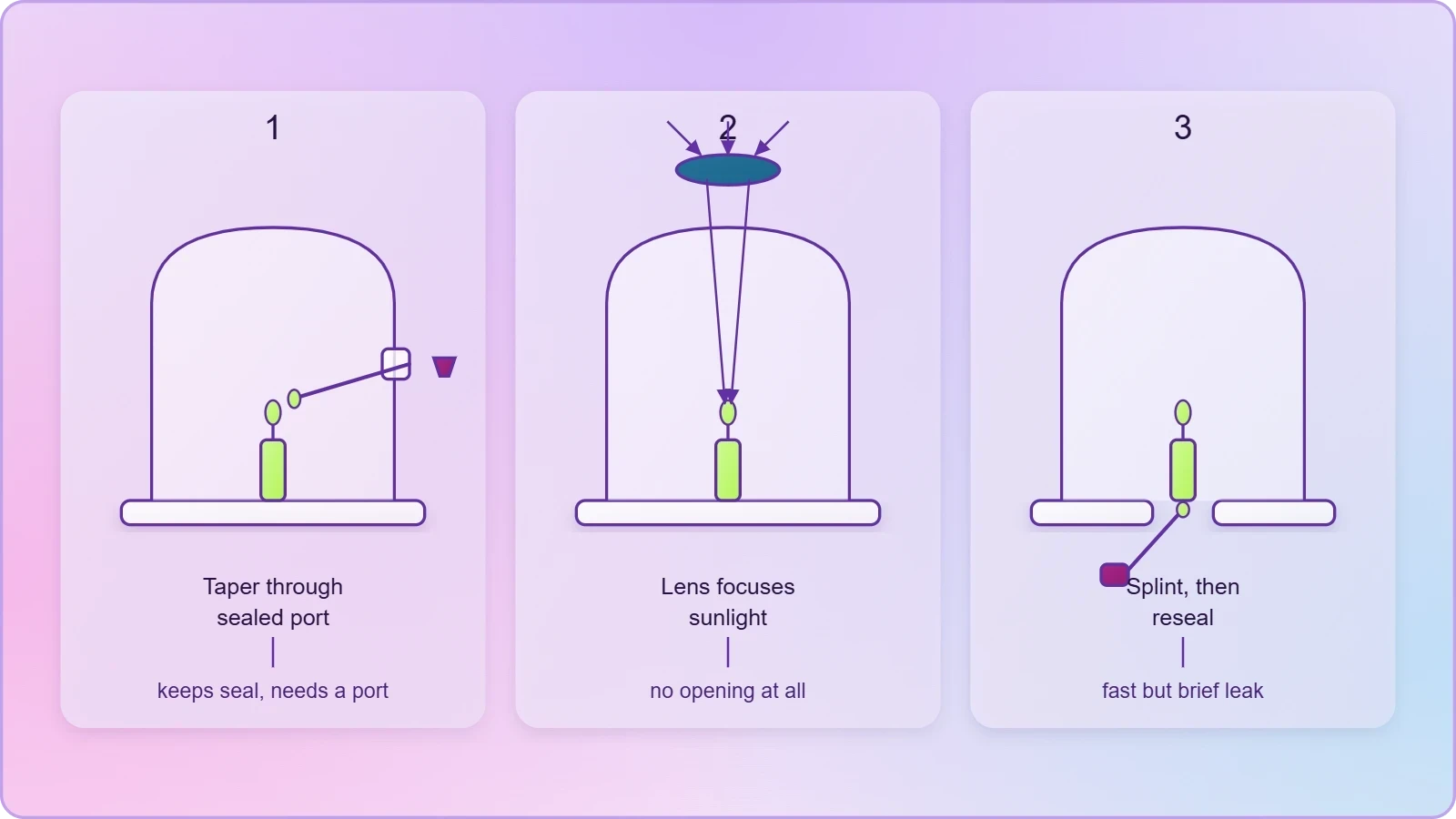
A practical difficulty runs through the whole experiment. Once the bell jar is sealed, the experimenter cannot simply lift it to check whether the candle will still light, because opening the vessel admits fresh air and destroys the very condition under test. Priestley therefore needed a method of rekindling the candle after a few days without disturbing the setup. The lesson poses this as an open design question, and learners should attempt several answers before reading on, because the exercise reveals how much ingenuity experimental work demands.
Plausible solutions include introducing a small burning taper through a sealed port, using a lens to focus sunlight onto the wick, or employing a smouldering splint passed through a narrow opening that is resealed immediately. Each option trades convenience against the risk of contamination. The value of the exercise lies not in identifying a single correct method but in recognising that every intervention must be judged by whether it preserves the integrity of the enclosed atmosphere.
What the Hypothesis Did and Did Not Claim
It is important to be precise about the scope of Priestley's conclusion. He claimed that plants restore to the air whatever breathing animals and burning candles remove. He did not claim to know what that substance was, nor did he identify the gas released by the plant. The discovery of oxygen in 1774 came later, and the full chemical interpretation of his observations required the work of subsequent investigators. The lesson therefore treats the hypothesis as a statement about observable effects rather than about molecular identity.
This restraint is scientifically appropriate and pedagogically useful. A hypothesis that specifies too much risks being wrong for the wrong reasons, whereas a hypothesis framed in terms of effects remains testable and open to refinement. Learners should notice that Priestley's formulation leaves room for Ingenhousz to ask a further question: under what conditions does restoration occur? That question, rather than any dispute about the nature of the gas, drives the next stage of the story.
Ingenhousz and the Discovery That Sunlight Is Essential
Jan Ingenhousz, working between 1730 and 1799, took Priestley's setup and introduced a new variable: light. Using a similar arrangement, he placed the apparatus once in the dark and once in the sunlight. The outcome was unambiguous. Sunlight is essential for the plant process that somehow purifies the air fouled by burning candles or breathing animals. In the dark, the restorative effect did not occur; in sunlight, it did. This single comparison transformed a general claim about plants into a claim about plants acting under specific conditions.
The methodological advance is considerable. Priestley had shown that plants matter; Ingenhousz showed when they matter. By holding the apparatus constant and varying only the illumination, he isolated light as a necessary condition for purification. This is the logic of the controlled comparison, and it is the same logic that underpins the KOH-soaked cotton experiment described in the course material, where one half of a leaf is exposed to air and the other enclosed with a carbon dioxide absorber, and only the exposed half later tests positive for starch.
The Aquatic Plant Experiment and the Bubbles
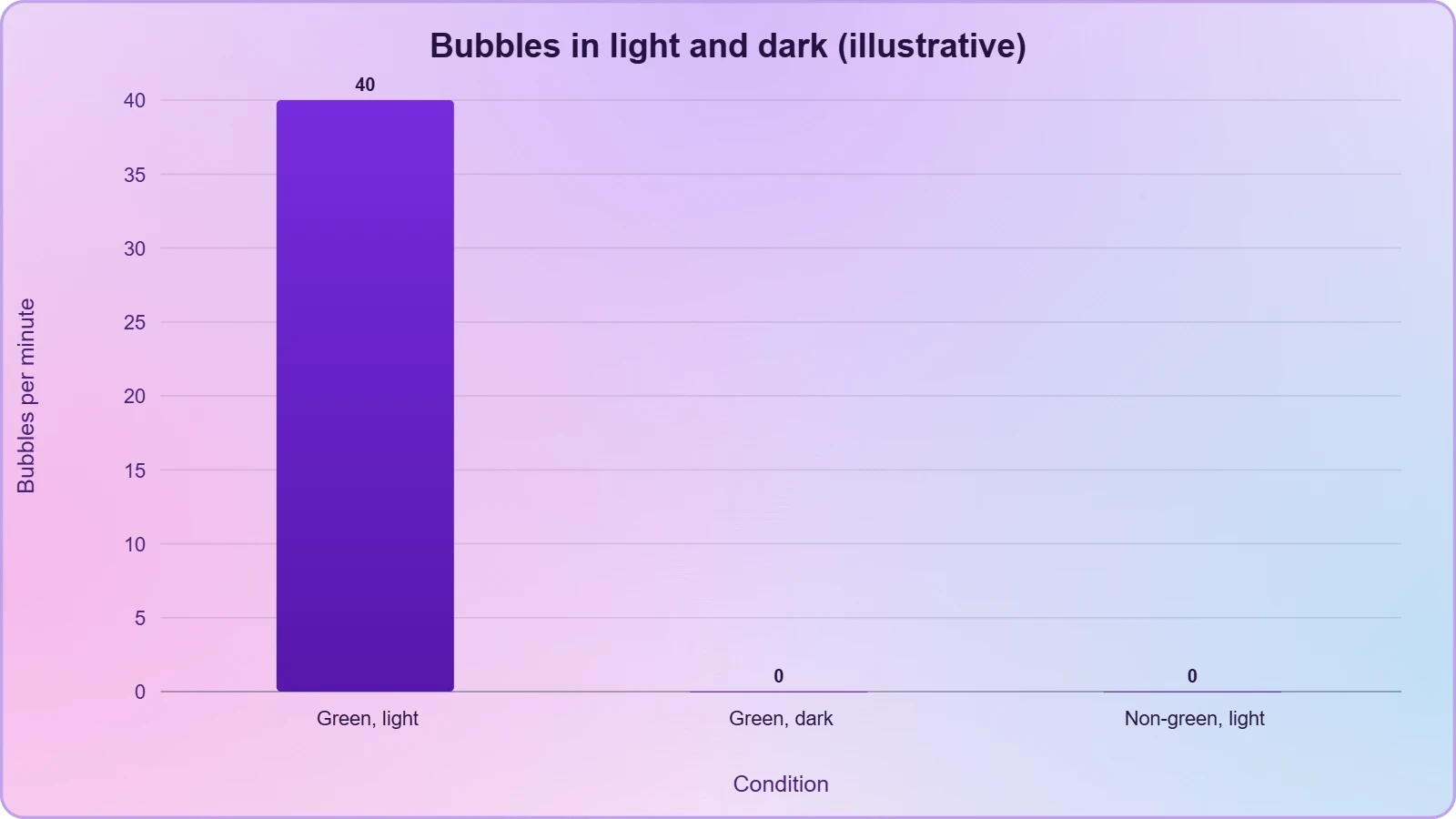
Ingenhousz then performed what the material calls an elegant experiment with an aquatic plant. In bright sunlight, small bubbles were formed around the green parts; in the dark, they did not form. Later he identified these bubbles as oxygen. The experiment is elegant because it makes the invisible visible. Instead of inferring the restoration of air from the behaviour of a candle or a mouse, Ingenhousz could observe a continuous, localised stream of gas emerging from the plant tissue itself, and he could compare its appearance in light and darkness directly.
The choice of an aquatic plant is itself a design decision worth noting. Submerged tissue releases gas into water, where bubbles are immediately visible and can be counted or collected. A terrestrial plant releases gas into the surrounding air, where it disperses invisibly. By moving the experiment into water, Ingenhousz gained a readout that required no chemical test and no sacrificed animal, only observation. The lesson encourages learners to appreciate how the medium of an experiment can determine what can be seen.
Only the Green Parts Release Oxygen
The second conclusion attributed to Ingenhousz is that only the green part of the plants could release oxygen. This follows from the localisation of the bubbles around green tissue. Non-green regions did not produce them. The finding connects directly to the preceding lesson's treatment of chlorophyll, light and carbon dioxide, because it identifies the green pigment-bearing tissue as the site of the gas-releasing process. It also anticipates the later, more detailed mapping of the photosynthetic machinery within the chloroplast.
The claim should be read with care. Ingenhousz established that oxygen release is associated with green parts; he did not describe the pigments or the light reaction. Those belong to later lessons. What he contributed is the spatial restriction of the phenomenon, which narrows the search for the responsible mechanism to a specific tissue type and prepares the ground for the anatomical and physiological work of von Sachs and Engelmann.
Reading the Evidence: From Observation to Inference
The two experiments together form a compact case study in evidential reasoning, and the lesson treats them as such rather than as isolated historical anecdotes. Priestley's contribution is a demonstration of complementarity: one process damages air, another restores it. Ingenhousz's contribution is a demonstration of conditionality: the restoration depends on light and is confined to green tissue. Neither investigator named the gases involved, and neither described the pigments or the electron transport chain. Their conclusions are therefore modest in scope but secure in logic, which is precisely why they have survived as foundational results.
Learners preparing for examinations should be able to state each conclusion in the investigator's own terms and then translate it into modern language. Priestley's "restoration" corresponds to the release of oxygen and the uptake of carbon dioxide; Ingenhousz's "purification in sunlight" corresponds to the light-dependent reactions. The translation is useful, but it must not be allowed to obscure the historical sequence. The lesson insists on the distinction because examiners frequently test whether candidates can separate what was observed from what was later inferred.
Connecting to the Carbon Dioxide Requirement
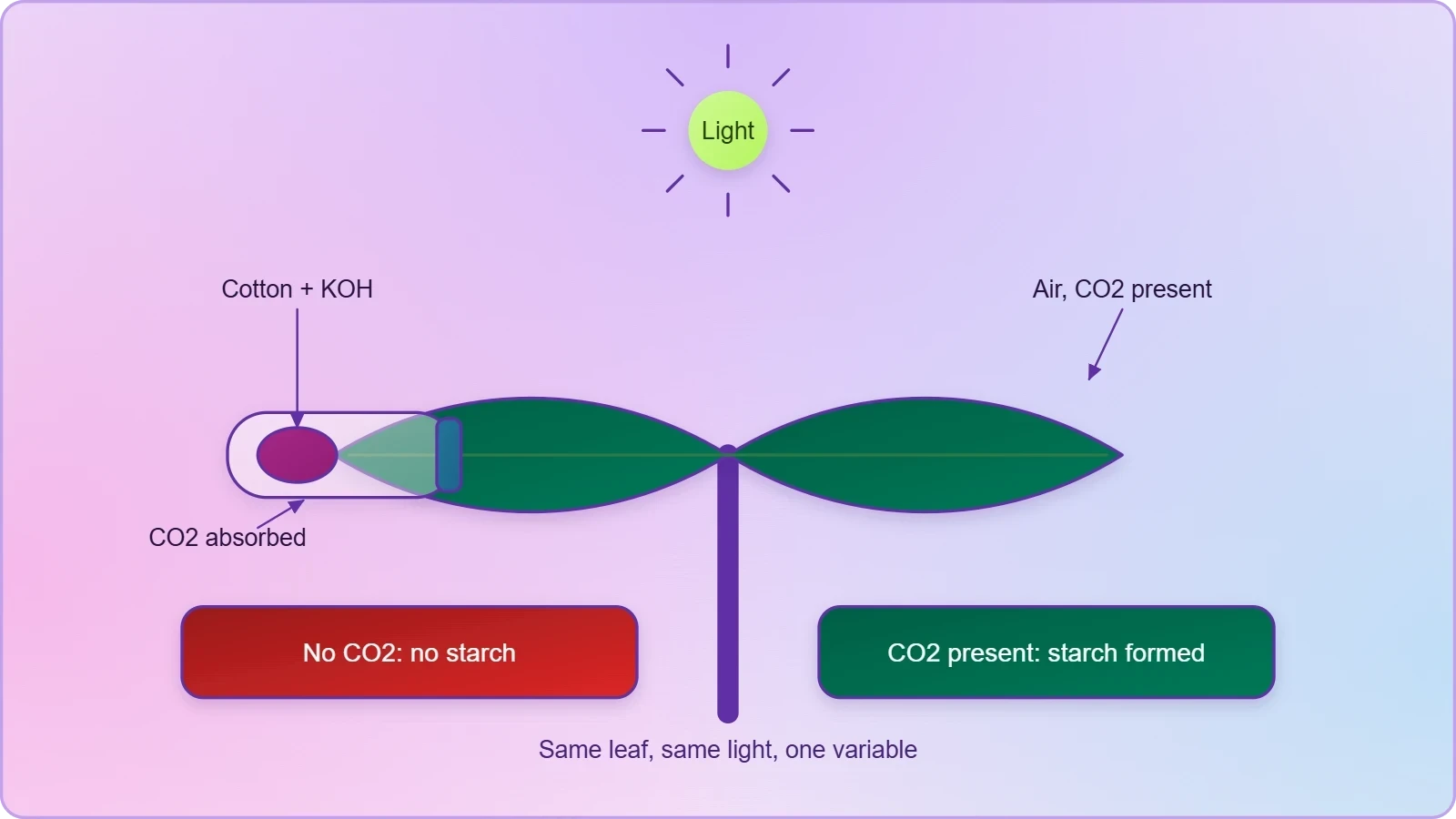
The course material includes a related experiment in which part of a leaf is enclosed in a test tube with potassium hydroxide soaked cotton, which absorbs carbon dioxide, while the other half is exposed to air. After the setup is placed in light for some time, the two parts are tested for starch. The exposed part tests positive; the portion inside the tube tests negative. This shows that carbon dioxide was required for photosynthesis. The design mirrors Ingenhousz's logic, isolating a single variable while holding light and tissue constant.
The comparison is instructive because it extends the method from whole plants to parts of a single leaf. By using one leaf and treating its two halves differently, the experiment controls for the plant's individual variation and for the light conditions. The negative starch test in the enclosed half is the critical result, since it demonstrates that the absence of carbon dioxide prevents the formation of the storage product even when light is available. Learners should be able to explain how this conclusion follows from the paired observations.
Common Misreadings to Avoid
Several misreadings recur in student answers and deserve explicit correction. The first is the claim that Priestley discovered photosynthesis; he did not, and the lesson is careful to describe his finding as the essential role of air in the growth of green plants. The second is the claim that Ingenhousz proved plants produce oxygen in the dark; the material states the opposite, since bubbles formed in bright sunlight and not in darkness. The third is the assumption that the mint plant merely "cleaned" the air mechanically, which ignores the dependence on light established by Ingenhousz.
A fourth misreading concerns the mouse. The animal is not a measuring instrument but an indicator of air quality, and its survival is evidence that the air remained fit for respiration. Learners should describe it in those terms rather than implying that the mouse was used to quantify oxygen. Precision of this kind is what distinguishes a well-argued answer from a vague one, and it is the habit the lesson seeks to cultivate throughout.
Experimental Method as a Transferable Skill
The value of studying Priestley and Ingenhousz lies partly in the transferable habits of mind their work displays. Both investigators worked with simple apparatus and limited theoretical knowledge, yet both produced conclusions that have endured because their designs were sound. The lesson draws out three such habits: the deliberate isolation of a single variable, the use of a visible readout to track an invisible process, and the willingness to state a conclusion no more strongly than the evidence permits. These habits recur in every subsequent experiment in the course, from the starch test to the study of limiting factors.
Learners should practise applying them. Given a novel setup, a student should be able to identify what is being varied, what is being held constant, what is being measured, and what conclusion the measurement supports. The KOH-soaked cotton experiment is an ideal exercise because it combines all four elements in a single leaf. The enclosed half lacks carbon dioxide; the exposed half has it; light is supplied to both; starch is the readout. The negative result in the enclosed half is what licenses the conclusion that carbon dioxide was required.
Variables, Controls and the Meaning of a Negative Result
A negative result is often more informative than a positive one, and the experiments in this lesson illustrate why. The absence of bubbles in the dark, the failure of the candle to burn in fouled air, and the absence of starch in the carbon dioxide-deprived half of the leaf all mark the boundaries of the process under study. Each negative observation tells the investigator that a particular condition is necessary. Without such controls, a positive result could be attributed to almost anything, and the conclusion would remain insecure.
The lesson therefore treats controls as the backbone of experimental meaning. In Priestley's setup, the sealed jar without a plant serves as the control against which the jar with a plant is compared. In Ingenhousz's aquatic experiment, darkness serves as the control against which sunlight is compared. In the leaf experiment, the air-exposed half serves as the control against which the potassium hydroxide-enclosed half is compared. Recognising this pattern allows learners to design their own comparisons rather than merely memorising historical ones.
Preparing for von Sachs, Engelmann and van Niel
The next lesson takes up the work of von Sachs, Engelmann and van Niel, and the present lesson deliberately stops short of their contributions. What has been established here is a set of requirements: a plant must be present, light must be supplied, green tissue must be involved, and carbon dioxide must be available. These requirements define the problem that the later investigators would address with finer tools, including the localisation of starch formation, the action spectrum of photosynthesis, and the use of isotopic tracers to follow the fate of atoms.
Learners who understand why each requirement was established will find the next lesson far easier to follow. The questions change from "does a plant restore air?" to "where exactly, and by what mechanism, is the restoration accomplished?" That shift in the scale of inquiry is the natural progression of the field, and it is the progression this course follows. The historical sequence is not a detour from the science; it is the science, presented in the order in which its logic became clear.
Going further
A bell jar is a glass vessel shaped like a bell, used to enclose a small experimental space. Its shape allows it to be placed over a plant or an animal on a flat surface, and its transparency permits observation without opening. Priestley's work is often described as one of the first demonstrations that plants and animals affect the air in opposite ways, a formulation that captures the complementarity at the heart of his hypothesis. These background points are offered for orientation and do not alter the material presented above.
Learners who wish to consolidate the lesson should be able to reconstruct Priestley's four arrangements from memory, state his hypothesis in his own words, explain what Ingenhousz added by varying light, and describe the aquatic-plant experiment and its two conclusions. They should also be able to explain how the potassium hydroxide experiment with a partly enclosed leaf supports the requirement for carbon dioxide. Mastery of these points prepares the ground for the next lesson, in which von Sachs, Engelmann and van Niel extend the inquiry from whole plants to the cellular and atomic scale.
Also Read
- No links available.
From our network :
- Trump Political Strategy How Geopolitical Stunts Serve As Media Diversions
- 98% of Global MBA Programs Now Prefer GRE Over GMAT Focus EditionExplore why 98% of global MBA programs now prefer the GRE over GMAT Focus. Learn about the shorter GRE format, verbal logic importance, and strategic versatility for students.
- Vite 6/7 'Cold Start' Regression in Massive Module GraphsIn-depth analysis of Vite 6/7 cold start regressions in massive module graphs. Learn about barrel file issues, pre-bundling optimizations, and how to improve Vite dev server performance.
- Mastering DB2 LUW v12 Tables: A Comprehensive Technical GuideComprehensive guide on DB2 LUW v12 tables. Explore CREATE TABLE syntax, BLU Acceleration, range partitioning, data types, and security features for IBM DB2 LUW v12.
- AI-Powered 'Precision Diagnostic' Replaces Standard GRE Score ReportsDiscover the new GRE Precision Diagnostic. Learn how AI-powered behavioral analytics and time-to-solve tracking are replacing standard GRE score reports to empower students.
- Analyzing Trump Deportation Numbers Insights Into The 2026 Immigration Crackdown
- EV 2.0: The Solid-State Battery Breakthrough and Global Factory ExpansionDiscover the impact of the Solid-State Battery Breakthrough on the EV market. Learn about CATL and BYD stock growth, global factory expansion in Europe, and the future of EV 2.0 technology.
- Mastering DB2 12.1 Instance Design: A Technical Deep Dive into Modern Database ArchitectureComprehensive guide to DB2 12.1 Instance Design. Explore architectural components, HADR setup, buffer pool tuning, and security policies for IBM DB2 12.1. Includes 10 functional SQL and Shell samples.
- 10 Physics Numerical Problems with Solutions for IIT JEEPrepare for IIT JEE with 10 physics numerical problems, complete with detailed solutions and conceptual explanations. Ideal for mastering kinematics, thermodynamics, electromagnetism, and optics.
RESOURCES
- Resources will be updated soon.