Dimensional analysis is the quiet discipline that turns a tangle of symbols into a trustworthy statement about nature. When a physicist writes an equation, the dimensions on both sides must agree, and that simple demand of homogeneity acts as a first filter against error. This lesson moves beyond the mechanics of checking formulas and shows how the same reasoning powers real engineering decisions, laboratory prototypes, and even back-of-the-envelope estimates that once shaped history.
Building on the previous lesson on combining uncertainties, we now treat dimensions as a working instrument rather than a bookkeeping chore. You will see how the principle of homogeneity validates the kinematic equation for position, how product-type dependencies yield the period of a pendulum, and how the same logic constrains wave speeds and drag forces. Each derivation is a small act of reasoning that reveals structure before any detailed theory is written.
The lesson also reaches into territory that textbooks rarely visit: similitude and model testing in engineering, Fermi's celebrated estimate of a blast wave, and the scaling laws that govern metabolism in living organisms. Throughout, the message remains disciplined. Dimensional analysis offers insight and a powerful sanity check, but it cannot replace a full physical theory, and it never supplies the dimensionless constants that complete an equation.
On This Page
- The Principle of Homogeneity as a Working Test
- Checking Equations and Ruling Out Impossible Formulas
- Deducing Relations Among Physical Quantities
- Similitude and Model Testing in Engineering
- Fermi Estimates and Scaling in the Physical Sciences
- Limits, Pitfalls, and the Proper Role of the Method
- From Classroom Checks to Real Systems
- Consolidating the Method Through Practice
The Principle of Homogeneity as a Working Test
At its core, the principle of homogeneity states that only quantities with identical dimensions may be added or subtracted. Velocity cannot be added to force, and thermodynamic temperature cannot be subtracted from electric current. This restriction is not a technicality; it is the structural grammar of physical equations, and it lets us reject impossible expressions instantly.
When magnitudes of physical quantities are multiplied, their units behave like ordinary algebraic symbols. Identical units cancel in numerator and denominator, and the same cancellation applies to dimensions. This algebraic freedom is what makes dimensional checking so economical: we never commit to a particular system of units, and we never worry about conversions between multiples and sub-multiples.
Testing the Kinematic Equation for Position
Consider a particle starting at position ##x_0## with initial velocity ##v_0## and uniform acceleration ##a## along the direction of motion. The distance travelled in time ##t## is written as the familiar relation below, and we now interrogate each term separately to see whether the equation survives the homogeneity test.
Each term reduces to the dimension of length. The initial position carries ##[L]##, the velocity term gives ##[L T^{-1}][T] = [L]##, and the acceleration term gives ##[L T^{-2}][T^{2}] = [L]##. Since every term matches the left-hand side, the equation is dimensionally correct and therefore homogeneous.
This test tells us no more and no less than a consistency check on units, but it carries a decisive advantage: it is unit-agnostic. A dimensionally inconsistent equation is proved wrong, yet a dimensionally correct equation is not proved right. Passing the test is necessary, never sufficient, and that asymmetry must be held firmly in mind.
Why Consistency Is Necessary but Not Sufficient
Dimensional consistency cannot detect dimensionless errors. If a factor of two is missing, or a trigonometric function is applied incorrectly, the dimensions remain intact while the physics collapses. The arguments of trigonometric, logarithmic, and exponential functions must themselves be dimensionless, since these functions accept pure numbers and return pure numbers.
Pure numbers arise as ratios of similar quantities: an angle is a length divided by a length, and refractive index is the speed of light in vacuum divided by the speed in a medium. Such ratios carry no dimensions, which is precisely why they can serve as arguments to special functions without violating homogeneity.
Checking Equations and Ruling Out Impossible Formulas
The most immediate use of dimensional reasoning is the elimination of candidate formulas. When several expressions are proposed for the same physical quantity, only those whose dimensions match the target quantity can possibly be correct. This screening is fast, requires no calculus, and often reduces a field of five options to two.
Worked examples make the method concrete. In each case, we compute the dimensions of the right-hand side and compare them with the known dimensions of the left-hand side, discarding any expression that fails. The surviving candidates then require physical argument or experiment to settle the final choice.
Worked Example: The Energy Equation
Take the relation ##\tfrac{1}{2} m v^2 = m g h##, where ##m## is mass, ##v## is velocity, ##g## is gravitational acceleration, and ##h## is height. The left-hand side has dimensions ##[M][L T^{-1}]^{2} = [M L^{2} T^{-2}]##, and the right-hand side gives ##[M][L T^{-2}][L] = [M L^{2} T^{-2}]##. Both sides agree, so the equation is dimensionally correct.
This result is reassuring but incomplete. Dimensional agreement confirms that the equation is at least plausible; it does not confirm the numerical factor or the physical interpretation. The equation expresses energy conservation, and that claim rests on mechanics, not on dimensional bookkeeping alone.
Worked Example: Screening Kinetic Energy Formulas
Suppose five candidate formulas for kinetic energy are offered, with ##m## the mass and ##v## the speed. Kinetic energy has dimensions ##[M L^{2} T^{-2}]##, so any expression failing to match this signature can be ruled out immediately, without appeal to experiment or to the definition of work.
The exercise demonstrates both the power and the limit of the method. Three candidates fall immediately, but two remain, and only the physical definition of kinetic energy as the work done to accelerate a mass from rest settles the matter. Dimensional analysis narrows the field; it does not crown the winner.
Deducing Relations Among Physical Quantities
Beyond checking, dimensions can sometimes construct a relation from scratch. The method assumes that the quantity of interest depends on a small set of other quantities through a product-type relationship, with unknown exponents. Equating dimensions on both sides yields a system of linear equations for those exponents, which is often solvable by inspection.
The technique works best when the dependence is known up to three linearly independent variables. With more variables than independent dimensions, the system becomes underdetermined and the exponents cannot be fixed uniquely. This is a genuine limitation, not a defect of technique, and it reflects the fact that dimensions alone cannot encode all the physics.
Case Study: The Simple Pendulum
Consider a bob of mass ##m## attached to a string of length ##l##, oscillating under gravity ##g##. Suppose the period ##T## depends on these three quantities as a product, so that ##T = k\, l^{x} g^{y} m^{z}##, where ##k## is a dimensionless constant and the exponents are to be found.
Writing dimensions on both sides gives ##[L^{0} M^{0} T^{1}] = [L^{x+y} T^{-2y} M^{z}]##. Equating powers yields ##x + y = 0##, ##-2y = 1##, and ##z = 0##, so that ##x = \tfrac{1}{2}##, ##y = -\tfrac{1}{2}##, and ##z = 0##. The period is therefore proportional to ##\sqrt{l/g}##, independent of mass.
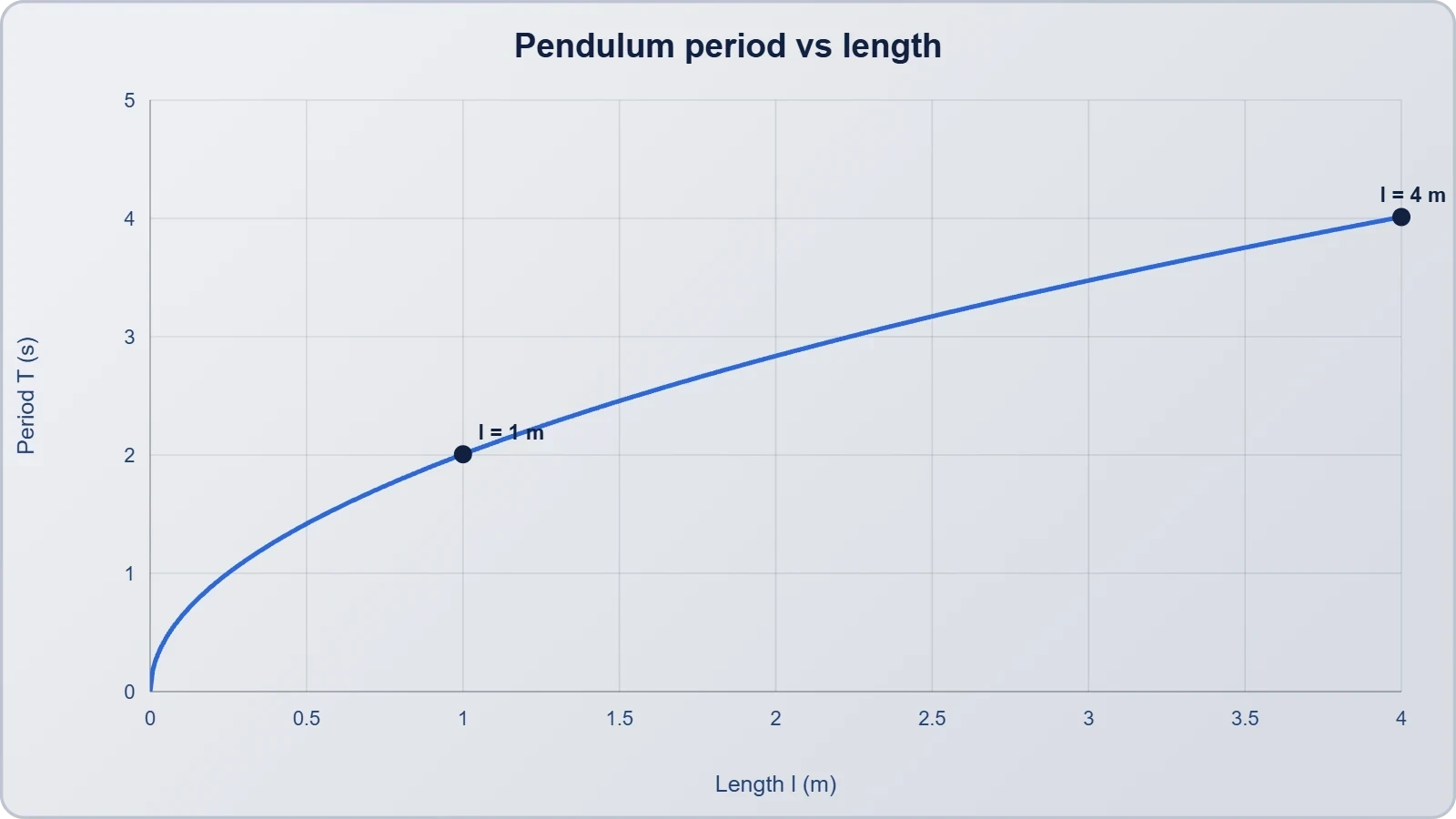
The dimensionless constant ##k## cannot be obtained by dimensional reasoning. In reality ##k = 2\pi##, a result that emerges from the full dynamical analysis of simple harmonic motion. The mass independence is a genuine physical prediction, confirmed by experiment, and it follows here from pure dimensional bookkeeping.
Case Study: Wave Speed and Drag Force
For a wave on a stretched string, the speed depends on tension ##F## and linear mass density ##\mu##. Assuming ##v = k F^{x} \mu^{y}##, dimensions give ##[L T^{-1}] = [M L T^{-2}]^{x} [M L^{-1}]^{y}##, which yields ##x = \tfrac{1}{2}## and ##y = -\tfrac{1}{2}##, so that ##v \propto \sqrt{F/\mu}##. The full theory supplies the missing constant, which equals one.
For drag on a body moving through a fluid, the force depends on density ##\rho##, speed ##v##, and cross-sectional area ##A##. Dimensional reasoning gives ##F \propto \rho v^{2} A##, and the dimensionless drag coefficient ##C_D## absorbs the geometry and Reynolds-number dependence. This is the standard engineering form, and it emerges from dimensions before any fluid dynamics is written.
Similitude and Model Testing in Engineering
Engineers rarely test full-scale structures before they exist. Instead, they build scaled models and rely on the theory of similitude to translate measurements from the model to the prototype. Dimensional analysis supplies the dimensionless groups, such as the Reynolds number and the Froude number, that must be matched between model and prototype for the results to transfer.
Two systems are dynamically similar when all relevant dimensionless groups take the same values in both. If the groups match, the scaled measurements can be rescaled to predict prototype behaviour. If they cannot all be matched simultaneously, the engineer must choose which groups matter most and accept a controlled approximation.
Designing Experiments with Dimensionless Groups
Wind-tunnel testing of aircraft and bridge sections depends on matching the Reynolds number ##Re = \rho v L / \mu##, which compares inertial to viscous forces. When full matching is impossible, engineers adjust speed, scale, or fluid properties to keep the dominant group close to the prototype value, then correct for the residual mismatch.
Ship hull testing in towing tanks relies instead on the Froude number ##Fr = v/\sqrt{gL}##, which compares inertial to gravitational forces. Because Reynolds and Froude matching conflict for the same model, naval architects use Froude scaling for wave resistance and apply empirical corrections for viscous drag.
Prototype Scaling and Practical Constraints
Scaling laws also govern structural and thermal prototypes. A quarter-scale model of a building frame must match the ratio of inertial to elastic forces, and a thermal model must match the Biot number to reproduce heat-transfer behaviour. Each dimensionless group encodes a specific physical competition between forces or transport mechanisms.
The practical lesson is that similitude converts a physical problem into a matching problem. Once the governing groups are identified, the engineer knows exactly which variables to control and which to sacrifice. This is dimensional analysis operating at industrial scale, guiding design decisions worth millions before a single prototype is built.
We Also Published
Fermi Estimates and Scaling in the Physical Sciences
Some of the most celebrated uses of dimensional reasoning occurred under extreme uncertainty. During the Second World War, Enrico Fermi estimated the energy released by the first atomic test by tracking how far a shock wave travelled over time. His approach combined dimensional reasoning with a handful of rough observations, producing an answer remarkably close to the classified value.
The method is instructive because it shows how dimensions constrain the form of a relationship even when the underlying physics is inaccessible. By assuming that blast radius depends on energy, time, and air density, Fermi obtained a scaling law that let him infer energy from a measured radius and time, using only a dimensionless constant estimated from a photograph.
The Blast-Wave Scaling Law
If the shock radius ##R## depends on energy ##E##, time ##t##, and air density ##\rho##, then ##R = k E^{a} t^{b} \rho^{c}##. Equating dimensions gives ##a = \tfrac{1}{5}##, ##b = \tfrac{2}{5}##, and ##c = -\tfrac{1}{5}##, so that ##R \propto (E t^{2}/\rho)^{1/5}##. Inverting this relation lets an observer recover ##E## from measured ##R## and ##t##.
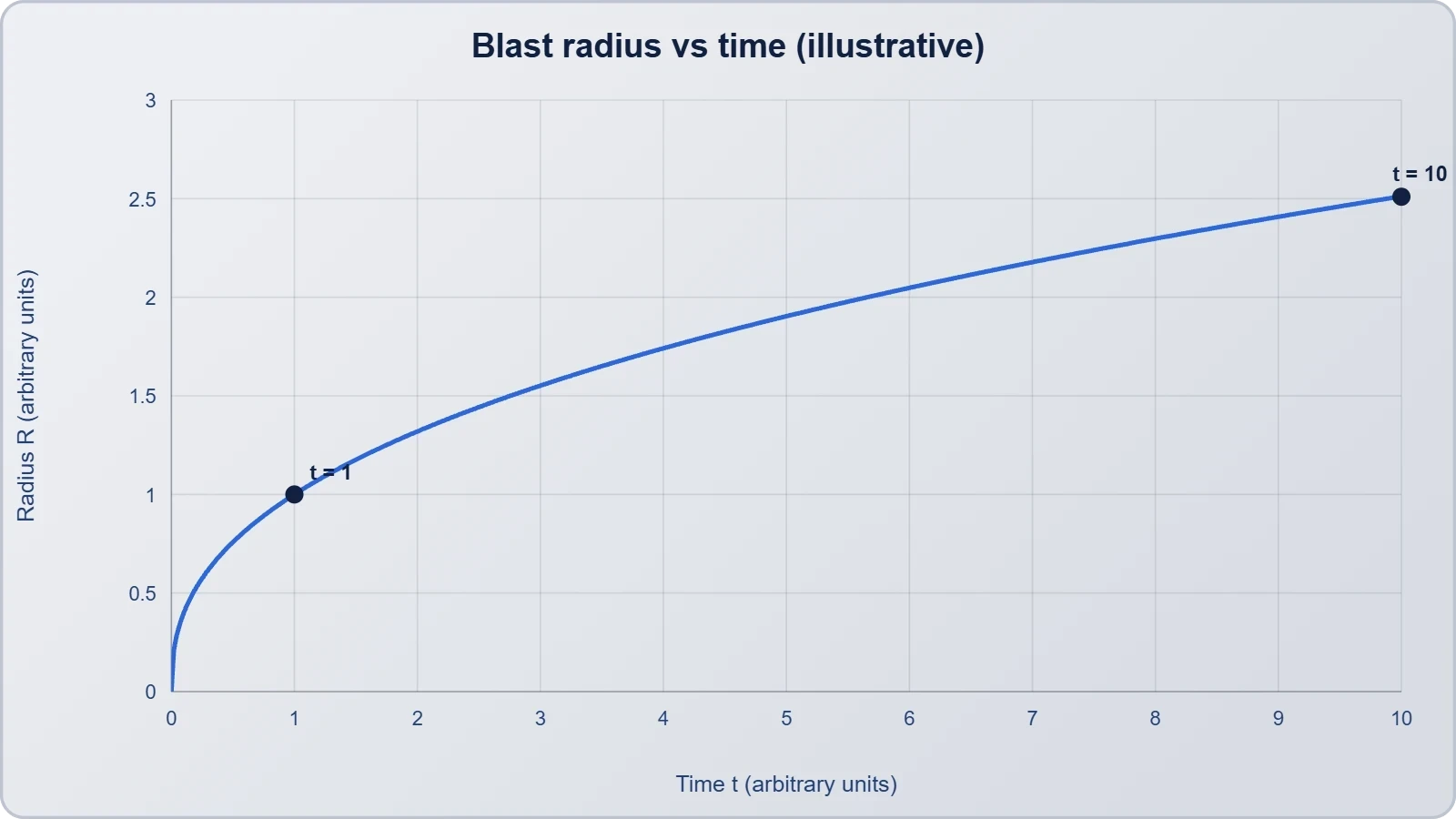
The fifth-power scaling is a striking prediction, and it matches the observed growth of the fireball in declassified photographs. The dimensionless constant ##k## was estimated from the same data, and the resulting energy estimate agreed with later measurements to within an order of magnitude, which is remarkable for a calculation of minutes.
Biological Scaling and Metabolic Rate
Dimensional reasoning also illuminates biology. The metabolic rate of an organism scales with body mass according to Kleiber's law, approximately ##P \propto M^{3/4}##. The exponent is not derivable from dimensions alone, but dimensional analysis frames the problem and constrains the possible forms of the relationship.
More refined models invoke fractal transport networks and surface-area arguments to explain the three-quarter exponent. The lesson is that dimensions provide the scaffolding, while the biological mechanism supplies the exponent. Neither alone is sufficient, and the interplay between them is where genuine insight lives.
Limits, Pitfalls, and the Proper Role of the Method
Dimensional analysis is a tool for insight, not a substitute for detailed theory. It cannot determine dimensionless constants, cannot distinguish between quantities sharing the same dimensions, and cannot detect errors that preserve dimensional balance. Treating it as a proof of correctness is the most common mistake made by students and, occasionally, by professionals.
Another pitfall is forgetting that special functions demand dimensionless arguments. Writing an exponential of a dimensional quantity, or a logarithm of a length, is an immediate error that homogeneity exposes. Similarly, adding terms of different dimensions, as in the mixed kinetic-energy candidate, is a structural failure that no amount of algebra can repair.
Common Errors and How to Avoid Them
Students often assume that a dimensionally correct equation is physically correct, and they stop checking. The remedy is to treat dimensional analysis as a first filter, then verify with physical reasoning, limiting cases, and experiment. A second common error is misidentifying the dimensions of a compound quantity, which propagates through the entire calculation.
A third error is overextending the product assumption when deriving relations. If the true dependence involves sums or non-power-law behaviour, the method fails silently. The disciplined response is to state the assumed form explicitly, solve, and then test the result against known limits before trusting it.
Where the Method Ends and Theory Begins
The boundary is clear. Dimensions tell us what is possible; theory tells us what is actual. The pendulum period is proportional to ##\sqrt{l/g}## by dimensions, but the factor ##2\pi## comes from solving the equation of motion. The drag force scales as ##\rho v^{2} A## by dimensions, but the coefficient ##C_D## comes from fluid mechanics and experiment.
This division of labour is not a weakness but a strength. Dimensional analysis gives the fastest possible route to the structure of a relationship, and it flags errors before expensive computation begins. Used with discipline, it is one of the most economical instruments in the physicist's toolkit, and one of the most enduring.
From Classroom Checks to Real Systems
The transition from textbook exercises to real systems is largely a matter of scale and discipline. In the classroom, dimensional checks are quick and forgiving. In engineering practice, they are the first line of defence against costly errors, and they are applied before simulation, before prototyping, and before any commitment of resources.
A useful habit is to perform a dimensional audit at every stage of a derivation. When a new term appears, check its dimensions immediately. When an equation is assembled, verify homogeneity before proceeding. This discipline catches errors early, when they are cheap to fix, and it builds intuition about which quantities can legitimately interact.
Building a Dimensional Audit Habit
Start by listing the dimensions of every symbol in the problem. Then verify each equation term by term, and finally check the dimensions of the final result against the target quantity. This three-step audit takes minutes and routinely saves hours, especially in multi-step problems where a single slip propagates silently.
The audit also reveals hidden assumptions. If a term cannot be made homogeneous without introducing a new constant, that constant must carry dimensions, and its presence signals that the model is incomplete. Recognising this early prevents the construction of equations that look plausible but cannot be correct.
Preparing for Constants and Their Dimensions
The next lesson examines the role of constants in physics and dimensional analysis. Many constants, such as ##G##, ##h##, and ##k_B##, carry dimensions, and their presence in an equation is itself a dimensional statement. Understanding how constants enter and how their dimensions constrain relationships is the natural continuation of the reasoning developed here.
For now, the essential lesson stands. Dimensional analysis is a compact, powerful instrument for checking, deriving, and scaling. It rewards precision, punishes carelessness, and never pretends to know more than it does. Mastered with discipline, it becomes a permanent companion to every physical argument you construct.
Consolidating the Method Through Practice
Fluency in dimensional analysis comes from repetition across varied problems. Begin with simple checks on familiar equations, then progress to derivations with two or three variables, and finally to scaling problems where the dimensionless groups must be identified. Each stage builds a different facet of the skill.
A useful exercise is to take a known result and reconstruct its form from dimensions alone, then compare with the exact expression. The gap between the two reveals the dimensionless constant and the physics it encodes. Over time, this comparison sharpens intuition about which relationships are dimensionally forced and which depend on deeper structure.
Practice Set and Self-Assessment
Try deriving the escape velocity from ##G##, ##M##, and ##R##, and check whether the result matches ##\sqrt{2GM/R}## up to a dimensionless factor. Then derive the frequency of a mass-spring system from ##k## and ##m##, and compare with ##\tfrac{1}{2\pi}\sqrt{k/m}##. In each case, note which constants dimensions cannot supply.
Finally, test a candidate formula for the period of a physical pendulum and identify where the method fails. The moment of inertia introduces a length scale that the simple product assumption cannot capture, and recognising this limitation is as valuable as any successful derivation.
Key Takeaways for Advanced Learners
Homogeneity is necessary but not sufficient. Product-type derivations yield exponents but never dimensionless constants. Similitude converts scaling into a matching problem, and Fermi estimates show how far dimensional reasoning can travel under uncertainty. These four ideas form the backbone of the method.
Carry them into the next lesson, where constants and their dimensions take centre stage. The discipline you build here, of checking every term and questioning every equation, will serve you through mechanics, electromagnetism, and beyond. Dimensional analysis is not a shortcut around physics; it is the first chapter of thinking like a physicist.
From our network :
- Analyzing Trump Deportation Numbers Insights Into The 2026 Immigration Crackdown
- 98% of Global MBA Programs Now Prefer GRE Over GMAT Focus EditionExplore why 98% of global MBA programs now prefer the GRE over GMAT Focus. Learn about the shorter GRE format, verbal logic importance, and strategic versatility for students.
- Trump Political Strategy How Geopolitical Stunts Serve As Media Diversions
- How to Print Cheaply: Cutting the Cost per PageA practical, measured guide to lowering what each printed page costs — duplex and draft modes, third-party ink, yield mathematics, and knowing when a new printer beats refills.
- Where to Put Your Wireless Router for Better CoverageA practical, physics-grounded guide to router placement: why the centre of the home beats the corner, how walls and metal sap signal, and how to run a simple survey that proves the improvement.
- AI-Powered 'Precision Diagnostic' Replaces Standard GRE Score ReportsDiscover the new GRE Precision Diagnostic. Learn how AI-powered behavioral analytics and time-to-solve tracking are replacing standard GRE score reports to empower students.
- Do You Need a New Router or Is Your Internet Plan the Problem?A practical comparison of the signs that point to router limits versus signs your broadband speed or provider is the bottleneck, so you can decide what to replace before spending money.
- EV 2.0: The Solid-State Battery Breakthrough and Global Factory ExpansionDiscover the impact of the Solid-State Battery Breakthrough on the EV market. Learn about CATL and BYD stock growth, global factory expansion in Europe, and the future of EV 2.0 technology.
- 10 Physics Numerical Problems with Solutions for IIT JEEPrepare for IIT JEE with 10 physics numerical problems, complete with detailed solutions and conceptual explanations. Ideal for mastering kinematics, thermodynamics, electromagnetism, and optics.
RESOURCES
- Mathematical Tools for Real-World Applications: A Gentle ...amazon.comIt presents six powerful tools for analysis, research, and problem-solving in the real world: dimensional analysis, limiting cases, symmetry, scaling ...
- Mathematical Tools for Real-World Applications - MIT Pressmitpress.mit.eduAug 2, 2022 ... It presents six powerful tools for analysis, research, and problem solving in the real world: dimensional analysis, limiting cases, symmetry ...
- Dimensional Analysis | CK-12 Foundationflexbooks.ck12.orgReal-world information is given in dimensions, or the units in which the value is measured. For example, the following are all examples of dimensions.
- "Real World Math" : r/mathteachers - Redditreddit.comMar 9, 2026 ... ... real world math to survive a nuclear apocalypse. Stuff like dimensional analysis to see how long a supply of…
- Mathematical Tools for Real-World Applications - MIT Press Directdirect.mit.eduIt presents six powerful tools for analysis, research, and problem solving in the real world: dimensional analysis, limiting cases, symmetry, scaling ...
- Opinion Mining Using Multi-Dimensional Analysis - IEEE Xploreieeexplore.ieee.orgMar 13, 2023 ... ... real-world applications, and insights into various dimensions of Opinion Mining. The findings have both theoretical and practical ...
- Computationally efficient reachability analysis in high dimensions for ...summit.sfu.caAug 6, 2026 ... Computationally efficient reachability analysis in high dimensions for real-world applications. Resource type. Thesis. Thesis type. (Thesis) Ph ...
- Similitude and Dimensional Analysis | HydroLearnedx.hydrolearn.orgConcepts, theory, and real world examples are blended through clear lecture notes, lecture videos, descriptive visuals, learning activities, and check-your- ...
- MATH6410 Course | Utah State University Catalogcatalog.usu.eduThis course introduces analytic techniques linking core mathematics to real-world applications, including dimensional analysis, Buckingham Pi, perturbation ...
- On local strong solutions to the three-dimensional ...sciencedirect.comNonlinear Analysis: Real World Applications · Volume 46, April 2019, Pages 58-81. Nonlinear Analysis: Real World Applications. On local strong solutions to the ...
- Mathematics in Contemporary Society - Chapter 12 (Spring 2018)academicworks.cuny.edu... , problem solving strategies, dimensional analysis, mathematics in music and art, and mathematical modeling. EXCEL is used to explore real world applications.
- Global bifurcation diagrams and multiplicity of positive solutions for ...sciencedirect.comNonlinear Analysis: Real World Applications · Volume 91, October 2026, 104597 ... Classification and evolution of bifurcation curves for the one-dimensional ...
- Concepts of Essential Math-Statistics (MAT-025)richmondcc.edu... real-world applications. Topics include decimals, percentages, ratios ... dimensional analysis, financial applications and elements of statistics and probability.
- Dimensional analysis answers Documentwww2.american-usa.com- Explore real-world applications to see the relevance of theoretical concepts. - Use textbooks, online courses, and educational videos for diverse ...
- Three-Dimensional Echocardiography: Current Status and Real-Life ...pmc.ncbi.nlm.nih.govThe growing availability of 3D echocardiography (3DE) over the last decade has allowed its applications to expand from establishing reference values for chamber ...