Dimensional formulae and dimensional equations form the grammatical backbone of physics. Just as a sentence is built from words arranged according to rules of syntax, every physical quantity can be expressed as a structured combination of seven base dimensions: mass, length, time, electric current, thermodynamic temperature, luminous intensity, and amount of substance. This lesson, the eighth in a rigorous twenty-five-part course on Units and Measurement for advanced CBSE Class 11 learners, teaches you how to construct those expressions with precision and how to read them back as physical meaning.
Building directly on the previous lesson's treatment of the dimensions of physical quantities, we now formalise the notation. You will learn to write dimensional formulae for derived quantities, convert them into dimensional equations, and recognise why magnitudes never appear in these expressions. The lesson also extends into electromagnetic quantities, dimensionless constants, and the practical limits of dimensional reasoning, preparing you for the next lesson on checking the consistency of equations.
Beyond definitions, this lesson supplies worked examples, practice problems, and a critical discussion of what dimensional equations can and cannot tell us. By the end, you should be able to look at any physical equation and immediately translate it into a statement about base dimensions, a skill that underpins error analysis, formula verification, and the derivation of unknown relationships throughout physics.
On This Page
- From Dimensions to Dimensional Formulae: The Core Notation
- Writing Dimensional Equations Correctly
- Dimensionless Constants and Pure Numbers
- Electromagnetic Quantities in Dimensional Form
- Using Dimensional Equations to Check Homogeneity
- Limitations and Practice Problems
- Consolidating the Lesson and Looking Ahead
From Dimensions to Dimensional Formulae: The Core Notation
The nature of a physical quantity is described by its dimensions, and every derived quantity can be expressed as some combination of the seven fundamental or base quantities. These base quantities are the seven dimensions of the physical world, denoted with square brackets: length [L], mass [M], time [T], electric current [A], thermodynamic temperature [K], luminous intensity [cd], and amount of substance [mol]. The dimensions of a physical quantity are the powers, or exponents, to which the base quantities are raised to represent that quantity.
The expression that shows how and which of the base quantities represent the dimensions of a physical quantity is called the dimensional formula of that quantity. For example, the dimensional formula of volume is [M⁰ L³ T⁰], and that of speed or velocity is [M⁰ L T⁻¹]. Similarly, [M⁰ L T⁻²] is the dimensional formula of acceleration and [M L⁻³ T⁰] that of mass density. Notice that the square brackets around a quantity mean we are dealing with "the dimensions of" that quantity.
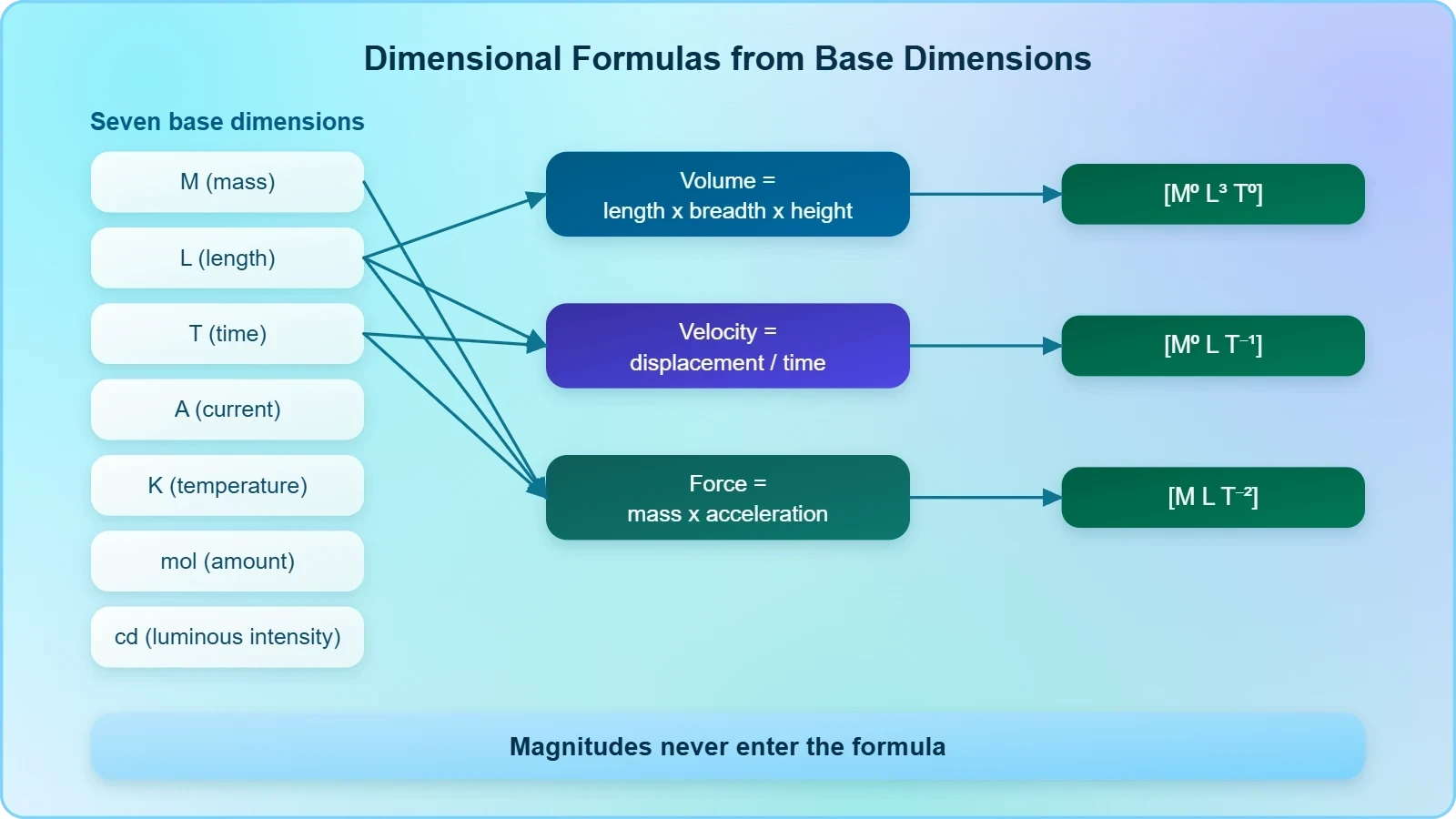
Constructing a Dimensional Formula Step by Step
To build a dimensional formula, begin with the defining equation of the quantity and replace every physical term with its own dimensional formula. Volume, for instance, is the product of length, breadth, and height, or three lengths, so its dimensions are [L] × [L] × [L] = [L³]. Because volume is independent of mass and time, it carries zero dimension in mass [M⁰] and zero dimension in time [T⁰], giving the complete formula [M⁰ L³ T⁰].
Force illustrates the same procedure with a compound definition. Force equals mass times acceleration, and acceleration equals length divided by time squared, so the dimensions of force are [M][L]/[T]² = [M L T⁻²]. Force therefore has one dimension in mass, one in length, and minus two in time, while its dimensions in all other base quantities are zero. Every derived quantity follows this same disciplined substitution.
Why Magnitudes Never Enter the Formula
In this type of representation, magnitudes are not considered; it is the quality of the type of physical quantity that enters. A change in velocity, initial velocity, average velocity, final velocity, and speed are all equivalent in this context, because all can be expressed as length divided by time, giving dimensions [L]/[T] or [L T⁻¹]. The dimensional formula captures the kind of quantity, never its size.
This distinction matters enormously in practice. A velocity of 5 m/s and a velocity of 5000 m/s share the identical dimensional formula [M⁰ L T⁻¹], even though their magnitudes differ by a factor of one thousand. Dimensional analysis therefore operates on the qualitative skeleton of physics, stripping away numerical flesh to reveal the underlying structure of relationships between quantities.
Writing Dimensional Equations Correctly
An equation obtained by equating a physical quantity with its dimensional formula is called the dimensional equation of that physical quantity. Dimensional equations represent the dimensions of a physical quantity in terms of the base quantities. For example, the dimensional equations of volume [V], speed [v], force [F], and mass density [ρ] may be expressed as [V] = [M⁰ L³ T⁰], [v] = [M⁰ L T⁻¹], [F] = [M L T⁻²], and [ρ] = [M L⁻³ T⁰].
The dimensional equation can be obtained from the equation representing the relations between the physical quantities. This means you should always start from a correct physical relationship, substitute the dimensional formulae of each term, and simplify the exponents. The resulting equation is a compact statement about the dimensional structure of the quantity, independent of any system of units or numerical values.
Worked Example: Momentum and Impulse
Consider linear momentum, defined as mass times velocity. Substituting the dimensional formula of velocity gives momentum dimensions [M][L T⁻¹] = [M L T⁻¹]. The dimensional equation is written [p] = [M L T⁻¹]. Now consider impulse, defined as force multiplied by the time interval over which it acts. Force has dimensions [M L T⁻²], so impulse has dimensions [M L T⁻²][T] = [M L T⁻¹].
The two dimensional equations are identical, which reflects the impulse–momentum theorem: impulse equals change in momentum. Dimensional analysis cannot prove this theorem, but it confirms that the two sides of the relationship are dimensionally compatible. This is precisely the kind of structural check that dimensional equations make possible, and it is the bridge to the next lesson on consistency.
Worked Example: Gravitational Constant
Newton's law of gravitation states that the force between two masses is ##F = G m_1 m_2 / r^2##. Rearranging for the gravitational constant gives ##G = F r^2 / (m_1 m_2)##. Substituting dimensions, force is [M L T⁻²], ##r^2## is [L²], and the mass product is [M²]. The dimensional equation becomes:
This result is worth memorising, because the gravitational constant appears in orbital mechanics, escape velocity, and Kepler's third law. Its negative exponent in mass is a signature of the inverse-square law combined with the product of two masses in the denominator. Every time you see [M⁻¹ L³ T⁻²], you can immediately recognise a gravitational or electrostatic constant.
Dimensionless Constants and Pure Numbers
Many physical equations contain constants that carry no dimensions at all. Pure numbers such as 2, π, and ½ are dimensionless by definition, and they never affect the dimensional formula of an expression. When you write a dimensional equation, these numerical factors are simply dropped, because the equation concerns only the quality of the quantity, not its magnitude or the numerical coefficients in its defining relation.
Some physical constants are also dimensionless, and these deserve special attention. The refractive index is the ratio of two speeds and therefore has dimensional formula [M⁰ L⁰ T⁰]. Strain is the ratio of two lengths, Poisson's ratio is a ratio of strains, and the Reynolds number is a ratio of inertial to viscous forces. All are dimensionless, and their dimensional equations reduce to the trivial identity [M⁰ L⁰ T⁰].
Angles, Ratios, and the Fine-Structure Constant
Plane angle is defined as arc length divided by radius, so its dimensions are [L]/[L] = [M⁰ L⁰ T⁰]. This is why the radian is a dimensionless unit, and why angular velocity has dimensions [T⁻¹] rather than [L T⁻¹] in the strict dimensional sense. The fine-structure constant of quantum electrodynamics, approximately 1/137, is another celebrated dimensionless quantity, built from the elementary charge, Planck's constant, the speed of light, and the permittivity of free space.
Dimensionless constants often signal deep physical significance. Their numerical values are independent of any unit system, so they can be compared across experiments and theories without conversion. When a dimensional equation collapses to [M⁰ L⁰ T⁰], it usually means the quantity describes a ratio, a probability, or a counting measure rather than a physical dimension in space and time.
Electromagnetic Quantities in Dimensional Form
Mechanics uses only [M], [L], and [T], but electromagnetic quantities require the fourth base dimension of electric current [A]. Electric charge, defined as current multiplied by time, has dimensions [A T]. Electric potential, defined as work per unit charge, has dimensions [M L² T⁻²]/[A T] = [M L² T⁻³ A⁻¹]. These formulae extend the same substitution discipline into a richer dimensional space.
Resistance, defined as potential divided by current, has dimensions [M L² T⁻³ A⁻¹]/[A] = [M L² T⁻³ A⁻²]. Capacitance, defined as charge per unit potential, has dimensions [A T]/[M L² T⁻³ A⁻¹] = [M⁻¹ L⁻² T⁴ A²]. Magnetic flux, defined as potential multiplied by time, has dimensions [M L² T⁻² A⁻¹]. Each of these is a dimensional equation in four base quantities.
Reading Electromagnetic Formulae as Physical Statements
Notice how the exponents encode physical relationships. The appearance of A⁻² in resistance reflects the fact that resistance grows with potential but falls with current. The A² in capacitance reflects the charge-per-potential definition, where charge itself carries one power of current. These patterns are not arbitrary; they are the dimensional fingerprints of the underlying physical laws.
When you encounter an unfamiliar electromagnetic formula, translate it into dimensions before trusting it. A quick check of the exponents in [M], [L], [T], and [A] will often reveal a missing factor of 4π, a sign error, or a confused definition. This habit is especially valuable in competitive examinations, where distractors are frequently dimensionally inconsistent.
We Also Published
Using Dimensional Equations to Check Homogeneity
A physical equation is homogeneous if every term on both sides has the same dimensional formula. Dimensional equations provide a rapid test of this property. If you add a length to a time, or equate a force to an energy, the dimensional equations will immediately reveal the mismatch. This principle of homogeneity is the foundation of the next lesson, and it is the single most useful application of dimensional reasoning in problem solving.
Consider the equation of motion ##v = u + at##. The dimensions of ##v## and ##u## are both [L T⁻¹], and the dimensions of ##at## are [L T⁻²][T] = [L T⁻¹]. All three terms share the same dimensional formula, so the equation is homogeneous. Now consider a suspected relation ##s = ut + \dfrac{1}{2}at^3##. The first term has dimensions [L], but the second has dimensions [L T⁻²][T³] = [L T], which is not a length. The equation fails the homogeneity test.
Homogeneity in Practice: A Systematic Procedure
To check homogeneity, write the dimensional equation for each term separately, simplify the exponents, and compare. If all terms agree, the equation passes; if any term differs, the equation is dimensionally inconsistent and cannot be correct as written. This procedure catches a large fraction of algebraic errors in derivations and is standard practice in physics examinations.
Homogeneity is a necessary but not sufficient condition. An equation can be dimensionally consistent and still be physically wrong, because dimensional analysis cannot determine numerical coefficients or the precise functional form of a relationship. The equation ##s = ut + at^2## is dimensionally homogeneous, yet it is incorrect by a factor of ½. Homogeneity rules out errors of kind, not errors of magnitude.
Common Mistakes in Homogeneity Checks
Students frequently forget that trigonometric, exponential, and logarithmic functions require dimensionless arguments. The expression ##\sin(\omega t)## is valid only because ##\omega t## is dimensionless, with ##\omega## having dimensions [T⁻¹]. Writing ##\sin(t)## or ##e^{x}## with a dimensional argument is a dimensional error, even though the algebra may look innocent.
Another common mistake is treating the argument of a square root carelessly. The quantity under a square root must have even total exponents if the result is to be a simple power of the base dimensions. For example, ##\sqrt{L^2 T^{-2}}## is fine, giving [L T⁻¹], but ##\sqrt{L}## produces a fractional exponent that signals a deeper structural issue in the formula.
Limitations and Practice Problems
Dimensional equations are powerful, but they have well-defined limits. They cannot determine dimensionless numerical constants, cannot distinguish between quantities with the same dimensions but different physical meanings, and cannot handle trigonometric, exponential, or logarithmic functions directly. They also fail when a quantity depends on more than three or four base dimensions in a way that admits multiple solutions.
Another limitation is that dimensional equations cannot detect errors in the numerical coefficient of a formula. The equation ##s = ut + at^2## passes the homogeneity test despite being wrong by a factor of ½. Similarly, dimensional analysis cannot tell you whether a relationship is linear, quadratic, or sinusoidal; it only constrains the dimensional structure, not the functional form.
Practice Problems on Writing Dimensional Equations
Attempt each problem before reading the solution. Write the dimensional equation for (a) kinetic energy, (b) surface tension, (c) Planck's constant, and (d) the universal gas constant. For kinetic energy, ##K = \dfrac{1}{2}mv^2##, so [K] = [M][L² T⁻²] = [M L² T⁻²]. For surface tension, force per unit length gives [M L T⁻²]/[L] = [M T⁻²].
Planck's constant, defined through ##E = h\nu##, has dimensions [M L² T⁻²]/[T⁻¹] = [M L² T⁻¹]. The universal gas constant, from ##PV = nRT##, has dimensions [M L² T⁻²]/[mol K] = [M L² T⁻² mol⁻¹ K⁻¹]. Each result follows from a clean substitution of the defining equation, and each is worth committing to memory for examination use.
Practice Problems on Homogeneity and Constants
Test the equation ##T = 2\pi\sqrt{l/g}## for homogeneity. The argument of the square root has dimensions [L]/[L T⁻²] = [T²], so the square root gives [T], matching the left side. The factor ##2\pi## is dimensionless and does not affect the check. The equation passes, confirming the dimensional structure of the simple pendulum period.
Now test ##v = \sqrt{P/\rho}##, where ##P## is pressure and ##\rho## is mass density. Pressure has dimensions [M L⁻¹ T⁻²] and density [M L⁻³], so the ratio is [L² T⁻²], and the square root gives [L T⁻¹], matching velocity. This equation describes the speed of sound in a fluid and passes the homogeneity test, though the true formula includes a dimensionless factor ##\sqrt{\gamma}## that dimensional analysis cannot supply.
A Short Programming Aid for Dimensional Checks
For repeated practice, a small script can automate the arithmetic of exponents. The following Python snippet represents dimensions as dictionaries and multiplies or divides them by adding or subtracting exponents. It is a convenient way to verify your hand calculations and to explore how compound quantities combine dimensionally.
from collections import Counter

def dim(**kwargs):
    return Counter(kwargs)

def mul(a, b):
    return a + b

def div(a, b):
    return a - b

def show(name, d):
    parts = [f"{k}^{v}" for k, v in sorted(d.items()) if v != 0]
    print(name, "=", " ".join(parts) if parts else "dimensionless")

force = dim(M=1, L=1, T=-2)
time = dim(T=1)
impulse = mul(force, time)
show("Impulse", impulse)

velocity = dim(L=1, T=-1)
momentum = mul(dim(M=1), velocity)
show("Momentum", momentum)
Running this script prints impulse and momentum with identical exponent sets, confirming the dimensional equivalence discussed earlier. Such tools are useful for checking long derivations, but they never replace the conceptual understanding that dimensional equations encode the qualitative structure of physical law.
Consolidating the Lesson and Looking Ahead
Dimensional formulae and dimensional equations translate physical relationships into statements about the seven base dimensions. The dimensional formula shows how and which base quantities represent a quantity's dimensions, while the dimensional equation equates the quantity with that formula. Together they provide a compact, unit-independent language for describing the structure of physics, from simple mechanics to electromagnetism.
The next lesson, Dimensional Analysis: Checking Consistency, builds directly on this foundation. You will apply the homogeneity principle systematically, test candidate equations, and learn how dimensional reasoning supports the derivation of unknown relationships. Mastering the notation in this lesson is therefore essential preparation for the analytical work that follows.
From our network :
- Trump Political Strategy How Geopolitical Stunts Serve As Media Diversions
- Do You Need a New Router or Is Your Internet Plan the Problem?A practical comparison of the signs that point to router limits versus signs your broadband speed or provider is the bottleneck, so you can decide what to replace before spending money.
- Where to Put Your Wireless Router for Better CoverageA practical, physics-grounded guide to router placement: why the centre of the home beats the corner, how walls and metal sap signal, and how to run a simple survey that proves the improvement.
- 98% of Global MBA Programs Now Prefer GRE Over GMAT Focus EditionExplore why 98% of global MBA programs now prefer the GRE over GMAT Focus. Learn about the shorter GRE format, verbal logic importance, and strategic versatility for students.
- 10 Physics Numerical Problems with Solutions for IIT JEEPrepare for IIT JEE with 10 physics numerical problems, complete with detailed solutions and conceptual explanations. Ideal for mastering kinematics, thermodynamics, electromagnetism, and optics.
- EV 2.0: The Solid-State Battery Breakthrough and Global Factory ExpansionDiscover the impact of the Solid-State Battery Breakthrough on the EV market. Learn about CATL and BYD stock growth, global factory expansion in Europe, and the future of EV 2.0 technology.
- How to Print Cheaply: Cutting the Cost per PageA practical, measured guide to lowering what each printed page costs — duplex and draft modes, third-party ink, yield mathematics, and knowing when a new printer beats refills.
- Analyzing Trump Deportation Numbers Insights Into The 2026 Immigration Crackdown
- AI-Powered 'Precision Diagnostic' Replaces Standard GRE Score ReportsDiscover the new GRE Precision Diagnostic. Learn how AI-powered behavioral analytics and time-to-solve tracking are replacing standard GRE score reports to empower students.
RESOURCES
- Dimensional Formulae and Dimensional Equationsflexbooks.ck12.orgNov 1, 2026 ... A dimensional equation is an equation that equates a physical quantity with its dimensional formula. It allows us to analyse…
- How do you convert a two dimensional equation to a three ...math.stackexchange.comOct 18, 2016 ... We can make a three-dimensional shape called an ellipsoid by including the z coordinate in the equation: x2+4y2+16z2=1.
- Dimensional analysis - Wikipediaen.wikipedia.orgMathematically, the dimension of the quantity Q is given by dim Q = 𝖳 a 𝖫 b 𝖬 c 𝖨 d Θ e…
- Dimensions And dimensional Formula - Physics Stack Exchangephysics.stackexchange.comOct 15, 2024 ... Ratios between values of the same dimension are indeed dimensionless. A ratio of 3 meters to 1 meter is a…
- Financial markets' deterministic aspects modeled by a low ... - Naturenature.comFinancial markets' deterministic aspects modeled by a low-dimensional equation. Article; Open access; Published: 01 February 2022; Volume 12, article number ...
- The Kolmogorov Infinite Dimensional Equation in a Hilbert space ...arxiv.orgJun 13, 2022 ... Abstract:We consider the nonlinear Kolmogorov equation posed in a Hilbert space H, not necessarily of finite dimension.
- Multiple soliton solutions, lump, rogue wave and breather solutions ...sciencedirect.cominvestigated two new high dimensional equations—ZK equation and generalized Boussinesq equation to describe higher-dimensional Rossby waves [4], [5]. Yang ...
- 4 dimensional formulas : r/askmath - Redditreddit.comMay 9, 2023 ... When you have a cube, the formula for the volume is x³ (or b x l x h). For a…
- Exploring optical solitary wave solutions in the (2+1) - PMC - NIHpmc.ncbi.nlm.nih.govThe current study explores the (2+1)-dimensional Chaffee-Infante equation, which holds significant importance in theoretical physics renowned ...
- Quasi-one-dimensional equation for a tube-shaped dilute Fermi gassciencedirect.comMar 15, 2023 ... Highlights. •. The 1D effective equation describes the behavior of the tube-shaped fermion gas. •. Dimensional reduction with a variational ...
- Exact solutions to three-dimensional generalized nonlinear Schr ...link.aps.org... equations with inhomogeneous coefficients can be reduced to one-dimensional stationary NLS equation with constant or varying coefficients, thus allowing for ...
- Chapter 1 UNITS AND DIMENSIONSgppanchkula.ac.inIt does not depends upon M. Dimensional Equation: An equation obtained by equating the physical quantity with its dimensional formula is called dimensional ...
- Integrability Properties of the Four-Dimensional Equation of ...link.springer.comJun 16, 2022 ... Properties associated with the integrability of the four-dimensional equation of universal hierarchy are considered.
- Dimensional Integrable Breaking Soliton Equation and Its Algebro ...mdpi.comA new (2 + 1)-dimensional breaking soliton equation with the help of the nonisospectral Lax pair is presented. It is shown that the compatible…
- Numerical Solution of Two-Dimensional Time Fractional Mobile ...pmc.ncbi.nlm.nih.gov[28] proposed a compact difference scheme for solving the one-dimensional time fractional mobile/immobile equation. The stability and convergence of the ...