Double fertilisation stands as one of the most consequential innovations in the evolutionary history of flowering plants, a mechanism that couples the formation of the embryo with the provisioning of its food supply in a single, coordinated act. When a compatible pollen tube finally reaches the embryo sac after traversing the stigma and style, it does not simply deliver one gamete to the egg. Instead, it discharges two male gametes into a synergid, and these two cells embark on two distinct fusions within the same embryo sac. This lesson examines that dual event closely, building directly on the pollination and pollen-pistil interaction groundwork established earlier and setting the stage for the post-fertilisation development of endosperm, embryo and seed that follows.
The significance of double fertilisation lies in its economy and its exclusivity. No other group of plants performs two fusions inside a single female gametophyte. One male gamete unites with the egg cell in a process termed syngamy, producing the diploid zygote that will become the embryo. The second male gamete fuses with the two polar nuclei of the central cell in a process called triple fusion, yielding the triploid primary endosperm nucleus. Because both events occur within one embryo sac, the entire phenomenon is named double fertilisation. Understanding the precise sequence, the participating nuclei and the ploidy of each product is essential for anyone studying angiosperm reproduction at an intermediate to advanced level.
This lesson traces the discharge of the male gametes, the mechanics of syngamy and triple fusion, the formation of the primary endosperm cell, and the biological rationale for why endosperm formation always precedes embryo development. It preserves the terminology and order of ideas central to the subject, adds structured comparison tables and a short "Going further" block for well-established background, and prepares learners for the next lesson on endosperm, embryo and seed. By the end, the learner should be able to define triple fusion, name the nuclei involved, explain where and how it takes place, and articulate why the zygote remains dormant for a time in a fertilised ovule.
On This Page
- The Discharge of Male Gametes into the Embryo Sac
- Syngamy: The Fusion of Male Gamete and Egg Cell
- Triple Fusion: The Second Fusion and the Primary Endosperm Nucleus
- Double Fertilisation as a Unifying Event
- Dormancy of the Zygote and the Priority of Endosperm
- Working Through the Evidence: Questions and Structured Reasoning
- Going further
- Consolidating the Lesson: From Fusion to Seed
The Discharge of Male Gametes into the Embryo Sac
Following compatible pollination, the pollen grain germinates on the stigma and the resulting pollen tube grows through the style, enters the ovules and finally discharges two male gametes in one of the synergids. This discharge is the culmination of the entire pollen-pistil interaction, the sequence of events that begins with the landing of pollen on the stigma and ends when the pollen tube enters the embryo sac. The synergid, one of the two companion cells flanking the egg in the egg apparatus, receives the tube and serves as the gateway through which the male gametes enter the female gametophyte. The precision of this delivery system ensures that both gametes arrive at the correct destination within the embryo sac.
The Pathway from Stigma to Synergid
The journey of the pollen tube is neither random nor passive. After germination, the tube navigates the style, often guided by chemical signals and structural cues, until it reaches the ovule and penetrates the micropylar end of the embryo sac. The tube enters one of the synergids, and it is within this cell that the two male gametes are released. This targeted delivery reflects the high degree of coordination between male and female tissues in angiosperms. The synergid effectively functions as the reception chamber for the male gametes, positioning them for the two fusions that must follow in rapid succession.
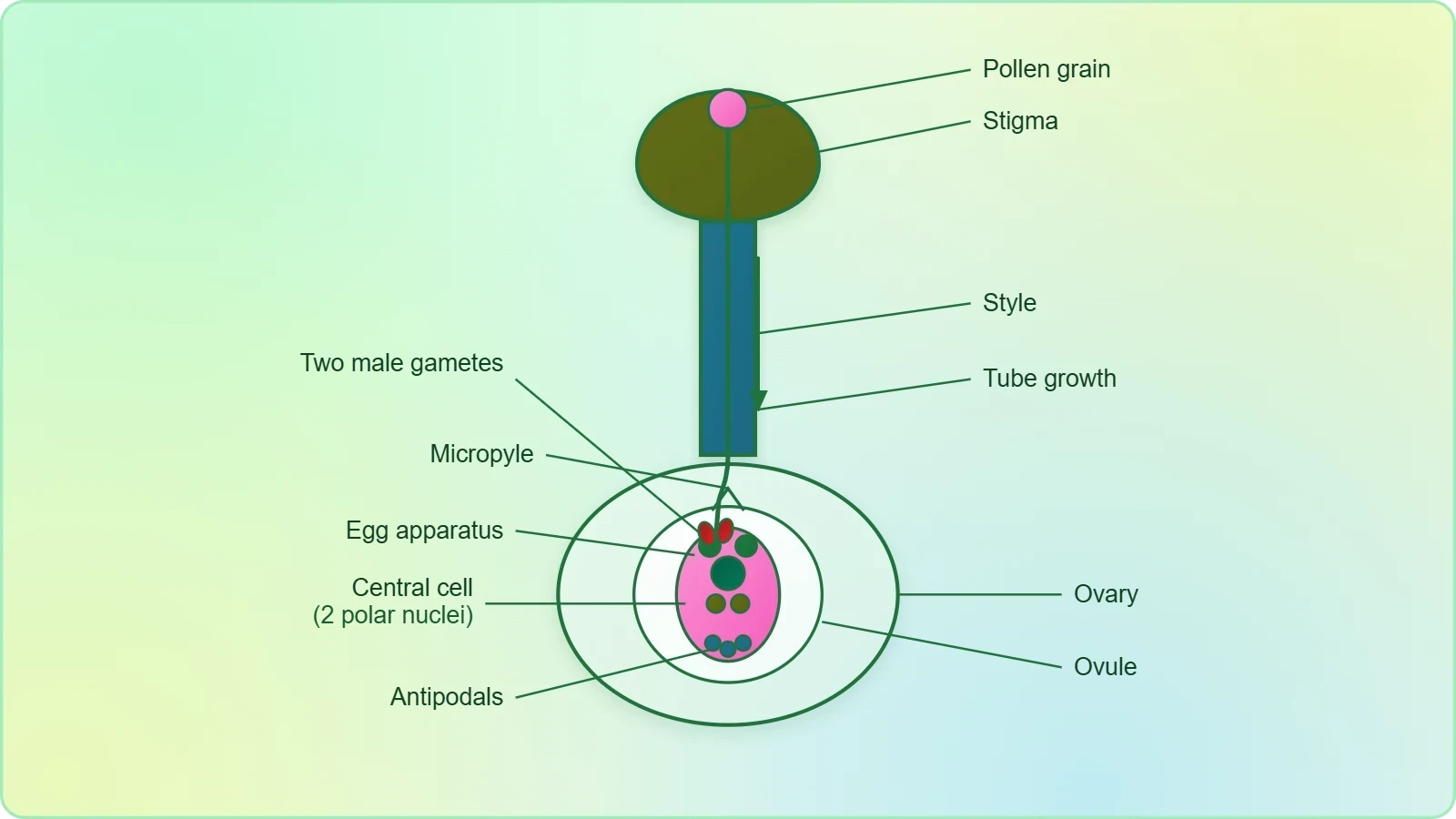
Once released, the two male gametes are motile only in the sense that they are positioned by the cytoplasmic environment of the synergid; they do not swim independently as in some lower plants. Their fate is determined by proximity and by the receptive states of the egg cell and the central cell. One gamete moves toward the egg, while the other is directed toward the large central cell containing the two polar nuclei. This division of labour between the two male gametes is the structural precondition for double fertilisation, and it explains why the discharge of two gametes, rather than one, is such a defining feature of flowering plant reproduction.
The Egg Apparatus and Central Cell as Fusion Targets
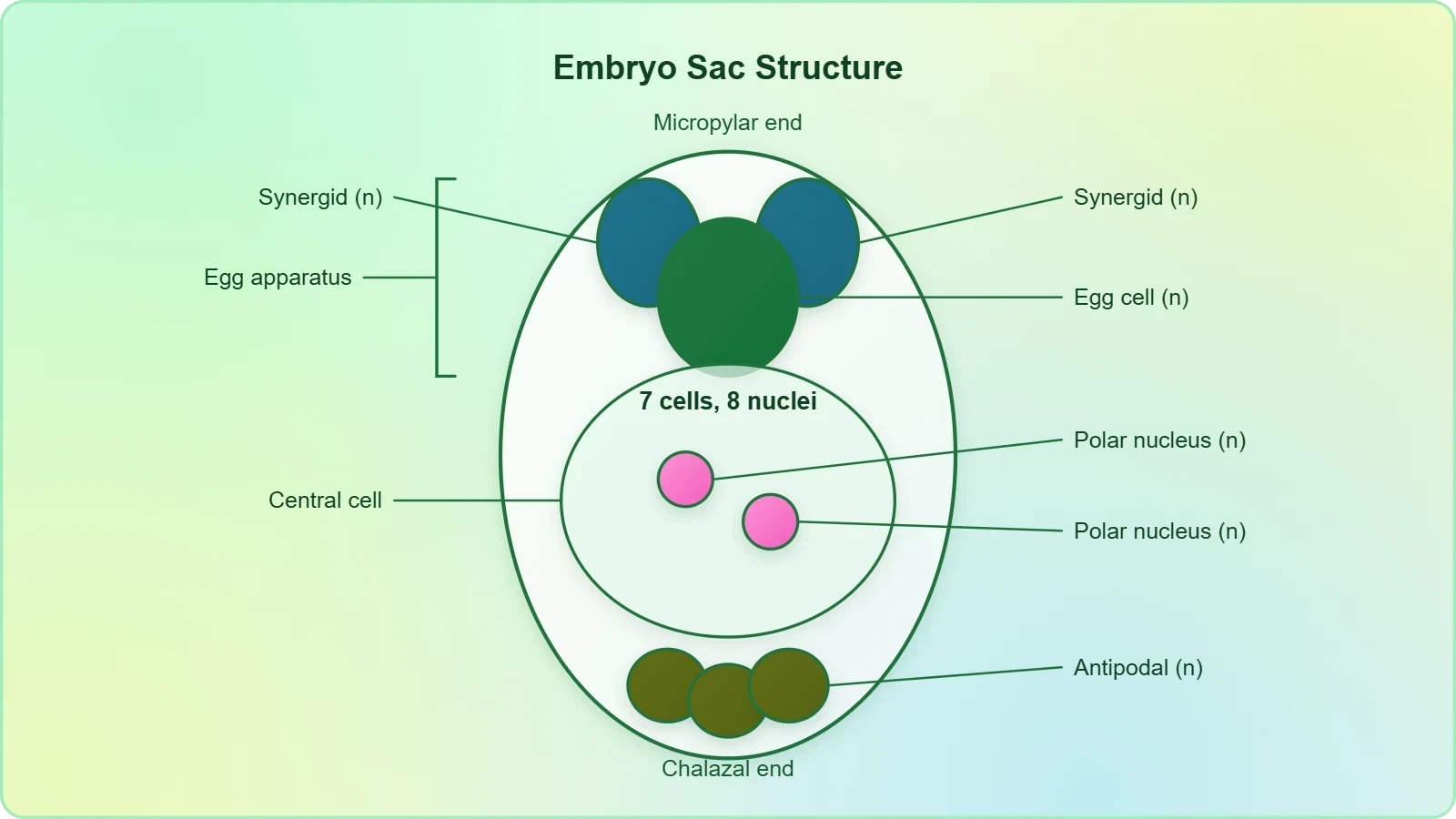
The mature female gametophyte is described as 7-celled and 8-nucleate. At the micropylar end lies the egg apparatus, consisting of two synergids and an egg cell. At the chalazal end are three antipodals. At the centre is a large central cell with two polar nuclei. This arrangement establishes the two distinct fusion targets: the egg cell for syngamy and the central cell for triple fusion. The antipodals, though present, do not participate directly in fertilisation, while the synergids facilitate the entry of the pollen tube. The spatial organisation of these cells within the embryo sac is what makes the dual fusion geometrically and biologically possible.
Understanding this cellular architecture is essential because the ploidy of each fusion product depends on the nuclei involved. The egg cell contributes one haploid nucleus, and each male gamete contributes one haploid nucleus, so syngamy yields a diploid zygote. The central cell contributes two haploid polar nuclei, and the second male gamete contributes one haploid nucleus, so triple fusion yields a triploid primary endosperm nucleus. The 7-celled, 8-nucleate description of the female gametophyte thus directly underpins the arithmetic of double fertilisation, connecting the structural account of the embryo sac to the genetic consequences of the two fusions.
Syngamy: The Fusion of Male Gamete and Egg Cell
Syngamy is the first of the two fusion events and the one that directly produces the next sporophytic generation. In this process, one of the two male gametes released into the synergid fuses with the egg cell, forming the diploid zygote. The zygote is the founding cell of the embryo, and its diploid constitution restores the chromosome number characteristic of the parent plant. Syngamy therefore represents the conventional sexual fusion familiar from the study of reproduction in other organisms, but in angiosperms it occurs alongside a second, accessory fusion that provisions the resulting embryo. The term syngamy distinguishes this primary fusion from the triple fusion that accompanies it.
Formation and Constitution of the Zygote
The zygote formed by syngamy is diploid, carrying one set of chromosomes from the male gamete and one from the egg cell. This restoration of the diploid state is the genetic essence of sexual reproduction, and it ensures that the embryo inherits genetic material from both parents. The zygote does not immediately divide; instead, it enters a period of dormancy within the fertilised ovule. This delay is a notable feature of angiosperm development and is addressed explicitly in the study of the subject, which asks why the zygote is dormant for some time in a fertilised ovule. The dormancy allows the endosperm to establish itself before the embryo begins its demanding developmental programme.
The dormancy of the zygote is best understood in the context of resource allocation. The developing seed must provision the embryo with stored food, and this food is supplied by the endosperm tissue derived from the primary endosperm cell. If the embryo were to begin dividing immediately, it would compete with the endosperm for the limited resources available within the ovule. By remaining quiescent until the endosperm has formed, the zygote ensures that its subsequent development occurs in a well-provisioned environment. This temporal sequencing is a recurring theme in the lesson and connects directly to the observation that formation of endosperm always precedes development of the embryo.
Why Syngamy Alone Does Not Define Angiosperm Reproduction
If syngamy were the only fusion, angiosperm reproduction would resemble that of many other organisms, with a single fertilisation producing a zygote and no accompanying nutritive fusion. The distinctive feature of flowering plants is that syngamy is always paired with triple fusion in the same embryo sac. This pairing means that the embryo and its food supply are formed in a coordinated manner, with the endosperm genetically related to both parents through the second male gamete. The result is a reproductive strategy in which the investment in seed provisioning is tightly linked to the act of fertilisation itself, rather than being a separate, preceding process as in some other plant groups.
This linkage has profound implications for seed biology. Because the endosperm receives genetic contributions from the male parent as well as the female parent, the nutritive tissue is not merely maternal in origin. The second male gamete contributes one haploid set of chromosomes to the triploid primary endosperm nucleus, giving the father a direct genetic stake in the provisioning of his offspring. This paternal contribution to endosperm is one of the reasons double fertilisation is regarded as an evolutionary refinement that enhances the success of the seed. It also explains why the phenomenon is described as unique to flowering plants, since no other plant group combines syngamy with a second fertilisation of the central cell.
Triple Fusion: The Second Fusion and the Primary Endosperm Nucleus
Triple fusion is the second fusion event and the one that gives double fertilisation its name and its distinctive character. In this process, the second male gamete fuses with the two polar nuclei of the central cell, forming the triploid primary endosperm nucleus. The fusion involves three haploid nuclei, hence the term triple fusion, and it occurs within the central cell of the embryo sac. The product, the primary endosperm nucleus, resides in the primary endosperm cell, which subsequently forms the endosperm tissue that nourishes the developing embryo. Triple fusion is thus the mechanism by which the nutritive tissue of the seed is initiated at the moment of fertilisation.
Location and Mechanics of Triple Fusion
Triple fusion takes place in the central cell of the embryo sac, the large cell positioned at the centre of the female gametophyte and containing the two polar nuclei. The second male gamete, having been discharged into the synergid along with its companion, migrates to the central cell and fuses with the two polar nuclei. The nuclei involved are therefore the two polar nuclei of the central cell and one male gamete nucleus, three haploid nuclei in total. The resulting primary endosperm nucleus is triploid, and it is housed within the primary endosperm cell. This precise localisation distinguishes triple fusion from syngamy, which occurs in the egg cell at the micropylar end of the embryo sac.
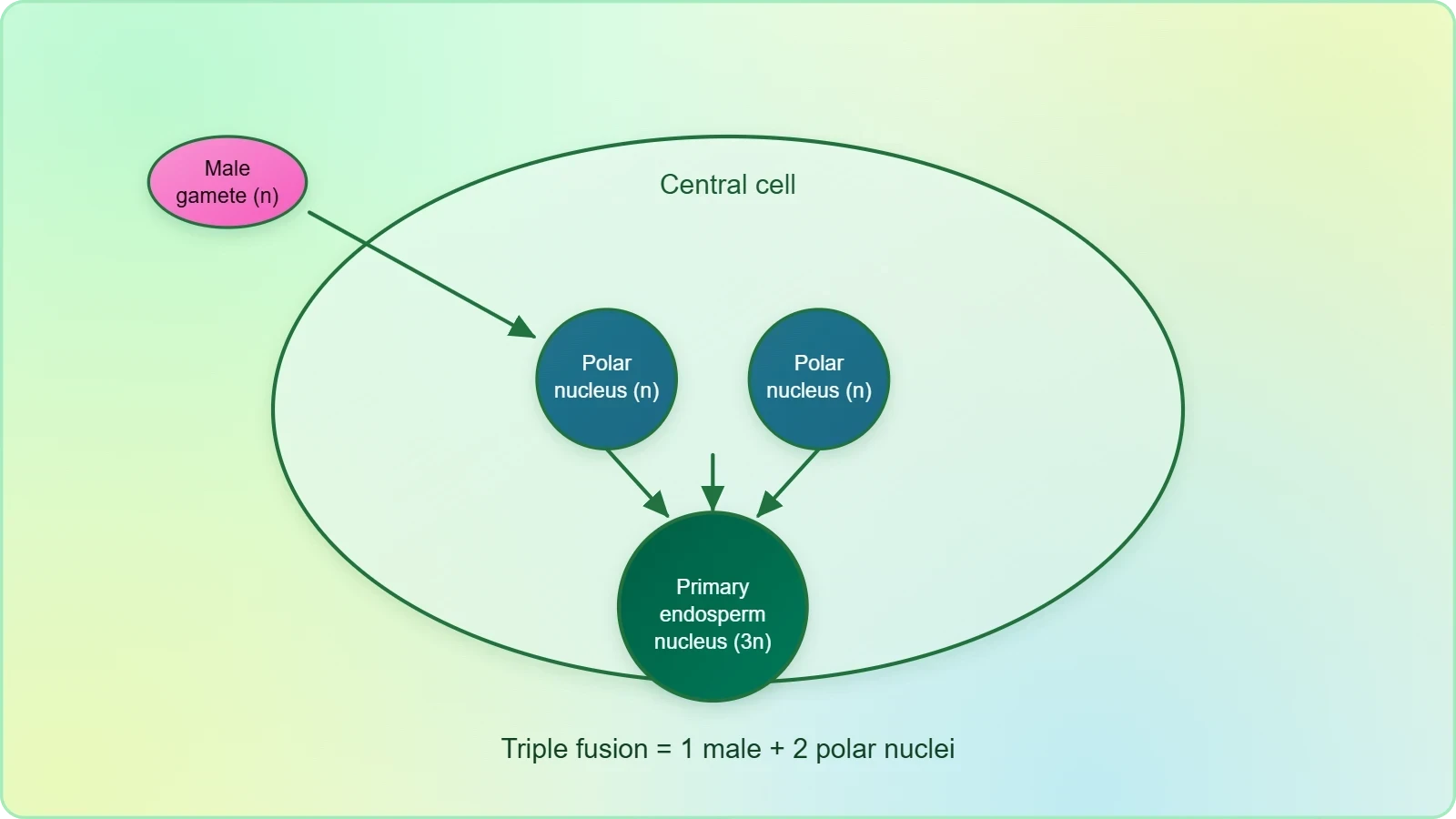
The mechanics of triple fusion reflect the same targeted delivery that characterises syngamy. Both male gametes are released into the synergid, but they are directed to different destinations within the embryo sac. The central cell, being large and centrally located, presents a substantial target for the second gamete. The fusion of three nuclei within this cell is a remarkable event, and it is the reason the process is called triple fusion rather than double fusion. The terminology is deliberate: syngamy involves two nuclei, while triple fusion involves three, and together they constitute the double fertilisation that defines angiosperm reproduction.
The Triploid Primary Endosperm Nucleus and the Primary Endosperm Cell
The primary endosperm nucleus is triploid because it is formed by the fusion of three haploid nuclei: two polar nuclei from the central cell and one male gamete nucleus. This triploid constitution is a direct consequence of the arithmetic of triple fusion, and it distinguishes the endosperm from the diploid embryo. The primary endosperm cell, containing this triploid nucleus, is the precursor of the endosperm tissue that will provision the seed. The formation of endosperm always precedes development of the embryo, a sequencing that ensures the embryo has a food supply in place before it begins to grow. The triploid endosperm is thus both a genetic and a nutritional foundation for seed development.
The significance of the triploid state extends beyond mere chromosome counting. Because the endosperm receives two maternal genomes and one paternal genome, it carries a genomic balance that differs from that of the embryo. This balance is thought to influence the development and function of the endosperm tissue, though the detailed mechanisms belong to more advanced study. For the purposes of this lesson, the key point is that triple fusion produces a triploid primary endosperm nucleus within the primary endosperm cell, and this cell gives rise to the endosperm that nourishes the embryo. The ploidy of the endosperm is therefore a direct readout of the fusion events that define double fertilisation.
Double Fertilisation as a Unifying Event
Because two fusion events occur in each embryo sac, namely syngamy and triple fusion, angiosperms exhibit double fertilisation. The term captures the fact that a single pollen tube delivers two gametes that participate in two separate fusions within one female gametophyte. This is not two fertilisations of the same egg, but two fertilisations of two different targets: the egg cell and the central cell. The products are correspondingly distinct: the diploid zygote and the triploid primary endosperm nucleus in the primary endosperm cell. The zygote develops into the embryo, and the primary endosperm cell forms the endosperm tissue. Together, these products constitute the essential components of a viable seed.
Coordinating Embryo and Endosperm Formation
The coordination of embryo and endosperm formation is the functional heart of double fertilisation. The zygote, though diploid and capable of development, remains dormant for a time, while the primary endosperm cell begins the formation of endosperm tissue. This sequencing ensures that the embryo, when it eventually begins to grow, finds itself surrounded by a nutritive tissue suited to its needs. The observation that formation of endosperm always precedes development of the embryo is therefore not a incidental detail but a reflection of the functional logic of the process. Double fertilisation couples the initiation of the embryo with the initiation of its food supply, making the seed a self-contained developmental unit.
This coupling also explains why the two fusions must occur in the same embryo sac and in close succession. If the second male gamete failed to fuse with the polar nuclei, the central cell would not form the primary endosperm nucleus, and the endosperm would not develop. The zygote might still form, but it would lack the nutritive support required for seed development. The evolutionary success of double fertilisation thus rests on the reliable delivery of two functional male gametes to the correct targets within the embryo sac, a reliability that is ensured by the pollen-pistil interaction and the guided growth of the pollen tube.
Ploidy Arithmetic of the Two Fusions
The ploidy of the fusion products follows directly from the number of haploid nuclei involved. Syngamy combines one haploid male nucleus with one haploid egg nucleus, giving a diploid zygote. Triple fusion combines one haploid male nucleus with two haploid polar nuclei, giving a triploid primary endosperm nucleus. These relationships can be expressed compactly. For syngamy, the chromosome number of the zygote is the sum of the contributions from the two gametes, and for triple fusion, the chromosome number of the primary endosperm nucleus is the sum of three haploid contributions. The arithmetic is simple, but its consequences for seed development are profound.
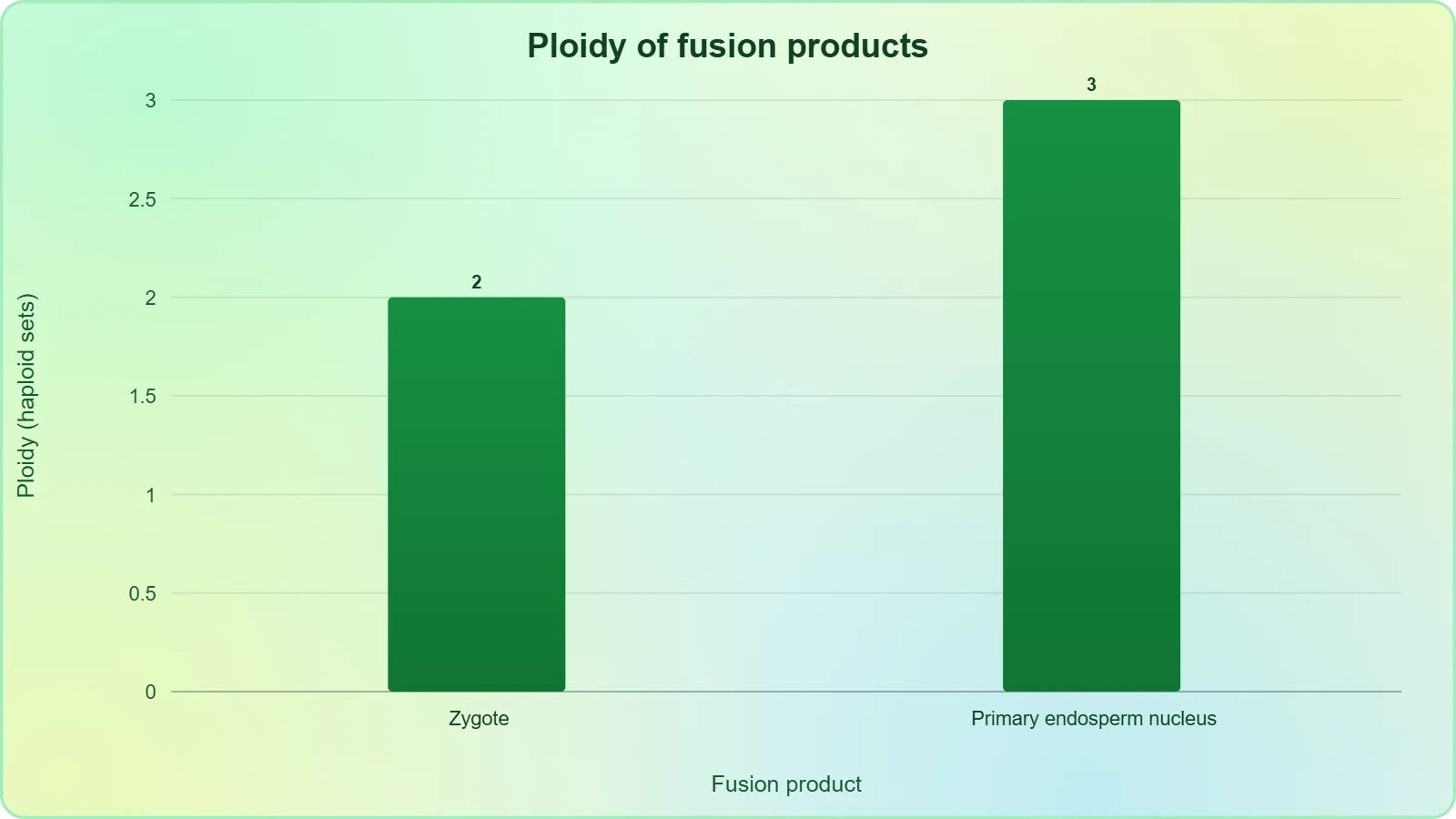
The same logic applies to triple fusion, where the primary endosperm nucleus receives one haploid set from the male gamete and two haploid sets from the polar nuclei. The resulting triploid state is a direct consequence of the three-nucleus fusion, and it is the reason the process is called triple fusion rather than double fusion. Expressing the relationship as an equation makes the arithmetic explicit and reinforces the connection between the cellular events and their genetic outcomes. The diploid zygote and the triploid primary endosperm nucleus are thus the two numerical signatures of double fertilisation, each reflecting the number of haploid nuclei that contributed to its formation.
Dormancy of the Zygote and the Priority of Endosperm
The zygote is dormant for some time in a fertilised ovule, and this dormancy is a deliberate feature of the developmental programme rather than a failure to initiate growth. During this period, the primary endosperm cell is active, forming the endosperm tissue that will nourish the embryo. The dormancy of the zygote therefore serves a clear biological purpose: it allows the nutritive tissue to become established before the embryo begins its own demanding sequence of divisions. This ordering is captured in the statement that formation of endosperm always precedes development of the embryo, a principle that governs the early post-fertilisation development of the seed.
Why the Zygote Waits
The question of why the zygote is dormant for some time in a fertilised ovule has a straightforward developmental answer. The embryo requires a supply of nutrients to sustain its growth, and those nutrients are provided by the endosperm. If the embryo began to develop immediately after syngamy, it would place demands on the ovule before the endosperm had formed, potentially compromising both tissues. By waiting, the zygote allows the endosperm to establish itself as a nutrient reserve. The dormancy is thus a coordination mechanism, ensuring that the two products of double fertilisation develop in the correct sequence and that the seed as a whole is properly provisioned.
This interpretation is consistent with the broader account of post-fertilisation development, in which the developing embryo passes through different stages such as the proembryo, globular and heart-shaped stages before maturation. These stages require a sustained nutrient supply, and the endosperm provides it. The dormancy of the zygote is therefore the temporal bridge between fertilisation and embryogenesis, a pause that aligns the embryo's development with the availability of its food reserve. Understanding this pause helps explain why double fertilisation is not merely two fusions but a coordinated developmental programme in which the timing of each event is as important as the event itself.
From Primary Endosperm Cell to Endosperm Tissue
The primary endosperm cell, containing the triploid primary endosperm nucleus, forms the endosperm tissue. This tissue is the nutritive component of the seed, and its formation is the first major post-fertilisation event. The endosperm develops while the zygote remains dormant, and it is this tissue that will support the embryo through its subsequent stages. The transition from primary endosperm cell to endosperm tissue is therefore a critical step in seed development, and it is directly dependent on the triple fusion that produced the primary endosperm nucleus. Without triple fusion, there would be no primary endosperm nucleus, no primary endosperm cell, and no endosperm to nourish the embryo.
The dependence of endosperm on triple fusion underscores the functional unity of double fertilisation. The two fusions are not independent events that happen to occur in the same embryo sac; they are linked by a shared developmental logic. Syngamy produces the embryo, triple fusion produces its food supply, and the timing of the two ensures that the food supply is ready before the embryo needs it. This unity is what makes double fertilisation a coherent phenomenon rather than a mere coincidence of two fusions. It also explains why the phenomenon is described as unique to flowering plants, since no other plant group coordinates embryo and endosperm formation in this precise way.
Working Through the Evidence: Questions and Structured Reasoning
The study of double fertilisation is best consolidated by working through the kinds of questions that test precise understanding. A representative question asks what triple fusion is, where and how it takes place, and which nuclei are involved. Answering it requires naming the central cell as the site, describing the fusion of the second male gamete with the two polar nuclei, and identifying the three haploid nuclei involved. Another question asks why the zygote is dormant for some time in a fertilised ovule, which requires linking the dormancy to the priority of endosperm formation. These questions are not merely recall exercises; they test the learner's grasp of the causal structure of the process.
Answering the Triple Fusion Question Precisely
A precise answer to the triple fusion question should state that triple fusion is the fusion of one male gamete with the two polar nuclei of the central cell, that it takes place in the central cell of the embryo sac, and that the nuclei involved are the two polar nuclei and one male gamete nucleus. The product is the triploid primary endosperm nucleus, which resides in the primary endosperm cell. The answer should also note that triple fusion occurs alongside syngamy in the same embryo sac, and that the two together constitute double fertilisation. This structure ensures that the answer covers definition, location, mechanism and nuclei, which are the four elements the question demands.
It is worth emphasising the distinction between the two fusions when answering such questions. Syngamy involves the egg cell and one male gamete, producing the diploid zygote, while triple fusion involves the central cell and the other male gamete, producing the triploid primary endosperm nucleus. Confusing the two is a common error, and the comparison table in this lesson is designed to prevent it. The learner should be able to state, without hesitation, that the zygote is diploid and the primary endosperm nucleus is triploid, and should be able to explain why the ploidy differs in terms of the number of haploid nuclei involved.
Connecting Forward to Endosperm, Embryo and Seed
The events described in this lesson set up the next stage of the story. The zygote will develop into the embryo, passing through the proembryo, globular and heart-shaped stages before maturation. The primary endosperm cell will form the endosperm tissue that nourishes the embryo. After fertilisation, the ovary develops into the fruit and the ovules develop into the seeds. The mature dicotyledonous embryo has two cotyledons and an embryonal axis with epicotyl and hypocotyl, while embryos of monocotyledons have a single cotyledon. These outcomes all trace back to the two fusions that occur in the embryo sac, and they are the subject of the next lesson.
Understanding double fertilisation is therefore essential preparation for understanding seed development. The ploidy of the endosperm, the timing of embryo development, and the relationship between the embryo and its nutritive tissue all depend on the events described here. The learner who has grasped syngamy and triple fusion will be well placed to follow the subsequent account of endosperm, embryo and seed formation, and to appreciate how the entire reproductive process of angiosperms is organised around the coordinated double fusion that occurs within the embryo sac.
Going further
Double fertilisation involves two fusion events in the same embryo sac: syngamy and triple fusion. This pairing is the defining feature of the process, and it is why the phenomenon is described as unique to flowering plants. The two fusions are not sequential stages of a single fertilisation but two distinct fertilisations of two different cells, each with its own product and its own developmental fate. Recognising this distinction helps clarify why the term double fertilisation is used rather than simply fertilisation, and it explains why the process is studied as a coordinated whole rather than as two separate events.
The primary endosperm nucleus is triploid because it is formed by the fusion of three haploid nuclei: two polar nuclei from the central cell and one male gamete nucleus. This triploid constitution is a direct consequence of the number of nuclei involved, and it can be verified by simple arithmetic. The zygote, by contrast, is diploid because it is formed by the fusion of two haploid nuclei. These ploidy relationships are the numerical expression of the two fusions, and they provide a compact way of summarising the genetic outcomes of double fertilisation. They also connect the cellular events to the broader study of inheritance and seed development.
Consolidating the Lesson: From Fusion to Seed
The lesson has traced the path from the discharge of two male gametes into a synergid to the formation of the diploid zygote and the triploid primary endosperm nucleus. It has established that double fertilisation consists of syngamy and triple fusion occurring in the same embryo sac, that the zygote develops into the embryo while the primary endosperm cell forms the endosperm tissue, and that formation of endosperm always precedes development of the embryo. It has also explained why the zygote is dormant for a time and how the ploidy of each product follows from the number of haploid nuclei involved. These points together provide a complete account of the events that immediately follow compatible pollination.
Summary of the Core Sequence
The core sequence can be stated compactly. Following compatible pollination, the pollen grain germinates on the stigma, the pollen tube grows through the style and enters the ovules, and it discharges two male gametes in one of the synergids. One male gamete fuses with the egg cell in syngamy, forming the diploid zygote. The other fuses with the two polar nuclei in triple fusion, forming the triploid primary endosperm nucleus in the primary endosperm cell. Because both fusions take place in an embryo sac, the phenomenon is called double fertilisation. The zygote develops into the embryo, the primary endosperm cell forms the endosperm, and after fertilisation the ovary develops into fruit and the ovules into seeds.
This sequence is the backbone of the lesson, and each element should be reproducible without reference to notes. The learner should be able to name the parts of the embryo sac involved, state the ploidy of each product, explain the relationship between the two fusions, and describe the developmental consequences. The comparison tables and the glossary in this lesson are designed to support that recall, while the "Going further" block provides the additional background that connects the events to broader themes in plant biology. Mastery of this sequence prepares the learner for the next lesson, which takes up the post-fertilisation development of endosperm, embryo and seed in detail.
Preparing for the Next Lesson
The next lesson examines post-fertilisation development: the formation of endosperm, the stages of embryo development, and the maturation of the seed. The developing embryo passes through the proembryo, globular and heart-shaped stages before maturation, and the mature dicotyledonous embryo has two cotyledons and an embryonal axis with epicotyl and hypocotyl, while embryos of monocotyledons have a single cotyledon. These details build directly on the foundation laid here, since the endosperm that nourishes the embryo is the tissue derived from the primary endosperm cell produced by triple fusion. The learner who understands double fertilisation will find the subsequent account of seed development coherent and well motivated.
Beyond the immediate sequence, the lesson also connects to broader themes such as apomixis and polyembryony, which are treated elsewhere in the course. Apomixis results in the formation of seeds without fertilisation and has advantages in horticulture and agriculture, while polyembryony refers to the production of more than one embryo in a seed. These phenomena are best understood against the background of normal sexual reproduction, which is why the detailed account of double fertilisation provided here is essential. With the two fusions firmly understood, the learner is equipped to appreciate both the normal pathway and the variations that occur in special cases.
Also Read
- No links available.
From our network :
- EV 2.0: The Solid-State Battery Breakthrough and Global Factory ExpansionDiscover the impact of the Solid-State Battery Breakthrough on the EV market. Learn about CATL and BYD stock growth, global factory expansion in Europe, and the future of EV 2.0 technology.
- Mastering DB2 12.1 Instance Design: A Technical Deep Dive into Modern Database ArchitectureComprehensive guide to DB2 12.1 Instance Design. Explore architectural components, HADR setup, buffer pool tuning, and security policies for IBM DB2 12.1. Includes 10 functional SQL and Shell samples.
- Vite 6/7 'Cold Start' Regression in Massive Module GraphsIn-depth analysis of Vite 6/7 cold start regressions in massive module graphs. Learn about barrel file issues, pre-bundling optimizations, and how to improve Vite dev server performance.
- Trump Political Strategy How Geopolitical Stunts Serve As Media Diversions
- 98% of Global MBA Programs Now Prefer GRE Over GMAT Focus EditionExplore why 98% of global MBA programs now prefer the GRE over GMAT Focus. Learn about the shorter GRE format, verbal logic importance, and strategic versatility for students.
- 10 Physics Numerical Problems with Solutions for IIT JEEPrepare for IIT JEE with 10 physics numerical problems, complete with detailed solutions and conceptual explanations. Ideal for mastering kinematics, thermodynamics, electromagnetism, and optics.
- Analyzing Trump Deportation Numbers Insights Into The 2026 Immigration Crackdown
- AI-Powered 'Precision Diagnostic' Replaces Standard GRE Score ReportsDiscover the new GRE Precision Diagnostic. Learn how AI-powered behavioral analytics and time-to-solve tracking are replacing standard GRE score reports to empower students.
- Mastering DB2 LUW v12 Tables: A Comprehensive Technical GuideComprehensive guide on DB2 LUW v12 tables. Explore CREATE TABLE syntax, BLU Acceleration, range partitioning, data types, and security features for IBM DB2 LUW v12.
RESOURCES
- Double Fertilization in Angiosperms - YouTubeyoutube.comApr 12, 2011 ... This animation explains the double fertilization process in flowering plants (Angiosperms). It was created as a co-production between the ...
- Double fertilization | Definition, Angiosperm, Results In ... - Britannicabritannica.com5 days ago ... In flowering plants, double fertilization involves two sperm cells from a pollen tube. One sperm fertilizes the egg cell, forming…
- 32.7: Pollination and Fertilization - Double Fertilization in Plantsbio.libretexts.org1 : Double fertilization: In angiosperms, one sperm fertilizes the egg to form the 2n zygote, while the other sperm fuses with two polar…
- Double fertilization - Wikipediaen.wikipedia.orgThis process involves the fusion of a female gametophyte or megagametophyte, also called the embryonic sac, with two male gametes (sperm). It begins when…
- Green love talks; cell–cell communication during double fertilization ...pmc.ncbi.nlm.nih.govFlowering plants (angiosperms) have evolved a unique fertilization process, called 'double fertilization'. Two sperm cells fertilize two female gametophytic ...
- Double Fertilization In Angiosperms - BYJU'Sbyjus.comWhat is Double Fertilization? Double fertilization is a chief trait of flowering plants. In the phenomena, one female gamete unites with two male gametes.
- Some reflections on double fertilization, from its discovery to the ...nph.onlinelibrary.wiley.comJul 25, 2003 ... Recent investigations in angiosperms describe the cell biology and nuclear cytology of double fertilization and the successful in vitro ...
- Twice the fun, double the trouble: gamete interactions in flowering ...pubmed.ncbi.nlm.nih.gov... double fertilization. The molecular and evolutionary characteristics of these players prove that flowering plants integrate plant-specific and widely ...
- Mechanisms Supporting Successful Double Fertilization ... - Frontiersfrontiersin.orgEmbryo production through the union of egg and sperm is a fundamental system for the birth of progeny in animals and plants. Flowering plants…
- Double Fertilization - Macmillan Learningmacmillanlearning.comDouble fertilization, in which a diploid zygote and a triploid endosperm form, is a characteristic unique to angiosperms (flowering plants). Gymnosperms ...
- Biologists discover gene behind 'plant sex mystery' - EurekAlert!eurekalert.orgOct 22, 2008 ... Double fertilisation is essential for fertility and seed production in flowering plants so increased understanding of the process is important.
- Double Fertilisation | CK-12 Foundationflexbooks.ck12.orgNov 1, 2026 ... Fertilisation in flowering plants occurs only after compatible pollination, ensured through pollen–pistil interaction. The pollen grain ...
- From pollen tube discharge to pronuclear union in Arabidopsisacademic.oup.comJul 22, 2026 ... 2022). Two-panel diagram illustrating double fertilization stages in flowering plants. Panel A shows a. Figure 1. Evidence ...
- How would you describe the process of double fertilization ... - Quoraquora.comDouble fertilization is a chief trait of flowering plants. In the phenomena, one female gamete unites with two male gametes. One of the male…
- Double fertilization in flowering plants: Discovery, study methods ...sciencedirect.comOnce the pollen tube has reached the embryo sac, it releases the two male gametes into a degenerated synergid. One fuses with the egg…