Every meal on this planet, whether it arrives on a porcelain plate or is consumed quietly in a forest canopy, can be traced back to a single physico-chemical process: photosynthesis. Green plants do not merely survive by finding food; they manufacture it, using light energy to drive the synthesis of organic compounds from simple inorganic raw materials. This capacity to synthesise their own nourishment places them in a category of their own, and it is the reason the rest of the living world, human beings included, can exist at all. Understanding this foundational relationship is the first step towards understanding the photosynthetic machinery itself.
The distinction between organisms that make their own food and those that depend on others is one of the most consequential ideas in biology. Green plants, through photosynthesis, are called autotrophs, while all other organisms that depend on green plants for food are heterotrophs. This lesson establishes that relationship in clear terms, explains why photosynthesis is important for two specific reasons, and sets the stage for the structural and biochemical detail that follows in later lessons. The emphasis here is on the ecological logic of the process before the machinery is examined.
Because this is the opening lesson of the course, it deliberately stays close to the broad picture. It asks where plants get their food, why sunlight is the ultimate energy source for all living forms on earth, and what would happen if the oxygen released by green plants were suddenly absent. These questions frame the entire course, which goes on to examine the structure of the photosynthetic machinery and the various reactions that transform light energy into chemical energy. The groundwork laid here will be assumed in every subsequent lesson.
On This Page
Autotrophs and Heterotrophs: The Fundamental Division
The living world divides, at its most basic level, into organisms that produce their own food and organisms that must obtain it from elsewhere. Green plants make or rather synthesise the food they need through photosynthesis and are therefore called autotrophs. All animals, including human beings, depend on plants for their food, and all other organisms that depend on green plants for food are heterotrophs. This division is not a matter of preference or habitat but of biochemical capability: only organisms with the photosynthetic apparatus can perform this synthesis, and everything else must draw its energy from what those organisms produce.
The Meaning of Autotrophic Nutrition
Autotrophic nutrition is found only in plants, and it is defined by the ability to synthesise food rather than to seek it. The green plant does not wander in search of nourishment; it constructs its own organic compounds using light energy, and in doing so it becomes the nutritional foundation for the organisms around it. This is why the term autotroph, meaning self-feeding, captures the essence of the plant's position in the living world. The plant's food-making capacity is not a private advantage but a public service to the entire ecosystem.
It is worth pausing on how unusual this arrangement is. Most organisms are consumers in some form, and their survival is contingent on the productivity of others. The autotroph alone stands at the beginning of the food chain, converting energy into a form that can be passed along. When we say that green plants synthesise their food, we are describing the origin point of every food chain on land and in water. The rest of this course examines precisely how that synthesis is accomplished.
Why Heterotrophs Depend on Plants
All animals, including human beings, depend on plants for their food, and this dependence is direct or indirect in every case. A grazing animal consumes plant material directly; a predator consumes the animal that grazed; a decomposer breaks down the remains of either. In each case, the energy originally captured by a green plant is being transferred. The heterotroph cannot create this energy from sunlight; it can only receive what the autotroph has already converted into organic compounds. This is the sense in which all other organisms depend on green plants for their needs.
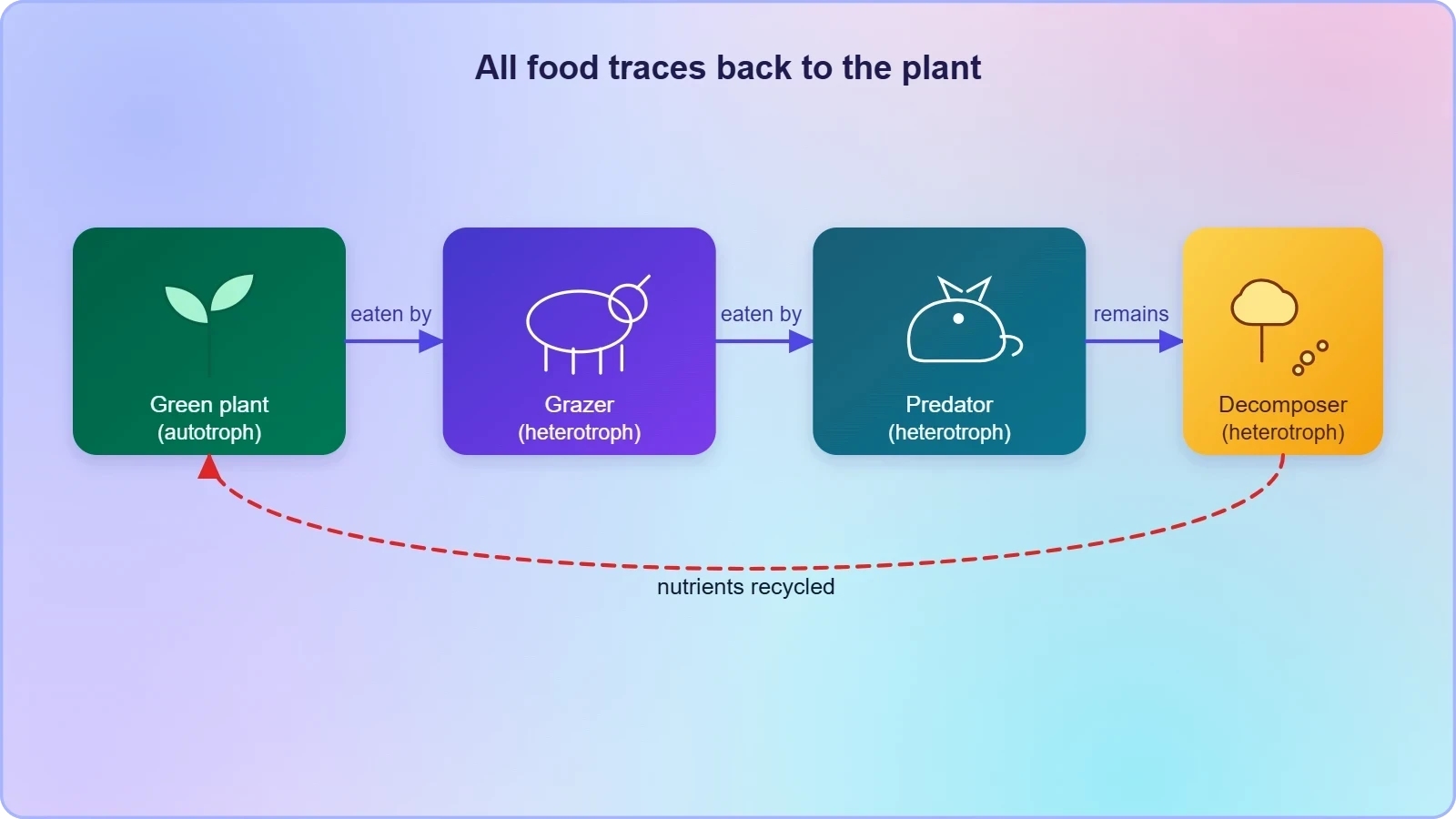
The dependence extends beyond food to the very air we breathe. Green plants are responsible for the release of oxygen into the atmosphere, and that oxygen is the same gas animals require for respiration. A heterotroph therefore relies on plants twice over: for the organic matter it eats and for the oxygen it breathes. These two dependencies are linked to the same process, which is why photosynthesis occupies such a central place in the study of life. The next sections examine why this dual role makes the process so important.
Photosynthesis as a Physico-Chemical Process
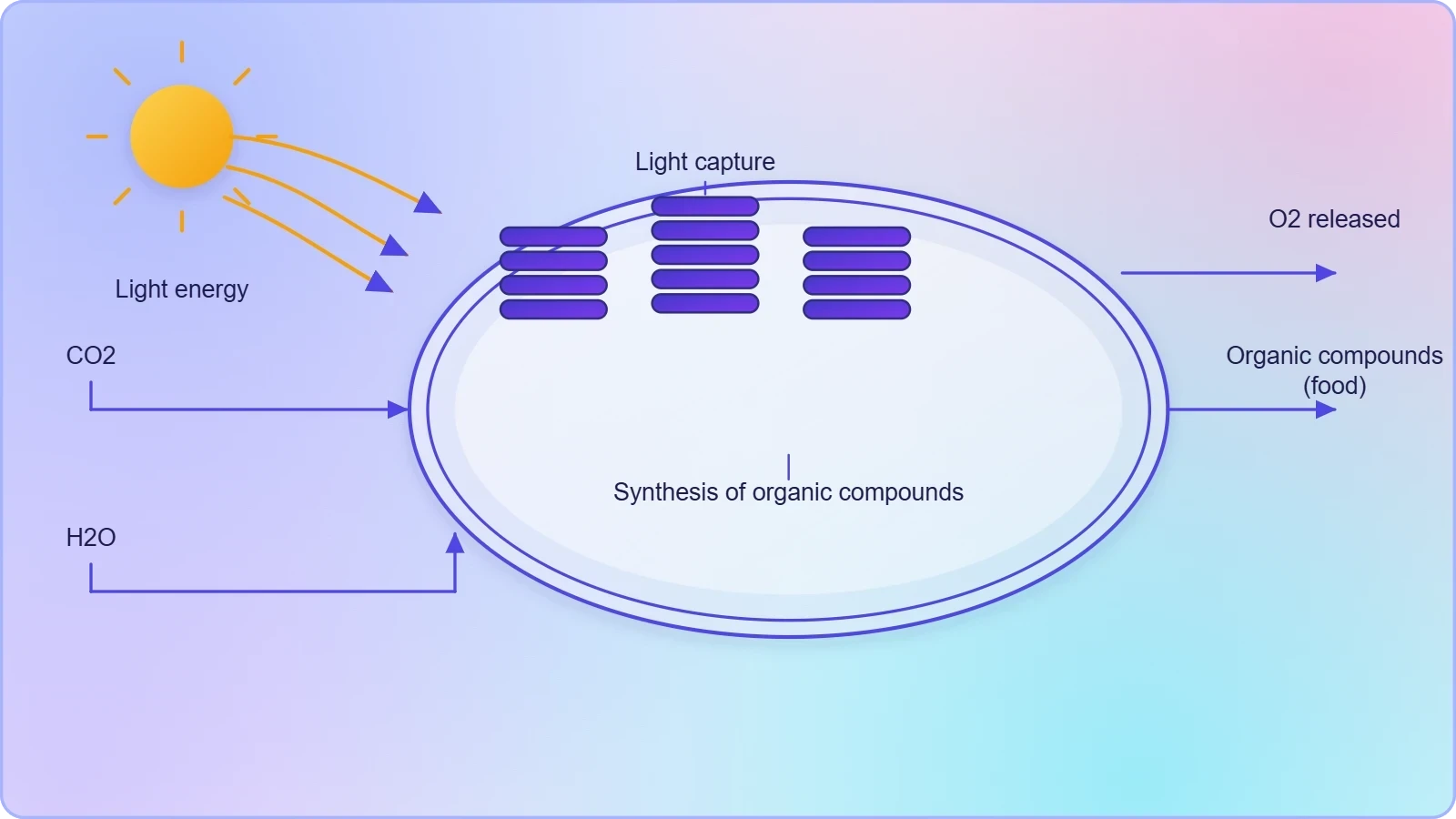
Green plants carry out photosynthesis, a physico-chemical process by which they use light energy to drive the synthesis of organic compounds. The phrase is carefully chosen: the process is physical in that it involves the capture of light, and chemical in that it builds new molecules from simpler ones. It is not a single reaction but a coordinated sequence, and the course will later trace that sequence from the absorption of light to the formation of carbohydrate. For now, the essential point is that light energy is the driving force and organic compounds are the product.
Light Energy Driving Synthesis
The synthesis of organic compounds requires energy, and photosynthesis obtains that energy from sunlight rather than from pre-existing chemical bonds. This is what distinguishes the process from ordinary metabolism: the plant is not releasing energy from food but storing it, using light as the input. The organic compounds produced become the energy currency that heterotrophs later spend. In this sense, photosynthesis is the reverse of respiration in its energy logic, capturing and storing rather than releasing and consuming.
The physico-chemical description also reminds us that the process can be studied at the level of molecules and energy transfers. Light is absorbed, electrons are moved, and chemical bonds are formed, all within the structured environment of the chloroplast. Later lessons will examine the pigments that absorb light, the electron transport chain that moves electrons, and the reactions that fix carbon. The present lesson establishes only that light energy is the driver and organic synthesis the outcome, which is the conceptual frame for everything that follows.
Sunlight as the Ultimate Energy Source
Ultimately, all living forms on earth depend on sunlight for energy. This statement is broader than it first appears, because it includes organisms that never see the sun directly. A deep-sea creature, a soil bacterium, a human being in a city, all draw their energy from organic compounds whose energy was originally captured from sunlight by a photosynthetic organism. The use of energy from sunlight by plants doing photosynthesis is the basis of life on earth. The food chain is, at bottom, a chain of energy transfers that begins with light.
This is why photosynthesis is described as the basis of life rather than merely one process among many. Without the capture of light energy and its conversion into chemical form, there would be no organic matter to eat and no oxygen to breathe. The dependence is absolute and universal. The course will later examine the machinery that makes this capture possible, but the ecological significance is already clear: sunlight, mediated by green plants, sustains the living world.
Two Reasons Photosynthesis Is Important
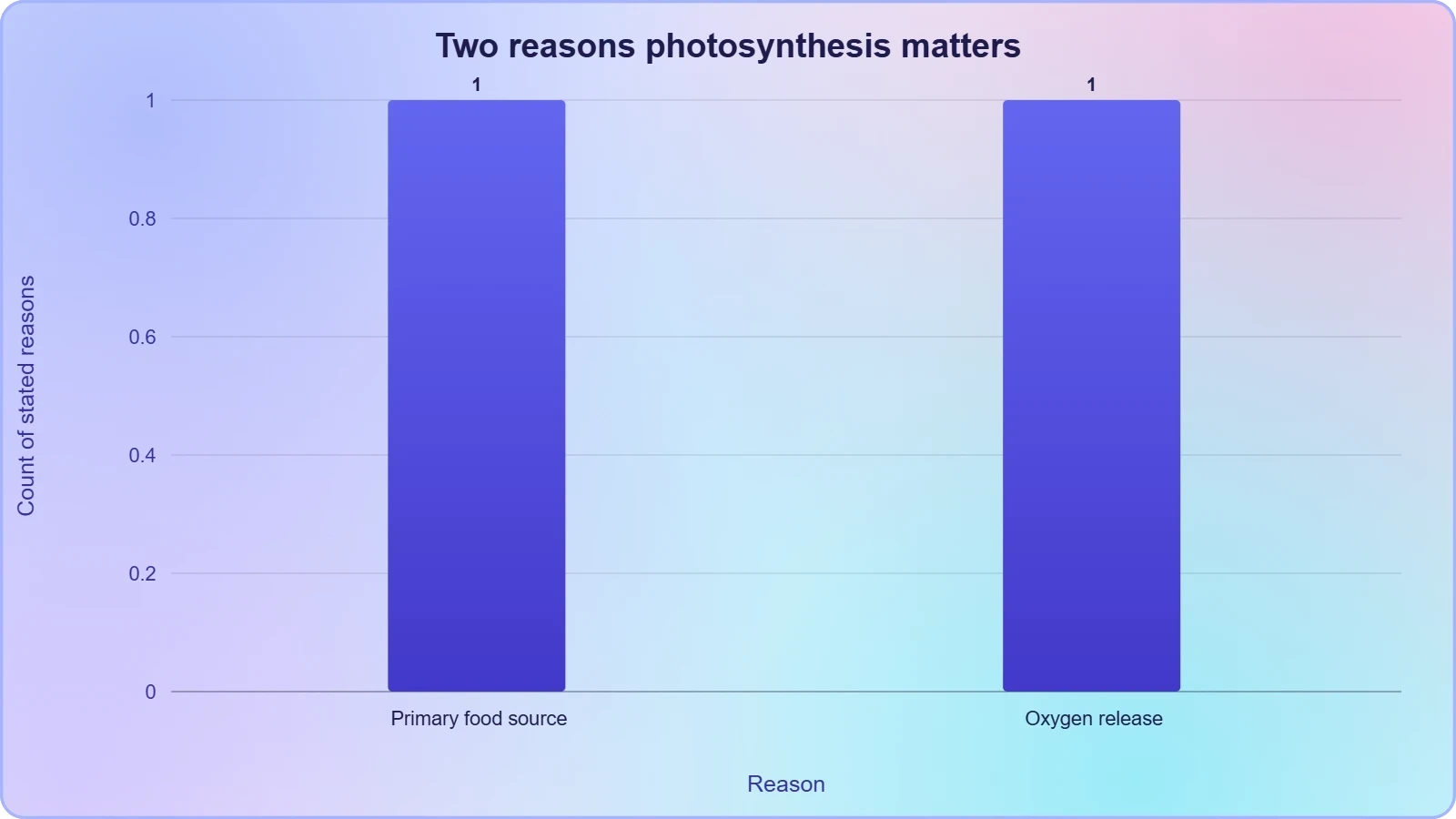
Photosynthesis is important due to two reasons, and the material states them plainly. First, it is the primary source of all food on earth. Second, it is responsible for the release of oxygen into the atmosphere by green plants. These two reasons correspond to the two great dependencies of heterotrophic life: the need for organic matter and the need for oxygen. Keeping them distinct helps clarify why the process matters, and it also anticipates the two sides of the photosynthetic reaction that later lessons will examine in detail.
The Primary Source of All Food
Every food chain begins with the organic compounds that green plants synthesise. Whether one eats rice, bread, fruit, meat, or fish, the energy in that food was originally captured from sunlight by a photosynthetic organism. The plant's synthesis is therefore the primary source of all food on earth, not one source among several. Heterotrophs do not create food; they consume, transform, and pass along what plants have already made. This is the first and most direct reason for the importance of photosynthesis.
The word primary deserves attention. It signals that the plant's production is not merely early in the chain but foundational to it. Remove the primary source and the rest of the chain collapses, because no amount of consumption can create new organic matter. The productivity of green plants sets the ceiling on the productivity of everything that feeds on them. This is why the study of photosynthesis is, in a real sense, the study of the limits and possibilities of life on earth.
The Release of Oxygen into the Atmosphere
The second reason is that photosynthesis is responsible for the release of oxygen into the atmosphere by green plants. This oxygen is the same gas that animals need for respiration, and the material asks the reader to consider what would happen if there were no oxygen to breathe. The question is rhetorical but pointed: the atmosphere we inhabit is, in large part, a product of plant activity. The oxygen released during photosynthesis is not a by-product of minor consequence but a condition of animal life.
The two reasons are linked because they arise from the same process. The plant captures light, synthesises organic compounds, and releases oxygen, and heterotrophs depend on both the compounds and the gas. This dual dependence explains why photosynthesis is treated as the basis of life rather than as a single topic within plant biology. The next lesson turns to the evidence: what we know about photosynthesis, and how chlorophyll, light, and carbon dioxide were established as its requirements.
The Question of Oxygen and Breathable Air
The material poses a direct question: what would happen if there were no oxygen to breathe? The question is designed to make the second reason for photosynthesis concrete. Oxygen is not an abstract product of plant chemistry; it is the gas that fills the atmosphere and sustains respiration in animals. By linking photosynthesis to the air we breathe, the material establishes that the process is not confined to the leaf but shapes the conditions of life on a planetary scale. This is a point worth dwelling on before the course turns to mechanism.
Oxygen as a Product of Plant Activity
Green plants are responsible for the release of oxygen into the atmosphere, and this release is a consequence of the photosynthetic process itself. The oxygen is produced as the plant captures light energy and drives the synthesis of organic compounds. It is not manufactured for the benefit of animals; it is simply released, and animals happen to require it. The atmosphere's oxygen content is therefore a record of plant activity over vast stretches of time, and the breathable air we take for granted is a biological product.
This perspective reframes the relationship between plants and animals. Animals are not independent inhabitants of the atmosphere but dependents of the organisms that produced it. The oxygen in a lungful of air was released by green plants, and the carbon in a meal was fixed by them. Recognising this dependence is part of understanding why photosynthesis is the basis of life. The course will later examine the light reaction and electron transport that make the release of oxygen possible, but the ecological point is already established here.
Why the Question Is Worth Asking
The question of what would happen without oxygen is worth asking because it converts an abstract fact into a felt dependence. Most people know that plants produce oxygen, but the knowledge often remains inert until it is connected to the act of breathing. The material uses the question to make that connection explicit. If there were no oxygen to breathe, animal life as we know it would cease, and the cause would be the failure of a process carried out by green plants. The question thus ties the lesson to the reader's own body.
There is also a scientific reason for asking. The oxygen released by photosynthesis is a product of the reactions that later lessons will describe, and understanding its origin requires understanding those reactions. The question therefore serves as a bridge from the ecological significance of photosynthesis to its mechanism. It invites the learner to move from appreciating the process to examining how it works, which is precisely the direction the course takes in the lessons that follow.
From Significance to Mechanism: What Comes Next
Having established why photosynthesis matters, the course turns to the structure of the photosynthetic machinery and the various reactions that transform light energy into chemical energy. This is the stated focus of the material, and it defines the path of the remaining lessons. The next lesson asks what we already know about photosynthesis, drawing on simple experiments that established chlorophyll, light, and carbon dioxide as requirements. From there the course moves to where photosynthesis takes place, the pigments involved, the light reaction, electron transport, the uses of ATP and NADPH, the C4 pathway, photorespiration, and the factors affecting photosynthesis.
Preparing for Chlorophyll, Light and CO2
The next lesson builds directly on the present one. It begins with what we already know: that chlorophyll, the green pigment of the leaf, light, and carbon dioxide are required for photosynthesis to occur. Simple experiments, such as testing variegated leaves or leaves partially covered with black paper for starch formation, showed that photosynthesis occurred only in the green parts of the leaves in the presence of light. These observations are the empirical foundation on which the rest of the course rests, and they follow naturally from the question of how plants make their food.
The transition is logical because the present lesson has established that plants synthesise food using light, while the next lesson asks what evidence supports that claim and what specific factors are involved. The learner moves from the why to the what and then, in later lessons, to the where and the how. Keeping this sequence in mind helps the learner see each lesson as part of a single argument rather than a collection of separate topics. The course is designed to be followed in order.
How This Lesson Fits the Course
This opening lesson occupies a specific place in the course: it establishes the ecological and conceptual frame within which the machinery will be studied. It does not describe the chloroplast, the pigments, or the electron transport chain, because those belong to later lessons. Instead it defines autotrophs and heterotrophs, states the two reasons photosynthesis is important, and connects the process to sunlight, food, and breathable air. Every subsequent lesson assumes this frame, and the learner who has grasped it will find the technical material easier to place.
The course as a whole follows the material's order of ideas, from the role of chlorophyll, light, and carbon dioxide through the Z scheme, chemiosmosis, and the Calvin cycle to Kranz anatomy and Blackman's Law of Limiting Factors. This lesson is the first step in that sequence, and its purpose is to make the rest of the sequence meaningful. A learner who understands why photosynthesis matters is better prepared to understand how it works, and that is the aim of the lesson.
Going Further
The term autotroph is a general biological term for an organism that makes its own food from inorganic substances, and photosynthetic plants are one kind of autotroph. Other kinds exist, such as certain bacteria that use chemical energy rather than light, but the plants described in this course are the photosynthetic variety. Recognising the general category helps place the green plant within a wider biological scheme without altering the specific definition used here: green plants synthesise their food through photosynthesis and are therefore called autotrophs.
Oxygen, Respiration and the Wider Picture
The oxygen released by photosynthesis is the same gas that animals need for respiration, which is why the material links photosynthesis to breathable air. This is a useful connection to carry into later study, because it shows that the two processes, photosynthesis and respiration, are complementary in the living world. The plant releases oxygen and synthesises organic compounds; the animal consumes oxygen and breaks down organic compounds. The cycle that results is one of the broadest patterns in biology, and it begins with the light-driven synthesis described in this course.
Keeping this wider picture in mind can make the technical lessons easier to follow. When the course later examines the light reaction and the release of oxygen, the learner will already know why that release matters. When it examines the Calvin cycle and the synthesis of organic compounds, the learner will already know who depends on those compounds. The significance established in this lesson is not decoration around the mechanism; it is the reason the mechanism is worth studying.
Consolidating the Lesson
The lesson can be reduced to a small set of connected claims. Green plants synthesise their own food through photosynthesis and are called autotrophs. All other organisms that depend on green plants for food are heterotrophs. Photosynthesis is a physico-chemical process by which light energy drives the synthesis of organic compounds. It is important for two reasons: it is the primary source of all food on earth, and it is responsible for the release of oxygen into the atmosphere by green plants. These claims form the frame within which the rest of the course operates.
A Short Self-Check
A learner preparing for the next lesson should be able to state these claims without hesitation and explain the connection between them. Why does the dependence of heterotrophs on plants follow from the definition of autotrophs? Why are food and oxygen described as two separate reasons rather than one? What does it mean to call photosynthesis a physico-chemical process? Answering these questions confirms that the conceptual frame is in place. The next lesson then asks what we know about the requirements of the process, beginning with chlorophyll, light, and carbon dioxide.
It is also useful to connect the lesson to the course description. The course follows the material's account of photosynthesis in higher plants, from the role of chlorophyll, light, and carbon dioxide through the Z scheme, chemiosmosis, and the Calvin cycle to Kranz anatomy and Blackman's Law of Limiting Factors. This first lesson supplies the reason for that journey. Without the significance established here, the machinery would be a collection of details; with it, the details become the explanation of how life on earth is sustained.
Looking Ahead to Lesson 2
The next lesson, What Do We Know? Chlorophyll, Light and CO2, turns from significance to evidence. It examines the simple experiments that established chlorophyll, light, and carbon dioxide as requirements for photosynthesis, including the starch test on variegated leaves and leaves partially covered with black paper. Those experiments showed that photosynthesis occurred only in the green parts of the leaves in the presence of light. The present lesson has prepared the ground for that evidence by explaining why the process matters; the next lesson begins the work of showing how we know what we know.
Learners should arrive at Lesson 2 ready to think about requirements rather than consequences. The question shifts from why photosynthesis matters to what it needs in order to occur. This shift is the beginning of the course's technical content, and it will be followed by questions of location, pigment, light reaction, electron transport, and carbon fixation. Each lesson builds on the one before, and the sequence is designed to be followed in order. The frame established here will be assumed throughout.
Also Read
- No links available.
From our network :
- Trump Political Strategy How Geopolitical Stunts Serve As Media Diversions
- 10 Physics Numerical Problems with Solutions for IIT JEEPrepare for IIT JEE with 10 physics numerical problems, complete with detailed solutions and conceptual explanations. Ideal for mastering kinematics, thermodynamics, electromagnetism, and optics.
- Analyzing Trump Deportation Numbers Insights Into The 2026 Immigration Crackdown
- Vite 6/7 'Cold Start' Regression in Massive Module GraphsIn-depth analysis of Vite 6/7 cold start regressions in massive module graphs. Learn about barrel file issues, pre-bundling optimizations, and how to improve Vite dev server performance.
- EV 2.0: The Solid-State Battery Breakthrough and Global Factory ExpansionDiscover the impact of the Solid-State Battery Breakthrough on the EV market. Learn about CATL and BYD stock growth, global factory expansion in Europe, and the future of EV 2.0 technology.
- 98% of Global MBA Programs Now Prefer GRE Over GMAT Focus EditionExplore why 98% of global MBA programs now prefer the GRE over GMAT Focus. Learn about the shorter GRE format, verbal logic importance, and strategic versatility for students.
- AI-Powered 'Precision Diagnostic' Replaces Standard GRE Score ReportsDiscover the new GRE Precision Diagnostic. Learn how AI-powered behavioral analytics and time-to-solve tracking are replacing standard GRE score reports to empower students.
- Mastering DB2 LUW v12 Tables: A Comprehensive Technical GuideComprehensive guide on DB2 LUW v12 tables. Explore CREATE TABLE syntax, BLU Acceleration, range partitioning, data types, and security features for IBM DB2 LUW v12.
- Mastering DB2 12.1 Instance Design: A Technical Deep Dive into Modern Database ArchitectureComprehensive guide to DB2 12.1 Instance Design. Explore architectural components, HADR setup, buffer pool tuning, and security policies for IBM DB2 12.1. Includes 10 functional SQL and Shell samples.
RESOURCES
- Resources will be updated soon.