Breathing is the most ordinary act of a living body, yet it conceals one of biology's most elegant arguments. Every inhalation delivers oxygen, every exhalation removes carbon dioxide, and between those two events a quiet chemistry unfolds that powers absorption, transport, movement, reproduction and even the act of breathing itself. The opening chapter of plant respiration begins precisely here, with a deceptively simple question: why is breathing so essential to life, and what actually happens when an organism breathes? The answer, as the chapter shows, is that breathing is inseparable from the release of energy from food.
That connection deserves careful attention because it reframes respiration as something far richer than a mechanical exchange of gases. All living organisms require energy for their daily activities, and all of that energy is obtained by the oxidation of certain macromolecules collectively called food. Green plants and cyanobacteria manufacture their own food through photosynthesis, trapping light energy and converting it into chemical energy stored in the bonds of carbohydrates such as glucose, sucrose and starch. Animals, by contrast, are heterotrophic and must obtain food from plants. The lesson that follows traces this logic step by step, establishing the foundation on which glycolysis, fermentation and aerobic respiration will later be built.
This first lesson of the course therefore sets the conceptual stage rather than rushing toward biochemical detail. It examines why energy is non-negotiable for life, how the term food is defined in a respiratory sense, how photosynthesis supplies that food, and why even a fully green plant cannot escape the need for oxidation in its non-green tissues. Along the way, the discussion clarifies a point that often confuses learners: plants do not eat, yet they still respire, and microbes follow the same fundamental rule. By the end, the reader should see breathing not as an isolated reflex but as the visible edge of a continuous energy economy.
On This Page
- The Universal Demand for Energy in Living Systems
- Food Defined by Oxidation, Not by Diet
- Plants, Animals and Microbes: Three Routes to the Same Chemistry
- From Food to Usable Energy: Setting Up the Respiratory Question
- Going Further: Background That Supports the Chapter
- Consolidating the Lesson: A Short Self-Check
The Universal Demand for Energy in Living Systems
Every organism, whether a towering tree, a microscopic bacterium or a human reader, spends energy continuously. The chapter lists the activities that consume it: absorption, transport, movement, reproduction and breathing itself. None of these processes is optional for a living system, and none can proceed without a steady supply of usable energy. This universality is the first principle of respiration, and it applies with equal force to plants, animals and microbes. Recognising that all life draws on the same energetic currency prepares the learner for the molecular machinery that will occupy the rest of the course.
Why No Living Organism Is Exempt
The chapter poses the question directly: do all living organisms, including plants and microbes, breathe? The implied answer is yes, though the mechanisms differ. A plant does not possess lungs or a diaphragm, yet its cells oxidise food exactly as animal cells do. Micro-organisms likewise satisfy their energy requirements through oxidation, even when their food sources look nothing like a meal. The lesson's insistence on this point matters because learners often assume that green, self-feeding organisms are somehow exempt from respiration. They are not, and the reasoning behind that claim becomes clearer once photosynthesis is examined closely.
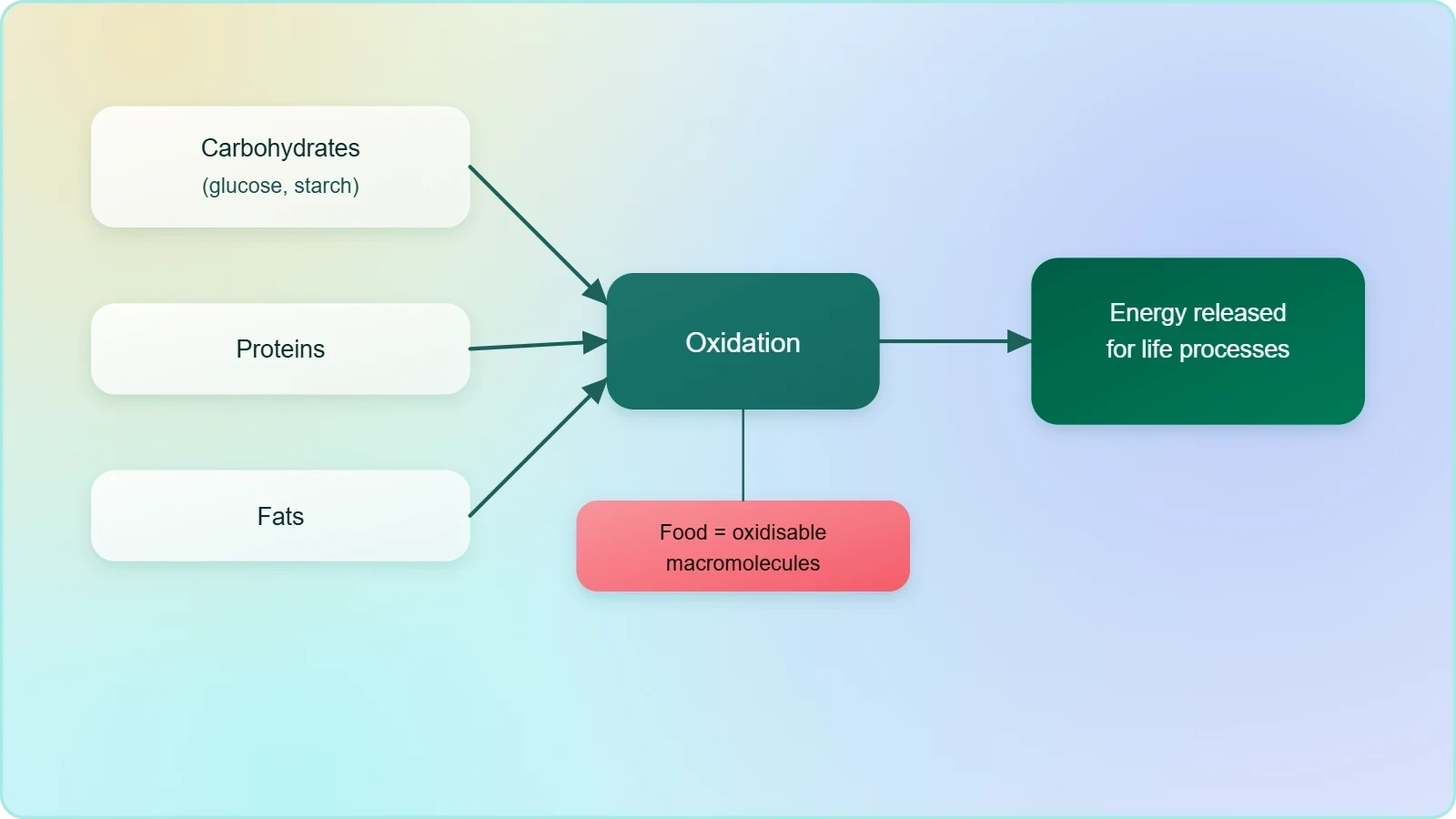
Energy, in this framework, is not a vague vital force but a quantity released through chemical change. The chapter states plainly that all energy for life processes is obtained by oxidation of macromolecules called food. Oxidation here means the controlled removal of electrons and hydrogen, releasing energy that the cell can capture and spend. The learner should hold onto the word oxidation, because it recurs throughout glycolysis, the Krebs cycle and the electron transport system. For now, the essential idea is that life runs on a chemical transaction, and breathing is the organism's way of keeping that transaction supplied.
Breathing as the Visible Edge of a Hidden Process
Breathing appears simple from the outside, but the chapter warns that the questions it raises may seem disconnected. Why do we eat? How is energy taken from food? Do all foods yield the same energy? Do plants eat? These queries look unrelated until the unifying thread is revealed: breathing is very much connected to the release of energy from food. The lesson's task is to weave these threads together so that the learner sees one continuous story rather than a list of separate facts. That narrative coherence is what makes the subsequent biochemistry intelligible.
Once the connection is established, respiration can be defined as the oxidative release of energy from food, with breathing serving as the gas-exchange process that supports it in aerobic organisms. The chapter does not yet introduce the full equation, but the direction of travel is clear. Oxygen enters, food is oxidised, energy is released, and carbon dioxide leaves. Each later lesson fills in a stage of this pathway, from the splitting of glucose in the cytoplasm to the final transfer of electrons to oxygen. The opening lesson supplies the destination; the rest supply the route.
Food Defined by Oxidation, Not by Diet
The chapter's definition of food is functional rather than culinary. Food refers to macromolecules that can be oxidised to release energy for life processes. This definition deliberately sidesteps the human notion of meals and applies equally to a glucose molecule inside a leaf and a sugar molecule inside a bacterium. Once food is understood this way, several of the chapter's opening questions resolve themselves. Plants do not eat in the animal sense, yet they possess food because photosynthesis manufactures oxidisable carbohydrates. Micro-organisms likewise acquire or synthesise molecules that can be oxidised, and their energy requirements are met by the same fundamental chemistry.
Photosynthesis as the Original Source of Food
Green plants and cyanobacteria prepare their own food through photosynthesis. The chapter describes this process as the trapping of light energy and its conversion into chemical energy stored in the bonds of carbohydrates such as glucose, sucrose and starch. The phrase stored in the bonds is important, because it locates energy in molecular structure rather than in some intangible essence. When those bonds are later broken through oxidation, the stored energy becomes available for cellular work. Photosynthesis therefore builds the energy reservoir, and respiration draws from it, forming a partnership that sustains nearly every ecosystem on the planet.
The chapter also notes that photosynthesis is not a whole-plant affair. Only cells containing chloroplasts carry out the process, and those cells are most often located in the superficial layers of the plant body. This anatomical detail has consequences that the next subsection explores. For now, the key point is that the green parts of a plant are the factories, while the non-green parts are consumers. The distinction between producer tissues and consumer tissues within a single organism is one of the chapter's most instructive observations, and it explains why translocation is biologically necessary.
Why Non-Green Tissues Still Need Food
Even in a vigorously photosynthesising plant, not all cells, tissues and organs are green. Roots, internal stem tissues, flowers, fruits and seeds generally lack chloroplasts, yet they are alive and therefore require energy. The chapter states the consequence plainly: all other organs, tissues and cells that are non-green need food for oxidation, and food must be translocated to them. This single sentence dismantles the misconception that plants are energetically self-sufficient everywhere. A plant is a divided economy, with photosynthetic regions exporting carbohydrate to respiratory regions that cannot manufacture their own supply.
Translocation, the movement of food through the plant, thus becomes an energy-dependent service in its own right. The chapter lists transport among the activities that consume energy, and the non-green tissue problem illustrates why. Sugars produced in illuminated leaves must travel to roots and storage organs, and that movement requires metabolic investment. Learners should appreciate the circularity here: energy is needed to move the food that will later release energy. This interdependence reinforces the lesson's central claim that breathing, transport and oxidation are linked rather than separate phenomena, and it prepares the ground for the respiratory substrates discussed next.
Plants, Animals and Microbes: Three Routes to the Same Chemistry
The chapter moves from plants to animals with a single, decisive sentence: animals are heterotrophic, meaning they obtain food from plants. This contrast establishes the two great nutritional strategies of the living world. Autotrophs, including green plants and cyanobacteria, build their own oxidisable molecules from light energy. Heterotrophs, including animals and most microbes, must import those molecules ready-made. Yet despite this divergence in food acquisition, both groups converge on oxidation as the means of extracting energy. The lesson emphasises this convergence because it reveals respiration as a universal biological solution rather than a specialised animal adaptation.
Autotrophy and Heterotrophy in Respiratory Terms
Autotrophy is best understood in this lesson as the capacity to synthesise food, not merely the capacity to live without eating. Cyanobacteria and green plants perform photosynthesis, trapping light and storing chemical energy in carbohydrate bonds. Heterotrophy, by contrast, means dependence on externally supplied food, which animals obtain from plants either directly or through other organisms. The respiratory significance of this distinction lies in the origin of the substrate. An autotroph's respiratory substrate is internally manufactured, while a heterotroph's is ingested. Once the substrate exists, however, the oxidative machinery that releases its energy is remarkably similar across kingdoms.
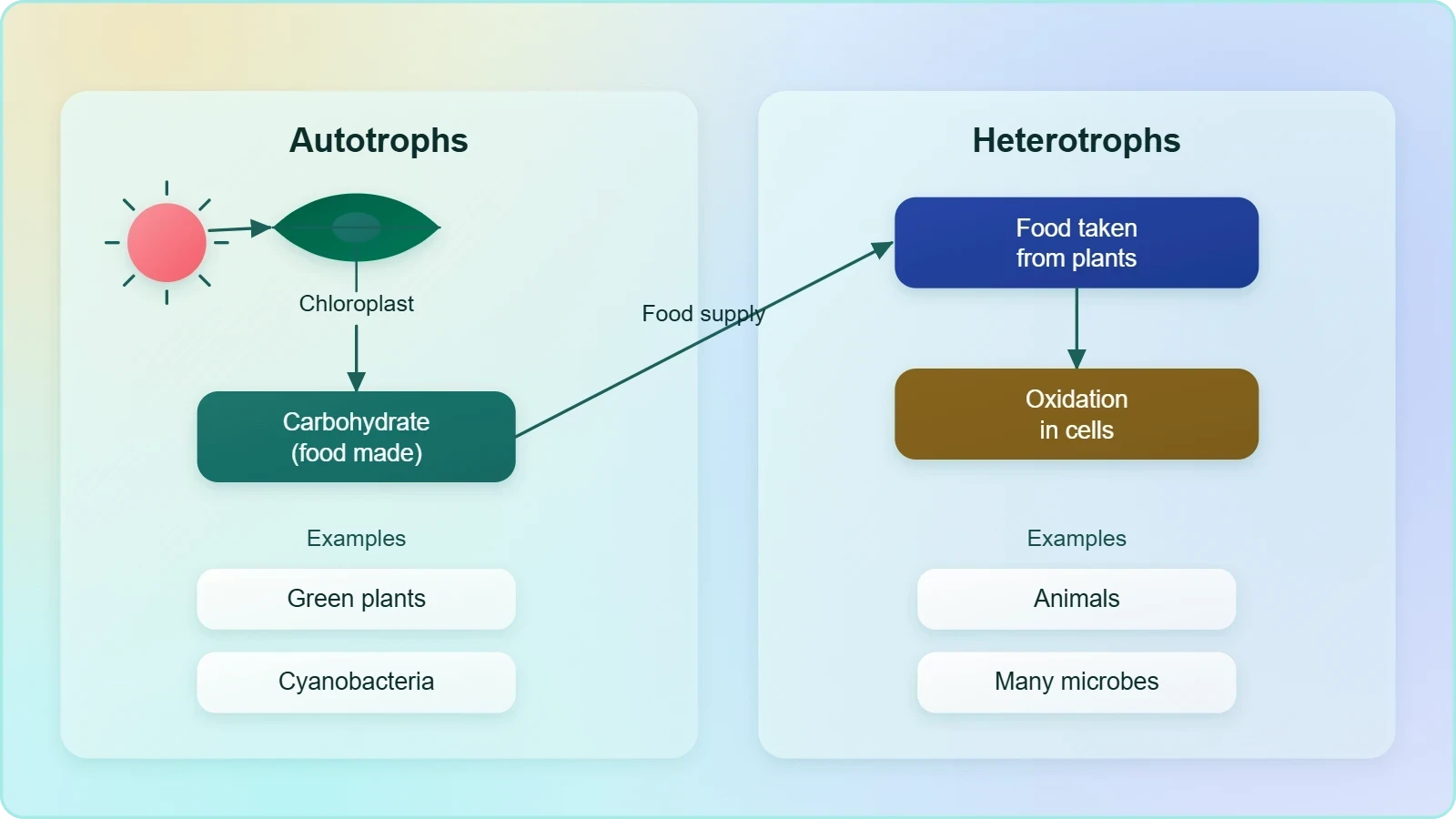
Micro-organisms complicate the picture in instructive ways. The chapter asks whether microbes eat food for their energy requirements, and the answer depends on the organism. Many microbes are heterotrophic and absorb organic molecules from their surroundings, while photosynthetic microbes such as cyanobacteria manufacture their own. Regardless of route, the chapter's principle holds: energy is obtained by oxidation of macromolecules called food. Learners should resist the temptation to treat microbes as exceptions. They are simply additional participants in the same oxidative economy, and their diversity of food sources enriches rather than contradicts the general rule.
Resolving the Apparent Paradox of the Self-Feeding Plant
A plant that photosynthesises might seem to have escaped the need to breathe, since it manufactures rather than consumes its food. The chapter dismantles this paradox with the observation about non-green tissues. Photosynthesis occurs only in chloroplast-containing cells, so the rest of the plant depends on translocated food and must oxidise it. Moreover, even photosynthetic cells respire, because their own maintenance requires energy around the clock. The self-feeding plant is therefore not exempt from respiration but doubly engaged in it, producing food in some tissues and oxidising it everywhere. This resolution is one of the lesson's most valuable conceptual gains.
The paradox also clarifies why the chapter insists that breathing is connected to the release of energy from food. If plants neither ate nor breathed, the connection would be trivial for them and meaningful only for animals. Instead, the connection is universal, and the plant simply demonstrates it in a more compartmentalised form. Food is made in the light, moved through the body, and oxidised wherever energy is needed. The learner who grasps this will find the later lessons on glycolysis and aerobic respiration easier to place, because the purpose of those pathways is already established: releasing energy from food, wherever that food originated.
From Food to Usable Energy: Setting Up the Respiratory Question
Having established that food is oxidised, the chapter naturally asks how this energy is taken from food and how it is utilised. These questions frame the remainder of the course. Oxidation releases energy, but a cell cannot simply absorb that release as heat; the energy must be captured in a form that can drive work. The chapter does not yet name the carrier molecule, leaving that for the next lesson on respiratory substrates and ATP. What it does establish is the logic of the problem: food contains stored chemical energy, oxidation liberates it, and the cell must somehow put it to use. Every subsequent pathway is an answer to that problem.
Why Not All Foods Are Equivalent
The chapter asks whether all foods give the same amount of energy, a question that anticipates the respiratory quotient discussed much later. Different macromolecules store different quantities of energy per unit mass, and their oxidation yields different amounts of carbon dioxide relative to oxygen consumed. Carbohydrates, lipids and proteins are not interchangeable fuels in strict energetic terms. For this opening lesson, the essential point is that food is a category containing diverse oxidisable molecules, and the energy released depends on which molecule is oxidised. The learner should register the question now and expect its quantitative treatment in later lessons.
This variability also explains why the chapter treats glucose, sucrose and starch as examples rather than as the whole story. These carbohydrates are the immediate products of photosynthesis and the most convenient respiratory substrates, but they are not the only ones. When the course reaches the respiratory balance sheet, the accounting of energy released per substrate will become precise. For the moment, the qualitative claim suffices: food is oxidised, energy is released, and the amount released varies with the food. That single sentence carries the learner from the opening questions toward the biochemical detail that follows.
Preparing for Glycolysis and the Pathways Ahead
The chapter's order of ideas is deliberate. It begins with breathing and energy, establishes food as an oxidisable macromolecule, explains photosynthesis as the source of that food, and only then proceeds to glycolysis, fermentation, aerobic respiration, the respiratory balance sheet, the amphibolic pathway and the respiratory quotient. This sequence moves from purpose to mechanism, ensuring that each pathway is understood as a means to an end already defined. The learner who appreciates why oxidation matters will read glycolysis not as a list of reactions but as the first stage in extracting energy from glucose. The lesson therefore ends where the next begins, with the substrate ready and the question sharpened.
Looking ahead, the course will show how glucose is split in the cytoplasm, how fermentation provides an anaerobic alternative, how aerobic respiration completes the oxidation in the presence of oxygen, and how the electron transport system and oxidative phosphorylation convert the released energy into a usable form. The respiratory balance sheet will then account for the energy yield, the amphibolic pathway will reveal how respiration doubles as a source of biosynthetic precursors, and the respiratory quotient will quantify the fuel being burned. None of this would be intelligible without the foundation laid here: breathing matters because it supports the oxidation of food.
Going Further: Background That Supports the Chapter
The chapter's argument stands on its own, but a small amount of well-established background can make the transition to later lessons smoother. Two ideas are especially helpful. The first concerns the molecule that cells use to store and transfer energy for life processes, and the second concerns the organelle in which photosynthesis takes place. Neither idea contradicts the chapter; both extend it in directions the learner will encounter shortly. They are offered here as supplementary context, clearly separated from the chapter's own claims, so that the distinction between the source material and general biological knowledge remains visible.
The Energy Currency Behind Oxidation
ATP, or adenosine triphosphate, is the molecule cells use to store and transfer energy for life processes. When the chapter says that energy released by oxidation is utilised, ATP is the principal form in which that utilisation occurs. The molecule carries energy in its phosphate bonds, and the controlled release of that energy powers absorption, transport, movement and reproduction. This is why the next lesson turns to respiratory substrates and ATP: the substrate supplies the electrons, and ATP captures the yield. Understanding ATP as a currency rather than a fuel helps the learner see why oxidation and energy utilisation are two sides of one process.
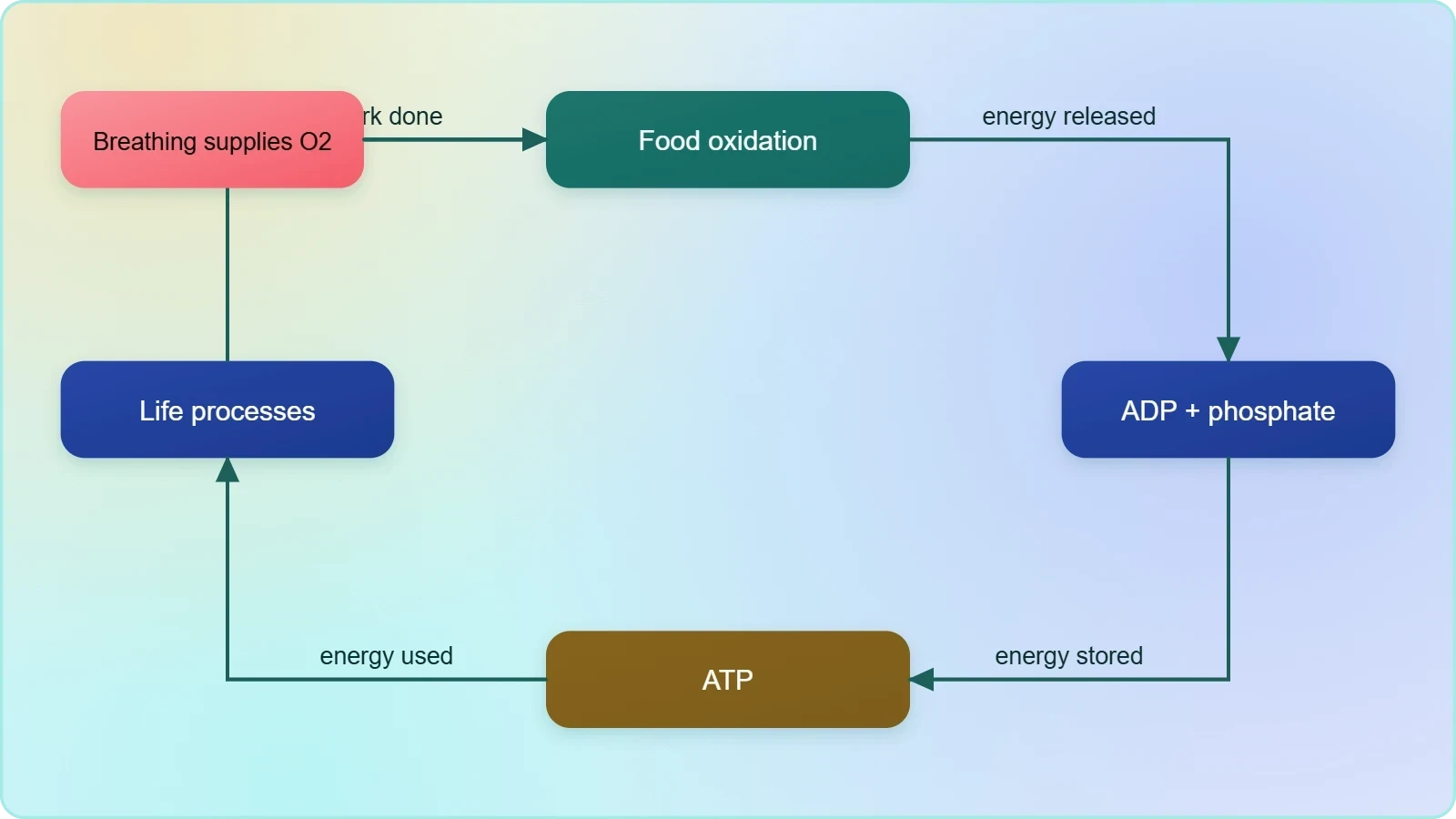
It is worth stressing that ATP is not a long-term energy store in the way starch is. It is a working molecule, generated and spent continuously, which is precisely why breathing must continue without pause. An organism cannot stockpile ATP against future need; it must regenerate it as it is consumed. This continuous turnover explains the chapter's insistence that breathing is essential to life. The oxidation of food and the regeneration of ATP are coupled, and interrupting either side of the coupling quickly halts the life activities listed earlier. The learner should carry this coupling into the next lesson as a guiding principle.
Chloroplasts and the Green Pigment
Photosynthesis takes place in chloroplasts, which contain the green pigment chlorophyll. The chapter notes that only cells containing chloroplasts carry out photosynthesis and that these cells are most often located in superficial layers. Chlorophyll absorbs light energy, which is then converted into chemical energy stored in carbohydrate bonds. This detail reinforces the chapter's point about non-green tissues: a root cell lacks chloroplasts and therefore cannot photosynthesise, no matter how much light reaches it. The anatomical distribution of chloroplasts thus explains the plant's internal division of labour and the necessity of translocation.
Recognising chlorophyll's role also clarifies why the chapter describes photosynthesis as the trapping of light energy. The pigment is the antenna, the chloroplast is the factory, and the carbohydrate is the product. When a leaf is illuminated, its chloroplast-containing cells manufacture food; when darkness falls, those same cells continue to respire, oxidising the food they made. The plant therefore alternates between production and consumption, and both phases depend on the same underlying chemistry of energy transfer. This background enriches the chapter's account without altering it, and it prepares the learner for the respiratory substrates that will be examined next.
Consolidating the Lesson: A Short Self-Check
Before moving to the next lesson, it is worth consolidating the chain of reasoning established here. Breathing matters because life requires energy; energy is obtained by oxidation of food; food is defined as oxidisable macromolecules; green plants and cyanobacteria make food by photosynthesis; animals obtain food from plants; and even green plants must oxidise food in their non-green tissues. Each link in this chain is stated in the chapter, and together they form a complete argument. A learner who can reproduce the chain in order has grasped the lesson's core. The self-check below offers a structured way to test that grasp.
Questions to Test Understanding
Consider why the chapter describes food in terms of oxidation rather than in terms of eating. Then explain why a plant with abundant chloroplasts still requires translocation. Next, account for the claim that animals are heterotrophic while cyanobacteria are not. Finally, connect the release of energy from food to the act of breathing itself. These questions mirror the chapter's own opening queries and should be answerable using its terminology. If any answer feels uncertain, revisit the relevant section before proceeding, because the next lesson builds directly on these foundations.
A useful discipline is to answer each question in two or three sentences, using the chapter's exact vocabulary. Refer to oxidation, macromolecules, photosynthesis, carbohydrate bonds, translocation and heterotrophic status where appropriate. Precision in language reflects precision in understanding, and the later lessons on glycolysis and aerobic respiration will demand both. The learner who can articulate why breathing is connected to the release of energy from food is ready for the molecular detail that follows, including the substrates that are oxidised and the ATP that captures the yield.
Looking Ahead to Respiratory Substrates and ATP
The next lesson examines respiration, respiratory substrates and ATP in greater depth. It will identify the molecules that serve as substrates, explain how their oxidation is coupled to energy capture, and introduce the carrier that makes energy available for cellular work. Everything in that lesson presupposes the present one: that food is oxidisable, that energy is released by oxidation, and that all organisms depend on this release. The learner should therefore treat the current lesson not as preliminary background but as the conceptual foundation on which the entire course rests. Breathing, food and energy are the three terms that organise the study of respiration.
With that foundation in place, the course can proceed to the mechanisms with confidence. Glycolysis will show the first steps in breaking down glucose, fermentation will reveal an anaerobic alternative, and aerobic respiration will complete the oxidation with oxygen as the final electron acceptor. The respiratory balance sheet will quantify the yield, the amphibolic pathway will show respiration's biosynthetic side, and the respiratory quotient will identify the fuel in use. Each of these topics answers a question raised in this opening lesson, and each depends on the simple but profound claim that breathing is connected to the release of energy from food.
Also Read
- No links available.
From our network :
- Mastering DB2 LUW v12 Tables: A Comprehensive Technical GuideComprehensive guide on DB2 LUW v12 tables. Explore CREATE TABLE syntax, BLU Acceleration, range partitioning, data types, and security features for IBM DB2 LUW v12.
- 10 Physics Numerical Problems with Solutions for IIT JEEPrepare for IIT JEE with 10 physics numerical problems, complete with detailed solutions and conceptual explanations. Ideal for mastering kinematics, thermodynamics, electromagnetism, and optics.
- Trump Political Strategy How Geopolitical Stunts Serve As Media Diversions
- 98% of Global MBA Programs Now Prefer GRE Over GMAT Focus EditionExplore why 98% of global MBA programs now prefer the GRE over GMAT Focus. Learn about the shorter GRE format, verbal logic importance, and strategic versatility for students.
- AI-Powered 'Precision Diagnostic' Replaces Standard GRE Score ReportsDiscover the new GRE Precision Diagnostic. Learn how AI-powered behavioral analytics and time-to-solve tracking are replacing standard GRE score reports to empower students.
- Mastering DB2 12.1 Instance Design: A Technical Deep Dive into Modern Database ArchitectureComprehensive guide to DB2 12.1 Instance Design. Explore architectural components, HADR setup, buffer pool tuning, and security policies for IBM DB2 12.1. Includes 10 functional SQL and Shell samples.
- Vite 6/7 'Cold Start' Regression in Massive Module GraphsIn-depth analysis of Vite 6/7 cold start regressions in massive module graphs. Learn about barrel file issues, pre-bundling optimizations, and how to improve Vite dev server performance.
- EV 2.0: The Solid-State Battery Breakthrough and Global Factory ExpansionDiscover the impact of the Solid-State Battery Breakthrough on the EV market. Learn about CATL and BYD stock growth, global factory expansion in Europe, and the future of EV 2.0 technology.
- Analyzing Trump Deportation Numbers Insights Into The 2026 Immigration Crackdown
RESOURCES
- Biochemistry, Glycolysis - StatPearls - NCBI Bookshelf - NIHncbi.nlm.nih.govIn anaerobic conditions, pyruvate converts to lactate through anaerobic glycolysis. Anaerobic respiration results in the production of 2 ATP molecules.[5] ...
- ATP yield of plant respiration: potential, actual and unknown - PMCpmc.ncbi.nlm.nih.gov... respiratory carbon metabolism reactions/pathways has not changed in over 50 years. Despite decades of awareness that aerobic respiration of a hexose cannot ...
- The process of aerobic respiration - Student Academic Successmonash.eduThe mitochondria; Glycolysis - the first stage of aerobic respiration; The Krebs cycle - the second stage of aerobic cellular respiration; The electron ...
- Glycolysis | Cellular respiration | Biology (article) - Khan Academykhanacademy.orgHowever, glycolysis doesn't require oxygen, and many anaerobic organisms—organisms that do not use oxygen—also have this pathway. Highlights of glycolysis.
- respiration in plants chapter 12 - NCERTncert.nic.in12.1 Do Plants. Breathe? 12.2 Glycolysis. 12.3 Fermentation. 12.4 Aerobic. Respiration. 12.5 The. Respiratory. Balance Sheet. 12.6 Amphibolic.
- Aerobic Respiration - an overview | ScienceDirect Topicssciencedirect.comGlycolysis. Aerobic respiration in plant and animal cells requires O2 in order to create ATP. Under aerobic conditions, one molecule of glucose is converted ...
- Cellular respiration - Wikipediaen.wikipedia.orgAerobic respiration takes place in the mitochondrion where oxygen is reduced into water. Glycolysis provides pyruvate and NADH to fuel the mitochondrial ...
- Aerobic and Anaerobic Respiration in Plants - Longdom.orglongdom.orgDescription · Aerobic respiration · Glycolysis · Location: Occurs in the cytoplasm of plant cells. · Process: Glucose is enzymatically broken down into two ...
- Regulation of respiration in plants: A role for alternative metabolic ...sciencedirect.comAug 15, 2011 ... Respiratory metabolism includes the reactions of glycolysis, the ... aerobic respiration. In addition, substrates for the TCA cycle ...
- What Is Aerobic Respiration? – Definition, Diagram and Stepsbyjus.comThe below-given chemical equation describes the complete process of photosynthesis or the aerobic respiration in plants. ... aerobic respiration is glycolysis and ...
- Cellular Respiration | Biology for Majors I - Lumen Learningcourses.lumenlearning.comGlycolysis is an anaerobic process, while the other two pathways are aerobic. In order to move from glycolysis to the citric acid cycle, pyruvate…
- Try or Die: Dynamics of Plant Respiration and How to Survive Low ...mdpi.comJan 13, 2022 ... Under these conditions, the anaerobic metabolism is upregulated instead, in which ATP and NAD+ supplies solely depend on glycolytic fermentation ...
- Weak acids produced during anaerobic respiration suppress both ...nature.comJul 14, 2023 ... While photosynthesis transforms sunlight energy into sugar, aerobic and anaerobic respiration (fermentation) catabolizes sugars to fuel ...
- Core principles which explain variation in respiration across ...nph.onlinelibrary.wiley.comNov 5, 2018 ... ... respiratory pathways: glycolysis, the TCA cycle and the mETC (Fig. ... Respiration rates of individual plants scale with plant…
- Aerobic Respiration | Products, Steps & Formula - Lesson - Study.comstudy.comSometimes, these steps are also called glycolysis, the citric acid cycle, and oxidative phosphorylation. Glycolysis takes place outside the mitochondria, while ...