By the close of the tricarboxylic acid cycle, the cell has accomplished something remarkable yet conspicuously incomplete. Glucose has been dismantled, carbon dioxide has been released, and a modest two molecules of ATP have been earned directly. But the real harvest sits parked in the form of eight NADH + H⁺ and two FADH₂ molecules, waiting for oxygen to enter the story. This lesson takes up precisely that moment: the point at which the respiratory process stops merely breaking molecules apart and begins converting stored reducing power into usable energy.
The electron transport system and oxidative phosphorylation represent the payoff stage of aerobic respiration. Here, NADH + H⁺ and FADH₂ are oxidised, their electrons are handed along a chain of carriers embedded in the inner mitochondrial membrane, and oxygen finally assumes its role as the terminal hydrogen acceptor. Coupled to this electron flow, ATP synthase manufactures ATP from ADP and inorganic phosphate. Understanding this stage explains why oxygen matters so profoundly despite acting only at the very end, and why the energy yield of respiration dwarfs everything achieved in the preceding phases.
This lesson follows the sequence of ideas carefully: the oxidation of NADH and FADH₂, the passage of electrons through complexes I to IV, the mobile carriers that shuttle between them, and the coupling of electron flow to ATP synthesis. It builds directly on the TCA cycle you have just completed and prepares the ground for the chemiosmotic mechanism examined in the next lesson. The numbers, terminology, and logic presented here form the backbone of the respiratory balance sheet that follows later in the course.
On This Page
Why the Cell Cannot Stop at the Citric Acid Cycle
The citric acid cycle delivers carbon dioxide and reducing equivalents, but it leaves the cell with an energy accounting problem. The eight NADH + H⁺ and two FADH₂ molecules produced are rich in chemical potential, yet that potential remains locked away until a mechanism exists to oxidise them. Without such a mechanism, the cycle would stall, because continued oxidation of acetyl CoA demands the regeneration of NAD⁺ and FAD⁺ from their reduced forms. The electron transport system exists to perform exactly this regeneration while extracting energy in the process.
The Problem of Regenerating NAD⁺ and FAD⁺
Every turn of the citric acid cycle consumes oxidised coenzymes and releases reduced ones. Three points in the cycle reduce NAD⁺ to NADH + H⁺, and one point reduces FAD⁺ to FADH₂. If these reduced carriers accumulated without being reoxidised, the cycle would grind to a halt for want of electron acceptors. The cell therefore requires a continuous sink for electrons, and in aerobic respiration that sink is molecular oxygen, reached through the carriers of the electron transport system.
This requirement explains why the discussion of respiration must now turn to oxygen. Until this point, neither O₂ nor the promised large number of ATP molecules has appeared. The reducing equivalents synthesised in the matrix are not waste products but stored energy, and their oxidation through the electron transport system is the step that converts that stored energy into a form the cell can spend. The regeneration of NAD⁺ and FAD⁺ and the production of ATP are two consequences of a single process.
Where the Machinery Sits
The electron transport system is located in the inner mitochondrial membrane, a positioning that is far from incidental. The carriers are arranged in sequence within the membrane, allowing electrons to pass from one carrier to another in an ordered fashion. This spatial organisation permits the energy released at each transfer to be harnessed rather than dissipated, and it sets the stage for the coupling to ATP synthase that defines oxidative phosphorylation.
The mitochondrial matrix supplies the NADH + H⁺ produced during the citric acid cycle, and these molecules are oxidised at the matrix-facing side of the membrane. The architecture of the organelle thus mirrors the logic of the process: the matrix generates the reducing power, the inner membrane conducts the electrons, and oxygen receives them at the end of the line. Every structural detail serves the orderly release of energy.

The Electron Transport System: Carriers in Sequence
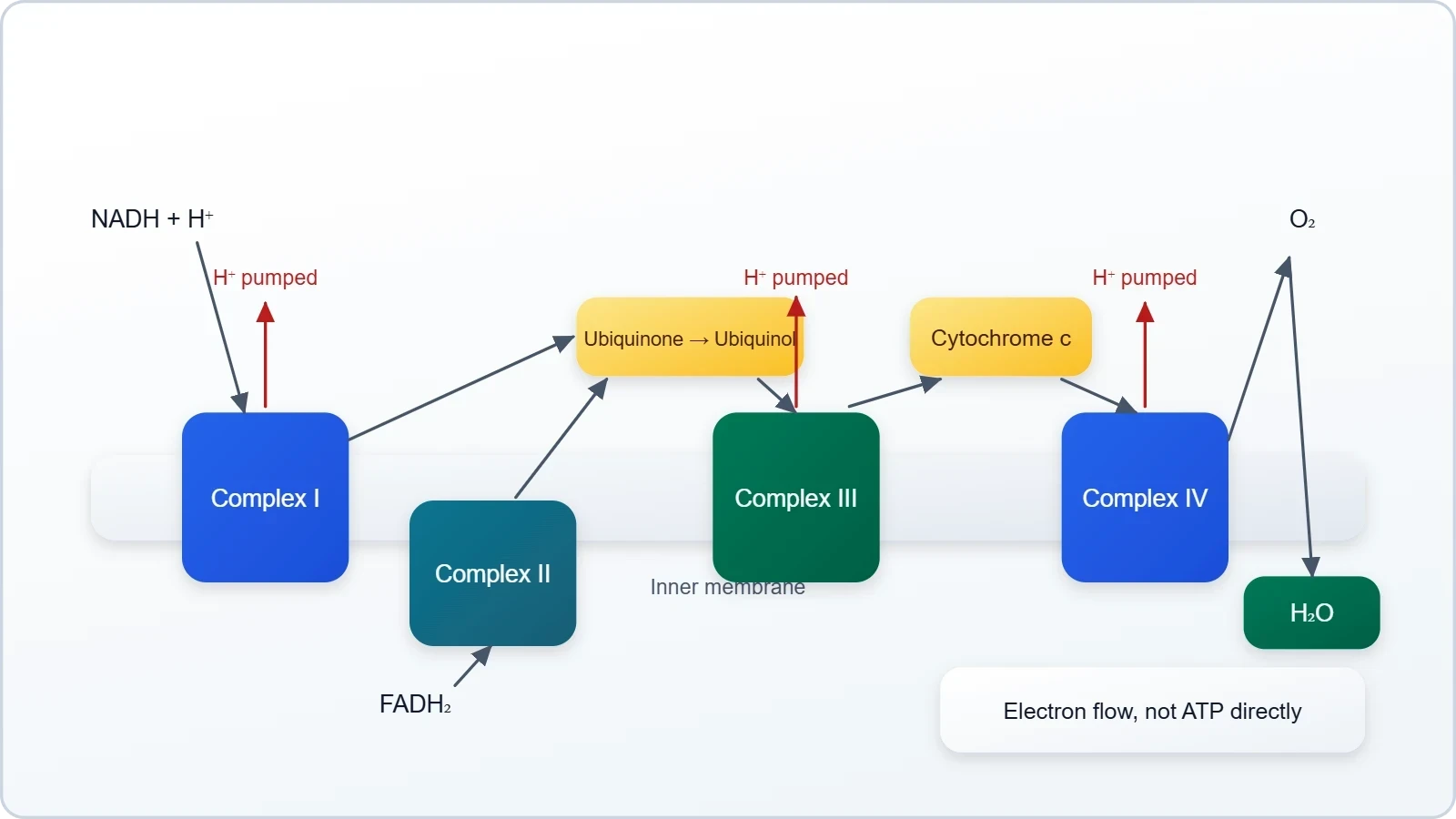
The metabolic pathway through which electrons pass from one carrier to another is called the electron transport system, and it resides in the inner mitochondrial membrane. Its operation is best understood as an ordered relay: each carrier accepts electrons, passes them onward, and in doing so contributes to the release of energy. The sequence runs from complex I through complex IV, with mobile carriers bridging the gaps between the larger membrane-embedded complexes. Oxygen waits at the terminus, receiving electrons and combining with hydrogen to form water.
Complex I and the Entry of NADH
Electrons from NADH produced in the mitochondrial matrix during the citric acid cycle are oxidised by an NADH dehydrogenase, designated complex I. This enzyme accepts the reducing equivalents and initiates their journey along the chain. The electrons are then transferred to ubiquinone, a carrier located within the inner membrane. Complex I thus serves as the principal gateway for the abundant NADH generated by the cycle, and its action marks the first step in converting that reducing power into a usable energy currency.
The significance of this entry point lies in the sheer volume of traffic it handles. Since the citric acid cycle reduces NAD⁺ at three separate points, the majority of electrons reaching the chain arrive through complex I. The NADH dehydrogenase complex must therefore operate continuously to keep pace with the cycle, and its activity is tightly linked to the cell's demand for ATP. When the cycle runs briskly, complex I receives a steady stream of substrate.
Complex II and the FADH₂ Route
Ubiquinone also receives reducing equivalents via FADH₂ through complex II, which is generated during the oxidation of succinate in the citric acid cycle. This second entry route is quantitatively smaller but mechanistically important, because it bypasses complex I entirely. The electrons from FADH₂ therefore join the chain at the level of ubiquinone rather than at the NADH dehydrogenase stage, a detail that will later explain why FADH₂ yields fewer ATP molecules than NADH.
Complex II is thus a distinct doorway into the same corridor. Succinate oxidation feeds its electrons directly into the ubiquinone pool, and from that point onward the route is shared with electrons arriving from complex I. The convergence of two entry pathways onto a single mobile carrier gives the system flexibility, allowing the cell to process reducing equivalents from different sources through a common downstream mechanism.
From Ubiquinol to Cytochrome c and Oxygen
Once ubiquinone has accepted electrons it becomes reduced ubiquinol, and the chain continues. The reduced ubiquinone is oxidised with the transfer of electrons to cytochrome c via the cytochrome bc₁ complex, designated complex III. Cytochrome c is a small protein attached to the outer surface of the inner membrane, and it acts as a mobile carrier for the transfer of electrons between complex III and complex IV. This arrangement allows electrons to shuttle across the membrane face without requiring a fixed physical connection between the two complexes.
Complex III and the Mobile Carrier Cytochrome c
Complex III occupies a pivotal position, receiving electrons from ubiquinol and delivering them to cytochrome c. Because cytochrome c is only loosely associated with the outer surface of the inner membrane, it functions as a genuine courier, collecting electrons from complex III and ferrying them to complex IV. This mobility distinguishes it from the large membrane-spanning complexes and gives the system a degree of flexibility in passing electrons along the chain.
The partnership between complex III and cytochrome c illustrates how the electron transport system balances fixed and mobile elements. The membrane-embedded complexes provide stable platforms for the chemistry of electron transfer, while the small mobile carriers bridge the distances between them. Ubiquinone performs a similar service earlier in the chain, and together these carriers ensure that electrons move smoothly from one catalytic station to the next.
Complex IV and the Terminal Acceptor
Complex IV refers to the cytochrome c oxidase complex, containing cytochromes a and a₃ along with two copper centres. This complex receives electrons from cytochrome c and passes them to oxygen, the final hydrogen acceptor. The electrons, together with hydrogen, result in the formation of water. Oxygen's role is thus limited to the terminal stage of the process, yet its presence is vital, since it drives the whole process by removing hydrogen from the system.
The formation of water at complex IV is the visible endpoint of the entire respiratory chain. Without oxygen to receive electrons at this final station, the carriers upstream would remain in their reduced state, electron flow would cease, and the regeneration of NAD⁺ and FAD⁺ would fail. The cycle would stall and ATP synthesis would stop. Oxygen's contribution is therefore small in position but decisive in consequence.
Coupling Electron Flow to ATP Synthesis
When electrons pass from one carrier to another via complexes I to IV in the electron transport chain, they are coupled to ATP synthase, designated complex V, for the production of ATP from ADP and inorganic phosphate. This coupling is the essence of oxidative phosphorylation. The energy released during electron transfer is not wasted as heat but is channelled into the synthesis of ATP, transforming the reducing power of NADH + H⁺ and FADH₂ into the universal energy currency of the cell.
Why the Process Is Called Oxidative Phosphorylation
The name of the process captures its two essential features. Unlike photophosphorylation, where light energy is utilised for the production of the proton gradient required for phosphorylation, in respiration it is the energy of oxidation-reduction that is utilised for the same purpose. Oxidation of the carriers supplies the energy, and phosphorylation of ADP follows. It is for this reason that the process is called oxidative phosphorylation, and the distinction from its photosynthetic counterpart is instructive.
Both processes ultimately rely on a proton gradient to drive ATP synthesis, but their energy sources differ fundamentally. Photophosphorylation draws on absorbed light, while oxidative phosphorylation draws on the chemical energy released as electrons move down the carrier chain. Recognising this parallel helps consolidate the earlier study of membrane-linked ATP synthesis, and it prepares the ground for the chemiosmotic mechanism that will be examined in detail in the next lesson.
The Yield Depends on the Electron Donor
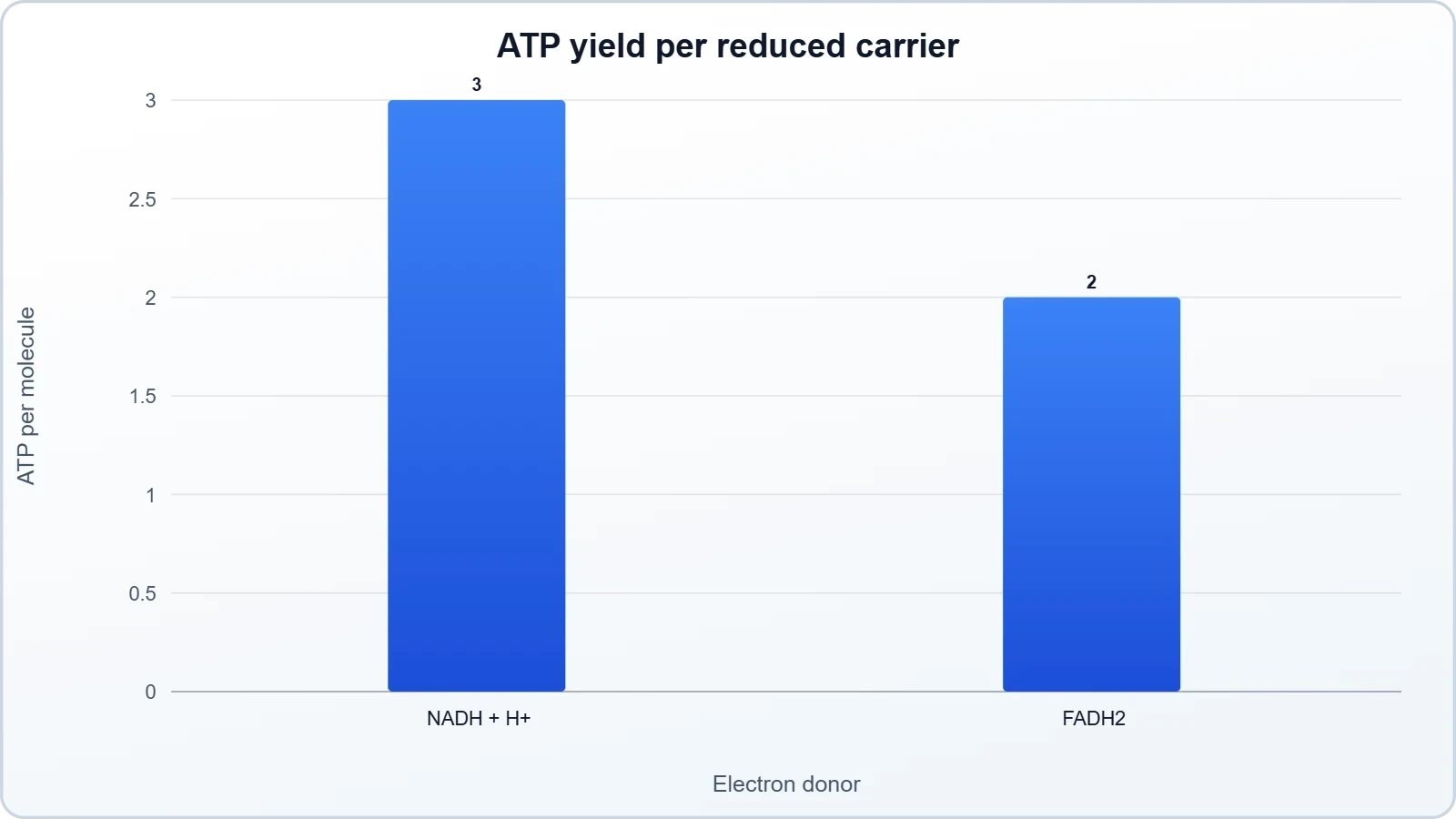
The number of ATP molecules synthesised depends on the nature of the electron donor. Oxidation of one molecule of NADH gives rise to three molecules of ATP, while that of one molecule of FADH₂ produces two molecules of ATP. This difference arises because FADH₂ enters the chain at complex II, bypassing complex I, and therefore contributes less to the energy released along the route. The donor's entry point determines its energetic contribution.
These figures are central to the respiratory balance sheet that will be assembled later in the course. With eight NADH + H⁺ and two FADH₂ emerging from the citric acid cycle, the arithmetic of the electron transport system becomes a matter of straightforward multiplication. The yield from NADH alone is substantial, and the combined total explains why aerobic respiration is so much more productive than the anaerobic alternatives examined earlier.
Working Through the Arithmetic of the Chain
The quantitative logic of oxidative phosphorylation can be expressed compactly, and doing so clarifies how the balance sheet is assembled. Each NADH oxidised through the chain yields three ATP, and each FADH₂ yields two. Given the eight NADH + H⁺ and two FADH₂ delivered by the citric acid cycle, the total ATP attributable to the electron transport system follows directly from these coefficients. The calculation is simple, but it carries the weight of the entire aerobic advantage.
Computing the Contribution of the Reducing Equivalents
The arithmetic proceeds in two parts. The eight NADH molecules contribute three ATP each, and the two FADH₂ molecules contribute two ATP each. Adding these contributions gives the total ATP generated through the electron transport system from one glucose molecule. This figure, combined with the ATP produced directly in earlier stages, forms the basis of the respiratory balance sheet that the course will examine subsequently.

This result of twenty-eight ATP molecules from the reducing equivalents alone dwarfs the two ATP produced directly in the citric acid cycle. The disproportion is the clearest possible illustration of why the electron transport system matters. The cycle's direct contribution is modest; its indirect contribution, routed through NADH and FADH₂, is enormous. The cell's investment in oxygen is repaid many times over.
Expressing the Coupled Reaction
The coupling of electron flow to ATP synthesis can also be represented as a reaction in which the oxidation of the donor is linked to the phosphorylation of ADP. The general form makes explicit that the energy of oxidation-reduction is the driving force, and that inorganic phosphate is incorporated into ADP to yield ATP. This representation reinforces the definition of oxidative phosphorylation and connects the arithmetic to the underlying chemistry.
For FADH₂ the corresponding expression carries a coefficient of two rather than three, reflecting its entry at complex II. Writing the two reactions side by side makes the difference in yield immediately visible and provides a compact summary of the lesson's central quantitative claim. The equations are not merely formal; they encode the reason the electron donor's identity matters so much to the cell's energy budget.
Looking Ahead to the Chemiosmotic Mechanism
The coupling of electron flow to ATP synthesis has been described here in terms of complexes and carriers, but the precise mechanism by which the energy of oxidation-reduction becomes a proton gradient and then ATP remains to be examined. The chemiosmotic hypothesis, already encountered in an earlier chapter, provides that explanation. The next lesson takes up ATP synthase and the chemiosmotic mechanism in detail, building directly on the carrier sequence established here.
What This Lesson Has Established
The essential architecture is now in place. NADH + H⁺ and FADH₂ are oxidised through the electron transport system on the inner mitochondrial membrane. Electrons pass from complex I to complex IV, with ubiquinone and cytochrome c serving as mobile carriers. Oxygen receives the electrons at complex IV and combines with hydrogen to form water. The flow is coupled to ATP synthase, and the yield depends on the donor: three ATP per NADH and two per FADH₂.
These conclusions rest on the material's own terminology and sequence, and they prepare the learner for the mechanistic detail to come. The distinction between oxidative phosphorylation and photophosphorylation has been drawn, the role of oxygen as the final hydrogen acceptor has been clarified, and the arithmetic of the reducing equivalents has been worked through. Each of these threads will be picked up again as the course proceeds toward the respiratory balance sheet.
Going Further
Two background details deepen the picture without altering anything established above. Ubiquinone is a lipid-soluble electron carrier within the inner mitochondrial membrane, a property that allows it to move freely within the membrane's hydrophobic interior and to shuttle electrons between the larger complexes. Cytochromes, meanwhile, are proteins containing haem groups that carry electrons, and their iron centres undergo reversible oxidation and reduction as they pass electrons along the chain.
These facts help explain why the carriers are so well suited to their roles. A lipid-soluble molecule like ubiquinone can diffuse laterally within the membrane, while haem-containing proteins provide stable, precisely positioned sites for electron transfer. Together they illustrate how molecular structure serves the orderly flow of electrons that underpins oxidative phosphorylation, and they offer a useful bridge to the chemiosmotic account that follows.
Also Read
- No links available.
From our network :
- 98% of Global MBA Programs Now Prefer GRE Over GMAT Focus EditionExplore why 98% of global MBA programs now prefer the GRE over GMAT Focus. Learn about the shorter GRE format, verbal logic importance, and strategic versatility for students.
- Mastering DB2 12.1 Instance Design: A Technical Deep Dive into Modern Database ArchitectureComprehensive guide to DB2 12.1 Instance Design. Explore architectural components, HADR setup, buffer pool tuning, and security policies for IBM DB2 12.1. Includes 10 functional SQL and Shell samples.
- Analyzing Trump Deportation Numbers Insights Into The 2026 Immigration Crackdown
- Trump Political Strategy How Geopolitical Stunts Serve As Media Diversions
- AI-Powered 'Precision Diagnostic' Replaces Standard GRE Score ReportsDiscover the new GRE Precision Diagnostic. Learn how AI-powered behavioral analytics and time-to-solve tracking are replacing standard GRE score reports to empower students.
- EV 2.0: The Solid-State Battery Breakthrough and Global Factory ExpansionDiscover the impact of the Solid-State Battery Breakthrough on the EV market. Learn about CATL and BYD stock growth, global factory expansion in Europe, and the future of EV 2.0 technology.
- 10 Physics Numerical Problems with Solutions for IIT JEEPrepare for IIT JEE with 10 physics numerical problems, complete with detailed solutions and conceptual explanations. Ideal for mastering kinematics, thermodynamics, electromagnetism, and optics.
- Mastering DB2 LUW v12 Tables: A Comprehensive Technical GuideComprehensive guide on DB2 LUW v12 tables. Explore CREATE TABLE syntax, BLU Acceleration, range partitioning, data types, and security features for IBM DB2 LUW v12.
- Vite 6/7 'Cold Start' Regression in Massive Module GraphsIn-depth analysis of Vite 6/7 cold start regressions in massive module graphs. Learn about barrel file issues, pre-bundling optimizations, and how to improve Vite dev server performance.
RESOURCES
- Biochemistry, Electron Transport Chain - StatPearls - NCBI Bookshelfncbi.nlm.nih.govSep 4, 2023 ... Oxidative phosphorylation has two parts: the electron transport chain (ETC) and chemiosmosis. The ETC is a collection of proteins bound…
- Mitochondrial electron transport chain: Oxidative phosphorylation ...pubmed.ncbi.nlm.nih.govThe mitochondrial electron transport chain utilizes a series of electron transfer reactions to generate cellular ATP through oxidative phosphorylation. A ...
- Mitochondrial electron transport chain: Oxidative phosphorylation ...pmc.ncbi.nlm.nih.govAug 6, 2020 ... The mitochondrial electron transport chain utilizes a series of electron transfer reactions to generate cellular ATP through oxidative ...
- The mitochondrial electron transport and oxidative ... - PubMed - NIHpubmed.ncbi.nlm.nih.govThe mitochondrial electron transport and oxidative phosphorylation system. Annu Rev Biochem. 1985:54:1015-69. doi: 10.1146/annurev.bi.54.070185.005055 ...
- 7.4 Oxidative Phosphorylation - Biology 2e | OpenStaxopenstax.orgMar 28, 2018 ... The electron transport chain (Figure 7.12) is the last component of aerobic respiration and is the only part of glucose…
- Learn and try: Oxidative phosphorylation (article) | Khan Academykhanacademy.orgIn the electron transport chain, electrons are passed from one molecule to another, and energy released in these electron transfers is used to form…
- 5.2: Electron Transport and Oxidative Phosphorylationbio.libretexts.orgThe process of oxidative phosphorylation uses the energy of the proton gradient established by the electron transport system as a means of phosphorylating ADP ...
- Electron Transport Chain And Oxidative Phosphorylation Substrates ...jackwestin.comOxidative phosphorylation, incorporating two interdependent processes – the flow of electrons through electron transport chain down to…
- 7.11: Oxidative Phosphorylation - Electron Transport Chainbio.libretexts.orgOxidative phosphorylation is the metabolic pathway in which electrons are transferred from electron donors to electron acceptors in redox reactions; this series ...
- Oxidative phosphorylation - Wikipediaen.wikipedia.orgOxidative phosphorylation [N 1] or electron transport-linked phosphorylation or terminal oxidation, is the metabolic pathway in which cells use enzymes to ...
- Lactate activates the mitochondrial electron transport chain ...sciencedirect.comLactate-induced increase in oxidative phosphorylation results in more pyruvate entry into the TCA cycle, thus further increasing mitochondrial ATP production ...
- A Biophysical Model of the Mitochondrial Respiratory System and ...journals.plos.org... oxidative phosphorylation and electron transport system in cardiac mitochondria. Class B refers to 17 parameters for which values are established in the ...
- Electron transport chain and oxidative phosphorylation - AMBOSSamboss.comJan 24, 2023 ... Oxidative phosphorylation is a metabolic pathway through which cells release the energy stored in carbohydrates, fats, and proteins to ...
- Targeting the Electron Transport System for Enhanced Longevitymdpi.comApr 23, 2025 ... Here, perhaps the most relevant function of the mitochondria is to facilitate oxidative phosphorylation (OXPHOS), whereby the oxidation of ...
- Oxidative Phosphorylation Definition - BYJU'Sbyjus.comThe electron transport system is located in the inner mitochondrial membrane. The electrons are transferred from one member of the transport chain to another ...