The genetic code is the molecular dictionary that translates a four-letter nucleic acid alphabet into a twenty-letter protein alphabet, and it stands as one of the most elegant solutions biology has ever produced. When transcription delivers a messenger RNA transcript into the cytoplasm, that molecule carries information encoded in nucleotide triplets, yet the ribosome cannot read nucleotides directly into amino acids without a shared set of rules. The genetic code supplies precisely that rulebook, assigning each three-base codon to a specific amino acid or to a termination signal. Understanding this code means grasping how information flows from DNA through RNA into functional protein, and why that flow is so remarkably consistent across nearly every organism on Earth.
This lesson examines the genetic code as a system rather than a mere lookup table. It begins with the intellectual problem that confronted mid-twentieth-century scientists: four bases must somehow specify twenty amino acids, and no chemical complementarity links nucleotides to amino acids. From George Gamow's bold triplet proposition to the cell-free systems of Marshall Nirenberg and the synthetic RNA chemistry of Har Gobind Khorana, the code was cracked through ingenious experimentation. We then survey the defining features of the code, including its triplet nature, degeneracy, non-overlapping reading, near universality, and the dual role of AUG. Each feature carries functional consequences that shape how genes evolve and how mutations manifest.
Beyond the foundational material, this lesson extends into wobble base pairing, codon usage bias, and the documented exceptions to universality found in mitochondria and certain protozoans. Worked translation examples will sharpen practical fluency, while the frameshift analogy of three-letter words illustrates why insertions and deletions behave so differently depending on their length. By the end, you should be able to read an mRNA sequence, predict its polypeptide product, and reason about how a single nucleotide change can ripple through a protein's structure. This prepares the ground for the next lesson on mutations and their effects on the genetic code.
On This Page
The Conceptual Problem of Encoding Twenty Amino Acids
Translation demands a transfer of information from a polymer of nucleotides to a polymer of amino acids, and this transfer is conceptually harder than replication or transcription. In those earlier processes, a nucleic acid template is copied into another nucleic acid, so Watson-Crick complementarity provides a ready-made mechanism for fidelity. Between nucleotides and amino acids, however, no such complementarity exists, nor could any be drawn theoretically. Yet abundant evidence indicated that changes in genetic material produced changes in protein amino acids, which forced biologists to postulate an intermediary code directing amino acid sequence during protein synthesis.
The arithmetic of the problem is deceptively simple. Four nucleotide bases must specify twenty standard amino acids. A single base could encode only four possibilities, clearly insufficient. A doublet code would yield ##4^2 = 16## combinations, still short of twenty. A triplet code yields ##4^3 = 64## combinations, comfortably exceeding the requirement. George Gamow, a physicist by training, argued in 1954 that the code must therefore be a combination of bases and proposed the triplet as the minimal sufficient unit. His reasoning was bold because 64 codons vastly outnumber the 20 amino acids, implying redundancy that demanded explanation.


Gamow's Proposition and the Logic of Combinatorics
Gamow's insight rested on straightforward combinatorics rather than biochemical evidence, yet it framed the entire subsequent research program. If the code were a triplet, then the 64 possible codons could be partitioned among 20 amino acids plus punctuation signals, leaving room for multiple codons per amino acid. This redundancy, later termed degeneracy, turned out to be a genuine and functionally important feature rather than an inefficiency. Gamow's proposal also implied that the code should be read without overlap, since overlapping triplets would constrain which amino acid sequences were chemically possible and create statistical patterns detectable in protein data.
The combinatorial argument can be expressed compactly. For an alphabet of ##n## symbols arranged in words of length ##k##, the number of distinct words is ##n^k##. With ##n = 4## and ##k = 3##, we obtain 64. The requirement is that ##n^k \geq 20##, and the smallest integer ##k## satisfying this inequality for ##n = 4## is three, since ##4^2 = 16 < 20##. This mathematical necessity made the triplet hypothesis almost unavoidable once the four-base, twenty-amino-acid premise was accepted, though direct experimental proof remained a separate and formidable challenge.
From Proposition to Proof: Khorana and Nirenberg
Providing experimental proof that the codon was a triplet required tools that did not yet exist. Har Gobind Khorana developed chemical methods to synthesize RNA molecules with defined base combinations, producing homopolymers such as poly-U and copolymers with controlled repeating sequences. Marshall Nirenberg, working independently, developed a cell-free system for protein synthesis in which synthetic RNA could be translated in vitro. The Severo Ochoa enzyme, polynucleotide phosphorylase, proved invaluable because it could polymerize RNA with defined sequences in a template-independent manner, enabling the enzymatic synthesis of tailored messengers.
The decisive experiment used poly-U RNA, which produced a polypeptide of pure phenylalanine, establishing UUU as the phenylalanine codon. Subsequent experiments with defined copolymers assigned the remaining codons, and the complete checkerboard of 64 codons was assembled. This collaborative achievement, spanning physics, organic chemistry, biochemistry, and genetics, earned Khorana, Nirenberg, and Robert Holley the 1968 Nobel Prize in Physiology or Medicine. The code had moved from theoretical necessity to experimental fact, and the foundation for molecular genetics was firmly established.
The Defining Features of the Genetic Code
The genetic code exhibits a set of properties that together make it both robust and versatile. The codon is a triplet, read contiguously along the mRNA without punctuation or spacing signals. Of the 64 codons, 61 specify amino acids while three, UAA, UAG, and UGA, serve as stop or terminator codons that signal the end of translation. The code is degenerate because most amino acids are specified by more than one codon, and it is nearly universal, meaning that from bacteria to humans the same codon generally specifies the same amino acid. These features are not arbitrary; each reflects evolutionary pressures and functional requirements.
AUG occupies a special position with dual functions. It codes for methionine and also serves as the initiator codon where translation begins. This dual role means that every newly synthesized polypeptide begins with methionine, though this residue is often removed post-translationally. The reading frame is established at the start codon and maintained thereafter, so the ribosome reads successive triplets without skipping or overlapping. Understanding these features provides the conceptual scaffolding for predicting protein sequences from mRNA and for interpreting the consequences of mutation.

Degeneracy and the Wobble Hypothesis
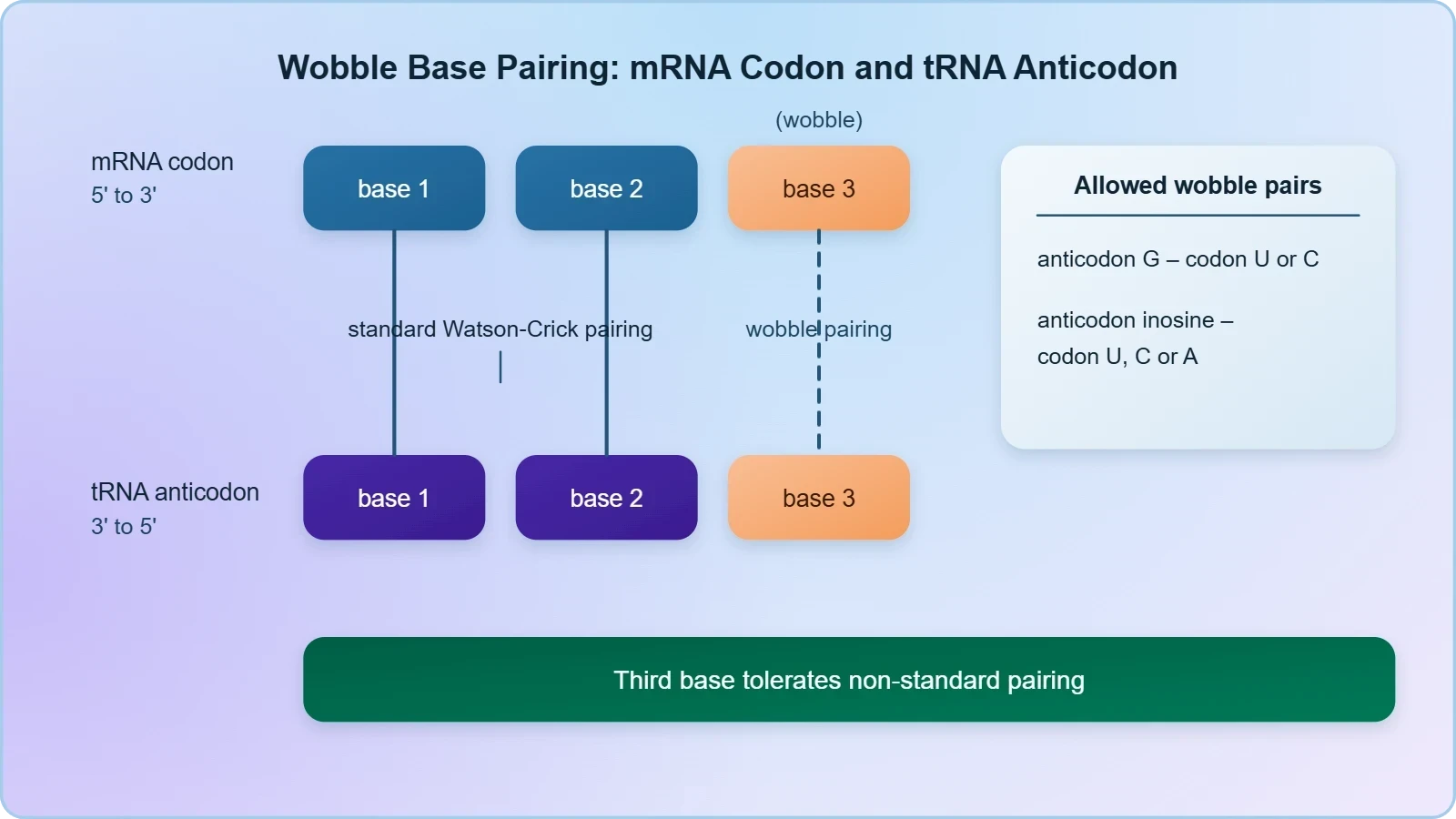
Degeneracy means that most amino acids are encoded by more than one codon, and the pattern of redundancy is highly structured. Codons for the same amino acid typically differ at the third position, which is why the third base is often called the wobble position. Francis Crick's wobble hypothesis explained this observation by proposing that the pairing between the third base of the codon and the first base of the tRNA anticodon is less stringent than standard Watson-Crick pairing. This relaxed pairing allows a single tRNA species to recognize multiple synonymous codons, reducing the number of tRNA genes an organism must maintain.
The wobble rules permit specific non-standard pairings. For example, a guanine in the anticodon's wobble position can pair with either cytosine or uracil in the codon, and inosine, a modified base, can pair with uracil, cytosine, or adenine. The consequence is that a cell needs far fewer than 61 tRNA species to read all 61 sense codons; typical bacterial cells carry around 30 to 45 tRNA genes. Degeneracy therefore serves a dual purpose: it buffers the effects of point mutations at the third position and it economizes the translational machinery.
Universality and Its Documented Exceptions
The code is described as nearly universal because the same codon assignments hold across the vast majority of life, from bacteria to humans. UUU codes for phenylalanine in an E. coli cell and in a human neuron alike, a conservation so deep that it implies a single origin of the code early in the history of life. This universality underpins biotechnology, allowing human insulin to be produced in bacterial cells and fluorescent proteins from jellyfish to be expressed in mammalian tissues. The shared code makes cross-species genetic engineering possible.
Yet universality is not absolute. Mitochondria possess their own genomes and a slightly modified code. In human mitochondria, UGA, normally a stop codon, codes for tryptophan, while AGA and AGG, normally arginine, serve as stop codons. Some protozoans such as Tetrahymena use UAA and UAG to encode glutamine rather than termination. Certain ciliates reassign stop codons to amino acids. These exceptions are thought to arise from the reduced genomes and altered tRNA populations of organelles and specialized lineages, and they remind us that the code is a biological convention subject to evolutionary drift.
Reading the Code: Worked Translation Examples
Translating an mRNA sequence into a polypeptide requires locating the start codon, reading successive triplets, and consulting the codon table until a stop signal is reached. Consider the sequence AUG UUU UUC UUC UUU UUU UUC. The first triplet, AUG, is the initiator and codes for methionine. The remaining triplets, UUU and UUC, both code for phenylalanine. The resulting polypeptide is Met-Phe-Phe-Phe-Phe-Phe-Phe, a short peptide of one methionine followed by six phenylalanines. This exercise demonstrates how degeneracy allows different codons to produce identical amino acid sequences.
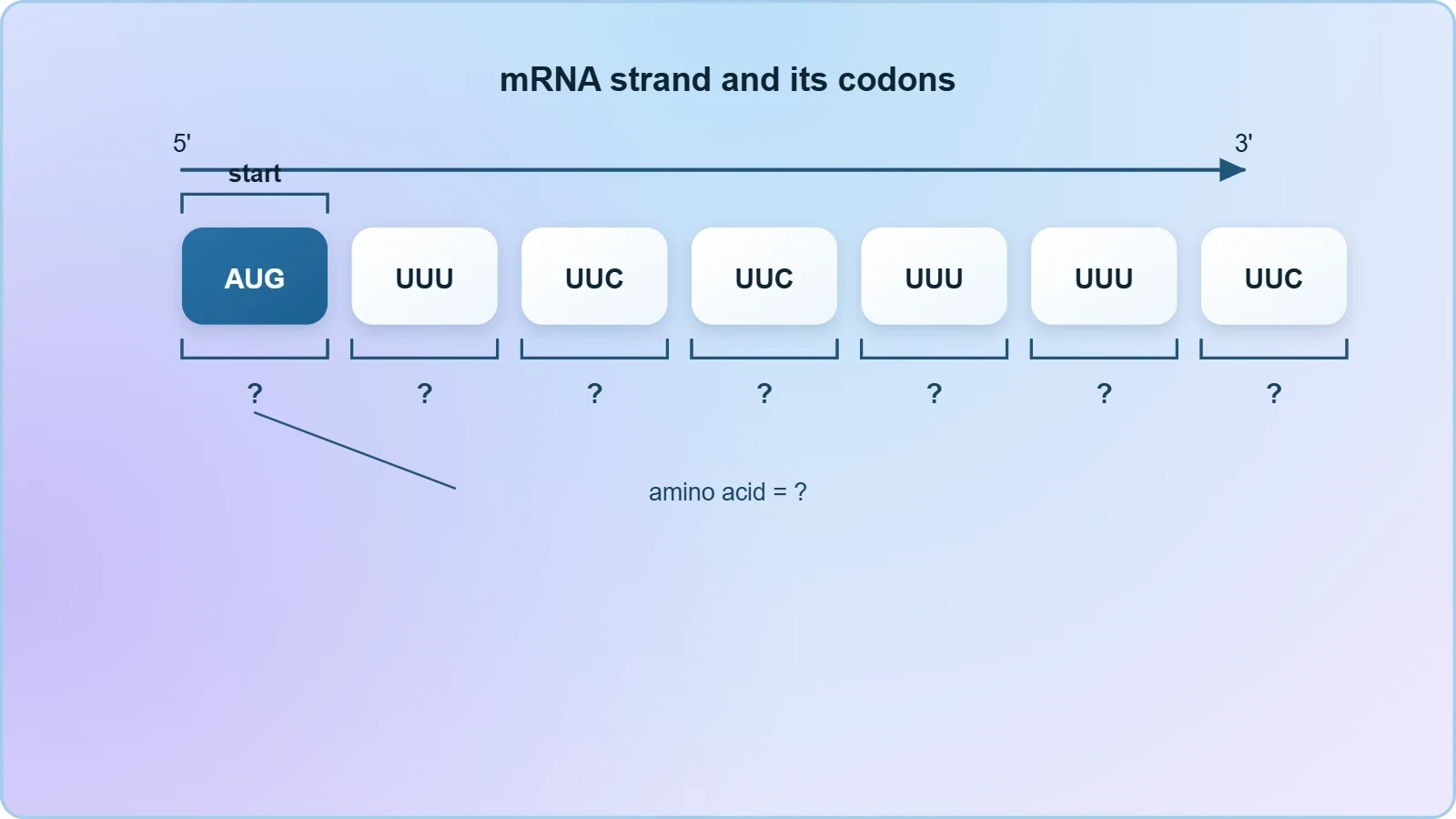
Now reverse the problem: given the amino acid sequence Met-Phe-Phe-Phe-Phe-Phe-Phe, predict the mRNA. The methionine is unambiguous because AUG is its only codon, but phenylalanine has two codons, UUU and UUC. The reverse translation is therefore ambiguous, and many mRNA sequences could encode the same peptide. This asymmetry reveals two properties simultaneously: degeneracy, which makes reverse translation non-unique, and the unidirectional nature of the code, which makes forward translation deterministic. The exercise also highlights why the code is described as redundant rather than reversible.
A Step-by-Step Translation Walkthrough
Take a slightly longer example to practice the full procedure. Consider the mRNA sequence AUG GCU UAC GGA UAA. Begin at AUG, which specifies methionine. The next codon, GCU, codes for alanine. UAC codes for tyrosine, and GGA codes for glycine. Finally, UAA is a stop codon, so translation terminates and the polypeptide is released. The product is Met-Ala-Tyr-Gly, a tetrapeptide. Note that the stop codon does not contribute an amino acid; it merely signals the end of the reading frame.
This walkthrough illustrates several principles at once. The reading frame is fixed by the start codon, so shifting the frame by one base would produce an entirely different polypeptide. The stop codon ensures that translation terminates at a defined point rather than continuing into the untranslated region. And the specificity of each codon-anticodon interaction guarantees that the amino acid sequence matches the gene's instructions. Practicing such translations builds the fluency needed to interpret real genomic data and to predict the consequences of sequence variants.
# Simple codon table and translation function
codon_table = {
    "AUG": "Met", "UUU": "Phe", "UUC": "Phe",
    "GCU": "Ala", "UAC": "Tyr", "GGA": "Gly",
    "UAA": "STOP", "UAG": "STOP", "UGA": "STOP"
}

def translate(mrna):
    protein = []
    for i in range(0, len(mrna) - 2, 3):
        codon = mrna[i:i+3]
        amino_acid = codon_table.get(codon, "?")
        if amino_acid == "STOP":
            break
        protein.append(amino_acid)
    return "-".join(protein)

print(translate("AUGGCUUAC GGAUAA".replace(" ", "")))
# Output: Met-Ala-Tyr-Gly
Codon Usage Bias and Translational Efficiency
Although degeneracy allows multiple codons for most amino acids, organisms do not use synonymous codons with equal frequency. Codon usage bias refers to the non-random distribution of synonymous codons, and it varies systematically across species and even across genes within a genome. Highly expressed genes, such as those encoding ribosomal proteins, tend to use codons that match the most abundant tRNA species, enhancing translational efficiency and accuracy. This bias is shaped by mutational pressures, selection for translational speed, and the availability of tRNA pools, and it carries practical implications for heterologous gene expression.
When a human gene is expressed in E. coli, rare codons in the bacterial host can stall the ribosome and reduce protein yield. Biotechnologists therefore optimize codon usage by replacing rare codons with synonymous alternatives favored by the host, a process called codon optimization. Codon bias also informs vaccine design, where mRNA sequences are tuned for stability and translation, and it provides a molecular signature useful in identifying the source organism of a sequenced gene. The phenomenon demonstrates that synonymous mutations are not always silent at the level of organismal fitness.
Mutations and the Reading Frame
The relationship between genes and DNA is best illuminated by mutation studies, because mutations reveal which parts of a sequence matter and how changes propagate. Large deletions and rearrangements can remove or duplicate entire genes, producing obvious functional consequences. Point mutations, which alter a single base pair, offer subtler lessons. A classical example is the change of a single base pair in the beta-globin gene that substitutes valine for glutamate, producing sickle cell anemia. This single substitution alters protein behavior dramatically, showing how a tiny genetic change can have profound physiological effects.
Insertions and deletions behave differently depending on their length, and the three-letter-word analogy makes this vivid. Consider the statement RAM HAS RED CAP, in which each word has three letters like a codon. Inserting a single letter B between HAS and RED yields RAM HAS BRE DCA P, which scrambles the reading frame from the insertion point onward. Inserting two letters produces a similar disruption. But inserting three letters, say BIG, yields RAM HAS BIG RED CAP, restoring the frame and adding exactly one word. The length of the insertion determines whether the reading frame survives.

Frameshift Mutations and Their Consequences
Insertion or deletion of one or two bases shifts the reading frame from the point of the mutation, and such mutations are called frameshift insertions or deletions. Every codon downstream of the mutation is read differently, typically producing a completely different amino acid sequence and often a premature stop codon. Frameshift mutations are usually far more damaging than substitutions because they corrupt the entire downstream protein. By contrast, insertion or deletion of three or a multiple of three bases adds or removes one or more complete codons, leaving the reading frame unaltered from that point onward.
The deletion exercise mirrors the insertion case. Deleting the letter R from RAM HAS RED CAP yields RAM HAS EDC AP, again scrambling the frame. Deleting R and E yields RAM HAS DCA P, still scrambled. Deleting R, E, and D together yields RAM HAS CAP, a coherent statement with one word removed. The lesson is that the reading frame is a property of the triplet grouping, and only changes in multiples of three preserve it. This principle explains why in-frame deletions often produce partially functional proteins while frameshifts usually abolish function entirely.

tRNA as the Adapter Molecule
From the earliest days of the code hypothesis, Francis Crick recognized that a mechanism must exist to read the code and link it to amino acids, because amino acids themselves have no structural features capable of reading nucleotides uniquely. He postulated an adapter molecule that would read the codon on one side and bind a specific amino acid on the other. The molecule now called tRNA, formerly known as soluble RNA or sRNA, was already known before the code was deciphered, but its role as the adapter was assigned only later. This conceptual leap resolved the apparent impossibility of direct nucleotide-amino acid recognition.
tRNA possesses an anticodon loop whose bases are complementary to the mRNA codon, and an amino acid acceptor end to which the corresponding amino acid is attached. Each tRNA is specific for one amino acid, and there is a dedicated initiator tRNA for starting translation. Notably, no tRNAs exist for stop codons, which is why stop signals are read by release factors rather than by adapter molecules. The secondary structure of tRNA resembles a cloverleaf, while its actual three-dimensional structure is a compact inverted L shape that fits precisely into the ribosome's active sites.
Charging of tRNA and the Fidelity of Translation
Translation is the polymerization of amino acids into a polypeptide, with the order and sequence defined by the mRNA. Amino acids are joined by peptide bonds, and forming these bonds requires energy. In the first phase of translation, amino acids are activated in the presence of ATP and linked to their cognate tRNA, a process called charging or aminoacylation of tRNA. The enzyme aminoacyl-tRNA synthetase catalyzes this reaction with remarkable specificity, and its accuracy is the primary determinant of translational fidelity, since the ribosome itself mainly checks codon-anticodon pairing.
The charging reaction can be summarized as an activation step followed by transfer. The amino acid is first adenylated with ATP, releasing pyrophosphate, and then transferred to the tRNA's acceptor end. The overall reaction is amino acid + ATP + tRNA → aminoacyl-tRNA + AMP + PPi. If two charged tRNAs are brought close enough within the ribosome, a peptide bond forms between them, extending the growing chain. This coupling of chemical energy to information transfer ensures that the polypeptide sequence faithfully reflects the mRNA instructions.
From Code to Genome: Broader Implications
The genetic code is more than a static table; it is a dynamic interface between genotype and phenotype, and its properties shape genome evolution. Degeneracy buffers the third position against mutation, reducing the probability that a random substitution alters the protein. The near universality of the code enables comparative genomics, allowing researchers to annotate genes in newly sequenced organisms by transferring knowledge from model species. Codon usage bias influences gene expression levels and mRNA stability, and it provides a window into the selective pressures acting on a genome. These features collectively make the code a central organizing principle of molecular biology.
Understanding the code also illuminates the origins of life. The near universality of codon assignments suggests that the code was fixed very early, before the divergence of the three domains of life. The wobble mechanism and the structured degeneracy of the code may reflect an ancient RNA world in which RNA molecules both stored information and catalyzed reactions. The presence of introns and the splicing machinery, discussed in earlier lessons, are reminiscent of that antiquity. The code thus connects the molecular present to the evolutionary past, and it remains a fertile ground for research into synthetic biology and genetic code expansion.
Practical Applications in Biotechnology and Medicine
The code's predictability underpins recombinant DNA technology. Because a human gene uses the same codons as a bacterial host, insulin, growth hormone, and vaccines can be manufactured in microbial or mammalian cell factories. Codon optimization further enhances yields by matching the gene's codons to the host's tRNA repertoire. In medicine, understanding codon assignments allows clinicians to interpret pathogenic variants, predict whether a mutation is silent, missense, or nonsense, and design therapies such as nonsense suppression drugs that read through premature stop codons.
Emerging technologies extend the code's reach. Synthetic biologists have engineered organisms with expanded genetic codes, incorporating non-standard amino acids for novel protein functions. mRNA vaccines rely on codon optimization and modified nucleosides to maximize translation and stability. CRISPR-based editing depends on precise knowledge of reading frames to predict off-target effects. Each of these applications rests on the foundational insight that the genetic code is a triplet, degenerate, nearly universal, and read in a contiguous frame, a set of principles that this lesson has explored in depth.
Exceptions, Ambiguity, and the Limits of Universality
The claim that the code is universal requires careful qualification. While the standard code applies to the vast majority of organisms, mitochondria and certain protozoans use variant codes. In mammalian mitochondria, UGA codes for tryptophan rather than termination, and AUA codes for methionine rather than isoleucine. In the ciliate Tetrahymena, UAA and UAG encode glutamine. These exceptions are not random; they often arise from the reduced genomes of organelles and from changes in tRNA populations that alter codon recognition. The existence of variant codes demonstrates that the genetic code is a biological convention subject to evolutionary change.
Ambiguity also arises in the reverse direction. Because most amino acids have multiple codons, a given polypeptide sequence does not uniquely specify an mRNA sequence. This asymmetry is fundamental: the code is a many-to-one mapping from codons to amino acids, not a one-to-one mapping. The forward direction, from mRNA to protein, is deterministic, while the reverse direction is ambiguous. This property has practical consequences for gene prediction algorithms, which must consider codon usage and reading frame when annotating genomes, and for synthetic biology, where multiple synonymous sequences can be designed to encode the same protein.
Variant Codes and Their Evolutionary Significance
Variant genetic codes are catalogued in databases such as the NCBI genetic code tables, which list over thirty distinct codes. Each variant reflects a specific reassignment of one or more codons, often accompanied by changes in tRNA genes or release factors. The mitochondrial code, for example, reassigns UGA to tryptophan and AGA/AGG to stop codons in vertebrates. These reassignments are thought to evolve through a process of codon capture, in which a codon disappears from the genome, its tRNA is lost, and the codon is subsequently reassigned to a different amino acid. The study of variant codes provides insight into the evolvability of the translation machinery.
The existence of variant codes also has practical implications for biotechnology. When expressing a mitochondrial gene in a bacterial host, codon optimization must account for the host's standard code rather than the mitochondrial code. Similarly, when annotating organellar genomes, researchers must use the appropriate variant code to predict protein sequences correctly. These considerations underscore the importance of specifying which genetic code applies when translating a sequence, and they remind us that the code is a set of rules with documented exceptions rather than an absolute law.
Also Read
- No links available.
From our network :
- Trump Political Strategy How Geopolitical Stunts Serve As Media Diversions
- How to Print Cheaply: Cutting the Cost per PageA practical, measured guide to lowering what each printed page costs — duplex and draft modes, third-party ink, yield mathematics, and knowing when a new printer beats refills.
- EV 2.0: The Solid-State Battery Breakthrough and Global Factory ExpansionDiscover the impact of the Solid-State Battery Breakthrough on the EV market. Learn about CATL and BYD stock growth, global factory expansion in Europe, and the future of EV 2.0 technology.
- Where to Put Your Wireless Router for Better CoverageA practical, physics-grounded guide to router placement: why the centre of the home beats the corner, how walls and metal sap signal, and how to run a simple survey that proves the improvement.
- Analyzing Trump Deportation Numbers Insights Into The 2026 Immigration Crackdown
- AI-Powered 'Precision Diagnostic' Replaces Standard GRE Score ReportsDiscover the new GRE Precision Diagnostic. Learn how AI-powered behavioral analytics and time-to-solve tracking are replacing standard GRE score reports to empower students.
- 10 Physics Numerical Problems with Solutions for IIT JEEPrepare for IIT JEE with 10 physics numerical problems, complete with detailed solutions and conceptual explanations. Ideal for mastering kinematics, thermodynamics, electromagnetism, and optics.
- 98% of Global MBA Programs Now Prefer GRE Over GMAT Focus EditionExplore why 98% of global MBA programs now prefer the GRE over GMAT Focus. Learn about the shorter GRE format, verbal logic importance, and strategic versatility for students.
- Do You Need a New Router or Is Your Internet Plan the Problem?A practical comparison of the signs that point to router limits versus signs your broadband speed or provider is the bottleneck, so you can decide what to replace before spending money.
RESOURCES
- Resources will be updated soon.