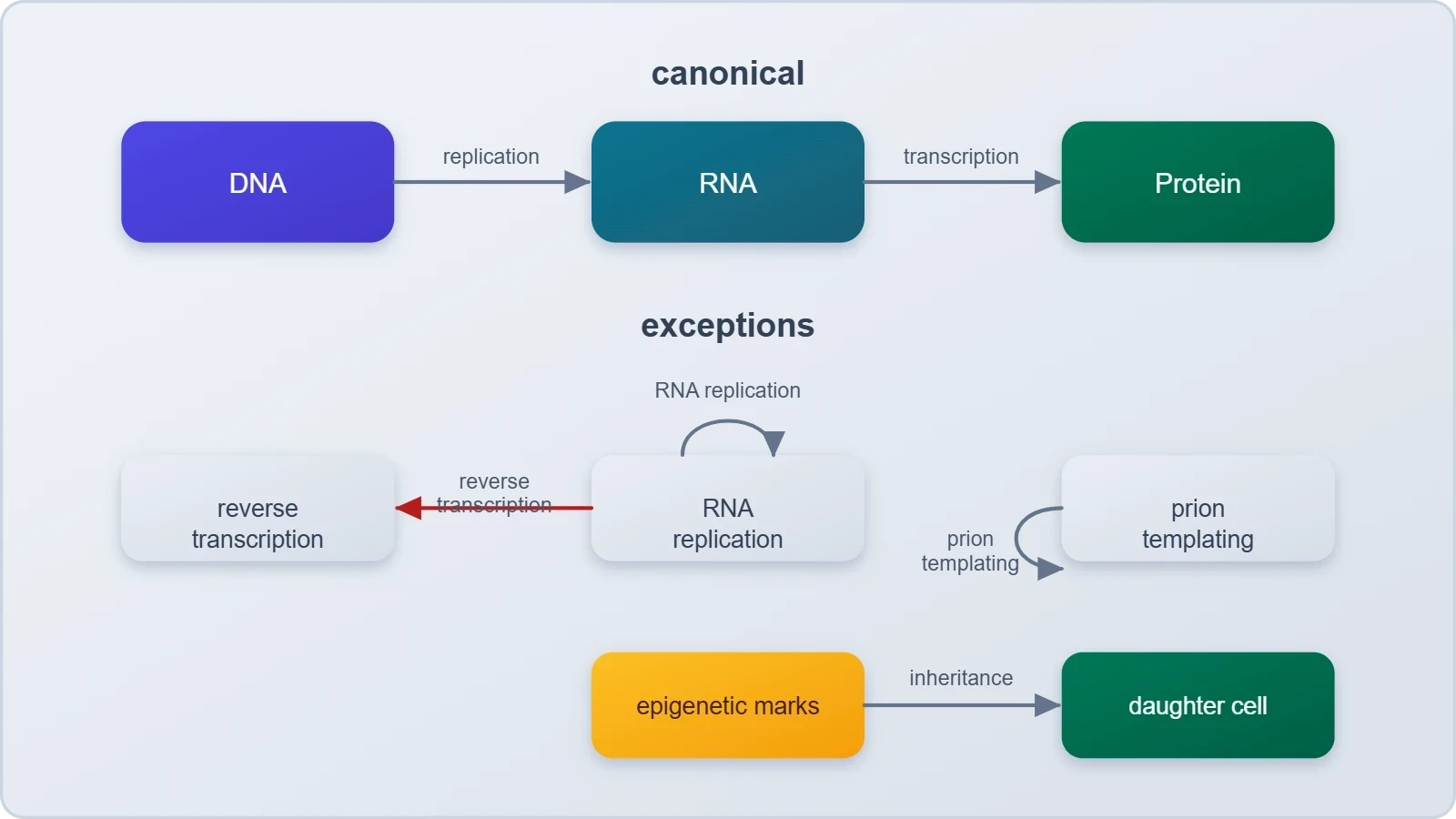
Molecular biology rests on a deceptively simple proposition: genetic information flows from DNA to RNA to protein, and that flow is essentially one-directional. Francis Crick articulated this principle in 1958 and refined it in 1970, giving the young discipline a unifying framework that organised decades of experimental work. The central dogma became the organising spine of the field, explaining how a stable archival molecule could direct the construction of the enzymes, structural proteins, and signalling molecules that make a living cell function. Its elegance lies in its asymmetry: DNA is copied, RNA is transcribed, protein is translated, and the sequence information is preserved at every step.
Yet biology rarely respects tidy boundaries. Within a few years of Crick's formulation, virologists were uncovering enzymes and replication strategies that ran directly against the presumed direction of information flow. Reverse transcriptase, discovered independently by Howard Temin and David Baltimore in 1970, showed that RNA could serve as a template for DNA synthesis. RNA viruses demonstrated that genomes need not be made of DNA at all. Prions revealed that heritable traits could propagate without any nucleic acid whatsoever. Each of these findings did not destroy the central dogma but forced a more precise reading of it, distinguishing between the general rule and the legitimate exceptions that operate alongside it.
This lesson examines both the rule and its exceptions with the rigour the subject demands. It revisits the precise formulation of the central dogma, clarifies what the principle actually claims and what it does not, and then works systematically through the documented exceptions: reverse transcription in retroviruses and retrotransposons, RNA-dependent RNA replication, the protein-only inheritance of prions, and the emerging evidence for epigenetic transmission across generations. Building on the RNA processing and non-coding RNA material of the previous lesson, this treatment prepares the ground for the genomic and bioinformatic perspectives that follow.
On This Page
- The Central Dogma: Precise Formulation and Its Boundaries
- Reverse Transcription: Temin, Baltimore, and the Retroviral Strategy
- RNA Replication and the RNA Virus World
- Prions: Protein-Only Inheritance
- Epigenetic Inheritance: A Fourth Exception
- Worked Example: Tracing Information Flow in an HIV Infection
- Consolidating the Framework
The Central Dogma: Precise Formulation and Its Boundaries
Crick's central dogma is frequently misquoted as a claim that information can never flow from protein back to nucleic acid. The original statement was narrower and more careful. Crick proposed that once sequence information has passed into protein, it cannot be recovered or transferred back to nucleic acid. The transfer of information from nucleic acid to nucleic acid, or from nucleic acid to protein, remained possible; the reverse transfer from protein to protein, or from protein to nucleic acid, was excluded. This distinction matters because it separates a claim about sequence information from a claim about all molecular interactions.
The dogma is best understood as a statement about the directionality of sequence information transfer, not about the directionality of every biochemical reaction. A cell can phosphorylate a protein, degrade it, or move it across a membrane without violating the principle. What the dogma forbids is the templated copying of protein sequence back into nucleic acid sequence. This precision is essential for evaluating the exceptions correctly: reverse transcription does not violate the dogma because it transfers information from RNA to DNA, both nucleic acids, and never from protein.
The Three Classical Information Transfers
The classical formulation recognises three canonical transfers: DNA to DNA (replication), DNA to RNA (transcription), and RNA to protein (translation). Replication preserves the genome across cell divisions through semi-conservative copying, a mechanism established by Meselson and Stahl in 1958. Transcription produces RNA copies that serve as working messages, and translation converts the nucleotide sequence of messenger RNA into the amino acid sequence of a polypeptide through the ribosome and the genetic code. These three transfers constitute the standard operating procedure of every living cell.
Each transfer has dedicated molecular machinery and dedicated fidelity mechanisms. DNA polymerases proofread against a template; RNA polymerases initiate at promoters and terminate at defined signals; ribosomes decode codons through tRNA adaptors. The information content is preserved at each step, though the chemical form changes. This conservation of sequence information across chemically distinct polymers is the deep insight of the dogma, and it explains why the principle proved so productive as a research heuristic for the following half-century.
What the Dogma Does Not Claim
The dogma does not claim that RNA cannot be copied into DNA, that RNA cannot be copied into RNA, or that information cannot flow between RNA molecules. It does not claim that all genetic information resides in DNA, nor that inheritance requires nucleic acid. These are common misreadings that the exceptions in this lesson expose. The dogma also does not address regulation, epigenetic modification, or the structural roles of RNA, all of which operate outside its scope. Recognising these boundaries prevents the principle from being used as a blunt instrument against legitimate discoveries.
A useful way to hold the distinction is to separate the question of information transfer from the question of information storage. The dogma addresses transfer. Storage can involve DNA methylation, histone modification, or even protein conformation, as the prion section will show. When students conflate the two, they misclassify exceptions as refutations. The correct reading treats the dogma as a strong default rule with well-characterised exceptions, each of which enriches rather than undermines the framework.
Reverse Transcription: Temin, Baltimore, and the Retroviral Strategy
Howard Temin spent the early 1960s studying Rous sarcoma virus and grew convinced that the RNA genome of the virus could not replicate without a DNA intermediate. His hypothesis, initially met with scepticism, predicted an enzyme that could copy RNA into DNA. In 1970, Temin and Satoshi Mizutani, working independently from David Baltimore, reported the discovery of exactly such an activity in virions of RNA tumour viruses. Baltimore's purification of the enzyme from Rauscher murine leukaemia virus and Temin's demonstration in Rous sarcoma virus particles established reverse transcriptase as a genuine molecular entity. The two shared the 1975 Nobel Prize in Physiology or Medicine with Renato Dulbecco.
Reverse transcriptase is an RNA-dependent DNA polymerase that synthesises a complementary DNA strand using an RNA template. Retroviral enzymes possess three distinct activities: the RNA-dependent DNA polymerase activity, an RNase H activity that degrades the RNA strand of the resulting RNA-DNA hybrid, and a DNA-dependent DNA polymerase activity that completes the second strand. The enzyme lacks proofreading exonuclease activity, which accounts for the high mutation rate of retroviruses and their rapid evolution under immune and drug pressure. This error-prone character is central to HIV pathogenesis and to the emergence of drug-resistant variants.
The Retroviral Life Cycle and Genome Integration
Retroviruses such as HIV carry a positive-sense single-stranded RNA genome. After entry, the viral RNA is reverse transcribed into double-stranded DNA within the cytoplasm. The resulting DNA is flanked by long terminal repeats generated during the reverse transcription process. This linear DNA is then imported into the nucleus, where the viral integrase enzyme catalyses its insertion into the host chromosome. Integration is essentially random with respect to sequence, though it favours transcriptionally active regions, and the integrated provirus becomes a permanent part of the host genome, replicated along with it at every cell division.
Once integrated, the provirus uses host RNA polymerase II to transcribe viral genes, producing both genomic RNA and spliced messenger RNAs for viral proteins. The provirus can remain latent for years, a property that complicates HIV eradication because latently infected cells are invisible to the immune system and to antiretroviral drugs. Integration also means that retroviral insertions can disrupt host genes, a phenomenon exploited in gene therapy vectors and responsible for adverse events in early clinical trials. The retroviral strategy thus converts an RNA genome into a stable DNA element, a striking inversion of the classical flow.
Retrotransposons and Endogenous Retroviruses
Reverse transcription is not confined to viruses. Eukaryotic genomes contain retrotransposons, mobile elements that replicate through an RNA intermediate and a reverse transcriptase step. The human genome harbours roughly 17 percent LINE-1 elements and about 8 percent Alu elements, both of which use reverse transcription to spread. Long interspersed nuclear elements encode their own reverse transcriptase and can mobilise autonomously, while Alu elements parasitise LINE machinery. These elements have shaped genome architecture, created new regulatory sequences, and occasionally caused disease through insertional mutagenesis.
Endogenous retroviruses represent ancient retroviral infections that became fixed in the germline. Roughly 8 percent of the human genome derives from such elements. Most are defective, but some retain functional envelope genes, and the syncytin proteins essential for placental development are domesticated retroviral envelope derivatives. This illustrates how an apparent exception to the central dogma became integrated into core mammalian biology. The enzyme that once served viral replication now contributes to placental morphogenesis, a remarkable example of evolutionary co-option.
RNA Replication and the RNA Virus World
RNA viruses that lack a DNA stage must replicate their genomes directly. RNA-dependent RNA polymerases catalyse the synthesis of RNA from an RNA template, a transfer that the central dogma does not forbid but that classical formulations rarely emphasised. Positive-sense single-stranded RNA viruses such as poliovirus and SARS-CoV-2 translate their genomes directly upon entry, producing the polymerase among the first proteins made. Negative-sense viruses such as influenza carry their own polymerase in the virion and transcribe genomic RNA into messenger RNA before replication can begin. Double-stranded RNA viruses replicate within capsids to avoid triggering host antiviral sensors.
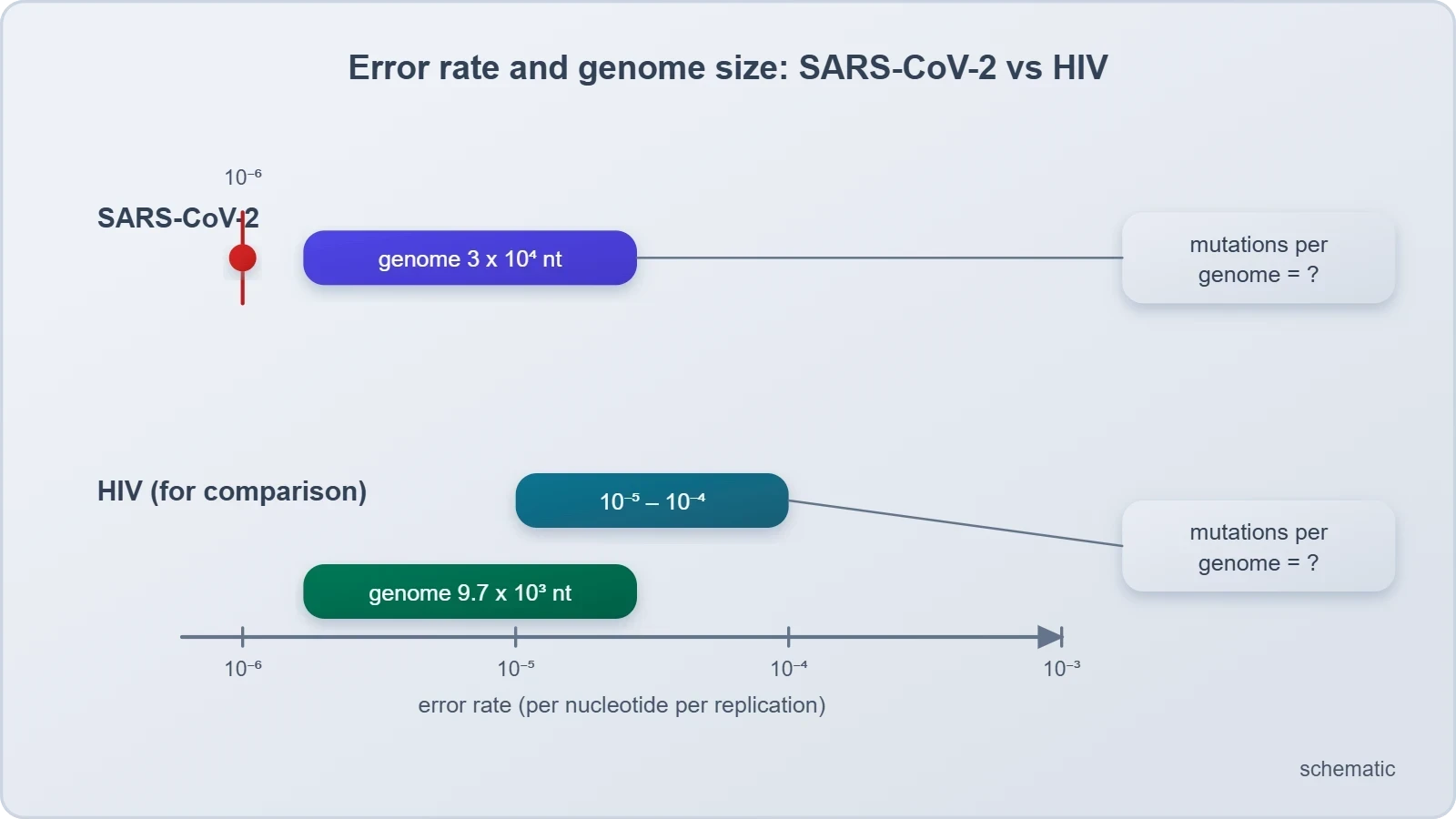
The replication strategies of RNA viruses are constrained by the absence of proofreading in most RNA-dependent RNA polymerases. Mutation rates are correspondingly high, typically between ##10^{-6}## and ##10^{-4}## substitutions per nucleotide per replication cycle. This error-prone replication generates diverse viral populations, often described as quasispecies, which facilitate immune escape and drug resistance. Coronaviruses are a notable exception: their polymerase possesses a proofreading exonuclease, giving SARS-CoV-2 a substantially lower mutation rate than influenza or HIV and enabling the development of effective mRNA vaccines and antiviral drugs.
HIV and SARS-CoV-2 as Contrasting Examples
HIV is a retrovirus with a positive-sense RNA genome that is reverse transcribed into DNA and integrated as a provirus. Its replication therefore combines RNA-to-DNA and DNA-to-RNA transfers, illustrating that some viruses use both nucleic acid types in a single life cycle. SARS-CoV-2 is a positive-sense RNA virus that replicates entirely through RNA intermediates, never integrating into the host genome. The two viruses thus represent opposite ends of the exception spectrum: HIV depends on reverse transcription and integration, while SARS-CoV-2 depends on RNA-dependent RNA replication without any DNA stage.
These differences have direct clinical consequences. HIV can establish latent reservoirs that require lifelong therapy, whereas SARS-CoV-2 infection is typically cleared by the immune system after acute replication. Antiretroviral drugs target reverse transcriptase, protease, and integrase; antivirals against SARS-CoV-2 target the RNA-dependent RNA polymerase and the main protease. Understanding the molecular basis of each replication strategy is therefore not academic but foundational to rational drug design and to anticipating resistance.
Hepatitis B Virus: A DNA Virus with an RNA Intermediate
Hepatitis B virus illustrates the reverse situation: a DNA virus that replicates through an RNA intermediate. The partially double-stranded DNA genome is repaired to a covalently closed circular form in the nucleus, transcribed into a pregenomic RNA, and then reverse transcribed into DNA within the viral capsid. This pararetroviral strategy means that hepatitis B depends on a reverse transcriptase despite being classified as a DNA virus. The enzyme is the target of tenofovir and entecavir, and its error rate contributes to the emergence of vaccine escape mutants.
The hepatitis B example reinforces a broader point: the central dogma describes the dominant flow of information in cellular life, not a rigid taxonomy of viral replication. Viruses have evolved every conceivable permutation of nucleic acid transfer, and each permutation carries its own enzymatic requirements and therapeutic vulnerabilities. Recognising this diversity is essential for anyone working in virology, vaccinology, or antiviral pharmacology, and it prepares the ground for the genomic and bioinformatic analyses that follow in the next lesson.
Prions: Protein-Only Inheritance
Stanley Prusiner's proposal in 1982 that the infectious agent of scrapie was a proteinaceous infectious particle, which he termed a prion, met fierce resistance because it violated the assumption that infectious agents must carry nucleic acid. The subsequent decades of work established that prions are misfolded conformers of the normal cellular prion protein, designated PrP. The normal protein, PrPC, is rich in alpha helices and soluble; the disease-associated conformer, PrPSc, is rich in beta sheets, insoluble, and resistant to proteases. PrPSc acts as a conformational template, converting PrPC molecules to the pathogenic fold in a self-propagating chain reaction.
This mechanism represents a transfer of information from protein to protein, a direction the central dogma explicitly excluded. The information is not sequence information in the nucleotide sense but conformational information encoded in the three-dimensional structure of the polypeptide. Prion diseases, including Creutzfeldt-Jakob disease, kuru, and bovine spongiform encephalopathy, are transmissible and fatal neurodegenerative conditions. The prion principle has since been extended to yeast prions such as [PSI+] and [URE3], which propagate heritable phenotypic traits without any nucleic acid change, and to the growing list of mammalian proteins with prion-like domains involved in neurodegeneration.
Mechanistic Basis of Conformational Templating
The conversion reaction can be represented as a nucleation-dependent polymerisation. A small seed of PrPSc recruits PrPC and catalyses its refolding, and the resulting aggregate fragments to create more seeds. The kinetics follow a sigmoidal curve with a lag phase that shortens as seed concentration increases. This explains the characteristic incubation periods of prion disease and the phenomenon of strain variation, in which different PrPSc conformers produce distinct disease phenotypes even within genetically identical hosts. The strain concept demonstrates that conformational information can be heritable in a meaningful biological sense.
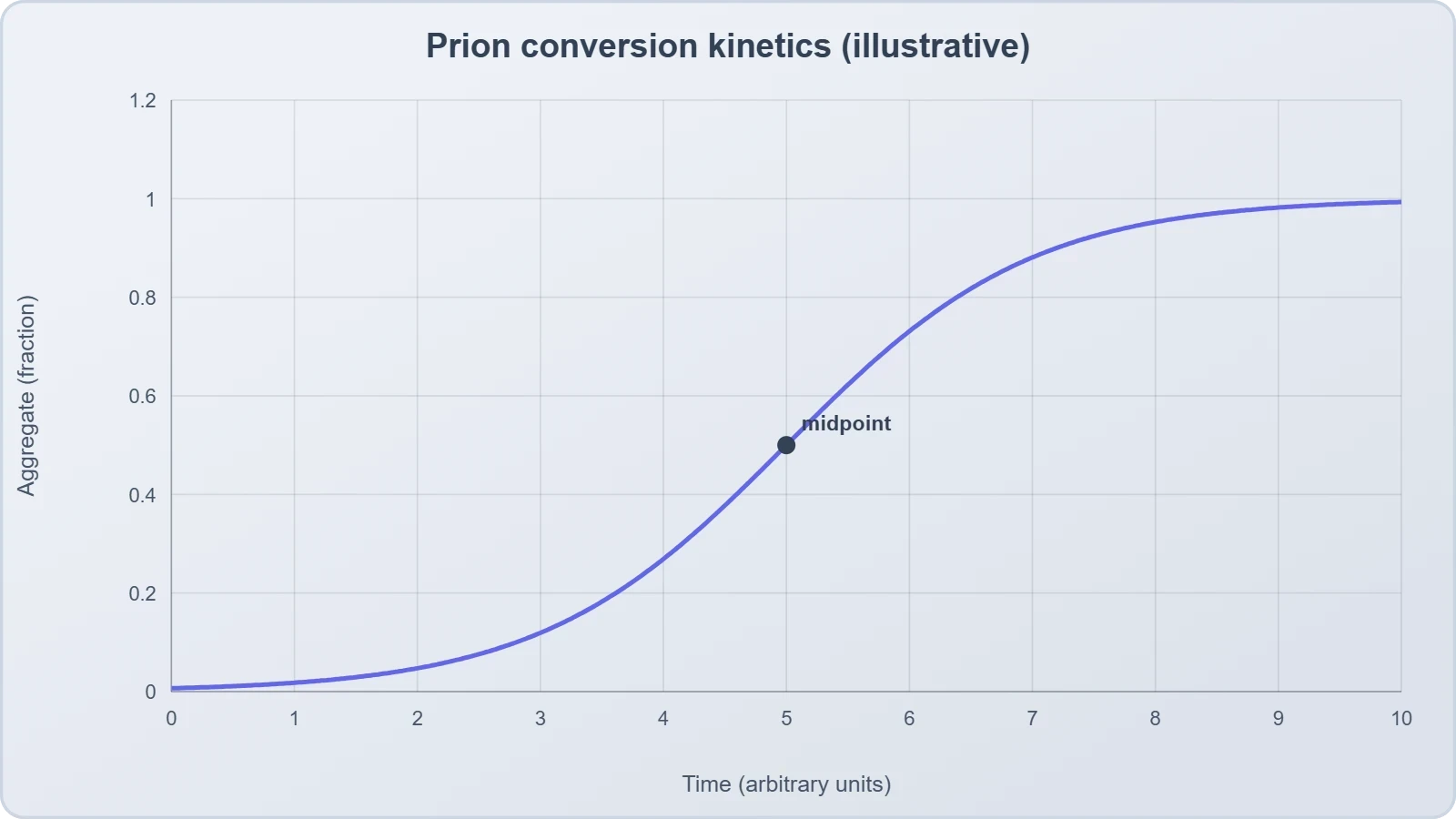
The prion mechanism also illuminates the broader principle that protein folding is not always determined solely by amino acid sequence in the cellular context. Chaperones, local environment, and existing aggregates influence the folding outcome. This has implications for understanding amyloid diseases such as Alzheimer's and Parkinson's, where prion-like propagation of misfolded proteins is increasingly recognised. The prion exception thus extends far beyond infectious disease into the fundamental biology of protein homeostasis and neurodegeneration.
Prions and the Limits of the Dogma
Prions are the clearest documented exception to the central dogma because they transmit heritable information without nucleic acid. Yet they do not refute the dogma's core claim, which concerns sequence information. The prion conformer does not encode a sequence that can be reverse translated into DNA; it propagates a shape. The distinction is subtle but important. The dogma remains a valid description of how sequence information flows, while prions demonstrate that not all biological inheritance is sequence-based. This recognition has broadened the concept of inheritance to include epigenetic and structural mechanisms.
The prion story also illustrates how scientific frameworks accommodate anomalies. Rather than discarding the central dogma, the field refined its scope and developed a richer account of information transfer that includes conformational templating. This is how mature scientific paradigms evolve: not by wholesale replacement but by progressive articulation of boundaries and exceptions. Students of molecular biology should internalise this lesson, because the next generation of discoveries will likely require similar refinements.
Epigenetic Inheritance: A Fourth Exception
Epigenetic inheritance describes the transmission of phenotypic states across cell divisions, or occasionally across generations, without changes to the underlying DNA sequence. The principal mechanisms are DNA methylation at CpG dinucleotides, post-translational modification of histone tails, and the deposition of histone variants. These marks influence chromatin accessibility and gene expression, and they can be propagated through replication by maintenance enzymes such as DNMT1, which copies methylation patterns onto the newly synthesised daughter strand. Epigenetic inheritance is therefore a genuine exception to the strict reading that DNA sequence alone determines heritable phenotype.
The relationship between epigenetic inheritance and the central dogma is nuanced. Epigenetic marks do not transfer sequence information, so they do not violate the dogma's core claim. They do, however, demonstrate that heritable information can reside outside the nucleotide sequence, expanding the concept of inheritance in a manner analogous to the prion exception. The distinction between genetic and epigenetic inheritance is now central to developmental biology, cancer research, and the study of environmental effects on phenotype, including the much-debated field of transgenerational epigenetic inheritance in mammals.
Mechanisms and Fidelity of Epigenetic Marks
DNA methylation is the best-characterised epigenetic mark in mammals. Maintenance methylation during S phase ensures that hemimethylated sites are converted to fully methylated sites, preserving the pattern across cell divisions. Histone modifications are propagated through a read-write mechanism in which modified histones recruit enzymes that modify neighbouring histones. The fidelity of these mechanisms is lower than that of DNA replication, which allows epigenetic states to be dynamic and responsive to developmental and environmental signals. This plasticity is essential for differentiation and for cellular memory.
Transgenerational epigenetic inheritance, in which marks pass through the germline to affect offspring phenotype, is well documented in plants and nematodes but remains controversial in mammals because of extensive reprogramming during gametogenesis and early embryogenesis. Nevertheless, some loci escape reprogramming, and epidemiological studies have suggested associations between ancestral nutrition and descendant health. The field is methodologically demanding, and claims require rigorous controls, but the phenomenon is now taken seriously as a legitimate dimension of inheritance.
Integrating the Exceptions
The four exceptions examined in this lesson, reverse transcription, RNA replication, prion propagation, and epigenetic inheritance, share a common feature: each expands the repertoire of mechanisms by which biological information can be stored and transmitted. None of them overturns the central dogma's claim about the directionality of sequence information. Instead, they delineate its boundaries and demonstrate that the molecular biology of inheritance is richer and more varied than the classical formulation suggested. This is the mature understanding that contemporary research supports.
For the practising molecular biologist, the practical implication is that assumptions about information flow must be tested rather than presumed. A novel virus may use an unexpected replication strategy; a disease may propagate without a pathogen genome; a phenotype may be inherited without a sequence change. The exceptions are not curiosities but active areas of research with direct clinical and biotechnological relevance. The next lesson turns to genomics and bioinformatics, where these diverse mechanisms are studied at genome scale.
Worked Example: Tracing Information Flow in an HIV Infection
Consider a CD4+ T lymphocyte infected by HIV-1. The virion carries two copies of positive-sense single-stranded RNA and a preformed reverse transcriptase. Following fusion and entry, the viral RNA is reverse transcribed into double-stranded DNA in the cytoplasm. The RNA strand is degraded by RNase H, the second DNA strand is synthesised, and the resulting linear DNA is imported into the nucleus. Integrase inserts the proviral DNA into a host chromosome, where it becomes a permanent genetic element. This sequence of events illustrates the RNA-to-DNA transfer that Temin and Baltimore discovered.
Once integrated, the provirus is transcribed by host RNA polymerase II into genomic RNA and spliced messenger RNAs. The genomic RNA serves both as a template for new virions and as the mRNA for Gag and Pol polyproteins. The full cycle therefore involves RNA-to-DNA, DNA-to-RNA, and RNA-to-protein transfers, demonstrating that a single virus can traverse the central dogma in both directions. The provirus persists for the lifetime of the cell, and latently infected cells constitute the principal barrier to HIV cure.
Quantitative Perspective on Reverse Transcription Fidelity
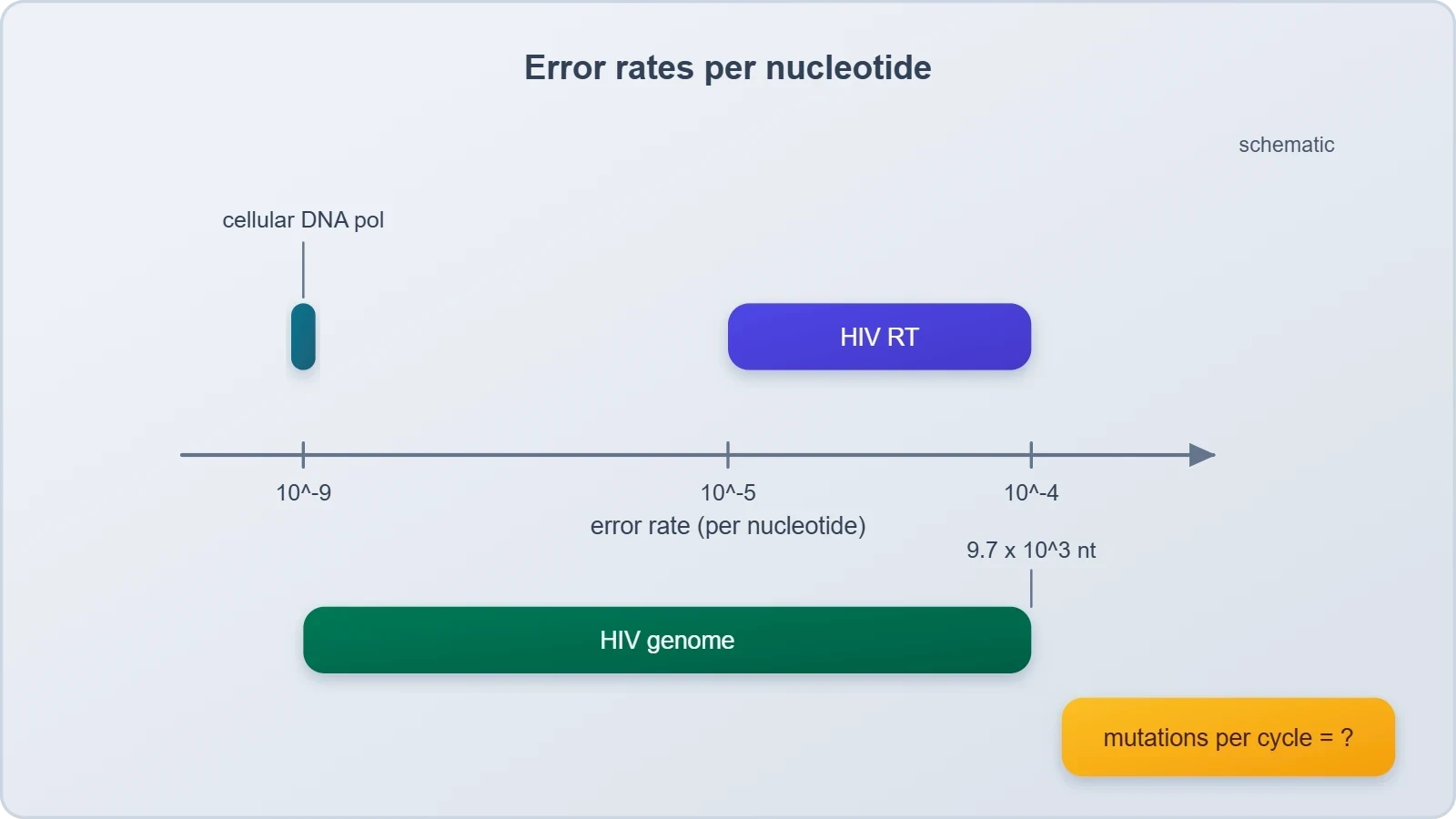
The fidelity of HIV reverse transcriptase can be quantified. The enzyme incorporates approximately one error per ##10^{4}## to ##10^{5}## nucleotides, compared with roughly one per ##10^{9}## for high-fidelity cellular DNA polymerases. Given a genome of about ##9.7 \times 10^{3}## nucleotides, the expected number of mutations per replication cycle is on the order of one. This calculation explains the rapid diversification of the viral population within a single host and the inevitability of resistance under monotherapy, which is why combination antiretroviral therapy is standard.
The same logic applies to SARS-CoV-2, though its proofreading exonuclease reduces the error rate substantially. The mutation rate of approximately ##10^{-6}## per nucleotide per cycle, combined with a genome of about ##3 \times 10^{4}## nucleotides, yields a lower per-genome mutation burden than HIV. This difference informs vaccine strategy: the relatively conserved spike protein of SARS-CoV-2 is a viable target, whereas HIV's envelope protein is shielded by glycan and highly variable, complicating vaccine development.
Consolidating the Framework
The central dogma remains the organising principle of molecular biology, but its mature form is more nuanced than the textbook slogan suggests. It asserts that sequence information flows from nucleic acid to nucleic acid and from nucleic acid to protein, and that protein sequence cannot be reverse-transcribed into nucleic acid. Within that framework, reverse transcription, RNA replication, prion propagation, and epigenetic inheritance operate as documented exceptions that expand the mechanisms of information storage and transfer without contradicting the core claim. Recognising both the rule and its boundaries is the mark of a rigorous understanding.
The discovery of reverse transcriptase by Temin and Baltimore in 1970 was the pivotal moment that forced this refinement. It demonstrated that RNA could serve as a template for DNA, opening the door to the retroviral integration paradigm and to the biotechnology of cDNA synthesis. Subsequent discoveries of RNA-dependent RNA polymerases, prions, and epigenetic marks have continued to enrich the picture. Each exception has generated its own field of research and its own clinical applications, from antiretroviral therapy to prion diagnostics to epigenetic cancer drugs.
Looking ahead, the genomic and bioinformatic methods introduced in the next lesson provide the tools to study these mechanisms at scale. Comparative genomics reveals the evolutionary history of reverse transcriptase and retrotransposons; transcriptomics captures RNA replication intermediates; epigenomics maps chromatin marks across cell types. The exceptions are not peripheral curiosities but central features of genome biology, and they will reappear throughout the remainder of the course. Mastery of this lesson's material is therefore essential preparation for the genomic perspectives that follow.
Also Read
- No links available.
From our network :
- EV 2.0: The Solid-State Battery Breakthrough and Global Factory ExpansionDiscover the impact of the Solid-State Battery Breakthrough on the EV market. Learn about CATL and BYD stock growth, global factory expansion in Europe, and the future of EV 2.0 technology.
- 10 Physics Numerical Problems with Solutions for IIT JEEPrepare for IIT JEE with 10 physics numerical problems, complete with detailed solutions and conceptual explanations. Ideal for mastering kinematics, thermodynamics, electromagnetism, and optics.
- Do You Need a New Router or Is Your Internet Plan the Problem?A practical comparison of the signs that point to router limits versus signs your broadband speed or provider is the bottleneck, so you can decide what to replace before spending money.
- AI-Powered 'Precision Diagnostic' Replaces Standard GRE Score ReportsDiscover the new GRE Precision Diagnostic. Learn how AI-powered behavioral analytics and time-to-solve tracking are replacing standard GRE score reports to empower students.
- Where to Put Your Wireless Router for Better CoverageA practical, physics-grounded guide to router placement: why the centre of the home beats the corner, how walls and metal sap signal, and how to run a simple survey that proves the improvement.
- 98% of Global MBA Programs Now Prefer GRE Over GMAT Focus EditionExplore why 98% of global MBA programs now prefer the GRE over GMAT Focus. Learn about the shorter GRE format, verbal logic importance, and strategic versatility for students.
- How to Print Cheaply: Cutting the Cost per PageA practical, measured guide to lowering what each printed page costs — duplex and draft modes, third-party ink, yield mathematics, and knowing when a new printer beats refills.
- Analyzing Trump Deportation Numbers Insights Into The 2026 Immigration Crackdown
- Trump Political Strategy How Geopolitical Stunts Serve As Media Diversions
RESOURCES
- Resources will be updated soon.