Nutrient cycling represents one of the four foundational components of any ecosystem, standing alongside productivity, decomposition, and energy flow as an essential pillar of ecological function. Unlike energy, which flows unidirectionally through trophic levels and is ultimately lost as heat, nutrient elements are repeatedly used, stored, and transformed as they move between living organisms and the physical environment. This distinction is fundamental: energy must be continuously supplied by the sun, but matter is conserved and recycled within the biosphere through a series of interconnected biogeochemical pathways that sustain life across generations.

The storage and movement of nutrient elements through the various components of an ecosystem is called nutrient cycling, and ecologists classify these cycles into two broad categories based on where the principal reservoir lies. Gaseous cycles, such as those of carbon and nitrogen, maintain their main reservoir in the atmosphere or hydrosphere, allowing relatively rapid exchange between organisms and the environment. Sedimentary cycles, exemplified by phosphorus, hold their primary reservoir in the Earth's crust, where the element is locked in rock and released only through slow geological weathering processes. Understanding this distinction illuminates why some nutrients circulate swiftly while others move at geological timescales.
This lesson examines the mechanisms, fluxes, and human disruptions of both cycle types, building directly on the ecological pyramids discussed previously and preparing the ground for understanding ecosystem services. We will explore detailed carbon and phosphorus pathways, examine the ocean's role as a carbon sink, introduce the nitrogen cycle, and analyse how activities such as fossil fuel combustion and fertiliser application have fundamentally altered natural nutrient budgets. The consequences of these alterations, particularly eutrophication, reveal how deeply human welfare depends on the integrity of these invisible cycles.
On This Page
- Nutrient Cycling as the Engine of Ecosystem Continuity
- The Gaseous Carbon Cycle: Atmosphere, Oceans, and Life
- The Sedimentary Phosphorus Cycle: Slow, Scarce, and Limiting
- The Nitrogen Cycle: A Second Gaseous Pathway
- Nutrient Budgets, Mass Balance, and Eutrophication
- Quantitative Modelling and Worked Examples
- Common Misconceptions and Advanced Perspectives
Nutrient Cycling as the Engine of Ecosystem Continuity
Nutrient cycling describes the continuous exchange of essential elements between the biotic community and the abiotic environment, ensuring that the same atoms of carbon, nitrogen, or phosphorus can be used repeatedly by successive generations of organisms. This recycling capacity distinguishes ecosystems from simple energy-transformation systems and explains why life has persisted on Earth for billions of years despite a finite supply of mineral nutrients. The concept rests on the recognition that ecosystems are open with respect to energy but essentially closed with respect to matter, a principle that governs all biogeochemical analysis.
Reservoirs, Pools, and Fluxes Defined
A reservoir, or pool, is a storage compartment where a nutrient resides for a measurable period, such as the atmosphere for carbon or sedimentary rock for phosphorus. Fluxes are the rates at which nutrients move between reservoirs, expressed in units such as grams per square metre per year. The residence time of a nutrient in any pool equals the pool size divided by the total flux leaving it, a relationship that explains why atmospheric carbon turns over in years while crustal phosphorus may remain locked for millions of years.
Ecologists distinguish between nutrient pools that are readily available to organisms and those that are unavailable, such as phosphorus bound in apatite minerals. The exchange between available and unavailable pools often depends on biological activity, as when mycorrhizal fungi solubilise mineral phosphorus or decomposers release organically bound nitrogen. Recognising these distinctions is essential for constructing accurate nutrient budgets and predicting how ecosystems respond to disturbance or enrichment.
Why Recycling Matters for Ecosystem Stability
Without efficient recycling, ecosystems would rapidly deplete their accessible nutrient stocks and productivity would collapse. Decomposers play a pivotal role here, converting complex organic detritus into carbon dioxide, water, and inorganic nutrients that producers can reabsorb. This decomposition pathway, comprising fragmentation, leaching, and catabolism, closes the loop between death and new growth, ensuring that the mineral wealth of an ecosystem remains in circulation rather than accumulating as inert waste.
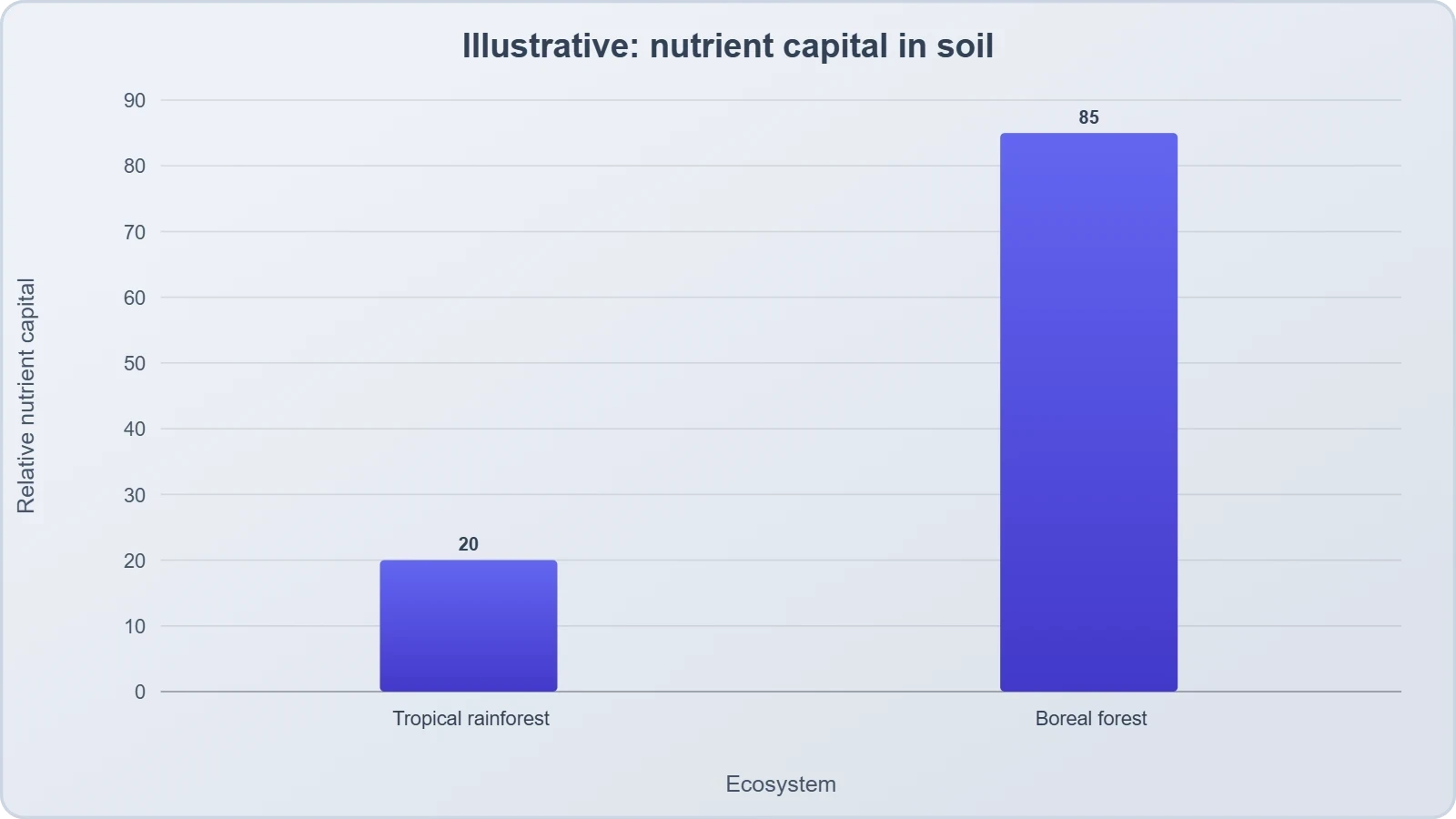
The efficiency of recycling varies markedly between ecosystems. Tropical rainforests, with warm, moist conditions, decompose organic matter rapidly and hold little nutrient capital in soil, relying on tight biological cycling. Boreal forests, by contrast, accumulate thick organic layers because cold temperatures slow decomposition, storing nutrients in dead biomass for decades. These contrasts demonstrate that climate strongly governs the balance between nutrient retention and release.
The Gaseous Carbon Cycle: Atmosphere, Oceans, and Life
Carbon cycles through the atmosphere, oceans, terrestrial biosphere, and lithosphere in one of the most extensively studied biogeochemical pathways. The atmosphere holds approximately 750 gigatonnes of carbon as carbon dioxide, while the oceans contain roughly 38,000 gigatonnes dissolved in various inorganic forms, and sedimentary rocks store an estimated 65,000,000 gigatonnes. These vastly different reservoir sizes mean that even small percentage changes in oceanic or geological carbon can profoundly affect atmospheric concentrations and, consequently, global climate.
Photosynthesis, Respiration, and the Biological Pump
Photosynthesis removes carbon dioxide from the atmosphere and fixes it into organic compounds, while respiration by producers, consumers, and decomposers returns it. In the oceans, phytoplankton perform the same function, and the biological pump describes the process by which organic carbon formed at the surface sinks to depth as dead cells, faecal pellets, and aggregates. This downward flux sequesters carbon in deep waters for centuries, making marine biology a critical regulator of atmospheric composition.
The biological pump operates with remarkable efficiency in nutrient-rich regions, where large phytoplankton blooms generate substantial sinking flux. Approximately 5 to 15 gigatonnes of carbon are exported annually from the surface ocean to depth through this mechanism. Without it, atmospheric carbon dioxide concentrations would be considerably higher, and the ocean's capacity to absorb anthropogenic emissions would be diminished, underscoring the tight coupling between marine ecology and global climate regulation.
Ocean Sinks and Anthropogenic Carbon Uptake
The oceans have absorbed roughly 25 to 30 percent of human carbon dioxide emissions since the industrial era began, buffering atmospheric accumulation but at a cost. Dissolved carbon dioxide forms carbonic acid, lowering seawater pH in a process termed ocean acidification. This chemical shift threatens calcifying organisms such as corals, molluscs, and coccolithophores, whose shells and skeletons depend on carbonate availability, potentially disrupting marine food webs and the biological pump itself.
Fossil fuel combustion and land-use change release approximately 10 gigatonnes of carbon annually, overwhelming the relatively modest natural fluxes that balanced the pre-industrial carbon cycle. Deforestation compounds this by removing photosynthetic capacity and releasing stored biomass carbon. The resulting atmospheric increase, from about 280 parts per million before industrialisation to over 420 today, represents one of the clearest examples of human disruption of a gaseous nutrient cycle.
The Sedimentary Phosphorus Cycle: Slow, Scarce, and Limiting
Phosphorus differs fundamentally from carbon in that it has no significant gaseous phase, cycling instead through rock, soil, water, and organisms. Its primary reservoir is the Earth's crust, where phosphate minerals such as apatite hold vast quantities locked in geological formations. Weathering releases phosphate ions slowly into soils and waterways, and this scarcity, combined with the element's essential role in DNA, ATP, and phospholipids, makes phosphorus the limiting nutrient in many freshwater and terrestrial ecosystems.
Weathering, Uptake, and Sedimentation Pathways
The phosphorus cycle begins with the weathering of phosphate-bearing rocks, a process accelerated by root exudates and microbial activity. Plants absorb dissolved phosphate, which passes to consumers through food chains and returns to soil via decomposition. Some phosphorus leaches into rivers and reaches the ocean, where it is taken up by marine organisms and eventually incorporated into sediments. Over geological time, these sediments lithify into rock, completing the cycle on timescales of millions of years.
Because the sedimentary return path is so slow, phosphorus is effectively lost from active biological circulation once it reaches deep ocean sediments. This one-way tendency means that ecosystems depend heavily on efficient internal recycling to retain phosphorus. Mycorrhizal fungi extend plant root access to soil phosphate, while phosphatase enzymes released by roots and microbes liberate phosphate from organic compounds, both adaptations that tighten the cycle and conserve this scarce nutrient.
Human Alteration Through Mining and Fertiliser Use
Human activity has dramatically accelerated phosphorus mobilisation. Phosphate rock mining extracts roughly 20 million tonnes of phosphorus annually for fertiliser production, bypassing the slow weathering pathway entirely. Agricultural runoff carries excess phosphate into waterways, while deforestation and soil erosion increase particulate phosphorus transport. These interventions have roughly doubled the amount of phosphorus entering the biosphere compared with pre-industrial levels, with consequences that extend far beyond agricultural fields.
The concept of peak phosphorus highlights the finite nature of accessible phosphate rock reserves, concentrated in a few countries such as Morocco and China. Unlike nitrogen, which can be fixed from the atmosphere, phosphorus has no atmospheric source, making its conservation a matter of long-term food security. Recovering phosphorus from wastewater and manure, and improving fertiliser efficiency, represent critical strategies for maintaining this essential sedimentary cycle within sustainable limits.
The Nitrogen Cycle: A Second Gaseous Pathway
Nitrogen constitutes approximately 78 percent of the atmosphere, yet most organisms cannot use atmospheric nitrogen directly because the triple bond in N₂ is exceptionally stable. The nitrogen cycle therefore depends on specialised microorganisms that convert inert nitrogen gas into biologically available forms, a process called nitrogen fixation. This gaseous cycle rivals carbon in importance, supplying the nitrogen essential for proteins, nucleic acids, and chlorophyll, and its disruption through industrial fixation has become a defining feature of the modern biosphere.
Fixation, Nitrification, and Denitrification
Biological nitrogen fixation is performed by bacteria such as Rhizobium in legume root nodules, free-living Azotobacter, and cyanobacteria, using the nitrogenase enzyme to reduce N₂ to ammonia. Ammonia is then nitrified by Nitrosomonas and Nitrobacter into nitrite and nitrate, forms readily absorbed by plants. Consumers obtain nitrogen through food, and decomposers release it as ammonium through ammonification, completing the internal loop of the cycle.
Denitrification, carried out by bacteria such as Pseudomonas under anaerobic conditions, converts nitrate back to nitrogen gas, returning it to the atmosphere and closing the cycle. This balance between fixation and denitrification maintained atmospheric nitrogen stable for millennia. However, the Haber-Bosch process, which industrially fixes nitrogen for fertiliser, now fixes more nitrogen than all natural terrestrial processes combined, profoundly altering the global nitrogen budget.
Consequences of Nitrogen Enrichment
Excess reactive nitrogen from fertilisers and fossil fuel combustion cascades through ecosystems, causing soil acidification, groundwater contamination, and the formation of ground-level ozone and fine particulate matter. Nitrous oxide, a byproduct of nitrification and denitrification, is a potent greenhouse gas roughly 300 times more warming than carbon dioxide per molecule. These interconnected effects make nitrogen management one of the most pressing environmental challenges of the century.
In aquatic systems, nitrogen enrichment frequently triggers eutrophication, the excessive growth of algae and cyanobacteria that depletes oxygen and degrades water quality. Coastal dead zones, such as those in the Gulf of Mexico and the Baltic Sea, result directly from nitrogen and phosphorus loading via river discharge. Understanding the nitrogen cycle is therefore inseparable from understanding water quality, fisheries health, and the broader ecosystem services that human societies depend upon.
Nutrient Budgets, Mass Balance, and Eutrophication
A nutrient budget quantifies all inputs, outputs, and internal transfers of a nutrient within a defined ecosystem boundary, allowing ecologists to determine whether the system is accumulating, depleting, or in steady state. The governing principle is mass balance: the change in storage equals inputs minus outputs. When inputs exceed outputs, nutrients accumulate; when outputs exceed inputs, the system loses nutrient capital. Constructing such budgets requires careful measurement of atmospheric deposition, weathering, biological fixation, leaching, erosion, and gaseous losses.
Constructing and Interpreting Mass Balance Equations
For any nutrient and any defined boundary, the mass balance can be expressed formally. If we denote storage as ##S##, inputs as ##I##, and outputs as ##O##, then over a time interval the change in storage is given by the difference between inflow and outflow. This simple relationship underpins all quantitative nutrient analysis, from a single forest plot to the entire global ocean.
At steady state, ##\dfrac{dS}{dt} = 0##, so inputs equal outputs. A forest receiving atmospheric nitrogen deposition of 10 kg per hectare per year and losing 6 kg through leaching and 4 kg through denitrification is approximately balanced. If deposition rises to 20 kg per hectare per year while losses remain unchanged, the ecosystem accumulates nitrogen, and the excess may eventually saturate biological retention capacity, leading to increased nitrate leaching into groundwater.
Residence time provides another useful metric, calculated as the ratio of pool size to total flux. For a soil phosphorus pool of 500 kg per hectare with an annual plant uptake flux of 5 kg per hectare, the residence time is 100 years, indicating slow turnover. Such calculations help predict how quickly an ecosystem will respond to changes in nutrient input and how long recovery might take after disturbance ceases.

Eutrophication: When Nutrient Enrichment Becomes Pollution
Eutrophication occurs when nutrient enrichment, typically by nitrogen and phosphorus, stimulates excessive primary production in aquatic ecosystems. Algal blooms shade submerged plants, and when the bloom dies, decomposition consumes dissolved oxygen, creating hypoxic or anoxic conditions. Fish and invertebrates suffocate, biodiversity declines, and the water body may shift to a turbid, degraded state dominated by cyanobacteria that can produce toxins harmful to humans and livestock.
Combating eutrophication requires addressing both nitrogen and phosphorus inputs, since freshwater systems are often phosphorus-limited while coastal marine systems are frequently nitrogen-limited. Strategies include improving wastewater treatment, reducing fertiliser application through precision agriculture, restoring riparian buffers that intercept runoff, and managing agricultural drainage. Long-term recovery can be slow because phosphorus stored in sediments may be released for decades after external inputs are reduced, a phenomenon known as internal loading.
Quantitative Modelling and Worked Examples
Applying nutrient cycling theory to real ecosystems requires quantitative tools that translate conceptual understanding into testable predictions. Ecologists use compartment models, flux measurements, and stable isotope tracers to quantify nutrient movement, while simple calculations of residence time and mass balance reveal whether systems are accumulating or depleting nutrients. These methods connect the qualitative descriptions of cycles to the rigorous analysis expected at intermediate and advanced levels of ecological study.
Calculating Residence Time and Turnover
Residence time, the average duration a nutrient atom spends in a given pool, is calculated by dividing pool size by the total flux leaving that pool. Consider a lake with a dissolved phosphorus pool of 200 kilograms and an outflow flux of 20 kilograms per year; the residence time is 10 years. This metric indicates how quickly the lake would flush accumulated phosphorus if inputs ceased, informing management expectations for recovery timelines.

Turnover time, closely related but focused on biological uptake, divides the nutrient content of living biomass by the rate of uptake. A grassland with 15 kilograms of nitrogen per hectare in plant biomass and an annual uptake of 75 kilograms per hectare has a turnover time of 0.2 years, meaning the standing crop is replaced roughly five times annually. Such calculations reveal the intensity of biological cycling relative to physical transport.

Programming a Simple Nutrient Budget Model
Computational models allow rapid exploration of how nutrient pools respond to changing inputs. The following Python script simulates a single nutrient pool over time using the mass balance equation, demonstrating how accumulation or depletion emerges from the balance between inflow and outflow. Such models form the basis of more elaborate ecosystem simulations used in environmental management.
# Simple single-pool nutrient budget model
pool = 500.0          # initial nutrient pool (kg/ha)
inflow = 20.0         # annual input (kg/ha/yr)
outflow_rate = 0.04   # fraction of pool lost per year
years = 50

for year in range(1, years + 1):
    outflow = outflow_rate * pool
    pool += inflow - outflow
    if year % 10 == 0:
        print(f"Year {year}: pool = {pool:.1f} kg/ha")

# Steady-state pool = inflow / outflow_rate
steady_state = inflow / outflow_rate
print(f"Predicted steady state: {steady_state:.1f} kg/ha")
Running this model reveals that the pool converges toward a steady state of 500 kilograms per hectare, where inflow exactly balances outflow. If the inflow doubles to 40 kilograms per hectare per year, the steady state rises to 1,000 kilograms per hectare, illustrating how increased nutrient loading translates into larger standing pools and, eventually, greater losses to downstream systems. Such reasoning underpins predictions of eutrophication risk.
Common Misconceptions and Advanced Perspectives
Several persistent misconceptions surround nutrient cycling, and correcting them sharpens ecological reasoning. A frequent error is assuming that nutrients cycle identically in all ecosystems, when in reality climate, geology, and organism composition create enormous variation. Another common mistake is treating gaseous and sedimentary cycles as entirely separate, when in fact elements such as sulfur participate in both, and human activities increasingly blur the boundaries by mobilising nutrients across reservoirs at unprecedented rates.
Correcting Frequent Errors
Students often confuse nutrient cycling with energy flow, believing that energy is recycled alongside matter. Energy is not recycled; it degrades to heat at each trophic transfer, which is why ecosystems require continuous solar input. Another error is assuming that decomposition is merely decay rather than an active, microbially mediated process essential to nutrient regeneration. Recognising decomposition as a constructive recycling mechanism, not a passive loss, is fundamental to understanding ecosystem function.
A further misconception holds that the ocean is an unlimited carbon sink. While the ocean absorbs substantial carbon dioxide, its capacity is constrained by chemistry, stratification, and biological pump efficiency, and uptake increases acidification. Similarly, the belief that phosphorus fertiliser simply boosts productivity ignores the reality that excess phosphorus causes eutrophication and that phosphate rock is a finite, geopolitically concentrated resource requiring careful stewardship.
Frontiers in Nutrient Cycling Research
Contemporary research explores how climate change alters nutrient cycling through warming-enhanced decomposition, shifting precipitation patterns, and permafrost thaw that releases stored carbon and nitrogen. Stable isotope techniques now trace nutrient sources and transformations with unprecedented precision, while Earth system models integrate terrestrial, oceanic, and atmospheric cycles to project future trajectories. These advances reveal that nutrient cycles are not independent but tightly coupled, so disruption of one reverberates through others.
Emerging perspectives emphasise the concept of planetary boundaries, which define safe operating spaces for nitrogen and phosphorus flows alongside climate change and biodiversity loss. Exceeding these boundaries risks abrupt, potentially irreversible ecosystem shifts. Managing nutrient cycles within safe limits therefore requires integrated approaches spanning agriculture, wastewater treatment, energy systems, and international policy, connecting the ecological science of this lesson directly to the ecosystem services and human dependence explored next.
Also Read
- No links available.
From our network :
- Where to Put Your Wireless Router for Better CoverageA practical, physics-grounded guide to router placement: why the centre of the home beats the corner, how walls and metal sap signal, and how to run a simple survey that proves the improvement.
- How to Print Cheaply: Cutting the Cost per PageA practical, measured guide to lowering what each printed page costs — duplex and draft modes, third-party ink, yield mathematics, and knowing when a new printer beats refills.
- 98% of Global MBA Programs Now Prefer GRE Over GMAT Focus EditionExplore why 98% of global MBA programs now prefer the GRE over GMAT Focus. Learn about the shorter GRE format, verbal logic importance, and strategic versatility for students.
- Trump Political Strategy How Geopolitical Stunts Serve As Media Diversions
- Analyzing Trump Deportation Numbers Insights Into The 2026 Immigration Crackdown
- Do You Need a New Router or Is Your Internet Plan the Problem?A practical comparison of the signs that point to router limits versus signs your broadband speed or provider is the bottleneck, so you can decide what to replace before spending money.
- AI-Powered 'Precision Diagnostic' Replaces Standard GRE Score ReportsDiscover the new GRE Precision Diagnostic. Learn how AI-powered behavioral analytics and time-to-solve tracking are replacing standard GRE score reports to empower students.
- 10 Physics Numerical Problems with Solutions for IIT JEEPrepare for IIT JEE with 10 physics numerical problems, complete with detailed solutions and conceptual explanations. Ideal for mastering kinematics, thermodynamics, electromagnetism, and optics.
- EV 2.0: The Solid-State Battery Breakthrough and Global Factory ExpansionDiscover the impact of the Solid-State Battery Breakthrough on the EV market. Learn about CATL and BYD stock growth, global factory expansion in Europe, and the future of EV 2.0 technology.
RESOURCES
- Resources will be updated soon.