Downstream processing is the discipline that decides whether a brilliant laboratory result ever becomes a medicine a patient can receive. After the bioreactor has finished its work and the cells have manufactured the target molecule, the product sits inside a complex, dilute, contaminated mixture of host proteins, nucleic acids, lipids, media components and metabolites. Recovering that single molecule at the required purity, in a form that remains stable through shipping and storage, is a problem of separation science, analytical chemistry, regulatory affairs and industrial logistics combined. It routinely consumes the majority of total manufacturing cost, and it is where most biotechnology projects quietly fail.
This lesson builds directly on the expression and bioreactor concepts established earlier and carries the story forward to the point where a bulk biological substance becomes a formulated, tested, marketable product. The reference material states the essential sequence with admirable economy: separation and purification, collectively called downstream processing; formulation with suitable preservatives; thorough clinical trials as for drugs; and strict quality control testing, all of which vary from product to product. That sentence is the skeleton. Our task is to put flesh on it, to explain the physics and chemistry of each separation step, to quantify purity and yield, and to show how Good Manufacturing Practice and regulatory pathways shape every decision.
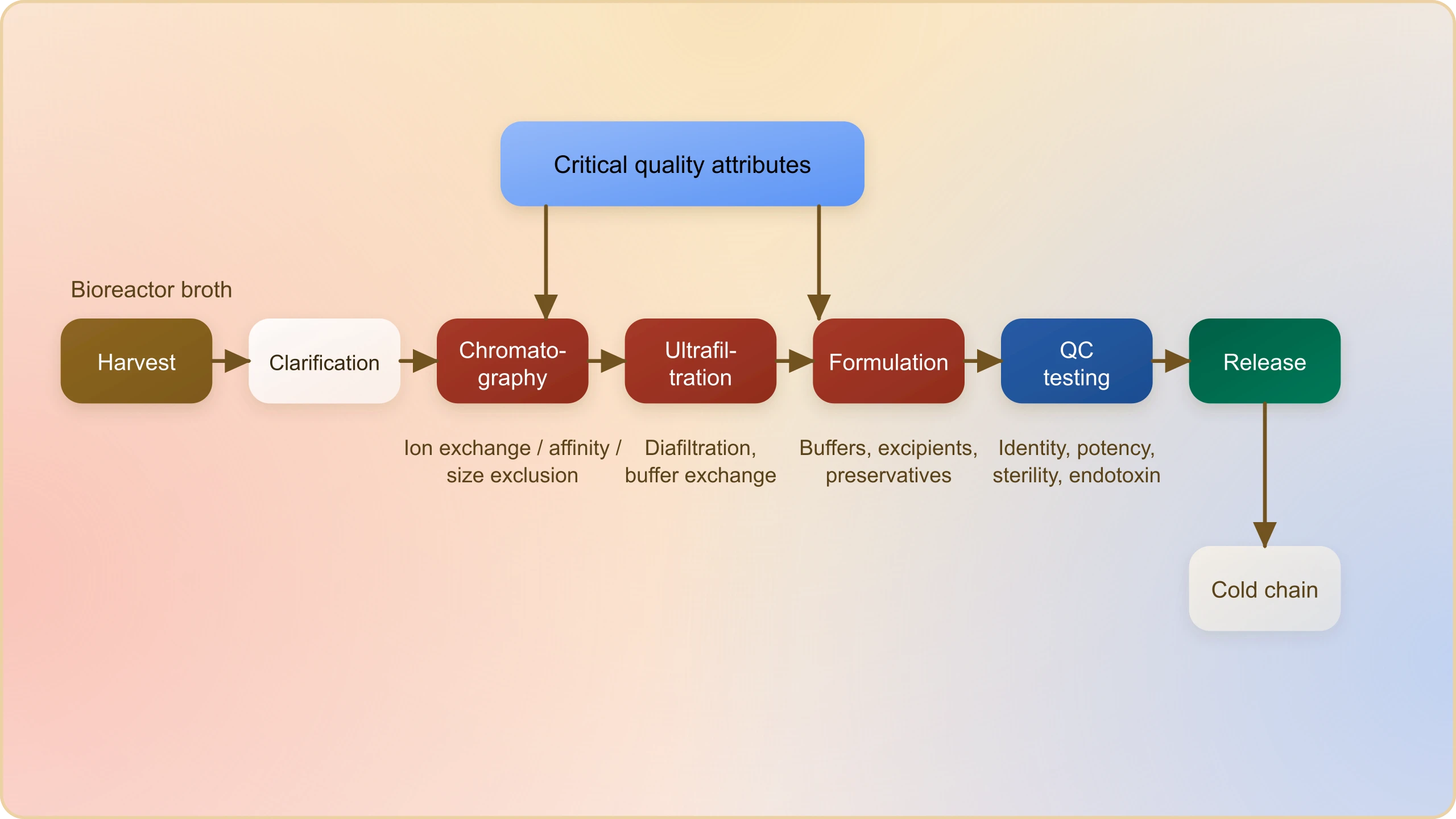
By the end of this lesson you should be able to design a plausible purification train for a given product, construct and interpret a purification table, distinguish identity, potency, sterility and endotoxin testing, and explain why a formulation scientist worries as much about the cold chain as about the active ingredient. The final lesson in this sequence will address troubleshooting, safety, ethics and the wider context; here we concentrate on the engineering and quality architecture that turns a biological molecule into a regulated product.
On This Page
- The Economic and Scientific Logic of Downstream Processing
- Core Separation Techniques and Their Physical Basis
- Quantifying Purity, Yield and Specific Activity
- Formulation, Stability and the Cold Chain
- Quality Control Testing and the Meaning of Specifications
- Process Validation, Scale-Up and Continuous Manufacturing
- Worked Calculations and Common Pitfalls
- Summary and Transition to the Final Lesson
The Economic and Scientific Logic of Downstream Processing
Downstream processing exists because biosynthesis is inherently messy. A mammalian cell culture might contain the therapeutic antibody at a concentration of one to five grams per litre, meaning that more than 99 percent of the material in the vessel is not the product. Bacterial systems expressing recombinant protein can be even less favourable, and intracellular products require an additional cell disruption step before separation can begin. The purification challenge is therefore one of enormous selectivity: isolating a trace component from a background that is thousands of times more abundant, while preserving the delicate three-dimensional structure on which biological activity depends.
The economics reinforce the science. For many monoclonal antibodies, chromatography resins and their associated buffers, validation and cleaning cycles account for the dominant share of cost of goods. Industry analyses consistently show that downstream processing can represent fifty to eighty percent of total manufacturing expense for recombinant biopharmaceuticals, which explains the intense interest in continuous chromatography, membrane adsorbers and crystallisation as alternatives to packed beds. Understanding this economic reality is part of understanding the science, because process design is always a negotiation between achievable purity and affordable cost.

Defining the Product and Its Critical Quality Attributes
Before any separation step is chosen, the product must be defined precisely. A critical quality attribute is a physical, chemical, biological or microbiological property that must fall within an appropriate limit to ensure the desired product quality. For a therapeutic protein these attributes typically include molecular weight and aggregation state, glycosylation profile, charge variants, residual host cell protein, residual DNA, endotoxin content and biological potency. Each attribute implies a specific analytical method and a specific purification or control strategy, so the quality target product profile effectively writes the specification for the entire downstream train.
This is why the reference material's observation that downstream processing varies from product to product is not a throwaway remark but a foundational principle. A small peptide, a glycosylated antibody, a plasmid DNA vaccine and a live attenuated viral vector share almost no purification chemistry. Their stability profiles differ, their contaminant risks differ, and their regulatory expectations differ. A learner who internalises this variability will avoid the common error of memorising one purification scheme and applying it indiscriminately to every biological product encountered.
Harvest, Cell Disruption and the First Clarification Step
Downstream processing begins with harvest, the recovery of cells or culture broth from the bioreactor. For secreted products the cells are removed and the clarified supernatant is retained; for intracellular products the cells are collected and then disrupted by high-pressure homogenisation, sonication, bead milling or enzymatic lysis. Disruption releases the product but also releases proteases and nucleic acids that can degrade or foul it, so the disruption buffer usually contains protease inhibitors and the step is performed cold and quickly. The choice between extracellular and intracellular recovery fundamentally reshapes everything that follows.
Clarification then removes particulate matter before chromatography. Centrifugation, either disc-stack or tubular bowl, separates cells and debris by density, while depth filtration and tangential flow microfiltration remove finer particles. A well-designed clarification sequence protects the expensive chromatography columns downstream, because a fouled column loses resolution, develops high back pressure and requires premature replacement. Many process failures traced to "chromatography problems" actually originate in inadequate clarification, a diagnostic lesson that will recur in the final lesson on troubleshooting.
Core Separation Techniques and Their Physical Basis
The purification train is assembled from a small number of unit operations, each exploiting a different physical property of the product. Centrifugation exploits density and size, filtration exploits size, precipitation exploits solubility, and chromatography exploits differential affinity or partitioning between a stationary and a mobile phase. Mastery of downstream processing means knowing which property distinguishes the product from its contaminants at each stage, and sequencing the operations so that each one removes the bulk of a different impurity class while the product remains stable and concentrated enough to survive the next step.
A useful design heuristic is to alternate high-capacity, low-resolution steps with low-capacity, high-resolution steps. Clarification and ultrafiltration handle large volumes cheaply but separate crudely; affinity chromatography is exquisitely selective but expensive per unit volume. Placing the crude, high-volume steps first reduces the volume that must be loaded onto the selective, expensive steps, which is precisely why process sequencing is an economic as well as a scientific decision. The table below summarises the principal techniques and the property each exploits.
Chromatography: Ion Exchange, Affinity and Size Exclusion
Ion exchange chromatography separates molecules by net surface charge. A protein loaded onto a cation exchanger at a pH below its isoelectric point binds through positively charged residues, and a rising salt gradient or pH shift elutes bound species in order of increasing affinity. Because different proteins carry different charge distributions, ion exchange resolves closely related variants and is the workhorse of polishing steps. The isoelectric point is the pH at which net charge is zero, and choosing an operating pH roughly one unit away from it maximises binding capacity while preserving solubility.
Affinity chromatography achieves the highest selectivity by exploiting a specific biological interaction, such as the binding of an antibody Fc region to immobilised Protein A or the capture of a polyhistidine-tagged protein by immobilised nickel ions. A single affinity step can remove ninety-five percent or more of contaminating protein, which is why it is usually placed first in the purification train. Size exclusion chromatography, by contrast, separates by hydrodynamic volume: large molecules cannot enter the porous beads and elute first, while small molecules penetrate the pores and elute later. It is gentle but capacity-limited, so it is reserved for final polishing and aggregate removal.
Ultrafiltration, Diafiltration and Buffer Exchange
Ultrafiltration uses a membrane with a defined molecular weight cut-off to concentrate a protein solution by forcing solvent and small solutes through the membrane under pressure. Diafiltration extends the same principle by repeatedly adding fresh buffer while removing filtrate, thereby exchanging the product into a formulation-friendly environment and removing residual salts from earlier elution steps. These operations are indispensable because chromatography elutes the product in a dilute, high-salt buffer that is unsuitable for injection or for the next column, and because the product must often be concentrated tenfold or more before formulation.
Membrane fouling and concentration polarisation are the practical enemies of ultrafiltration. As water is removed, solute accumulates at the membrane surface, creating a boundary layer that resists further flow and can cause aggregation of the product. Cross-flow operation, in which the feed sweeps tangentially across the membrane, mitigates this effect, and careful control of transmembrane pressure and shear rate preserves activity. A learner should appreciate that these are not mere engineering details: excessive shear or local concentration can irreversibly denature a therapeutic protein and destroy the value of the entire batch.
Quantifying Purity, Yield and Specific Activity
Purification is meaningless without measurement, and the two central metrics are yield and purity. Yield expresses how much of the original product survives a step, usually as a percentage of the activity or mass present before that step. Purity expresses what fraction of the total protein in the sample is the desired product. Specific activity, defined as enzyme activity units per milligram of total protein, is the most informative single number for an enzyme because it rises as contaminants are removed and plateaus when the product approaches homogeneity. Together these metrics allow a purification table to tell the story of a process.
The concept of fold purification captures the enrichment achieved at each stage. It is calculated as the specific activity after a step divided by the specific activity before it, and a well-designed train might achieve several hundred-fold enrichment overall. Total activity, by contrast, can only fall, because every physical handling step loses some product to adsorption, denaturation or incomplete recovery. The tension between rising purity and falling yield is the central trade-off of downstream processing, and the purification table makes that trade-off visible and auditable.
Constructing and Reading a Purification Table
A purification table records, for each step, the total protein, total activity, specific activity, yield and fold purification. Consider a hypothetical recombinant enzyme starting from a clarified lysate containing 10,000 mg of total protein and 200,000 units of activity, giving a specific activity of 20 units per milligram. After ammonium sulphate precipitation, 4,000 mg of protein remains with 160,000 units, so specific activity rises to 40 and yield is eighty percent. An ion exchange step might leave 400 mg and 120,000 units, giving 300 units per milligram and sixty percent overall yield, and a final size exclusion step might yield 200 mg and 100,000 units at 500 units per milligram.

Reading such a table reveals where the process is efficient and where it leaks. A step that raises fold purification sharply while sacrificing little activity is performing well; a step that loses half the activity for modest enrichment demands scrutiny. The overall figures here would be fifty percent yield and twenty-five-fold purification, respectable for a four-step laboratory process. Note that the final specific activity of 500 units per milligram is a property of the pure enzyme under defined assay conditions, and comparing it with literature values is a useful sanity check on both the purification and the assay itself.

Analytical Methods That Underpin the Numbers
Every figure in a purification table depends on an assay, and assay quality determines whether the table is trustworthy. Total protein is commonly measured by the Bradford or bicinchoninic acid method, both of which rely on colorimetric reactions and both of which can be biased by buffer components, detergents or the protein's own amino acid composition. Enzyme activity is measured under defined substrate, pH and temperature conditions, and the choice of assay conditions must match those used to define the unit. A mismatch between assay and process buffer is a frequent source of inexplicable yield loss.
Purity is assessed by orthogonal methods because no single technique reveals all impurities. Sodium dodecyl sulphate polyacrylamide gel electrophoresis separates proteins by molecular weight and reveals host cell protein bands and fragmentation; high-performance liquid chromatography quantifies aggregates and charge variants; mass spectrometry confirms molecular identity; and immunoassays such as ELISA detect specific contaminants like residual host cell protein or Protein A leached from affinity resins. The principle of orthogonality, using methods that rely on different physical principles, is central to regulatory acceptance of purity claims.
Formulation, Stability and the Cold Chain
Formulation is the science of turning a purified bulk substance into a stable, deliverable product. The reference material notes that the product must be formulated with suitable preservatives, and this is true for multi-dose preparations, but formulation encompasses far more. Buffers maintain pH within the narrow range where the protein is stable; tonicity agents such as sodium chloride or sucrose ensure the solution is isotonic with blood; surfactants like polysorbate reduce interfacial denaturation during shaking and filtration; and lyoprotectants such as trehalose protect structure during freeze-drying. Each excipient must be justified, because every added component becomes part of the regulatory dossier.
Stability is the ultimate test of formulation. Proteins can aggregate, deamidate, oxidise, fragment or adsorb to container surfaces, and these degradation pathways accelerate at elevated temperature, at interfaces and under light exposure. Formulation scientists therefore conduct forced degradation studies, holding samples at high temperature, varying pH and subjecting them to freeze-thaw cycles to predict shelf life. The results define storage conditions, and for many biological products those conditions include a tightly controlled cold chain from manufacturing site to patient bedside.
Preservatives, Packaging and Container Closure Integrity
Preservatives such as benzyl alcohol, phenol or m-cresol are added to multi-dose vials to prevent microbial growth after repeated needle entry, but they must be shown not to compromise protein stability, and many biologics are therefore supplied as single-dose, preservative-free presentations. Packaging is not passive: silicone oil in prefilled syringes can nucleate aggregation, glass can leach alkali, and rubber stoppers can adsorb protein or release extractables. Container closure integrity testing verifies that the chosen package excludes microorganisms and maintains sterility throughout shelf life, and it is a formal regulatory requirement rather than a formality.
The cold chain extends the formulation challenge into logistics. A product requiring storage at two to eight degrees Celsius, or at minus twenty or minus seventy for cell and gene therapies, demands validated shipping containers, temperature data loggers and contingency plans for excursions. A temperature deviation during transit can render an entire shipment unusable, and the associated financial loss can be substantial. Formulation, packaging and distribution are therefore a single integrated design problem, and the learner should resist the temptation to treat them as separate topics.
Quality Control Testing and the Meaning of Specifications
Quality control is the analytical and microbiological verification that each batch meets its specification before release. The reference material insists on strict quality control testing for each product, and the word strict is well chosen, because release testing is a legal gate rather than a scientific suggestion. A specification is a list of tests, each with an acceptance criterion, and a batch that fails any criterion cannot be released. The specification is product-specific, derived from clinical experience and process capability, and it is agreed with the regulator before commercial supply begins.
Four categories of testing deserve particular attention because they recur across almost all biological products. Identity testing confirms that the product is what it claims to be, typically by peptide mapping, mass spectrometry or immunoassay. Potency testing measures biological activity in a relevant bioassay and is the closest surrogate for clinical effect. Sterility testing verifies the absence of viable microorganisms, while endotoxin testing quantifies lipopolysaccharide from Gram-negative bacteria, which can cause fever and shock even at nanogram quantities. Each test has its own method, its own limitations and its own regulatory guidance.
Sterility, Endotoxin and Adventitious Agent Testing
Sterility testing is performed by membrane filtration or direct inoculation into growth media, and it is inherently statistical: it can detect contamination but cannot prove absence with certainty. Endotoxin is measured by the limulus amoebocyte lysate assay or recombinant factor C methods, with limits expressed in endotoxin units per kilogram of body weight per hour for parenteral products. Because endotoxin is heat-stable and survives autoclaving, it must be removed by the process itself, typically through chromatography and ultrafiltration, rather than destroyed at the end.
Adventitious agent testing guards against viral or mycoplasma contamination introduced through cell banks, media or raw materials. Manufacturers demonstrate viral clearance by spiking model viruses into process intermediates and showing that the purification train removes or inactivates them by a validated margin. This clearance validation is a distinctive feature of biological manufacturing and reflects the reality that biological starting materials carry inherent contamination risks that chemical synthesis does not. The entire testing programme is documented in batch records that regulators inspect.
Good Manufacturing Practice and Regulatory Pathways
Good Manufacturing Practice is the system of documented procedures, validated equipment, trained personnel and quality oversight that ensures consistent production. Its core principle is that quality cannot be tested into a product; it must be built in. GMP therefore governs facility design, air handling, cleaning validation, deviation management and change control, and it requires that every critical process parameter be monitored and recorded. A process is validated when it is shown to deliver a product meeting specification consistently across consecutive batches, and any significant change triggers revalidation.
Regulatory approval pathways vary by jurisdiction but share a common architecture. Preclinical studies establish safety and biological plausibility in animal models; Phase I trials assess safety and dosing in a small number of volunteers; Phase II trials explore efficacy and optimal dose in patients; and Phase III trials confirm efficacy and safety in large populations. A marketing authorisation application then assembles chemistry, manufacturing and controls data alongside clinical evidence. The reference material's statement that formulation must undergo thorough clinical trials as in case of drugs is precisely this pathway, and it applies to biological products with additional requirements for immunogenicity and comparability.
Process Validation, Scale-Up and Continuous Manufacturing
Scale-up is the translation of a laboratory purification scheme into an industrial process, and it is rarely a matter of simple multiplication. Column diameter scales with cross-sectional area while bed height and linear flow rate must be preserved to maintain resolution, so a tenfold increase in diameter requires a hundredfold increase in volumetric flow. Centrifuges, membranes and mixing tanks each have their own scaling rules, and the dimensionless numbers that govern them, such as the Reynolds number for fluid flow, must be held constant where possible. A process that works in a one-litre column may fail at a thousand litres for reasons of residence time, pressure drop or heat transfer.
Process validation demonstrates that the scaled process performs consistently. The traditional approach required three consecutive successful batches, but modern regulators increasingly favour a lifecycle approach with continued process verification, in which critical parameters are monitored continuously and trends are analysed statistically. This shift reflects the recognition that quality is a property of the process state rather than of a final test, and it aligns with the GMP principle that quality must be built in rather than tested in.
Continuous Chromatography and Process Intensification
Continuous manufacturing represents a significant departure from batch processing. Rather than running discrete cycles, continuous chromatography systems such as simulated moving bed or periodic counter-current chromatography use multiple columns in sequence, with the product continuously loaded and eluted. The advantages include higher resin utilisation, smaller equipment footprint and more consistent product quality, while the challenges include greater process complexity and the need for sophisticated control systems. Regulatory agencies have established frameworks for continuous manufacturing, and several approved biologics are now produced this way.
Process intensification more broadly seeks to increase productivity per unit volume and per unit time. Alternatives to packed-bed chromatography, including membrane adsorbers, monoliths and crystallisation, offer higher flow rates and lower pressure drops. Precipitation and aqueous two-phase extraction are being revisited as capture steps that avoid the cost of affinity resins. These developments do not render classical chromatography obsolete, but they illustrate that downstream processing is an active field of engineering innovation rather than a settled body of technique.
Data Integrity, Documentation and the Audit Trail
Every measurement, deviation and decision in a regulated facility must be documented in a way that withstands audit. Data integrity requirements demand that electronic records be attributable, legible, contemporaneous, original and accurate, and that any change to a record be traceable through an audit trail. A chromatogram without its acquisition metadata, or a batch record with an unexplained correction, is a compliance finding regardless of whether the product itself was satisfactory. This documentation culture can feel burdensome to laboratory scientists, but it is the mechanism by which a regulator can reconstruct what happened to a batch months or years earlier.
The audit trail also supports investigation when something goes wrong. If a batch fails potency testing, the investigation traces backwards through the batch record, the chromatography data, the buffer preparation logs and the raw material certificates to identify the root cause. This forensic reconstruction is the bridge to the final lesson, which addresses troubleshooting systematically. For now, the essential point is that documentation is not administrative overhead but the memory of the process, and a process without memory cannot be improved or defended.
We Also Published
Worked Calculations and Common Pitfalls
Quantitative reasoning is what separates a competent downstream scientist from a technician following a protocol. Consider a diafiltration calculation: to exchange a protein solution into a new buffer, the number of diavolumes required to reduce the original buffer concentration to a target fraction follows an exponential relationship. If ##n## diavolumes are used, the residual fraction of the original buffer is ##e^{-n}## for an ideal well-mixed system. To reduce the original buffer to one percent, we require ##e^{-n} = 0.01##, giving ##n = \ln(100) \approx 4.6## diavolumes. In practice, five diavolumes are typically specified to provide a margin.

Concentration factors follow equally simple arithmetic. If 500 millilitres of feed at 2 milligrams per millilitre is concentrated to 50 millilitres, the concentration factor is ten and the expected concentration is 20 milligrams per millilitre, assuming complete retention. Real membranes leak small amounts of product and foul, so the observed concentration is usually slightly lower. These calculations appear trivial, but errors in them are among the most common causes of a batch falling outside specification, and they illustrate why downstream processing demands numerical fluency alongside biological insight.

Frequent Errors in Purification and Formulation
Several mistakes recur so often that they deserve explicit warning. Loading a chromatography column beyond its dynamic binding capacity causes product to break through into the flow-through, silently reducing yield. Equilibrating a column with the wrong buffer pH shifts the charge state of the protein and abolishes binding. Omitting protease inhibitors during early steps allows degradation that only becomes visible at the final analysis. Failing to account for hold times between steps exposes the product to room temperature for longer than validated, and pooling fractions by eye rather than by chromatogram criteria introduces variability that undermines reproducibility.
In formulation, the classic errors include choosing a buffer whose pH sits too close to the protein's isoelectric point, promoting precipitation; adding a preservative without checking compatibility; and neglecting to validate the container closure system. A particularly instructive failure mode is the "successful" purification that yields a product which aggregates on storage, because the process removed impurities but also stripped away stabilising excipients or exposed the protein to interfacial stress. Purity at release does not guarantee stability over shelf life, and the two must be assessed separately.
Connecting Downstream Processing to the Wider Curriculum
The concepts in this lesson connect backwards to expression and bioreactor design and forwards to troubleshooting and ethics. A poorly designed expression system that produces insoluble inclusion bodies imposes an additional solubilisation and refolding burden on downstream processing, which is why process development is iterative across the whole chain rather than sequential. Similarly, the choice of host organism determines the contaminant profile: bacterial hosts bring endotoxin, yeast brings glycosylation differences, and mammalian cells bring viral risk. Downstream design begins with the choice of host, not with the choice of column.
The ethical dimension, which the final lesson develops, is already visible here. Quality control failures are not abstract; they translate into patient harm, and the thalidomide tragedy of the late 1950s and early 1960s remains the historical justification for rigorous clinical trials and post-marketing surveillance. The regulatory architecture described in this lesson exists because unregulated biological products have caused preventable harm. A learner who understands both the science and the reason for the rules is better equipped to work within them intelligently rather than mechanically.
Summary and Transition to the Final Lesson
Downstream processing transforms a dilute biological mixture into a purified, formulated, tested product. It begins with harvest and clarification, proceeds through a sequence of separation techniques chosen for the physical property each exploits, and is quantified by yield, purity and specific activity recorded in a purification table. Formulation then stabilises the product for storage and delivery, and quality control verifies that each batch meets its specification. Good Manufacturing Practice and regulatory pathways provide the framework within which all of this occurs, and process validation demonstrates that the whole system performs consistently at scale.
The reference material's summary captures the essential logic: separation and purification, formulation with preservatives, clinical trials, and strict quality control, all varying from product to product. What we have added is the physical basis of each separation, the arithmetic of purification tables, the analytical methods behind the numbers, the science of excipients and stability, the architecture of GMP and clinical development, and the engineering of scale-up and continuous manufacturing. These additions do not contradict the source; they elaborate it into a working understanding suitable for intermediate and advanced learners.
The next and final lesson turns to troubleshooting, safety, ethics and the wider context of biotechnology. The failures catalogued here, from column overload to formulation instability, will be revisited as case studies in systematic investigation. The safety and ethical questions raised by quality control failures will be examined in depth, and the broader social context of biotechnology will be considered. Learners should arrive at that lesson equipped with the quantitative and procedural vocabulary developed here, ready to reason about what happens when processes fail and why the rules that govern them exist.
From our network :
- Analyzing Trump Deportation Numbers Insights Into The 2026 Immigration Crackdown
- EV 2.0: The Solid-State Battery Breakthrough and Global Factory ExpansionDiscover the impact of the Solid-State Battery Breakthrough on the EV market. Learn about CATL and BYD stock growth, global factory expansion in Europe, and the future of EV 2.0 technology.
- 98% of Global MBA Programs Now Prefer GRE Over GMAT Focus EditionExplore why 98% of global MBA programs now prefer the GRE over GMAT Focus. Learn about the shorter GRE format, verbal logic importance, and strategic versatility for students.
- AI-Powered 'Precision Diagnostic' Replaces Standard GRE Score ReportsDiscover the new GRE Precision Diagnostic. Learn how AI-powered behavioral analytics and time-to-solve tracking are replacing standard GRE score reports to empower students.
- 10 Physics Numerical Problems with Solutions for IIT JEEPrepare for IIT JEE with 10 physics numerical problems, complete with detailed solutions and conceptual explanations. Ideal for mastering kinematics, thermodynamics, electromagnetism, and optics.
- How to Print Cheaply: Cutting the Cost per PageA practical, measured guide to lowering what each printed page costs — duplex and draft modes, third-party ink, yield mathematics, and knowing when a new printer beats refills.
- Trump Political Strategy How Geopolitical Stunts Serve As Media Diversions
- Do You Need a New Router or Is Your Internet Plan the Problem?A practical comparison of the signs that point to router limits versus signs your broadband speed or provider is the bottleneck, so you can decide what to replace before spending money.
- Where to Put Your Wireless Router for Better CoverageA practical, physics-grounded guide to router placement: why the centre of the home beats the corner, how walls and metal sap signal, and how to run a simple survey that proves the improvement.